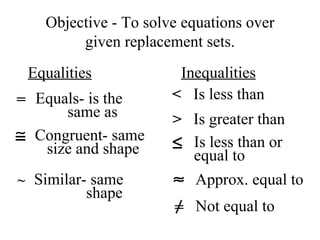
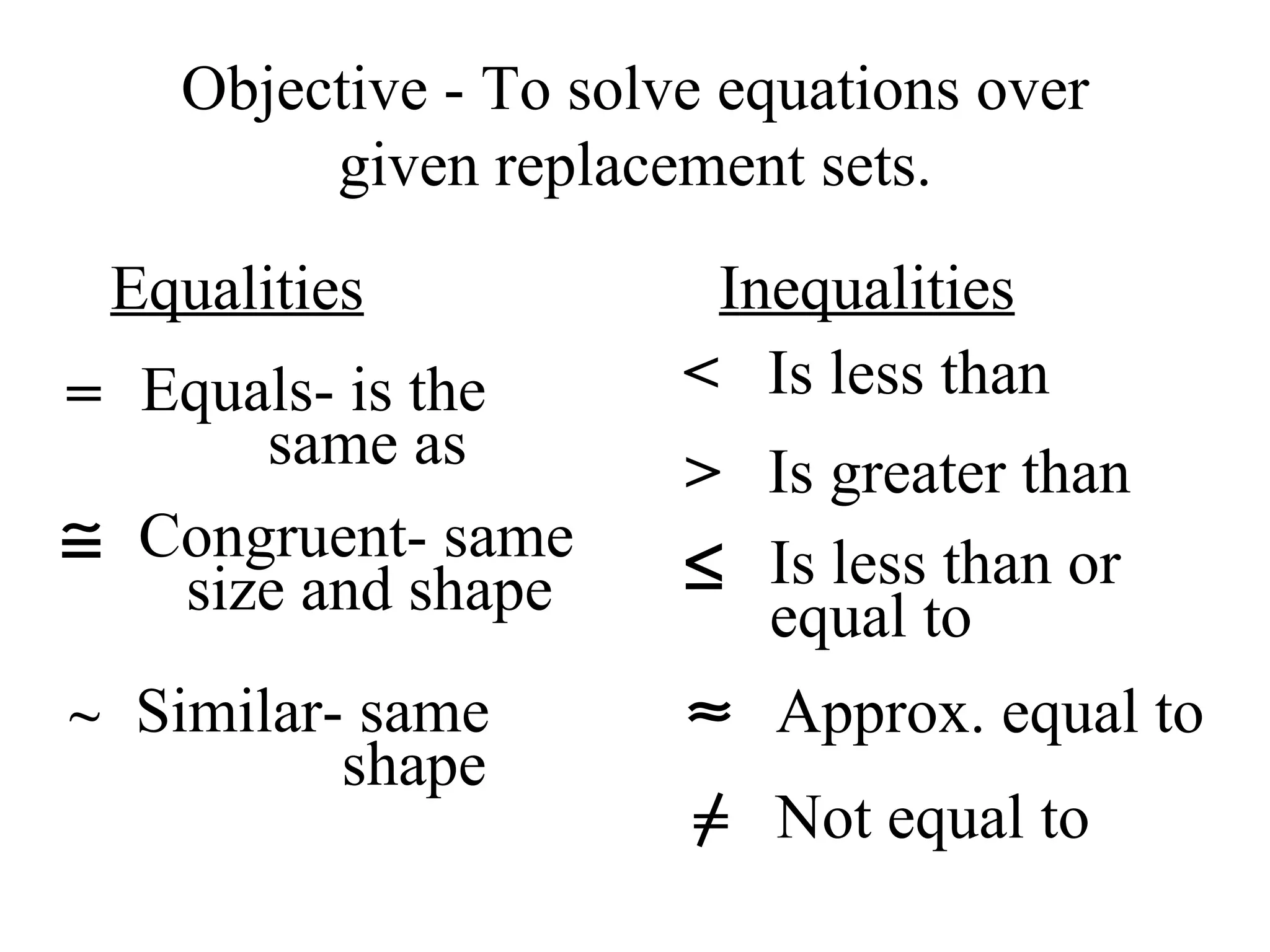
Objective - To solve equations over given replacement sets. Equalities Inequalities = Equals- is the same as Congruent- same size and shape Similar- same shape < Is less than > Is greater than Is less than or  equal to Approx. equal to = Not equal to ~
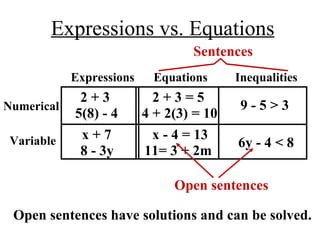
Expressions vs. Equations Numerical Variable Expressions Equations Inequalities 2 + 3 5(8) - 4 x + 7 8 - 3y 2 + 3 = 5 4 + 2(3) = 10 x - 4 = 13 11= 3 + 2m 9 - 5 > 3 6y - 4 < 8 Sentences Open sentences Open sentences have solutions and can be solved.
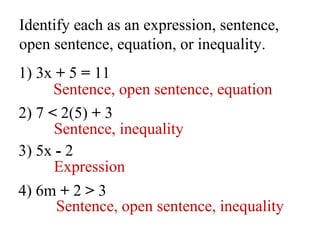
Identify each as an expression, sentence,  open sentence, equation, or inequality. 1) 3x  +  5  =  11 2) 7  <  2(5)  +  3 3) 5x  -  2 4) 6m  +  2  >  3 Sentence, open sentence, equation Sentence, inequality Expression Sentence, open sentence, inequality
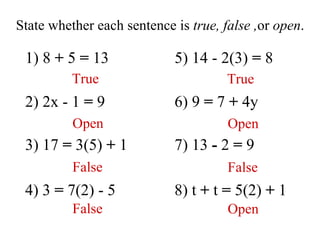
State whether each sentence is  true, false , or  open . 1) 8  +  5  =  13 2) 2x - 1  =  9 3) 17  =  3(5)  +  1 4) 3  =  7(2) - 5 5) 14 - 2(3)  =  8 6) 9  =  7  +  4y 7) 13  -  2  =  9  8) t  +  t  =  5(2)  +  1 True Open False False True Open False Open
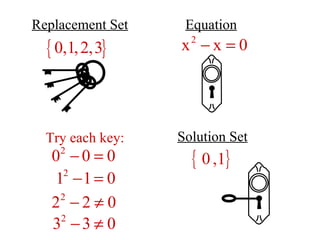
Replacement Set Equation Solution Set Try each key:
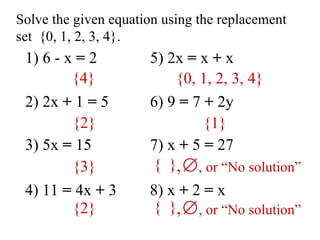
Solve the given equation using the replacement set  {0, 1, 2, 3, 4}. 1) 6 - x  =  2 2) 2x  +  1  =  5 3) 5x  =  15 4) 11  =  4x  +  3 5) 2x  =  x  +  x 6) 9  =  7  +  2y 7) x  +  5  =  27  8) x  +  2  =  x {4} {2} {3} {2} {0, 1, 2, 3, 4} {1} {  } , or “No solution” {  } , or “No solution”
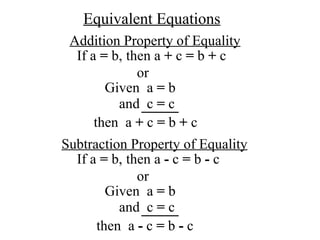
Addition Property of Equality If a  =  b,  then a  +  c  =  b  +  c or Given  a  =  b and  c  =  c then  a  +  c  =  b  +  c Subtraction Property of Equality If a  =  b,  then a  -  c  =  b  -  c or Given  a  =  b and  c  =  c then  a  -  c  =  b  -  c Equivalent Equations
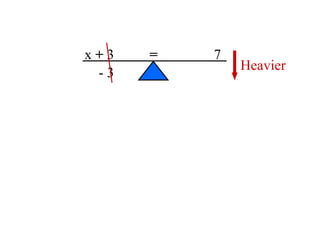
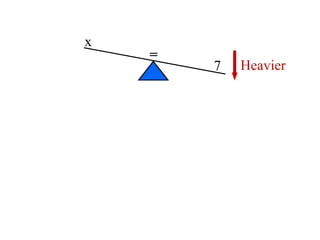
= x  +  3 7 - 3 Heavier
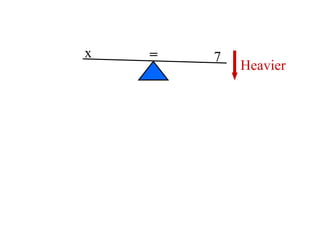
= x 7 Heavier
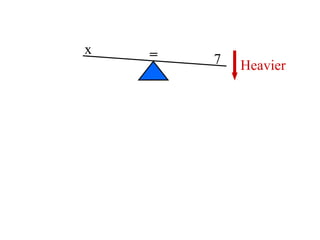
= x 7 Heavier
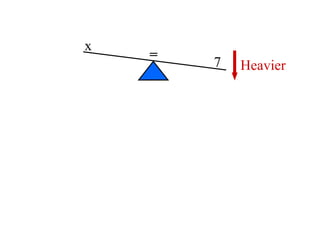
= x 7 Heavier
= x 7 Heavier
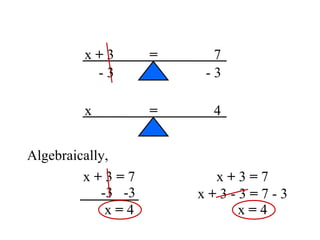
= x  +  3 7 Algebraically, x  +  3  =  7 -3  -3 x  =  4 x  +  3  =  7 x  =  4 x  +  3 - 3  =  7 - 3 - 3 - 3 = x 4
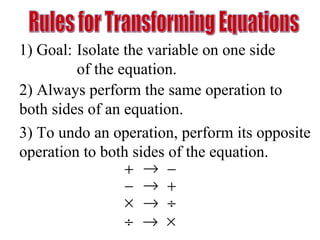
Rules for Transforming Equations 1) Goal: Isolate the variable on one side  of the equation. 2) Always perform the same operation to both sides of an equation. 3) To undo an operation, perform its opposite  operation to both sides of the equation.
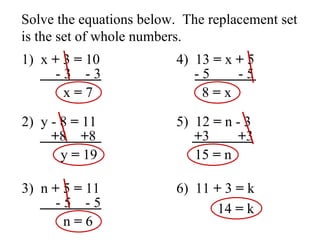
Solve the equations below.  The replacement set is the set of whole numbers. 1)  x  +  3  =  10 - 3  - 3 x  =  7 2)  y - 8  =  11 + 8  + 8 y  =  19 3)  n  +  5  =  11 - 5  - 5 n  =  6 4)  13  =  x  +  5 - 5  - 5 8  =  x 5)  12  =  n - 3 + 3  + 3 15  =  n 6)  11  +  3  =  k 14  =  k
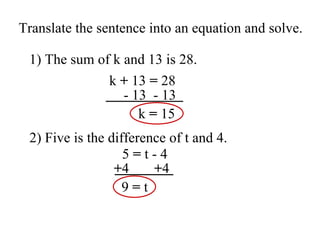
Translate the sentence into an equation and solve. 1) The sum of k and 13 is 28. 2) Five is the difference of t and 4. k  +  13  =  28 - 13  - 13 k  =  15 5  =  t - 4 + 4  + 4 9  =  t
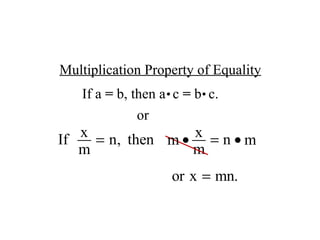
Multiplication Property of Equality or If a  =  b, then a  c  =  b  c.
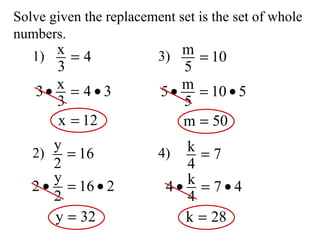
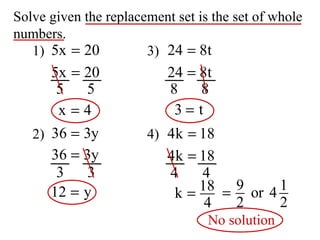
Solve given the replacement set is the set of whole numbers. 1) 2) 3) 4)
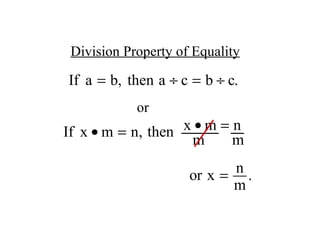
Division Property of Equality or
1) 2) 3) 4) Solve given the replacement set is the set of whole numbers. No solution
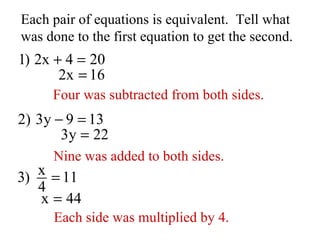
Each pair of equations is equivalent.  Tell what was done to the first equation to get the second. Four was subtracted from both sides. Nine was added to both sides. Each side was multiplied by 4.
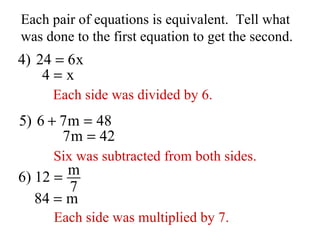
Each pair of equations is equivalent.  Tell what was done to the first equation to get the second. Each side was divided by 6. Six was subtracted from both sides. Each side was multiplied by 7.

Factoring Quadratics

  • 1.
    Objective - Tosolve equations over given replacement sets. Equalities Inequalities = Equals- is the same as Congruent- same size and shape Similar- same shape < Is less than > Is greater than Is less than or equal to Approx. equal to = Not equal to ~
  • 2.
    Expressions vs. EquationsNumerical Variable Expressions Equations Inequalities 2 + 3 5(8) - 4 x + 7 8 - 3y 2 + 3 = 5 4 + 2(3) = 10 x - 4 = 13 11= 3 + 2m 9 - 5 > 3 6y - 4 < 8 Sentences Open sentences Open sentences have solutions and can be solved.
  • 3.
    Identify each asan expression, sentence, open sentence, equation, or inequality. 1) 3x + 5 = 11 2) 7 < 2(5) + 3 3) 5x - 2 4) 6m + 2 > 3 Sentence, open sentence, equation Sentence, inequality Expression Sentence, open sentence, inequality
  • 4.
    State whether eachsentence is true, false , or open . 1) 8 + 5 = 13 2) 2x - 1 = 9 3) 17 = 3(5) + 1 4) 3 = 7(2) - 5 5) 14 - 2(3) = 8 6) 9 = 7 + 4y 7) 13 - 2 = 9 8) t + t = 5(2) + 1 True Open False False True Open False Open
  • 5.
    Replacement Set EquationSolution Set Try each key:
  • 6.
    Solve the givenequation using the replacement set {0, 1, 2, 3, 4}. 1) 6 - x = 2 2) 2x + 1 = 5 3) 5x = 15 4) 11 = 4x + 3 5) 2x = x + x 6) 9 = 7 + 2y 7) x + 5 = 27 8) x + 2 = x {4} {2} {3} {2} {0, 1, 2, 3, 4} {1} { } , or “No solution” { } , or “No solution”
  • 7.
    Addition Property ofEquality If a = b, then a + c = b + c or Given a = b and c = c then a + c = b + c Subtraction Property of Equality If a = b, then a - c = b - c or Given a = b and c = c then a - c = b - c Equivalent Equations
  • 8.
    = x + 3 7 - 3 Heavier
  • 9.
    = x 7Heavier
  • 10.
    = x 7Heavier
  • 11.
    = x 7Heavier
  • 12.
    = x 7Heavier
  • 13.
    = x + 3 7 Algebraically, x + 3 = 7 -3 -3 x = 4 x + 3 = 7 x = 4 x + 3 - 3 = 7 - 3 - 3 - 3 = x 4
  • 14.
    Rules for TransformingEquations 1) Goal: Isolate the variable on one side of the equation. 2) Always perform the same operation to both sides of an equation. 3) To undo an operation, perform its opposite operation to both sides of the equation.
  • 15.
    Solve the equationsbelow. The replacement set is the set of whole numbers. 1) x + 3 = 10 - 3 - 3 x = 7 2) y - 8 = 11 + 8 + 8 y = 19 3) n + 5 = 11 - 5 - 5 n = 6 4) 13 = x + 5 - 5 - 5 8 = x 5) 12 = n - 3 + 3 + 3 15 = n 6) 11 + 3 = k 14 = k
  • 16.
    Translate the sentenceinto an equation and solve. 1) The sum of k and 13 is 28. 2) Five is the difference of t and 4. k + 13 = 28 - 13 - 13 k = 15 5 = t - 4 + 4 + 4 9 = t
  • 17.
    Multiplication Property ofEquality or If a = b, then a c = b c.
  • 18.
    Solve given thereplacement set is the set of whole numbers. 1) 2) 3) 4)
  • 19.
  • 20.
    1) 2) 3)4) Solve given the replacement set is the set of whole numbers. No solution
  • 21.
    Each pair ofequations is equivalent. Tell what was done to the first equation to get the second. Four was subtracted from both sides. Nine was added to both sides. Each side was multiplied by 4.
  • 22.
    Each pair ofequations is equivalent. Tell what was done to the first equation to get the second. Each side was divided by 6. Six was subtracted from both sides. Each side was multiplied by 7.