By: Ms. Diksha
Assistant Professor
Pharmacy Academy
IFTM University Moradabad
Physical Pharmaceutics I
Unit 1
Solubility of Drugs
Importance of studying the phenomenon of solubility-
Understanding the phenomenon of solubility helps the pharmacist to:
1.Select the best solvent for a drug or a mixture of drugs.
2.Overcome problems arising during preparation of pharmaceutical
solutions.
3.Have information about the structure and intermolecular forces of the drug.
4.Many drugs are formulated as solutions, or added as powder or solution
forms to liquids.
5.Drugs with low aqueous solubility often present problems related to their
formulation and bioavailability.
Definitions
 Solution: is a mixture of two or more components that form a homogenous
mixture. The components are referred to the solute and/or solutes & the solvent
and/or solvents .
 Solute: is the dissolved agent . (less abundant part of the solution )
 Solvent : is the component in which the solute is dissolved (more abundant part of
the solution).
 A saturated solution: is one in which an equilibrium is established between
dissolved and undissolved solute at a definite temperature. Or A solution that
contains the maximum amount of solute at a definite temperature
 An unsaturated solution: or subsaturated solution is one containing the
dissolved solute in a concentration below that necessary for complete
saturation at a definite temperature.
 A supersaturated solution: contains more of the dissolved solute than it
would normally contain in a saturated state at a definite temperature.
 In a quantitative way: it is the concentration of solute in a saturated
solution at a certain temperature
 In a qualitative way: it is the spontaneous interaction of two or more
substances (solute & solvent) to form a homogeneous molecular dispersion
Thermodynamic solubility of drugs
 The thermodynamic solubility of a drug in a solvent is the maximum amount
of the most stable crystalline form that remains in solution in a given volume
of the solvent at a given temperature and pressure under equilibrium
conditions.
 The equilibrium involves a balance of the energy of three interactions against
each other:
(1) solvent with solvent
(2) solute with solute
(3) solvent and solute
Solubility expressions
 The USP lists the solubility of drugs as: the number of ml of solvent in
which 1g of solute will dissolve.
 E.g. 1g of boric acid dissolves in 18 mL of water, and in 4 mL of
 glycerin.
 Substances whose solubility values are not known are described by the
following terms:
Sr.
No.
Description forms
( Solubility)
Parts of solvent required
for one part of solute
1 Very soluble (VS) <1
2 Poorly soluble (PS) 1-10
3 Soluble 10-30
4 Sparingly soluble (SPS) 30-100
5 Slightly soluble (SS) 100-1000
6 Very slightly soluble (VSS 1000-10000
7 Practically insoluble (PI) >10000
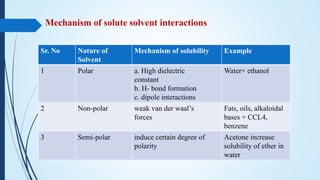
Mechanism of solute solvent interactions
Sr. No Nature of
Solvent
Mechanism of solubility Example
1 Polar a. High dielectric
constant
b. H- bond formation
c. dipole interactions
Water+ ethanol
2 Non-polar weak van der waal’s
forces
Fats, oils, alkaloidal
bases + CCL4,
benzene
3 Semi-polar induce certain degree of
polarity
Acetone increase
solubility of ether in
water
Solvent - Solute Interactions
 In pre - or early formulation, selection of the most suitable solvent is based on the
principle of “like dissolves like”
 That is, a solute dissolves best in a solvent with similar chemical properties. Or
two substances with similar intermolecular forces are likely to be soluble in each
others
 Polar solutes dissolve in polar solvents. E.g salts & sugar dissolve in water.
 Non polar solutes dissolve in non polar solvents. Eg. Naphtalene dissolves in
benzene.
Polar solute – polar solvent
Ammonia Dissolves in Water:
 Polar ammonia molecules dissolve in polar water molecules.
 These molecules mix readily because both types of molecules
 engage in hydrogen bonding.
 Since the intermolecular attractions are roughly equal, the molecules can
break away from each other and form new solute (NH3), solvent (H2O)
hydrogen bonds.
Alcohol Dissolves in Water:
 The -OH group on alcohol is polar and mixes with the polar water through
the formation of hydrogen bonds.
 A wide variety of solutions are in this category such as sugar in water,
alcohol in water, acetic and hydrochloric acids.
Solute-Solvent interactions
 If the solvent is A & the solute is B, and the forces of attraction are represented by A-
A, B-B and A-B, One of the following conditions will occur:
1. If A-A >> A-B The solvent molecules will be attracted to each other & the solute will
be excluded. Example: Benzene & water, where benzene molecules are unable to
penetrate the closely bound water aggregates.
2. If B-B >> A-A The solvent will not be able to break the binding forces between solute
molecules. Example NaCl in benzene, where the NaCl crystal is held by strong
electrovalent forces which cannot be broken by benzene.
3. If A-B >> A-A or B-B, or the three forces are equal The solute will Form a solution.
Example: NaCl in water.
Solvation / Dissolution
“ Interaction of a solute with the solvent, which leads to stabilization of solute
species in the solution”
+ve solvation energy= endothermic dissolution
-ve solvation energy= exothermic dissolution
Association
“ Chemical reaction in which the opposite electric charge ions come together in
solution & form a distinct chemical entity”
Classification according to nature of interaction:
1. Contact
2. Solvent shared
3. Solvent separated
Factors influencing solubility
 Temperature
 Nature of solvent ( like dissolves like)
 Pressure
 pH
 Particle size
 Crystal structure
 Solubilizing agents
Solubility of gases in
liquids
 When the pressure above the
solution is released
(decreases), the solubility of
the gas decreases
 As the temperature increases
the solubility of gases
decreases.
 Ex: Carbonated water: is
exothermic process.
 Ex: Pharmaceutical aerosols:
Liquefied gas under pressure
“Propellant”
Solubility of liquids in liquids
 Preparation of pharmaceutical solutions involves mixing of 2 or more liquids
 Alcohol & water to form hydroalcoholic solutions
 volatile oils & water to form aromatic waters
 volatile oils & alcohols to form spirits , elixirs
Liquid-liquid systems may be divided into 2 categories:
 1. Systems showing complete miscibility such as alcohol & water, glycerin &
alcohol, benzene & carbon tetrachloride.
 2. Systems showing Partial miscibility as phenol and water; two liquid layers are
formed each containing some of the other liquid in the dissolved state.
 The term miscibility refers to the mutual solubility of the components in
liquid-liquid systems.
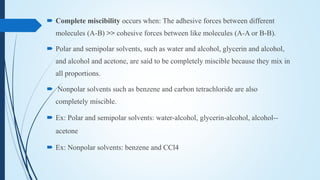
 Complete miscibility occurs when: The adhesive forces between different
molecules (A-B) >> cohesive forces between like molecules (A-A or B-B).
 Polar and semipolar solvents, such as water and alcohol, glycerin and alcohol,
and alcohol and acetone, are said to be completely miscible because they mix in
all proportions.
 Nonpolar solvents such as benzene and carbon tetrachloride are also
completely miscible.
 Ex: Polar and semipolar solvents: water-alcohol, glycerin-alcohol, alcohol--
acetone
 Ex: Nonpolar solvents: benzene and CCl4
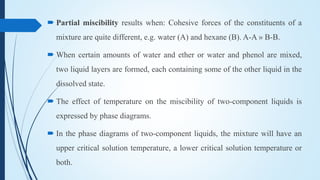
 Partial miscibility results when: Cohesive forces of the constituents of a
mixture are quite different, e.g. water (A) and hexane (B). A-A » B-B.
 When certain amounts of water and ether or water and phenol are mixed,
two liquid layers are formed, each containing some of the other liquid in the
dissolved state.
 The effect of temperature on the miscibility of two-component liquids is
expressed by phase diagrams.
 In the phase diagrams of two-component liquids, the mixture will have an
upper critical solution temperature, a lower critical solution temperature or
both.
Raoult’s law
 “The partial pressure (Pi) of each component in a solution is equal to
the mole fraction of the component & the vapour pressure of the pure
component”
Pi = xP
Or
P = pAxA + pBxB
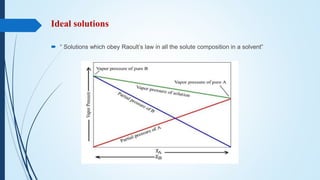
Ideal solutions
 “ Solutions which obey Raoult’s law in all the solute composition in a solvent”
Real/ non ideal solutions
 “Solutions which do not obey
Raoult’s law over entire range
of composition”
Negative deviation
PA < Xa P
△H < 0
△V < 0
Positive deviation
PA > Xa P
△H > 0
△V > 0
Critical Solution Temperature
 When two partialy miscible liquids mixed
together , some liquid A is dissolved into B
and some liquid B is dissoved into B both of
these layer are known as conjugate solution.
 If such a mixture is heated the two layers
disappear and form one layer. The tem at
Which two partially miscible liquids
become completely miscible is called “
Critical Solution Temparature” or “Upper
Consulate temperature”
Example
 Water and Phenol System
 Upper layer contams- 95% water and 5% Phenol
 Lower layer contains- 70% Phenol and 30% water
 At 68.4˚C (CST), two layer disappears.
Distribution Law
 The movement of molecules from one phase to another is called
partitioning.
 If two immiscible phases are placed adjacent to each other, the solute will
distribute itself between two immiscible phases until equilibrium is attained;
therefore no further transfer of solute occurs.
 When a substance is added in excess quantity in two immiscible solvents, it
distributes itself between two liquid phases so that each becomes saturated.
 The distribution or partition of a solute between immiscible liquids is known
as Nernst’s distribution law or simply distribution law or partition law.
 Nernst’s distribution law states that when the added substance is insufficient to saturate
the immiscible liquids, the solute distributes between the liquids in such a way that at
equilibrium the ratio of concentrations of the solute in the two liquids is constant, at
constant temperature.
 Partition(P) or distribution coefficient(D) is the ratio of concentration of a compound
in the two phases of a mixture of two immiscible solvents at equilibrium.
 Hence these coefficients are a measure of differential solubility of the compound
between two solvents. • One of the solvents is water and the second one is hydrophobic
such as octanol. It is useful in estimating the distribution of drugs within the body.
SOLUBILITY

SOLUBILITY

  • 1.
    By: Ms. Diksha AssistantProfessor Pharmacy Academy IFTM University Moradabad Physical Pharmaceutics I Unit 1 Solubility of Drugs
  • 2.
    Importance of studyingthe phenomenon of solubility- Understanding the phenomenon of solubility helps the pharmacist to: 1.Select the best solvent for a drug or a mixture of drugs. 2.Overcome problems arising during preparation of pharmaceutical solutions. 3.Have information about the structure and intermolecular forces of the drug. 4.Many drugs are formulated as solutions, or added as powder or solution forms to liquids. 5.Drugs with low aqueous solubility often present problems related to their formulation and bioavailability.
  • 3.
    Definitions  Solution: isa mixture of two or more components that form a homogenous mixture. The components are referred to the solute and/or solutes & the solvent and/or solvents .  Solute: is the dissolved agent . (less abundant part of the solution )  Solvent : is the component in which the solute is dissolved (more abundant part of the solution).  A saturated solution: is one in which an equilibrium is established between dissolved and undissolved solute at a definite temperature. Or A solution that contains the maximum amount of solute at a definite temperature
  • 4.
     An unsaturatedsolution: or subsaturated solution is one containing the dissolved solute in a concentration below that necessary for complete saturation at a definite temperature.  A supersaturated solution: contains more of the dissolved solute than it would normally contain in a saturated state at a definite temperature.
  • 5.
     In aquantitative way: it is the concentration of solute in a saturated solution at a certain temperature  In a qualitative way: it is the spontaneous interaction of two or more substances (solute & solvent) to form a homogeneous molecular dispersion
  • 6.
    Thermodynamic solubility ofdrugs  The thermodynamic solubility of a drug in a solvent is the maximum amount of the most stable crystalline form that remains in solution in a given volume of the solvent at a given temperature and pressure under equilibrium conditions.  The equilibrium involves a balance of the energy of three interactions against each other: (1) solvent with solvent (2) solute with solute (3) solvent and solute
  • 7.
    Solubility expressions  TheUSP lists the solubility of drugs as: the number of ml of solvent in which 1g of solute will dissolve.  E.g. 1g of boric acid dissolves in 18 mL of water, and in 4 mL of  glycerin.  Substances whose solubility values are not known are described by the following terms:
  • 8.
    Sr. No. Description forms ( Solubility) Partsof solvent required for one part of solute 1 Very soluble (VS) <1 2 Poorly soluble (PS) 1-10 3 Soluble 10-30 4 Sparingly soluble (SPS) 30-100 5 Slightly soluble (SS) 100-1000 6 Very slightly soluble (VSS 1000-10000 7 Practically insoluble (PI) >10000
  • 9.
    Mechanism of solutesolvent interactions Sr. No Nature of Solvent Mechanism of solubility Example 1 Polar a. High dielectric constant b. H- bond formation c. dipole interactions Water+ ethanol 2 Non-polar weak van der waal’s forces Fats, oils, alkaloidal bases + CCL4, benzene 3 Semi-polar induce certain degree of polarity Acetone increase solubility of ether in water
  • 10.
    Solvent - SoluteInteractions  In pre - or early formulation, selection of the most suitable solvent is based on the principle of “like dissolves like”  That is, a solute dissolves best in a solvent with similar chemical properties. Or two substances with similar intermolecular forces are likely to be soluble in each others  Polar solutes dissolve in polar solvents. E.g salts & sugar dissolve in water.  Non polar solutes dissolve in non polar solvents. Eg. Naphtalene dissolves in benzene.
  • 11.
    Polar solute –polar solvent Ammonia Dissolves in Water:  Polar ammonia molecules dissolve in polar water molecules.  These molecules mix readily because both types of molecules  engage in hydrogen bonding.  Since the intermolecular attractions are roughly equal, the molecules can break away from each other and form new solute (NH3), solvent (H2O) hydrogen bonds.
  • 12.
    Alcohol Dissolves inWater:  The -OH group on alcohol is polar and mixes with the polar water through the formation of hydrogen bonds.  A wide variety of solutions are in this category such as sugar in water, alcohol in water, acetic and hydrochloric acids.
  • 13.
    Solute-Solvent interactions  Ifthe solvent is A & the solute is B, and the forces of attraction are represented by A- A, B-B and A-B, One of the following conditions will occur: 1. If A-A >> A-B The solvent molecules will be attracted to each other & the solute will be excluded. Example: Benzene & water, where benzene molecules are unable to penetrate the closely bound water aggregates. 2. If B-B >> A-A The solvent will not be able to break the binding forces between solute molecules. Example NaCl in benzene, where the NaCl crystal is held by strong electrovalent forces which cannot be broken by benzene. 3. If A-B >> A-A or B-B, or the three forces are equal The solute will Form a solution. Example: NaCl in water.
  • 14.
    Solvation / Dissolution “Interaction of a solute with the solvent, which leads to stabilization of solute species in the solution” +ve solvation energy= endothermic dissolution -ve solvation energy= exothermic dissolution
  • 15.
    Association “ Chemical reactionin which the opposite electric charge ions come together in solution & form a distinct chemical entity” Classification according to nature of interaction: 1. Contact 2. Solvent shared 3. Solvent separated
  • 16.
    Factors influencing solubility Temperature  Nature of solvent ( like dissolves like)  Pressure  pH  Particle size  Crystal structure  Solubilizing agents
  • 17.
    Solubility of gasesin liquids  When the pressure above the solution is released (decreases), the solubility of the gas decreases  As the temperature increases the solubility of gases decreases.  Ex: Carbonated water: is exothermic process.  Ex: Pharmaceutical aerosols: Liquefied gas under pressure “Propellant”
  • 18.
    Solubility of liquidsin liquids  Preparation of pharmaceutical solutions involves mixing of 2 or more liquids  Alcohol & water to form hydroalcoholic solutions  volatile oils & water to form aromatic waters  volatile oils & alcohols to form spirits , elixirs Liquid-liquid systems may be divided into 2 categories:  1. Systems showing complete miscibility such as alcohol & water, glycerin & alcohol, benzene & carbon tetrachloride.  2. Systems showing Partial miscibility as phenol and water; two liquid layers are formed each containing some of the other liquid in the dissolved state.  The term miscibility refers to the mutual solubility of the components in liquid-liquid systems.
  • 19.
     Complete miscibilityoccurs when: The adhesive forces between different molecules (A-B) >> cohesive forces between like molecules (A-A or B-B).  Polar and semipolar solvents, such as water and alcohol, glycerin and alcohol, and alcohol and acetone, are said to be completely miscible because they mix in all proportions.  Nonpolar solvents such as benzene and carbon tetrachloride are also completely miscible.  Ex: Polar and semipolar solvents: water-alcohol, glycerin-alcohol, alcohol-- acetone  Ex: Nonpolar solvents: benzene and CCl4
  • 20.
     Partial miscibilityresults when: Cohesive forces of the constituents of a mixture are quite different, e.g. water (A) and hexane (B). A-A » B-B.  When certain amounts of water and ether or water and phenol are mixed, two liquid layers are formed, each containing some of the other liquid in the dissolved state.  The effect of temperature on the miscibility of two-component liquids is expressed by phase diagrams.  In the phase diagrams of two-component liquids, the mixture will have an upper critical solution temperature, a lower critical solution temperature or both.
  • 21.
    Raoult’s law  “Thepartial pressure (Pi) of each component in a solution is equal to the mole fraction of the component & the vapour pressure of the pure component” Pi = xP Or P = pAxA + pBxB
  • 22.
    Ideal solutions  “Solutions which obey Raoult’s law in all the solute composition in a solvent”
  • 23.
    Real/ non idealsolutions  “Solutions which do not obey Raoult’s law over entire range of composition” Negative deviation PA < Xa P △H < 0 △V < 0 Positive deviation PA > Xa P △H > 0 △V > 0
  • 24.
    Critical Solution Temperature When two partialy miscible liquids mixed together , some liquid A is dissolved into B and some liquid B is dissoved into B both of these layer are known as conjugate solution.  If such a mixture is heated the two layers disappear and form one layer. The tem at Which two partially miscible liquids become completely miscible is called “ Critical Solution Temparature” or “Upper Consulate temperature”
  • 25.
    Example  Water andPhenol System  Upper layer contams- 95% water and 5% Phenol  Lower layer contains- 70% Phenol and 30% water  At 68.4˚C (CST), two layer disappears.
  • 26.
    Distribution Law  Themovement of molecules from one phase to another is called partitioning.  If two immiscible phases are placed adjacent to each other, the solute will distribute itself between two immiscible phases until equilibrium is attained; therefore no further transfer of solute occurs.  When a substance is added in excess quantity in two immiscible solvents, it distributes itself between two liquid phases so that each becomes saturated.  The distribution or partition of a solute between immiscible liquids is known as Nernst’s distribution law or simply distribution law or partition law.
  • 27.
     Nernst’s distributionlaw states that when the added substance is insufficient to saturate the immiscible liquids, the solute distributes between the liquids in such a way that at equilibrium the ratio of concentrations of the solute in the two liquids is constant, at constant temperature.  Partition(P) or distribution coefficient(D) is the ratio of concentration of a compound in the two phases of a mixture of two immiscible solvents at equilibrium.  Hence these coefficients are a measure of differential solubility of the compound between two solvents. • One of the solvents is water and the second one is hydrophobic such as octanol. It is useful in estimating the distribution of drugs within the body.