2
Terminology
Solute: acomponent which dissolved in the solvent, present in less
amount in the solution.
Solvent: a component in which solute is dissolved, present in more
amount than solute.
Solution: A system in which solutes are completely dissolved in solvent
& form a homogenous molecular dispersion.
3.
3
Terminology
Saturated solution:is one in which an equilibrium is established
between dissolved and undissolved solute at a definite temperature. Or
A solution that contains the maximum amount of solute at a definite
temperature
Unsaturated solution: is one containing the dissolved solute in a
concentration below that necessary for complete saturation at a
definite temperature.
Supersaturated solution: : contains more of the dissolved solute
than it would normally contain in a saturated state at a definite
temperature.
4.
4
SOLUBILITY
Solubility isdefined inquantitative terms as the concentration of solute in a
saturated solution at a certain temperature,
Solubility is defined in a qualitative way, as the spontaneous interaction of
two or more substances to form a homogeneous molecular dispersion.
Solubility is an intrinsic material property that can be altered only by
chemical modification of the molecule.
Solubility, the phenomenon of dissolution of solute in solvent to give a
homogenous system, is one of the important parameters to achieve desired
concentration of drug in systemic circulation for desired pharmacological
response.
5.
The solubility ofa compound depends on the physical and
chemical properties of the solute and the solvent as well as on
such factors as temperature, pressure, the pH of the solution,
and, to a lesser extent, the state of subdivision of the solute.
Low aqueous solubility is the major problem encountered with
formulation development of new chemical entities as well as for
the generic development.
More than 40% NCEs (new chemical entities) developed in
pharmaceutical industry are practically insoluble in water.
Solubility is a major challenge for formulation scientist.
6.
Any drug tobe absorbed must be present in the form of solution
at the site of absorption.
Various techniques are used for the enhancement of the solubility of
poorly soluble drugs which include physical and chemical
modifications of drug and other methods like particle size reduction,
crystal engineering, salt formation, solid dispersion, use of surfactant,
complexation, and so forth.
Selection of solubility improving method depends on drug
property, site of absorption, and required dosage form
characteristics.
Solubility is the property of a solid, liquid, or gaseous
chemical substance called solute to dissolve in a solid, liquid,
or gaseous solvent to form a homogeneous solution of the
solute in the solvent.
7.
Importance of Solubility
Oral ingestion is the most convenient and commonly employed route of drug delivery due to
its ease of administration, high patient compliance, cost effectiveness, least sterility
constraints, and flexibility in the design of dosage form.
Solubility also plays a major role for other dosage forms like parenteral formulations as
well.
Solubility is one of the important parameters to achieve desired concentration of drug in
systemic circulation for achieving required pharmacological response.
Poorly water soluble drugs often require high doses in order to reach therapeutic
plasma concentrations after oral administration.
Low aqueous solubility is the major problem encountered with formulation
development of new chemical entities as well as generic development.
8.
Thermodynamic solubilityof drugs
The thermodynamic solubility of a drug in a solvent is the
maximum amount of the most stable crystalline form that remains
in solution in a given volume of the solvent at a given temperature
and pressure under equilibrium conditions.
9.
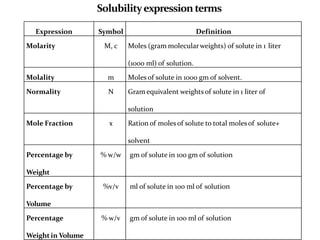
Expression Symbol Definition
MolarityM, c Moles (gram molecularweights) of solute in 1 liter
(1000 ml) of solution.
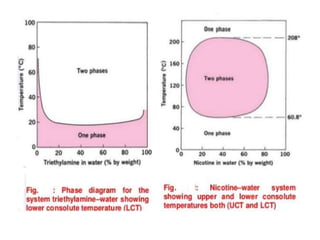
Molality m Moles of solute in 1000 gm of solvent.
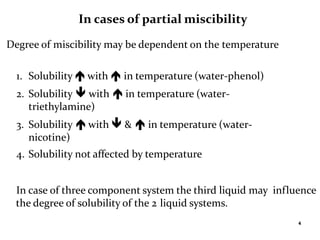
Normality N Gram equivalent weights of solute in 1 liter of
solution
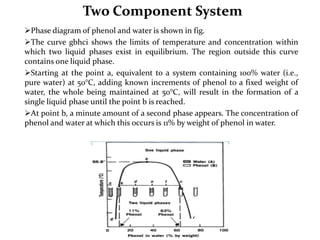
Mole Fraction x Ration of molesof solute to total molesof solute+
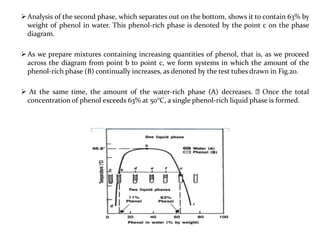
solvent
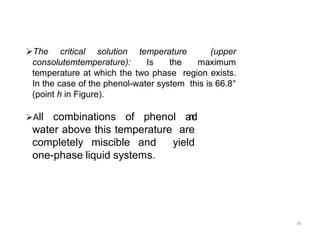
Percentage by
Weight
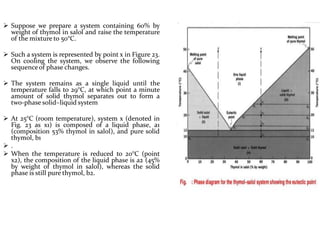
% w/w gm of solute in 100 gm of solution
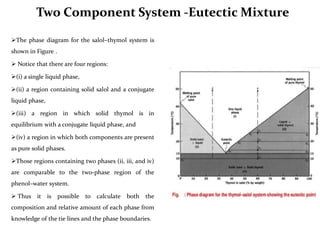
Percentage by
Volume
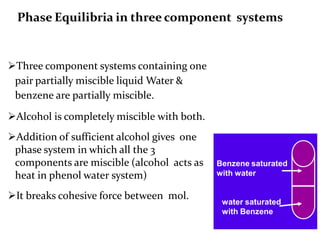
%v/v ml of solute in 100 ml of solution
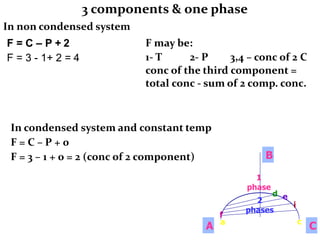
Percentage
Weightin Volume
% w/v gm of solute in 100 ml of solution
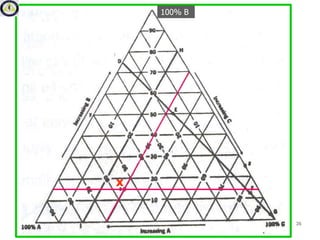
Solubilityexpression terms
10.
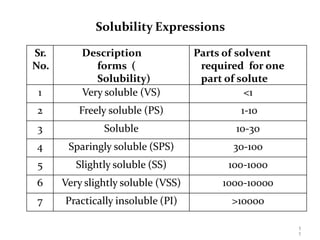
The solubilityof a drug may be expressed in a number of ways.
The United States Pharmacopeia (USP) describes the solubility of
drugs as parts of solvent required for one part solute.
The USP describes solubility using the seven groups listed in Table.
Solubility is also quantitatively expressed in terms of molality,
molarity, and percentage.
Solubility Expressions
11.
1
1
Solubility Expressions
Sr.
No.
Description
forms (
Solubility)
Partsof solvent
required for one
part of solute
1 Very soluble (VS) <1
2 Freely soluble (PS) 1-10
3 Soluble 10-30
4 Sparingly soluble (SPS) 30-100
5 Slightly soluble (SS) 100-1000
6 Very slightly soluble (VSS) 1000-10000
7 Practically insoluble (PI) >10000
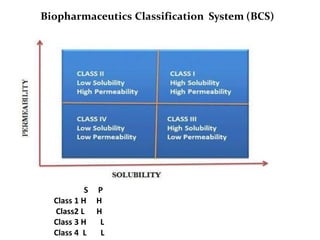
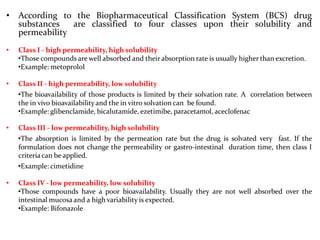
• According tothe Biopharmaceutical Classification System (BCS) drug
substances are classified to four classes upon their solubility and
permeability
• Class I - high permeability, high solubility
•Those compounds are well absorbed and their absorption rate is usually higher than excretion.
•Example: metoprolol
• Class II - high permeability, low solubility
•The bioavailability of those products is limited by their solvation rate. A correlation between
the in vivo bioavailabilityand the in vitro solvation can be found.
•Example: glibenclamide, bicalutamide, ezetimibe, paracetamol, aceclofenac
• Class III - low permeability, high solubility
•The absorption is limited by the permeation rate but the drug is solvated very fast. If the
formulation does not change the permeability or gastro-intestinal duration time, then class I
criteriacan be applied.
•Example: cimetidine
• Class IV - low permeability, low solubility
•Those compounds have a poor bioavailability. Usually they are not well absorbed over the
intestinal mucosa and a high variability is expected.
•Example: Bifonazole
14.
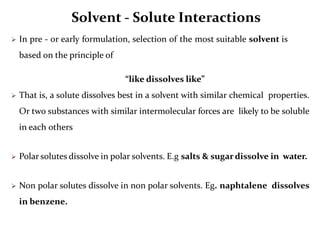
Solvent - SoluteInteractions
In pre - or early formulation, selection of the most suitable solvent is
based on the principle of
“like dissolves like”
That is, a solute dissolves best in a solvent with similar chemical properties.
Or two substances with similar intermolecular forces are likely to be soluble
in each others
Polar solutes dissolve in polar solvents. E.g salts & sugar dissolve in water.
Non polar solutes dissolve in non polar solvents. Eg. naphtalene dissolves
in benzene.
15.
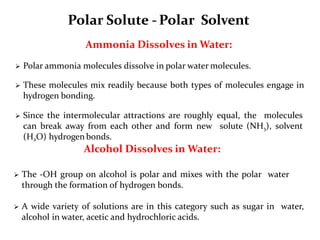
Polar Solute -Polar Solvent
Ammonia Dissolves in Water:
Polar ammonia molecules dissolve in polar water molecules.
These molecules mix readily because both types of molecules engage in
hydrogen bonding.
Since the intermolecular attractions are roughly equal, the molecules
can break away from each other and form new solute (NH3), solvent
(H2O) hydrogen bonds.
Alcohol Dissolves in Water:
The -OH group on alcohol is polar and mixes with the polar water
through the formation of hydrogen bonds.
A wide variety of solutions are in this category such as sugar in water,
alcohol in water, acetic and hydrochloric acids.
16.
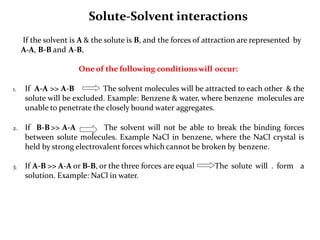
Solute-Solvent interactions
If thesolvent is A & the solute is B, and the forces of attraction are represented by
A-A, B-B and A-B,
One of the following conditionswill occur:
1. If A-A >> A-B The solvent molecules will be attracted to each other & the
solute will be excluded. Example: Benzene & water, where benzene molecules are
unable to penetrate the closely bound water aggregates.
2. If B-B >> A-A The solvent will not be able to break the binding forces
between solute molecules. Example NaCl in benzene, where the NaCl crystal is
held by strong electrovalent forces which cannot be broken by benzene.
3. If A-B >> A-A or B-B, or the three forces are equal The solute will . form a
solution. Example: NaCl in water.
17.
Classification of solvents& their mechanism of action
1. Polar solvents
2. Non polar solvents
3. Semi polar solvents
18.
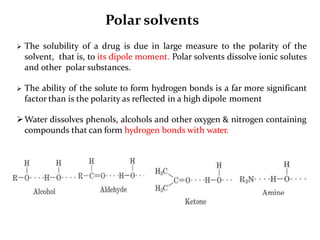
Polar solvents
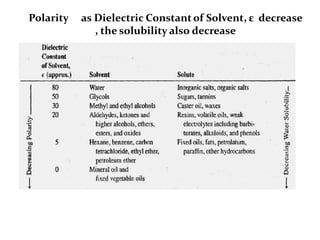
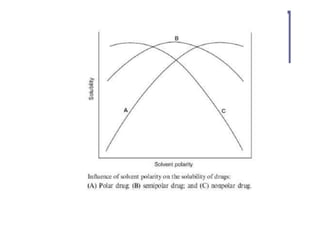
Thesolubility of a drug is due in large measure to the polarity of the
solvent, that is, to its dipole moment. Polar solvents dissolve ionic solutes
and other polar substances.
The ability of the solute to form hydrogen bonds is a far more significant
factor than is the polarity as reflected in a high dipole moment
Water dissolves phenols, alcohols and other oxygen & nitrogen containing
compounds that can form hydrogen bonds with water.
19.
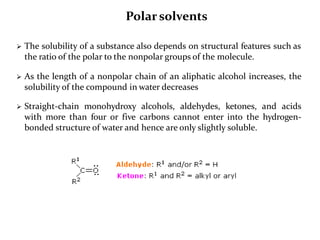
The solubilityof a substance also depends on structural features such as
the ratio of the polar to the nonpolar groups of the molecule.
As the length of a nonpolar chain of an aliphatic alcohol increases, the
solubility of the compound in water decreases
Straight-chain monohydroxy alcohols, aldehydes, ketones, and acids
with more than four or five carbons cannot enter into the hydrogen-
bonded structure of water and hence are only slightly soluble.
Polar solvents
20.
Polarsolvents
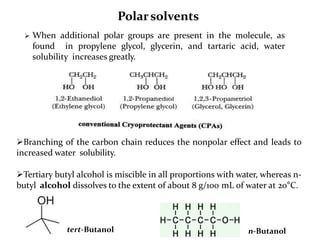
When additionalpolar groups are present in the molecule, as
found in propylene glycol, glycerin, and tartaric acid, water
solubility increases greatly.
Branching of the carbon chain reduces the nonpolar effect and leads to
increased water solubility.
Tertiary butyl alcohol is miscible in all proportions with water, whereas n-
butyl alcohol dissolves to the extent of about 8 g/100 mL of water at 20°C.
tert-Butanol n-Butanol
21.
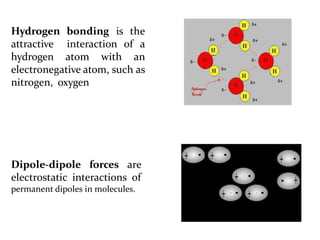
Hydrogen bonding isthe
attractive interaction of a
hydrogen atom with an
electronegative atom, such as
nitrogen, oxygen
Dipole-dipole forces are
electrostatic interactions of
permanent dipoles in molecules.
22.
Non polarsolvents
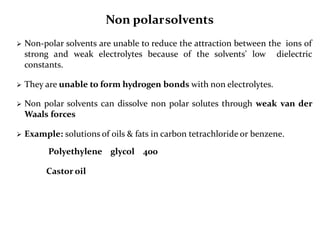
Non-polarsolvents are unable to reduce the attraction between the ions of
strong and weak electrolytes because of the solvents' low dielectric
constants.
They are unable to form hydrogen bonds with non electrolytes.
Non polar solvents can dissolve non polar solutes through weak van der
Waals forces
Example: solutions of oils & fats in carbon tetrachloride or benzene.
Polyethylene glycol 400
Castor oil
24.
Solute solvent interaction
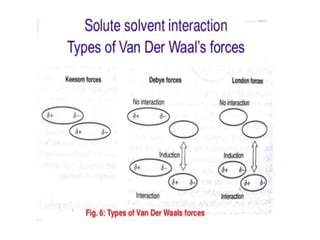
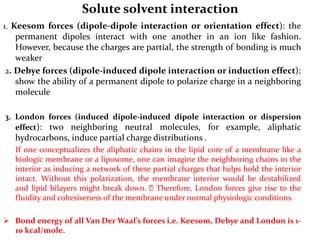
1.Keesom forces (dipole-dipole interaction or orientation effect): the
permanent dipoles interact with one another in an ion like fashion.
However, because the charges are partial, the strength of bonding is much
weaker
2. Debye forces (dipole-induced dipole interaction or induction effect):
show the ability of a permanent dipole to polarize charge in a neighboring
molecule
3. London forces (induced dipole-induced dipole interaction or dispersion
effect): two neighboring neutral molecules, for example, aliphatic
hydrocarbons, induce partial charge distributions .
If one conceptualizes the aliphatic chains in the lipid core of a membrane like a
biologic membrane or a liposome, one can imagine the neighboring chains in the
interior as inducing a network of these partial charges that helps hold the interior
intact. Without this polarization, the membrane interior would be destabilized
and lipid bilayers might break down. Therefore, London forces give rise to the
fluidity and cohesiveness of the membrane under normal physiologic conditions.
Bond energy of all Van Der Waal’s forces i.e. Keesom, Debye and London is 1-
10 kcal/mole.
25.
Semi polarsolvents
Semipolar solvents, such as ketones can induce a certain degree of
polarity in non polar solvent molecules. For example, benzene, which
is readily polarizable, becomes soluble in alcohol
They can act as intermediate solvents to bring about miscibility of
polar & non polar liquids.
Example: acetone increases solubility of ether in water.
Propylene glycol has been shown to increase the mutual solubility of
water and peppermint oil and of water and benzyl benzoate
26.
2
6
Sr.
No
Nature of
Solvent
Mechanism of
solubility
Example
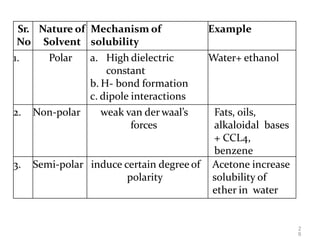
1.Polar a. High dielectric
constant
b. H- bond formation
c. dipole interactions
Water+ ethanol
2. Non-polar weak van der waal’s
forces
Fats, oils,
alkaloidal bases
+ CCL4,
benzene
3. Semi-polar induce certain degree of
polarity
Acetone increase
solubility of
ether in water
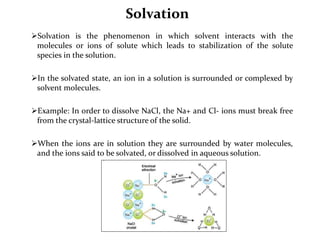
Solvation
Solvation is thephenomenon in which solvent interacts with the
molecules or ions of solute which leads to stabilization of the solute
species in the solution.
In the solvated state, an ion in a solution is surrounded or complexed by
solvent molecules.
Example: In order to dissolve NaCl, the Na+ and Cl- ions must break free
from the crystal-lattice structure of the solid.
When the ions are in solution they are surrounded by water molecules,
and the ions said to be solvated, or dissolved in aqueous solution.
32.
Solvation
Water is apolar solvent with negatively and positively charged regions.
The charged regions are attracted to ions with the opposite charge.
Hence, the positively charged regions of water molecules are attracted to Cl-
ions, and negatively charged regions of water molecules are attracted to Cl-
ions.
When similar water molecules surrounding ions in crystal, the sum of the
attractive forces between the water molecules and the ions may become
strong enough to overcome the attractive forces between the cations and
anions in the crystal.
The water molecules forms a shell of solvation around the ions and the
water-surrounded ion can break away from the crystal and the ions have
become solvated by water molecules.
33.
Co-ordination and solvationnumber:
It reflects the simple idea that the solvation of ions or molecules consists of aco-
ordination of soluteandsolventmolecules.
The co-ordination number is defined asthe number of solvent molecules in the
firstco-ordination sphereof anioninsolution.
The solvation numberisdefined asthe number of solvent molecules per
ion that remain attached to a given ion long enough to experience its
translational movements.
The solvation number of an ion in asolvent depends upon the reference ion as
well as the method of measurement. Smaller the anion or cation more is its
solvationandgreater isits solvation numberandsolvationenergy.
34.
Association
Association or ionassociation is a chemical reaction in which
oppositely charged ions come together to form a distinct chemical
entity.
It can be classified based on number of ions that associate with each
other. Accordingly they can be classified as ion pairs and ion triplets.
Ion pairs are further classified according to the nature of interaction
1. Fully solvated
2. Solvent-shared or solvent separated
3. Contact
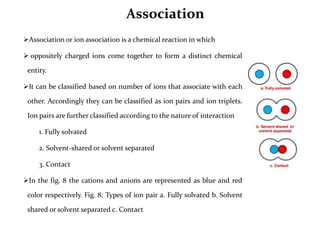
In the fig. 8 the cations and anions are represented as blue and red
color respectively. Fig. 8: Types of ion pair a. Fully solvated b. Solvent
shared or solvent separated c. Contact
35.
The area surroundingions is representing solvent molecules in a
primary solvation shell; secondary solvation is ignored.
When both ions have a complete primary solvation sphere, the ion
pair may be termed as fully solvated as shown in Fig. 8 (a).
When there is about one solvent molecule between cation and
anion, the ion pair may be termed solvent-shared or solvent
separated as shown in fig.8 (b).
Finally the ions are in contact with each other, the ion pair is
termed as contact ion pair as shown in fig. 8 (c).
An ion triplet may be formed from one cation and two anions or
from one anion and two cations.
36.
Solubility Parameter andits determination:
The solubility parameter is a numerical value that indicates the
relative solvency behavior of a specific solvent.
The various scales available to determine the solubility parameter
are: Kauri-Butanol number, solubility grade, aromatic character,
aniline cloud point, wax number, heptane number, and Hildebrand
solubility parameter.
The Hildebrand solubility parameter is applicable for almost all
systems and hence is the most widely used.
Sometimes only numerical values for these terms are encountered,
while at other times values are presented in the form of two or three
dimensional graphs and a triangular graph called a Teas graph. It is
used because of its accuracy and clarity.
37.
The Hildebrand SolubilityParameter:
The solubility behavior of an unknown substance often gives us a clue to its
identification, and the change in solubility of a known material can provide
essential information about its ageing characteristics.
Our choice of solvent in a particular situation involves many factors, including
evaporation rate, solution viscosity, or environmental and health concerns,
and often the effectiveness of a solvent depends on its ability to adequately
dissolve material.
It should be noted that these systems relate to non -ionic liquid interactions
that are extended to polymer interactions; water based systems and those
systems involving acid-base reactions cannot be evaluated by simple solubility
parameter systems alone.
38.
It isthe van der Waals force, which is reflected in the simplest
solubility value: the Hildebrand solubility parameter.
It is derived from the cohesive energy of the solvent, which in
turn is derived from the heat of vaporization.
The relationship between vaporization, van der Waals forces and solubility
will help us to clarify this.
39.
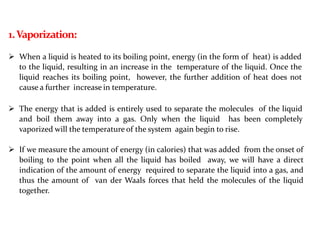
1.Vaporization:
When aliquid is heated to its boiling point, energy (in the form of heat) is added
to the liquid, resulting in an increase in the temperature of the liquid. Once the
liquid reaches its boiling point, however, the further addition of heat does not
cause a further increase in temperature.
The energy that is added is entirely used to separate the molecules of the liquid
and boil them away into a gas. Only when the liquid has been completely
vaporized will the temperature of the system again begin to rise.
If we measure the amount of energy (in calories) that was added from the onset of
boiling to the point when all the liquid has boiled away, we will have a direct
indication of the amount of energy required to separate the liquid into a gas, and
thus the amount of van der Waals forces that held the molecules of the liquid
together.
40.
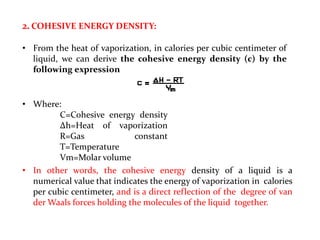
2. COHESIVE ENERGYDENSITY:
• From the heat of vaporization, in calories per cubic centimeter of
liquid, we can derive the cohesive energy density (c) by the
following expression
• Where:
C=Cohesive energy density
Δh=Heat of vaporization
R=Gas constant
T=Temperature
Vm=Molar volume
• In other words, the cohesive energy density of a liquid is a
numerical value that indicates the energy of vaporization in calories
per cubic centimeter, and is a direct reflection of the degree of van
der Waals forces holding the molecules of the liquid together.
41.
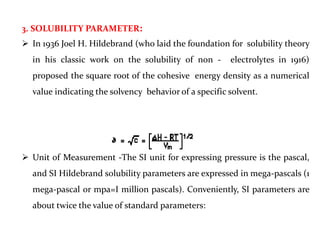
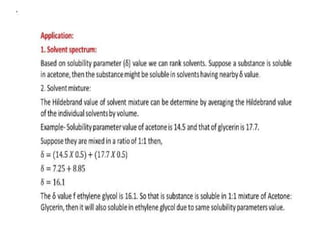
3. SOLUBILITY PARAMETER:
In 1936 Joel H. Hildebrand (who laid the foundation for solubility theory
in his classic work on the solubility of non - electrolytes in 1916)
proposed the square root of the cohesive energy density as a numerical
value indicating the solvency behavior of a specific solvent.
Unit of Measurement -The SI unit for expressing pressure is the pascal,
and SI Hildebrand solubility parameters are expressed in mega-pascals (1
mega-pascal or mpa=I million pascals). Conveniently, SI parameters are
about twice the value of standard parameters:
Solubilization: Solubilization canbe defined as a preparation of
thermodynamically stable isotropic solution of a substance
normally insoluble or slightly soluble in a given solvent by
introduction of an additional component or components
Solubility isdefined in quantitativetermsas the
concentration of solute in a saturated solution at a certain
temperature,
Solubility isdefined inaqualitativeway, as the spontaneous
interaction of two or more substances to form a homogeneous
molecular dispersion.
Solubilization
45.
Enthalpy
The enthalpychange of solution refers to the overall
amount of heat which is released or absorbed during the
dissolving process (at constant pressure).
The enthalpy of solution can either be positive
(endothermic reaction) or negative (exothermic reaction).
The enthalpy of solution is commonly referred to as ΔH
solution.
46.
Solubility of solidsin liquids
Most frequently encountered and probably most
important type of pharmaceutical solutions.
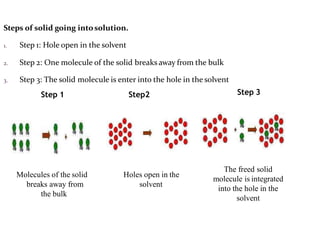
The process can be considered as occurring in three steps
as follows
1. Removal of a molecule from the solute phase at a definite
temperature.
2. Creation of a hole in the solvent just enough to accept the
solute molecule.
3. The solute molecule is finally placed in the hole in the
solvent.
47.
Step 1 Step2Step 3
Holes open in the
solvent
Molecules of the solid
breaks away from
the bulk
The freed solid
molecule is integrated
into the hole in the
solvent
Steps of solid going intosolution.
1. Step 1: Hole open in the solvent
2. Step 2: One molecule of the solid breaks away from the bulk
3. Step 3: The solid molecule is enter into the hole in the solvent
48.
Factors affecting solubilityof solids in liquids
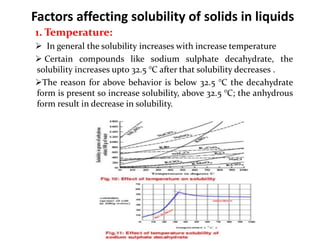
1. Temperature:
In general the solubility increases with increase temperature
Certain compounds like sodium sulphate decahydrate, the
solubility increases upto 32.5 °C after that solubility decreases .
The reason for above behavior is below 32.5 °C the decahydrate
form is present so increase solubility, above 32.5 °C; the anhydrous
form result in decrease in solubility.
49.
2. Molecular structureof solute:
e.g. incorporation of OH group in phenol compare to benzene increases
solubility of former by 100 times that of latter.
Conversion of weak acid to its sodium salts increase solubility.
e.g. conversion of salicylic acid to its sodium salt results in increase in
solubility of the salt form 1 in 1 compare to only salicylic acid as 1 in 550.
Sometimes decrease the solubility of the parent drug is carried out by
esterification.
e.g. Erythromycin degrate in gut so it is administered as erythromycin
propionate which is less soluble.
Masking the taste e.g. chloramphenicol palmitate is used in paediatric
suspension rather than parent drug which is more soluble but bitter in taste.
50.
3. Solvent
: 'likedissolve like'
Weak electrolyte in solution with pH adjusted such that it is in ionized
form, solubility not a problem. But as the pH change & drug goes into
unionized form, it ppt.
Solute more soluble in mixture of solvent rather than individual one.
This is called cosolvency & the solvent called as cosolvent.
e.g. 1 g phenobarbital soluble in 1 lit water, 10 mL alcohol, 40 mL
chloroform & 15 mL ether.
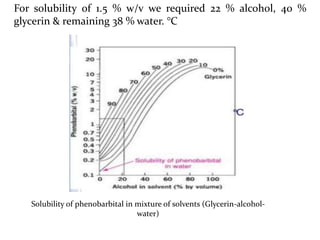
When semilog of solubility of phenobarbital plotted Vs the water-
alcohol-glycerin mixture. We can select the composition of the
mixture according to the solubility you desired.
51.
For solubility of1.5 % w/v we required 22 % alcohol, 40 %
glycerin & remaining 38 % water. °C
Solubility of phenobarbital in mixture of solvents (Glycerin-alcohol-
water)
52.
4. Influence ofsubstituent's on the solubility
An influence of substituents on the solubility of molecules in water can
be due to their effect on the properties of the solid or liquid (for
example, on its molecular cohesion, or to the effect of the substituent
on its interaction with water molecules.
Substituents can be classified as either hydrophobic or hydrophilic,
depending on their polarity
Polar groups such as –OH capable of hydrogen bonding with water
molecules impart high solubility
Non-polar groups such as –CH3 and –Cl are hydrophobic and impart
low solubility.
53.
Ionization ofthe substituent increases solubility, e.g. –COOH and –NH2
are slightly hydrophilic whereas –COO– and –NH3 are very hydrophilic.
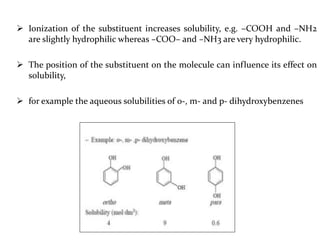
The position of the substituent on the molecule can influence its effect on
solubility,
for example the aqueous solubilities of o-, m- and p- dihydroxybenzenes
54.
5. Crystal characteristics:Polymorphism & Solvation
Steroids, sulphonamides, barbiturates etc. exhibit polymorphism.
More stable polymorph posses lower energy & is most stable crystal & have
lowest solubility compare to other polymorphs.
While metastable form is thermodynamically unstable and which shows
highest solubility compare to any other form
e.g. Ritonavir
55.
6. Particle sizeof the solid:
As the particle size decreases, surface area of solids
increases, which results in increase in solubility of
solids.
7. pH:
For weakly acidic drug or a salt form solubility
decreases when pH decreases, conversely weakly basic
drugs or their salts, precipitated with increase in pH.
Their solubility is depends on degree of ionization.
And Degree of ionization depends on pH.
56.
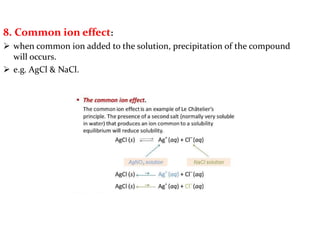
8. Common ioneffect:
when common ion added to the solution, precipitation of the compound
will occurs.
e.g. AgCl & NaCl.
57.
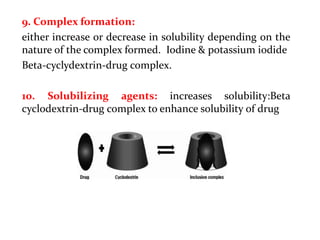
9. Complex formation:
eitherincrease or decrease in solubility depending on the
nature of the complex formed. Iodine & potassium iodide
Beta-cyclydextrin-drug complex.
10. Solubilizing agents: increases solubility:Beta
cyclodextrin-drug complex to enhance solubility of drug
Solubility of gasesin liquids
Pharmaceutical example of gases containing
liquids are hydrochloric acid, ammonia
water, effervescent preparation containing
carbon dioxide that are dissolved &
maintained in solution under positive
pressure.
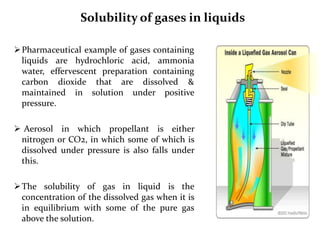
Aerosol in which propellant is either
nitrogen or CO2, in which some of which is
dissolved under pressure is also falls under
this.
The solubility of gas in liquid is the
concentration of the dissolved gas when it is
in equilibrium with some of the pure gas
above the solution.
60.
Factors affecting solubilityof gases in liquids
1. Effect of pressure:
The pressure of a gas above the solution is an important consideration in
gaseous solutions since it changes the solubility of the dissolved gas in
equilibrium with it.
It is expressed by Henry's Law
Statement: In a very dilute solution at constant temperature, the
concentration of dissolved gas is proportional to the partial pressure of the
gas above the solution at equilibrium.
It can obtained by subtracting the vapor pressure of the solvent from the
total pressure above the solution.
61.
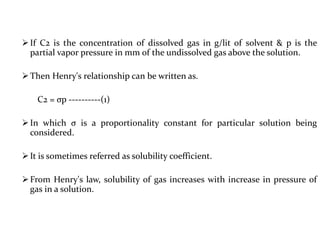
If C2 isthe concentration of dissolved gas in g/lit of solvent & p is the
partial vapor pressure in mm of the undissolved gas above the solution.
Then Henry's relationship can be written as.
C2 = σp ----------(1)
In which σ is a proportionality constant for particular solution being
considered.
It is sometimes referred as solubility coefficient.
From Henry's law, solubility of gas increases with increase in pressure of
gas in a solution.
62.
2. Effect oftemperature:
As the temperature increases, solubility of gases in liquids
decreases.
This behavior is due to greater tendency of a gas to expand.
As expansion property coupled with the pressure, one should
be very cautious while opening a gas containers in warm
condition or at elevated temperature.
63.
3. Salting Out:
When electrolytes like NaCl is added into a solution in
which gases are dissolved, it results in liberation of gases
from the solution.
This phenomenon known as salting out. Mechanism:
When an electrolyte or highly polar non-electrolyte is
added into a carbonated water, gas is liberated.
This phenomenon is due to the attraction of the salt
ions or highly polar non-electrolyte for water molecules,
which reduces the density of the aqueous environment
adjacent to the gas molecules.
Salting out may also occur in solutions of liquids in
liquids & solids in liquids.
64.
4. Effect ofchemical reaction:
Henry's law is strictly applied to gases that are only slightly soluble in
solution & that do not react in any way in the solvent.
Gases like hydrogen chloride, ammonia & carbon dioxide show
deviations from Henry's law due to the chemical reaction between
the gas & solvent.
Due to chemical reaction, usually solubility increases.
Example: hydrogen chloride is about 10,000 times more soluble in
water than oxygen.
66.
Solubility of liquidin liquid
Before discussing Solubility of liquid in
liquid you should know following things
Phase rule
Phase: Ashomogenous, physically distinct portion of a system that is
separated from other portions of the system by bounding surface.
Liquid water & water vapor two phases, & liquid water, water vapor, & solid
ice is the three phases.
69.
Number of Components:
Itis smallest number of constituents by which the composition
of each phase in the system at equilibrium can be expressed in
the form of a chemical formula or equation.
So take example of water, it exist as in liquid, solid & vapor phase,
but the composition remains same i.e. H2O, so that one
component system.
In Phenol-water system, two constituents i.e. phenol & water are
there so it is two phase system.
70.
Number ofDegrees of freedom: It is the least number of
intensive variables that must be fixed/known to describe the system
completely.
A system with F = 0 is known as nonvariant or
having no degree of freedom.
A system with F = 1 is known as univariant or having
one degree of freedom.
A system with F = 2 is known as bivariant or having
two degrees of freedom.
71.
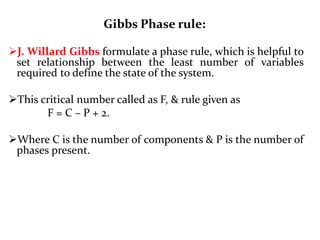
Gibbs Phase rule:
J.Willard Gibbs formulate a phase rule, which is helpful to
set relationship between the least number of variables
required to define the state of the system.
This critical number called as F, & rule given as
F = C – P + 2.
Where C is the number of components & P is the number of
phases present.
72.
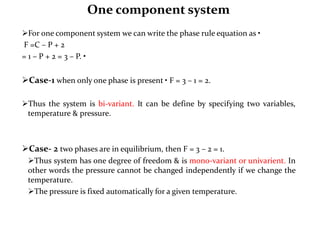
One component system
Forone component system we can write the phase rule equation as •
F =C – P + 2
= 1 – P + 2 = 3 – P. •
Case-1 when only one phase is present • F = 3 – 1 = 2.
Thus the system is bi-variant. It can be define by specifying two variables,
temperature & pressure.
Case- 2 two phases are in equilibrium, then F = 3 – 2 = 1.
Thus system has one degree of freedom & is mono-variant or univarient. In
other words the pressure cannot be changed independently if we change the
temperature.
The pressure is fixed automatically for a given temperature.
73.
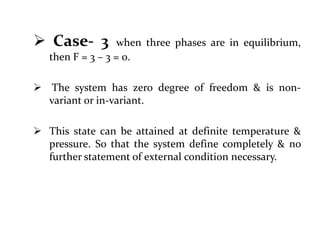
Case- 3when three phases are in equilibrium,
then F = 3 – 3 = 0.
The system has zero degree of freedom & is non-
variant or in-variant.
This state can be attained at definite temperature &
pressure. So that the system define completely & no
further statement of external condition necessary.
74.
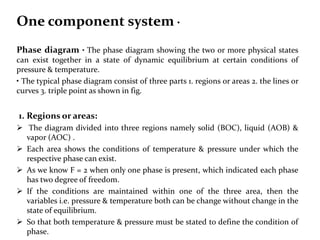
One component system•
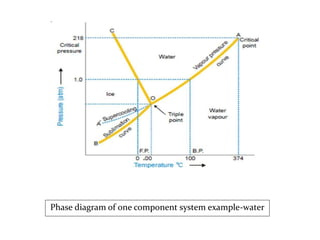
Phase diagram • The phase diagram showing the two or more physical states
can exist together in a state of dynamic equilibrium at certain conditions of
pressure & temperature.
• The typical phase diagram consist of three parts 1. regions or areas 2. the lines or
curves 3. triple point as shown in fig.
1. Regions or areas:
The diagram divided into three regions namely solid (BOC), liquid (AOB) &
vapor (AOC) .
Each area shows the conditions of temperature & pressure under which the
respective phase can exist.
As we know F = 2 when only one phase is present, which indicated each phase
has two degree of freedom.
If the conditions are maintained within one of the three area, then the
variables i.e. pressure & temperature both can be change without change in the
state of equilibrium.
So that both temperature & pressure must be stated to define the condition of
phase.
One component system
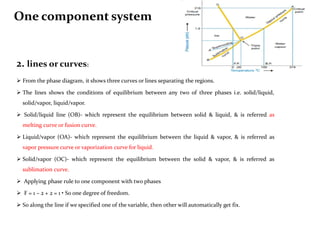
2.lines or curves:
From the phase diagram, it shows three curves or lines separating the regions.
The lines shows the conditions of equilibrium between any two of three phases i.e. solid/liquid,
solid/vapor, liquid/vapor.
Solid/liquid line (OB)- which represent the equilibrium between solid & liquid, & is referred as
melting curve or fusion curve.
Liquid/vapor (OA)- which represent the equilibrium between the liquid & vapor, & is referred as
vapor pressure curve or vaporization curve for liquid.
Solid/vapor (OC)- which represent the equilibrium between the solid & vapor, & is referred as
sublimation curve.
Applying phase rule to one component with two phases
F = 1 – 2 + 2 = 1 • So one degree of freedom.
So along the line if we specified one of the variable, then other will automatically get fix.
77.
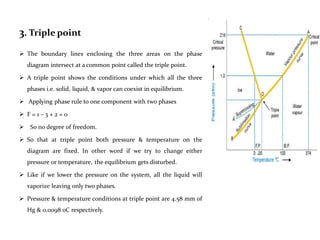
3. Triple point
The boundary lines enclosing the three areas on the phase
diagram intersect at a common point called the triple point.
A triple point shows the conditions under which all the three
phases i.e. solid, liquid, & vapor can coexist in equilibrium.
Applying phase rule to one component with two phases
F = 1 – 3 + 2 = 0
So no degree of freedom.
So that at triple point both pressure & temperature on the
diagram are fixed. In other word if we try to change either
pressure or temperature, the equilibrium gets disturbed.
Like if we lower the pressure on the system, all the liquid will
vaporize leaving only two phases.
Pressure & temperature conditions at triple point are 4.58 mm of
Hg & 0.0098 0C respectively.
78.
One component system
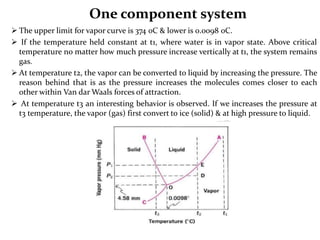
The upper limit for vapor curve is 374 0C & lower is 0.0098 0C.
If the temperature held constant at t1, where water is in vapor state. Above critical
temperature no matter how much pressure increase vertically at t1, the system remains
gas.
At temperature t2, the vapor can be converted to liquid by increasing the pressure. The
reason behind that is as the pressure increases the molecules comes closer to each
other within Van dar Waals forces of attraction.
At temperature t3 an interesting behavior is observed. If we increases the pressure at
t3 temperature, the vapor (gas) first convert to ice (solid) & at high pressure to liquid.
79.
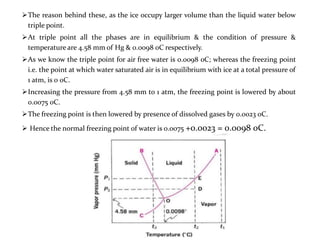
The reason behindthese, as the ice occupy larger volume than the liquid water below
triple point.
At triple point all the phases are in equilibrium & the condition of pressure &
temperature are 4.58 mm of Hg & 0.0098 0C respectively.
As we know the triple point for air free water is 0.0098 0C; whereas the freezing point
i.e. the point at which water saturated air is in equilibrium with ice at a total pressure of
1 atm, is 0 0C.
Increasing the pressure from 4.58 mm to 1 atm, the freezing point is lowered by about
0.0075 0C.
The freezing point is then lowered by presence of dissolved gases by 0.0023 0C.
Hence the normal freezing point of water is 0.0075 +0.0023 = 0.0098 0C.
80.
Application:
A gas, e.g.water vapour confined to a particular volume. Apply
phase rule: F=1-1+2=2.
This means that two intensive variables (temperature and
pressure, temperature and concentration) must be known to
duplicate this system exactly. Such a system is usually described as
bivariant.
A liquid such as water in equilibrium with its vapour (we have 2
phase system)
F=1-2+2=1.
By stating temperature, the system is completely defined because
the pressure under which liquid and vapour can coexist is also
fixed.
If we decide to work under a particular pressure, then the
temperature of the system is automatically defined.
81.
Solubility of liquidin liquid
i) Complete miscibility:
A pair of polar & semipolar solvents like, water & alcohol,
glycerin & alcohol are said to be completely miscible
because they are mix in all proportions.
Non-polar solvents like benzene & carbon tetrachloride
are also completely miscible.
Generally completely miscible liquids, do not create
solubility problems.
82.
Solubility of liquidin liquid
i) Partial miscibility:
When water is added into ether or phenol, two liquid layers are
formed, each containing some of the other liquid in the
dissolved state.
Example phenol-water system
We know from experience that ethyl alcohol and water are
miscible in all proportions, whereas water and mercury are, for
all practical purposes, completely immiscible regardless of the
relative amounts of each present.
Between these two extremes lies a whole range of systems that
exhibit partial miscibility (or immiscibility)
83.
Solubility of liquidin liquid
From the knowledge of the phase diagram, the composition of each component
in the two conjugate phases & amount of one phase relative to the other can be
calculated.
In case of some liquids pairs, the solubility increases as the temperature
decreases, & system will exhibit lower consolute temperature (LCT). Example
triethylamine and water.
Some liquid pairs shows both UCT & LCT.
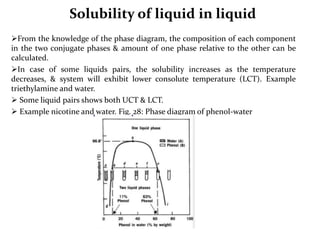
Example nicotine and water. Fig. 28: Phase diagram of phenol-water
84.
4
In cases ofpartial miscibility
Degree of miscibility may be dependent on the temperature
1. Solubility with in temperature (water-phenol)
2. Solubility with in temperature (water-
triethylamine)
3. Solubility with & in temperature (water-
nicotine)
4. Solubility not affected by temperature
In case of three component system the third liquid may influence
the degree of solubility of the 2 liquid systems.
85.
5
Effect of temperaturevariation on the degreeof miscibility in these
systems is described by means of phase diagrams.
Phase diagrams
= graphs of temperature versus composition at constant P
86.
Two Component System
Phasediagram of phenol and water is shown in fig.
The curve gbhci shows the limits of temperature and concentration within
which two liquid phases exist in equilibrium. The region outside this curve
contains one liquid phase.
Starting at the point a, equivalent to a system containing 100% water (i.e.,
pure water) at 50°C, adding known increments of phenol to a fixed weight of
water, the whole being maintained at 50°C, will result in the formation of a
single liquid phase until the point b is reached.
At point b, a minute amount of a second phase appears. The concentration of
phenol and water at which this occurs is 11% by weight of phenol in water.
87.
Analysis of thesecond phase, which separates out on the bottom, shows it to contain 63% by
weight of phenol in water. This phenol-rich phase is denoted by the point c on the phase
diagram.
As we prepare mixtures containing increasing quantities of phenol, that is, as we proceed
across the diagram from point b to point c, we form systems in which the amount of the
phenol-rich phase (B) continually increases, as denoted by the test tubes drawn in Fig.20.
At the same time, the amount of the water-rich phase (A) decreases. Once the total
concentration of phenol exceeds 63% at 50°C, a single phenol-rich liquid phase is formed.
88.
11
The critical solutiontemperature (upper
consolutemtemperature): Is the maximum
temperature at which the two phase region exists.
In the case of the phenol-water system this is 66.8°
(point h in Figure).
All combinations of phenol a
n
d
water above this temperature are
completely miscible and yield
one-phase liquid systems.
90.
Two-Component Systems ContainingSolid and Liquid
Phases : Eutectic Mixtures
•
Solid–liquid mixtures in which the two components are completely
miscible in the liquid state and completely immiscible as solids.
A eutectic mixture is defined as a mixture of two or more components
which usually do not interact to form a new chemical compound but,
which at certain ratios, inhibit the crystallization process of one another
resulting in a system having a lower melting point than either of the
components
Examples of such systems are:
salol–thymol,
salol–camphor,
acetaminophen–propyphenazone.
91.
Two Component System-Eutectic Mixture
The phase diagram for the salol–thymol system is
shown in Figure .
Notice that there are four regions:
(i) a single liquid phase,
(ii) a region containing solid salol and a conjugate
liquid phase,
(iii) a region in which solid thymol is in
equilibrium with a conjugate liquid phase, and
(iv) a region in which both components are present
as pure solid phases.
Those regions containing two phases (ii, iii, and iv)
are comparable to the two-phase region of the
phenol–water system.
Thus it is possible to calculate both the
composition and relative amount of each phase from
knowledge of the tie lines and the phase boundaries.
92.
Suppose weprepare a system containing 60% by
weight of thymol in salol and raise the temperature
of the mixture to 50°C.
Such a system is represented by point x in Figure 23.
On cooling the system, we observe the following
sequenceof phase changes.
The system remains as a single liquid until the
temperature falls to 29°C, at which point a minute
amount of solid thymol separates out to form a
two-phase solid–liquid system
At 25°C (room temperature), system x (denoted in
Fig. 23 as x1) is composed of a liquid phase, a1
(composition 53% thymol in salol), and pure solid
thymol, b1
.
When the temperature is reduced to 20°C (point
x2), the composition of the liquid phase is a2 (45%
by weight of thymol in salol), whereas the solid
phase is still pure thymol, b2.
93.
26
Phase Equilibria inthree component systems
Three component systems containing one
pair partially miscible liquid Water &
benzene are partially miscible.
Alcohol is completely miscible with both.
Addition of sufficient alcohol gives one
phase system in which all the 3
components are miscible (alcohol acts as
heat in phenol water system)
It breaks cohesive force between mol.
Benzene saturated
with water
water saturated
with Benzene
94.
3 components &one phase
In non condensed system
F = C – P + 2
F = 3 - 1+ 2 = 4
In condensed system and constant temp
F = C – P + 0
F = 3 – 1 + 0 = 2 (conc of 2 component)
A C
B
1
phase
2
phases
f
a
d e
i
2
c
7
F may be:
1- T 2- P 3,4 – conc of 2 C
conc of the third component =
total conc - sum of 2 comp. conc.
29
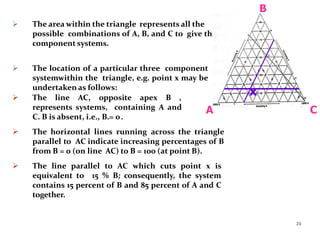
The areawithin the triangle represents all the
possible combinations of A, B, and C to give three
component systems.
The location of a particular three component
systemwithin the triangle, e.g. point x may be
undertaken as follows:
The line AC, opposite apex B ,
represents systems, containing A and
C. B is absent, i.e., B.= 0.
The horizontal lines running across the triangle
parallel to AC indicate increasing percentages of B
from B = 0 (on line AC) to B = 100 (at point B).
The line parallel to AC which cuts point x is
equivalent to 15 % B; consequently, the system
contains 15 percent of B and 85 percent of A and C
together.
A C
B
x
97.
30
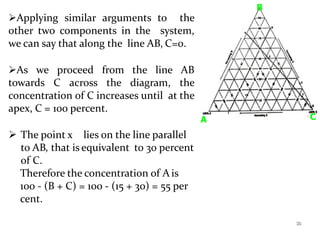
Applying similar argumentsto the
other two components in the system,
we can say that along the line AB, C=0.
As we proceed from the line AB
towards C across the diagram, the
concentration of C increases until at the
apex, C = 100 percent.
The point x lies on the line parallel
to AB, that is equivalent to 30 percent
of C.
Therefore the concentration of A is
100 - (B + C) = 100 - (15 + 30) = 55 per
cent.
A C
B
98.
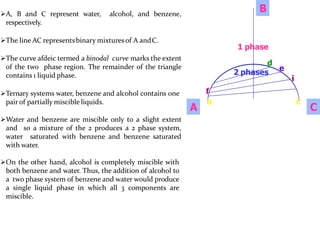
A, B andC represent water, alcohol, and benzene,
respectively.
The line AC representsbinary mixturesof A andC.
The curve afdeic termed a binodal curve marks the extent
of the two phase region. The remainder of the triangle
contains 1 liquid phase.
Ternary systems water, benzene and alcohol contains one
pair of partially miscible liquids.
Water and benzene are miscible only to a slight extent
and so a mixture of the 2 produces a 2 phase system,
water saturated with benzene and benzene saturated
with water.
On the other hand, alcohol is completely miscible with
both benzene and water. Thus, the addition of alcohol to
a two phase system of benzene and water would produce
a single liquid phase in which all 3 components are
miscible.
31
A C
B
1 phase
2 phases
f
a
d
e
i
c
99.
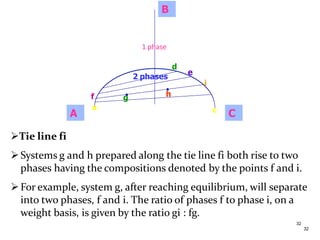
Tie line fi
Systemsg and h prepared along the tie line fi both rise to two
phases having the compositions denoted by the points f and i.
For example, system g, after reaching equilibrium, will separate
into two phases, f and i. The ratio of phases f to phase i, on a
weight basis, is given by the ratio gi : fg.
32
A C
B
1 phase
2 phases
f
a
d
e
i
c
g h
100.
33
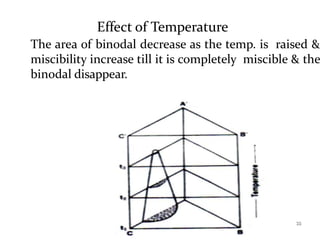
Effect of Temperature
Thearea of binodal decrease as the temp. is raised &
miscibility increase till it is completely miscible & the
binodal disappear.
 Most read
 Most read