SOLID WASTE MANAGEMENT
PRESENTATION
KUMAR CHANDAN
PRESENTS
Q. Compare sanitary landfill and uncontrolled dumping
from the point of view of public health and the environment.
ANS:- sanitary landfill uncontrolled dumping
1.Soil is applied over wastes
daily or on a regular basis to
keep bad odours & pests off
the land surface.
2.so, it causes less
environmental & public health
issues compare to
uncontrolled dumping.
1.No soil application over
wastes which further causes
bad odours containing harmful
contaminants.
2.This method poses a greater
danger to the environment &
public health.
3.Only set up by the authority
of the state or local gov.
It is not a personal or
individualized decision,but a
societal one.
4.This method ensures that
the site land can be reused for
other community purposes.
3.This method is not
processed officially by the
relevant gov authority.
People set up their own open
dumping sites that is left open
for rats & flies to make habitat.
4. It doesn't so.
5.Proper monitoring is
required to prevent the
seepaged water to mix with
underground water.
6.Also some supportive
equipments are provided to
prevent the toxic gases
produced at the sites from
directly releasing to the
environment.
5. No monitoring at all.
so,there is a probability of
seepaged water to mix with
underground & run off water.
6. Moreover, these don't have
treatment pants &supportive
equipments for the treatment
of liquids or gases (methane
etc.) from the dumping site.
These gases contribute to
global warming &
contamination of the nearby
environment.
Q. Explain the need for monitoring sanitary landfills.
ANS:-
Monitoring is a necessity to ensure that there is no
measurable affect on ground and surface water resulting from
landfilling activities.
It is necessary either to detect failure and correct it or to confirm
that the controlled seepage is behaving as predicted & lies within
the safe limit.
The objectives of monitoring sanitory landfills are:
• to establish baseline environmental conditions;
• to detect adverse environmental impacts from the
landfilling of waste;
• to provide information for the assessment of an
application for a waste licence, review of a waste
licence or surrender of a waste licence;
• to demonstrate that the environmental control measures
are operating as designed;
• to assist in the evaluation of the processes occurring
within the waste body;
• to demonstrate compliance with the licence conditions;
• to provide data for emission inventories;
• to provide data to inform the public;
• to provide data for the improvement and updating of
monitoring programmes;
• to assist in an investigation in the event of a trigger level
or emission limit value being breached
Q.Considering the selection criteria,suggest the best
disposal option for your locality.
Ans:-Solid Waste disposal method is selected based on the
following criterias-
(i)Quantities and characteristics of wastes: Higher income
category tends to generate larger quantity of wastes.
(ii) Climate and seasonal variations
(iv) Financial and foreign exchange constraints-In regions where
wage rates are low, The unfavourable financial situation
generates during purchase of equipment and vehicles, and this
situation is further worsened by the acute shortage of foreign
exchange.
(vi) Management and technical resources
• Sanitary Landfill
• Composting
Sanitary landfilling
• Simple, cheap, and effective
• A deep trench (3 to 5 m) is excavated
• Refuse is laid in layers
• Layers are compacted with some mechanical equipment and
covered with earth, leveled, and compacted
• With time, the fill settle
• Microorganisms act on the organic matter and degrade them
• bacteria break down complex organic matter into simpler
molecules.
Sanitary landfill site, PHULWARI SHARIF (PATNA)
Composting
Composting is a natural biological process, carried out under
controlled aerobic conditions (requires oxygen). In this process,
various microorganisms, including bacteria and fungi, break
down organic matter into simpler substances.
composting plant,muzzaffarpur (Bihar)
composting plant Bodhgaya,Bihar
Q.Explain the need for source reduction in waste
management.
ANS:- Source reduction in waste management is the
elimination of waste before it is created.
The practice of source reduction benefits the environment
through reduced energy consumption and pollution,
conservation of natural resources, and extension of
valuable landfill space. It can also have economic
benefits by reducing costs associated with transportation,
disposal or recycling of waste. Plus, source reduction
can save our money every day.
#
Waste source reduction can protect the environment and often
turns out to have positive economic benefits.
It is much needed to improve:-
◎Efficient production practices. Waste minimisation can achieve
more output of product per unit of input of raw materials.
◎Economic returns. More efficient use of products means
reduced costs of purchasing new materials improving the
financial performance of a company
◎Public image. The environmental profile of a company
is an important part of its overall reputation and waste
minimisation reflects a proactive movement towards
environmental protection.
◎Quality of products produced. New innovation and
technological practices can reduce waste generation and
improve the quality of the inputs in the production phase.
◎Environmental responsibility. Minimising or eliminating
waste generation makes it easier to meet targets of
environmental regulations, policies, and standards. The
environmental impact of waste will be reduced.
Q.Explain how recycling take place in your lacality and
list out its advantages.
ANS:-
Recycling is the recovery and reuse of materials from wastes.
Solid waste recycling refers to the reuse of manufactured goods
from which resources such as steel, copper , or plastics can be
recovered and reused.
Collection Processing Manufacturing
COLLECTION
Waste materials are collected through drop-off centers.
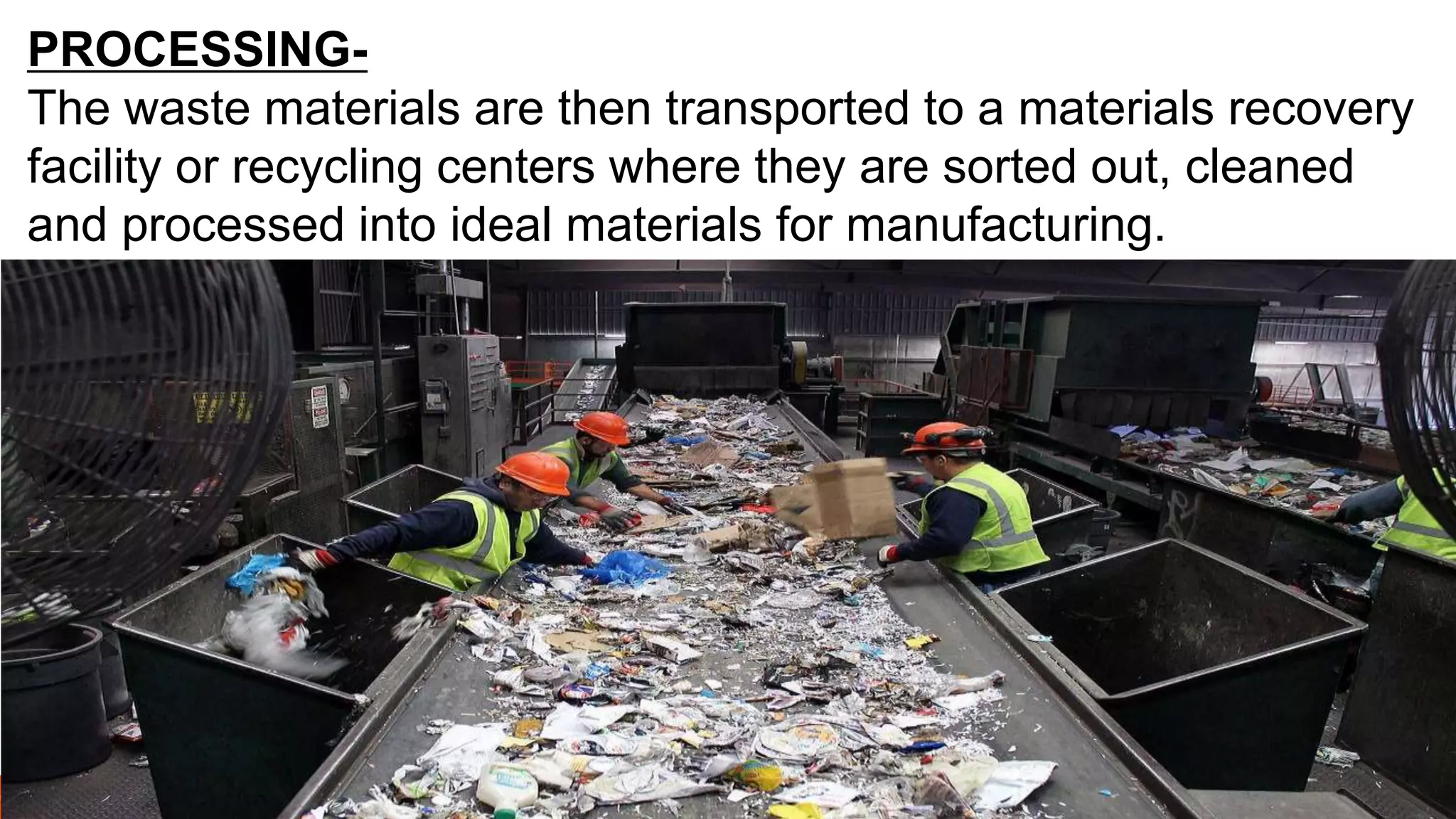
PROCESSING-
The waste materials are then transported to a materials recovery
facility or recycling centers where they are sorted out, cleaned
and processed into ideal materials for manufacturing.
Manufacturing
Manufacturing is where the processed waste materials are converted into
useful products.Common products manufactured using waste materials
include paper towels, newspapers, steel cans, soft drink containers made
of plastic glass and aluminum.
1) Paper-
PAPER RECYCLING & MANUFACTURING PLANT,FATUHA,PATNA(BIHAR)
2)Newspapers and Magazines -
3) Cardboard –
4). Metallic Containers
3. Glass -
GLASS RECYCLING PLANT,PATLIPUTRA INDUSTRIAL AREA (BIHAR)
4. Plastic -
PLASTIC RECYCLING PLANT, BIHTA ,PATNA (BIHAR)
Advantages of Recycling
• Recycling minimizes pollution.
• Protects the environment.
• Recycling minimizes global warming.
• Conserves natural resources.
• Recycling cuts down amount of waste in landfill sites.
• Recycling ensures sustainable use of resources.
• Recycling contributes to creation of jobs.
• Reduces energy consumption
Q. State end use of recycled plastic.
ANS:-
1.PET (Polyethylene terephthalate)
PET is used in the production of soft drink bottles, peanut butter jars...
PET can be recycled into fiberfill for
sleeping bags, carpet fibers, rope,
pillows...
2.HDPE (High density polyethylene)
HDPE is found in milk jugs, butter tubs,detergent bottles, motor oil
bottles...HDPE can be recycled into flower pots,
trash cans, traffic barrier cones,detergent bottles...
3.PVC (Polyvinyl chloride)
PVC is used in shampoo bottles, cooking oil bottles, fast food
service items...
PVC can be recycled into drainage and irrigation pipes...
4.LDPE (Low density polyethylene)
LDPE is found in grocery bags, bread bags,
shrink wrap, margarine tub tops...
LDPE can be recycled into new grocery
bags...
5.PP (Polypropylene)
PP is used in most yogurt containers, straws, pancake syrup
bottles, bottle caps....
PP can be recycled into plastic lumber, car
battery cases, manhole steps...
6.PS (Polystyrene)
PS is found in disposable hot cups, packaging materials
(peanuts), and meat trays...PS can be recycled into plastic
lumber, cassette tape boxes, flower pots...
7.OTHER
This is usually a mixture of various plastics, like
squeeze ketchup bottles,"microwaveable" dishes...
It is usually not recycled because it is a mixture of
different types of plastics.
Solid waste management presentation

Solid waste management presentation

  • 1.
  • 2.
    Q. Compare sanitarylandfill and uncontrolled dumping from the point of view of public health and the environment. ANS:- sanitary landfill uncontrolled dumping 1.Soil is applied over wastes daily or on a regular basis to keep bad odours & pests off the land surface. 2.so, it causes less environmental & public health issues compare to uncontrolled dumping. 1.No soil application over wastes which further causes bad odours containing harmful contaminants. 2.This method poses a greater danger to the environment & public health.
  • 3.
    3.Only set upby the authority of the state or local gov. It is not a personal or individualized decision,but a societal one. 4.This method ensures that the site land can be reused for other community purposes. 3.This method is not processed officially by the relevant gov authority. People set up their own open dumping sites that is left open for rats & flies to make habitat. 4. It doesn't so.
  • 4.
    5.Proper monitoring is requiredto prevent the seepaged water to mix with underground water. 6.Also some supportive equipments are provided to prevent the toxic gases produced at the sites from directly releasing to the environment. 5. No monitoring at all. so,there is a probability of seepaged water to mix with underground & run off water. 6. Moreover, these don't have treatment pants &supportive equipments for the treatment of liquids or gases (methane etc.) from the dumping site. These gases contribute to global warming & contamination of the nearby environment.
  • 5.
    Q. Explain theneed for monitoring sanitary landfills. ANS:- Monitoring is a necessity to ensure that there is no measurable affect on ground and surface water resulting from landfilling activities. It is necessary either to detect failure and correct it or to confirm that the controlled seepage is behaving as predicted & lies within the safe limit.
  • 6.
    The objectives ofmonitoring sanitory landfills are: • to establish baseline environmental conditions; • to detect adverse environmental impacts from the landfilling of waste; • to provide information for the assessment of an application for a waste licence, review of a waste licence or surrender of a waste licence; • to demonstrate that the environmental control measures are operating as designed; • to assist in the evaluation of the processes occurring within the waste body;
  • 7.
    • to demonstratecompliance with the licence conditions; • to provide data for emission inventories; • to provide data to inform the public; • to provide data for the improvement and updating of monitoring programmes; • to assist in an investigation in the event of a trigger level or emission limit value being breached
  • 8.
    Q.Considering the selectioncriteria,suggest the best disposal option for your locality. Ans:-Solid Waste disposal method is selected based on the following criterias- (i)Quantities and characteristics of wastes: Higher income category tends to generate larger quantity of wastes. (ii) Climate and seasonal variations (iv) Financial and foreign exchange constraints-In regions where wage rates are low, The unfavourable financial situation generates during purchase of equipment and vehicles, and this situation is further worsened by the acute shortage of foreign exchange. (vi) Management and technical resources
  • 9.
  • 10.
    Sanitary landfilling • Simple,cheap, and effective • A deep trench (3 to 5 m) is excavated • Refuse is laid in layers • Layers are compacted with some mechanical equipment and covered with earth, leveled, and compacted • With time, the fill settle • Microorganisms act on the organic matter and degrade them • bacteria break down complex organic matter into simpler molecules.
  • 11.
    Sanitary landfill site,PHULWARI SHARIF (PATNA)
  • 12.
    Composting Composting is anatural biological process, carried out under controlled aerobic conditions (requires oxygen). In this process, various microorganisms, including bacteria and fungi, break down organic matter into simpler substances.
  • 13.
  • 14.
  • 15.
    Q.Explain the needfor source reduction in waste management. ANS:- Source reduction in waste management is the elimination of waste before it is created. The practice of source reduction benefits the environment through reduced energy consumption and pollution, conservation of natural resources, and extension of valuable landfill space. It can also have economic benefits by reducing costs associated with transportation, disposal or recycling of waste. Plus, source reduction can save our money every day.
  • 16.
    # Waste source reductioncan protect the environment and often turns out to have positive economic benefits. It is much needed to improve:- ◎Efficient production practices. Waste minimisation can achieve more output of product per unit of input of raw materials. ◎Economic returns. More efficient use of products means reduced costs of purchasing new materials improving the financial performance of a company
  • 17.
    ◎Public image. Theenvironmental profile of a company is an important part of its overall reputation and waste minimisation reflects a proactive movement towards environmental protection. ◎Quality of products produced. New innovation and technological practices can reduce waste generation and improve the quality of the inputs in the production phase. ◎Environmental responsibility. Minimising or eliminating waste generation makes it easier to meet targets of environmental regulations, policies, and standards. The environmental impact of waste will be reduced.
  • 18.
    Q.Explain how recyclingtake place in your lacality and list out its advantages. ANS:- Recycling is the recovery and reuse of materials from wastes. Solid waste recycling refers to the reuse of manufactured goods from which resources such as steel, copper , or plastics can be recovered and reused.
  • 19.
    Collection Processing Manufacturing COLLECTION Wastematerials are collected through drop-off centers.
  • 20.
    PROCESSING- The waste materialsare then transported to a materials recovery facility or recycling centers where they are sorted out, cleaned and processed into ideal materials for manufacturing.
  • 21.
    Manufacturing Manufacturing is wherethe processed waste materials are converted into useful products.Common products manufactured using waste materials include paper towels, newspapers, steel cans, soft drink containers made of plastic glass and aluminum. 1) Paper- PAPER RECYCLING & MANUFACTURING PLANT,FATUHA,PATNA(BIHAR)
  • 22.
  • 23.
  • 24.
  • 25.
  • 26.
    GLASS RECYCLING PLANT,PATLIPUTRAINDUSTRIAL AREA (BIHAR)
  • 27.
  • 28.
    PLASTIC RECYCLING PLANT,BIHTA ,PATNA (BIHAR)
  • 29.
    Advantages of Recycling •Recycling minimizes pollution. • Protects the environment. • Recycling minimizes global warming. • Conserves natural resources. • Recycling cuts down amount of waste in landfill sites. • Recycling ensures sustainable use of resources. • Recycling contributes to creation of jobs. • Reduces energy consumption
  • 30.
    Q. State enduse of recycled plastic. ANS:- 1.PET (Polyethylene terephthalate) PET is used in the production of soft drink bottles, peanut butter jars... PET can be recycled into fiberfill for sleeping bags, carpet fibers, rope, pillows... 2.HDPE (High density polyethylene) HDPE is found in milk jugs, butter tubs,detergent bottles, motor oil bottles...HDPE can be recycled into flower pots, trash cans, traffic barrier cones,detergent bottles...
  • 31.
    3.PVC (Polyvinyl chloride) PVCis used in shampoo bottles, cooking oil bottles, fast food service items... PVC can be recycled into drainage and irrigation pipes... 4.LDPE (Low density polyethylene) LDPE is found in grocery bags, bread bags, shrink wrap, margarine tub tops... LDPE can be recycled into new grocery bags...
  • 32.
    5.PP (Polypropylene) PP isused in most yogurt containers, straws, pancake syrup bottles, bottle caps.... PP can be recycled into plastic lumber, car battery cases, manhole steps... 6.PS (Polystyrene) PS is found in disposable hot cups, packaging materials (peanuts), and meat trays...PS can be recycled into plastic lumber, cassette tape boxes, flower pots...
  • 33.
    7.OTHER This is usuallya mixture of various plastics, like squeeze ketchup bottles,"microwaveable" dishes... It is usually not recycled because it is a mixture of different types of plastics.