Solid Modeling
Ref. Mantyla
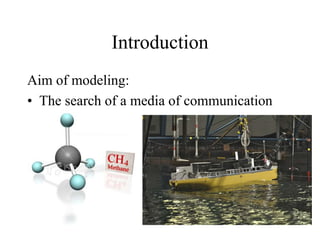
Introduction
Aim of modeling:
• The search of a media of communication
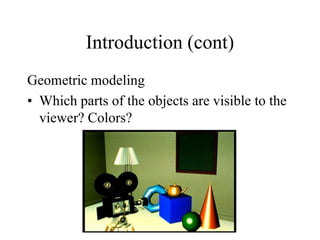
Introduction (cont)
Geometric modeling
• Which parts of the objects are visible to the
viewer? Colors?
Introduction
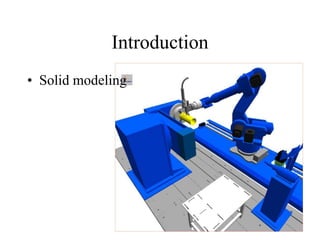
• Solid modeling
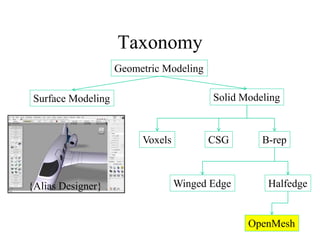
Geometric Modeling
Surface Modeling Solid Modeling
CSG
Voxels B-rep
Winged Edge Halfedge
OpenMesh
{Alias Designer}
Taxonomy
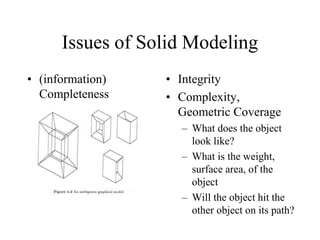
Issues of Solid Modeling
• (information)
Completeness
• Integrity
• Complexity,
Geometric Coverage
– What does the object
look like?
– What is the weight,
surface area, of the
object
– Will the object hit the
other object on its path?
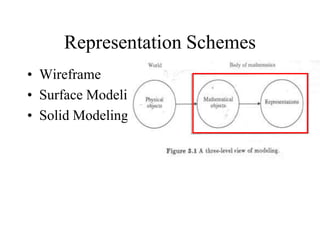
Representation Schemes
• Wireframe
• Surface Modeling
• Solid Modeling
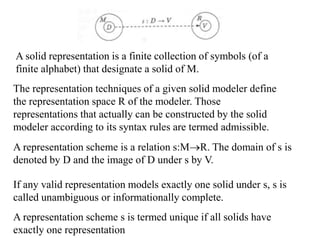
A representation scheme is a relation s:MR. The domain of s is
denoted by D and the image of D under s by V.
If any valid representation models exactly one solid under s, s is
called unambiguous or informationally complete.
A representation scheme s is termed unique if all solids have
exactly one representation
A solid representation is a finite collection of symbols (of a
finite alphabet) that designate a solid of M.
The representation techniques of a given solid modeler define
the representation space R of the modeler. Those
representations that actually can be constructed by the solid
modeler according to its syntax rules are termed admissible.
Solid Modeling
• CSG
– Constructive solid geometry
• Volumetric model
• B-rep
– Boundary representation
Information Completeness
• Able to resolve point inclusion test
unambiguously
• Given a point and a solid; return In/Out/On
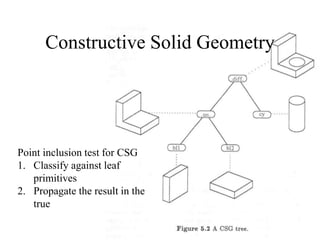
Constructive Solid Geometry
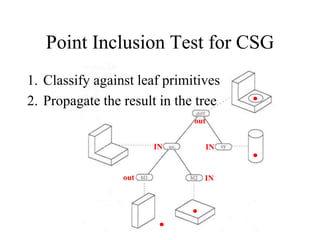
Point inclusion test for CSG
1. Classify against leaf
primitives
2. Propagate the result in the
true
Point Inclusion Test for CSG
1. Classify against leaf primitives
2. Propagate the result in the tree
IN
out
IN
IN
out
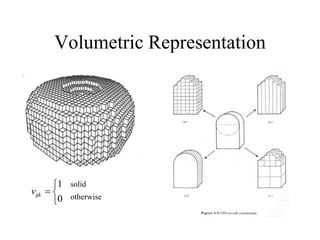
Volumetric Representation




0
1
ijk
v
solid
otherwise
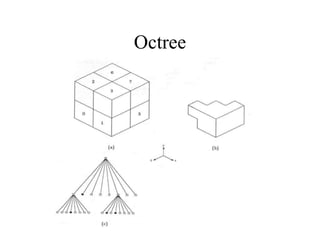
Octree
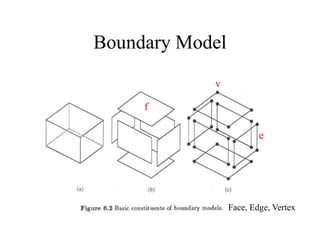
Boundary Model
Face, Edge, Vertex
v
e
f
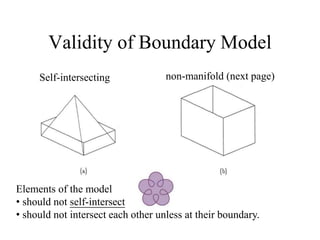
Validity of Boundary Model
Elements of the model
• should not self-intersect
• should not intersect each other unless at their boundary.
Self-intersecting non-manifold (next page)
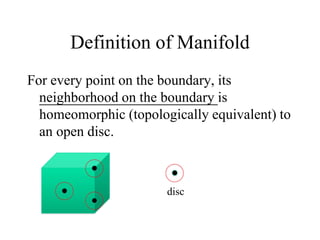
Definition of Manifold
For every point on the boundary, its
neighborhood on the boundary is
homeomorphic (topologically equivalent) to
an open disc.
disc
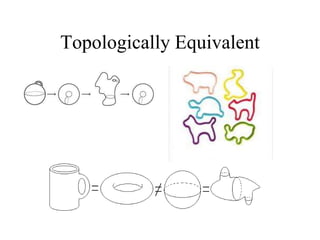
Topologically Equivalent
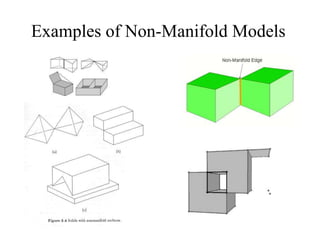
Examples of Non-Manifold Models
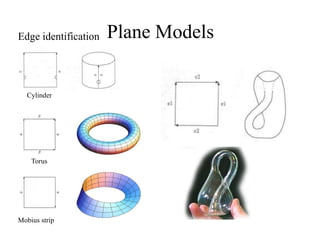
Plane Models
Mobius strip
Torus
Cylinder
Edge identification
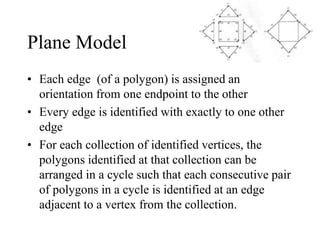
Plane Model
• Each edge (of a polygon) is assigned an
orientation from one endpoint to the other
• Every edge is identified with exactly to one other
edge
• For each collection of identified vertices, the
polygons identified at that collection can be
arranged in a cycle such that each consecutive pair
of polygons in a cycle is identified at an edge
adjacent to a vertex from the collection.
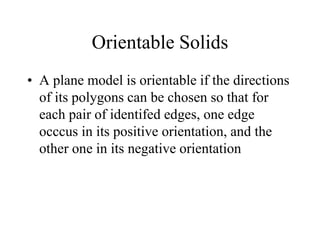
Orientable Solids
• A plane model is orientable if the directions
of its polygons can be chosen so that for
each pair of identifed edges, one edge
occcus in its positive orientation, and the
other one in its negative orientation
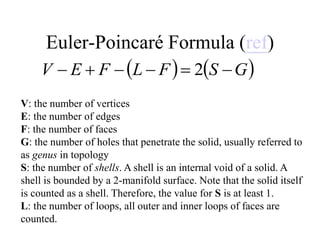
Euler-Poincaré Formula (ref)
V: the number of vertices
E: the number of edges
F: the number of faces
G: the number of holes that penetrate the solid, usually referred to
as genus in topology
S: the number of shells. A shell is an internal void of a solid. A
shell is bounded by a 2-manifold surface. Note that the solid itself
is counted as a shell. Therefore, the value for S is at least 1.
L: the number of loops, all outer and inner loops of faces are
counted.
   
G
S
F
L
F
E
V 




 2
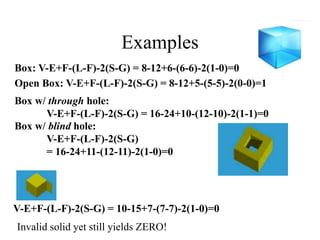
Examples
Box w/ through hole:
V-E+F-(L-F)-2(S-G) = 16-24+10-(12-10)-2(1-1)=0
V-E+F-(L-F)-2(S-G) = 10-15+7-(7-7)-2(1-0)=0
Invalid solid yet still yields ZERO!
Box: V-E+F-(L-F)-2(S-G) = 8-12+6-(6-6)-2(1-0)=0
Open Box: V-E+F-(L-F)-2(S-G) = 8-12+5-(5-5)-2(0-0)=1
Box w/ blind hole:
V-E+F-(L-F)-2(S-G)
= 16-24+11-(12-11)-2(1-0)=0
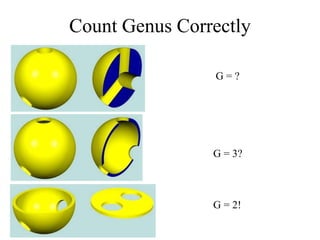
Count Genus Correctly
G = 3?
G = 2!
G = ?
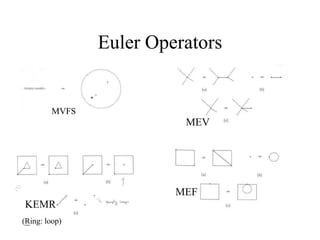
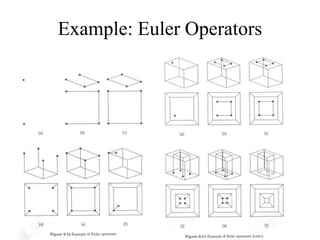
Euler Operators
MVFS
MEV
MEF
KEMR
(Ring: loop)
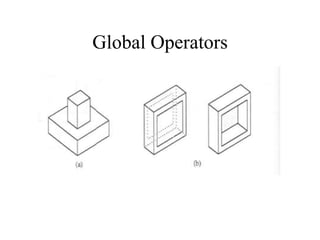
Global Operators
Example: Euler Operators
Winged-Edge Data Structure
• Commonly used to describe polygon models
• Quick traversal between faces, edges, vertices
• Linked structure of the network
• Assume there is no holes in each face
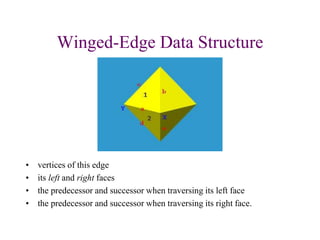
Winged-Edge Data Structure
• vertices of this edge
• its left and right faces
• the predecessor and successor when traversing its left face
• the predecessor and successor when traversing its right face.
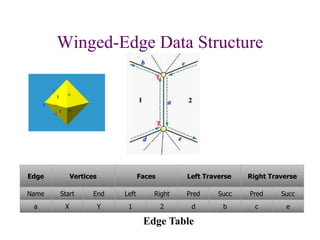
Winged-Edge Data Structure
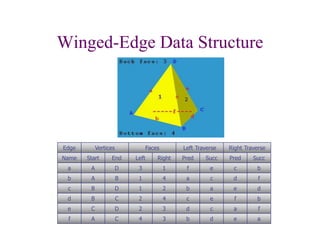
Edge Vertices Faces Left Traverse Right Traverse
Name Start End Left Right Pred Succ Pred Succ
a X Y 1 2 d b c e
Edge Table
Winged-Edge Data Structure
Edge Vertices Faces Left Traverse Right Traverse
Name Start End Left Right Pred Succ Pred Succ
a A D 3 1 f e c b
b A B 1 4 a c d f
c B D 1 2 b a e d
d B C 2 4 c e f b
e C D 2 3 d c a f
f A C 4 3 b d e a
Winged-Edge Data Structure
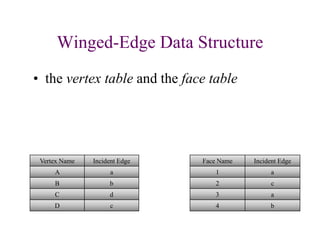
Vertex Name Incident Edge
A a
B b
C d
D c
• the vertex table and the face table
Face Name Incident Edge
1 a
2 c
3 a
4 b
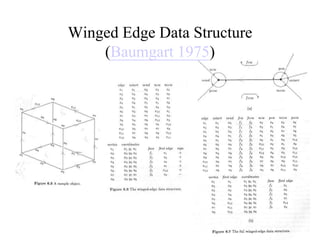
Winged Edge Data Structure
(Baumgart 1975)
Winged-Edge Data Structure
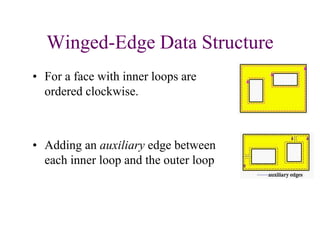
• For a face with inner loops are
ordered clockwise.
• Adding an auxiliary edge between
each inner loop and the outer loop
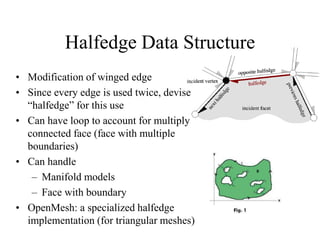
Halfedge Data Structure
• Modification of winged edge
• Since every edge is used twice, devise
“halfedge” for this use
• Can have loop to account for multiply
connected face (face with multiple
boundaries)
• Can handle
– Manifold models
– Face with boundary
• OpenMesh: a specialized halfedge
implementation (for triangular meshes)
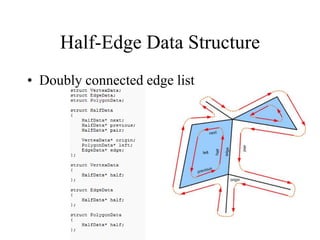
Half-Edge Data Structure
• Doubly connected edge list
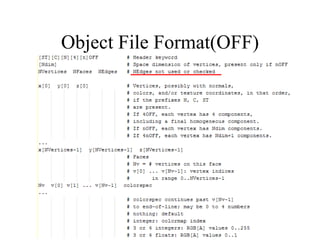
Object File Format(OFF)
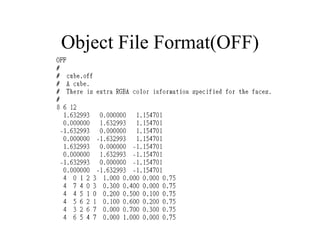
• Storing a description a 2D or 3D object
• Simple extension can handle 4D objects
– 4D: (x,y,z,w)
• OFF File Characteristics
– ASCII (there is also a binary version)
– Color optional
– 3D
– No compression
Object File Format(OFF)
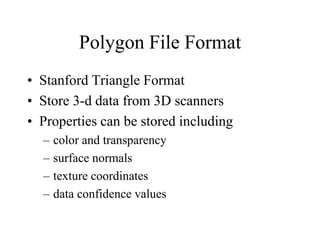
Polygon File Format
• Stanford Triangle Format
• Store 3-d data from 3D scanners
• Properties can be stored including
– color and transparency
– surface normals
– texture coordinates
– data confidence values
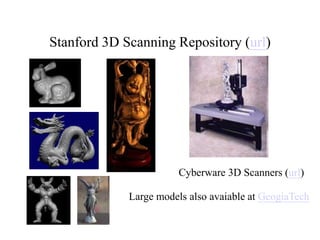
Stanford 3D Scanning Repository (url)
Cyberware 3D Scanners (url)
Large models also avaiable at GeogiaTech
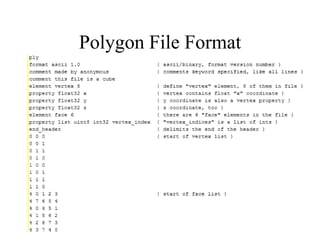
Polygon File Format
• PLY structure
– Header
– Vertex List
– Face List
– (lists of other elements)
Polygon File Format

Solid modeling

  • 1.
  • 2.
    Introduction Aim of modeling: •The search of a media of communication
  • 3.
    Introduction (cont) Geometric modeling •Which parts of the objects are visible to the viewer? Colors?
  • 4.
  • 5.
    Geometric Modeling Surface ModelingSolid Modeling CSG Voxels B-rep Winged Edge Halfedge OpenMesh {Alias Designer} Taxonomy
  • 6.
    Issues of SolidModeling • (information) Completeness • Integrity • Complexity, Geometric Coverage – What does the object look like? – What is the weight, surface area, of the object – Will the object hit the other object on its path?
  • 7.
    Representation Schemes • Wireframe •Surface Modeling • Solid Modeling
  • 8.
    A representation schemeis a relation s:MR. The domain of s is denoted by D and the image of D under s by V. If any valid representation models exactly one solid under s, s is called unambiguous or informationally complete. A representation scheme s is termed unique if all solids have exactly one representation A solid representation is a finite collection of symbols (of a finite alphabet) that designate a solid of M. The representation techniques of a given solid modeler define the representation space R of the modeler. Those representations that actually can be constructed by the solid modeler according to its syntax rules are termed admissible.
  • 9.
    Solid Modeling • CSG –Constructive solid geometry • Volumetric model • B-rep – Boundary representation
  • 10.
    Information Completeness • Ableto resolve point inclusion test unambiguously • Given a point and a solid; return In/Out/On
  • 11.
    Constructive Solid Geometry Pointinclusion test for CSG 1. Classify against leaf primitives 2. Propagate the result in the true
  • 12.
    Point Inclusion Testfor CSG 1. Classify against leaf primitives 2. Propagate the result in the tree IN out IN IN out
  • 13.
  • 14.
  • 15.
  • 16.
    Validity of BoundaryModel Elements of the model • should not self-intersect • should not intersect each other unless at their boundary. Self-intersecting non-manifold (next page)
  • 17.
    Definition of Manifold Forevery point on the boundary, its neighborhood on the boundary is homeomorphic (topologically equivalent) to an open disc. disc
  • 18.
  • 19.
  • 20.
  • 21.
    Plane Model • Eachedge (of a polygon) is assigned an orientation from one endpoint to the other • Every edge is identified with exactly to one other edge • For each collection of identified vertices, the polygons identified at that collection can be arranged in a cycle such that each consecutive pair of polygons in a cycle is identified at an edge adjacent to a vertex from the collection.
  • 22.
    Orientable Solids • Aplane model is orientable if the directions of its polygons can be chosen so that for each pair of identifed edges, one edge occcus in its positive orientation, and the other one in its negative orientation
  • 23.
    Euler-Poincaré Formula (ref) V:the number of vertices E: the number of edges F: the number of faces G: the number of holes that penetrate the solid, usually referred to as genus in topology S: the number of shells. A shell is an internal void of a solid. A shell is bounded by a 2-manifold surface. Note that the solid itself is counted as a shell. Therefore, the value for S is at least 1. L: the number of loops, all outer and inner loops of faces are counted.     G S F L F E V       2
  • 24.
    Examples Box w/ throughhole: V-E+F-(L-F)-2(S-G) = 16-24+10-(12-10)-2(1-1)=0 V-E+F-(L-F)-2(S-G) = 10-15+7-(7-7)-2(1-0)=0 Invalid solid yet still yields ZERO! Box: V-E+F-(L-F)-2(S-G) = 8-12+6-(6-6)-2(1-0)=0 Open Box: V-E+F-(L-F)-2(S-G) = 8-12+5-(5-5)-2(0-0)=1 Box w/ blind hole: V-E+F-(L-F)-2(S-G) = 16-24+11-(12-11)-2(1-0)=0
  • 25.
    Count Genus Correctly G= 3? G = 2! G = ?
  • 26.
  • 27.
  • 28.
  • 29.
    Winged-Edge Data Structure •Commonly used to describe polygon models • Quick traversal between faces, edges, vertices • Linked structure of the network • Assume there is no holes in each face
  • 30.
    Winged-Edge Data Structure •vertices of this edge • its left and right faces • the predecessor and successor when traversing its left face • the predecessor and successor when traversing its right face.
  • 31.
    Winged-Edge Data Structure EdgeVertices Faces Left Traverse Right Traverse Name Start End Left Right Pred Succ Pred Succ a X Y 1 2 d b c e Edge Table
  • 32.
    Winged-Edge Data Structure EdgeVertices Faces Left Traverse Right Traverse Name Start End Left Right Pred Succ Pred Succ a A D 3 1 f e c b b A B 1 4 a c d f c B D 1 2 b a e d d B C 2 4 c e f b e C D 2 3 d c a f f A C 4 3 b d e a
  • 33.
    Winged-Edge Data Structure VertexName Incident Edge A a B b C d D c • the vertex table and the face table Face Name Incident Edge 1 a 2 c 3 a 4 b
  • 34.
    Winged Edge DataStructure (Baumgart 1975)
  • 35.
    Winged-Edge Data Structure •For a face with inner loops are ordered clockwise. • Adding an auxiliary edge between each inner loop and the outer loop
  • 36.
    Halfedge Data Structure •Modification of winged edge • Since every edge is used twice, devise “halfedge” for this use • Can have loop to account for multiply connected face (face with multiple boundaries) • Can handle – Manifold models – Face with boundary • OpenMesh: a specialized halfedge implementation (for triangular meshes)
  • 37.
    Half-Edge Data Structure •Doubly connected edge list
  • 38.
    Object File Format(OFF) •Storing a description a 2D or 3D object • Simple extension can handle 4D objects – 4D: (x,y,z,w) • OFF File Characteristics – ASCII (there is also a binary version) – Color optional – 3D – No compression
  • 39.
  • 40.
  • 41.
    Polygon File Format •Stanford Triangle Format • Store 3-d data from 3D scanners • Properties can be stored including – color and transparency – surface normals – texture coordinates – data confidence values
  • 42.
    Stanford 3D ScanningRepository (url) Cyberware 3D Scanners (url) Large models also avaiable at GeogiaTech
  • 43.
    Polygon File Format •PLY structure – Header – Vertex List – Face List – (lists of other elements)
  • 44.