SECTIONS OF SOLIDS
Part I
Prof.T.JEYAPOOVAN
Department of Mechanical Engineering
Hindustan Institute of Technology and Science
Chennai-603103, India
www.jeyapoovan.com
SECTION OF A SOLID
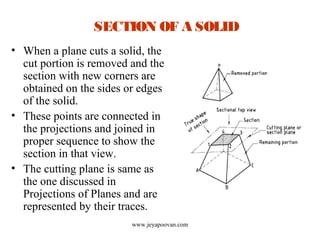
• When a plane cuts a solid, the
cut portion is removed and the
section with new corners are
obtained on the sides or edges
of the solid.
• These points are connected in
the projections and joined in
proper sequence to show the
section in that view.
• The cutting plane is same as
the one discussed in
Projections of Planes and are
represented by their traces.
www.jeyapoovan.com
To draw Sections
• Draw the projections of the solid, then draw the trace of
the cutting plane. Carefully mark the new corners on the
edges cut by the cutting plane, then project them to the
other view.
• Cutting plane will be in one of the following positions
– inclined to HP and perpendicular to VP
– inclined to VP and perpendicular to HP
– perpendicular to both HP and VP
– perpendicular to HP and parallel to VP
– perpendicular to VP and parallel to HP
www.jeyapoovan.com
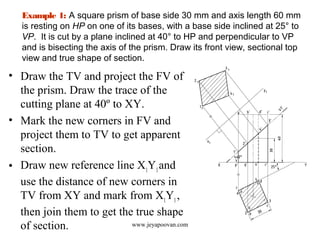
Example 1: A square prism of base side 30 mm and axis length 60 mm
is resting on HP on one of its bases, with a base side inclined at 25° to
VP. It is cut by a plane inclined at 40° to HP and perpendicular to VP
and is bisecting the axis of the prism. Draw its front view, sectional top
view and true shape of section.
• Draw the TV and project the FV of
the prism. Draw the trace of the
cutting plane at 40º to XY.
• Mark the new corners in FV and
project them to TV to get apparent
section.
• Draw new reference line X1
Y1
and
use the distance of new corners in
TV from XY and mark from X1
Y1
,
then join them to get the true shape
of section. www.jeyapoovan.com
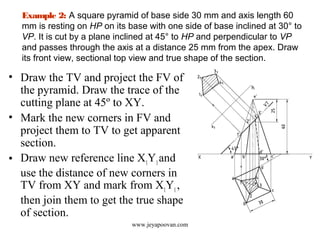
Example 2: A square pyramid of base side 30 mm and axis length 60
mm is resting on HP on its base with one side of base inclined at 30° to
VP. It is cut by a plane inclined at 45° to HP and perpendicular to VP
and passes through the axis at a distance 25 mm from the apex. Draw
its front view, sectional top view and true shape of the section.
• Draw the TV and project the FV of
the pyramid. Draw the trace of the
cutting plane at 45º to XY.
• Mark the new corners in FV and
project them to TV to get apparent
section.
• Draw new reference line X1
Y1
and
use the distance of new corners in
TV from XY and mark from X1
Y1
,
then join them to get the true shape
of section.
www.jeyapoovan.com
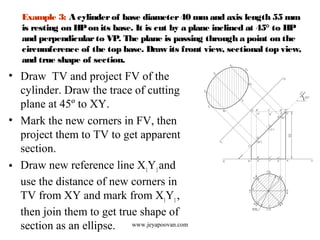
Example 3: A cylinderof base diameter40 mmand axis length 55 mm
is resting on HPon its base. It is cut by a plane inclined at 45° to HP
and perpendicularto VP. The plane is passing through a point on the
circumference of the top base. Draw its front view, sectional top view,
and true shape of section.
• Draw TV and project FV of the
cylinder. Draw the trace of cutting
plane at 45º to XY.
• Mark the new corners in FV, then
project them to TV to get apparent
section.
• Draw new reference line X1
Y1
and
use the distance of new corners in
TV from XY and mark from X1
Y1
,
then join them to get true shape of
section as an ellipse. www.jeyapoovan.com
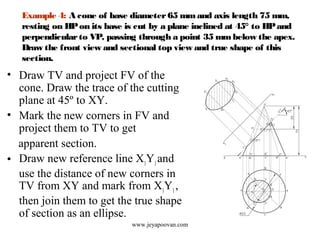
Example 4: A cone of base diameter65 mmand axis length 75 mm,
resting on HPon its base is cut by a plane inclined at 45° to HPand
perpendicularto VP, passing through a point 35 mmbelow the apex.
Draw the front view and sectional top view and true shape of this
section.
• Draw TV and project FV of the
cone. Draw the trace of the cutting
plane at 45º to XY.
• Mark the new corners in FV and
project them to TV to get
apparent section.
• Draw new reference line X1
Y1
and
use the distance of new corners in
TV from XY and mark from X1
Y1
,
then join them to get the true shape
of section as an ellipse.
www.jeyapoovan.com
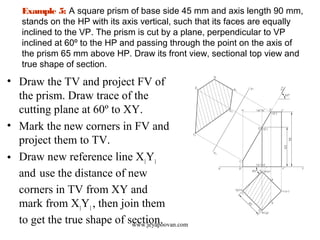
Example 5: A square prism of base side 45 mm and axis length 90 mm,
stands on the HP with its axis vertical, such that its faces are equally
inclined to the VP. The prism is cut by a plane, perpendicular to VP
inclined at 60º to the HP and passing through the point on the axis of
the prism 65 mm above HP. Draw its front view, sectional top view and
true shape of section.
• Draw the TV and project FV of
the prism. Draw trace of the
cutting plane at 60º to XY.
• Mark the new corners in FV and
project them to TV.
• Draw new reference line X1
Y1
and use the distance of new
corners in TV from XY and
mark from X1
Y1
, then join them
to get the true shape of section.www.jeyapoovan.com
Tips to draw Sections
• Draw the projections of the solid, then draw the trace of
the cutting plane. Carefully mark the new corners on the
edges cut by the cutting plane, then project them to the
other view.
• When a solid is resting on HP on its base and the cutting
plane passes through a base in front view, then two
points will be obtained on that base, the point in the
front and behind are coinciding and are marked clearly
in top view.
www.jeyapoovan.com
www.jeyapoovan.com
REFERENCE BOOKS
1. Jeyapoovan T, “Lesson Plans for Engineering
Graphics”, 2010, Vikas Publishing House Pvt
Ltd, New Delhi.
2. Jeyapoovan T, “Engineering Drawing and
Graphics”, 2011, Vikas Publishing House Pvt
Ltd, New Delhi.
End of Lesson 7
ThankYou
www.jeyapoovan.com

Lesson 7 Section of Solids - Part I

  • 1.
    SECTIONS OF SOLIDS PartI Prof.T.JEYAPOOVAN Department of Mechanical Engineering Hindustan Institute of Technology and Science Chennai-603103, India www.jeyapoovan.com
  • 2.
    SECTION OF ASOLID • When a plane cuts a solid, the cut portion is removed and the section with new corners are obtained on the sides or edges of the solid. • These points are connected in the projections and joined in proper sequence to show the section in that view. • The cutting plane is same as the one discussed in Projections of Planes and are represented by their traces. www.jeyapoovan.com
  • 3.
    To draw Sections •Draw the projections of the solid, then draw the trace of the cutting plane. Carefully mark the new corners on the edges cut by the cutting plane, then project them to the other view. • Cutting plane will be in one of the following positions – inclined to HP and perpendicular to VP – inclined to VP and perpendicular to HP – perpendicular to both HP and VP – perpendicular to HP and parallel to VP – perpendicular to VP and parallel to HP www.jeyapoovan.com
  • 4.
    Example 1: Asquare prism of base side 30 mm and axis length 60 mm is resting on HP on one of its bases, with a base side inclined at 25° to VP. It is cut by a plane inclined at 40° to HP and perpendicular to VP and is bisecting the axis of the prism. Draw its front view, sectional top view and true shape of section. • Draw the TV and project the FV of the prism. Draw the trace of the cutting plane at 40º to XY. • Mark the new corners in FV and project them to TV to get apparent section. • Draw new reference line X1 Y1 and use the distance of new corners in TV from XY and mark from X1 Y1 , then join them to get the true shape of section. www.jeyapoovan.com
  • 5.
    Example 2: Asquare pyramid of base side 30 mm and axis length 60 mm is resting on HP on its base with one side of base inclined at 30° to VP. It is cut by a plane inclined at 45° to HP and perpendicular to VP and passes through the axis at a distance 25 mm from the apex. Draw its front view, sectional top view and true shape of the section. • Draw the TV and project the FV of the pyramid. Draw the trace of the cutting plane at 45º to XY. • Mark the new corners in FV and project them to TV to get apparent section. • Draw new reference line X1 Y1 and use the distance of new corners in TV from XY and mark from X1 Y1 , then join them to get the true shape of section. www.jeyapoovan.com
  • 6.
    Example 3: Acylinderof base diameter40 mmand axis length 55 mm is resting on HPon its base. It is cut by a plane inclined at 45° to HP and perpendicularto VP. The plane is passing through a point on the circumference of the top base. Draw its front view, sectional top view, and true shape of section. • Draw TV and project FV of the cylinder. Draw the trace of cutting plane at 45º to XY. • Mark the new corners in FV, then project them to TV to get apparent section. • Draw new reference line X1 Y1 and use the distance of new corners in TV from XY and mark from X1 Y1 , then join them to get true shape of section as an ellipse. www.jeyapoovan.com
  • 7.
    Example 4: Acone of base diameter65 mmand axis length 75 mm, resting on HPon its base is cut by a plane inclined at 45° to HPand perpendicularto VP, passing through a point 35 mmbelow the apex. Draw the front view and sectional top view and true shape of this section. • Draw TV and project FV of the cone. Draw the trace of the cutting plane at 45º to XY. • Mark the new corners in FV and project them to TV to get apparent section. • Draw new reference line X1 Y1 and use the distance of new corners in TV from XY and mark from X1 Y1 , then join them to get the true shape of section as an ellipse. www.jeyapoovan.com
  • 8.
    Example 5: Asquare prism of base side 45 mm and axis length 90 mm, stands on the HP with its axis vertical, such that its faces are equally inclined to the VP. The prism is cut by a plane, perpendicular to VP inclined at 60º to the HP and passing through the point on the axis of the prism 65 mm above HP. Draw its front view, sectional top view and true shape of section. • Draw the TV and project FV of the prism. Draw trace of the cutting plane at 60º to XY. • Mark the new corners in FV and project them to TV. • Draw new reference line X1 Y1 and use the distance of new corners in TV from XY and mark from X1 Y1 , then join them to get the true shape of section.www.jeyapoovan.com
  • 9.
    Tips to drawSections • Draw the projections of the solid, then draw the trace of the cutting plane. Carefully mark the new corners on the edges cut by the cutting plane, then project them to the other view. • When a solid is resting on HP on its base and the cutting plane passes through a base in front view, then two points will be obtained on that base, the point in the front and behind are coinciding and are marked clearly in top view. www.jeyapoovan.com
  • 10.
    www.jeyapoovan.com REFERENCE BOOKS 1. JeyapoovanT, “Lesson Plans for Engineering Graphics”, 2010, Vikas Publishing House Pvt Ltd, New Delhi. 2. Jeyapoovan T, “Engineering Drawing and Graphics”, 2011, Vikas Publishing House Pvt Ltd, New Delhi.
  • 11.
    End of Lesson7 ThankYou www.jeyapoovan.com