INTRODUCTION
INTRODUCTION
 1969 -The ‘mechatronics’ word introduced by Tessturo
Mori he was a senior engineer of Japanese company
Yaskawa Electric Corporation.
 1971 – the company was granted the trademark rights
on the word.
 1970- 80- mostly the servo technology is used in
mechatronics
 1981-90-IT introduced. Microprocessors were
embedded in Mechanical system.
 1991 -2000 – Communication technology was added.
Remote operation and robotics were developed .
 1996 – 1st journal IEEE on mechatronics was released.
 After 2000, finds application in aerospace, defence, bio-
mechanics, automotive electronics, banking(ATM) etc.,
DEFINITION
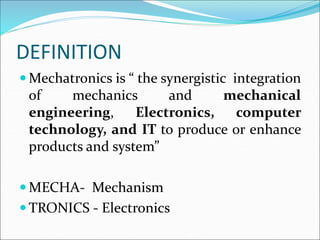
 Mechatronics is “ the synergistic integration
of mechanics and mechanical
engineering, Electronics, computer
technology, and IT to produce or enhance
products and system”
 MECHA- Mechanism
 TRONICS - Electronics
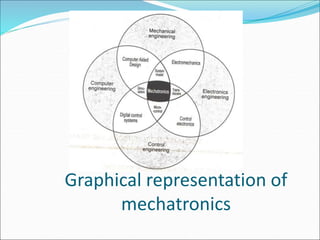
Graphical representation of
mechatronics
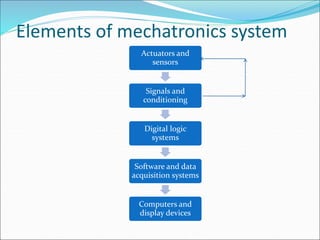
Elements of mechatronics system
Actuators and
sensors
Signals and
conditioning
Digital logic
systems
Software and data
acquisition systems
Computers and
display devices
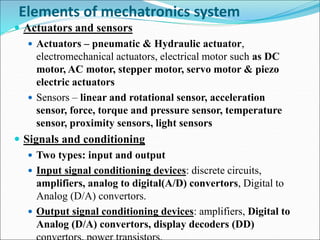
Elements of mechatronics system
 Actuators and sensors
 Actuators – pneumatic & Hydraulic actuator,
electromechanical actuators, electrical motor such as DC
motor, AC motor, stepper motor, servo motor & piezo
electric actuators
 Sensors – linear and rotational sensor, acceleration
sensor, force, torque and pressure sensor, temperature
sensor, proximity sensors, light sensors
 Signals and conditioning
 Two types: input and output
 Input signal conditioning devices: discrete circuits,
amplifiers, analog to digital(A/D) convertors, Digital to
Analog (D/A) convertors.
 Output signal conditioning devices: amplifiers, Digital to
Analog (D/A) convertors, display decoders (DD)
Elements of mechatronics system
 Digital logic systems
 Logic circuits, micro controllers, programmable logic
controllers(PLC), sequencing and timing controls, control
algorithm.
 Software and data acquisition systems
 Data logger, computer with plug in boards
 Computers and display devices
 LED, CRT, LCD, digital displays etc.,
Examples of mechatronics systems
 NC and CNC machine tools, flexible manufacturing
system, Prototyping & robots
 Photo copiers, laser printers & fax machines
 Automatic washing machines automatic ovens, modern
sewing machine
 Automatic teller machine (ATM)
 Coin counter
 Automatic/digital camera, digital watch
 CT scan system, automatic blood testing equipment
 Automatic sliding door
Advantages of Mechatronics systems
 Cost effective and good quality products
 High degree of flexibility to modify or redesign
 Very good performance characteristics
 Wide area of applications
 Greater productivity in case of manufacturing organization
 Possibility or remote controlling as well as centralized
monitoring and control
 Greater extend of machine utilization
Disadvantages of Mechatronics systems
 High initial cost
 Multi-disciplinary engineering background required to
design and implementation
 Need of highly trained workers
 Complexity in identification and correction of problem
in the system
TYPES OF CONTROL SYSTEM
Open loop control system
Closed loop or feedback control system
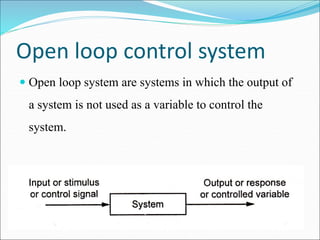
Open loop control system
 Open loop system are systems in which the output of
a system is not used as a variable to control the
system.
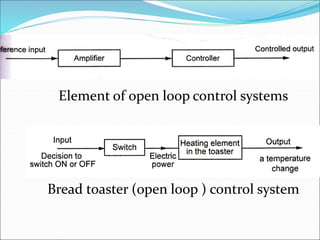
Element of open loop control systems
Bread toaster (open loop ) control system
ADVANTAGES
 Its simple and cost effective construction
 Easy maintenance, because no complex circuits.
 Good stability
 Good reliability
 Response quickly
 No Calibration is involved
 More convinent
DIS-ADVANTAGES
 It is Less accuruate
 Presence of non-linearity causes malfunctining
 Slow because of manual control
 Optimisation control is not possible
 System affected by internal and external disturbance
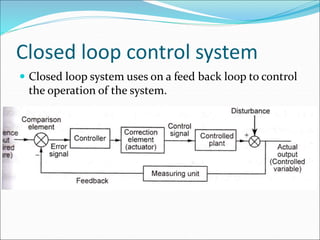
Closed loop control system
 Closed loop system uses on a feed back loop to control
the operation of the system.
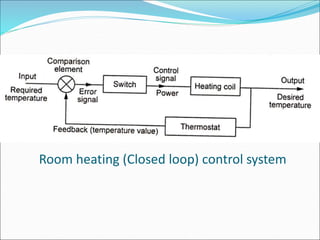
Room heating (Closed loop) control system
ADVANTAGES AND DIS ADVANTAGES
 Appropriate sensor,
greater stability.
 Better repetability.
 Task faster than open
loop.
 Good reliability.
 Closed loop complicated
in construction.
 Cost is higher.
 Sometimes closed loop
system is unstable.
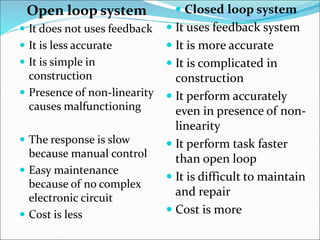
Open loop system
 It does not uses feedback
 It is less accurate
 It is simple in
construction
 Presence of non-linearity
causes malfunctioning
 The response is slow
because manual control
 Easy maintenance
because of no complex
electronic circuit
 Cost is less
 Closed loop system
 It uses feedback system
 It is more accurate
 It is complicated in
construction
 It perform accurately
even in presence of non-
linearity
 It perform task faster
than open loop
 It is difficult to maintain
and repair
 Cost is more
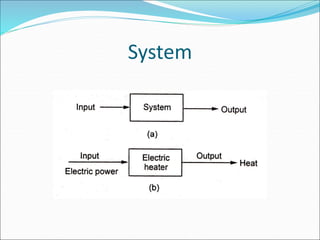
System
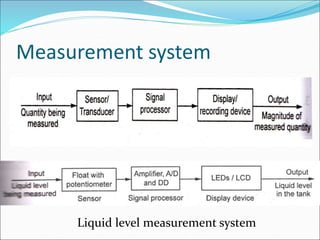
Measurement system
Liquid level measurement system
AUTOMATIC Control systems
 A control system refers to a group of
physical component connected or related in
such a manner as to command direct or
regulate itself or another system.
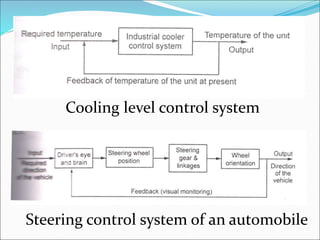
Cooling level control system
Steering control system of an automobile
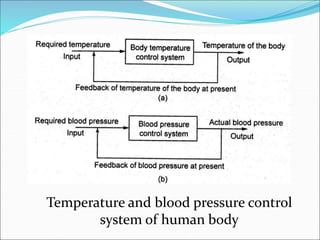
Temperature and blood pressure control
system of human body
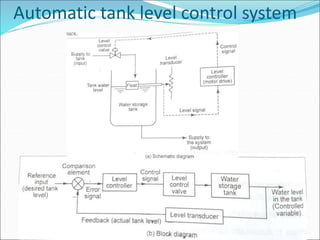
Automatic tank level control system
Sequential control system
 A sequential control involve sequential execution of well
defined operations.( particular order)
 Each operation or activity called step.
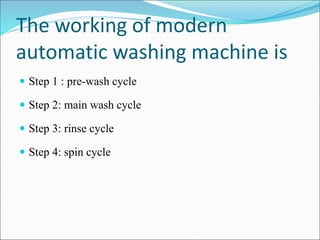
The working of modern
automatic washing machine is
 Step 1 : pre-wash cycle
 Step 2: main wash cycle
 Step 3: rinse cycle
 Step 4: spin cycle
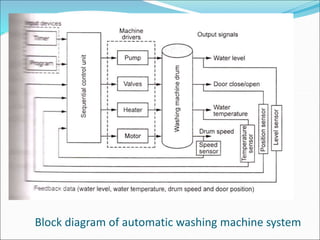
Block diagram of automatic washing machine system
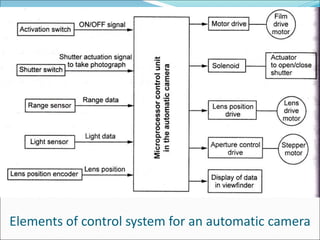
Elements of control system for an automatic camera
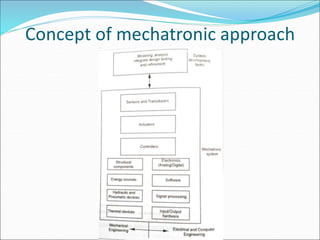
Concept of mechatronic approach
Emerging area of mechatronics
 Machine vision
 Automation and robotics
 Development of unmanned vehicles
 Design of subsystem for automotive engineering
 Sensing and control system
 Operation and maintenance of CNC machine
 Expert system and artificial intelligence
 Industrial electronics and consumer products
 Medical mechatronics and medical imaging systems
 Micro/nano mechatronics
 Computer integrated manufacturing (CIM) system
Need for mechatronics
 Dynamic market conditions
 Producing next generation products
 Integration of modern technologies in products
 Variety in product ranges
 Batch production runs
 Change in design perspective
 Product quality and consistency
 Ease of reconfiguration of the process
 Demand for increased flexibility
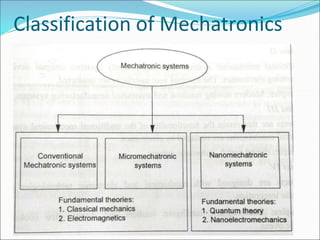
Classification of Mechatronics
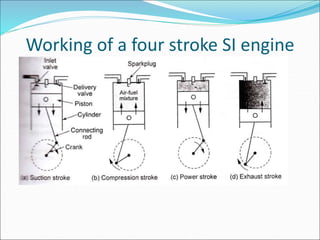
Working of a four stroke SI engine
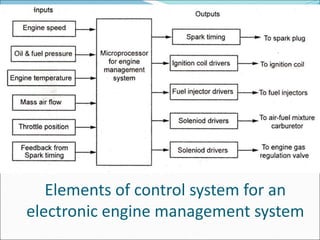
Elements of control system for an
electronic engine management system

MECHATRONICS-Introduction

  • 2.
  • 3.
    INTRODUCTION  1969 -The‘mechatronics’ word introduced by Tessturo Mori he was a senior engineer of Japanese company Yaskawa Electric Corporation.  1971 – the company was granted the trademark rights on the word.  1970- 80- mostly the servo technology is used in mechatronics  1981-90-IT introduced. Microprocessors were embedded in Mechanical system.
  • 4.
     1991 -2000– Communication technology was added. Remote operation and robotics were developed .  1996 – 1st journal IEEE on mechatronics was released.  After 2000, finds application in aerospace, defence, bio- mechanics, automotive electronics, banking(ATM) etc.,
  • 5.
    DEFINITION  Mechatronics is“ the synergistic integration of mechanics and mechanical engineering, Electronics, computer technology, and IT to produce or enhance products and system”  MECHA- Mechanism  TRONICS - Electronics
  • 6.
  • 7.
    Elements of mechatronicssystem Actuators and sensors Signals and conditioning Digital logic systems Software and data acquisition systems Computers and display devices
  • 8.
    Elements of mechatronicssystem  Actuators and sensors  Actuators – pneumatic & Hydraulic actuator, electromechanical actuators, electrical motor such as DC motor, AC motor, stepper motor, servo motor & piezo electric actuators  Sensors – linear and rotational sensor, acceleration sensor, force, torque and pressure sensor, temperature sensor, proximity sensors, light sensors  Signals and conditioning  Two types: input and output  Input signal conditioning devices: discrete circuits, amplifiers, analog to digital(A/D) convertors, Digital to Analog (D/A) convertors.  Output signal conditioning devices: amplifiers, Digital to Analog (D/A) convertors, display decoders (DD)
  • 9.
    Elements of mechatronicssystem  Digital logic systems  Logic circuits, micro controllers, programmable logic controllers(PLC), sequencing and timing controls, control algorithm.  Software and data acquisition systems  Data logger, computer with plug in boards  Computers and display devices  LED, CRT, LCD, digital displays etc.,
  • 10.
    Examples of mechatronicssystems  NC and CNC machine tools, flexible manufacturing system, Prototyping & robots  Photo copiers, laser printers & fax machines  Automatic washing machines automatic ovens, modern sewing machine  Automatic teller machine (ATM)  Coin counter  Automatic/digital camera, digital watch  CT scan system, automatic blood testing equipment  Automatic sliding door
  • 11.
    Advantages of Mechatronicssystems  Cost effective and good quality products  High degree of flexibility to modify or redesign  Very good performance characteristics  Wide area of applications  Greater productivity in case of manufacturing organization  Possibility or remote controlling as well as centralized monitoring and control  Greater extend of machine utilization
  • 12.
    Disadvantages of Mechatronicssystems  High initial cost  Multi-disciplinary engineering background required to design and implementation  Need of highly trained workers  Complexity in identification and correction of problem in the system
  • 13.
    TYPES OF CONTROLSYSTEM Open loop control system Closed loop or feedback control system
  • 14.
    Open loop controlsystem  Open loop system are systems in which the output of a system is not used as a variable to control the system.
  • 15.
    Element of openloop control systems Bread toaster (open loop ) control system
  • 16.
    ADVANTAGES  Its simpleand cost effective construction  Easy maintenance, because no complex circuits.  Good stability  Good reliability  Response quickly  No Calibration is involved  More convinent
  • 17.
    DIS-ADVANTAGES  It isLess accuruate  Presence of non-linearity causes malfunctining  Slow because of manual control  Optimisation control is not possible  System affected by internal and external disturbance
  • 18.
    Closed loop controlsystem  Closed loop system uses on a feed back loop to control the operation of the system.
  • 19.
    Room heating (Closedloop) control system
  • 20.
    ADVANTAGES AND DISADVANTAGES  Appropriate sensor, greater stability.  Better repetability.  Task faster than open loop.  Good reliability.  Closed loop complicated in construction.  Cost is higher.  Sometimes closed loop system is unstable.
  • 21.
    Open loop system It does not uses feedback  It is less accurate  It is simple in construction  Presence of non-linearity causes malfunctioning  The response is slow because manual control  Easy maintenance because of no complex electronic circuit  Cost is less  Closed loop system  It uses feedback system  It is more accurate  It is complicated in construction  It perform accurately even in presence of non- linearity  It perform task faster than open loop  It is difficult to maintain and repair  Cost is more
  • 22.
  • 23.
  • 24.
    AUTOMATIC Control systems A control system refers to a group of physical component connected or related in such a manner as to command direct or regulate itself or another system.
  • 25.
    Cooling level controlsystem Steering control system of an automobile
  • 26.
    Temperature and bloodpressure control system of human body
  • 27.
    Automatic tank levelcontrol system
  • 28.
    Sequential control system A sequential control involve sequential execution of well defined operations.( particular order)  Each operation or activity called step.
  • 29.
    The working ofmodern automatic washing machine is  Step 1 : pre-wash cycle  Step 2: main wash cycle  Step 3: rinse cycle  Step 4: spin cycle
  • 30.
    Block diagram ofautomatic washing machine system
  • 31.
    Elements of controlsystem for an automatic camera
  • 32.
  • 33.
    Emerging area ofmechatronics  Machine vision  Automation and robotics  Development of unmanned vehicles  Design of subsystem for automotive engineering  Sensing and control system  Operation and maintenance of CNC machine  Expert system and artificial intelligence  Industrial electronics and consumer products  Medical mechatronics and medical imaging systems  Micro/nano mechatronics  Computer integrated manufacturing (CIM) system
  • 34.
    Need for mechatronics Dynamic market conditions  Producing next generation products  Integration of modern technologies in products  Variety in product ranges  Batch production runs  Change in design perspective  Product quality and consistency  Ease of reconfiguration of the process  Demand for increased flexibility
  • 35.
  • 36.
    Working of afour stroke SI engine
  • 37.
    Elements of controlsystem for an electronic engine management system