Department of Pharmacology & Toxicology 
Medical University – Sofia 
Dr. Rumen Nikolov, PhD 
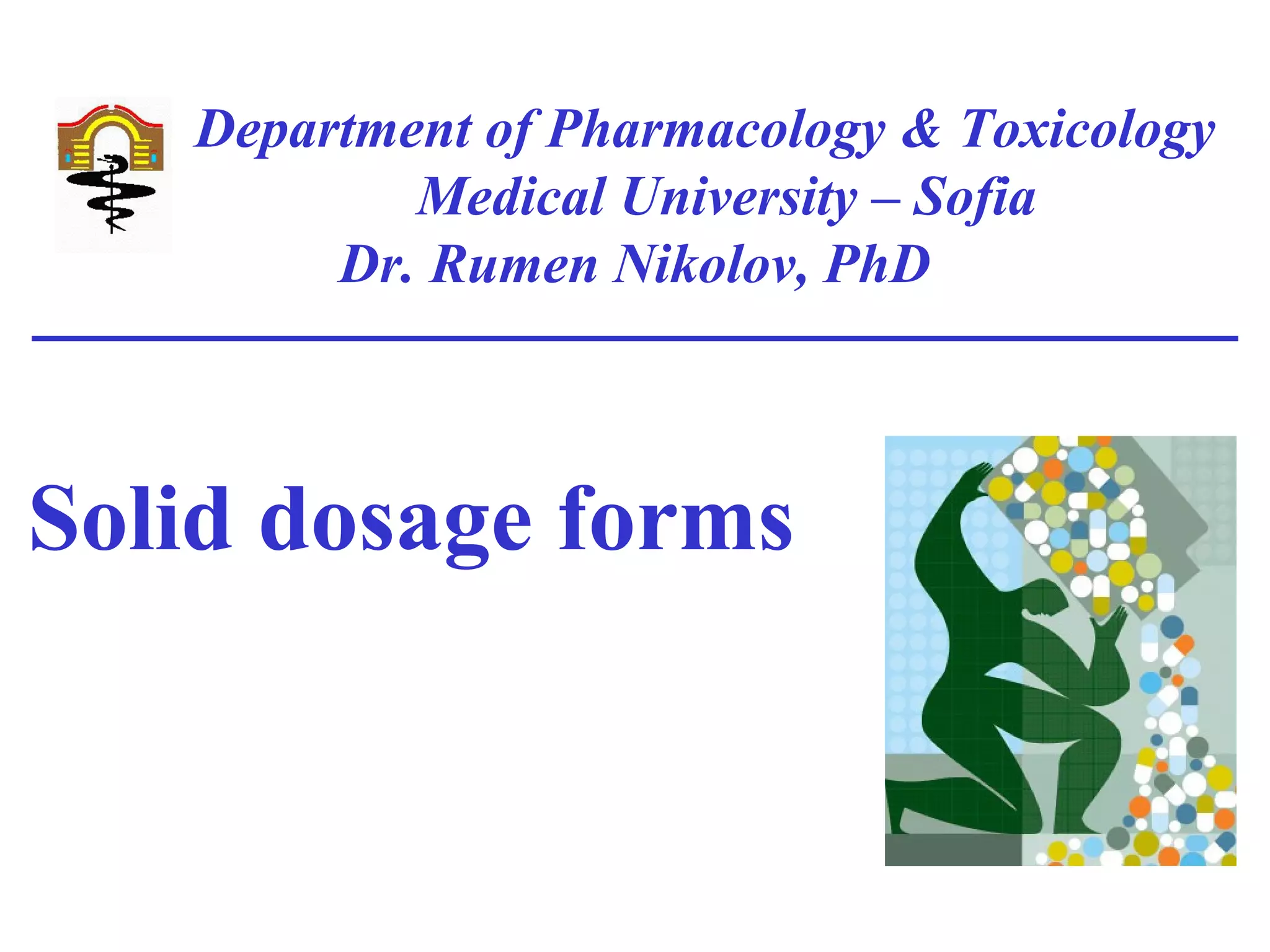
Solid dosage forms
Drugs are prepared in various forms 
for administration. 
The solid type of preparation is most 
common. 
The advantages of solid drug forms 
are convenience of administration; 
accuracy and reproducibility of a 
dosing; increased of a drug stability 
and easy of mass production.
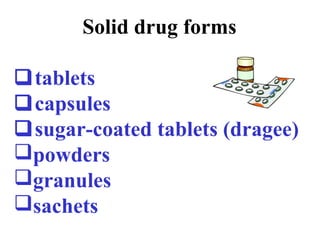
Solid drug forms 
tablets 
capsules 
sugar-coated tablets (dragee) 
powders 
granules 
sachets
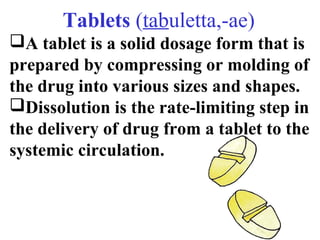
Тablets (tabuletta,-ae) 
A tablet is a solid dosage form that is 
prepared by compressing or molding of 
the drug into various sizes and shapes. 
Dissolution is the rate-limiting step in 
the delivery of drug from a tablet to the 
systemic circulation.
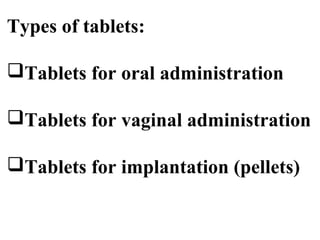
Types of tablets: 
Tablets for oral administration 
Tablets for vaginal administration 
Tablets for implantation (pellets)
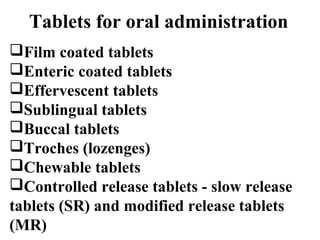
Tablets for oral administration 
Film coated tablets 
Enteric coated tablets 
Effervescent tablets 
Sublingual tablets 
Buccal tablets 
Troches (lozenges) 
Chewable tablets 
Controlled release tablets - slow release 
tablets (SR) and modified release tablets 
(MR)
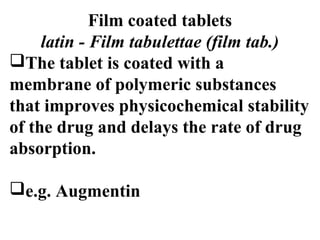
Film coated tablets 
latin - Film tabulettae (film tab.) 
The tablet is coated with a 
membrane of polymeric substances 
that improves physicochemical stability 
of the drug and delays the rate of drug 
absorption. 
e.g. Augmentin
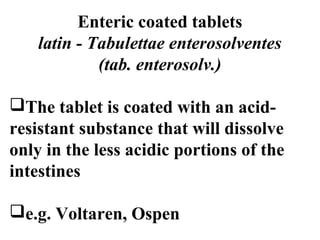
Enteric coated tablets 
latin - Tabulettae enterosolventes 
(tab. enterosolv.) 
The tablet is coated with an acid-resistant 
substance that will dissolve 
only in the less acidic portions of the 
intestines 
e.g. Voltaren, Ospen
Effervescent tablets 
latin – tabulettae effervescentes 
(tab. efferv.) 
The tablet contain sodium 
bicarbonate in addition to the drug 
substance. 
Before use they are dissolve in water. 
e.g. Acetylsalicylic acid
Sublingual tablets 
latin – linguetta (ling.) 
The tablet is placed under the tongue 
Sublingual tablets are absorbed 
quickly into the bloodstream 
e.g. Nitroglycerin, Uprima
Buccal tablets 
latin – tabulettae buccales (tab. bucc.) 
Buccal tablets are placed in the 
pouch between the cheek and gum 
They are usually small, flat and oval 
in shape 
e.g. Sandopart
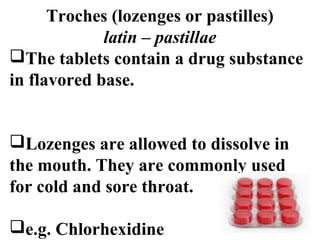
Troches (lozenges or pastilles) 
latin – pastillae 
The tablets contain a drug substance 
in flavored base. 
Lozenges are allowed to dissolve in 
the mouth. They are commonly used 
for cold and sore throat. 
e.g. Chlorhexidine
Chewable tablets 
The tablets are placed in the mouth, 
chewed and swallowed. 
e.g. Talcid, Aspirin Direct
Slow release tablets (SR) 
latin - depot-tabulettae (depot-tab.) 
The tablets are treated with special 
coatings so that various portions of the 
drug will dissolve at different rates. 
They are designed to produce drug 
effects over an extended time. 
SR tablets are administered less 
frequently (usually once daily). 
e.g. Isoptin SR, Ravel SR
Modified release tablets (MR) 
Modified release tablets are a more 
advanced version in which release of 
the active ingredient is related to time. 
e.g. Preductal MR
Implants (pellets) 
A small tablet that is prepared for 
insertion under the skin by giving 
a small surgical cut into the skin which 
is stitched after the insertion of tablets. 
The tablet must be sterile one. 
Contraceptive tablets are formulated 
as implant.
Tablets for vaginal administration 
latin – tabulettae vaginales (tab. vag.) 
The tablets are intended for insertion 
into the vagina. 
e.g. Metronidazole, Tinidazole, 
Dinprostone
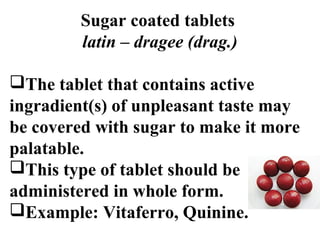
Sugar coated tablets 
latin – dragee (drag.) 
The tablet that contains active 
ingradient(s) of unpleasant taste may 
be covered with sugar to make it more 
palatable. 
This type of tablet should be 
administered in whole form. 
Example: Vitaferro, Quinine.
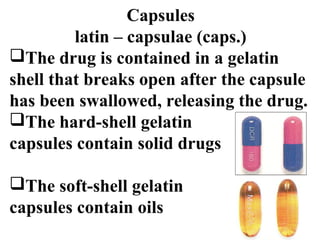
Capsules 
latin – capsulae (caps.) 
The drug is contained in a gelatin 
shell that breaks open after the capsule 
has been swallowed, releasing the drug. 
The hard-shell gelatin 
capsules contain solid drugs 
The soft-shell gelatin 
capsules contain oils
Slow-release capsules contain pellets 
that dissolve in the gastrointestinal 
tract, releasing the drug slowly. 
Gastro-resistant capsules contain 
pellets that dissolve in the intestine.
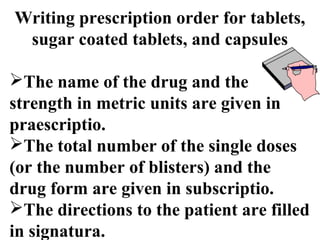
Writing prescription order for tablets, 
sugar coated tablets, and capsules 
The name of the drug and the 
strength in metric units are given in 
praescriptio. 
The total number of the single doses 
(or the number of blisters) and the 
drug form are given in subscriptio. 
The directions to the patient are filled 
in signatura.
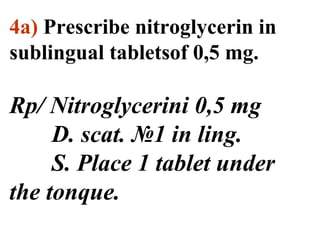
4а) Prescribe nitroglycerin in 
sublingual tabletsof 0,5 mg. 
Rp/ Nitroglycerini 0,5 mg 
D. scat. №1 in ling. 
S. Place 1 tablet under 
the tonque.
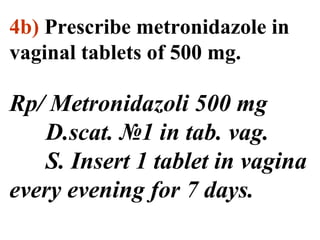
4b) Prescribe metronidazole in 
vaginal tablets of 500 mg. 
Rp/ Metronidazoli 500 mg 
D.scat. №1 in tab. vag. 
S. Insert 1 tablet in vagina 
every evening for 7 days.
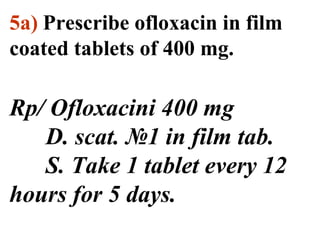
5a) Prescribe ofloxacin in film 
coated tablets of 400 mg. 
Rp/ Ofloxacini 400 mg 
D. scat. №1 in film tab. 
S. Take 1 tablet every 12 
hours for 5 days.
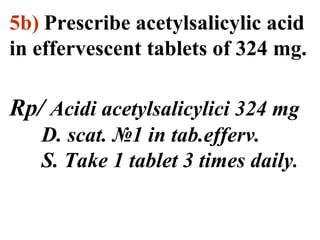
5b) Prescribe acetylsalicylic acid 
in effervescent tablets of 324 mg. 
Rp/ Acidi acetylsalicylici 324 mg 
D. scat. №1 in tab.efferv. 
S. Take 1 tablet 3 times daily.
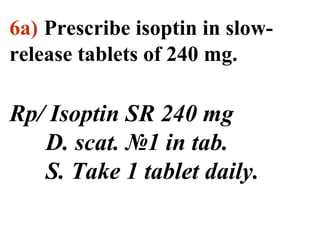
6а) Prescribe isoptin in slow-release 
tablets of 240 mg. 
Rp/ Isoptin SR 240 mg 
D. scat. №1 in tab. 
S. Take 1 tablet daily.
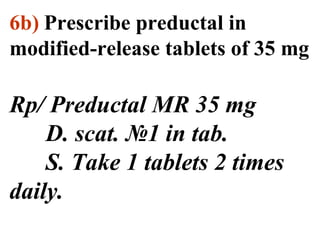
6b) Prescribe preductal in 
modified-release tablets of 35 mg 
Rp/ Preductal MR 35 mg 
D. scat. №1 in tab. 
S. Take 1 tablets 2 times 
daily.
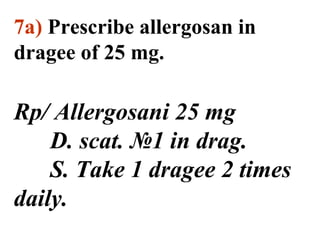
7а) Prescribe allergosan in 
dragee of 25 mg. 
Rp/ Allergosani 25 mg 
D. scat. №1 in drag. 
S. Take 1 dragee 2 times 
daily.
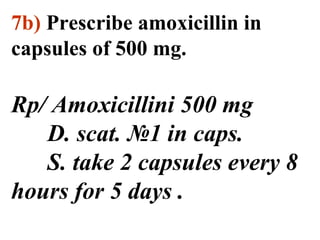
7b) Prescribe amoxicillin in 
capsules of 500 mg. 
Rp/ Amoxicillini 500 mg 
D. scat. №1 in caps. 
S. take 2 capsules every 8 
hours for 5 days .
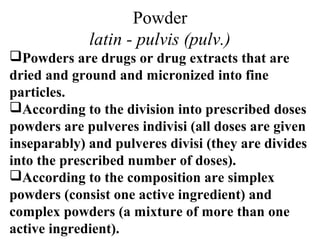
Powder 
latin - pulvis (pulv.) 
Powders are drugs or drug extracts that are 
dried and ground and micronized into fine 
particles. 
According to the division into prescribed doses 
powders are pulveres indivisi (all doses are given 
inseparably) and pulveres divisi (they are divides 
into the prescribed number of doses). 
According to the composition are simplex 
powders (consist one active ingredient) and 
complex powders (a mixture of more than one 
active ingredient).
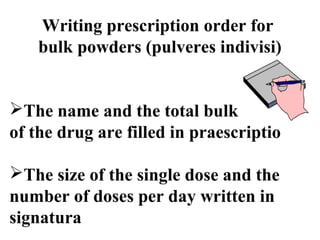
Writing prescription order for 
bulk powders (pulveres indivisi) 
The name and the total bulk 
of the drug are filled in praescriptio 
The size of the single dose and the 
number of doses per day written in 
signatura
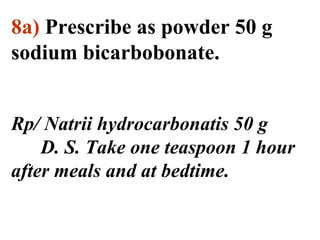
8а) Prescribe as powder 50 g 
sodium bicarbobonate. 
Rp/ Natrii hydrocarbonatis 50 g 
D. S. Take one teaspoon 1 hour 
after meals and at bedtime.
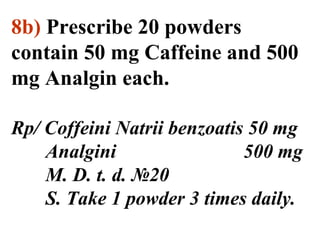
8b) Prescribe 20 powders 
contain 50 mg Caffeine and 500 
mg Analgin each. 
Rp/ Coffeini Natrii benzoatis 50 mg 
Analgini 500 mg 
M. D. t. d. №20 
S. Take 1 powder 3 times daily.
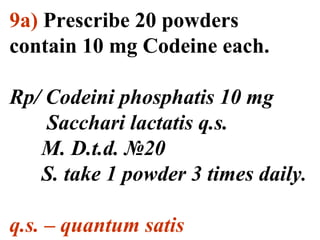
9а) Prescribe 20 powders 
contain 10 mg Codeine each. 
Rp/ Codeini phosphatis 10 mg 
Sacchari lactatis q.s. 
M. D.t.d. №20 
S. take 1 powder 3 times daily. 
q.s. – quantum satis
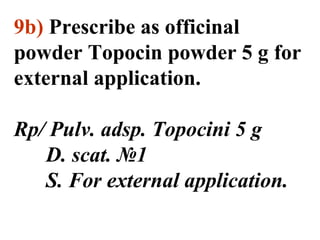
9b) Prescribe as officinal 
powder Topocin powder 5 g for 
external application. 
Rp/ Pulv. adsp. Topocini 5 g 
D. scat. №1 
S. For external application.

Solid forms ppt by saroj singh

  • 1.
    Department of Pharmacology& Toxicology Medical University – Sofia Dr. Rumen Nikolov, PhD Solid dosage forms
  • 2.
    Drugs are preparedin various forms for administration. The solid type of preparation is most common. The advantages of solid drug forms are convenience of administration; accuracy and reproducibility of a dosing; increased of a drug stability and easy of mass production.
  • 3.
    Solid drug forms tablets capsules sugar-coated tablets (dragee) powders granules sachets
  • 4.
    Тablets (tabuletta,-ae) Atablet is a solid dosage form that is prepared by compressing or molding of the drug into various sizes and shapes. Dissolution is the rate-limiting step in the delivery of drug from a tablet to the systemic circulation.
  • 5.
    Types of tablets: Tablets for oral administration Tablets for vaginal administration Tablets for implantation (pellets)
  • 6.
    Tablets for oraladministration Film coated tablets Enteric coated tablets Effervescent tablets Sublingual tablets Buccal tablets Troches (lozenges) Chewable tablets Controlled release tablets - slow release tablets (SR) and modified release tablets (MR)
  • 7.
    Film coated tablets latin - Film tabulettae (film tab.) The tablet is coated with a membrane of polymeric substances that improves physicochemical stability of the drug and delays the rate of drug absorption. e.g. Augmentin
  • 8.
    Enteric coated tablets latin - Tabulettae enterosolventes (tab. enterosolv.) The tablet is coated with an acid-resistant substance that will dissolve only in the less acidic portions of the intestines e.g. Voltaren, Ospen
  • 9.
    Effervescent tablets latin– tabulettae effervescentes (tab. efferv.) The tablet contain sodium bicarbonate in addition to the drug substance. Before use they are dissolve in water. e.g. Acetylsalicylic acid
  • 10.
    Sublingual tablets latin– linguetta (ling.) The tablet is placed under the tongue Sublingual tablets are absorbed quickly into the bloodstream e.g. Nitroglycerin, Uprima
  • 11.
    Buccal tablets latin– tabulettae buccales (tab. bucc.) Buccal tablets are placed in the pouch between the cheek and gum They are usually small, flat and oval in shape e.g. Sandopart
  • 12.
    Troches (lozenges orpastilles) latin – pastillae The tablets contain a drug substance in flavored base. Lozenges are allowed to dissolve in the mouth. They are commonly used for cold and sore throat. e.g. Chlorhexidine
  • 13.
    Chewable tablets Thetablets are placed in the mouth, chewed and swallowed. e.g. Talcid, Aspirin Direct
  • 14.
    Slow release tablets(SR) latin - depot-tabulettae (depot-tab.) The tablets are treated with special coatings so that various portions of the drug will dissolve at different rates. They are designed to produce drug effects over an extended time. SR tablets are administered less frequently (usually once daily). e.g. Isoptin SR, Ravel SR
  • 15.
    Modified release tablets(MR) Modified release tablets are a more advanced version in which release of the active ingredient is related to time. e.g. Preductal MR
  • 16.
    Implants (pellets) Asmall tablet that is prepared for insertion under the skin by giving a small surgical cut into the skin which is stitched after the insertion of tablets. The tablet must be sterile one. Contraceptive tablets are formulated as implant.
  • 17.
    Tablets for vaginaladministration latin – tabulettae vaginales (tab. vag.) The tablets are intended for insertion into the vagina. e.g. Metronidazole, Tinidazole, Dinprostone
  • 18.
    Sugar coated tablets latin – dragee (drag.) The tablet that contains active ingradient(s) of unpleasant taste may be covered with sugar to make it more palatable. This type of tablet should be administered in whole form. Example: Vitaferro, Quinine.
  • 19.
    Capsules latin –capsulae (caps.) The drug is contained in a gelatin shell that breaks open after the capsule has been swallowed, releasing the drug. The hard-shell gelatin capsules contain solid drugs The soft-shell gelatin capsules contain oils
  • 20.
    Slow-release capsules containpellets that dissolve in the gastrointestinal tract, releasing the drug slowly. Gastro-resistant capsules contain pellets that dissolve in the intestine.
  • 21.
    Writing prescription orderfor tablets, sugar coated tablets, and capsules The name of the drug and the strength in metric units are given in praescriptio. The total number of the single doses (or the number of blisters) and the drug form are given in subscriptio. The directions to the patient are filled in signatura.
  • 22.
    4а) Prescribe nitroglycerinin sublingual tabletsof 0,5 mg. Rp/ Nitroglycerini 0,5 mg D. scat. №1 in ling. S. Place 1 tablet under the tonque.
  • 23.
    4b) Prescribe metronidazolein vaginal tablets of 500 mg. Rp/ Metronidazoli 500 mg D.scat. №1 in tab. vag. S. Insert 1 tablet in vagina every evening for 7 days.
  • 24.
    5a) Prescribe ofloxacinin film coated tablets of 400 mg. Rp/ Ofloxacini 400 mg D. scat. №1 in film tab. S. Take 1 tablet every 12 hours for 5 days.
  • 25.
    5b) Prescribe acetylsalicylicacid in effervescent tablets of 324 mg. Rp/ Acidi acetylsalicylici 324 mg D. scat. №1 in tab.efferv. S. Take 1 tablet 3 times daily.
  • 26.
    6а) Prescribe isoptinin slow-release tablets of 240 mg. Rp/ Isoptin SR 240 mg D. scat. №1 in tab. S. Take 1 tablet daily.
  • 27.
    6b) Prescribe preductalin modified-release tablets of 35 mg Rp/ Preductal MR 35 mg D. scat. №1 in tab. S. Take 1 tablets 2 times daily.
  • 28.
    7а) Prescribe allergosanin dragee of 25 mg. Rp/ Allergosani 25 mg D. scat. №1 in drag. S. Take 1 dragee 2 times daily.
  • 29.
    7b) Prescribe amoxicillinin capsules of 500 mg. Rp/ Amoxicillini 500 mg D. scat. №1 in caps. S. take 2 capsules every 8 hours for 5 days .
  • 30.
    Powder latin -pulvis (pulv.) Powders are drugs or drug extracts that are dried and ground and micronized into fine particles. According to the division into prescribed doses powders are pulveres indivisi (all doses are given inseparably) and pulveres divisi (they are divides into the prescribed number of doses). According to the composition are simplex powders (consist one active ingredient) and complex powders (a mixture of more than one active ingredient).
  • 31.
    Writing prescription orderfor bulk powders (pulveres indivisi) The name and the total bulk of the drug are filled in praescriptio The size of the single dose and the number of doses per day written in signatura
  • 32.
    8а) Prescribe aspowder 50 g sodium bicarbobonate. Rp/ Natrii hydrocarbonatis 50 g D. S. Take one teaspoon 1 hour after meals and at bedtime.
  • 33.
    8b) Prescribe 20powders contain 50 mg Caffeine and 500 mg Analgin each. Rp/ Coffeini Natrii benzoatis 50 mg Analgini 500 mg M. D. t. d. №20 S. Take 1 powder 3 times daily.
  • 34.
    9а) Prescribe 20powders contain 10 mg Codeine each. Rp/ Codeini phosphatis 10 mg Sacchari lactatis q.s. M. D.t.d. №20 S. take 1 powder 3 times daily. q.s. – quantum satis
  • 35.
    9b) Prescribe asofficinal powder Topocin powder 5 g for external application. Rp/ Pulv. adsp. Topocini 5 g D. scat. №1 S. For external application.