ASSIGNMENT 
TOPIC:- 
Submitted by, 
Sreedevi. A. S 
English Optional 
Reg.No: 13983011 
KUCTE NDD
Introduction 
In American Universities, the term Seminar refers to a course of intense study relating to 
the student’s major. Seminars typically have significantly fewer students per professor than normal 
courses, and are generally more specific in topic of study. Seminars can revolve around term 
papers, exams, presentations and several other assignments. Seminars are almost always required 
for University graduation. 
In some European Universities, a seminar may be a large lecture course, especially when 
conducted by a renowned thinker (regardless of the size of the audience or the scope of student 
participation in discussion). Some non-English speaking countries in Europe use the word seminar 
(example: German Seminar, Slovenian Seminar, Polish Seminarium etc) to refer to a University 
class that includes a term paper, or project as opposed to a lecture class. 
Content 
The word Seminar is derived from the Latin word Seminarium, meaning “speed plot”. 
Seminar has got an increased importance among the learning experiences provided in schools, 
consequent on the introduction of grading system. Apart from the usual type of seminar it can take 
up wider dimensions. It is a highly practical and useful educative programme to a large group. In 
this technique a person presents a readymade paper or lecture on a specific subject before a group. 
Now day’s audio visual aids also are used while presenting the matter Over head Projector and 
Liquid Crystal Display (LCD) Projector are extensively used for this. The paper presenter can 
either be an expert from outside or one of the members of the group. Sometimes, copies of the 
paper or abstracts of the presented matter are distributed to the audience in advance. After the 
presentation, there is a general discussion in which all participants can get involved. At this stage,
they get an opportunity to clear their doubts and to highlight their specific view points. The 
various actions are taken up according to an appropriate time schedule. 
Dressel defines the term seminar as, “the structured group discussion that may proceed or 
follow a formal lecture, often in the form of an essay or paper presentation.” 
Seminars dealing with special topics have actually been around for decades and are an 
older form of information exchanges that have seen quite a resurgence of interest in the past ten 
years. Seminars are simply a group of people coming together for the discussion and learning of 
specific techniques and topics. Usually there are several keynote speakers within each seminar and 
these speakers are usually experts in there own fields or topics. Several topic reviews are 
scheduled each day throughout the seminar and attendees can usually make their choice of topics 
from among these scheduled events. Many individuals attend seminars each year, some attending 
several times a year. The topics of seminars can be as varied as the groups attending them, but in 
particular, there has been a rise of internet facilities over the past five years, due to the interest in 
this field. 
The primary aim of the proposed seminar series to encourage dialogue between different 
disciplinary approaches in order to promote further enquiry into the uses of nostalgia in 
contemporary culture, and especially its links to technology. We will draw on perspectives from 
disciplines including marketing, consumer research, literary studies, history and media and cultural 
studies and thus establish an international network of academics in order to encourage future 
research collaboration. We also aim to stimulate interchange with those working in heritage 
industries, publishing and commercial marketing, particularly within Glasgow, where urban 
regeneration is producing both technological achievement and new forms of nostalgic identity. 
The overall aim of the seminar series is to help, develop an emerging field at the inter 
section of multi-disciplinary understandings of culture and education. It will build on the existing 
body of work on education and culture, but its aim is explore and develop new perspectives in this 
area. A properly organized seminar offers attendees a wealth of information in one place in a 
condensed period of time. Seminars often feature several speakers, each one providing information 
from a different angle or perspective. People who attend seminars learn new ideas and skills to 
help them improve their knowledge.
Objectives of Seminar Technique 
♦ To help the students get an in-depth understanding of the subject matter. 
♦ To develop the habit of tolerance and co-operation among the students. 
♦ To help the students to overcome the problem of stage fear. 
♦ To help in developing the ability for keen attention and to present ideas 
effectively. 
♦ To help in acquiring good manners of raising and answering questions. 
♦To explore new research from a range of academic disciplines which sheds light on the questions. 
♦To showcase cutting edge research on education and culture from outstanding academic 
researchers from the UK and internationally. 
♦To bring together seminar participants from different disciplines such as sociology, philosophy, 
psychology, human geography, media studies as well as education and cultural studies. 
♦To raise awareness of the significance of nostalgia within contemporary culture by presenting 
current work and research in this area. 
♦To deepen understanding of the impact of technology on nostalgic experiences. 
♦To encourage interdisciplinary dialogue compare theoretical underpinnings and open the area to 
multiple methods of research enquiry. 
♦To promote exploration of nostalgia by graduate research students and stimulate new projects in 
the field. 
♦To strengthen the link between theory and practice in this area, disseminating contributions to the 
widest possible audience. 
♦To bring together a national and international group of academics to create a cross-cultural 
network for future collaboration. 
♦To identify specific research projects special editions of journals and conference opportunities. 
♦ To encourage and financially support the participation of PhD students. 
♦To actively involved practitioners and users from each venue. 
♦ To encourage a core group of policy makers. 
♦To use the seminars to develop links between academics and stake-holders in the arts, library, 
media, community and educational sectors.
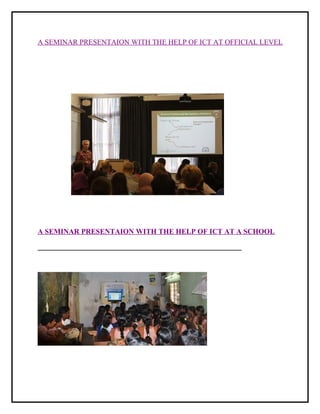
A SEMINAR PRESENTAION WITH THE HELP OF ICT AT OFFICIAL LEVEL 
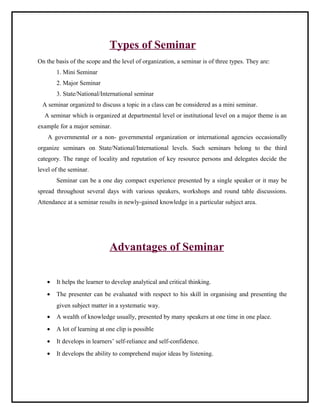
A SEMINAR PRESENTAION WITH THE HELP OF ICT AT A SCHOOL
Types of Seminar 
On the basis of the scope and the level of organization, a seminar is of three types. They are: 
1. Mini Seminar 
2. Major Seminar 
3. State/National/International seminar 
A seminar organized to discuss a topic in a class can be considered as a mini seminar. 
A seminar which is organized at departmental level or institutional level on a major theme is an 
example for a major seminar. 
A governmental or a non- governmental organization or international agencies occasionally 
organize seminars on State/National/International levels. Such seminars belong to the third 
category. The range of locality and reputation of key resource persons and delegates decide the 
level of the seminar. 
Seminar can be a one day compact experience presented by a single speaker or it may be 
spread throughout several days with various speakers, workshops and round table discussions. 
Attendance at a seminar results in newly-gained knowledge in a particular subject area. 
Advantages of Seminar 
· It helps the learner to develop analytical and critical thinking. 
· The presenter can be evaluated with respect to his skill in organising and presenting the 
given subject matter in a systematic way. 
· A wealth of knowledge usually, presented by many speakers at one time in one place. 
· A lot of learning at one clip is possible 
· It develops in learners’ self-reliance and self-confidence. 
· It develops the ability to comprehend major ideas by listening.
· A sense of camaraderie, where individuals can meet others with the same 
interest/problems, concerns that they may have in their chosen subject. 
· It develops the ability to raise relevant and pin-pointed questions. 
· Great ways for those that don’t like to read, or attend classes, to improve their knowledge 
of a specific subject. 
Disadvantages of seminar 
· Lack of preparation on the part of the paper presenter may make the seminar a mere waste. 
· The formal structure of seminar restricts the participants from asking questions as and 
when needed. 
· The success of the seminar fully depends on the ability of the person who is presenting the 
topic. His inability will create problems. 
Conclusion 
A seminar is, generally a form of academic instruction, either at an academic institution or 
offered by a commercial or professional organization. It has the function of bringing together small 
groups for recurring meetings, focusing each time on some particular subjects, in which everyone 
present is requested to actively participate. This is often accomplished through an ongoing Socratic 
dialogue with a seminar leader or instructor or through a more formal presentation of research. 
Normally, participants must not be beginners in the field under discussion ( at US and Canadian 
Universities , seminar classes are generally reserved for upper class students, although at UK and 
Australian universities seminars are often used for all years). 
The idea behind the seminar system is to familiarize students more extensively with the 
methodology of their chosen subjects and also to allow them to interact with examples of the
practical problems that always occur during research work. It is relatively informal, at least 
compared to the lecture system of academic instructions. 
Reference 
1. Miller,Robert J, The Complete Gospels, 2010, Polebridge Press Salem, Orgon. 
2. Sivarajan. K. 2012. Methodology of Teaching and Pedagogic Analysis: Calicut. Premier 
printers. 
3. Wikipedia

assignment

  • 1.
    ASSIGNMENT TOPIC:- Submittedby, Sreedevi. A. S English Optional Reg.No: 13983011 KUCTE NDD
  • 2.
    Introduction In AmericanUniversities, the term Seminar refers to a course of intense study relating to the student’s major. Seminars typically have significantly fewer students per professor than normal courses, and are generally more specific in topic of study. Seminars can revolve around term papers, exams, presentations and several other assignments. Seminars are almost always required for University graduation. In some European Universities, a seminar may be a large lecture course, especially when conducted by a renowned thinker (regardless of the size of the audience or the scope of student participation in discussion). Some non-English speaking countries in Europe use the word seminar (example: German Seminar, Slovenian Seminar, Polish Seminarium etc) to refer to a University class that includes a term paper, or project as opposed to a lecture class. Content The word Seminar is derived from the Latin word Seminarium, meaning “speed plot”. Seminar has got an increased importance among the learning experiences provided in schools, consequent on the introduction of grading system. Apart from the usual type of seminar it can take up wider dimensions. It is a highly practical and useful educative programme to a large group. In this technique a person presents a readymade paper or lecture on a specific subject before a group. Now day’s audio visual aids also are used while presenting the matter Over head Projector and Liquid Crystal Display (LCD) Projector are extensively used for this. The paper presenter can either be an expert from outside or one of the members of the group. Sometimes, copies of the paper or abstracts of the presented matter are distributed to the audience in advance. After the presentation, there is a general discussion in which all participants can get involved. At this stage,
  • 3.
    they get anopportunity to clear their doubts and to highlight their specific view points. The various actions are taken up according to an appropriate time schedule. Dressel defines the term seminar as, “the structured group discussion that may proceed or follow a formal lecture, often in the form of an essay or paper presentation.” Seminars dealing with special topics have actually been around for decades and are an older form of information exchanges that have seen quite a resurgence of interest in the past ten years. Seminars are simply a group of people coming together for the discussion and learning of specific techniques and topics. Usually there are several keynote speakers within each seminar and these speakers are usually experts in there own fields or topics. Several topic reviews are scheduled each day throughout the seminar and attendees can usually make their choice of topics from among these scheduled events. Many individuals attend seminars each year, some attending several times a year. The topics of seminars can be as varied as the groups attending them, but in particular, there has been a rise of internet facilities over the past five years, due to the interest in this field. The primary aim of the proposed seminar series to encourage dialogue between different disciplinary approaches in order to promote further enquiry into the uses of nostalgia in contemporary culture, and especially its links to technology. We will draw on perspectives from disciplines including marketing, consumer research, literary studies, history and media and cultural studies and thus establish an international network of academics in order to encourage future research collaboration. We also aim to stimulate interchange with those working in heritage industries, publishing and commercial marketing, particularly within Glasgow, where urban regeneration is producing both technological achievement and new forms of nostalgic identity. The overall aim of the seminar series is to help, develop an emerging field at the inter section of multi-disciplinary understandings of culture and education. It will build on the existing body of work on education and culture, but its aim is explore and develop new perspectives in this area. A properly organized seminar offers attendees a wealth of information in one place in a condensed period of time. Seminars often feature several speakers, each one providing information from a different angle or perspective. People who attend seminars learn new ideas and skills to help them improve their knowledge.
  • 4.
    Objectives of SeminarTechnique ♦ To help the students get an in-depth understanding of the subject matter. ♦ To develop the habit of tolerance and co-operation among the students. ♦ To help the students to overcome the problem of stage fear. ♦ To help in developing the ability for keen attention and to present ideas effectively. ♦ To help in acquiring good manners of raising and answering questions. ♦To explore new research from a range of academic disciplines which sheds light on the questions. ♦To showcase cutting edge research on education and culture from outstanding academic researchers from the UK and internationally. ♦To bring together seminar participants from different disciplines such as sociology, philosophy, psychology, human geography, media studies as well as education and cultural studies. ♦To raise awareness of the significance of nostalgia within contemporary culture by presenting current work and research in this area. ♦To deepen understanding of the impact of technology on nostalgic experiences. ♦To encourage interdisciplinary dialogue compare theoretical underpinnings and open the area to multiple methods of research enquiry. ♦To promote exploration of nostalgia by graduate research students and stimulate new projects in the field. ♦To strengthen the link between theory and practice in this area, disseminating contributions to the widest possible audience. ♦To bring together a national and international group of academics to create a cross-cultural network for future collaboration. ♦To identify specific research projects special editions of journals and conference opportunities. ♦ To encourage and financially support the participation of PhD students. ♦To actively involved practitioners and users from each venue. ♦ To encourage a core group of policy makers. ♦To use the seminars to develop links between academics and stake-holders in the arts, library, media, community and educational sectors.
  • 5.
    A SEMINAR PRESENTAIONWITH THE HELP OF ICT AT OFFICIAL LEVEL A SEMINAR PRESENTAION WITH THE HELP OF ICT AT A SCHOOL
  • 6.
    Types of Seminar On the basis of the scope and the level of organization, a seminar is of three types. They are: 1. Mini Seminar 2. Major Seminar 3. State/National/International seminar A seminar organized to discuss a topic in a class can be considered as a mini seminar. A seminar which is organized at departmental level or institutional level on a major theme is an example for a major seminar. A governmental or a non- governmental organization or international agencies occasionally organize seminars on State/National/International levels. Such seminars belong to the third category. The range of locality and reputation of key resource persons and delegates decide the level of the seminar. Seminar can be a one day compact experience presented by a single speaker or it may be spread throughout several days with various speakers, workshops and round table discussions. Attendance at a seminar results in newly-gained knowledge in a particular subject area. Advantages of Seminar · It helps the learner to develop analytical and critical thinking. · The presenter can be evaluated with respect to his skill in organising and presenting the given subject matter in a systematic way. · A wealth of knowledge usually, presented by many speakers at one time in one place. · A lot of learning at one clip is possible · It develops in learners’ self-reliance and self-confidence. · It develops the ability to comprehend major ideas by listening.
  • 7.
    · A senseof camaraderie, where individuals can meet others with the same interest/problems, concerns that they may have in their chosen subject. · It develops the ability to raise relevant and pin-pointed questions. · Great ways for those that don’t like to read, or attend classes, to improve their knowledge of a specific subject. Disadvantages of seminar · Lack of preparation on the part of the paper presenter may make the seminar a mere waste. · The formal structure of seminar restricts the participants from asking questions as and when needed. · The success of the seminar fully depends on the ability of the person who is presenting the topic. His inability will create problems. Conclusion A seminar is, generally a form of academic instruction, either at an academic institution or offered by a commercial or professional organization. It has the function of bringing together small groups for recurring meetings, focusing each time on some particular subjects, in which everyone present is requested to actively participate. This is often accomplished through an ongoing Socratic dialogue with a seminar leader or instructor or through a more formal presentation of research. Normally, participants must not be beginners in the field under discussion ( at US and Canadian Universities , seminar classes are generally reserved for upper class students, although at UK and Australian universities seminars are often used for all years). The idea behind the seminar system is to familiarize students more extensively with the methodology of their chosen subjects and also to allow them to interact with examples of the
  • 8.
    practical problems thatalways occur during research work. It is relatively informal, at least compared to the lecture system of academic instructions. Reference 1. Miller,Robert J, The Complete Gospels, 2010, Polebridge Press Salem, Orgon. 2. Sivarajan. K. 2012. Methodology of Teaching and Pedagogic Analysis: Calicut. Premier printers. 3. Wikipedia