
SOLAR POWER GENERATION
WITH MPP TRACKER
Guided by
Omega A R
Asst. Professor
Dept. of EEE
Presented by
Anoop Kumar N
Pooja Vijayan
Rinu John George
Shambhu R
Veena Chandran S
20-01-2015
INTRODUCTION .
• MPPT is a tool for extracting maximum power
from solar panel.
• Impedance matching is the principle behind
Maximum power transfer.
• Boost converter is used as the MPP Tracker
20-01-20151
HARDWARE SECTION
20-01-2015
SOLAR PANEL .
Panel Design
• Total load = 2x20 = 40W
• Working hours = 7 hrs (9:30 am to 4:30 pm)
• Total watt hour = 45 x 7 = 315Wh [load is taken as 45W with
additional 5W]
Since period of peak sunshine in a day is 4 hrs, so the panel
should capable for charging the battery within this 4 hrs
• Therefore, panel rating must be greater than (315/4 =78W)
2 Solar panel of 100W each is connected in parallel.
20-01-20152
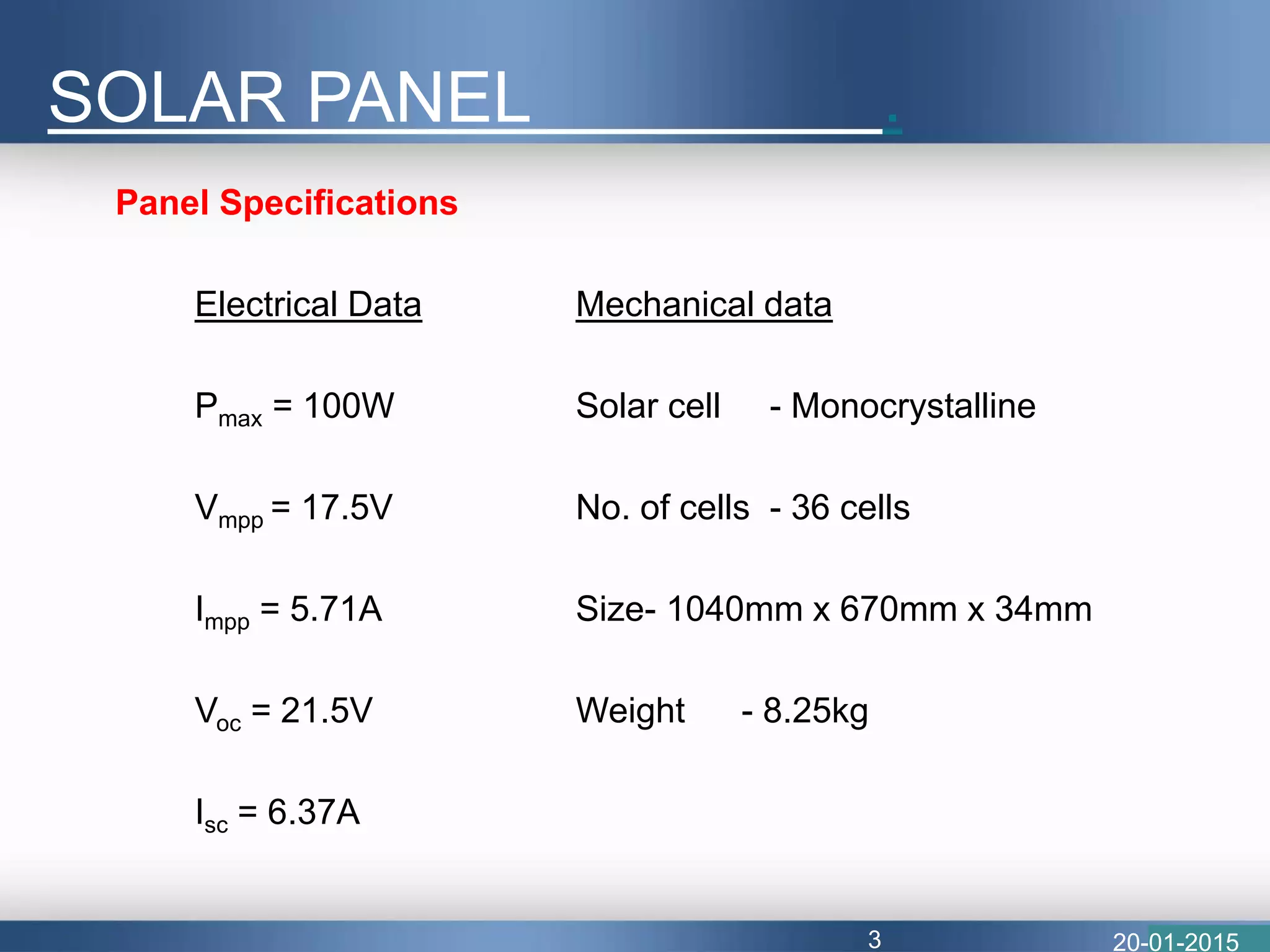
Panel Specifications
Electrical Data Mechanical data
Pmax = 100W Solar cell - Monocrystalline
Vmpp = 17.5V No. of cells - 36 cells
Impp = 5.71A Size- 1040mm x 670mm x 34mm
Voc = 21.5V Weight - 8.25kg
Isc = 6.37A
SOLAR PANEL .
20-01-20153
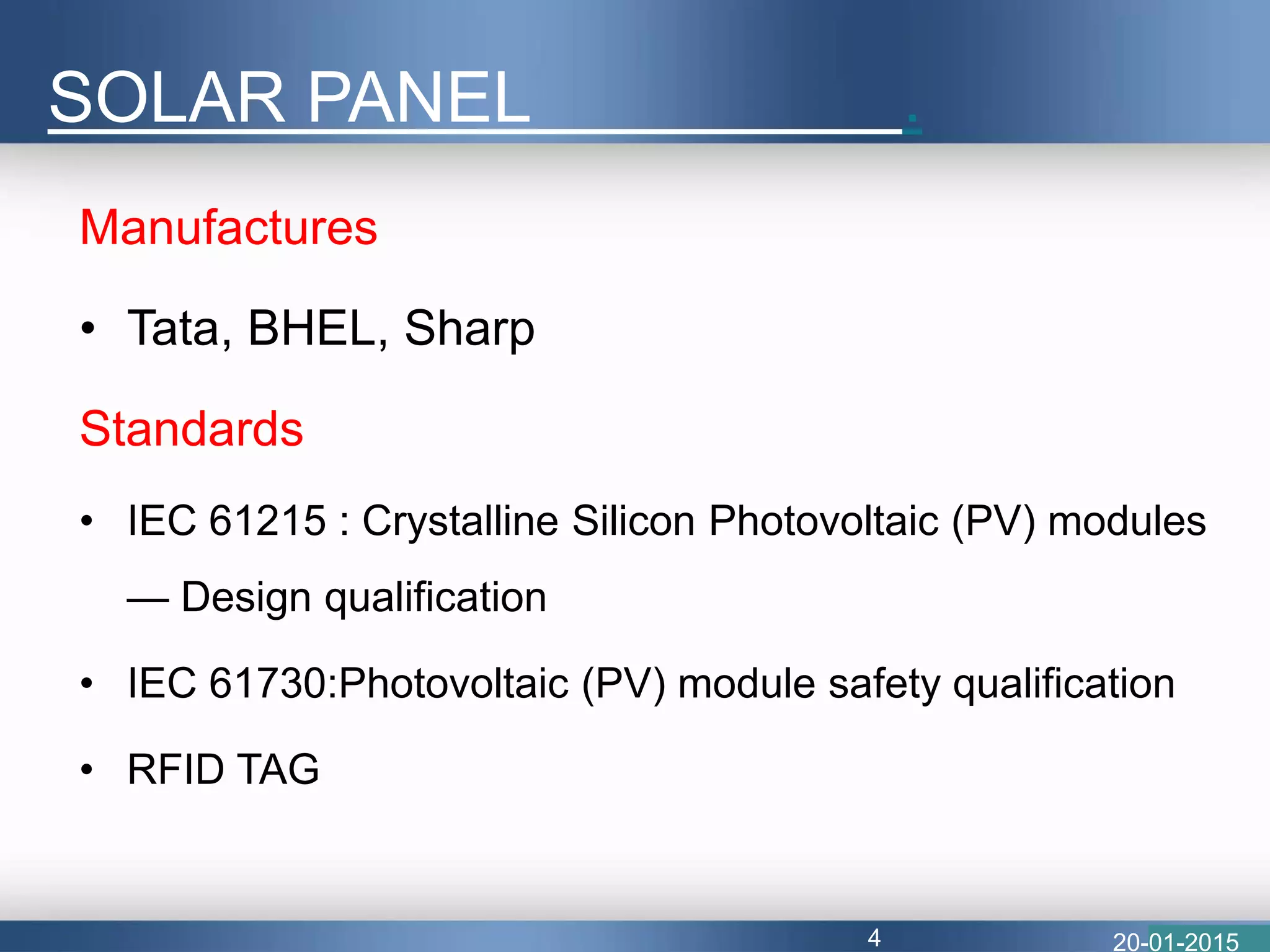
Manufactures
• Tata, BHEL, Sharp
Standards
• IEC 61215 : Crystalline Silicon Photovoltaic (PV) modules
— Design qualification
• IEC 61730:Photovoltaic (PV) module safety qualification
• RFID TAG
SOLAR PANEL .
20-01-20154
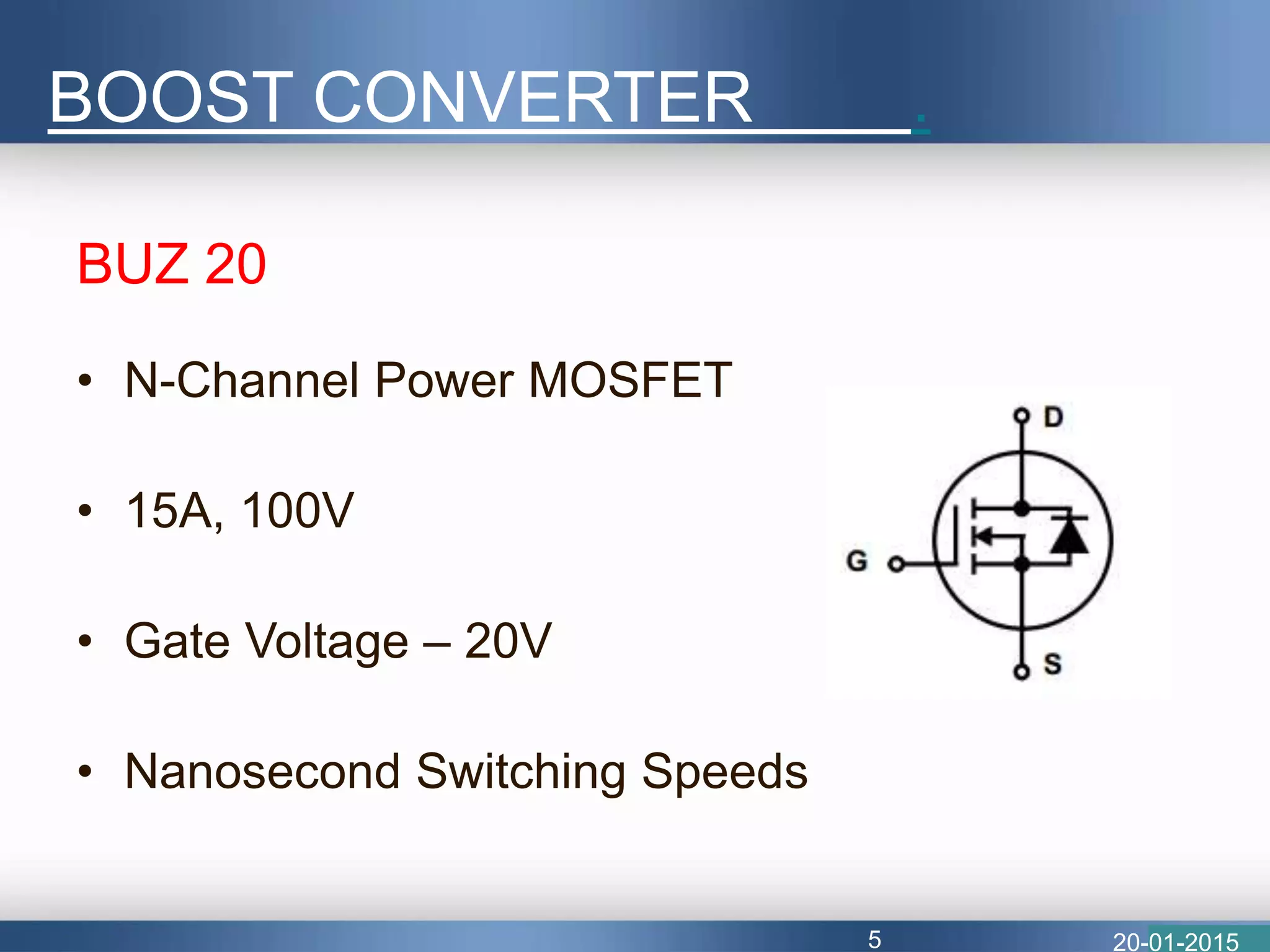
BUZ 20
• N-Channel Power MOSFET
• 15A, 100V
• Gate Voltage – 20V
• Nanosecond Switching Speeds
BOOST CONVERTER .
20-01-20155
BOOST CONVERTER .
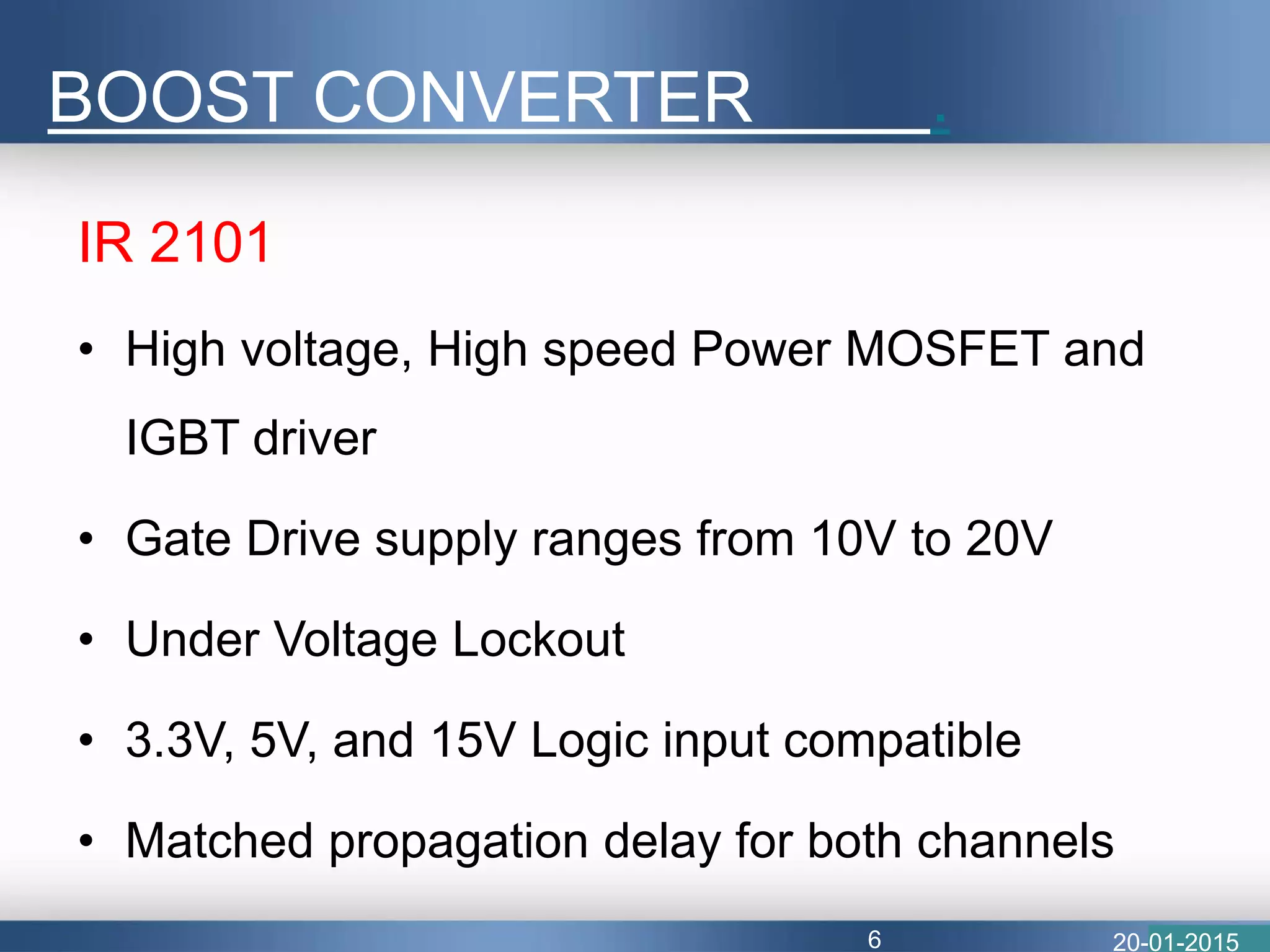
IR 2101
• High voltage, High speed Power MOSFET and
IGBT driver
• Gate Drive supply ranges from 10V to 20V
• Under Voltage Lockout
• 3.3V, 5V, and 15V Logic input compatible
• Matched propagation delay for both channels
20-01-20156
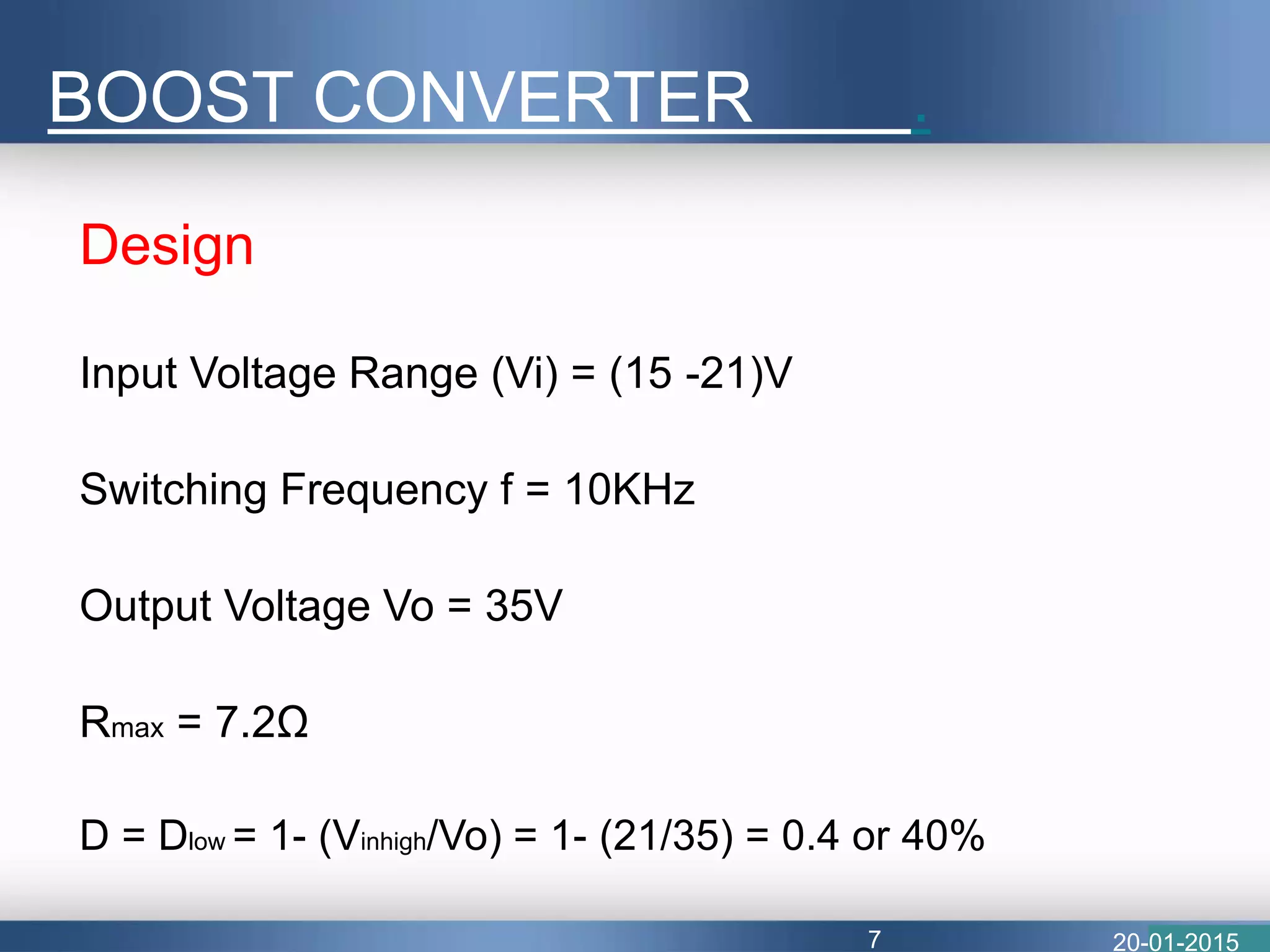
Design
Input Voltage Range (Vi) = (15 -21)V
Switching Frequency f = 10KHz
Output Voltage Vo = 35V
Rmax = 7.2Ω
D = Dlow = 1- (Vinhigh/Vo) = 1- (21/35) = 0.4 or 40%
BOOST CONVERTER .
20-01-20157
BOOST CONVERTER .
20-01-20158
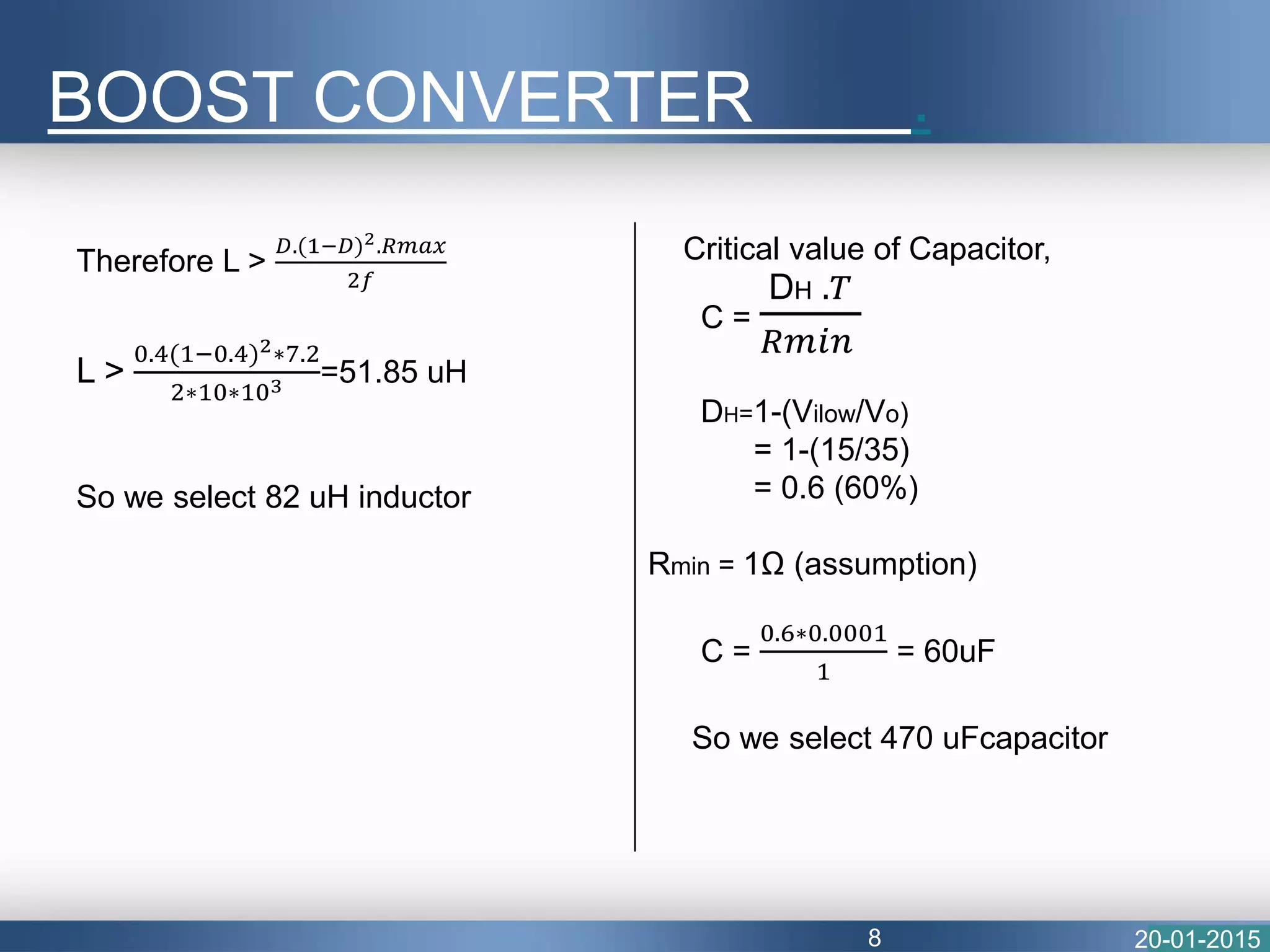
Therefore L >
𝐷.(1−𝐷)2.𝑅𝑚𝑎𝑥
2𝑓
L >
0.4(1−0.4)2∗7.2
2∗10∗103 =51.85 uH
So we select 82 uH inductor
Critical value of Capacitor,
C =
DH .𝑇
𝑅𝑚𝑖𝑛
DH=1-(Vilow/Vo)
= 1-(15/35)
= 0.6 (60%)
Rmin = 1Ω (assumption)
C =
0.6∗0.0001
1
= 60uF
So we select 470 uFcapacitor
BOOST CONVERTER .
20-01-2015
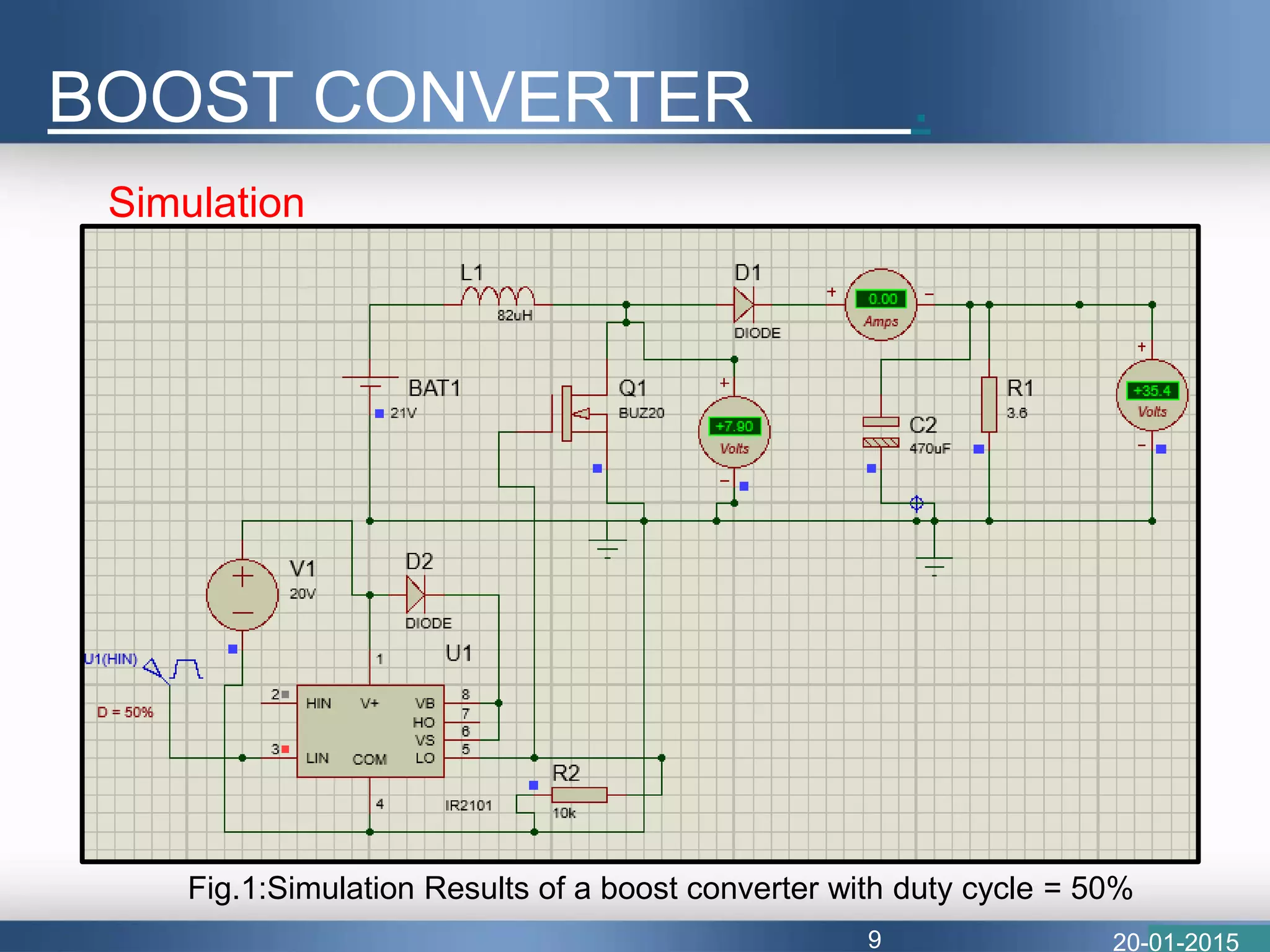
Simulation
Fig.1:Simulation Results of a boost converter with duty cycle = 50%
9
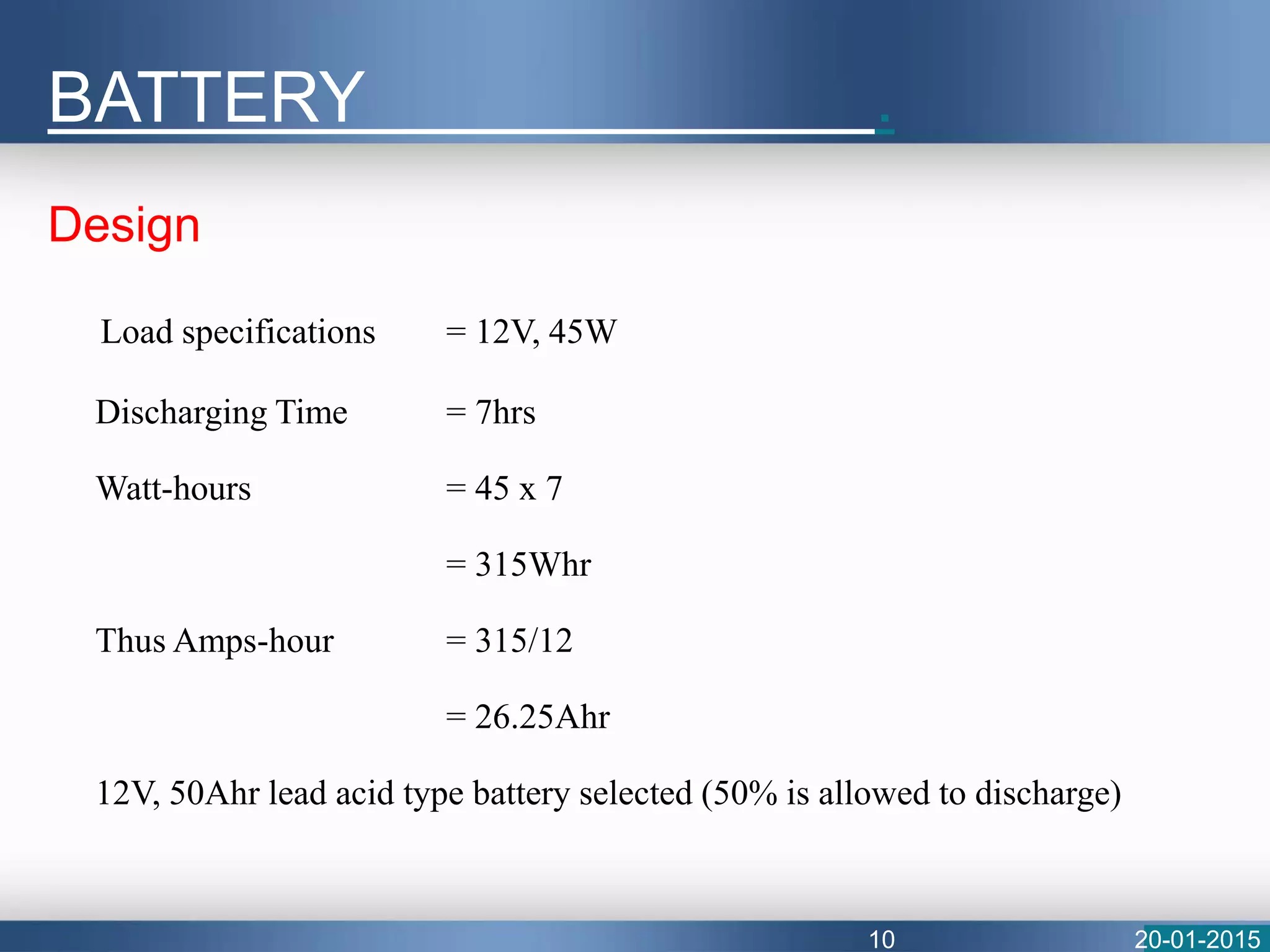
Design
Load specifications = 12V, 45W
Discharging Time = 7hrs
Watt-hours = 45 x 7
= 315Whr
Thus Amps-hour = 315/12
= 26.25Ahr
12V, 50Ahr lead acid type battery selected (50% is allowed to discharge)
BATTERY .
20-01-201510
BATTERY .
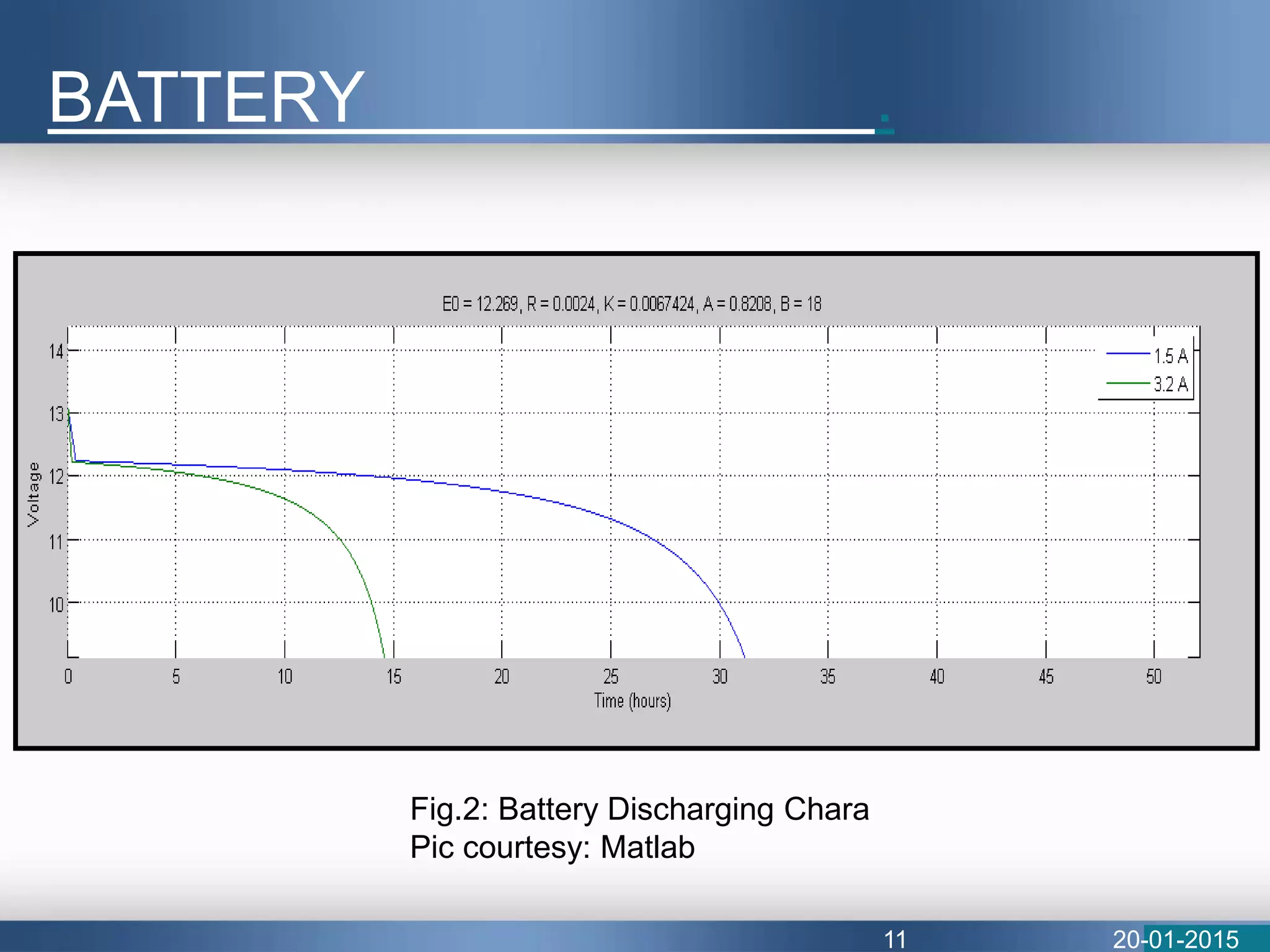
Fig.2: Battery Discharging Chara
Pic courtesy: Matlab
20-01-201511
SOFTWARE SECTION
20-01-2015
LCD INTERFACE .
20-01-2015
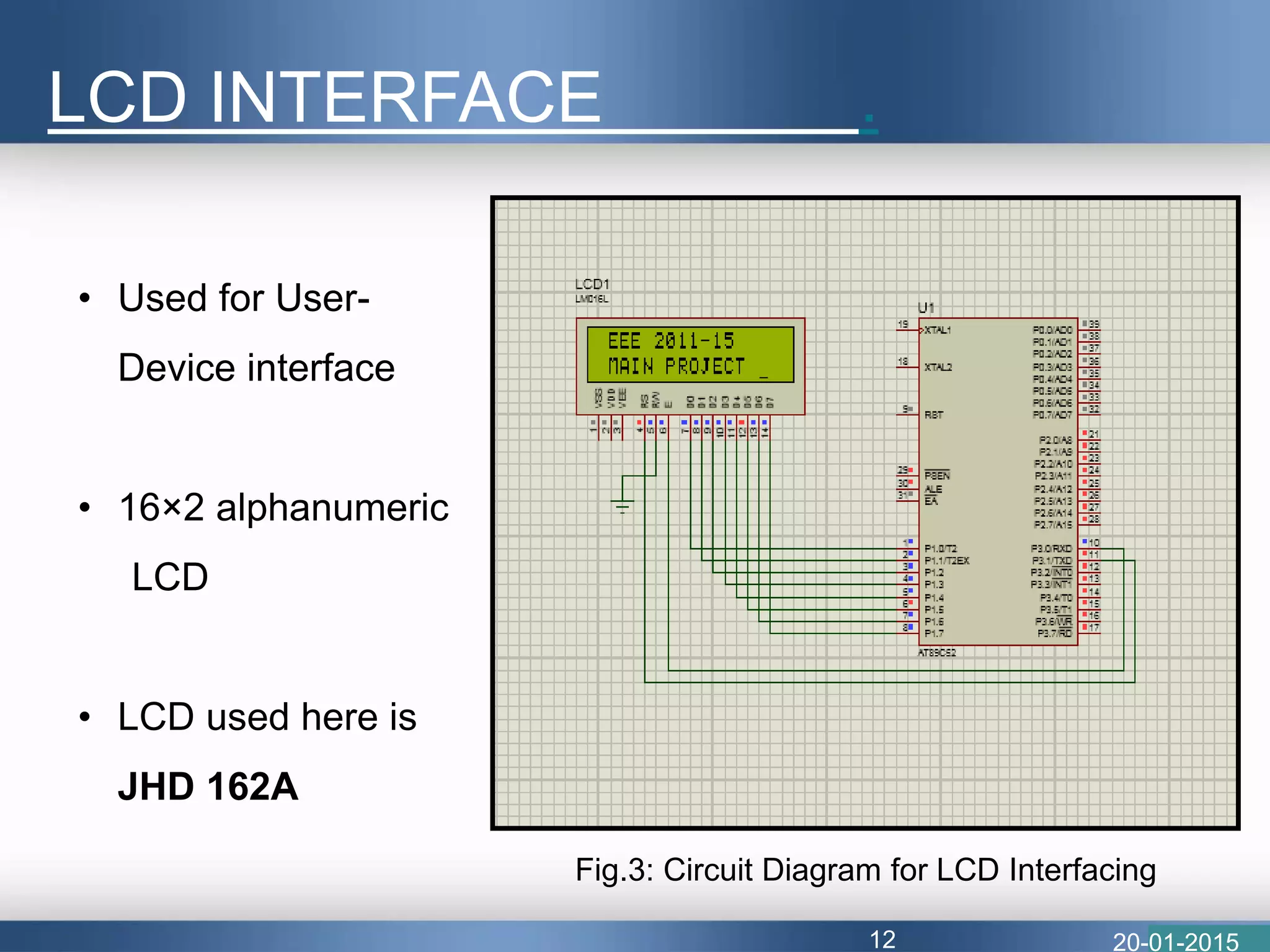
• Used for User-
Device interface
• 16×2 alphanumeric
LCD
• LCD used here is
JHD 162A
Fig.3: Circuit Diagram for LCD Interfacing
12
ADC INTERFACE .
20-01-2015
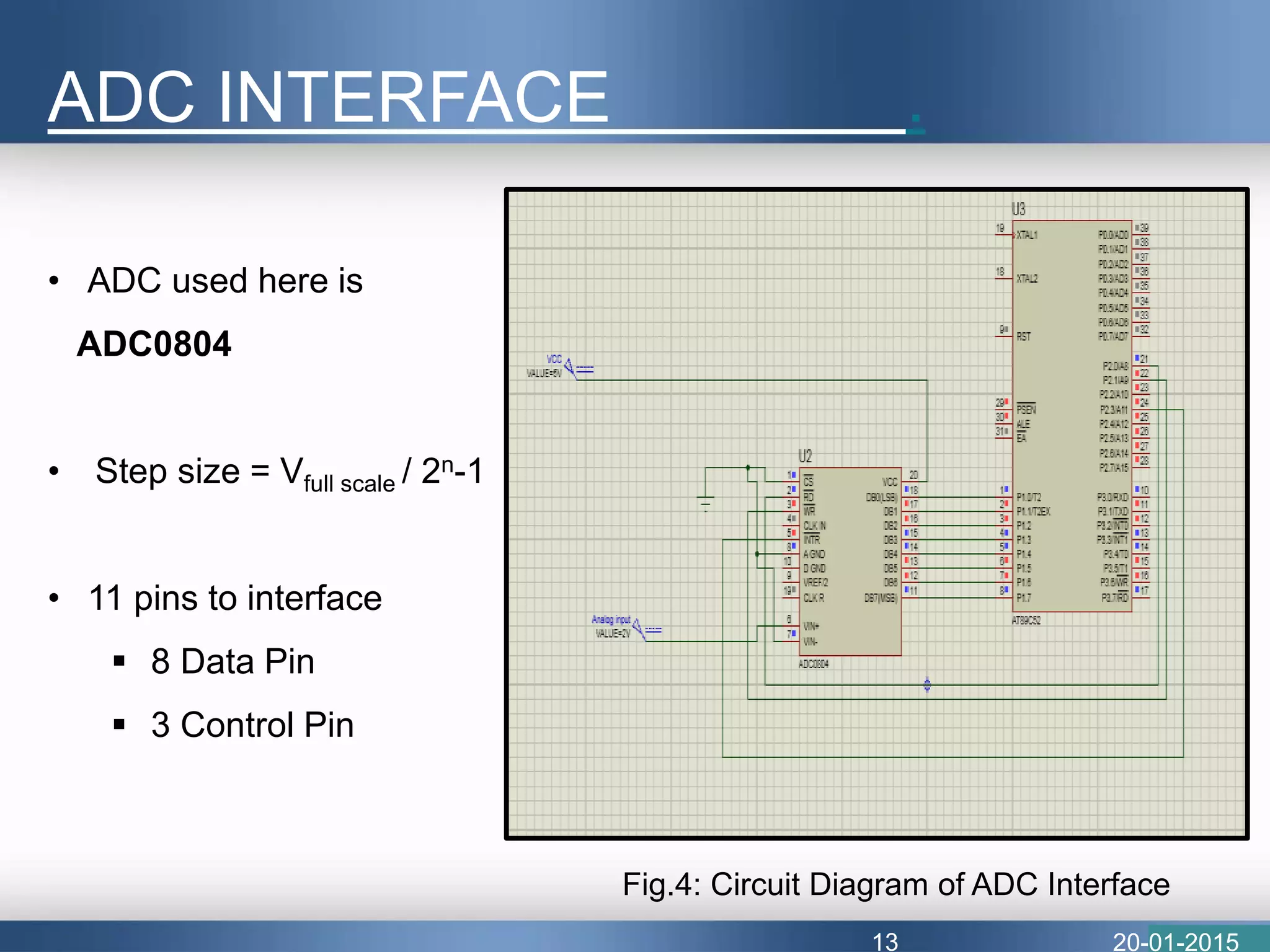
• ADC used here is
ADC0804
• Step size = Vfull scale / 2n-1
• 11 pins to interface
 8 Data Pin
 3 Control Pin
Fig.4: Circuit Diagram of ADC Interface
13
20-01-2015
DUTY CYCLE VARIATION .
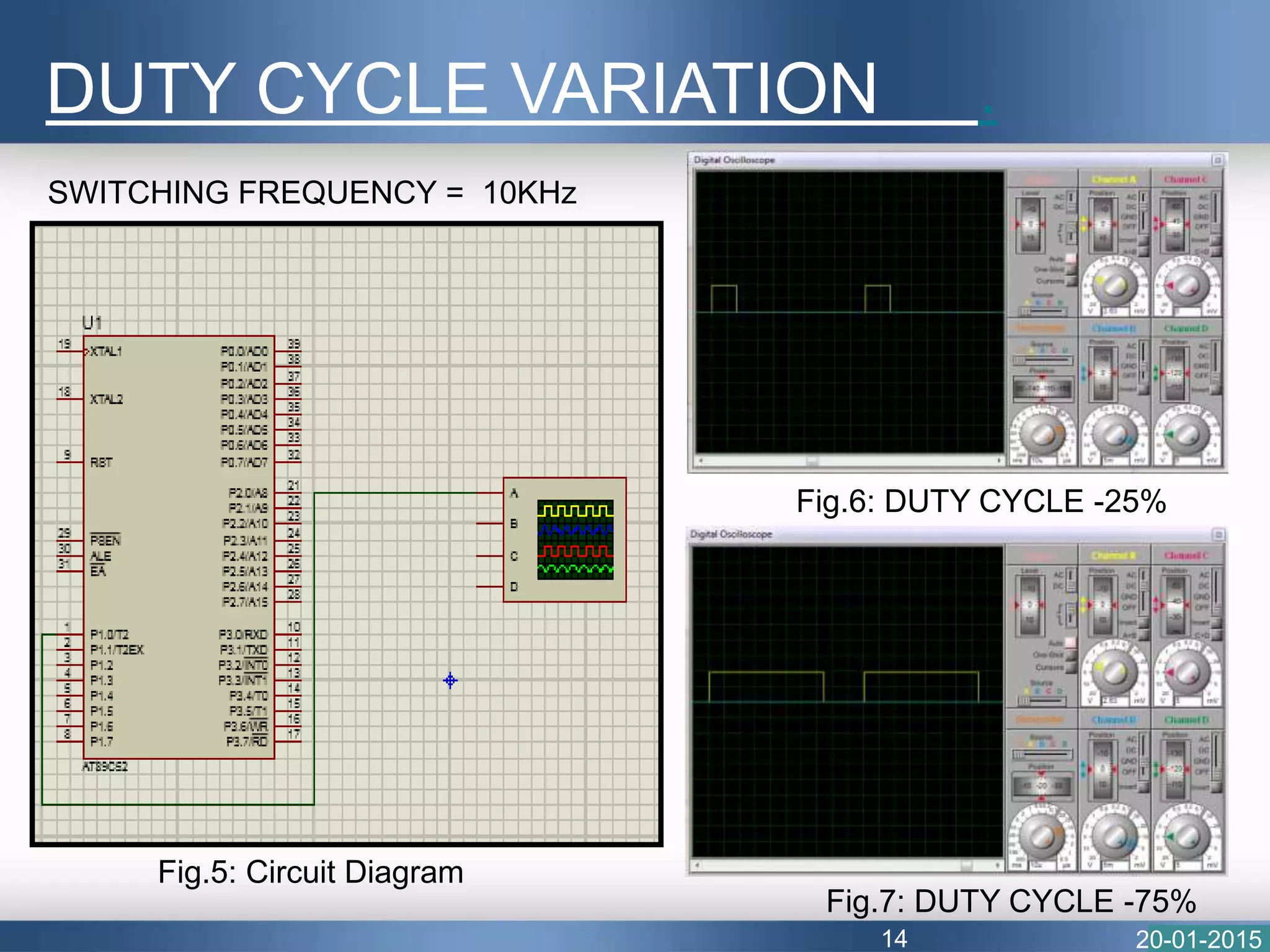
SWITCHING FREQUENCY = 10KHz
Fig.6: DUTY CYCLE -25%
Fig.7: DUTY CYCLE -75%
Fig.5: Circuit Diagram
14
• Debugging of Entire Program
• Testing of the Hardware components
• Hardware implementation
FUTURE WORK .
20-01-201515
• Koutroulis And Voulgaris N.C., “Development of a Microcontroller-based
photovoltaic Maximum power point tracking control system”, IEEE
Transactions on Power Electronic, Vol. 16, No. 1, January 2001.
• V.C.Kotak, Preti Tyagi, 2013, DC to DC Converter in Maximum Power Point
Tracker, Vol.2, Issue12, International Journal on Advanced Research in
Electrical, Electronics and Instrumentation Engineering.
• Mohamed Azab, “A New Maximum Power Point Tracking for Photovoltaic
Systems,” World Academy of Science, Engineering and Technology, 44
2008.
REFERENCE .
20-01-201516
• S.K, Mandal, “Digital Electronics Principles and Applications,” 2nd Edition,
Tata McGraw Hill, 2011.
• Predko Myke., “Programming and Customizing the 8051 Microcontroller,
TATA McGraw Hill Production”, January 1999, Second Edition.
• ADC 0808/0809 8-bit μP compatible A/D converters with 8-channel
Multiplexer, National Instruments, October 1999 Revised March 2013.
• Kenneth J. Ayala., “The 8051 Microcontroller: Architecture, Programming,
and Applications”, Thomson Delmer Learning, July 2004, Third edition.
• Mazidi Muhammad Ali, “The 8051 Microcontroller And Embedded Systems
Using Assembly And C”, Pearson Education, September 2007, Second
edition.
REFERENCE .
20-01-201517
20-01-201518

Solar powered illumination with maximum power point tracking MPPT by Anoop kumar Niravuparambil

  • 1.
    SOLAR POWER GENERATION WITHMPP TRACKER Guided by Omega A R Asst. Professor Dept. of EEE Presented by Anoop Kumar N Pooja Vijayan Rinu John George Shambhu R Veena Chandran S 20-01-2015
  • 2.
    INTRODUCTION . • MPPTis a tool for extracting maximum power from solar panel. • Impedance matching is the principle behind Maximum power transfer. • Boost converter is used as the MPP Tracker 20-01-20151
  • 3.
  • 4.
    SOLAR PANEL . PanelDesign • Total load = 2x20 = 40W • Working hours = 7 hrs (9:30 am to 4:30 pm) • Total watt hour = 45 x 7 = 315Wh [load is taken as 45W with additional 5W] Since period of peak sunshine in a day is 4 hrs, so the panel should capable for charging the battery within this 4 hrs • Therefore, panel rating must be greater than (315/4 =78W) 2 Solar panel of 100W each is connected in parallel. 20-01-20152
  • 5.
    Panel Specifications Electrical DataMechanical data Pmax = 100W Solar cell - Monocrystalline Vmpp = 17.5V No. of cells - 36 cells Impp = 5.71A Size- 1040mm x 670mm x 34mm Voc = 21.5V Weight - 8.25kg Isc = 6.37A SOLAR PANEL . 20-01-20153
  • 6.
    Manufactures • Tata, BHEL,Sharp Standards • IEC 61215 : Crystalline Silicon Photovoltaic (PV) modules — Design qualification • IEC 61730:Photovoltaic (PV) module safety qualification • RFID TAG SOLAR PANEL . 20-01-20154
  • 7.
    BUZ 20 • N-ChannelPower MOSFET • 15A, 100V • Gate Voltage – 20V • Nanosecond Switching Speeds BOOST CONVERTER . 20-01-20155
  • 8.
    BOOST CONVERTER . IR2101 • High voltage, High speed Power MOSFET and IGBT driver • Gate Drive supply ranges from 10V to 20V • Under Voltage Lockout • 3.3V, 5V, and 15V Logic input compatible • Matched propagation delay for both channels 20-01-20156
  • 9.
    Design Input Voltage Range(Vi) = (15 -21)V Switching Frequency f = 10KHz Output Voltage Vo = 35V Rmax = 7.2Ω D = Dlow = 1- (Vinhigh/Vo) = 1- (21/35) = 0.4 or 40% BOOST CONVERTER . 20-01-20157
  • 10.
    BOOST CONVERTER . 20-01-20158 ThereforeL > 𝐷.(1−𝐷)2.𝑅𝑚𝑎𝑥 2𝑓 L > 0.4(1−0.4)2∗7.2 2∗10∗103 =51.85 uH So we select 82 uH inductor Critical value of Capacitor, C = DH .𝑇 𝑅𝑚𝑖𝑛 DH=1-(Vilow/Vo) = 1-(15/35) = 0.6 (60%) Rmin = 1Ω (assumption) C = 0.6∗0.0001 1 = 60uF So we select 470 uFcapacitor
  • 11.
    BOOST CONVERTER . 20-01-2015 Simulation Fig.1:SimulationResults of a boost converter with duty cycle = 50% 9
  • 12.
    Design Load specifications =12V, 45W Discharging Time = 7hrs Watt-hours = 45 x 7 = 315Whr Thus Amps-hour = 315/12 = 26.25Ahr 12V, 50Ahr lead acid type battery selected (50% is allowed to discharge) BATTERY . 20-01-201510
  • 13.
    BATTERY . Fig.2: BatteryDischarging Chara Pic courtesy: Matlab 20-01-201511
  • 14.
  • 15.
    LCD INTERFACE . 20-01-2015 •Used for User- Device interface • 16×2 alphanumeric LCD • LCD used here is JHD 162A Fig.3: Circuit Diagram for LCD Interfacing 12
  • 16.
    ADC INTERFACE . 20-01-2015 •ADC used here is ADC0804 • Step size = Vfull scale / 2n-1 • 11 pins to interface  8 Data Pin  3 Control Pin Fig.4: Circuit Diagram of ADC Interface 13
  • 17.
    20-01-2015 DUTY CYCLE VARIATION. SWITCHING FREQUENCY = 10KHz Fig.6: DUTY CYCLE -25% Fig.7: DUTY CYCLE -75% Fig.5: Circuit Diagram 14
  • 18.
    • Debugging ofEntire Program • Testing of the Hardware components • Hardware implementation FUTURE WORK . 20-01-201515
  • 19.
    • Koutroulis AndVoulgaris N.C., “Development of a Microcontroller-based photovoltaic Maximum power point tracking control system”, IEEE Transactions on Power Electronic, Vol. 16, No. 1, January 2001. • V.C.Kotak, Preti Tyagi, 2013, DC to DC Converter in Maximum Power Point Tracker, Vol.2, Issue12, International Journal on Advanced Research in Electrical, Electronics and Instrumentation Engineering. • Mohamed Azab, “A New Maximum Power Point Tracking for Photovoltaic Systems,” World Academy of Science, Engineering and Technology, 44 2008. REFERENCE . 20-01-201516
  • 20.
    • S.K, Mandal,“Digital Electronics Principles and Applications,” 2nd Edition, Tata McGraw Hill, 2011. • Predko Myke., “Programming and Customizing the 8051 Microcontroller, TATA McGraw Hill Production”, January 1999, Second Edition. • ADC 0808/0809 8-bit μP compatible A/D converters with 8-channel Multiplexer, National Instruments, October 1999 Revised March 2013. • Kenneth J. Ayala., “The 8051 Microcontroller: Architecture, Programming, and Applications”, Thomson Delmer Learning, July 2004, Third edition. • Mazidi Muhammad Ali, “The 8051 Microcontroller And Embedded Systems Using Assembly And C”, Pearson Education, September 2007, Second edition. REFERENCE . 20-01-201517
  • 21.