Solar Energy
Meeting Bossa 21st -25th March
1-Importance of renewable energy
Renewable energies are clean, inexhaustible and increasingly
competitive energy sources.
They do not produce greenhouse gases -causing climate
change- or polluting emissions.
The growth of renewable energy is unstoppable
2- WHAT TYPES OF RENEWABLE ENERGY EXIST
● Wind energy: the energy obtained from the wind
● Solar energy: the energy obtained from the sun. The main technologies are solar
photovoltaic (uses sunlight) and solar thermic (uses heat from the sun)
● Hydraulic or hydroelectric power: the energy obtained from rivers and
freshwater streams
● Biomass and biogas: the energy that is extracted from organic matter
● Geothermal energy: the heat energy contained in the interior of the Earth
● Tidal energy: the energy obtained from the tides
● Wave energy or wave energy: the energy obtained from
waves
● Bioethanol: organic fuel suitable for the automotive industry
that is obtained through fermentation processes of vegetable
products.
● Biodiesel: organic fuel for the automotive industry, among
other applications, obtained from vegetable oils
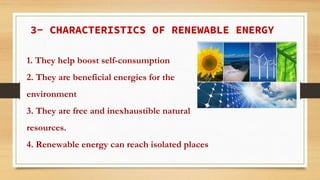
3- CHARACTERISTICS OF RENEWABLE ENERGY
1. They help boost self-consumption
2. They are beneficial energies for the
environment
3. They are free and inexhaustible natural
resources.
4. Renewable energy can reach isolated places
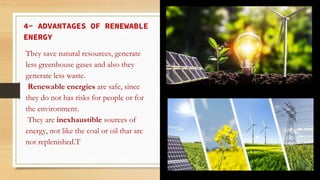
4- ADVANTAGES OF RENEWABLE
ENERGY
They save natural resources, generate
less greenhouse gases and also they
generate less waste.
Renewable energies are safe, since
they do not has risks for people or for
the environment.
They are inexhaustible sources of
energy, not like the coal or oil that are
not replenished.T
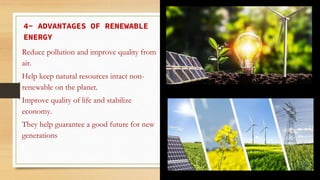
4- ADVANTAGES OF RENEWABLE
ENERGY
Reduce pollution and improve quality from
air.
Help keep natural resources intact non-
renewable on the planet.
Improve quality of life and stabilize
economy.
They help guarantee a good future for new
generations
SOLAR ENERGY.
Characteristics and advantages.
SOLAR ENERGY
Solar energy is a renewable energy obtained from the electromagnetic
radiation of the Sun. It is a renewable energy because it is obtained
from a natural source and inexhaustible, in this case the Sun.
How solar energy is produced.
Solar energy can be captured through photoelectric cells (which make
up the photovoltaic panels that we all know), heliostats or solar collectors,
which subsequently transform
-in solar thermal energy (via temperature)
-photovoltaic solar energy (through light).
It can also be used passively with bioclimatic architecture techniques and
sustainable, as we will see below.
Main characteristics of solar panels
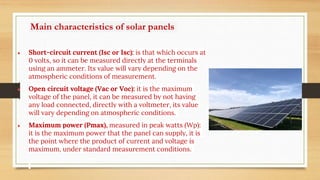
● Short-circuit current (Isc or Isc): is that which occurs at
0 volts, so it can be measured directly at the terminals
using an ammeter. Its value will vary depending on the
atmospheric conditions of measurement.
● Open circuit voltage (Vac or Voc): it is the maximum
voltage of the panel, it can be measured by not having
any load connected, directly with a voltmeter, its value
will vary depending on atmospheric conditions.
● Maximum power (Pmax), measured in peak watts (Wp):
it is the maximum power that the panel can supply, it is
the point where the product of current and voltage is
maximum, under standard measurement conditions.
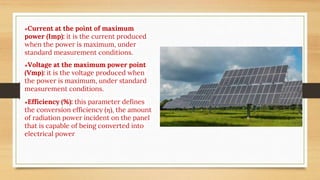
●Current at the point of maximum
power (Imp): it is the current produced
when the power is maximum, under
standard measurement conditions.
●Voltage at the maximum power point
(Vmp): it is the voltage produced when
the power is maximum, under standard
measurement conditions.
●Efficiency (%): this parameter defines
the conversion efficiency (ƞ), the amount
of radiation power incident on the panel
that is capable of being converted into
electrical power
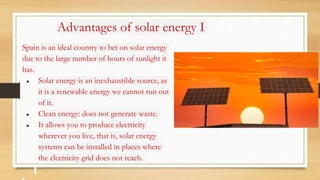
Advantages of solar energy I
Spain is an ideal country to bet on solar energy
due to the large number of hours of sunlight it
has.
● Solar energy is an inexhaustible source, as
it is a renewable energy we cannot run out
of it.
● Clean energy: does not generate waste.
● It allows you to produce electricity
wherever you live, that is, solar energy
systems can be installed in places where
the electricity grid does not reach.
Advantages of solar energy II
● It is profitable: although it is true that installing solar panels requires a
certain initial outlay, it is a bet that pays for itself sooner and later and in
the medium-long term it is beneficial in economic terms..
● Solar energy systems are poorly maintained. Normally, solar panels only
need certain preventive care per year to guarantee their proper
functioning during their 20-25 year useful life.
Disadvantages of solar energy
● The cost of solar energy systems requires some initial investment.
● The sites with the most solar radiation are places far from large cities and
deserts.
● Isolated self-consumption systems require solar accumulators, which have
a high cost.
● Solar energy is not constant, since it varies throughout the day and
depends on the weather conditions of the place.
● Pollution has negative effects on solar energy, this is because its
performance is lower in polluted cities.
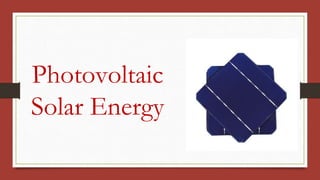
Photovoltaic
Solar Energy
What is the photovoltaic energy?
First of all, solar energy is all that comes
from the sun. Specifically, photovoltaics is
one that transforms sun light into electricity.
How does a solar panel work?
● The operation of a solar panel is based on the principle that when
a beam of photons (light) hits a semiconductor, it is excited and
produces electricity.
● This semiconductor is usually crystallized silicon due to its low
price and manufacturing cost.
● The plate is made up of groups of crystals, called wafers, and
these in turn are joined by aluminum wires to form the plate.
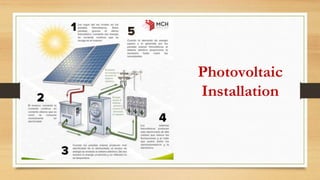
Photovoltaic
Installation
Conclusion
Photovoltaic energy is one of the most widely
used in Spain due to its versatility and price
compared to other types of renewable energy, a
complete solar installation costs around €3,000,
and provides plenty of energy to feed into the
grid.
THERMOSOLAR
ENERGY
What is thermal solar energy?
•Thermosolar energy take profit the sun
energy to produce heat.
•The usual uses in a home are:
➔Having hot water.
➔Having heating.
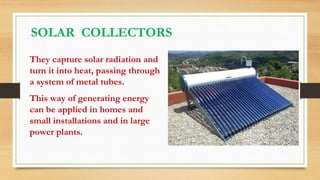
They capture solar radiation and
turn it into heat, passing through
a system of metal tubes.
This way of generating energy
can be applied in homes and
small installations and in large
power plants.
SOLAR COLLECTORS
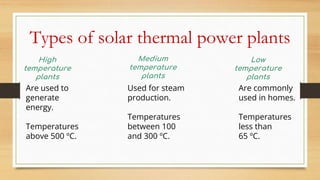
Types of solar thermal power plants
High
temperature
plants
Low
temperature
plants
Medium
temperature
plants
Are used to
generate
energy.
Temperatures
above 500 ºC.
Are commonly
used in homes.
Temperatures
less than
65 ºC.
Used for steam
production.

Temperatures
between 100
and 300 ºC.
Solar energy in
Spain
DSITRIBUTION OF SOLAR
ENERGY IN SPAIN
The distribution of solar energy in Spain
Solar energy in Spain is at an advanced stage of development, installation and
use.
Can be subdivided into two types, mainly:
● Photovoltaic solar energy
● Thermic solar energy
Spain is one of the countries in Europe with the highest number of hours of
sunshine, to which are added to European commitments in the installation of
renewable energies as well as the strategic convenience of reducing the great
dependence of foreing energy and increasing energy autonomy.
TOP 3 PHOTOVOLTAIC
PLANTS
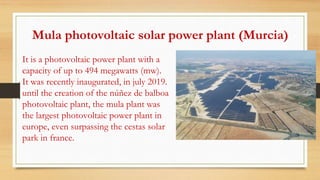
It is a photovoltaic power plant with a
capacity of up to 494 megawatts (mw).
It was recently inaugurated, in july 2019.
until the creation of the núñez de balboa
photovoltaic plant, the mula plant was
the largest photovoltaic power plant in
europe, even surpassing the cestas solar
park in france.
Mula photovoltaic solar power plant (Murcia)
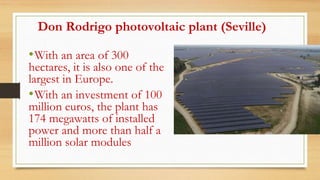
Don Rodrigo photovoltaic plant (Seville)
•With an area of 300
hectares, it is also one of the
largest in Europe.
•With an investment of 100
million euros, the plant has
174 megawatts of installed
power and more than half a
million solar modules
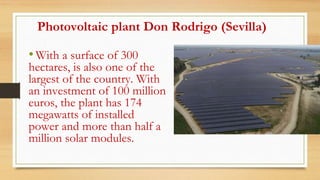
Photovoltaic plant Don Rodrigo (Sevilla)
•With a surface of 300
hectares, is also one of the
largest of the country. With
an investment of 100 million
euros, the plant has 174
megawatts of installed
power and more than half a
million solar modules.
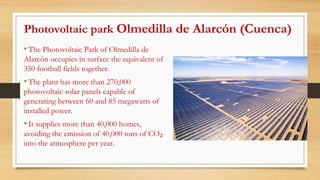
Photovoltaic park Olmedilla de Alarcón (Cuenca)
•The Photovoltaic Park of Olmedilla de
Alarcón occupies in surface the equivalent of
350 football fields together.
•The plant has more than 270,000
photovoltaic solar panels capable of
generating between 60 and 85 megawatts of
installed power.
•It supplies more than 40,000 homes,
avoiding the emission of 40,000 tons of CO₂
into the atmosphere per year.
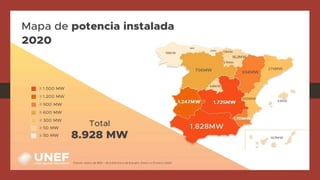
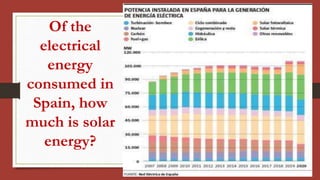
Installed capacity in Spain for the
generation of electricity
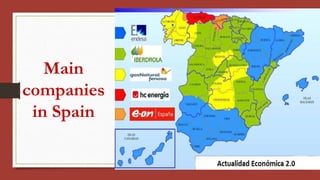
Companies in Spain
Main
companies
in Spain
j
Percentage of solar
energy in Spain
Of the
electrical
energy
consumed in
Spain, how
much is solar
energy?
CONCLUSION
Spain has enough power to supply itself, as well
as other countries, which is why we must
continue promoting the use of solar energy.
Extremadura
and
Solar Energy
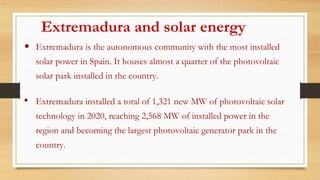
Extremadura and solar energy
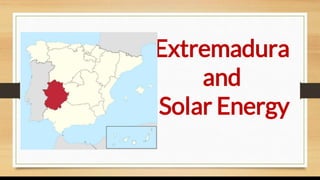
• Extremadura is the autonomous community with the most installed
solar power in Spain. It houses almost a quarter of the photovoltaic
solar park installed in the country.
• Extremadura installed a total of 1,321 new MW of photovoltaic solar
technology in 2020, reaching 2,568 MW of installed power in the
region and becoming the largest photovoltaic generator park in the
country.
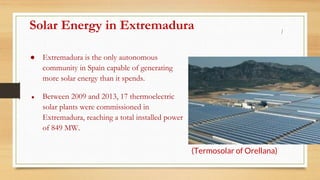
Solar Energy in Extremadura
● Extremadura is the only autonomous
community in Spain capable of generating
more solar energy than it spends.
● Between 2009 and 2013, 17 thermoelectric
solar plants were commissioned in
Extremadura, reaching a total installed power
of 849 MW.
(Termosolar of Orellana)
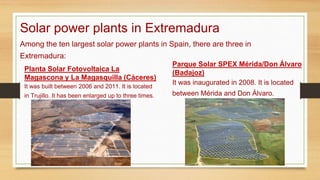
Solar power plants in Extremadura
Planta Solar Fotovoltaica La
Magascona y La Magasquilla (Cáceres)
It was built between 2006 and 2011. It is located
in Trujillo. It has been enlarged up to three times.
Parque Solar SPEX Mérida/Don Álvaro
(Badajoz)
It was inaugurated in 2008. It is located
between Mérida and Don Álvaro.
Among the ten largest solar power plants in Spain, there are three in
Extremadura:
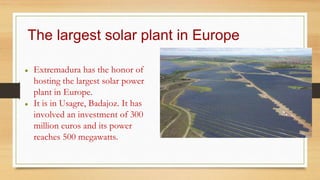
The largest solar plant in Europe
● Extremadura has the honor of
hosting the largest solar power
plant in Europe.
● It is in Usagre, Badajoz. It has
involved an investment of 300
million euros and its power
reaches 500 megawatts.
Percentage of solar energy in
Extremadura
• Extremadura produces enough electricity from the sun to
cover 61% of its consumption.
• The coverage of the internal demand for electricity with
renewables reached 116.56% in 2016.
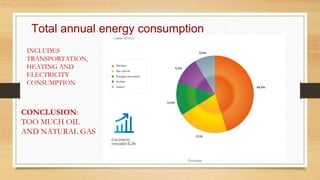
Total annual energy consumption
INCLUDES
TRANSPORTATION,
HEATING AND
ELECTRICITY
CONSUMPTION
CONCLUSION:
TOO MUCH OIL
AND NATURAL GAS
Conclusion: The future of solar energy in
Extremadura
Extremadura plans to install 11,060 MW of renewable generation and 800
MW of storage in the next decade.
• Renewable generation continues to grow strongly in Spain and
Extremadura, in this case especially, thanks to large photovoltaic
projects.
• A situation that is radically changing the map of electricity
demands coverage in many territories that are already capable of
self-sufficiency with energy produced in their region.
THANKS FOR YOUR ATTENTION
SOLAR ENERGY SPAIN .pptx

SOLAR ENERGY SPAIN .pptx

  • 1.
  • 2.
    1-Importance of renewableenergy Renewable energies are clean, inexhaustible and increasingly competitive energy sources. They do not produce greenhouse gases -causing climate change- or polluting emissions. The growth of renewable energy is unstoppable
  • 3.
    2- WHAT TYPESOF RENEWABLE ENERGY EXIST ● Wind energy: the energy obtained from the wind ● Solar energy: the energy obtained from the sun. The main technologies are solar photovoltaic (uses sunlight) and solar thermic (uses heat from the sun) ● Hydraulic or hydroelectric power: the energy obtained from rivers and freshwater streams ● Biomass and biogas: the energy that is extracted from organic matter ● Geothermal energy: the heat energy contained in the interior of the Earth
  • 4.

    ● Tidal energy:the energy obtained from the tides ● Wave energy or wave energy: the energy obtained from waves ● Bioethanol: organic fuel suitable for the automotive industry that is obtained through fermentation processes of vegetable products. ● Biodiesel: organic fuel for the automotive industry, among other applications, obtained from vegetable oils
  • 5.
    3- CHARACTERISTICS OFRENEWABLE ENERGY 1. They help boost self-consumption 2. They are beneficial energies for the environment 3. They are free and inexhaustible natural resources. 4. Renewable energy can reach isolated places
  • 6.
    4- ADVANTAGES OFRENEWABLE ENERGY They save natural resources, generate less greenhouse gases and also they generate less waste. Renewable energies are safe, since they do not has risks for people or for the environment. They are inexhaustible sources of energy, not like the coal or oil that are not replenished.T
  • 7.
    4- ADVANTAGES OFRENEWABLE ENERGY Reduce pollution and improve quality from air. Help keep natural resources intact non- renewable on the planet. Improve quality of life and stabilize economy. They help guarantee a good future for new generations
  • 8.
  • 9.
    SOLAR ENERGY Solar energyis a renewable energy obtained from the electromagnetic radiation of the Sun. It is a renewable energy because it is obtained from a natural source and inexhaustible, in this case the Sun.
  • 10.
    How solar energyis produced. Solar energy can be captured through photoelectric cells (which make up the photovoltaic panels that we all know), heliostats or solar collectors, which subsequently transform -in solar thermal energy (via temperature) -photovoltaic solar energy (through light). It can also be used passively with bioclimatic architecture techniques and sustainable, as we will see below.
  • 11.
    Main characteristics ofsolar panels ● Short-circuit current (Isc or Isc): is that which occurs at 0 volts, so it can be measured directly at the terminals using an ammeter. Its value will vary depending on the atmospheric conditions of measurement. ● Open circuit voltage (Vac or Voc): it is the maximum voltage of the panel, it can be measured by not having any load connected, directly with a voltmeter, its value will vary depending on atmospheric conditions. ● Maximum power (Pmax), measured in peak watts (Wp): it is the maximum power that the panel can supply, it is the point where the product of current and voltage is maximum, under standard measurement conditions.
  • 12.
    ●Current at thepoint of maximum power (Imp): it is the current produced when the power is maximum, under standard measurement conditions. ●Voltage at the maximum power point (Vmp): it is the voltage produced when the power is maximum, under standard measurement conditions. ●Efficiency (%): this parameter defines the conversion efficiency (ƞ), the amount of radiation power incident on the panel that is capable of being converted into electrical power
  • 13.
    Advantages of solarenergy I Spain is an ideal country to bet on solar energy due to the large number of hours of sunlight it has. ● Solar energy is an inexhaustible source, as it is a renewable energy we cannot run out of it. ● Clean energy: does not generate waste. ● It allows you to produce electricity wherever you live, that is, solar energy systems can be installed in places where the electricity grid does not reach.
  • 14.
    Advantages of solarenergy II ● It is profitable: although it is true that installing solar panels requires a certain initial outlay, it is a bet that pays for itself sooner and later and in the medium-long term it is beneficial in economic terms.. ● Solar energy systems are poorly maintained. Normally, solar panels only need certain preventive care per year to guarantee their proper functioning during their 20-25 year useful life.
  • 15.
    Disadvantages of solarenergy ● The cost of solar energy systems requires some initial investment. ● The sites with the most solar radiation are places far from large cities and deserts. ● Isolated self-consumption systems require solar accumulators, which have a high cost. ● Solar energy is not constant, since it varies throughout the day and depends on the weather conditions of the place. ● Pollution has negative effects on solar energy, this is because its performance is lower in polluted cities.
  • 16.
  • 17.
    What is thephotovoltaic energy? First of all, solar energy is all that comes from the sun. Specifically, photovoltaics is one that transforms sun light into electricity.
  • 18.
    How does asolar panel work? ● The operation of a solar panel is based on the principle that when a beam of photons (light) hits a semiconductor, it is excited and produces electricity. ● This semiconductor is usually crystallized silicon due to its low price and manufacturing cost. ● The plate is made up of groups of crystals, called wafers, and these in turn are joined by aluminum wires to form the plate.
  • 19.
  • 20.
    Conclusion Photovoltaic energy isone of the most widely used in Spain due to its versatility and price compared to other types of renewable energy, a complete solar installation costs around €3,000, and provides plenty of energy to feed into the grid.
  • 21.
  • 22.
    What is thermalsolar energy? •Thermosolar energy take profit the sun energy to produce heat. •The usual uses in a home are: ➔Having hot water. ➔Having heating.
  • 23.
    They capture solarradiation and turn it into heat, passing through a system of metal tubes. This way of generating energy can be applied in homes and small installations and in large power plants. SOLAR COLLECTORS
  • 24.
    Types of solarthermal power plants High temperature plants Low temperature plants Medium temperature plants Are used to generate energy. Temperatures above 500 ºC. Are commonly used in homes. Temperatures less than 65 ºC. Used for steam production. Temperatures between 100 and 300 ºC.
  • 25.
  • 26.
  • 27.
    The distribution ofsolar energy in Spain Solar energy in Spain is at an advanced stage of development, installation and use. Can be subdivided into two types, mainly: ● Photovoltaic solar energy ● Thermic solar energy Spain is one of the countries in Europe with the highest number of hours of sunshine, to which are added to European commitments in the installation of renewable energies as well as the strategic convenience of reducing the great dependence of foreing energy and increasing energy autonomy.
  • 28.
  • 29.
    It is aphotovoltaic power plant with a capacity of up to 494 megawatts (mw). It was recently inaugurated, in july 2019. until the creation of the núñez de balboa photovoltaic plant, the mula plant was the largest photovoltaic power plant in europe, even surpassing the cestas solar park in france. Mula photovoltaic solar power plant (Murcia)
  • 30.
    Don Rodrigo photovoltaicplant (Seville) •With an area of 300 hectares, it is also one of the largest in Europe. •With an investment of 100 million euros, the plant has 174 megawatts of installed power and more than half a million solar modules
  • 31.
    Photovoltaic plant DonRodrigo (Sevilla) •With a surface of 300 hectares, is also one of the largest of the country. With an investment of 100 million euros, the plant has 174 megawatts of installed power and more than half a million solar modules.
  • 32.
    Photovoltaic park Olmedillade Alarcón (Cuenca) •The Photovoltaic Park of Olmedilla de Alarcón occupies in surface the equivalent of 350 football fields together. •The plant has more than 270,000 photovoltaic solar panels capable of generating between 60 and 85 megawatts of installed power. •It supplies more than 40,000 homes, avoiding the emission of 40,000 tons of CO₂ into the atmosphere per year.
  • 33.
    Installed capacity inSpain for the generation of electricity
  • 35.
  • 36.
  • 37.
  • 38.
  • 39.
  • 40.
    Spain has enoughpower to supply itself, as well as other countries, which is why we must continue promoting the use of solar energy.
  • 41.
  • 42.
    Extremadura and solarenergy • Extremadura is the autonomous community with the most installed solar power in Spain. It houses almost a quarter of the photovoltaic solar park installed in the country. • Extremadura installed a total of 1,321 new MW of photovoltaic solar technology in 2020, reaching 2,568 MW of installed power in the region and becoming the largest photovoltaic generator park in the country.
  • 43.
    Solar Energy inExtremadura ● Extremadura is the only autonomous community in Spain capable of generating more solar energy than it spends. ● Between 2009 and 2013, 17 thermoelectric solar plants were commissioned in Extremadura, reaching a total installed power of 849 MW. (Termosolar of Orellana)
  • 44.
    Solar power plantsin Extremadura Planta Solar Fotovoltaica La Magascona y La Magasquilla (Cáceres) It was built between 2006 and 2011. It is located in Trujillo. It has been enlarged up to three times. Parque Solar SPEX Mérida/Don Álvaro (Badajoz) It was inaugurated in 2008. It is located between Mérida and Don Álvaro. Among the ten largest solar power plants in Spain, there are three in Extremadura:
  • 45.
    The largest solarplant in Europe ● Extremadura has the honor of hosting the largest solar power plant in Europe. ● It is in Usagre, Badajoz. It has involved an investment of 300 million euros and its power reaches 500 megawatts.
  • 46.
    Percentage of solarenergy in Extremadura • Extremadura produces enough electricity from the sun to cover 61% of its consumption. • The coverage of the internal demand for electricity with renewables reached 116.56% in 2016.
  • 47.
    Total annual energyconsumption INCLUDES TRANSPORTATION, HEATING AND ELECTRICITY CONSUMPTION CONCLUSION: TOO MUCH OIL AND NATURAL GAS
  • 48.
    Conclusion: The futureof solar energy in Extremadura Extremadura plans to install 11,060 MW of renewable generation and 800 MW of storage in the next decade. • Renewable generation continues to grow strongly in Spain and Extremadura, in this case especially, thanks to large photovoltaic projects.
  • 49.
    • A situationthat is radically changing the map of electricity demands coverage in many territories that are already capable of self-sufficiency with energy produced in their region. THANKS FOR YOUR ATTENTION