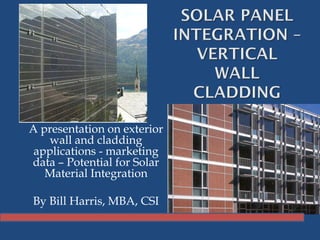
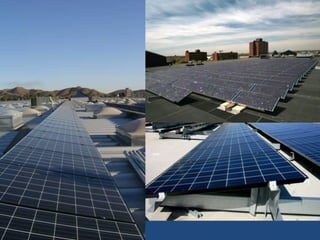
A presentation on exterior
wall and cladding
applications - marketing
data – Potential for Solar
Material Integration
By Bill Harris, MBA, CSI
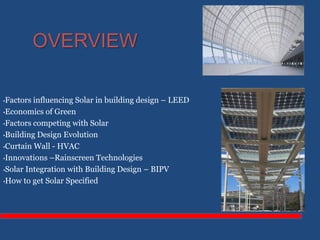
•Factors influencing Solar in building design – LEED
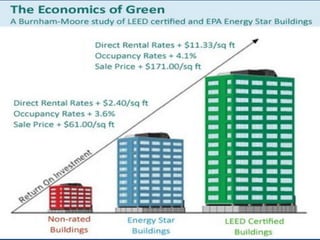
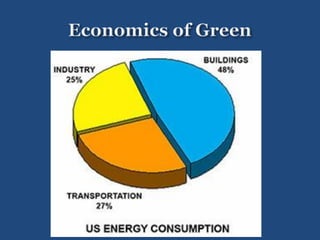
•Economics of Green
•Factors competing with Solar
•Building Design Evolution
•Curtain Wall - HVAC
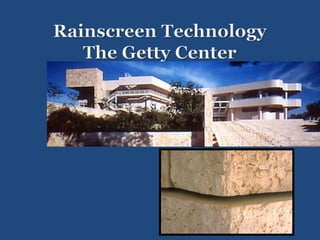
•Innovations –Rainscreen Technologies
•Solar Integration with Building Design – BIPV
•How to get Solar Specified
OVERVIEW
Leadership in Energy and Environmental
Design (LEED)
 PROVIDE A COMPETITIVE
DIFFERENTIATOR
 61% of corporate leaders believe that
sustainability leads to market differentiation
and improved financial performance
 MAKE FOR HAPPIER EMPLOYEES AND
OCCUPANTS
 LEED-certified buildings are demonstrating
increased recruitment and retention rates and
increased productivity benefits for employers.
2.5 million employees are currently
experiencing better indoor environmental
quality in LEED buildings.
 ATTRACT TENANTS
 Today’s tenants understand and are looking for
the benefits that LEED-certified spaces have to
offer. The new Class A office space is green;
lease-up rates for green buildings typically
range from average to 20% above average
 INCREASE RENTAL RATES
 A recent study of the San Diego market
showed that the overall vacancy rate for green
buildings was 4% lower than for non-green
properties — 11.7%, compared to 15.7% — and
that LEED-certified buildings continued to
command the highest rents
 OPTIMIZE HEALTH
 By bringing the good in — like clean air and
access to daylight — and keeping the bad out—
including harmful chemicals found in paints,
finishing's and more — LEED creates healthy
spaces. Buildings that optimize wellbeing are
more important than ever.
 The LEED Green Building Rating System is a program that provides
third-party verification of green buildings.
 Development of LEED began in 1993, spearheaded by Natural
Resources Defense Council (NRDC)
 The U.S. Green Building Council (USGBC), founded in 1993, is a
private 501(c)3, membership-based non-profit organization that
promotes sustainability in how buildings are designed, built, and
operated. USGBC is best known for its development of the Leadership
in Energy and Environmental Design (LEED) green building rating
systems. USGBC offers a suite of LEED professional credentials that
denote expertise in the field of green building.
 Beginning with its launch in 2000, LEED has grown from one rating
system for new construction to a comprehensive system of nine
interrelated rating systems covering all aspects of the development and
construction process
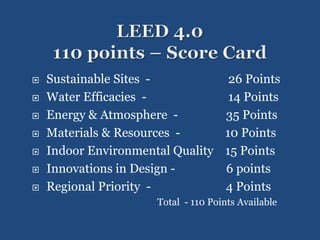
 Sustainable Sites - 26 Points
 Water Efficacies - 14 Points
 Energy & Atmosphere - 35 Points
 Materials & Resources - 10 Points
 Indoor Environmental Quality 15 Points
 Innovations in Design - 6 points
 Regional Priority - 4 Points
Total - 110 Points Available
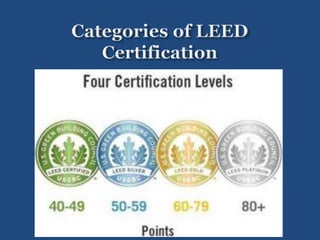
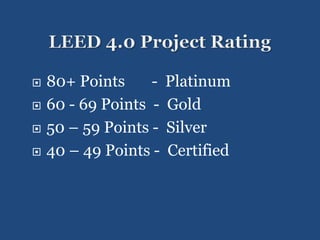
 80+ Points - Platinum
 60 - 69 Points - Gold
 50 – 59 Points - Silver
 40 – 49 Points - Certified
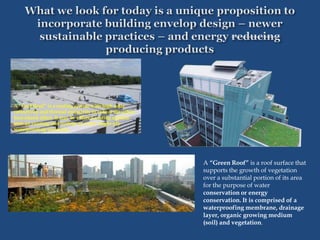
A “Cool Roof” is a roofing system with high solar
reflectivity and thermal emissivity to reduce the urban
heat island effect. It may be either a coating applied
over an existing roof system or a new single-ply
waterproofing membrane.
A “Green Roof” is a roof surface that
supports the growth of vegetation
over a substantial portion of its area
for the purpose of water
conservation or energy
conservation. It is comprised of a
waterproofing membrane, drainage
layer, organic growing medium
(soil) and vegetation.
 •Innovations – Curtain Wall –
HVAC – Glazing
 Closed Cavity – Face Sealed
 Sick Building Syndrome – Product Off
Gassing – Moisture infestation (Mold)
 Ventilated Rainscreen Wall
Technology
 Applications to combine Solar
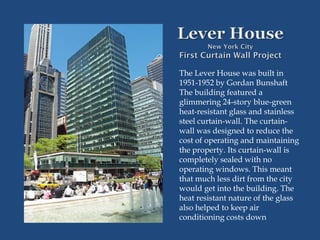
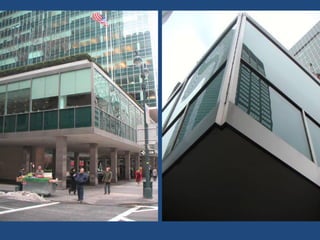
The Lever House was built in
1951-1952 by Gordan Bunshaft
The building featured a
glimmering 24-story blue-green
heat-resistant glass and stainless
steel curtain-wall. The curtain-
wall was designed to reduce the
cost of operating and maintaining
the property. Its curtain-wall is
completely sealed with no
operating windows. This meant
that much less dirt from the city
would get into the building. The
heat resistant nature of the glass
also helped to keep air
conditioning costs down
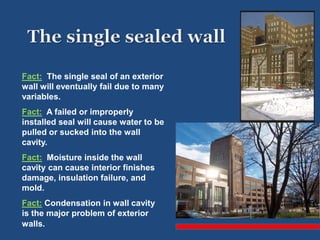
Fact: The single seal of an exterior
wall will eventually fail due to many
variables.
Fact: A failed or improperly
installed seal will cause water to be
pulled or sucked into the wall
cavity.
Fact: Moisture inside the wall
cavity can cause interior finishes
damage, insulation failure, and
mold.
Fact: Condensation in wall cavity
is the major problem of exterior
walls.
The primary exterior wall construction
used today, is designed around providing
joint sealants to allow the various exterior
cladding components to act as a barrier to
resist all air and water infiltration much like
a submarine.
This is referred to as:
“Face Sealed”
 Like a submarine….the wall attempts to resist all air and water. As
long as the seals hold…the air and water is repelled.
 Unfortunately, as with a submarine, the pressure outside of the
building is greater than the pressure inside the building.
 Due to unequal pressure between the exterior surface and the
interior cavity, water is driven into the cavity wherever a breach is
developed in the sealant. Design driven by use of sealant
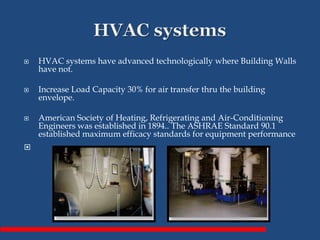
 HVAC systems have advanced technologically where Building Walls
have not.
 Increase Load Capacity 30% for air transfer thru the building
envelope.
 American Society of Heating, Refrigerating and Air-Conditioning
Engineers was established in 1894.. The ASHRAE Standard 90.1
established maximum efficacy standards for equipment performance

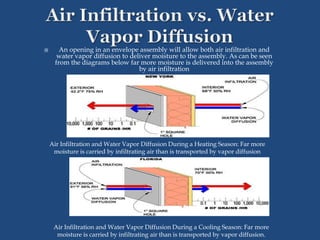
 An opening in an envelope assembly will allow both air infiltration and
water vapor diffusion to deliver moisture to the assembly. As can be seen
from the diagrams below far more moisture is delivered into the assembly
by air infiltration
Air Infiltration and Water Vapor Diffusion During a Heating Season: Far more
moisture is carried by infiltrating air than is transported by vapor diffusion
Air Infiltration and Water Vapor Diffusion During a Cooling Season: Far more
moisture is carried by infiltrating air than is transported by vapor diffusion.
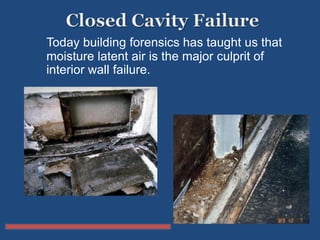
Today building forensics has taught us that
moisture latent air is the major culprit of
interior wall failure.
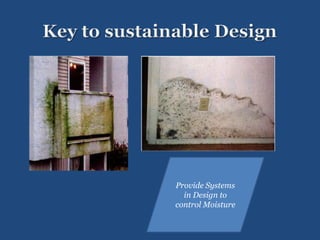
 System
Provide Systems
in Design to
control Moisture
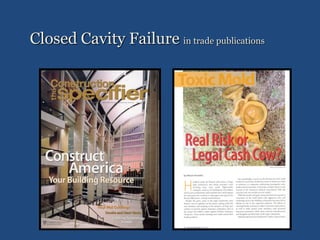
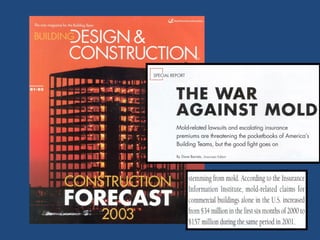
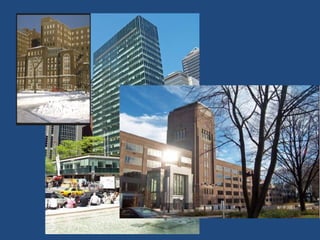
Closed Cavity Failure in trade publications
__
__
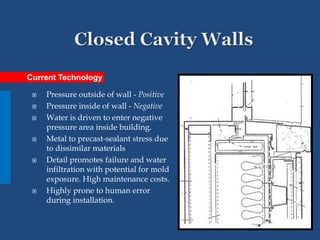
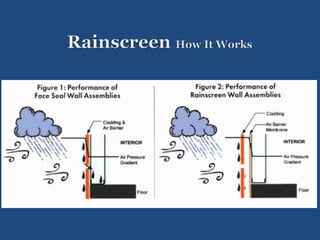
 Pressure outside of wall - Positive
 Pressure inside of wall - Negative
 Water is driven to enter negative
pressure area inside building.
 Metal to precast-sealant stress due
to dissimilar materials
 Detail promotes failure and water
infiltration with potential for mold
exposure. High maintenance costs.
 Highly prone to human error
during installation.
Current Technology
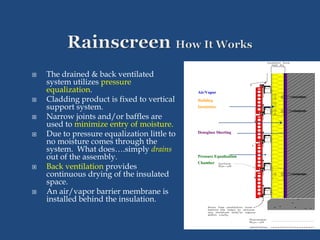
 The drained & back ventilated
system utilizes pressure
equalization.
 Cladding product is fixed to vertical
support system.
 Narrow joints and/or baffles are
used to minimize entry of moisture.
 Due to pressure equalization little to
no moisture comes through the
system. What does….simply drains
out of the assembly.
 Back ventilation provides
continuous drying of the insulated
space.
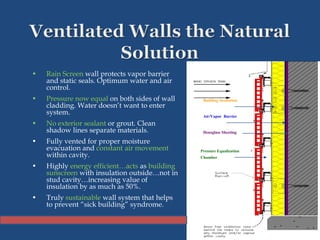
 An air/vapor barrier membrane is
installed behind the insulation.
Air/Vapor
BarrierBuilding
Insulation
Densglass Sheeting
Pressure Equalization
Chamber
• Rain Screen wall protects vapor barrier
and static seals. Optimum water and air
control.
• Pressure now equal on both sides of wall
cladding. Water doesn’t want to enter
system.
• No exterior sealant or grout. Clean
shadow lines separate materials.
• Fully vented for proper moisture
evacuation and constant air movement
within cavity.
• Highly energy efficient…acts as building
sunscreen with insulation outside…not in
stud cavity…increasing value of
insulation by as much as 50%.
• Truly sustainable wall system that helps
to prevent “sick building” syndrome.
Building Insulation
Air/Vapor Barrier
Densglass Sheeting
Pressure Equalization
Chamber
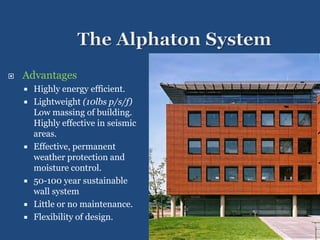
 Advantages
 Highly energy efficient.
 Lightweight (10lbs p/s/f)
Low massing of building.
Highly effective in seismic
areas.
 Effective, permanent
weather protection and
moisture control.
 50-100 year sustainable
wall system
 Little or no maintenance.
 Flexibility of design.
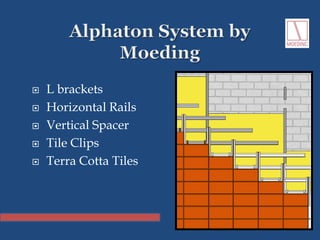
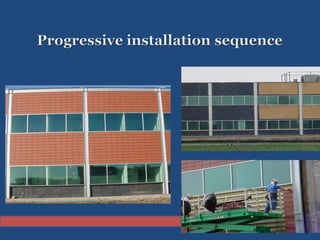
 L brackets
 Horizontal Rails
 Vertical Spacer
 Tile Clips
 Terra Cotta Tiles
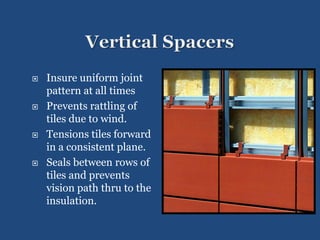
 Insure uniform joint
pattern at all times
 Prevents rattling of
tiles due to wind.
 Tensions tiles forward
in a consistent plane.
 Seals between rows of
tiles and prevents
vision path thru to the
insulation.
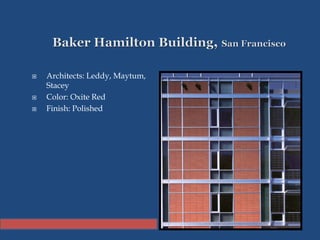
 Architects: Leddy, Maytum,
Stacey
 Color: Oxite Red
 Finish: Polished
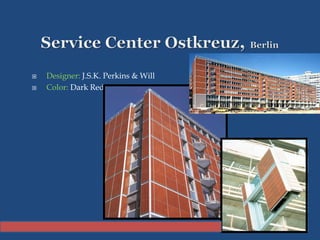
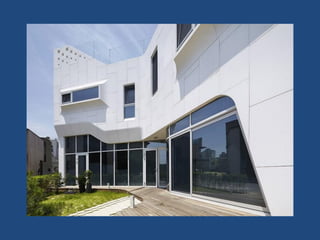
 Designer: J.S.K. Perkins & Will
 Color: Dark Red
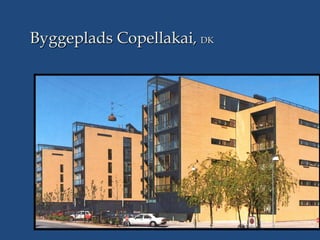
Byggeplads Copellakai, DK
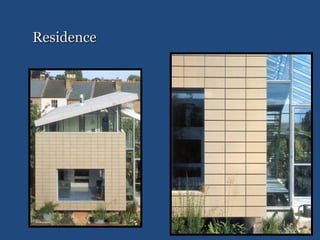
Residence
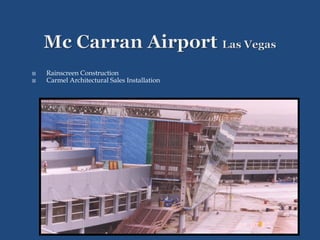
 Rainscreen Construction
 Carmel Architectural Sales Installation
 Total US nonresidential cladding market is ~1.5 billion square
feet.. High end architectural cladding materials such as insulated
metal panels, aluminum composite materials (Alucobond etc),
aluminum plate, stone and other specialty materials account for
~10% of the total market in volume/area terms.
June 2009
Research information provided by:
Nick Limb
Partner
Ducker Worldwide
1250 Maplelawn Drive
Troy, MI 48084
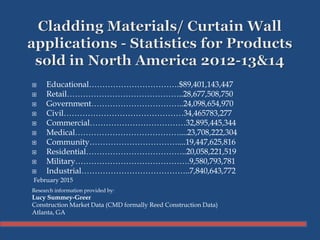
 Educational…………………………….$89,401,143,447
 Retail……………………………………..28,677,508,750
 Government……………………………..24,098,654,970
 Civil………………………………………34,465783,277
 Commercial………………………………32,895,445,344
 Medical…………………………………....23,708,222,304
 Community……………………………....19,447,625,816
 Residential………………………………..20,058,221,519
 Military…………………………………….9,580,793,781
 Industrial…………………………………..7,840,643,772
February 2015
Research information provided by:
Lucy Summey-Greer
Construction Market Data (CMD formally Reed Construction Data)
Atlanta, GA
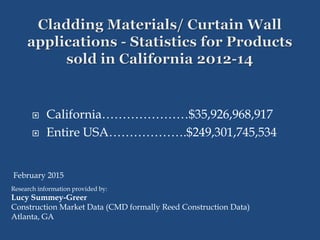
 California…………………$35,926,968,917
 Entire USA……………….$249,301,745,534
February 2015
Research information provided by:
Lucy Summey-Greer
Construction Market Data (CMD formally Reed Construction Data)
Atlanta, GA
Click here to download.
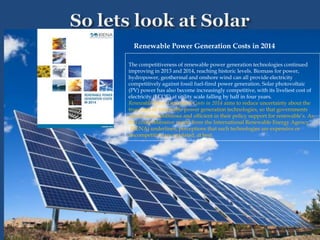
The competitiveness of
renewable power
generation technologies
continued improving in 2013
and 2014, reaching historic
levels. Biomass for power,
hydropower, geothermal
and onshore wind can all
provide electricity
competitively against fossil
fuel-fired power generation.
Solar photovoltaic (PV)
power has also become
increasingly competitive,
with its levelised cost of
electricity (LCOE) at utility
scale falling by half in four
years.
Renewable Power
Generation Costs in
2014 aims to reduce
uncertainty about the true
costs of renewable power
generation technologies, so
that governments can be
more ambitious and efficient
in their policy support for
renewables. As this
comprehensive report from
the International Renewable
Energy Agency (IRENA)
underlines, perceptions that
such technologies are
expensive or uncompetitive
are outdated, at best.
The competitiveness of renewable power generation technologies continued
improving in 2013 and 2014, reaching historic levels. Biomass for power,
hydropower, geothermal and onshore wind can all provide electricity
competitively against fossil fuel-fired power generation. Solar photovoltaic
(PV) power has also become increasingly competitive, with its liveliest cost of
electricity (LCOE) at utility scale falling by half in four years.
Renewable Power Generation Costs in 2014 aims to reduce uncertainty about the
true costs of renewable power generation technologies, so that governments
can be more ambitious and efficient in their policy support for renewable’s. As
this comprehensive report from the International Renewable Energy Agency
(IRENA) underlines, perceptions that such technologies are expensive or
uncompetitive are outdated, at best.
Renewable Power Generation Costs in 2014
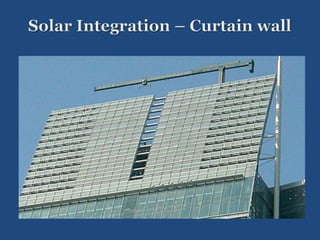
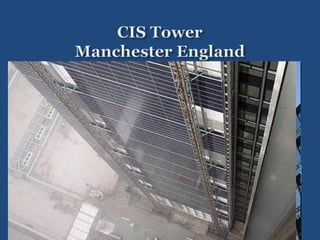
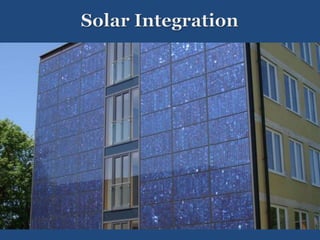
What do you do when your 40 old building
tower is in need of a facelift? This was the
dilemma that the owners of the CIS tower in
Manchester faced after the original facade of
the building became in serious need of repair.
Their solution? To cover it in solar panels to
provide electrical power to the building.
The original facade of the service tower was
composed of small mosaic tiles which had over
time begun to fall exposing the concrete
structure to the weather. After looking at the
available options, the owners of the building
decided to cover the 120m. tall service tower
with over 7,000 photovoltaic panels. The
panels, as well as calling back to the original
facade of the building and weatherproof the
service core, are also expected to provide the
equivalent energy needed to power an
additional 55 homes for a year.
The total cost of the project ended up being
about 5.5 million pounds (about 10 million
dollars). And was recently finished, making it
the largest vertical solar array on Europe.
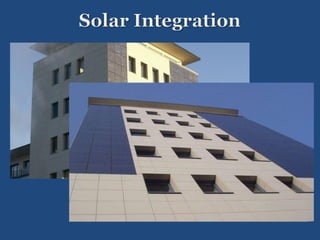
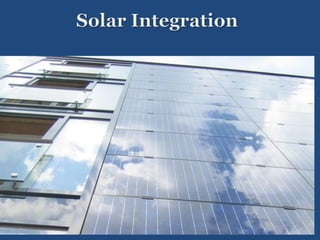
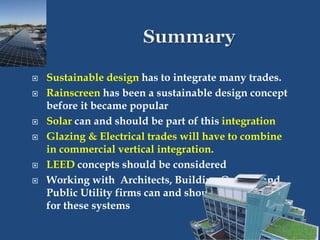
 Sustainable design has to integrate many trades.
 Rainscreen has been a sustainable design concept
before it became popular
 Solar can and should be part of this integration
 Glazing & Electrical trades will have to combine
in commercial vertical integration.
 LEED concepts should be considered
 Working with Architects, Building Owners and
Public Utility firms can and should be the focus
for these systems
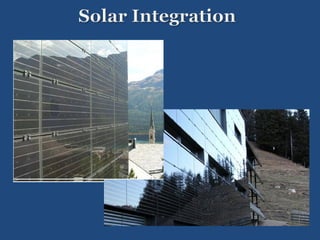
Solar panel integration – vertical wall cladding   la build expo 2015

Solar panel integration – vertical wall cladding la build expo 2015

  • 1.
    A presentation onexterior wall and cladding applications - marketing data – Potential for Solar Material Integration By Bill Harris, MBA, CSI
  • 2.
    •Factors influencing Solarin building design – LEED •Economics of Green •Factors competing with Solar •Building Design Evolution •Curtain Wall - HVAC •Innovations –Rainscreen Technologies •Solar Integration with Building Design – BIPV •How to get Solar Specified OVERVIEW
  • 5.
    Leadership in Energyand Environmental Design (LEED)  PROVIDE A COMPETITIVE DIFFERENTIATOR  61% of corporate leaders believe that sustainability leads to market differentiation and improved financial performance
  • 6.
     MAKE FORHAPPIER EMPLOYEES AND OCCUPANTS  LEED-certified buildings are demonstrating increased recruitment and retention rates and increased productivity benefits for employers. 2.5 million employees are currently experiencing better indoor environmental quality in LEED buildings.
  • 7.
     ATTRACT TENANTS Today’s tenants understand and are looking for the benefits that LEED-certified spaces have to offer. The new Class A office space is green; lease-up rates for green buildings typically range from average to 20% above average
  • 8.
     INCREASE RENTALRATES  A recent study of the San Diego market showed that the overall vacancy rate for green buildings was 4% lower than for non-green properties — 11.7%, compared to 15.7% — and that LEED-certified buildings continued to command the highest rents
  • 10.
     OPTIMIZE HEALTH By bringing the good in — like clean air and access to daylight — and keeping the bad out— including harmful chemicals found in paints, finishing's and more — LEED creates healthy spaces. Buildings that optimize wellbeing are more important than ever.
  • 12.
     The LEEDGreen Building Rating System is a program that provides third-party verification of green buildings.  Development of LEED began in 1993, spearheaded by Natural Resources Defense Council (NRDC)  The U.S. Green Building Council (USGBC), founded in 1993, is a private 501(c)3, membership-based non-profit organization that promotes sustainability in how buildings are designed, built, and operated. USGBC is best known for its development of the Leadership in Energy and Environmental Design (LEED) green building rating systems. USGBC offers a suite of LEED professional credentials that denote expertise in the field of green building.  Beginning with its launch in 2000, LEED has grown from one rating system for new construction to a comprehensive system of nine interrelated rating systems covering all aspects of the development and construction process
  • 13.
     Sustainable Sites- 26 Points  Water Efficacies - 14 Points  Energy & Atmosphere - 35 Points  Materials & Resources - 10 Points  Indoor Environmental Quality 15 Points  Innovations in Design - 6 points  Regional Priority - 4 Points Total - 110 Points Available
  • 15.
     80+ Points- Platinum  60 - 69 Points - Gold  50 – 59 Points - Silver  40 – 49 Points - Certified
  • 18.
    A “Cool Roof”is a roofing system with high solar reflectivity and thermal emissivity to reduce the urban heat island effect. It may be either a coating applied over an existing roof system or a new single-ply waterproofing membrane. A “Green Roof” is a roof surface that supports the growth of vegetation over a substantial portion of its area for the purpose of water conservation or energy conservation. It is comprised of a waterproofing membrane, drainage layer, organic growing medium (soil) and vegetation.
  • 19.
     •Innovations –Curtain Wall – HVAC – Glazing  Closed Cavity – Face Sealed  Sick Building Syndrome – Product Off Gassing – Moisture infestation (Mold)  Ventilated Rainscreen Wall Technology  Applications to combine Solar
  • 20.
    The Lever Housewas built in 1951-1952 by Gordan Bunshaft The building featured a glimmering 24-story blue-green heat-resistant glass and stainless steel curtain-wall. The curtain- wall was designed to reduce the cost of operating and maintaining the property. Its curtain-wall is completely sealed with no operating windows. This meant that much less dirt from the city would get into the building. The heat resistant nature of the glass also helped to keep air conditioning costs down
  • 22.
    Fact: The singleseal of an exterior wall will eventually fail due to many variables. Fact: A failed or improperly installed seal will cause water to be pulled or sucked into the wall cavity. Fact: Moisture inside the wall cavity can cause interior finishes damage, insulation failure, and mold. Fact: Condensation in wall cavity is the major problem of exterior walls.
  • 23.
    The primary exteriorwall construction used today, is designed around providing joint sealants to allow the various exterior cladding components to act as a barrier to resist all air and water infiltration much like a submarine. This is referred to as: “Face Sealed”
  • 24.
     Like asubmarine….the wall attempts to resist all air and water. As long as the seals hold…the air and water is repelled.  Unfortunately, as with a submarine, the pressure outside of the building is greater than the pressure inside the building.  Due to unequal pressure between the exterior surface and the interior cavity, water is driven into the cavity wherever a breach is developed in the sealant. Design driven by use of sealant
  • 25.
     HVAC systemshave advanced technologically where Building Walls have not.  Increase Load Capacity 30% for air transfer thru the building envelope.  American Society of Heating, Refrigerating and Air-Conditioning Engineers was established in 1894.. The ASHRAE Standard 90.1 established maximum efficacy standards for equipment performance 
  • 26.
     An openingin an envelope assembly will allow both air infiltration and water vapor diffusion to deliver moisture to the assembly. As can be seen from the diagrams below far more moisture is delivered into the assembly by air infiltration Air Infiltration and Water Vapor Diffusion During a Heating Season: Far more moisture is carried by infiltrating air than is transported by vapor diffusion Air Infiltration and Water Vapor Diffusion During a Cooling Season: Far more moisture is carried by infiltrating air than is transported by vapor diffusion.
  • 27.
    Today building forensicshas taught us that moisture latent air is the major culprit of interior wall failure.
  • 28.
     System Provide Systems inDesign to control Moisture
  • 29.
    Closed Cavity Failurein trade publications
  • 32.
    __ __  Pressure outsideof wall - Positive  Pressure inside of wall - Negative  Water is driven to enter negative pressure area inside building.  Metal to precast-sealant stress due to dissimilar materials  Detail promotes failure and water infiltration with potential for mold exposure. High maintenance costs.  Highly prone to human error during installation. Current Technology
  • 35.
     The drained& back ventilated system utilizes pressure equalization.  Cladding product is fixed to vertical support system.  Narrow joints and/or baffles are used to minimize entry of moisture.  Due to pressure equalization little to no moisture comes through the system. What does….simply drains out of the assembly.  Back ventilation provides continuous drying of the insulated space.  An air/vapor barrier membrane is installed behind the insulation. Air/Vapor BarrierBuilding Insulation Densglass Sheeting Pressure Equalization Chamber
  • 36.
    • Rain Screenwall protects vapor barrier and static seals. Optimum water and air control. • Pressure now equal on both sides of wall cladding. Water doesn’t want to enter system. • No exterior sealant or grout. Clean shadow lines separate materials. • Fully vented for proper moisture evacuation and constant air movement within cavity. • Highly energy efficient…acts as building sunscreen with insulation outside…not in stud cavity…increasing value of insulation by as much as 50%. • Truly sustainable wall system that helps to prevent “sick building” syndrome. Building Insulation Air/Vapor Barrier Densglass Sheeting Pressure Equalization Chamber
  • 37.
     Advantages  Highlyenergy efficient.  Lightweight (10lbs p/s/f) Low massing of building. Highly effective in seismic areas.  Effective, permanent weather protection and moisture control.  50-100 year sustainable wall system  Little or no maintenance.  Flexibility of design.
  • 38.
     L brackets Horizontal Rails  Vertical Spacer  Tile Clips  Terra Cotta Tiles
  • 39.
     Insure uniformjoint pattern at all times  Prevents rattling of tiles due to wind.  Tensions tiles forward in a consistent plane.  Seals between rows of tiles and prevents vision path thru to the insulation.
  • 40.
     Architects: Leddy,Maytum, Stacey  Color: Oxite Red  Finish: Polished
  • 42.
     Designer: J.S.K.Perkins & Will  Color: Dark Red
  • 43.
  • 44.
  • 46.
     Rainscreen Construction Carmel Architectural Sales Installation
  • 47.
     Total USnonresidential cladding market is ~1.5 billion square feet.. High end architectural cladding materials such as insulated metal panels, aluminum composite materials (Alucobond etc), aluminum plate, stone and other specialty materials account for ~10% of the total market in volume/area terms. June 2009 Research information provided by: Nick Limb Partner Ducker Worldwide 1250 Maplelawn Drive Troy, MI 48084
  • 48.
     Educational…………………………….$89,401,143,447  Retail……………………………………..28,677,508,750 Government……………………………..24,098,654,970  Civil………………………………………34,465783,277  Commercial………………………………32,895,445,344  Medical…………………………………....23,708,222,304  Community……………………………....19,447,625,816  Residential………………………………..20,058,221,519  Military…………………………………….9,580,793,781  Industrial…………………………………..7,840,643,772 February 2015 Research information provided by: Lucy Summey-Greer Construction Market Data (CMD formally Reed Construction Data) Atlanta, GA
  • 49.
     California…………………$35,926,968,917  EntireUSA……………….$249,301,745,534 February 2015 Research information provided by: Lucy Summey-Greer Construction Market Data (CMD formally Reed Construction Data) Atlanta, GA
  • 50.
    Click here todownload. The competitiveness of renewable power generation technologies continued improving in 2013 and 2014, reaching historic levels. Biomass for power, hydropower, geothermal and onshore wind can all provide electricity competitively against fossil fuel-fired power generation. Solar photovoltaic (PV) power has also become increasingly competitive, with its levelised cost of electricity (LCOE) at utility scale falling by half in four years. Renewable Power Generation Costs in 2014 aims to reduce uncertainty about the true costs of renewable power generation technologies, so that governments can be more ambitious and efficient in their policy support for renewables. As this comprehensive report from the International Renewable Energy Agency (IRENA) underlines, perceptions that such technologies are expensive or uncompetitive are outdated, at best. The competitiveness of renewable power generation technologies continued improving in 2013 and 2014, reaching historic levels. Biomass for power, hydropower, geothermal and onshore wind can all provide electricity competitively against fossil fuel-fired power generation. Solar photovoltaic (PV) power has also become increasingly competitive, with its liveliest cost of electricity (LCOE) at utility scale falling by half in four years. Renewable Power Generation Costs in 2014 aims to reduce uncertainty about the true costs of renewable power generation technologies, so that governments can be more ambitious and efficient in their policy support for renewable’s. As this comprehensive report from the International Renewable Energy Agency (IRENA) underlines, perceptions that such technologies are expensive or uncompetitive are outdated, at best. Renewable Power Generation Costs in 2014
  • 54.
    What do youdo when your 40 old building tower is in need of a facelift? This was the dilemma that the owners of the CIS tower in Manchester faced after the original facade of the building became in serious need of repair. Their solution? To cover it in solar panels to provide electrical power to the building. The original facade of the service tower was composed of small mosaic tiles which had over time begun to fall exposing the concrete structure to the weather. After looking at the available options, the owners of the building decided to cover the 120m. tall service tower with over 7,000 photovoltaic panels. The panels, as well as calling back to the original facade of the building and weatherproof the service core, are also expected to provide the equivalent energy needed to power an additional 55 homes for a year. The total cost of the project ended up being about 5.5 million pounds (about 10 million dollars). And was recently finished, making it the largest vertical solar array on Europe.
  • 60.
     Sustainable designhas to integrate many trades.  Rainscreen has been a sustainable design concept before it became popular  Solar can and should be part of this integration  Glazing & Electrical trades will have to combine in commercial vertical integration.  LEED concepts should be considered  Working with Architects, Building Owners and Public Utility firms can and should be the focus for these systems