LEED your way
Of life
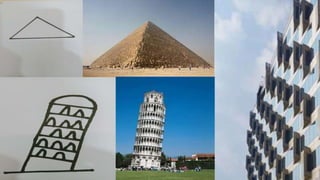
Do identify the buildings the following sketch
represents
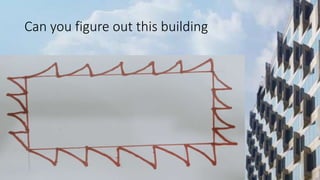
Can you figure out this building
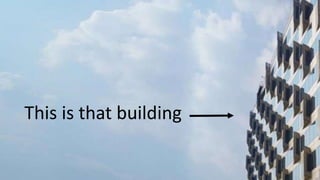
This is that building
MAIN ENVIRONMENTAL CATEGORIES:
• Sustainable Architecture and Design
• Site Selection and Planning
• Water Conservation
• Energy Efficiency
• Building Materials and Resources
• Indoor Environmental Quality
• Innovation and Development
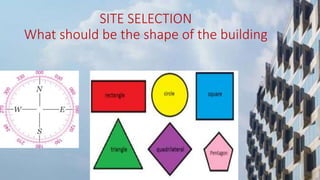
SITE SELECTION
What should be the shape of the building
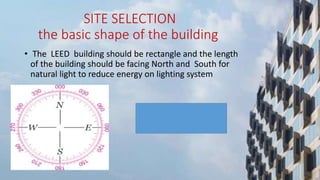
SITE SELECTION
the basic shape of the building
• The LEED building should be rectangle and the length
of the building should be facing North and South for
natural light to reduce energy on lighting system
SITE SELECTION
Advantages of building with N&S facing
• No shadow at any time of the day time
• No glaring at any time during morning or evening hours
• Buildings can be constructed close to each others
• More space will be covered with natural light
• Can accommodate more solar panels
Site Selection and Planning
• Site should be proximity to rail road connection
• Near by housing complex or society
• Abundance of raw material for construction
• Possibly away from Urban Heat Load
• Amble parking slots and proper way for vehicle movement
inside the campus
• Not near a heavy traffic zone
Sustainable Architecture and Design
LIFE CYCLE ASSESSMENT
• 80 % steel for the paneling compared to conventional wood based partition
• Fabrics : 100% Cotton or PP based without any blend
• 100 % use of reconstituted wood: (PPB or MDF) for work surfaces
• Number of parts reduced to minimum
• Easy to disassemble reconfigure and refurbish for reuse
• Paper based packing material: 100 % Recyclable
Advantages of sunlight in home
• Increase in vitamins B and D
• Ultraviolet rays in the sun are naturally antiseptic.
• Sunlight stimulates appetite and improves digestion.
• Natural sun increases red blood cells.
• Sunlight boosts your immune system.
• Natural light boosts white blood cell counts.
• Daytime sun helps persons sleep better at night.
• Sunlight helps to balance the body’s hormones.
• Natural sun boosts energy and strengthens organs.
Advantages of facade glasses (DGU)
• Can deflect heat and allow only light to indoor
• Not easily affected by air or water and any chemicals.
• Can be polished, cast into any desired shape and modify
• its properties like hardness,
• Very high resistance to heat flow and allows light to pass
through and Provide insulating effect
• It is made of two or more plates of glass of 6mm and 12mm of
gap between each glass
• dehydrated captive air or vacuum
• Edges are sealed of the glass.
Energy Efficiency lighting system
• Maximum usage of day light
• Use glass to reduce heat gain and max natural light
• Online monitoring system to monitor the energy
performance. and energy consumption.
• Usage of timers occupancy sensor luminous sensors .
• Else install DALI system for lighting to save energy
up to 60 %
Advantages of DALI system
• Saves lighting power up to 60 % max
• Light intensity for each person can be set
• Light adjustment based on luminous
• Occupancy sensor
• Timer based operation that can be programmed with
meteorological time (IMD,BBC, Accuweather )
• Can be connected with access control
• Can be connected to BMS
Which will have impact on energy loss in HVAC
• Chillers
• Pumps
• Cooling tower
• Water quality
• Control system
• AHU
• Air duct
• Building construction
HVAC
➢ Air Cooled Chiller Advantages
• Lower installed cost
• Quicker availability
• No cooling tower or condenser pump required
• Less maintenance
• No mechanical room required
➢ Water-Cooled Chiller advantages
• Higher efficiency
• Custom selection in larger sizes
• Large tonnage capabilities
• Indoor Chiller location
• Longer life
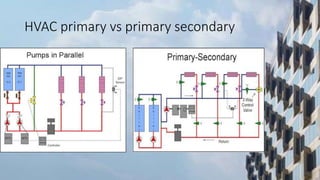
HVAC primary vs primary secondary
• ONLY PRIMARY PUMP
This simple design AND low first cost and good flexibility.
It decreases the complexity of the chiller plant
However, efficiency is limited because the zone
Only applicable single tenant fixed working hours
• PRIMARY AND SECONDARY
This offers all the efficiency and flexibility for 24/7
but does eliminate some of the extra equipment
High initial cost additional pumps and controls
Advantage for multi tenant 24/7 working hours
WATER EFFICIENCY
• Harvest 100% of the rain water, and recycle 100% of all the
water used in the building including waste water.
• Use of waterless urinals in the building with biological
blocks hence saves 3lakhs liters of water per annum.
• Annually, storm water pits recharged ground water
by around 5500 KL
• sewage treatment plant recycled 6900 KL of water
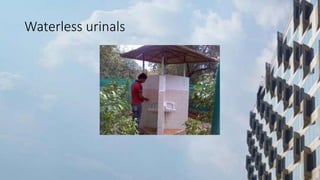
Waterless urinals
Advantages of waterless urinals
• Waterless Urinals do not require water for flushing
• Human Urine is a potential resource that can be beneficially used for
agriculture
• waterless urinals save min 56,800 liters per urinal
• waterless urinals and touch free operations reduce spreading of
communicable diseases.
• Save enormous quantities of freshwater
• Optimize cost of plumbing accessories
• Conserve electricity used for pumping &water treating
• Saves cost of production of fertilizers
Rain water harvesting
• It can either be stored in a tank or recharge system. This method is
less expensive and very useful and helps in augmenting the
groundwater level of the area
• Filter
• doubts are raised that rainwater may contaminate groundwater. T
• here is a remote possibility of this fear coming true if
the proper filter mechanism is not adopted.
Water distribution for high raise building
Volatile Organic Compounds in Your Home
• Volatile Organic Compounds (VOCs) are a large group of chemicals
that are found in many products we use to build and maintain our
homes. Once these chemicals are in our homes, they are released or
“off-gas” into the indoor air we breathe. They may or may not be
able to be smelled, and smelling is not a good indicator of health risk.
• Common examples of VOCs that may be present in our daily lives
are: benzene, ethylene glycol, formaldehyde, methylene chloride,
tetrachloroethylene, toluene, xylene, and 1,3-butadiene.
• Sources of VOCs
• Building Materials
• Home & Personal Care Products
• Activities ( smoking )
Volatile Organic Compounds Present in
•ETHANOL, ACETONE ,BENZENE
• Paint, varnishes, caulks, adhesives
• Carpet, vinyl flooring
• Composite wood products
• Upholstery and foam
• Air fresheners, cleaning products Cosmetics
• Fuel oil, gasoline
• Smoking
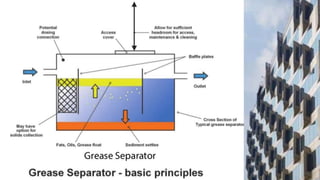
Impact of FOG in drainage and STP
• FOG is the most common cause of slow and blocked drains in a
drainage system. FOG flow down drains initially, but as they
cool, they harden, slowing drainage and causing drain backups.
• As oil and fats cool, they join the grease and collect on the sides
of pipes as well.
• FOG reduces the efficiency of STP which will lead to higher
BIO/COD levels, continuous foul odor, increase in Total
Suspended Solids (TSS) and bottom solids and dirty water from
the outlets.
LEED Karle.pptx
LEED Karle.pptx
LEED Karle.pptx

LEED Karle.pptx

  • 1.
  • 2.
    Do identify thebuildings the following sketch represents
  • 5.
    Can you figureout this building
  • 6.
    This is thatbuilding
  • 7.
    MAIN ENVIRONMENTAL CATEGORIES: •Sustainable Architecture and Design • Site Selection and Planning • Water Conservation • Energy Efficiency • Building Materials and Resources • Indoor Environmental Quality • Innovation and Development
  • 8.
    SITE SELECTION What shouldbe the shape of the building
  • 9.
    SITE SELECTION the basicshape of the building • The LEED building should be rectangle and the length of the building should be facing North and South for natural light to reduce energy on lighting system
  • 10.
    SITE SELECTION Advantages ofbuilding with N&S facing • No shadow at any time of the day time • No glaring at any time during morning or evening hours • Buildings can be constructed close to each others • More space will be covered with natural light • Can accommodate more solar panels
  • 11.
    Site Selection andPlanning • Site should be proximity to rail road connection • Near by housing complex or society • Abundance of raw material for construction • Possibly away from Urban Heat Load • Amble parking slots and proper way for vehicle movement inside the campus • Not near a heavy traffic zone
  • 12.
    Sustainable Architecture andDesign LIFE CYCLE ASSESSMENT • 80 % steel for the paneling compared to conventional wood based partition • Fabrics : 100% Cotton or PP based without any blend • 100 % use of reconstituted wood: (PPB or MDF) for work surfaces • Number of parts reduced to minimum • Easy to disassemble reconfigure and refurbish for reuse • Paper based packing material: 100 % Recyclable
  • 13.
    Advantages of sunlightin home • Increase in vitamins B and D • Ultraviolet rays in the sun are naturally antiseptic. • Sunlight stimulates appetite and improves digestion. • Natural sun increases red blood cells. • Sunlight boosts your immune system. • Natural light boosts white blood cell counts. • Daytime sun helps persons sleep better at night. • Sunlight helps to balance the body’s hormones. • Natural sun boosts energy and strengthens organs.
  • 14.
    Advantages of facadeglasses (DGU) • Can deflect heat and allow only light to indoor • Not easily affected by air or water and any chemicals. • Can be polished, cast into any desired shape and modify • its properties like hardness, • Very high resistance to heat flow and allows light to pass through and Provide insulating effect • It is made of two or more plates of glass of 6mm and 12mm of gap between each glass • dehydrated captive air or vacuum • Edges are sealed of the glass.
  • 15.
    Energy Efficiency lightingsystem • Maximum usage of day light • Use glass to reduce heat gain and max natural light • Online monitoring system to monitor the energy performance. and energy consumption. • Usage of timers occupancy sensor luminous sensors . • Else install DALI system for lighting to save energy up to 60 %
  • 16.
    Advantages of DALIsystem • Saves lighting power up to 60 % max • Light intensity for each person can be set • Light adjustment based on luminous • Occupancy sensor • Timer based operation that can be programmed with meteorological time (IMD,BBC, Accuweather ) • Can be connected with access control • Can be connected to BMS
  • 17.
    Which will haveimpact on energy loss in HVAC • Chillers • Pumps • Cooling tower • Water quality • Control system • AHU • Air duct • Building construction
  • 18.
    HVAC ➢ Air CooledChiller Advantages • Lower installed cost • Quicker availability • No cooling tower or condenser pump required • Less maintenance • No mechanical room required ➢ Water-Cooled Chiller advantages • Higher efficiency • Custom selection in larger sizes • Large tonnage capabilities • Indoor Chiller location • Longer life
  • 19.
    HVAC primary vsprimary secondary
  • 20.
    HVAC primary vsprimary secondary • ONLY PRIMARY PUMP This simple design AND low first cost and good flexibility. It decreases the complexity of the chiller plant However, efficiency is limited because the zone Only applicable single tenant fixed working hours • PRIMARY AND SECONDARY This offers all the efficiency and flexibility for 24/7 but does eliminate some of the extra equipment High initial cost additional pumps and controls Advantage for multi tenant 24/7 working hours
  • 24.
    WATER EFFICIENCY • Harvest100% of the rain water, and recycle 100% of all the water used in the building including waste water. • Use of waterless urinals in the building with biological blocks hence saves 3lakhs liters of water per annum. • Annually, storm water pits recharged ground water by around 5500 KL • sewage treatment plant recycled 6900 KL of water
  • 25.
  • 26.
    Advantages of waterlessurinals • Waterless Urinals do not require water for flushing • Human Urine is a potential resource that can be beneficially used for agriculture • waterless urinals save min 56,800 liters per urinal • waterless urinals and touch free operations reduce spreading of communicable diseases. • Save enormous quantities of freshwater • Optimize cost of plumbing accessories • Conserve electricity used for pumping &water treating • Saves cost of production of fertilizers
  • 27.
    Rain water harvesting •It can either be stored in a tank or recharge system. This method is less expensive and very useful and helps in augmenting the groundwater level of the area • Filter • doubts are raised that rainwater may contaminate groundwater. T • here is a remote possibility of this fear coming true if the proper filter mechanism is not adopted.
  • 28.
    Water distribution forhigh raise building
  • 29.
    Volatile Organic Compoundsin Your Home • Volatile Organic Compounds (VOCs) are a large group of chemicals that are found in many products we use to build and maintain our homes. Once these chemicals are in our homes, they are released or “off-gas” into the indoor air we breathe. They may or may not be able to be smelled, and smelling is not a good indicator of health risk. • Common examples of VOCs that may be present in our daily lives are: benzene, ethylene glycol, formaldehyde, methylene chloride, tetrachloroethylene, toluene, xylene, and 1,3-butadiene. • Sources of VOCs • Building Materials • Home & Personal Care Products • Activities ( smoking )
  • 30.
    Volatile Organic CompoundsPresent in •ETHANOL, ACETONE ,BENZENE • Paint, varnishes, caulks, adhesives • Carpet, vinyl flooring • Composite wood products • Upholstery and foam • Air fresheners, cleaning products Cosmetics • Fuel oil, gasoline • Smoking
  • 31.
    Impact of FOGin drainage and STP • FOG is the most common cause of slow and blocked drains in a drainage system. FOG flow down drains initially, but as they cool, they harden, slowing drainage and causing drain backups. • As oil and fats cool, they join the grease and collect on the sides of pipes as well. • FOG reduces the efficiency of STP which will lead to higher BIO/COD levels, continuous foul odor, increase in Total Suspended Solids (TSS) and bottom solids and dirty water from the outlets.