Dr. Maribel C. Tubera, PDQM, DBA,
MsCM, UAP, PIEP, PSQ
Green Building Strategies
Towards Smart and Sustainable Cities
Design is a powerful process, it has the
potential of changing how buildings,
communities, and societies functions.
Design has the power of both
satisfying a need and providing value.
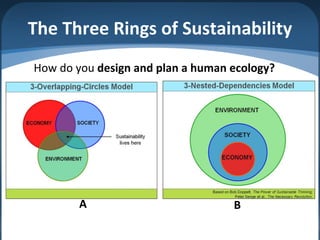
The Three Rings of Sustainability
How do you design and plan a human ecology?
A B
Sustainable Infrastructure
Building sustainability is not new...
-accommodating the site and climate
-preserving resources
-use local materials and expertise
...these are all ancient techniques which have just
been neglected since the beginning of Industrial
Revolution.
BUT...
• Today’s sustainability demands higher level
of knowledge and sophistication than it did
100 years ago.
• Green building doesn’t need to be high tech
or complex, there are simply more variables
to consider in order to minimize the
environmental disruption.
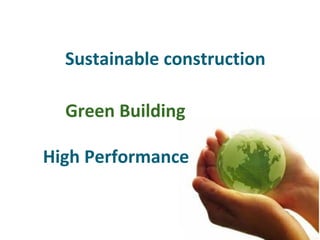
High Performance
Green Building
Sustainable construction
What is Green building?
Green building, or sustainable building, is
designed, built, operated, and maintained
using environmentally responsible and
resource efficient processes.
What is Green building?
Renovated or refurbished properties can
be also considered as green sustainable
buildings if sustainable practices are
carried out during the process.
The most important benefit of green
building is the energy efficiency, which is
reflected in the direct costs of running the
real estate property and the increase in the
net income of the building.
3 Major Forces of going GREEN
1. Growing evidence of accelerated destruction
of planetary ecosystem, alteration of global
biogeochemical cycles, and enormous
increase in population and consumption
• “The sixth extinction- the human species’
massive destruction of life and biodiversity on
the planet.”
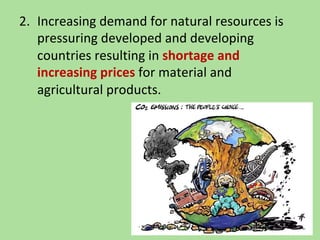
2. Increasing demand for natural resources is
pressuring developed and developing
countries resulting in shortage and
increasing prices for material and
agricultural products.
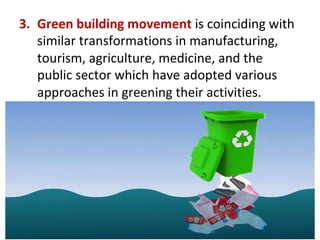
3. Green building movement is coinciding with
similar transformations in manufacturing,
tourism, agriculture, medicine, and the
public sector which have adopted various
approaches in greening their activities.
Principles of Sustainable Construction
• Reduce resource consumption
• Reuse resources
• Use recyclable resources
• Protect nature
• Eliminate toxins
• Apply life cycle costing
• Focus on quality
1. Reduce
2. Reuse
3. Recycle
4. Nature
5. Toxics
6. Economics
7. Quality
RA 9729 – Climate Change Act of 2009
• An Act mainstreaming CLIMATE CHANGE into
government policy formulations, establishing
the framework strategy and program on
climate change, creating for this purpose the
climate change commission, and for other
purposes.
RA 9729 Section 2
• The state has adopted the Philippine Agenda
21 framework which espouses sustainable
development to fulfil human needs while
maintaining the quality of the natural
environment for current and future
generations
PHILIPPINE GREEN BUILDING
CODE
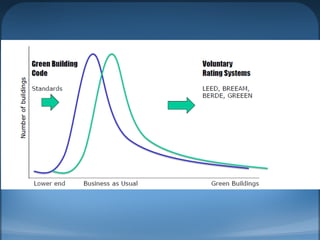
• The Code proposes a set of standards
which apply to efficient use of resources,
site selection, planning, design,
construction, use, occupancy, operation
and maintenance.
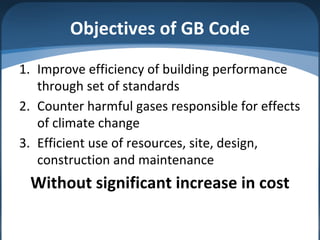
Objectives of GB Code
1. Improve efficiency of building performance
through set of standards
2. Counter harmful gases responsible for effects
of climate change
3. Efficient use of resources, site, design,
construction and maintenance
Without significant increase in cost
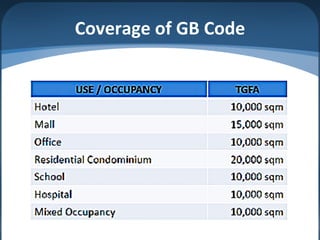
Coverage of GB Code
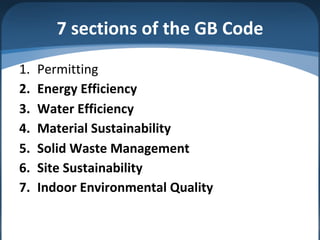
7 sections of the GB Code
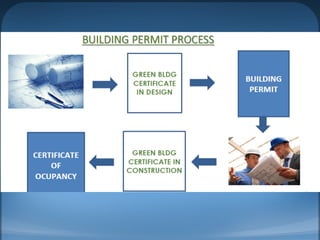
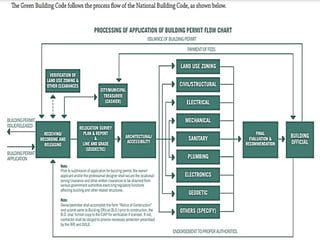
1. Permitting
2. Energy Efficiency
3. Water Efficiency
4. Material Sustainability
5. Solid Waste Management
6. Site Sustainability
7. Indoor Environmental Quality
ENERGY EFFICIENCY
Design Principles for Energy Efficiency
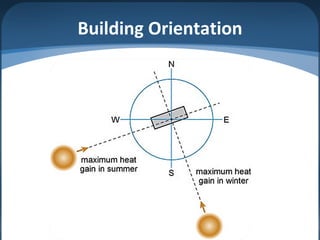
Building Orientation
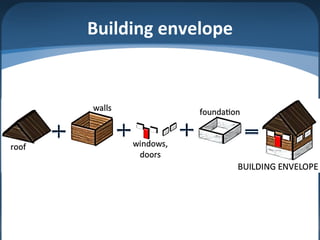
Building envelope
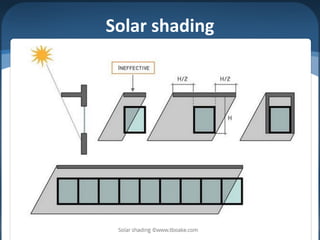
Solar shading
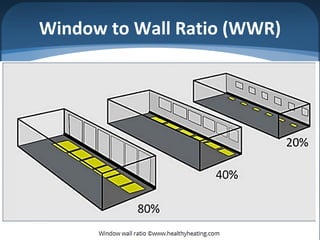
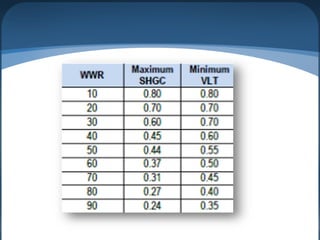
Window to Wall Ratio (WWR)
U-factor:
• It measures how much heat is conducted
through a window.
• A low U-factor signifies that a window is
well-insulated and therefore more energy-
efficient.
• A rating of 0.30 or below is considered very
good.
Solar heat-gain coefficient (SHGC):
• SHGC can improve indoor climate control
through the installation of high-SHGC
(>0.55) windows in cold climates and
low-SHGC (<0.40) windows in warm
climates.
Visible transmittance (VT):
• the amount of visible light that can pass
through a window.
• VT is measured on a scale of 0 to 1, where 0
signifies no light transmittance and 1 is
complete light transmittance.
• Coatings, glazes, and tints can reduce VT
Light-to-solar gain (LSG):
• Ratio of VT to SHGC.
• A high LSG rating is given to a window that
lets through a lot of light relative to the
amount of heat.
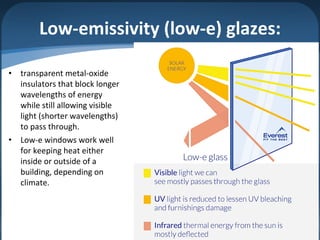
Low-emissivity (low-e) glazes:
• transparent metal-oxide
insulators that block longer
wavelengths of energy
while still allowing visible
light (shorter wavelengths)
to pass through.
• Low-e windows work well
for keeping heat either
inside or outside of a
building, depending on
climate.
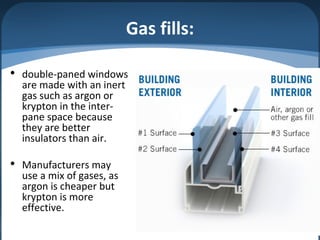
Gas fills:
• double-paned windows
are made with an inert
gas such as argon or
krypton in the inter-
pane space because
they are better
insulators than air.
• Manufacturers may
use a mix of gases, as
argon is cheaper but
krypton is more
effective.
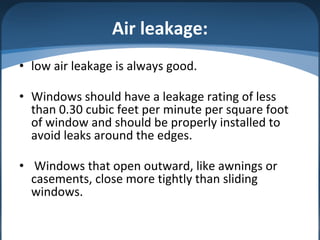
Air leakage:
• low air leakage is always good.
• Windows should have a leakage rating of less
than 0.30 cubic feet per minute per square foot
of window and should be properly installed to
avoid leaks around the edges.
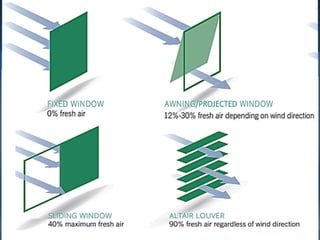
• Windows that open outward, like awnings or
casements, close more tightly than sliding
windows.
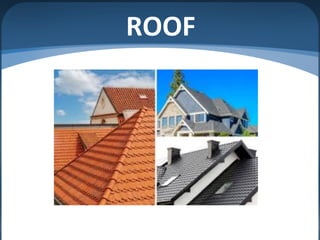
ROOF
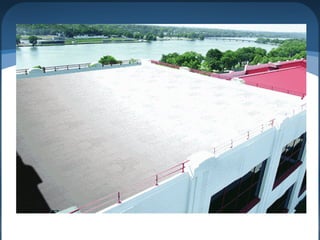
Cool Roofs
• Rooftops have become a large
contributor to excessive heat issues.
• 90% of roofs are poorly designed and
built with dark, non-reflective, heat-
absorbing materials.
• Cool roofing is one of the main strategies
used to prevent future occurrences of
heat island effects.
• A cool roof prevents heat absorption by
reflecting the sun’s heat and then
emitting its radiation back into the
atmosphere.
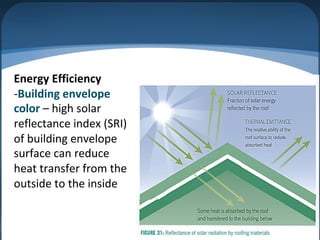
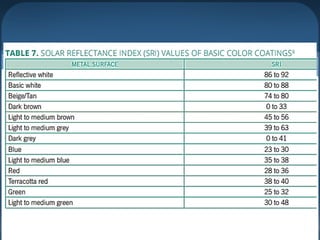
Energy Efficiency
-Building envelope
color – high solar
reflectance index (SRI)
of building envelope
surface can reduce
heat transfer from the
outside to the inside
• Green roofs reduce the temperature of the
building and the surrounding air in multiple
ways:
1.Shading: They provide shade to the top of a
building
2.Evapotranspiration: the plants in a green
roof absorb water through their roots, and
then use surrounding heat from the air to
evaporate the water
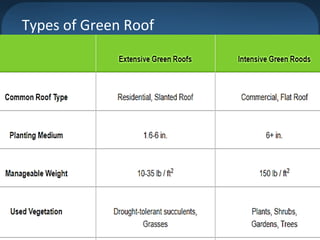
Types of Green Roof
Energy Efficiency
Roof insulation – reduction of heat
transfer at the roof through proper
insulation thus improving thermal
comfort, acoustic quality and load
reduction for air conditioning system.
Energy Efficiency
Efficiency of electrical systems
• Daylighting provision – harvest natural
daylighting through the use of windows, light
shelf, clerestory, skylight and light scoop
• Daylight controlled of lighting system–
controlled use of artificial lighting due to
daylighting
Energy Efficiency
Efficiency of electrical systems
–Lighting power density – regulated power
consumption due to lighting lower watts
per sq. meter
–Occupancy sensors – controlled use of
artificial lighting in areas with variable
occupancy
• In order to limit the use of electricity in the
unoccupied areas of buildings, occupancy
sensors linked to lighting (except for
emergency and security lighting) shall be
installed in areas with variable occupancy
such as corridors, private offices, storage
rooms, common toilets, meeting rooms,
stairways, other similar areas.
• For covered car parks: minimum of 60% of
the lighting must be controlled by the
occupancy sensors.
• Transformers that are part of the building
electrical system shall have efficiencies not
lower than 98% as prescribed in the DOE
Guidelines on Energy Conserving Design of
Buildings.
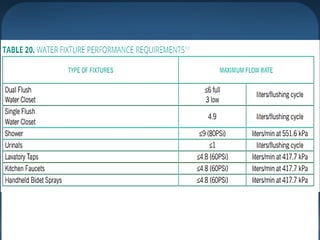
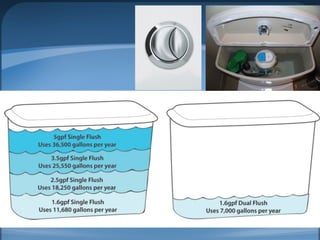
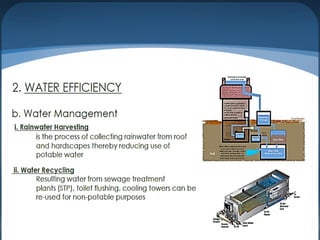
WATER EFFICIENCY
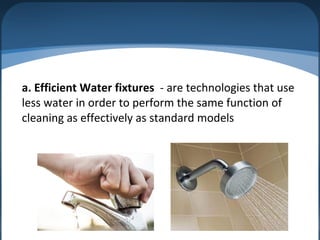
a. Efficient Water fixtures - are technologies that use
less water in order to perform the same function of
cleaning as effectively as standard models
MATERIAL SUSTAINABILITY
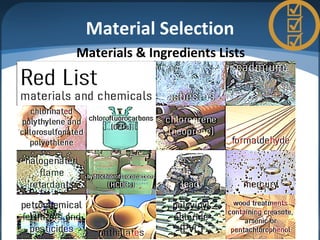
Material Selection
Materials & Ingredients Lists
Material Sustainability
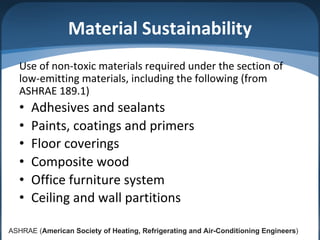
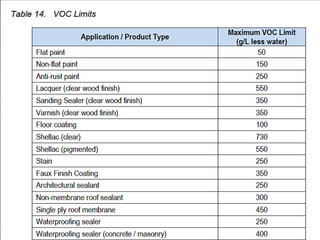
Use of non-toxic materials required under the section of
low-emitting materials, including the following (from
ASHRAE 189.1)
• Adhesives and sealants
• Paints, coatings and primers
• Floor coverings
• Composite wood
• Office furniture system
• Ceiling and wall partitions
ASHRAE (American Society of Heating, Refrigerating and Air-Conditioning Engineers)
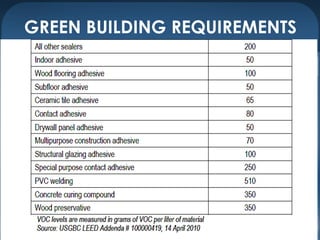
GREEN BUILDING REQUIREMENTS
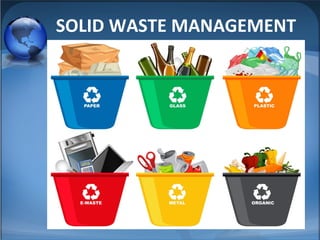
SOLID WASTE MANAGEMENT
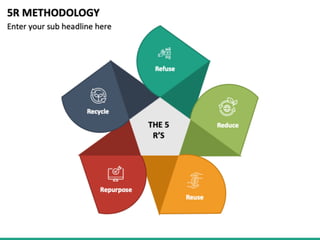
The new 5 R’s cycle approach
4. Solid Waste Management
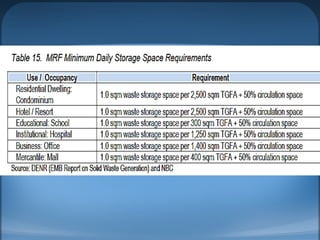
• MRF – Material Recovery Facility
• It is a solid waste management facility that
provides for the extraction from solid waste
of recyclable materials suitable for use as a
fuel or soil amendment is combination;
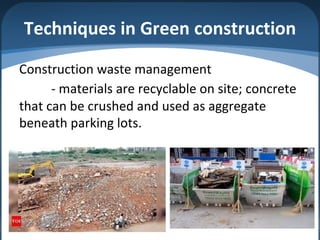
Techniques in Green construction
Construction waste management
- materials are recyclable on site; concrete
that can be crushed and used as aggregate
beneath parking lots.
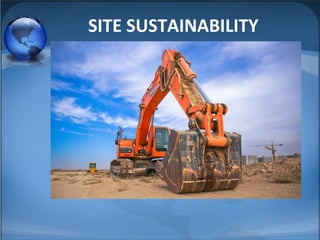
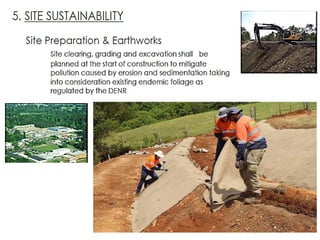
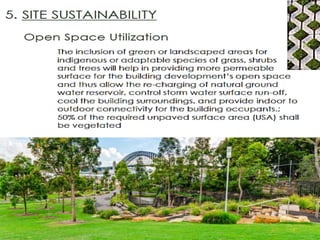
SITE SUSTAINABILITY
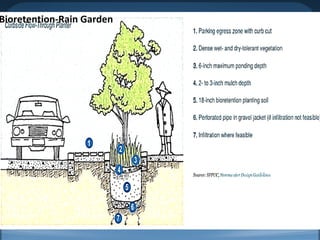
Site Solution
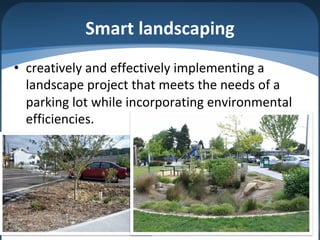
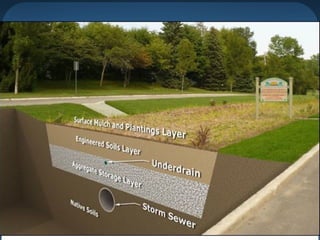
Smart landscaping
• creatively and effectively implementing a
landscape project that meets the needs of a
parking lot while incorporating environmental
efficiencies.
Bioretention-Rain Garden
Techniques in Green construction
Managing the site for improved environment
• Treat water on site and avoid it to flow into
the local sewer system; silt fencing
surrounding the area
• No smoking on the site
• Bring recycling containers for food wastes
INDOOR ENVIRONMENTAL
QUALITY
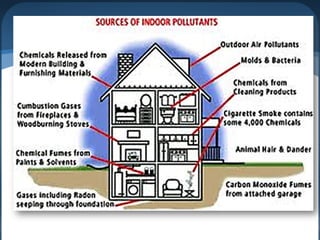
• Indoor characteristics that most
affect human health are connected
to thermal comfort, lighting,
moisture, mold and noise.
GREEN BUILDING REQUIREMENTS
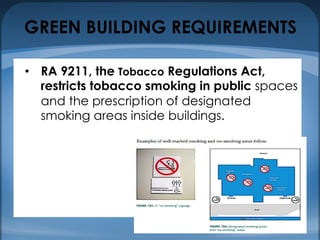
• RA 9211, the Tobacco Regulations Act,
restricts tobacco smoking in public spaces
and the prescription of designated
smoking areas inside buildings.
GREEN BUILDING REQUIREMENTS
❖ Requirements:
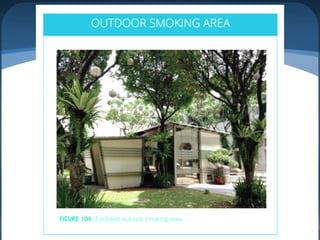
❑If smoking is only allowed outdoors,
designated smoking areas shall be
naturally ventilated, outside of the
building shell and away from
building entrances, windows and
outside supply air (OSA) intakes by
at least ten (10) meters.
GREEN BUILDING REQUIREMENTS
❖ Requirements:
❑ If smoking is allowed indoors,
designated smoking areas shall be
provided, partitioned from the rest of
the indoor areas. Partitions shall be
from floor to soffit of the next floor or
roof structure.
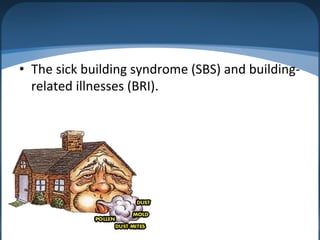
• The sick building syndrome (SBS) and building-
related illnesses (BRI).
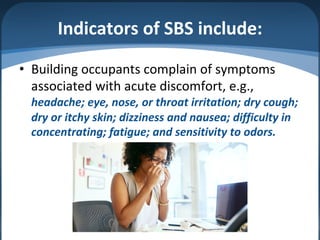
Indicators of SBS include:
• Building occupants complain of symptoms
associated with acute discomfort, e.g.,
headache; eye, nose, or throat irritation; dry cough;
dry or itchy skin; dizziness and nausea; difficulty in
concentrating; fatigue; and sensitivity to odors.
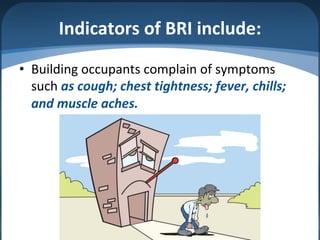
Indicators of BRI include:
• Building occupants complain of symptoms
such as cough; chest tightness; fever, chills;
and muscle aches.
buildings condition in terms of
comfort and health:
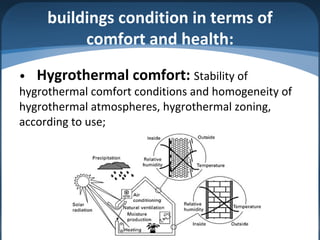
• Hygrothermal comfort: Stability of
hygrothermal comfort conditions and homogeneity of
hygrothermal atmospheres, hygrothermal zoning,
according to use;
buildings condition in terms of
comfort and health:
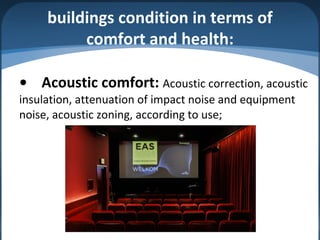
• Acoustic comfort: Acoustic correction, acoustic
insulation, attenuation of impact noise and equipment
noise, acoustic zoning, according to use;
buildings condition in terms of
comfort and health:
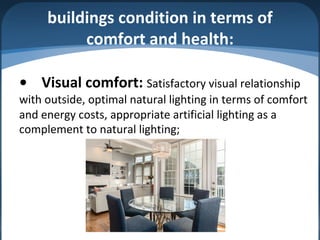
• Visual comfort: Satisfactory visual relationship
with outside, optimal natural lighting in terms of comfort
and energy costs, appropriate artificial lighting as a
complement to natural lighting;
buildings condition in terms of
comfort and health:
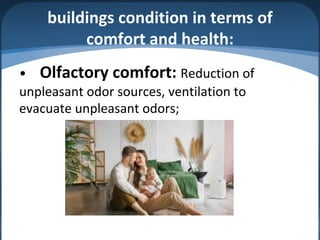
• Olfactory comfort: Reduction of
unpleasant odor sources, ventilation to
evacuate unpleasant odors;
buildings condition in terms of
comfort and health:
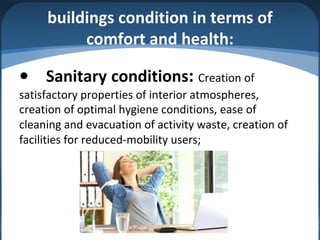
• Sanitary conditions: Creation of
satisfactory properties of interior atmospheres,
creation of optimal hygiene conditions, ease of
cleaning and evacuation of activity waste, creation of
facilities for reduced-mobility users;
Interior Solutions
• Building insulation
• Air sealing and ventilation
• Greywater system
• Flooring materials
• Lighting strategies
• Paints and coatings
• Materials red list
• Green cleaning
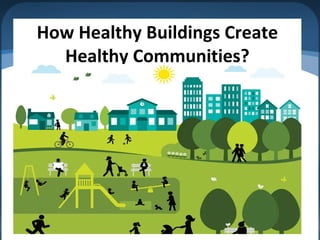
How Healthy Buildings Create
Healthy Communities?
Smart city would have:
• Adequate and reliable water and energy supplies
• efficient sanitation and waste management.
• Effective urban mobility
• Affordable housing
• Excellent connectivity and digitization.
• Effective governance/e-governance.
• Safety and security for citizens
• Excellent health and education facilities, with a
focus on sustainability.
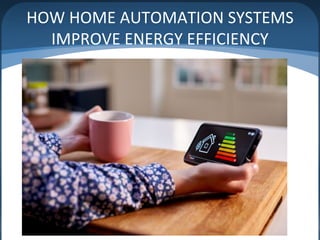
HOW HOME AUTOMATION SYSTEMS
IMPROVE ENERGY EFFICIENCY
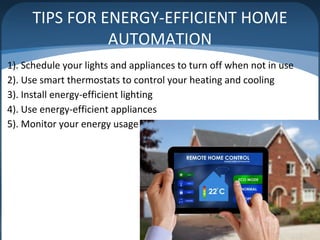
TIPS FOR ENERGY-EFFICIENT HOME
AUTOMATION
1). Schedule your lights and appliances to turn off when not in use
2). Use smart thermostats to control your heating and cooling
3). Install energy-efficient lighting
4). Use energy-efficient appliances
5). Monitor your energy usage
GREEN BUILDING
We are nature, all changes to
nature and to the habitat have an
impact on us.
END
References
• Sustainable Construction: Green Building Design and Delivery by Charles j.
Kibert, 2008
• https://www.ashrae.org/education
• https://www.azobuild.com/article.aspx?ArticleID=8514
• http://www.hpbmagazine.org
• Grumman, David. What Makes Buildings High Performing.
• DPWH
• http://www.ifma.org/resources/sustainability/
• http://architecture2030.org
• http://www.epa.gov/oaintrnt/projects/guidingprinciples.htm
• http://www.treehugger.com/green-architecture/proof-greenest-building-
one-already-standing-released-new-report-preservation-green-lab.html
References
• Burroughs, H. Managing Indoor Air Quality
• Morawska, L. Indoor Environment
• USEPA. Sick Building Syndrome.
• Green Building Materials. Calrecycle.ca.gov. (2019). Retrieved 3 December
2020, from
https://www.calrecycle.ca.gov/greenbuilding/materials#:~:text=Green%2
0building%20materials%20offer%20specific,Improved%20occupant%20
health%20and%20productivity.
• Guide, B. (2020). 23 Different Green Building Materials. The Constructor.
Retrieved 28 August 2020, from
https://theconstructor.org/building/green-building-materials/7028/.
• https://www.mashvisor.com/blog/green-building/
• https://www.re-thinkingthefuture.com/fresh-perspectives/a1312-10-
things-to-consider-when-designing-a-green-building/
• https://f.hubspotusercontent40.net/hubfs/8182097/Mitsubishi%20Power%20Thr
ee%20Technologies%20to%20Watch%20FINAL%202.26.21%20(002).pdf?_hsmi=1
15104162&_hsenc=p2ANqtz-_EHD1vCBesifFE1TNEcER-
j6AjF23MF8Q9qdKI7CRg2P28vF5Mf0GezxyCIRlQbRhkP93ZTKVDe9DP2D94P4pAN1
_BPg

Green Building Code of the Philippines.pdf
  • 1.
    Dr. Maribel C.Tubera, PDQM, DBA, MsCM, UAP, PIEP, PSQ Green Building Strategies Towards Smart and Sustainable Cities
  • 3.
    Design is apowerful process, it has the potential of changing how buildings, communities, and societies functions. Design has the power of both satisfying a need and providing value.
  • 4.
    The Three Ringsof Sustainability How do you design and plan a human ecology? A B
  • 5.
    Sustainable Infrastructure Building sustainabilityis not new... -accommodating the site and climate -preserving resources -use local materials and expertise ...these are all ancient techniques which have just been neglected since the beginning of Industrial Revolution.
  • 6.
    BUT... • Today’s sustainabilitydemands higher level of knowledge and sophistication than it did 100 years ago. • Green building doesn’t need to be high tech or complex, there are simply more variables to consider in order to minimize the environmental disruption.
  • 7.
  • 8.
    What is Greenbuilding? Green building, or sustainable building, is designed, built, operated, and maintained using environmentally responsible and resource efficient processes.
  • 9.
    What is Greenbuilding? Renovated or refurbished properties can be also considered as green sustainable buildings if sustainable practices are carried out during the process.
  • 10.
    The most importantbenefit of green building is the energy efficiency, which is reflected in the direct costs of running the real estate property and the increase in the net income of the building.
  • 11.
    3 Major Forcesof going GREEN 1. Growing evidence of accelerated destruction of planetary ecosystem, alteration of global biogeochemical cycles, and enormous increase in population and consumption • “The sixth extinction- the human species’ massive destruction of life and biodiversity on the planet.”
  • 13.
    2. Increasing demandfor natural resources is pressuring developed and developing countries resulting in shortage and increasing prices for material and agricultural products.
  • 14.
    3. Green buildingmovement is coinciding with similar transformations in manufacturing, tourism, agriculture, medicine, and the public sector which have adopted various approaches in greening their activities.
  • 16.
    Principles of SustainableConstruction • Reduce resource consumption • Reuse resources • Use recyclable resources • Protect nature • Eliminate toxins • Apply life cycle costing • Focus on quality 1. Reduce 2. Reuse 3. Recycle 4. Nature 5. Toxics 6. Economics 7. Quality
  • 17.
    RA 9729 –Climate Change Act of 2009 • An Act mainstreaming CLIMATE CHANGE into government policy formulations, establishing the framework strategy and program on climate change, creating for this purpose the climate change commission, and for other purposes.
  • 18.
    RA 9729 Section2 • The state has adopted the Philippine Agenda 21 framework which espouses sustainable development to fulfil human needs while maintaining the quality of the natural environment for current and future generations
  • 19.
  • 21.
    • The Codeproposes a set of standards which apply to efficient use of resources, site selection, planning, design, construction, use, occupancy, operation and maintenance.
  • 24.
    Objectives of GBCode 1. Improve efficiency of building performance through set of standards 2. Counter harmful gases responsible for effects of climate change 3. Efficient use of resources, site, design, construction and maintenance Without significant increase in cost
  • 25.
  • 26.
    7 sections ofthe GB Code 1. Permitting 2. Energy Efficiency 3. Water Efficiency 4. Material Sustainability 5. Solid Waste Management 6. Site Sustainability 7. Indoor Environmental Quality
  • 29.
  • 30.
    Design Principles forEnergy Efficiency
  • 31.
  • 32.
  • 33.
  • 34.
    Window to WallRatio (WWR)
  • 36.
    U-factor: • It measureshow much heat is conducted through a window. • A low U-factor signifies that a window is well-insulated and therefore more energy- efficient. • A rating of 0.30 or below is considered very good.
  • 37.
    Solar heat-gain coefficient(SHGC): • SHGC can improve indoor climate control through the installation of high-SHGC (>0.55) windows in cold climates and low-SHGC (<0.40) windows in warm climates.
  • 38.
    Visible transmittance (VT): •the amount of visible light that can pass through a window. • VT is measured on a scale of 0 to 1, where 0 signifies no light transmittance and 1 is complete light transmittance. • Coatings, glazes, and tints can reduce VT
  • 39.
    Light-to-solar gain (LSG): •Ratio of VT to SHGC. • A high LSG rating is given to a window that lets through a lot of light relative to the amount of heat.
  • 40.
    Low-emissivity (low-e) glazes: •transparent metal-oxide insulators that block longer wavelengths of energy while still allowing visible light (shorter wavelengths) to pass through. • Low-e windows work well for keeping heat either inside or outside of a building, depending on climate.
  • 41.
    Gas fills: • double-panedwindows are made with an inert gas such as argon or krypton in the inter- pane space because they are better insulators than air. • Manufacturers may use a mix of gases, as argon is cheaper but krypton is more effective.
  • 42.
    Air leakage: • lowair leakage is always good. • Windows should have a leakage rating of less than 0.30 cubic feet per minute per square foot of window and should be properly installed to avoid leaks around the edges. • Windows that open outward, like awnings or casements, close more tightly than sliding windows.
  • 44.
  • 45.
    Cool Roofs • Rooftopshave become a large contributor to excessive heat issues. • 90% of roofs are poorly designed and built with dark, non-reflective, heat- absorbing materials.
  • 46.
    • Cool roofingis one of the main strategies used to prevent future occurrences of heat island effects. • A cool roof prevents heat absorption by reflecting the sun’s heat and then emitting its radiation back into the atmosphere.
  • 47.
    Energy Efficiency -Building envelope color– high solar reflectance index (SRI) of building envelope surface can reduce heat transfer from the outside to the inside
  • 49.
    • Green roofsreduce the temperature of the building and the surrounding air in multiple ways: 1.Shading: They provide shade to the top of a building 2.Evapotranspiration: the plants in a green roof absorb water through their roots, and then use surrounding heat from the air to evaporate the water
  • 51.
  • 52.
    Energy Efficiency Roof insulation– reduction of heat transfer at the roof through proper insulation thus improving thermal comfort, acoustic quality and load reduction for air conditioning system.
  • 53.
    Energy Efficiency Efficiency ofelectrical systems • Daylighting provision – harvest natural daylighting through the use of windows, light shelf, clerestory, skylight and light scoop • Daylight controlled of lighting system– controlled use of artificial lighting due to daylighting
  • 54.
    Energy Efficiency Efficiency ofelectrical systems –Lighting power density – regulated power consumption due to lighting lower watts per sq. meter –Occupancy sensors – controlled use of artificial lighting in areas with variable occupancy
  • 55.
    • In orderto limit the use of electricity in the unoccupied areas of buildings, occupancy sensors linked to lighting (except for emergency and security lighting) shall be installed in areas with variable occupancy such as corridors, private offices, storage rooms, common toilets, meeting rooms, stairways, other similar areas. • For covered car parks: minimum of 60% of the lighting must be controlled by the occupancy sensors.
  • 56.
    • Transformers thatare part of the building electrical system shall have efficiencies not lower than 98% as prescribed in the DOE Guidelines on Energy Conserving Design of Buildings.
  • 60.
  • 62.
    a. Efficient Waterfixtures - are technologies that use less water in order to perform the same function of cleaning as effectively as standard models
  • 66.
  • 67.
  • 68.
    Material Sustainability Use ofnon-toxic materials required under the section of low-emitting materials, including the following (from ASHRAE 189.1) • Adhesives and sealants • Paints, coatings and primers • Floor coverings • Composite wood • Office furniture system • Ceiling and wall partitions ASHRAE (American Society of Heating, Refrigerating and Air-Conditioning Engineers)
  • 69.
  • 70.
  • 71.
  • 72.
    The new 5R’s cycle approach
  • 73.
    4. Solid WasteManagement • MRF – Material Recovery Facility • It is a solid waste management facility that provides for the extraction from solid waste of recyclable materials suitable for use as a fuel or soil amendment is combination;
  • 75.
    Techniques in Greenconstruction Construction waste management - materials are recyclable on site; concrete that can be crushed and used as aggregate beneath parking lots.
  • 76.
  • 79.
  • 80.
    Smart landscaping • creativelyand effectively implementing a landscape project that meets the needs of a parking lot while incorporating environmental efficiencies.
  • 81.
  • 83.
    Techniques in Greenconstruction Managing the site for improved environment • Treat water on site and avoid it to flow into the local sewer system; silt fencing surrounding the area • No smoking on the site • Bring recycling containers for food wastes
  • 84.
  • 85.
    • Indoor characteristicsthat most affect human health are connected to thermal comfort, lighting, moisture, mold and noise.
  • 86.
    GREEN BUILDING REQUIREMENTS •RA 9211, the Tobacco Regulations Act, restricts tobacco smoking in public spaces and the prescription of designated smoking areas inside buildings.
  • 87.
    GREEN BUILDING REQUIREMENTS ❖Requirements: ❑If smoking is only allowed outdoors, designated smoking areas shall be naturally ventilated, outside of the building shell and away from building entrances, windows and outside supply air (OSA) intakes by at least ten (10) meters.
  • 89.
    GREEN BUILDING REQUIREMENTS ❖Requirements: ❑ If smoking is allowed indoors, designated smoking areas shall be provided, partitioned from the rest of the indoor areas. Partitions shall be from floor to soffit of the next floor or roof structure.
  • 90.
    • The sickbuilding syndrome (SBS) and building- related illnesses (BRI).
  • 91.
    Indicators of SBSinclude: • Building occupants complain of symptoms associated with acute discomfort, e.g., headache; eye, nose, or throat irritation; dry cough; dry or itchy skin; dizziness and nausea; difficulty in concentrating; fatigue; and sensitivity to odors.
  • 92.
    Indicators of BRIinclude: • Building occupants complain of symptoms such as cough; chest tightness; fever, chills; and muscle aches.
  • 94.
    buildings condition interms of comfort and health: • Hygrothermal comfort: Stability of hygrothermal comfort conditions and homogeneity of hygrothermal atmospheres, hygrothermal zoning, according to use;
  • 95.
    buildings condition interms of comfort and health: • Acoustic comfort: Acoustic correction, acoustic insulation, attenuation of impact noise and equipment noise, acoustic zoning, according to use;
  • 96.
    buildings condition interms of comfort and health: • Visual comfort: Satisfactory visual relationship with outside, optimal natural lighting in terms of comfort and energy costs, appropriate artificial lighting as a complement to natural lighting;
  • 97.
    buildings condition interms of comfort and health: • Olfactory comfort: Reduction of unpleasant odor sources, ventilation to evacuate unpleasant odors;
  • 98.
    buildings condition interms of comfort and health: • Sanitary conditions: Creation of satisfactory properties of interior atmospheres, creation of optimal hygiene conditions, ease of cleaning and evacuation of activity waste, creation of facilities for reduced-mobility users;
  • 99.
    Interior Solutions • Buildinginsulation • Air sealing and ventilation • Greywater system • Flooring materials • Lighting strategies • Paints and coatings • Materials red list • Green cleaning
  • 100.
    How Healthy BuildingsCreate Healthy Communities?
  • 101.
    Smart city wouldhave: • Adequate and reliable water and energy supplies • efficient sanitation and waste management. • Effective urban mobility • Affordable housing • Excellent connectivity and digitization. • Effective governance/e-governance. • Safety and security for citizens • Excellent health and education facilities, with a focus on sustainability.
  • 102.
    HOW HOME AUTOMATIONSYSTEMS IMPROVE ENERGY EFFICIENCY
  • 103.
    TIPS FOR ENERGY-EFFICIENTHOME AUTOMATION 1). Schedule your lights and appliances to turn off when not in use 2). Use smart thermostats to control your heating and cooling 3). Install energy-efficient lighting 4). Use energy-efficient appliances 5). Monitor your energy usage
  • 104.
    GREEN BUILDING We arenature, all changes to nature and to the habitat have an impact on us.
  • 106.
  • 107.
    References • Sustainable Construction:Green Building Design and Delivery by Charles j. Kibert, 2008 • https://www.ashrae.org/education • https://www.azobuild.com/article.aspx?ArticleID=8514 • http://www.hpbmagazine.org • Grumman, David. What Makes Buildings High Performing. • DPWH • http://www.ifma.org/resources/sustainability/ • http://architecture2030.org • http://www.epa.gov/oaintrnt/projects/guidingprinciples.htm • http://www.treehugger.com/green-architecture/proof-greenest-building- one-already-standing-released-new-report-preservation-green-lab.html
  • 108.
    References • Burroughs, H.Managing Indoor Air Quality • Morawska, L. Indoor Environment • USEPA. Sick Building Syndrome. • Green Building Materials. Calrecycle.ca.gov. (2019). Retrieved 3 December 2020, from https://www.calrecycle.ca.gov/greenbuilding/materials#:~:text=Green%2 0building%20materials%20offer%20specific,Improved%20occupant%20 health%20and%20productivity. • Guide, B. (2020). 23 Different Green Building Materials. The Constructor. Retrieved 28 August 2020, from https://theconstructor.org/building/green-building-materials/7028/. • https://www.mashvisor.com/blog/green-building/ • https://www.re-thinkingthefuture.com/fresh-perspectives/a1312-10- things-to-consider-when-designing-a-green-building/ • https://f.hubspotusercontent40.net/hubfs/8182097/Mitsubishi%20Power%20Thr ee%20Technologies%20to%20Watch%20FINAL%202.26.21%20(002).pdf?_hsmi=1 15104162&_hsenc=p2ANqtz-_EHD1vCBesifFE1TNEcER- j6AjF23MF8Q9qdKI7CRg2P28vF5Mf0GezxyCIRlQbRhkP93ZTKVDe9DP2D94P4pAN1 _BPg