
SOLAR ENERGY, COLLECTION
AND APPLICATIONS
Dr. Ajay Singh Lodhi
Assistant Professor
College of Agriculture, Balaghat
Jawahar Lal Krishi Vishwa Vidyalaya, Jabalpur (M.P.)
SOLAR ENERGY
 Energy from the sun is called solar energy. The
Sun’s energy comes from nuclear fusion reaction that
takes place deep in the sun. Hydrogen nucleus fuse into
helium nucleus. The energy from these reactions flow
out from the sun and escape into space.
 Solar energy is sometimes called radiant energy.
 The beam radiation received from the sun on the earth is
reflected in to space, another 15% is absorbed by the
earth atmosphere and the rest is absorbed by the earth’s
surface.
 All life on the earth depends on solar energy. Green
plants make food by means of photosynthesis.
SOLAR CONSTANT
 “The rate at which solar energy arrives at the top
of the atmosphere is called solar constant”. This is
the amount of energy received in unit time on a unit
area perpendicular to the sun’s direction at the mean
distance of the earth from the sun. Because of the sun’s
distance and activity vary throughout the year, the rate
of arrival of solar constant is thus an average from
which the actual values vary up to 3 percent in either
direction.
 The National Aeronautics and Space Administration’s
(NASA) standard value the solar constant, expressed in
three common units, is as follows:
 (i) 1.353 kilowatts per square meter
 (ii) 116.5 Langley per hour (1 Langley being equal
to 1cal/cm2 of solar radiation received in one day)
 (iii) 429.2 Btu per Sq.ft. per hour.
 Solar Radiation that has not been absorbed or scattered
and reaches the ground directly from the sun is called
“Direct Radiation” or Beam Radiation.
 Diffuse radiation is that Solar Radiation received from
the sun after its direction has been changed by reflection
and scattering by the atmosphere. Because of the Solar
Radiation is scattered in all directions in the
atmosphere, diffuses radiation comes to the earth from
all parts of the sky.
 The sum of the beam and diffuse radiation flux is
referred to as total or global radiation.
INSTRUMENTS FOR MEASURING SOLAR
RADIATION AND SUN SHINE
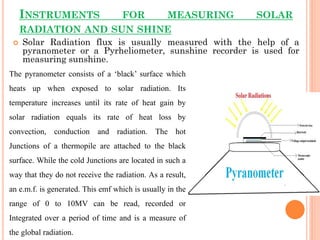
 Solar Radiation flux is usually measured with the help of a
pyranometer or a Pyrheliometer, sunshine recorder is used for
measuring sunshine.
The pyranometer consists of a ‘black’ surface which
heats up when exposed to solar radiation. Its
temperature increases until its rate of heat gain by
solar radiation equals its rate of heat loss by
convection, conduction and radiation. The hot
Junctions of a thermopile are attached to the black
surface. While the cold Junctions are located in such a
way that they do not receive the radiation. As a result,
an e.m.f. is generated. This emf which is usually in the
range of 0 to 10MV can be read, recorded or
Integrated over a period of time and is a measure of
the global radiation.
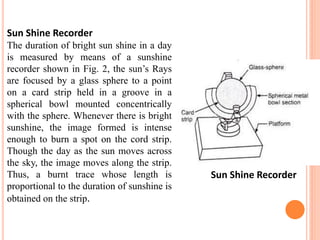
Sun Shine Recorder
The duration of bright sun shine in a day
is measured by means of a sunshine
recorder shown in Fig. 2, the sun’s Rays
are focused by a glass sphere to a point
on a card strip held in a groove in a
spherical bowl mounted concentrically
with the sphere. Whenever there is bright
sunshine, the image formed is intense
enough to burn a spot on the cord strip.
Though the day as the sun moves across
the sky, the image moves along the strip.
Thus, a burnt trace whose length is
proportional to the duration of sunshine is
obtained on the strip.
Sun Shine Recorder
SOLAR COLLECTOR
 A solar collector is a device that collects and/or
concentrates solar radiation from the Sun.
Types of Solar Collectors
Flat Plate Collectors
These collectors are simply metal boxes
that have some sort of transparent glazing
as a cover on top of a dark-coloured
absorber plate. The sides and bottom of
the collector are usually covered with
insulation to minimize heat losses to other
parts of the collector. Solar radiation
passes through the transparent glazing
material and hits the absorber plate. This
plate heats up, transferring the heat to
either water or air that is held between
the glazing and absorber plate.
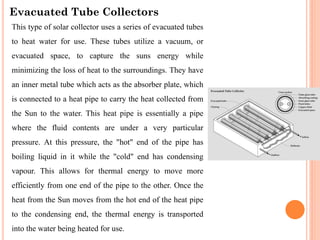
Evacuated Tube Collectors
This type of solar collector uses a series of evacuated tubes
to heat water for use. These tubes utilize a vacuum, or
evacuated space, to capture the suns energy while
minimizing the loss of heat to the surroundings. They have
an inner metal tube which acts as the absorber plate, which
is connected to a heat pipe to carry the heat collected from
the Sun to the water. This heat pipe is essentially a pipe
where the fluid contents are under a very particular
pressure. At this pressure, the "hot" end of the pipe has
boiling liquid in it while the "cold" end has condensing
vapour. This allows for thermal energy to move more
efficiently from one end of the pipe to the other. Once the
heat from the Sun moves from the hot end of the heat pipe
to the condensing end, the thermal energy is transported
into the water being heated for use.
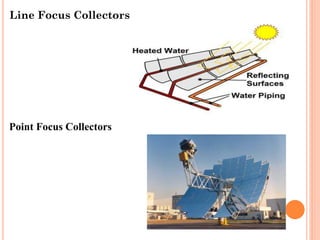
Line Focus Collectors
Point Focus Collectors
Application of Solar Energy
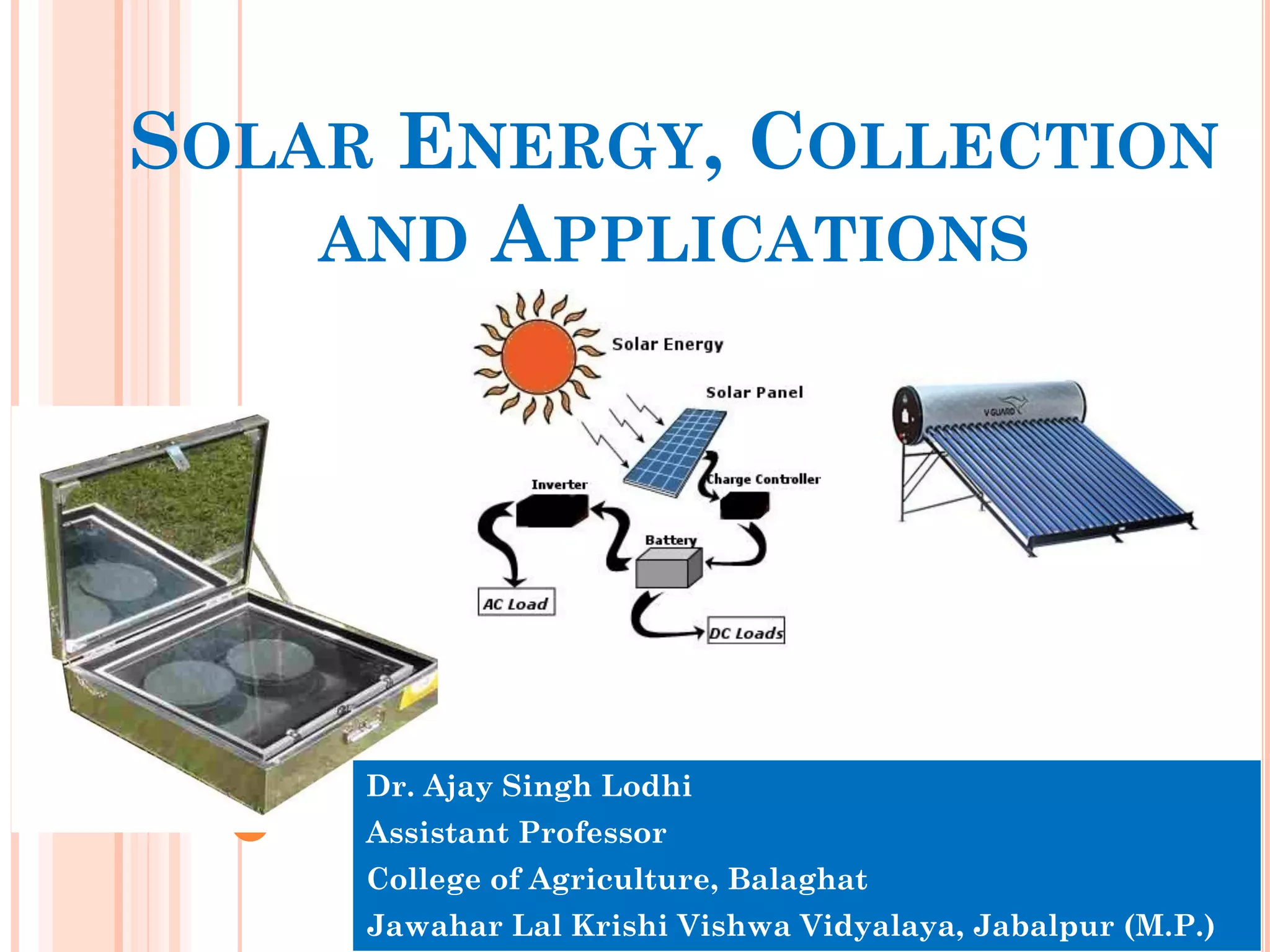
 Solar Cooler - To cook food
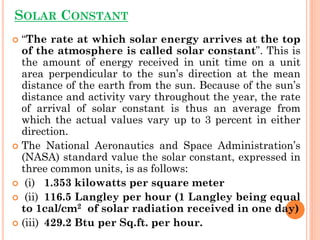
 Solar Water Heater- To heat water
 Solar Drying - For drying of agricultural
produce
 Solar Pond
 Solar Distillation
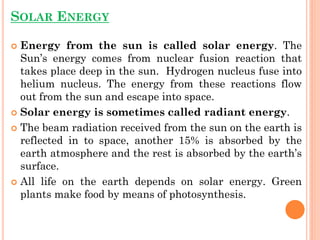
 Solar Photovoltaic System – To generate electricity
 Solar Light
 Solar Fencing
 Solar Pumping
Thank You

Solar energy, collection and applications

  • 1.
    SOLAR ENERGY, COLLECTION ANDAPPLICATIONS Dr. Ajay Singh Lodhi Assistant Professor College of Agriculture, Balaghat Jawahar Lal Krishi Vishwa Vidyalaya, Jabalpur (M.P.)
  • 2.
    SOLAR ENERGY  Energyfrom the sun is called solar energy. The Sun’s energy comes from nuclear fusion reaction that takes place deep in the sun. Hydrogen nucleus fuse into helium nucleus. The energy from these reactions flow out from the sun and escape into space.  Solar energy is sometimes called radiant energy.  The beam radiation received from the sun on the earth is reflected in to space, another 15% is absorbed by the earth atmosphere and the rest is absorbed by the earth’s surface.  All life on the earth depends on solar energy. Green plants make food by means of photosynthesis.
  • 3.
    SOLAR CONSTANT  “Therate at which solar energy arrives at the top of the atmosphere is called solar constant”. This is the amount of energy received in unit time on a unit area perpendicular to the sun’s direction at the mean distance of the earth from the sun. Because of the sun’s distance and activity vary throughout the year, the rate of arrival of solar constant is thus an average from which the actual values vary up to 3 percent in either direction.  The National Aeronautics and Space Administration’s (NASA) standard value the solar constant, expressed in three common units, is as follows:  (i) 1.353 kilowatts per square meter  (ii) 116.5 Langley per hour (1 Langley being equal to 1cal/cm2 of solar radiation received in one day)  (iii) 429.2 Btu per Sq.ft. per hour.
  • 4.
     Solar Radiationthat has not been absorbed or scattered and reaches the ground directly from the sun is called “Direct Radiation” or Beam Radiation.  Diffuse radiation is that Solar Radiation received from the sun after its direction has been changed by reflection and scattering by the atmosphere. Because of the Solar Radiation is scattered in all directions in the atmosphere, diffuses radiation comes to the earth from all parts of the sky.  The sum of the beam and diffuse radiation flux is referred to as total or global radiation.
  • 5.
    INSTRUMENTS FOR MEASURINGSOLAR RADIATION AND SUN SHINE  Solar Radiation flux is usually measured with the help of a pyranometer or a Pyrheliometer, sunshine recorder is used for measuring sunshine. The pyranometer consists of a ‘black’ surface which heats up when exposed to solar radiation. Its temperature increases until its rate of heat gain by solar radiation equals its rate of heat loss by convection, conduction and radiation. The hot Junctions of a thermopile are attached to the black surface. While the cold Junctions are located in such a way that they do not receive the radiation. As a result, an e.m.f. is generated. This emf which is usually in the range of 0 to 10MV can be read, recorded or Integrated over a period of time and is a measure of the global radiation.
  • 6.
    Sun Shine Recorder Theduration of bright sun shine in a day is measured by means of a sunshine recorder shown in Fig. 2, the sun’s Rays are focused by a glass sphere to a point on a card strip held in a groove in a spherical bowl mounted concentrically with the sphere. Whenever there is bright sunshine, the image formed is intense enough to burn a spot on the cord strip. Though the day as the sun moves across the sky, the image moves along the strip. Thus, a burnt trace whose length is proportional to the duration of sunshine is obtained on the strip. Sun Shine Recorder
  • 7.
    SOLAR COLLECTOR  Asolar collector is a device that collects and/or concentrates solar radiation from the Sun. Types of Solar Collectors Flat Plate Collectors These collectors are simply metal boxes that have some sort of transparent glazing as a cover on top of a dark-coloured absorber plate. The sides and bottom of the collector are usually covered with insulation to minimize heat losses to other parts of the collector. Solar radiation passes through the transparent glazing material and hits the absorber plate. This plate heats up, transferring the heat to either water or air that is held between the glazing and absorber plate.
  • 8.
    Evacuated Tube Collectors Thistype of solar collector uses a series of evacuated tubes to heat water for use. These tubes utilize a vacuum, or evacuated space, to capture the suns energy while minimizing the loss of heat to the surroundings. They have an inner metal tube which acts as the absorber plate, which is connected to a heat pipe to carry the heat collected from the Sun to the water. This heat pipe is essentially a pipe where the fluid contents are under a very particular pressure. At this pressure, the "hot" end of the pipe has boiling liquid in it while the "cold" end has condensing vapour. This allows for thermal energy to move more efficiently from one end of the pipe to the other. Once the heat from the Sun moves from the hot end of the heat pipe to the condensing end, the thermal energy is transported into the water being heated for use.
  • 9.
  • 10.
    Application of SolarEnergy  Solar Cooler - To cook food  Solar Water Heater- To heat water  Solar Drying - For drying of agricultural produce  Solar Pond  Solar Distillation  Solar Photovoltaic System – To generate electricity  Solar Light  Solar Fencing  Solar Pumping
  • 11.