BIRSA AGRICULTURAL UNIVERSITY
Protected Cultivation and Secondary
Agriculture
LECTURE 11: GREENHOUSE DRYING
BY
DR. PRAMOD RAI
DEPARTMENT OF AGRICULTURAL ENGINEERING
Drying
Fresh agricultural produce have the tendency to
get spoiled after the harvest.
Drying is one of the oldest and easiest methods
of food preservation.
It is the process of removing water or moisture
from a food product.
The removal of moisture from foods makes
them smaller, lighter and less voluminous.
Principle of Drying
Foods can be spoiled by microorganisms or
through enzymatic reactions within the food.
Bacteria, yeast, and molds must have a
sufficient amount of moisture around them to
grow and cause spoilage.
Reducing the moisture content of food
prevents the growth of these spoilage-causing
microorganisms and slows down enzymatic
reactions.
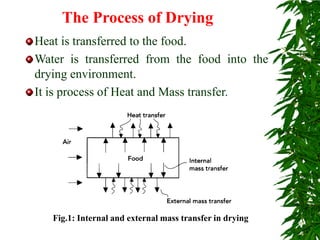
The Process of Drying
Heat is transferred to the food.
Water is transferred from the food into the
drying environment.
It is process of Heat and Mass transfer.
Fig.1: Internal and external mass transfer in drying
Predrying Treatments
Selection ( Fresh ,
Undamaged)
Cleaning (Washing and Disinfection)
Preparation ( Peeling ,
Slicing)
Pretreatment (Sulfurization , Salting,
Blanching)
Drying
Packaging
Storage (Shelf life)
Fig.2: Flow chart of predrying treatments
Factors affecting Drying Process
External parameters
Solar radiation
Temperature
RH
Air velocity
Internal parameters
Initial moisture content
Type of crops
Size and composition of food materials
Crop absorptivity
Exposed surface area
Slideshare.net
a b(critical moisture content)
Fig.3: Drying rate curve with time
Slideshare.net
Methods of Drying
Conventional drying
Tray drying
Vacuum tray drying
Freeze Drying
Spray drying
Micro wave /radio Frequency /infrared drying
Others
Solar Drying
Open sun drying.
Greenhouse Drying
Slideshare.net
Advantages and Disadvantages of Conventional Drying
Advantages
Continuous or batch process, maximum product can
be dried in less time.
Control over operating condition of drying.
Can be used round the year.
Disadvantages
High cost investment.
High energy consumption.
High maintenance cost is required etc.
Slideshare.net
Solar Drying
A device used for the purpose of solar drying
is known as solar dryer.
Solar energy, renewable source can play an
effective role to meet energy demand. Among
all, solar energy is most reliable, abundant,
inexhaustible and environmental friendly.
We can use for pumping, drying of agricultural
produce etc.
.
Classification of Solar Drying Techniques
Fig.4: Classification of solar drying techniques
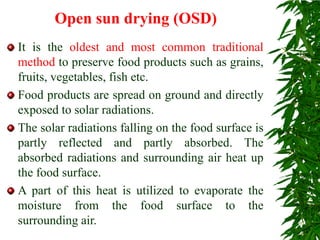
It is the oldest and most common traditional
method to preserve food products such as grains,
fruits, vegetables, fish etc.
Food products are spread on ground and directly
exposed to solar radiations.
The solar radiations falling on the food surface is
partly reflected and partly absorbed. The
absorbed radiations and surrounding air heat up
the food surface.
A part of this heat is utilized to evaporate the
moisture from the food surface to the
surrounding air.
Open sun drying (OSD)
Working of OSD
Fig.5: Working of Open sun drying (OSD)
Advantages of OSD
No fuel or mechanical energy is required.
Operation is very simple and inexpensive.
Viability, germination, baking qualities are
fully maintained.
Disadvantages of OSD
Slow drying method, takes several days.
Dust contamination, insect infestation,
microbial contamination and spoilage due to
rains.
Product dried is unhygienic and sometimes
unfit for human consumption.
Completely dependent on weather.
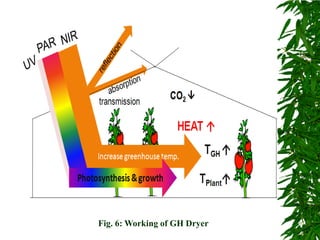
Greenhouse dryers
All the solar dryer acts on the principle of
greenhouse effect, so it is also called greenhouse
dryer.
The greenhouse effect in solar dryer due to (i) a
confinement effect, resulting from the decrease
in the air exchanges with the outside
environment; and (ii) an effect caused by the
existence of a cover characterized by its low
transparency to far infrared radiation (emitted by
the food materials and the inner greenhouse
elements), but its high transparency to sunlight.
Fig. 6: Working of GH Dryer
Advantages of GH dryer
It is faster than OSD, fresh produce can be dried in a shorter
time period.
It is more efficient, since foodstuffs can be dried more
quickly, less will be lost due to spoilage.
It is hygienic, since foodstuffs are dried in a controlled
environment.
It is healthier, drying fresh produce at optimum temperatures
and in a shorter amount of time enables them to retain more
of their nutritional value such as vitamin C.
It is cheap, using freely available solar energy instead of
conventional fuels to dry products.
Disadvantages of GH dryer
Small capacity limits it to small scale applications.
Depends upon open field microclimate condition.
Control of temperature & RH is difficult.
Passive (Natural convection) solar dryer
The air movement is occurs by natural
circulation, and products get heated due to
direct absorption of heat or due to high
temperature in the enclosure and then moisture
removed from the crop escapes out of the
chamber by natural circulation of air.
Movement of air take place due to density or
the pressure difference.
Fig.7: Working of Passive Solar Dryer
Fig.8: GH natural Solar Dryer
Active (Force Convection) Solar Dryer
The air is forced into or out of the drying
chamber using a blower or fan which is
electrically or mechanically operated.
Forced convection dryers are best suited for
high moisture content crops whereas natural
convection is best for low moisture content
crops.
Working of Active Solar Dryer
Fig.9: Working of Active Solar Dryer
Fig. 11: Active solar energy cabinet dryer
Fig.10: Forced-convection GH dryer
In direct solar dryers, collection of solar energy
and drying of product takes place in an enclosed
insulated structure.
The moisture is taken away by the air entering
into the dryer from below and escaping through
at the top exit
These driers have enclosures and covered with
glass or transparent LDPE etc.
Direct solar dryer (DSD)
Working of DSD
Fig.12: Working of Direct Solar Dryer
Advantages of DSD
Simpler and cheaper to construct than the
indirect-type for the same capacity.
Offer protection from rains, dews, debris etc.
Product quality obtained is better than open sun
drying.
Disadvantages of DSD
Poor vapor removal rates leading to relatively
slow overall drying rates.
Small capacity limits it to small scale
applications.
Discoloration of crop due to direct exposure to
solar radiation.
The crops are dried in trays or shelves inside an
opaque drying chamber and a separate unit, solar
collector is used for heating of the entering air into the
cabinet.
The heated air is allowed to flow through/over the wet
crop that provides the heat for moisture evaporation
by convective heat transfer between the hot air and
the wet crop.
Drying takes place due to the difference in moisture
concentration between the drying air and the air in the
vicinity of crop surface.
The better controlled of temperature in dryer results in
efficient operation.
Indirect solar dryer (ISD)
Fig.13: Working of Indirect Solar Dryer
Fig.14: Indirect natural convection dryer
Advantages of ISD
Can be operated at higher temperature,
recommended for deep bed drying.
It is more efficient than the direct solar dryer.
Maintain the quality of product by avoiding
direct exposure of solar radiations.
Disadvantages of ISD
More complex and expensive than direct solar
dryer.
Incur larger maintenance costs than the direct
solar dryer.
Mixed-mode solar dryer
The products are exposed directly to solar
radiations and hot air from solar collector. It is
a combination of direct and indirect solar
dryers.
Working of mixed-mode solar dryer
Fig.15: Isometric illustration of the mixed-mode solar dryer
Advantages of mixed-mode solar dryer
Less damage from temperature extreme.
Disadvantages of mixed-mode solar dryer
More complex and expensive than direct sun
drying.
UV radiation can damage food.
Fig.16: Typical solar energy dryer designs
Low cost Multipurpose GH (MGH)
Due to high temperature and high light intensity
during summer season in open, it is very difficult
utilize GH for cultivation/nursery growing.
The MGH can utilize high temperature for other
beneficial application.
When the GH is used for cultivation/nursery
growing and drying/soil solarization, it is called
Multipurpose greenhouse (MGH).
Here during winter and rainy season it is use for
cultivation/nursery growing but during summer
season it is used for drying/soil solarization.
Mid Feb-June: Utilized for drying & Soil
solarization.
Drying process: Passive (natural) & active (using
fan or chimney)
Fig.17: Low cost multipurpose
GH
Fig.18: Tomato cultivated under
low cost multipurpose GH
Fig.19a: Open field dried tomato (WB) Fig.19b: Open field dried tomato (B)
Fig.20a: Low cost multipurpose GH
dried tomato (WB)
Fig.20b: Low cost multipurpose GH
dried tomato (B)
Advantages
It can be efficiently utilized for cultivation of
vegetables or nursery raising during June-Mid.
February.
It can be used for drying of cauliflower,
mushroom, mahua etc. during Mid. Feb-June due
to high temperature (40-550C).
It can be also be utilized for soil sterilization
before next crop.
Youtube video: Low cost multipurpose
greenhouse (MGH)
https://youtu.be/Xbyq8U9TUaE)
Multipurpose Greenhouse (MGH) vs Conventional GH
Dryer
The MGH can be used for drying as well as
cultivation where as GH dryer used for only drying
purpose.
The construction cost of low cost MGH is around
Rs. 300 per square meter where as GH dryer it
varies between Rs. 400 to 600 per square meter.
The cost economics of GH dryer is major hindrance
in its adaption.
The MGH is used for drying & cultivation has
better economics then stand alone GH dryer and it
can be constructed locally and used by farmer
community to improved there livelihood.
If you have any question/suggestion
Mail me: pramod_kgp@yahoo.co.uk
Contact me on WhatsApp: 8986644713

GREENHOUSE DRYING

  • 1.
    BIRSA AGRICULTURAL UNIVERSITY ProtectedCultivation and Secondary Agriculture LECTURE 11: GREENHOUSE DRYING BY DR. PRAMOD RAI DEPARTMENT OF AGRICULTURAL ENGINEERING
  • 2.
    Drying Fresh agricultural producehave the tendency to get spoiled after the harvest. Drying is one of the oldest and easiest methods of food preservation. It is the process of removing water or moisture from a food product. The removal of moisture from foods makes them smaller, lighter and less voluminous.
  • 3.
    Principle of Drying Foodscan be spoiled by microorganisms or through enzymatic reactions within the food. Bacteria, yeast, and molds must have a sufficient amount of moisture around them to grow and cause spoilage. Reducing the moisture content of food prevents the growth of these spoilage-causing microorganisms and slows down enzymatic reactions.
  • 4.
    The Process ofDrying Heat is transferred to the food. Water is transferred from the food into the drying environment. It is process of Heat and Mass transfer. Fig.1: Internal and external mass transfer in drying
  • 5.
    Predrying Treatments Selection (Fresh , Undamaged) Cleaning (Washing and Disinfection) Preparation ( Peeling , Slicing) Pretreatment (Sulfurization , Salting, Blanching) Drying Packaging Storage (Shelf life) Fig.2: Flow chart of predrying treatments
  • 6.
    Factors affecting DryingProcess External parameters Solar radiation Temperature RH Air velocity Internal parameters Initial moisture content Type of crops Size and composition of food materials Crop absorptivity Exposed surface area
  • 7.
    Slideshare.net a b(critical moisturecontent) Fig.3: Drying rate curve with time
  • 8.
    Slideshare.net Methods of Drying Conventionaldrying Tray drying Vacuum tray drying Freeze Drying Spray drying Micro wave /radio Frequency /infrared drying Others Solar Drying Open sun drying. Greenhouse Drying
  • 9.
    Slideshare.net Advantages and Disadvantagesof Conventional Drying Advantages Continuous or batch process, maximum product can be dried in less time. Control over operating condition of drying. Can be used round the year. Disadvantages High cost investment. High energy consumption. High maintenance cost is required etc.
  • 10.
    Slideshare.net Solar Drying A deviceused for the purpose of solar drying is known as solar dryer. Solar energy, renewable source can play an effective role to meet energy demand. Among all, solar energy is most reliable, abundant, inexhaustible and environmental friendly. We can use for pumping, drying of agricultural produce etc. .
  • 11.
    Classification of SolarDrying Techniques Fig.4: Classification of solar drying techniques
  • 12.
    It is theoldest and most common traditional method to preserve food products such as grains, fruits, vegetables, fish etc. Food products are spread on ground and directly exposed to solar radiations. The solar radiations falling on the food surface is partly reflected and partly absorbed. The absorbed radiations and surrounding air heat up the food surface. A part of this heat is utilized to evaporate the moisture from the food surface to the surrounding air. Open sun drying (OSD)
  • 13.
    Working of OSD Fig.5:Working of Open sun drying (OSD)
  • 14.
    Advantages of OSD Nofuel or mechanical energy is required. Operation is very simple and inexpensive. Viability, germination, baking qualities are fully maintained. Disadvantages of OSD Slow drying method, takes several days. Dust contamination, insect infestation, microbial contamination and spoilage due to rains. Product dried is unhygienic and sometimes unfit for human consumption. Completely dependent on weather.
  • 15.
    Greenhouse dryers All thesolar dryer acts on the principle of greenhouse effect, so it is also called greenhouse dryer. The greenhouse effect in solar dryer due to (i) a confinement effect, resulting from the decrease in the air exchanges with the outside environment; and (ii) an effect caused by the existence of a cover characterized by its low transparency to far infrared radiation (emitted by the food materials and the inner greenhouse elements), but its high transparency to sunlight.
  • 16.
    Fig. 6: Workingof GH Dryer
  • 17.
    Advantages of GHdryer It is faster than OSD, fresh produce can be dried in a shorter time period. It is more efficient, since foodstuffs can be dried more quickly, less will be lost due to spoilage. It is hygienic, since foodstuffs are dried in a controlled environment. It is healthier, drying fresh produce at optimum temperatures and in a shorter amount of time enables them to retain more of their nutritional value such as vitamin C. It is cheap, using freely available solar energy instead of conventional fuels to dry products. Disadvantages of GH dryer Small capacity limits it to small scale applications. Depends upon open field microclimate condition. Control of temperature & RH is difficult.
  • 18.
    Passive (Natural convection)solar dryer The air movement is occurs by natural circulation, and products get heated due to direct absorption of heat or due to high temperature in the enclosure and then moisture removed from the crop escapes out of the chamber by natural circulation of air. Movement of air take place due to density or the pressure difference.
  • 19.
    Fig.7: Working ofPassive Solar Dryer
  • 20.
    Fig.8: GH naturalSolar Dryer
  • 21.
    Active (Force Convection)Solar Dryer The air is forced into or out of the drying chamber using a blower or fan which is electrically or mechanically operated. Forced convection dryers are best suited for high moisture content crops whereas natural convection is best for low moisture content crops.
  • 22.
    Working of ActiveSolar Dryer Fig.9: Working of Active Solar Dryer
  • 23.
    Fig. 11: Activesolar energy cabinet dryer Fig.10: Forced-convection GH dryer
  • 24.
    In direct solardryers, collection of solar energy and drying of product takes place in an enclosed insulated structure. The moisture is taken away by the air entering into the dryer from below and escaping through at the top exit These driers have enclosures and covered with glass or transparent LDPE etc. Direct solar dryer (DSD)
  • 25.
    Working of DSD Fig.12:Working of Direct Solar Dryer
  • 26.
    Advantages of DSD Simplerand cheaper to construct than the indirect-type for the same capacity. Offer protection from rains, dews, debris etc. Product quality obtained is better than open sun drying. Disadvantages of DSD Poor vapor removal rates leading to relatively slow overall drying rates. Small capacity limits it to small scale applications. Discoloration of crop due to direct exposure to solar radiation.
  • 27.
    The crops aredried in trays or shelves inside an opaque drying chamber and a separate unit, solar collector is used for heating of the entering air into the cabinet. The heated air is allowed to flow through/over the wet crop that provides the heat for moisture evaporation by convective heat transfer between the hot air and the wet crop. Drying takes place due to the difference in moisture concentration between the drying air and the air in the vicinity of crop surface. The better controlled of temperature in dryer results in efficient operation. Indirect solar dryer (ISD)
  • 28.
    Fig.13: Working ofIndirect Solar Dryer
  • 29.
    Fig.14: Indirect naturalconvection dryer
  • 30.
    Advantages of ISD Canbe operated at higher temperature, recommended for deep bed drying. It is more efficient than the direct solar dryer. Maintain the quality of product by avoiding direct exposure of solar radiations. Disadvantages of ISD More complex and expensive than direct solar dryer. Incur larger maintenance costs than the direct solar dryer.
  • 31.
    Mixed-mode solar dryer Theproducts are exposed directly to solar radiations and hot air from solar collector. It is a combination of direct and indirect solar dryers.
  • 32.
    Working of mixed-modesolar dryer Fig.15: Isometric illustration of the mixed-mode solar dryer
  • 33.
    Advantages of mixed-modesolar dryer Less damage from temperature extreme. Disadvantages of mixed-mode solar dryer More complex and expensive than direct sun drying. UV radiation can damage food.
  • 34.
    Fig.16: Typical solarenergy dryer designs
  • 35.
    Low cost MultipurposeGH (MGH) Due to high temperature and high light intensity during summer season in open, it is very difficult utilize GH for cultivation/nursery growing. The MGH can utilize high temperature for other beneficial application. When the GH is used for cultivation/nursery growing and drying/soil solarization, it is called Multipurpose greenhouse (MGH). Here during winter and rainy season it is use for cultivation/nursery growing but during summer season it is used for drying/soil solarization.
  • 36.
    Mid Feb-June: Utilizedfor drying & Soil solarization. Drying process: Passive (natural) & active (using fan or chimney) Fig.17: Low cost multipurpose GH Fig.18: Tomato cultivated under low cost multipurpose GH
  • 37.
    Fig.19a: Open fielddried tomato (WB) Fig.19b: Open field dried tomato (B) Fig.20a: Low cost multipurpose GH dried tomato (WB) Fig.20b: Low cost multipurpose GH dried tomato (B)
  • 38.
    Advantages It can beefficiently utilized for cultivation of vegetables or nursery raising during June-Mid. February. It can be used for drying of cauliflower, mushroom, mahua etc. during Mid. Feb-June due to high temperature (40-550C). It can be also be utilized for soil sterilization before next crop. Youtube video: Low cost multipurpose greenhouse (MGH) https://youtu.be/Xbyq8U9TUaE)
  • 39.
    Multipurpose Greenhouse (MGH)vs Conventional GH Dryer The MGH can be used for drying as well as cultivation where as GH dryer used for only drying purpose. The construction cost of low cost MGH is around Rs. 300 per square meter where as GH dryer it varies between Rs. 400 to 600 per square meter. The cost economics of GH dryer is major hindrance in its adaption. The MGH is used for drying & cultivation has better economics then stand alone GH dryer and it can be constructed locally and used by farmer community to improved there livelihood.
  • 40.
    If you haveany question/suggestion Mail me: pramod_kgp@yahoo.co.uk Contact me on WhatsApp: 8986644713