Md. I. A. Ansari
Department of Agricultural Engineering
(e-mail: irfan26200@yahoo.com)
Renewable Energy and Green Technology
The energy that is received from sun in the
form of electromagnetic radiation is called
solar energy.
 The sun is a gaseous body composed mostly of
hydrogen.
 Heat is generated due to fusion of hydrogen
nuclei into helium nuclei.
 Sun’s surface temperature is about 5800 K
/6000 K.
Solar Energy
The amount of energy is greatest in the noon
compared to morning and evening time.
This energy can be captured and converted
into two major useful forms: Heat and
Electricity
Solar energy is one of the most promising
the non-conventional energy sources.
Solar energy
Inexhaustible source of energy.
Environmentally clean and green source of
energy
Freely available in adequate quantities in
almost all parts of the world
The main problems associated with solar
energy are:
(i) dilute source of energy
(ii) availability varies widely with time and
location.
Availability of amount of solar energy
depends on:
Atmospheric conditions
Duration of day
Season
Latitude
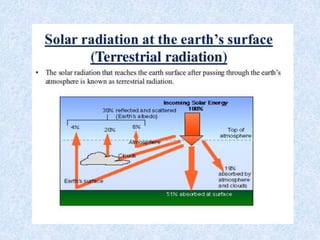
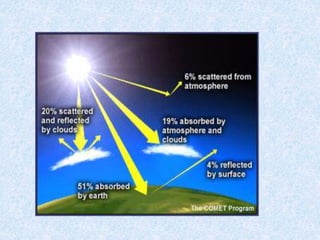
• Terrestial solar radiation: The solar
radiation which is the available at the earth’s
surface is called terrestial solar radiation.
• It is long wave radiation.
• Extraterrestrial radiation: Solar radiation
incident on outer atmosphere of earth’s is
called extraterrestrial radiation.
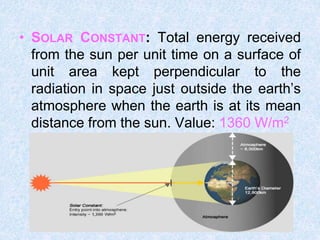
• SOLAR CONSTANT: Total energy received
from the sun per unit time on a surface of
unit area kept perpendicular to the
radiation in space just outside the earth’s
atmosphere when the earth is at its mean
distance from the sun. Value: 1360 W/m2
Solar Radiation Reflection
• Types of reflection :
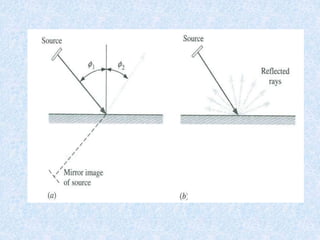
• Specular or regular reflection: When the
angle of incidence is equal to the angle of
reflection, the reflection is called specular or
regular reflection .
• Diffuse reflection: When an incident beam is
distributed uniformly in all directions after
reflection, the reflection is called diffuse
reflection.
• Specular reflection occurs on a highly
polished surface where the diffused reflection
occurs on a rough surface.
Solar Radiation
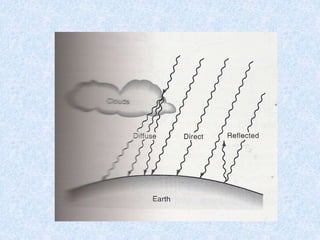
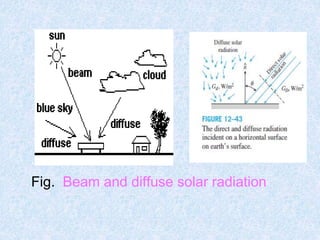
The solar radiation which reaches the earth’s
surface, is sometimes broken down into two
components: beam radiation (also called direct
radiation or direct beam radiation) and diffuse
radiation.
 Beam radiation is solar radiation that passes
through the atmosphere in essentially a straight
line without being reflected, scattered or absorbed
by particles or gases in the air. Beam radiation is
almost parallel
 Diffuse radiation is solar radiation, which is
scattered, reflected or absorbed by molecules of
air, water vapor, aerosols and dust particles,
but ultimately still reaches the earth’s surface.
Fig. Beam and diffuse solar radiation
 Even in clear skies, the diffuse
component of sunlight accounts for
between 10% and 20% of the total solar
radiation on a horizontal surface.
 On partly sunny days, up to 50% of that
radiation is diffuse.
 And on cloudy days, 100% of the
radiation is diffuse.
• The practical distinction between the two
components is that only the beam
radiation can be focused.
1.Direct radiation: can be focused , throws
sharp shadows.
2.Diffused radiation: cannot be focused,
does not throw sharp shadows.
• The total solar radiation on a horizontal
surface is called global radiation or
insolation and is the sum of beam
radiation (also called direct radiation or
direct beam radiation) and diffuse
radiation.
Solar Radiation Measurement
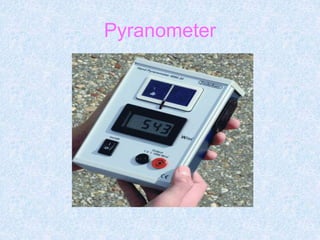
• Pyranometer: It is used to measure total
radiation or global radiation (direct and
diffuse) in terms of energy per unit time
per unit area on a horizontal surface.
• Pyrheliometer: It is used for measuring
beam radiation.
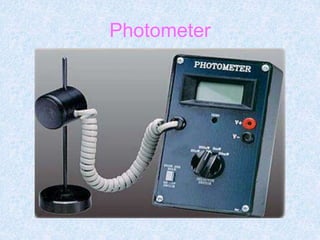
• Photometer –measures intensity of visible
light.
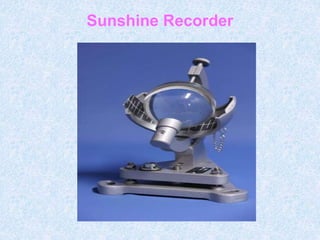
• Sunshine recorder-measures duration of
sunlight.
Pyranometer
Pyrheliometer
Photometer
Sunshine Recorder
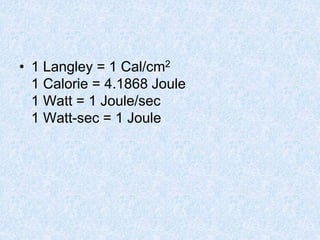
• 1 Langley = 1 Cal/cm2
1 Calorie = 4.1868 Joule
1 Watt = 1 Joule/sec
1 Watt-sec = 1 Joule
Sun does not shine consistently.
Solar energy is a diffuse source of
energy. To harness it, we must
concentrate it into an amount and form
that we can use, such as heat and
electricity.
We can harness solar energy by following
approaches:
1) collection,
2) conversion,
3) storage.
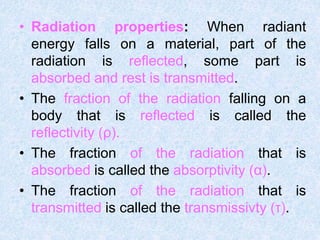
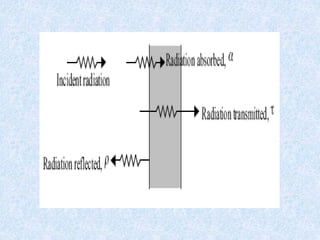
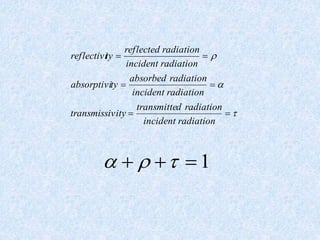
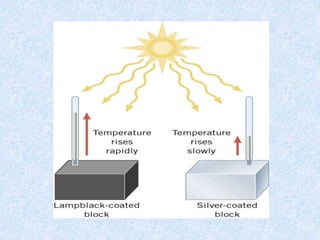
• Radiation properties: When radiant
energy falls on a material, part of the
radiation is reflected, some part is
absorbed and rest is transmitted.
• The fraction of the radiation falling on a
body that is reflected is called the
reflectivity (ρ).
• The fraction of the radiation that is
absorbed is called the absorptivity (α).
• The fraction of the radiation that is
transmitted is called the transmissivty (τ).
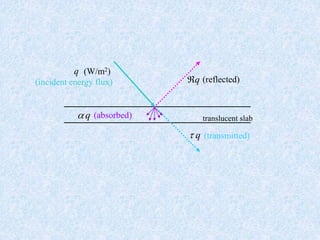
(W/m2)
(incident energy flux) (reflected)
(transmitted)
(absorbed) translucent slab
q
q
q
q






radiationincident
radiationdtransmitte
vitytransmissi
radiationincident
radiationabsorbed
tyabsorptivi
radiationincident
radiationreflected
tyreflectivi
1 
• and 0≤ρ≤1
• 0≤ α≤1
• 0≤ τ≤1
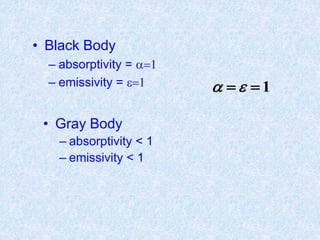
• Black Body
– absorptivity = 1
– emissivity = e1 1 e
• Gray Body
– absorptivity < 1
– emissivity < 1
Emissivity
• The emissivity of a surface is defined as
the ratio of radiation emitted by a surface
to that emitted by a black surface at same
temperature is called emissivity.
• It is denoted by ε and its value lies
between 0 and 1.
• It is
a measure of the ability of a surface to radi
ate energy.
• Black body: A body that absorbs all incident
radiation is called a black body.
• The absorbtivity of a black body is unity and
its reflectivity and transmissivity are both zero.
• The substances that have emissivity of less
than 1 are called gray bodies.
• All real materials have an emissivity less than
1.
Irradiance: The rate at which radiant energy
is incident on a surface per unit area of
surface. It is expressed in W/m2.
Emissive Power: The rate at which the
radiant energy leaves a surface per unit
area surface by emission only. Unit: W/m2
• A translucent plastic sheet transmits
35% of the solar radiation striking it and
has an absorptivity of 0.5. If 0.7 kW of
solar radiation is striking a sheet of this
plastic, what will be the rate of reflected
solar radiation from the sheet?
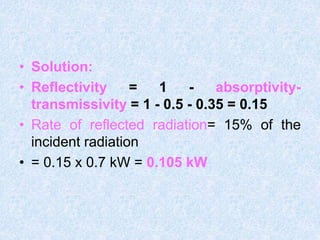
• Solution:
• Reflectivity = 1 - absorptivity-
transmissivity = 1 - 0.5 - 0.35 = 0.15
• Rate of reflected radiation= 15% of the
incident radiation
• = 0.15 x 0.7 kW = 0.105 kW
• Solar radiation is incident on a semi-transparent
surface at a rate of 500 W/m2. If 50 W/m2 of this
incident radiation is reflected back and 225
W/m2 is transmitted across the surface, the
absorptivity of the surface is
A.0
B.0.25
C.0.3
D.0.45
Solution: Absorptivity = [500-(225+50)] x
100/500=0.45
• Ans.: (D)
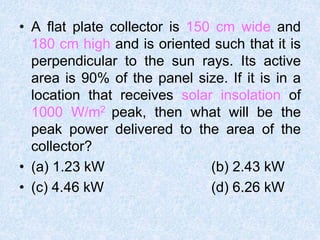
• A flat plate collector is 150 cm wide and
180 cm high and is oriented such that it is
perpendicular to the sun rays. Its active
area is 90% of the panel size. If it is in a
location that receives solar insolation of
1000 W/m2 peak, then what will be the
peak power delivered to the area of the
collector?
• (a) 1.23 kW (b) 2.43 kW
• (c) 4.46 kW (d) 6.26 kW
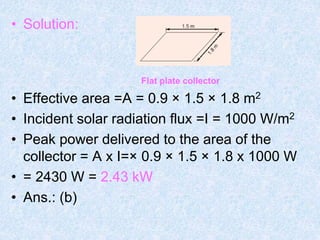
• Solution:
Flat plate collector
• Effective area =A = 0.9 × 1.5 × 1.8 m2
• Incident solar radiation flux =I = 1000 W/m2
• Peak power delivered to the area of the
collector = A x I=× 0.9 × 1.5 × 1.8 x 1000 W
• = 2430 W = 2.43 kW
• Ans.: (b)
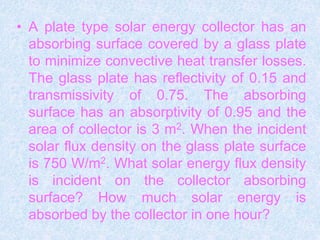
• A plate type solar energy collector has an
absorbing surface covered by a glass plate
to minimize convective heat transfer losses.
The glass plate has reflectivity of 0.15 and
transmissivity of 0.75. The absorbing
surface has an absorptivity of 0.95 and the
area of collector is 3 m2. When the incident
solar flux density on the glass plate surface
is 750 W/m2. What solar energy flux density
is incident on the collector absorbing
surface? How much solar energy is
absorbed by the collector in one hour?
• Solution:
• Solar energy flux incident on the absorbing
surface=1000 x 0.75=562.5 W/m2
• Amount of solar energy absorbed by the
collector in 1 h=562.5 x 1 x 3600 x 0.95 x
3
• =5771.25 kJ Ans.
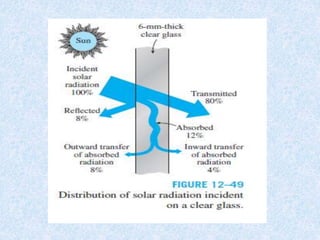
Conversion of Solar Energy into Heat
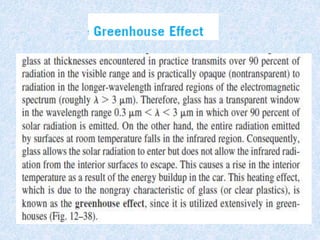
• The transmittance of glass for wavelength
over 3 micrometer is practically zero and
hence the majority of this radiated energy
dose not pass back to the atmosphere but
is contained within the collector.
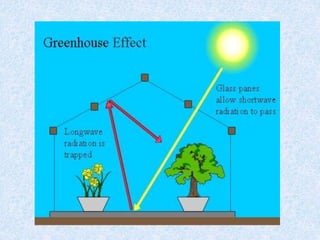
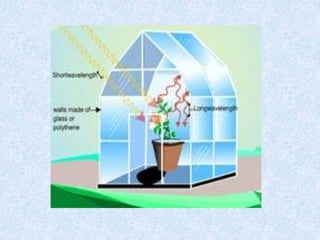
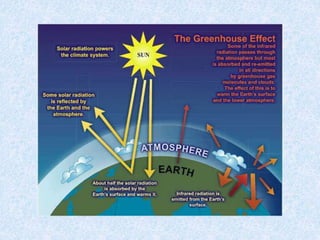
Greenhouse Effect
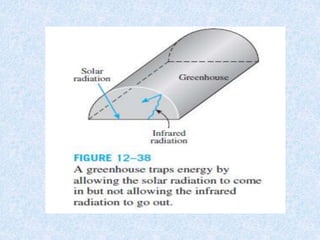
• The greenhouse effect refers to
circumstances where the short
wavelengths of visible light from the sun
pass through a transparent medium and
are absorbed, but the longer wavelengths
of the infrared re-radiation from the heated
objects are unable to pass through that
medium. The trapping of the long
wavelength radiation leads to more
heating and a higher resultant
temperature.
Greenhouse Effect due to Greenhouse Gases
Water vapour
Carbon dioxide
Nitrous oxide
Methane, etc
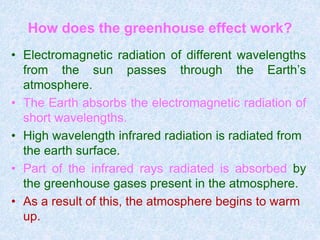
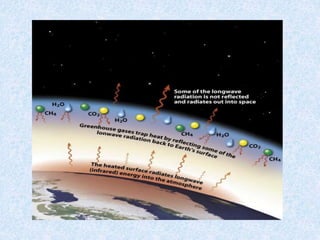
How does the greenhouse effect work?
• Electromagnetic radiation of different wavelengths
from the sun passes through the Earth’s
atmosphere.
• The Earth absorbs the electromagnetic radiation of
short wavelengths.
• High wavelength infrared radiation is radiated from
the earth surface.
• Part of the infrared rays radiated is absorbed by
the greenhouse gases present in the atmosphere.
• As a result of this, the atmosphere begins to warm
up.
Application
Solar water and air heating
Solar refrigeration system
Solar evaporative cooling
 Solar distillation
Solar drying of agricultural products
 Solar cookers
Solar oven
Solar thermal power generation
Solar pond
• Electricity generation through Photo voltaic
cells
• Solar water pumping
• Solar lantern
• Solar street light
• Solar fencing, etc.
3 solar radiation and greenhouse effect

3 solar radiation and greenhouse effect

  • 1.
    Md. I. A.Ansari Department of Agricultural Engineering (e-mail: irfan26200@yahoo.com) Renewable Energy and Green Technology
  • 2.
    The energy thatis received from sun in the form of electromagnetic radiation is called solar energy.  The sun is a gaseous body composed mostly of hydrogen.  Heat is generated due to fusion of hydrogen nuclei into helium nuclei.  Sun’s surface temperature is about 5800 K /6000 K. Solar Energy
  • 3.
    The amount ofenergy is greatest in the noon compared to morning and evening time. This energy can be captured and converted into two major useful forms: Heat and Electricity Solar energy is one of the most promising the non-conventional energy sources.
  • 4.
    Solar energy Inexhaustible sourceof energy. Environmentally clean and green source of energy Freely available in adequate quantities in almost all parts of the world
  • 5.
    The main problemsassociated with solar energy are: (i) dilute source of energy (ii) availability varies widely with time and location.
  • 6.
    Availability of amountof solar energy depends on: Atmospheric conditions Duration of day Season Latitude
  • 9.
    • Terrestial solarradiation: The solar radiation which is the available at the earth’s surface is called terrestial solar radiation. • It is long wave radiation. • Extraterrestrial radiation: Solar radiation incident on outer atmosphere of earth’s is called extraterrestrial radiation.
  • 10.
    • SOLAR CONSTANT:Total energy received from the sun per unit time on a surface of unit area kept perpendicular to the radiation in space just outside the earth’s atmosphere when the earth is at its mean distance from the sun. Value: 1360 W/m2
  • 11.
    Solar Radiation Reflection •Types of reflection : • Specular or regular reflection: When the angle of incidence is equal to the angle of reflection, the reflection is called specular or regular reflection . • Diffuse reflection: When an incident beam is distributed uniformly in all directions after reflection, the reflection is called diffuse reflection. • Specular reflection occurs on a highly polished surface where the diffused reflection occurs on a rough surface.
  • 13.
    Solar Radiation The solarradiation which reaches the earth’s surface, is sometimes broken down into two components: beam radiation (also called direct radiation or direct beam radiation) and diffuse radiation.  Beam radiation is solar radiation that passes through the atmosphere in essentially a straight line without being reflected, scattered or absorbed by particles or gases in the air. Beam radiation is almost parallel  Diffuse radiation is solar radiation, which is scattered, reflected or absorbed by molecules of air, water vapor, aerosols and dust particles, but ultimately still reaches the earth’s surface.
  • 15.
    Fig. Beam anddiffuse solar radiation
  • 16.
     Even inclear skies, the diffuse component of sunlight accounts for between 10% and 20% of the total solar radiation on a horizontal surface.  On partly sunny days, up to 50% of that radiation is diffuse.  And on cloudy days, 100% of the radiation is diffuse. • The practical distinction between the two components is that only the beam radiation can be focused.
  • 17.
    1.Direct radiation: canbe focused , throws sharp shadows. 2.Diffused radiation: cannot be focused, does not throw sharp shadows.
  • 18.
    • The totalsolar radiation on a horizontal surface is called global radiation or insolation and is the sum of beam radiation (also called direct radiation or direct beam radiation) and diffuse radiation.
  • 19.
    Solar Radiation Measurement •Pyranometer: It is used to measure total radiation or global radiation (direct and diffuse) in terms of energy per unit time per unit area on a horizontal surface. • Pyrheliometer: It is used for measuring beam radiation. • Photometer –measures intensity of visible light. • Sunshine recorder-measures duration of sunlight.
  • 20.
  • 21.
  • 22.
  • 23.
  • 24.
    • 1 Langley= 1 Cal/cm2 1 Calorie = 4.1868 Joule 1 Watt = 1 Joule/sec 1 Watt-sec = 1 Joule
  • 25.
    Sun does notshine consistently. Solar energy is a diffuse source of energy. To harness it, we must concentrate it into an amount and form that we can use, such as heat and electricity. We can harness solar energy by following approaches: 1) collection, 2) conversion, 3) storage.
  • 26.
    • Radiation properties:When radiant energy falls on a material, part of the radiation is reflected, some part is absorbed and rest is transmitted. • The fraction of the radiation falling on a body that is reflected is called the reflectivity (ρ). • The fraction of the radiation that is absorbed is called the absorptivity (α). • The fraction of the radiation that is transmitted is called the transmissivty (τ).
  • 28.
    (W/m2) (incident energy flux)(reflected) (transmitted) (absorbed) translucent slab q q q q
  • 30.
  • 31.
    • and 0≤ρ≤1 •0≤ α≤1 • 0≤ τ≤1
  • 32.
    • Black Body –absorptivity = 1 – emissivity = e1 1 e • Gray Body – absorptivity < 1 – emissivity < 1
  • 33.
    Emissivity • The emissivityof a surface is defined as the ratio of radiation emitted by a surface to that emitted by a black surface at same temperature is called emissivity. • It is denoted by ε and its value lies between 0 and 1. • It is a measure of the ability of a surface to radi ate energy.
  • 34.
    • Black body:A body that absorbs all incident radiation is called a black body. • The absorbtivity of a black body is unity and its reflectivity and transmissivity are both zero. • The substances that have emissivity of less than 1 are called gray bodies. • All real materials have an emissivity less than 1.
  • 36.
    Irradiance: The rateat which radiant energy is incident on a surface per unit area of surface. It is expressed in W/m2. Emissive Power: The rate at which the radiant energy leaves a surface per unit area surface by emission only. Unit: W/m2
  • 37.
    • A translucentplastic sheet transmits 35% of the solar radiation striking it and has an absorptivity of 0.5. If 0.7 kW of solar radiation is striking a sheet of this plastic, what will be the rate of reflected solar radiation from the sheet?
  • 38.
    • Solution: • Reflectivity= 1 - absorptivity- transmissivity = 1 - 0.5 - 0.35 = 0.15 • Rate of reflected radiation= 15% of the incident radiation • = 0.15 x 0.7 kW = 0.105 kW
  • 39.
    • Solar radiationis incident on a semi-transparent surface at a rate of 500 W/m2. If 50 W/m2 of this incident radiation is reflected back and 225 W/m2 is transmitted across the surface, the absorptivity of the surface is A.0 B.0.25 C.0.3 D.0.45 Solution: Absorptivity = [500-(225+50)] x 100/500=0.45 • Ans.: (D)
  • 40.
    • A flatplate collector is 150 cm wide and 180 cm high and is oriented such that it is perpendicular to the sun rays. Its active area is 90% of the panel size. If it is in a location that receives solar insolation of 1000 W/m2 peak, then what will be the peak power delivered to the area of the collector? • (a) 1.23 kW (b) 2.43 kW • (c) 4.46 kW (d) 6.26 kW
  • 41.
    • Solution: Flat platecollector • Effective area =A = 0.9 × 1.5 × 1.8 m2 • Incident solar radiation flux =I = 1000 W/m2 • Peak power delivered to the area of the collector = A x I=× 0.9 × 1.5 × 1.8 x 1000 W • = 2430 W = 2.43 kW • Ans.: (b)
  • 42.
    • A platetype solar energy collector has an absorbing surface covered by a glass plate to minimize convective heat transfer losses. The glass plate has reflectivity of 0.15 and transmissivity of 0.75. The absorbing surface has an absorptivity of 0.95 and the area of collector is 3 m2. When the incident solar flux density on the glass plate surface is 750 W/m2. What solar energy flux density is incident on the collector absorbing surface? How much solar energy is absorbed by the collector in one hour?
  • 43.
    • Solution: • Solarenergy flux incident on the absorbing surface=1000 x 0.75=562.5 W/m2 • Amount of solar energy absorbed by the collector in 1 h=562.5 x 1 x 3600 x 0.95 x 3 • =5771.25 kJ Ans.
  • 44.
    Conversion of SolarEnergy into Heat
  • 47.
    • The transmittanceof glass for wavelength over 3 micrometer is practically zero and hence the majority of this radiated energy dose not pass back to the atmosphere but is contained within the collector.
  • 48.
    Greenhouse Effect • Thegreenhouse effect refers to circumstances where the short wavelengths of visible light from the sun pass through a transparent medium and are absorbed, but the longer wavelengths of the infrared re-radiation from the heated objects are unable to pass through that medium. The trapping of the long wavelength radiation leads to more heating and a higher resultant temperature.
  • 51.
    Greenhouse Effect dueto Greenhouse Gases Water vapour Carbon dioxide Nitrous oxide Methane, etc
  • 52.
    How does thegreenhouse effect work? • Electromagnetic radiation of different wavelengths from the sun passes through the Earth’s atmosphere. • The Earth absorbs the electromagnetic radiation of short wavelengths. • High wavelength infrared radiation is radiated from the earth surface. • Part of the infrared rays radiated is absorbed by the greenhouse gases present in the atmosphere. • As a result of this, the atmosphere begins to warm up.
  • 55.
    Application Solar water andair heating Solar refrigeration system Solar evaporative cooling  Solar distillation Solar drying of agricultural products  Solar cookers Solar oven Solar thermal power generation Solar pond
  • 56.
    • Electricity generationthrough Photo voltaic cells • Solar water pumping • Solar lantern • Solar street light • Solar fencing, etc.