Solution
Week 40 (6/16/03)
Staying ahead
Consider a two-dimensional lattice on which a vote for A is signified by a unit step in
the positive x-direction, and a vote for B by a unit step in the positive y-direction.
Then the counting of the votes until A has a votes and B has b votes corresponds
to a path from the origin to the point (a, b), with a > b. There are a+b
a such paths
(because any a steps of the total a + b steps can be chosen to be the ones in the
x-direction). All of these paths from the origin to (a, b) are equally likely, as you
can show.1 The probability that a particular path corresponds to the way the votes
are counted is thus 1/ a+b
a .
The problem can therefore be solved by finding the number, Ng, of paths that
reach the point (a, b) without passing through the region y > x. (We’ll call these
the “good” paths; hence the subscript “g”.)
It will actually be easier to find the number, Nb, of paths that reach the point
(a, b) and that do pass through the region y > x. (We’ll call these the “bad” paths.)
The desired probability that A’s sub-total is always greater than or equal to B’s
sub-total equals 1 − Nb/ a+b
a
Claim: The number of “bad” paths from the origin to (a, b) (that is, the number
of paths that pass through the region y > x) equals Nb = a+b
b−1 .
Proof: The number of bad paths from (0, 0) to (a, b) equals the number of bad
paths from (0, 1) to (a, b) plus the number of bad paths from (1, 0) to (a, b). Let’s
look at these two classes of paths.
• The number of bad paths from (0, 1) to (a, b) is simply all of the paths from
(0, 1) to (a, b), which equals a+b−1
b−1 .
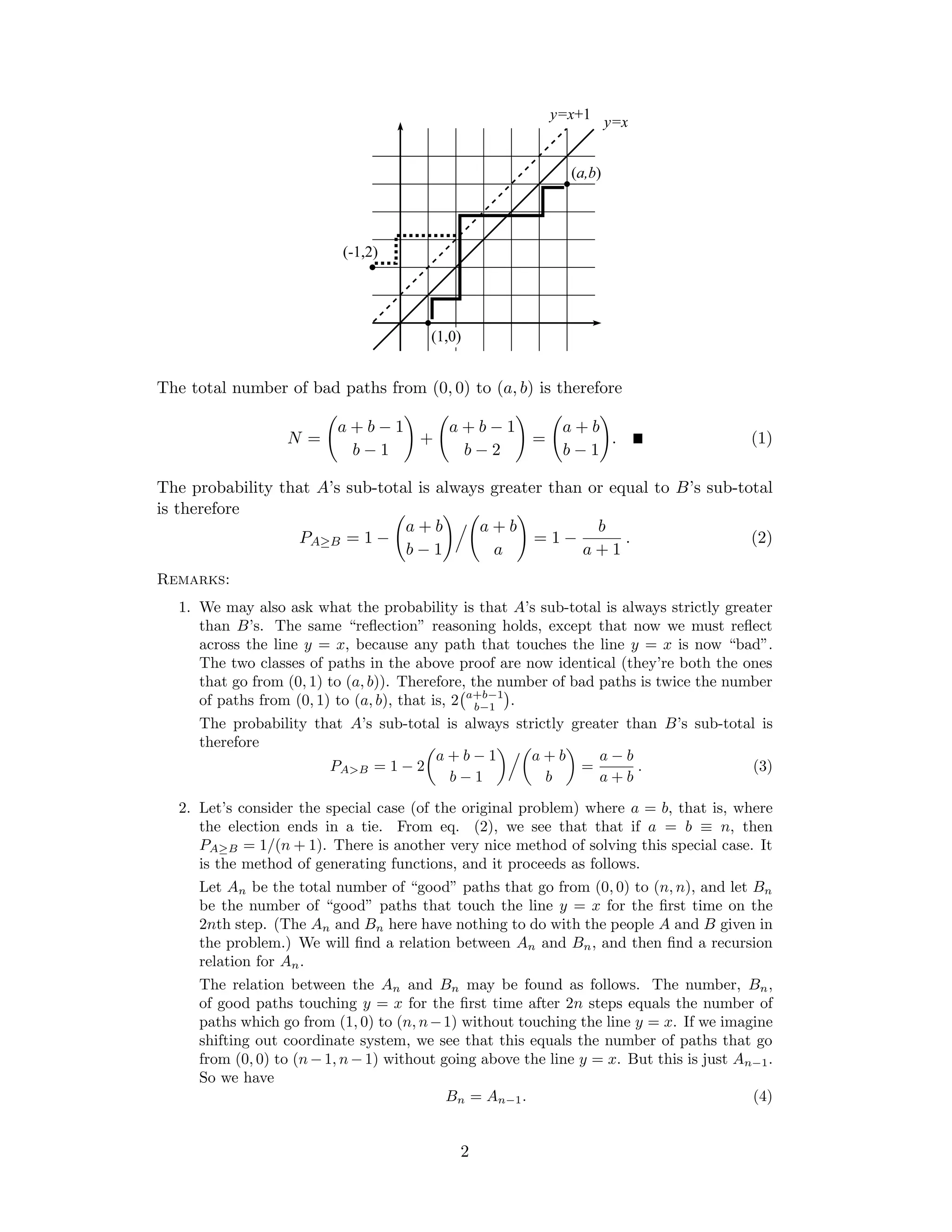
• The number of bad paths from (1, 0) to (a, b) equals the number of paths from
(−1, 2) to (a, b). This follows from the fact that any bad path from (1, 0) to
(a, b) must proceed via a point on the line y = x + 1, as shown below. Hence,
there is a one-to-one correspondence between the bad paths starting at (1, 0)
and all of the paths starting at (−1, 2). This correspondence is obtained by
reflecting, in the line y = x + 1, the portion of the bad path between (1, 0)
and the first point of contact with y = x + 1. An example of such a reflection
is shown below. The number of paths from (−1, 2) to (a, b) is a+b−1
b−2 .
1
The probabilities are all equal to a!b!/(a + b)!, as you can see by picking an arbitrary path and
writing down the product of the probabilities of each step. This result can be written as 1/ a+b
a
,
which makes sense, because a+b
a
is the total number of paths.
1
y=x
y=x+1
(a,b)
(-1,2)
(1,0)
The total number of bad paths from (0, 0) to (a, b) is therefore
N =
a + b − 1
b − 1
+
a + b − 1
b − 2
=
a + b
b − 1
. (1)
The probability that A’s sub-total is always greater than or equal to B’s sub-total
is therefore
PA≥B = 1 −
a + b
b − 1
a + b
a
= 1 −
b
a + 1
. (2)
Remarks:
1. We may also ask what the probability is that A’s sub-total is always strictly greater
than B’s. The same “reflection” reasoning holds, except that now we must reflect
across the line y = x, because any path that touches the line y = x is now “bad”.
The two classes of paths in the above proof are now identical (they’re both the ones
that go from (0, 1) to (a, b)). Therefore, the number of bad paths is twice the number
of paths from (0, 1) to (a, b), that is, 2 a+b−1
b−1 .
The probability that A’s sub-total is always strictly greater than B’s sub-total is
therefore
PA>B = 1 − 2
a + b − 1
b − 1
a + b
b
=
a − b
a + b
. (3)
2. Let’s consider the special case (of the original problem) where a = b, that is, where
the election ends in a tie. From eq. (2), we see that that if a = b ≡ n, then
PA≥B = 1/(n + 1). There is another very nice method of solving this special case. It
is the method of generating functions, and it proceeds as follows.
Let An be the total number of “good” paths that go from (0, 0) to (n, n), and let Bn
be the number of “good” paths that touch the line y = x for the first time on the
2nth step. (The An and Bn here have nothing to do with the people A and B given in
the problem.) We will find a relation between An and Bn, and then find a recursion
relation for An.
The relation between the An and Bn may be found as follows. The number, Bn,
of good paths touching y = x for the first time after 2n steps equals the number of
paths which go from (1, 0) to (n, n−1) without touching the line y = x. If we imagine
shifting out coordinate system, we see that this equals the number of paths that go
from (0, 0) to (n−1, n−1) without going above the line y = x. But this is just An−1.
So we have
Bn = An−1. (4)
2
Now let’s find a recursion relation for An. We may categorize the An good paths
from (0, 0) to (n, n) according to when they first touch the line y = x. There will be,
for example, some paths that touch this line after 2 steps. The number of these is
B1An−1. This is true because there are B1 (= 1) paths that touch the line for the
first time at the point (1,1), and then there are An−1 good paths that go from (1, 1)
to (n, n). Likewise, there are B2An−2 paths that touch y = x for the first time at
(2, 2), on the way to (n, n). Continuing in this fashion, we find
An = B1An−1 + B2An−2 + · · · + Bn−1A1 + BnA0, (5)
where A0 is defined to be 1.
Using eq. (4), we obtain the recursion relation
An = A0An−1 + A1An−2 + · · · + An−2A1 + An−1A0, (6)
We can calculate the first few of these. They are A0 = 1, A1 = 1, A2 = 2, A3 = 5,
A4 = 14, and A5 = 42. A lucky guess can produce the result An = 2n
n /(n + 1), but
let’s obtain this in a more deductive way.
A nice way to solve recursion relations such as the one in eq. (6) is to use generating
functions. By this, we mean consider the polynomial
F(x) = A0 + A1x + A2x2
+ A3x3
+ · · · . (7)
The key in this problem is to note that if we square F(x) and use eq. (6), we obtain
(F(x))2
= A0A0 + (A0A1 + A1A0)x + (A0A2 + A1A1 + A2A0)x2
+(A0A3 + A1A2 + A2A1 + A3A0)x3
+ · · ·
= A1 + A2x + A3x2
+ A4x3
+ · · ·
= (F(x) − 1)/x. (8)
Therefore, F(x) satisfies the equation,
xF2
− F + 1 = 0. (9)
The solution to this is
F =
1 ±
√
1 − 4x
2x
. (10)
We must now expand the square root in a Taylor series in order to obtain the coeffi-
cients of the various powers of x. It is clear that we must choose the minus sign if we
want the coefficient of x0
(which is A0) to be 1. By taking a plethora of derivatives,
you can show that the Taylor expansion of
√
1 + y can be written as
1 + y = 1 +
∞
n=1
1
n!
1
2
−1
2
−3
2
−5
2
· · ·
−(2n − 3)
2
yn
= 1 +
∞
n=1
(−1)n−1
(2(n − 1))!
22n−1n!(n − 1)!
yn
. (11)
Therefore, with y ≡ (−4x), eq. (10) gives
F =
∞
m=0
(2m)!
m!(m + 1)!
xm
. (12)
Thus,
An =
(2n)!
n!(n + 1)!
=
1
n + 1
2n
n
(13)
is the number of “good” paths that go from (0, 0) to (n, n). Since the total number
of paths from the origin to (n, n) is 2n
n , the probability of a good path is 1/(n + 1),
as we wanted to show.
3

Sol40

  • 1.
    Solution Week 40 (6/16/03) Stayingahead Consider a two-dimensional lattice on which a vote for A is signified by a unit step in the positive x-direction, and a vote for B by a unit step in the positive y-direction. Then the counting of the votes until A has a votes and B has b votes corresponds to a path from the origin to the point (a, b), with a > b. There are a+b a such paths (because any a steps of the total a + b steps can be chosen to be the ones in the x-direction). All of these paths from the origin to (a, b) are equally likely, as you can show.1 The probability that a particular path corresponds to the way the votes are counted is thus 1/ a+b a . The problem can therefore be solved by finding the number, Ng, of paths that reach the point (a, b) without passing through the region y > x. (We’ll call these the “good” paths; hence the subscript “g”.) It will actually be easier to find the number, Nb, of paths that reach the point (a, b) and that do pass through the region y > x. (We’ll call these the “bad” paths.) The desired probability that A’s sub-total is always greater than or equal to B’s sub-total equals 1 − Nb/ a+b a Claim: The number of “bad” paths from the origin to (a, b) (that is, the number of paths that pass through the region y > x) equals Nb = a+b b−1 . Proof: The number of bad paths from (0, 0) to (a, b) equals the number of bad paths from (0, 1) to (a, b) plus the number of bad paths from (1, 0) to (a, b). Let’s look at these two classes of paths. • The number of bad paths from (0, 1) to (a, b) is simply all of the paths from (0, 1) to (a, b), which equals a+b−1 b−1 . • The number of bad paths from (1, 0) to (a, b) equals the number of paths from (−1, 2) to (a, b). This follows from the fact that any bad path from (1, 0) to (a, b) must proceed via a point on the line y = x + 1, as shown below. Hence, there is a one-to-one correspondence between the bad paths starting at (1, 0) and all of the paths starting at (−1, 2). This correspondence is obtained by reflecting, in the line y = x + 1, the portion of the bad path between (1, 0) and the first point of contact with y = x + 1. An example of such a reflection is shown below. The number of paths from (−1, 2) to (a, b) is a+b−1 b−2 . 1 The probabilities are all equal to a!b!/(a + b)!, as you can see by picking an arbitrary path and writing down the product of the probabilities of each step. This result can be written as 1/ a+b a , which makes sense, because a+b a is the total number of paths. 1
  • 2.
    y=x y=x+1 (a,b) (-1,2) (1,0) The total numberof bad paths from (0, 0) to (a, b) is therefore N = a + b − 1 b − 1 + a + b − 1 b − 2 = a + b b − 1 . (1) The probability that A’s sub-total is always greater than or equal to B’s sub-total is therefore PA≥B = 1 − a + b b − 1 a + b a = 1 − b a + 1 . (2) Remarks: 1. We may also ask what the probability is that A’s sub-total is always strictly greater than B’s. The same “reflection” reasoning holds, except that now we must reflect across the line y = x, because any path that touches the line y = x is now “bad”. The two classes of paths in the above proof are now identical (they’re both the ones that go from (0, 1) to (a, b)). Therefore, the number of bad paths is twice the number of paths from (0, 1) to (a, b), that is, 2 a+b−1 b−1 . The probability that A’s sub-total is always strictly greater than B’s sub-total is therefore PA>B = 1 − 2 a + b − 1 b − 1 a + b b = a − b a + b . (3) 2. Let’s consider the special case (of the original problem) where a = b, that is, where the election ends in a tie. From eq. (2), we see that that if a = b ≡ n, then PA≥B = 1/(n + 1). There is another very nice method of solving this special case. It is the method of generating functions, and it proceeds as follows. Let An be the total number of “good” paths that go from (0, 0) to (n, n), and let Bn be the number of “good” paths that touch the line y = x for the first time on the 2nth step. (The An and Bn here have nothing to do with the people A and B given in the problem.) We will find a relation between An and Bn, and then find a recursion relation for An. The relation between the An and Bn may be found as follows. The number, Bn, of good paths touching y = x for the first time after 2n steps equals the number of paths which go from (1, 0) to (n, n−1) without touching the line y = x. If we imagine shifting out coordinate system, we see that this equals the number of paths that go from (0, 0) to (n−1, n−1) without going above the line y = x. But this is just An−1. So we have Bn = An−1. (4) 2
  • 3.
    Now let’s finda recursion relation for An. We may categorize the An good paths from (0, 0) to (n, n) according to when they first touch the line y = x. There will be, for example, some paths that touch this line after 2 steps. The number of these is B1An−1. This is true because there are B1 (= 1) paths that touch the line for the first time at the point (1,1), and then there are An−1 good paths that go from (1, 1) to (n, n). Likewise, there are B2An−2 paths that touch y = x for the first time at (2, 2), on the way to (n, n). Continuing in this fashion, we find An = B1An−1 + B2An−2 + · · · + Bn−1A1 + BnA0, (5) where A0 is defined to be 1. Using eq. (4), we obtain the recursion relation An = A0An−1 + A1An−2 + · · · + An−2A1 + An−1A0, (6) We can calculate the first few of these. They are A0 = 1, A1 = 1, A2 = 2, A3 = 5, A4 = 14, and A5 = 42. A lucky guess can produce the result An = 2n n /(n + 1), but let’s obtain this in a more deductive way. A nice way to solve recursion relations such as the one in eq. (6) is to use generating functions. By this, we mean consider the polynomial F(x) = A0 + A1x + A2x2 + A3x3 + · · · . (7) The key in this problem is to note that if we square F(x) and use eq. (6), we obtain (F(x))2 = A0A0 + (A0A1 + A1A0)x + (A0A2 + A1A1 + A2A0)x2 +(A0A3 + A1A2 + A2A1 + A3A0)x3 + · · · = A1 + A2x + A3x2 + A4x3 + · · · = (F(x) − 1)/x. (8) Therefore, F(x) satisfies the equation, xF2 − F + 1 = 0. (9) The solution to this is F = 1 ± √ 1 − 4x 2x . (10) We must now expand the square root in a Taylor series in order to obtain the coeffi- cients of the various powers of x. It is clear that we must choose the minus sign if we want the coefficient of x0 (which is A0) to be 1. By taking a plethora of derivatives, you can show that the Taylor expansion of √ 1 + y can be written as 1 + y = 1 + ∞ n=1 1 n! 1 2 −1 2 −3 2 −5 2 · · · −(2n − 3) 2 yn = 1 + ∞ n=1 (−1)n−1 (2(n − 1))! 22n−1n!(n − 1)! yn . (11) Therefore, with y ≡ (−4x), eq. (10) gives F = ∞ m=0 (2m)! m!(m + 1)! xm . (12) Thus, An = (2n)! n!(n + 1)! = 1 n + 1 2n n (13) is the number of “good” paths that go from (0, 0) to (n, n). Since the total number of paths from the origin to (n, n) is 2n n , the probability of a good path is 1/(n + 1), as we wanted to show. 3