Submitted by
Arafat Rahman Parvez
193 017 031
TYPES OF SOIL:- LOAMY,PEAT,CHALK
PRESENTATION TOPIC
The upper layer of earth in which plants grow, a black or dark brown material
typically consisting of a mixture of organic remains, clay, and rock particles.
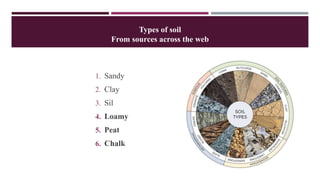
1. Sandy
2. Clay
3. Sil
4. Loamy
5. Peat
6. Chalk
Types of soil
From sources across the web
LOAMY SOIL
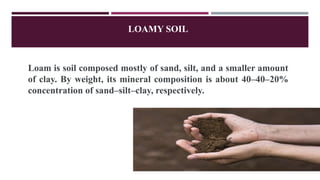
Loam is soil composed mostly of sand, silt, and a smaller amount
of clay. By weight, its mineral composition is about 40–40–20%
concentration of sand–silt–clay, respectively.
COMPOSITION OF LOAMY SOIL
THREE MAIN USES OF LOAMY SOIL
 Raising Crops. Loam soil provides vegetable plants with soil conditions needed to
produce abundant crops during the growing season.
 Planting Trees.
 Growing Flowers.
ADVANTAGES LOAMY SOIL
 They have more humus (the organic component of the soil)
 The hold more moisture and nutrients.
 They have better drainage.
 Loamy soils have better infiltration of water and air.
 Loam soils are a better habitat for beneficial microorganisms.
So while water is retained easily in loam soils, it does not enter into it easily to
increase bulk and density. As a result, the particles in loam soils have a
tendency to detach. If soil is disturbed by rain, wind or construction, its silt and
clay particles are transported easily and the soil can begin to erode.
DISADVANTAGES LOAMY SOIL
PEAT SOIL
Peat is the surface organic layer of a soil that consists of partially
decomposed organic matter, derived mostly from plant material, which
has accumulated under conditions of waterlogging, oxygen deficiency,
high acidity and nutrient deficiency.
COMPOSITIONS OF PEAT SOIL
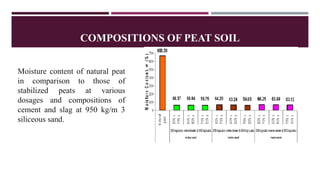
Moisture content of natural peat
in comparison to those of
stabilized peats at various
dosages and compositions of
cement and slag at 950 kg/m 3
siliceous sand.
USES OF PEAT SOIL
 Horticulture
 Oil absorbent
 Biofiltration
 Peat uses elsewhere in the world
ADVANTAGES OF PEAT SOIL
Peat moss offers numerous advantages and benefits to gardeners who wish to make their
plants thrive. It has several important characteristics that gardeners need, such as high
absorbency, sterile material, acidic ph features, compaction prevention properties, and
more.
CHALK SOIL
Chalky soil is comprised mostly of calcium carbonate from
sediment that has built up over time. It is usually shallow, stony,
and dries out quickly.
COMPOSITION OF CHALK SOIL
 Alkaline, with a pH of 7.5 or more.
 Usually stony.
 Free draining.
 Often overlays chalk or limestone bedrock.
 This means some minerals, such as manganese (Mg) and iron (Fe),
become unavailable to plants, causing poor growth and yellowing of
leaves.
 This can be remedied by adding fertilisers
USES OF CHALK SOIL
chalk is used for raising pH in soils with high acidity. The most common
forms are CaCO3 (calcium carbonate) and CaO (calcium oxide). Small
doses of chalk can also be used as an antacid. Additionally, the small
particles of chalk make it a substance ideal for cleaning and polishing.
ADVANTAGES & DISADVANTAGES OF CHALK SOIL
Advantage
It is very free draining, and chalky soils hold little water and dry out
easily.
Disadvantage
Chalky soils are fertile, but many of the nutrients are not available to
plants because of the high alkalinity of the soil, which prevents the
absorption of iron by plant roots.
Soil type loamy,peat,chalk

Soil type loamy,peat,chalk

  • 2.
    Submitted by Arafat RahmanParvez 193 017 031
  • 3.
    TYPES OF SOIL:-LOAMY,PEAT,CHALK PRESENTATION TOPIC
  • 4.
    The upper layerof earth in which plants grow, a black or dark brown material typically consisting of a mixture of organic remains, clay, and rock particles.
  • 5.
    1. Sandy 2. Clay 3.Sil 4. Loamy 5. Peat 6. Chalk Types of soil From sources across the web
  • 6.
    LOAMY SOIL Loam issoil composed mostly of sand, silt, and a smaller amount of clay. By weight, its mineral composition is about 40–40–20% concentration of sand–silt–clay, respectively.
  • 7.
  • 8.
    THREE MAIN USESOF LOAMY SOIL  Raising Crops. Loam soil provides vegetable plants with soil conditions needed to produce abundant crops during the growing season.  Planting Trees.  Growing Flowers.
  • 9.
    ADVANTAGES LOAMY SOIL They have more humus (the organic component of the soil)  The hold more moisture and nutrients.  They have better drainage.  Loamy soils have better infiltration of water and air.  Loam soils are a better habitat for beneficial microorganisms.
  • 10.
    So while wateris retained easily in loam soils, it does not enter into it easily to increase bulk and density. As a result, the particles in loam soils have a tendency to detach. If soil is disturbed by rain, wind or construction, its silt and clay particles are transported easily and the soil can begin to erode. DISADVANTAGES LOAMY SOIL
  • 11.
    PEAT SOIL Peat isthe surface organic layer of a soil that consists of partially decomposed organic matter, derived mostly from plant material, which has accumulated under conditions of waterlogging, oxygen deficiency, high acidity and nutrient deficiency.
  • 12.
    COMPOSITIONS OF PEATSOIL Moisture content of natural peat in comparison to those of stabilized peats at various dosages and compositions of cement and slag at 950 kg/m 3 siliceous sand.
  • 13.
    USES OF PEATSOIL  Horticulture  Oil absorbent  Biofiltration  Peat uses elsewhere in the world
  • 14.
    ADVANTAGES OF PEATSOIL Peat moss offers numerous advantages and benefits to gardeners who wish to make their plants thrive. It has several important characteristics that gardeners need, such as high absorbency, sterile material, acidic ph features, compaction prevention properties, and more.
  • 15.
    CHALK SOIL Chalky soilis comprised mostly of calcium carbonate from sediment that has built up over time. It is usually shallow, stony, and dries out quickly.
  • 16.
    COMPOSITION OF CHALKSOIL  Alkaline, with a pH of 7.5 or more.  Usually stony.  Free draining.  Often overlays chalk or limestone bedrock.  This means some minerals, such as manganese (Mg) and iron (Fe), become unavailable to plants, causing poor growth and yellowing of leaves.  This can be remedied by adding fertilisers
  • 17.
    USES OF CHALKSOIL chalk is used for raising pH in soils with high acidity. The most common forms are CaCO3 (calcium carbonate) and CaO (calcium oxide). Small doses of chalk can also be used as an antacid. Additionally, the small particles of chalk make it a substance ideal for cleaning and polishing.
  • 18.
    ADVANTAGES & DISADVANTAGESOF CHALK SOIL Advantage It is very free draining, and chalky soils hold little water and dry out easily. Disadvantage Chalky soils are fertile, but many of the nutrients are not available to plants because of the high alkalinity of the soil, which prevents the absorption of iron by plant roots.