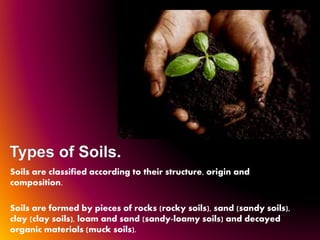
Soils are classified according to their structure, origin and
composition.
Soils are formed by pieces of rocks (rocky soils), sand (sandy soils),
clay (clay soils), loam and sand (sandy-loamy soils) and decayed
organic materials (muck soils).
Can you guess which one is which?
•ROCKY SOIL
•SANDY SOIL
•CLAY SOIL
•SANDY-LOAMY SOIL
•MUCK SOIL
Can you guess which one is which?
•ROCKY SOIL
•SANDY SOIL
•CLAY SOIL
•SANDY-LOAMY SOIL
•MUCK SOIL
ROCKY SOIL SANDY-LOAMY SOIL SANDY SOIL
MUCK SOIL
CLAY SOIL
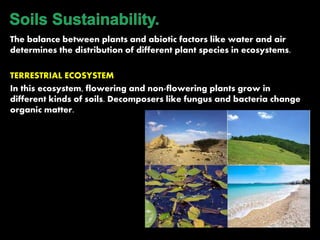
The balance between plants and abiotic factors like water and air
determines the distribution of different plant species in ecosystems.
TERRESTRIAL ECOSYSTEM
In this ecosystem, flowering and non-flowering plants grow in
different kinds of soils. Decomposers like fungus and bacteria change
organic matter.
The balance between plants and abiotic factors like water and air
determines the distribution of different plant species in ecosystems.
TERRESTRIAL ECOSYSTEM
In this ecosystem, flowering and non-flowering plants grow in
different kinds of soils. Decomposers like fungus and bacteria change
organic matter.
AQUATIC ECOSYSTEM
In this ecosystem, plankton, algae and plants adapted to the aquatic
environment grow. The relationship between soil and the aquatic ecosystem
is caused by the organic matter that is carried from terrestrial ecosystems
by the rivers to the oceans and lakes.
Terrestrial and aquatic ecosystems depend on each other since the energy
flows between both ecosystems to maintain the balance and the
sustainability of the biotic and abiotic factors.
A group of microscopic organisms which live in salt or sweet water,
more abundant up to 200 meters of depth.
A very large and diverse group of organisms, ranging from
unicellular to multi-cell forms such as the giant kelp, a large brown
alga that may grow up to 50 meters in length.
Science ruleS!!!

Soil and Ecosystems

  • 2.
    Soils are classifiedaccording to their structure, origin and composition. Soils are formed by pieces of rocks (rocky soils), sand (sandy soils), clay (clay soils), loam and sand (sandy-loamy soils) and decayed organic materials (muck soils).
  • 3.
    Can you guesswhich one is which? •ROCKY SOIL •SANDY SOIL •CLAY SOIL •SANDY-LOAMY SOIL •MUCK SOIL
  • 4.
    Can you guesswhich one is which? •ROCKY SOIL •SANDY SOIL •CLAY SOIL •SANDY-LOAMY SOIL •MUCK SOIL ROCKY SOIL SANDY-LOAMY SOIL SANDY SOIL MUCK SOIL CLAY SOIL
  • 5.
    The balance betweenplants and abiotic factors like water and air determines the distribution of different plant species in ecosystems. TERRESTRIAL ECOSYSTEM In this ecosystem, flowering and non-flowering plants grow in different kinds of soils. Decomposers like fungus and bacteria change organic matter.
  • 6.
    The balance betweenplants and abiotic factors like water and air determines the distribution of different plant species in ecosystems. TERRESTRIAL ECOSYSTEM In this ecosystem, flowering and non-flowering plants grow in different kinds of soils. Decomposers like fungus and bacteria change organic matter. AQUATIC ECOSYSTEM In this ecosystem, plankton, algae and plants adapted to the aquatic environment grow. The relationship between soil and the aquatic ecosystem is caused by the organic matter that is carried from terrestrial ecosystems by the rivers to the oceans and lakes. Terrestrial and aquatic ecosystems depend on each other since the energy flows between both ecosystems to maintain the balance and the sustainability of the biotic and abiotic factors.
  • 7.
    A group ofmicroscopic organisms which live in salt or sweet water, more abundant up to 200 meters of depth.
  • 8.
    A very largeand diverse group of organisms, ranging from unicellular to multi-cell forms such as the giant kelp, a large brown alga that may grow up to 50 meters in length.
  • 9.