@PETER .L. OKION
778001502/758795415
8/3/2023
@PETER .L. OKION 77800150 2/
7587954 15
,
'
t
-
11, ..,·_ .'
,
+
.. •
... '
4 _
4 ' · . ,
_- .. ~ - -
.
~ -
L,~ . . . .
..
•
.
t
@PETER .L. OKION 778001502/ 758795415
SOIL
•
•
Soil is the top most layer of the earth's crust.
OR The finely divided material covering the earth's surface. It is
normally treated as dirt
Soil is the most essential natural resource on earth, and without
it, there would be no home and food for all organisms on earth.
•
8/3/2023 @PETER .L. OKION 778001502/ 758795415 6
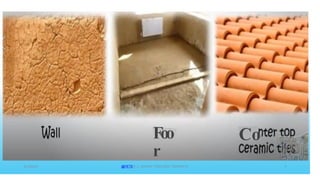
Foo
r
Co
8/3/2023 @PETER .L. OKION 778001502/ 758795415 7
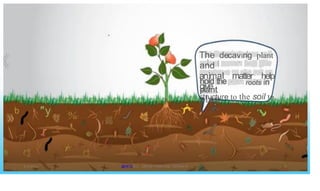
The decaving plant
and
animal matter help
give
structure to the soil to
hold the
plant
place.
roots in
"y
r
b (
'
-,
» %
'
/
4s
«"
) ~


l
-----
l
f
!
. 0
I (
r
•
@PETER .L. OKION 778001502/ 758795415
8/3/2023
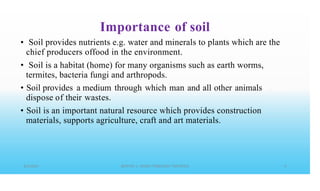
Importance of soil
• Soil provides nutrients e.g. water and minerals to plants which are the
chief producers offood in the environment.
Soil is a habitat (home) for many organisms such as earth worms,
termites, bacteria fungi and arthropods.
Soil provides a medium through which man and all other animals
dispose of their wastes.
Soil is an important natural resource which provides construction
materials, supports agriculture, craft and art materials.
•
•
•
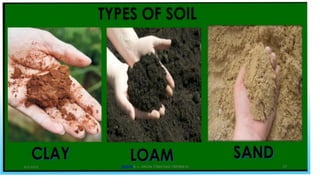
TYPES OF SOIL
• The appearance of soil varies from place to place.
• Question: are soils from the swamps similar to those
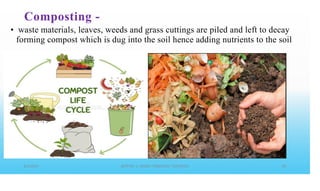
do the two soils differ?
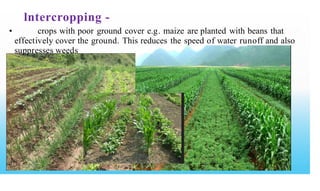
from hills?, how
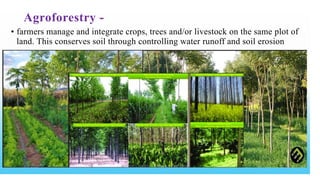
ctd
• Soils differ in color, texture and size of the particles. The difference in
this properties determines the type of the soil.
• The type of soil determines the use of the soil, which soil types are
common in your area?, what are the main uses of the soil types in
your community?
'peso 'oi
rent
o h
¢
«
@P
ET
ER
.L.
OKI
ON
778
8/3/2023 12
@PETER .L. OKION 778001502/ 758795415
8/3/2023
.,,,
J
'
t
.
I ' ,
' '
•
' ., t '
'
!
...
6f
~ 4
'
4
'
.
•
,. I'',
,
4
I
+
'
.'j:,
4
J1
:
I
f
,. I
,
6
;
e.
.
« d
t
1
.,
·.
("
'I
~
a
•
i J l
'
0
-
I,
~
~
I
d
...
~
.-
-
f
t
f
,
.
4
.,
.
1
'
$ i ' 4
J
t f
4
/- F
.I
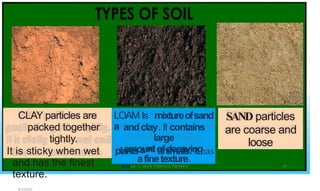
CLAY particles are
packed together
tightly.
It is sticky when wet
and has the finest
texture.
8/3/2023
LOAM Is
a
mixtureofsand SAND particles
andclay. It contains
large
amountofdecaying
are coarse and
loose
and
plants animals. It has
afinetexture.
@PETER .L. OKION 778001502/ 758795415
Loam
ctd
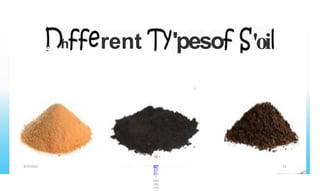
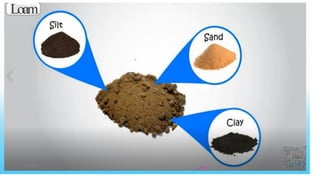
LOAM SOIL, this is a mixture of sand(about 40%), clay(15%) and
organic matter. It is dark and has a stable crumb structure. Usually
found almost everywhere especially in gardens, near compost pits and
dumping areas.
SANDY SOIL, it is light and has a gritty feel when wet. Found on
lake shores and hilly areas.
CLAY SOIL, it is heavy and has fine particles with a sticky feel
when wet. found in swamps and anthills.
•
•
•
CHARACTERISTICS OF SOIL
•
•
•
A) COLOUR
Have you noticed that different soils have different colors?
Do you know the color of loam soil? Why do you think it is that color?
ctd
• The color of soil is usually determined by the mineral present and by the
organic matter that covers the surface of the soil particles.
• Black soils are generally more fertile than lighter soils because they tend to
have higher organic matter content.
•
•
•
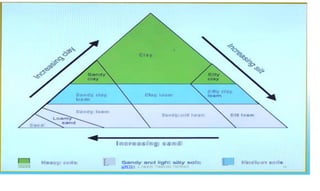
B)TEXTURE
this is how rough or how smooth a particular soil sample is.
The texture of
sand, silt, clay
analysis chart,
fine-textured.
a soil sample is determined by the relative proportions of
and particle sizes present in the soil, e.g. using soil texture
we see that sandy soils are coarse-textured and clay soils
are
C l a y
S Ity c l a y
t o a m
S a n d y
lo a mn
c l a y C l a y
S a n d y l o a m
S a n d y s i i t t o a r S i l t l o a m
S a n d
I n c r e a s i n g s a n d
L
L u t e d i u m s o il
l s
H e a v y s o i l s t
e « i v silt
. 2 o 2 3 @PETER .L. OKION 778001502/ 758795415 19
ctd
•
•
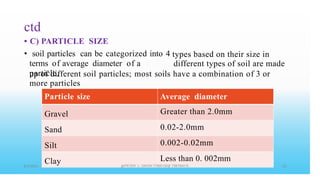
C) PARTICLE SIZE
soil particles can be categorized into 4
terms of average diameter of a
particle,
types based on their size in
different types of soil are made
up of different soil
more particles
particles; most soils have a combination of 3 or
Particle
Gravel
Sand
Silt
Clay
size Average diameter
Greater than 2.0mm
0.02-2.0mm
0.002-0.02mm
Less than 0. 002mm
PETER .L. OKION 778001502 758795415
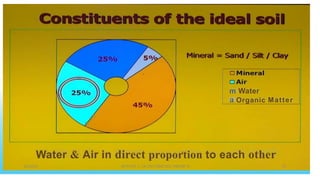
m Water
a Organic Matter
A
I
A
'g
Water & Air in direct proportion to each other
8 3/2023 PETER L OK ON 778001502/ 758795 15
CONSTITUENTS OF SOIL
• Soil constituents are materials that
living and non-living things e.g
............................. '
combine to form soil. They include
,
'
.........................................
• • • • • • • • • • • • • • • • • • • • • • • • • • • • • • • • • • • • • • • • •
And
soln
Humus
Water,
Air,
or organic matter
Minerals
Soil living organisms.
PROPERTIES OF SOIL
• Different soils have different properties. The properties can be
categorized into physical and chemical properties.
PHYSICAL PROPERTIES, are qualities that can be perceived
• by
body senses like seeing, feeling and tasting E.g. water retention,
drainage, color, texture and particle size.
A) WATER RETENTION
If plants are to obtain water from the soil, then the
soil ability to retain water in its particles.
•
• must have the
• Qn. Do all the soils have the same capacity to retain water?
ctd
• Soils that retain more water are said to have a High water retention
capacity
while soils that retain less water are said to have
• • • • • • • • • • • • • • • • • • • • • • • • • • • • • • • • • • • •
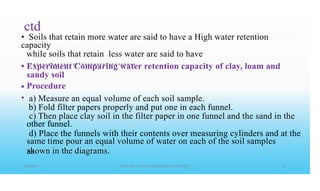
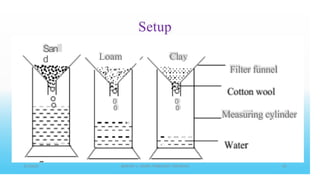
• Experiment Comparing water retention capacity of clay, loam and
sandy soil
Procedure
a) Measure an equal volume of each soil sample.
b) Fold filter papers properly and put one in each funnel.
other funnel.
same time pour an equal volume of water on each of the soil samples
as
•
•
c) Then place clay soil in the filter paper in one funnel and the sand in the
d) Place the funnels with their contents over measuring cylinders and at the
shown in the diagrams.
Setup
San
d Loam Clav
;J
Filter funnel
.
3·•
'I
··I:,
,.
.
.
0
0
0
0
Measuring cylinder
s
- - -
-
i i i i i
•
Observation
• Water passes through sandy soil faster than it does in loam and clay
soils.
Sandy soil gives the first drop of water and clay soil gives the last.
•
• So much water is
water is collected
collected in the cylinder with sandy soil and the least
in the cylinder with clay soil.
• CONCLUSION, Clay soil holds more water than loam and sandy soil
explanation
• Sandy soil has large air spaces which enable water to pass through more
rapidly and on the other hand , clay soil retains more water than sandy
and loam soils. This is because clay soil has many small particles with
small air spaces thereby retaining more water
Loam soil has medium retention
B) DRAINAGE
•
•
• After rain, some places dry immediately while others remain water
logged. What is the reason for this?
The ability of the soil to let water move through it is called
soil
• • • • • • • • • • • • • •
•
ctd
Soil
drai
nage
soil
parti
cles.
to
have
go through it
• depends on the size of the particles and air spaces between the
The soil type that easily allows water to pass through it is said
drainage while the soil type that does not allow water to
easily is said to have drainage .
• Poor soil drainage leads to water logging that destroys property and crops.
•
•
Experiment to compare drainage of sandy, loam and clay soils.
NB: For procedure and setup, refer to experiment on water retention
observation
• Water passes faster through sandy soil than through loam and clay
soils.
Sandy soil gives the first drop of water and clay soil gives the last
drop
•
So much water is
water is collected
collected in the cylinder with sandy soil and the least
in the cylinder with clay soil.
• CONCLUSION, sandy soil drains faster than loam and clay soil
explanation
• Sandy soil has larger air spaces which enable water to drain through more
more
space
s
rapidly and on the other hand, clay soil has low
because
drainage and retains
water than sandy and loam soil. This
and small particles.
Loam soil has a medium drainage
is clay soil has few air
•
•
•
C) CAPILLARITY
Qn. At a construction site, you have seen builders use a black polythene
sheet to cover the slab after laying the foundation. Why do you think this
is necessary before continuing the construction of the wall?
ctd
• The rise of water from the bottom layers to the top layers through the
soil particles is called It also
depends on the size of the soil particles.
Imagine sipping
NOVIDA using
a straw
•
•
Experiment to compare capillarity of
sandy, loam and clay soils
• Procedure
a) Tie a muslin sheath tightly at the end of the glass tubes.
b) Fill one glass tube with dry sample of sand soil and pack
it ensuring that there are no spaces in the soil.
c) Repeat this with clay and loam soils.
well
d) The
sheath
e) The
shown
glass tubes are stood vertically with the ends tied with
immersed in a glass trough containing enough water.
muslin
glass tubes are supported upright with retort stands and clamps
in the diagram below.
as
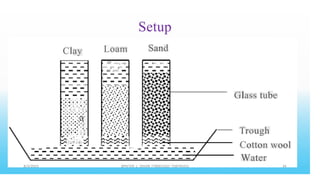
Setup
Sand
Loam
= a a
- a a
Clay
a o
m i
Glass tube
i I i
i i i i i
i i i i i
I
• • •
i i i ii i i i
II 11
1
1 II I II II
4 .a
a
ii i i i ii ii
I
• •
t Ii
Ii
a
i
i
i
a a
I
Trough
Cotton wool
Water
i i
• ■l ■
i
II I I
I
i d ii
' a ' a
. " · · .
. - " · +
- - -
m
Observation
Water rises faster but to a lower level in sandy soil while in clay soil, water
rises slowly but to higher levels.
In loam soil water rises moderately to a moderate level.
CONCLUSION; Clay soil has the highest capillarity while sandy soil has
the lowest capillarity and loam soil has medium water capillarity.
EXPLANATION: Water rises fastest during early stages of the experiment
in sandy soil because sand has large spaces that enable water to rise rapidly
Clay soil has the highest water capillarity because it is composed of tiny soil
particles which present a large surface are over which water molecules cling.
Water rises at a slow rate in clay soil because clay has small spaces between
its particles.
•
•
•
•
•
•
Application
• Clay mixed with water, oil and honey can be used to make clay masks
that ladies apply on their faces to maintain beauty.
• Basing on clay's property of being sticky when wet, it
germs on the surface of the skin and deep in the
pores dried up germs to the surface of the skin to be
washed
binds with
and brings
the away
• Pottery, brick making .
Chemical properties of soil
• SOIL PH, IS the degree of acidity or alkalinity of the soil. Most
soils in the tropics are acidic. The pH of soil can be determined using
universal indicator or litmus solution.
a
•
•
Qn. Why do you think it is important to know the pH of soil?
SOLN. Helps one to know the crops can grow well in a given soil or
land type.
Qn. What would happen if you grew crops in soils with
unsuitable pH?
PH scale range from Oto 14.
•
•
ctd
Soils with pH above 7 are basic or alkaline while soils with pH below 7
acidic. A soil type with a pH 7 is neither acidic nor basic, it is neutral.
The pH of soil depends on its parent rock (rock from which the soil
was
• are
•
formed). pH controls which nutrients are available for plant use
•
•
NB: PH is Potential of Hydrogen
Examples of crops that grow well in acidic soils include; beans,
onions,
tomatoes, sweet potatoes .
• Crops that grow well in alkaline soils include; pumpkin, cabbages .....
QUICK TIP
cidic soils are found
• •
in places where the
rainfall is very high
poor.
and drainage is
Why is this s o ?
PERCENTAGE COMPOSITION OF
SOIL CONSTITUENTS
• Experiment to determine the percentage of air in the soil
Apparatus: Measuring cylinders (2), dry soil sample, water,
Method
1. Measure about 50 cm3 of dry soil in a measuring
cylinder container to level out the soil.
and glass rod.
and tap the
2.
3.
4.
Measure 50 cm3 of water in another measuring cylinder.
Add the two together (observe carefully as you pour the water onto the
soil) Allow the mixture to stand until no more bubbles appear. Read and
record
the final level of water plus soil in the measuring cylinder. Calculate the air
content in terms of percentage.
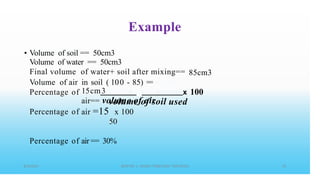
Example
• Volume of soil == 50cm3
Volume of water == 50cm3
Final volume of water+ soil after mixing== 85cm3
Volume of air in soil ( 100 - 85) =
=
15cm3
air== volume of air
100
Percentage of x
volume of soil
air =15 x 100
50
used
Percentage of
Percentage of air == 30%
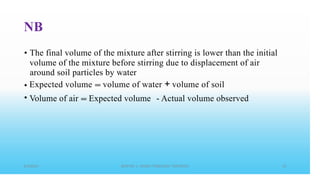
NB
• The final volume of the mixture after stirring is lower than the initial
volume of the mixture before stirring due to displacement of air
around soil particles by water
Expected volume == volume of water + volume of soil
•
• Volume of air == Expected volume - Actual volume observed
exerci•
se
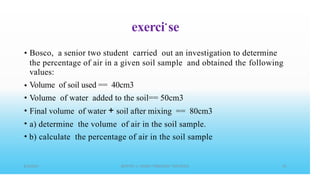
• Bosco, a senior two student carried out an investigation to determine
the percentage of air in a given soil sample and obtained
values:
Volume of soil used == 40cm3
Volume of water added to the soil== 50cm3
Final volume of water + soil after mixing == 80cm3
a) determine the volume of air in the soil sample.
b) calculate the percentage of air in the soil sample
the following
•
•
•
•
•
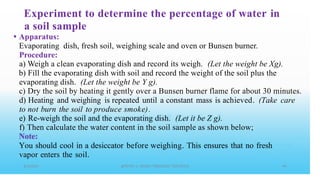
Experiment to determine the percentage of water
a soil sample
Apparatus:
Evaporating dish, fresh soil, weighing scale and oven or Bunsen burner.
Procedure:
in
•
a) Weigh a clean evaporating dish and record its weigh. (Let the weight be Xg).
b) Fill the evaporating dish with soil and record the weight of the soil plus the
evaporating dish. (Let the weight be Y g).
c)
d)
to
e)
f)
Dry the soil by heating it gently over a Bunsen burner flame for about 30 minutes.
Heating and weighing is repeated until a constant mass is achieved. (Take care
not burn the soil to produce smoke).
Re-weigh the soil and the evaporating dish. (Let it be Z g).
Then calculate the water content in the soil sample as shown below;
Note:
You should cool in a desiccator before weighing. This ensures that no fresh
vapor enters the soil.
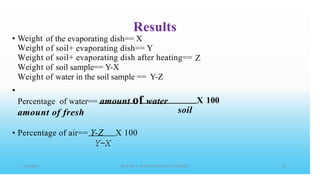
Results
of the evaporating dish== X
• Weight
Weight
Weight
Weight
Weight
of
of
of
of
soil+ evaporating dish== Y
soil+ evaporating dish after heating==
soil sample== Y-X
water in the soil sample == Y-Z
Z
•
Percentage of water== amount of water
amount of fresh
X 100
soil
Percentage of air== Y-Z
Y-X
• X 100
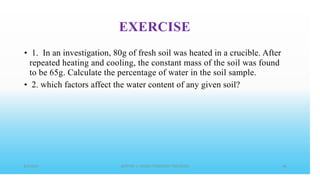
EXERCISE
• 1. In an investigation, 80g of fresh soil was heated in a crucible. After
repeated heating and cooling, the constant mass of the soil was found
to be 65g. Calculate the percentage of water in the soil sample.
• 2. which factors affect the water content of any given soil?
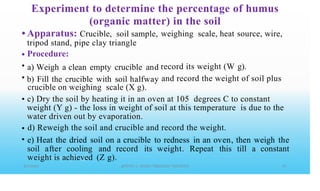
Experiment to determine the percentage of humus
(organic matter) in the soil
• Apparatus: Crucible, soil sample,
tripod stand, pipe clay triangle
Procedure:
a) Weigh a clean empty crucible and
b) Fill the crucible with soil halfway
crucible on weighing scale (X g).
weighing scale, heat source, wire,
•
•
•
record its weight (W g).
and record the weight of soil plus
• c) Dry the soil by heating it in an oven at 105 degrees C to constant
weight (Y g) - the loss in weight of soil at this temperature is due to the
water driven out by evaporation.
d) Reweigh the soil and crucible and record the weight.
e) Heat the dried soil on a crucible to redness in an oven, then weigh the
soil after cooling and record its weight. Repeat this till a constant
weight is achieved (Z g).
•
•
RESULTS
•
•
•
•
•
•
•
•
•
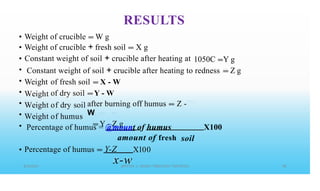
Weight of crucible == W g
Weight of crucible + fresh soil == X g
Constant weight of soil + crucible after heating at 1050C ==Y g
Constant weight of soil + crucible after heating to redness == Z g
Weight
Weight
Weight
Weight
of fresh soil == X - W
of dry soil
of dry soil
of humus
== Y - W
after burning off humus == Z -
W
== Y - Z g
Percentage of humus = @mount of humus
amount of fresh
X100
soil
Percentage of humus == Y-Z
x-w
• Xl00
Exercise
obtained by a
student a given soil
sample ;
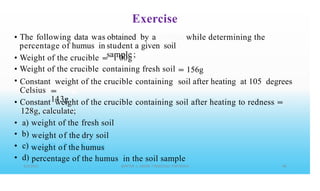
• The following data was
percentage of humus in
while determining the
•
•
•
Weight of the crucible
=
= 1 00g
containing fresh soil 156g
==
Constant weight of the crucible containing soil after heating at 105 degrees
Celsius ==
143g
• Constant weight
128g, calculate;
of the crucible containing soil after heating to redness ==
•
•
•
•
a)
b)
c)
d)
weight
weight
weight
of the
of the
of the
fresh soil
dry soil
humus
percentage of the humus in the soil sample
NB:
• Humus bums off into carbon di oxide and water vapor causing change
in color, smell and emergency of smoke
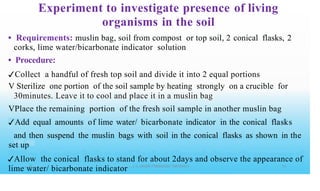
Experiment to investigate presence of living
organisms in the soil
• Requirements: muslin bag, soil from compost or top soil, 2
corks, lime water/bicarbonate indicator solution
• Procedure:
✓Collect a handful of fresh top soil and divide it into 2 equal portions
V Sterilize one portion of the soil sample by heating strongly on a crucible for
30minutes. Leave it to cool and place it in a muslin bag
VPlace the remaining portion of the fresh soil sample in another muslin bag
✓Add equal amounts of lime water/ bicarbonate indicator in the conical flasks
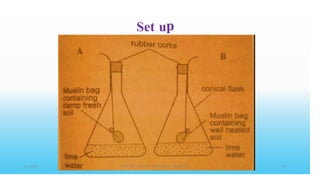
and then suspend the muslin bags with soil in the conical flasks as shown in the
set up
✓Allow the conical flasks to stand for about 2days and observe the appearance of
lime water/ bicarbonate indicator
conical flasks, 2
Set u
52
8/3/2023
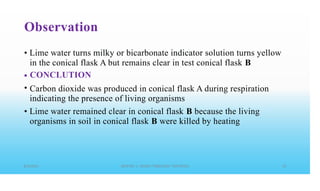
Observation
• Lime water turns milky or bicarbonate indicator solution turns yellow
in the conical flask A but remains clear in test conical flask B
CONCLUTION
Carbon dioxide was produced in conical flask A during respiration
indicating the presence of living organisms
Lime water remained clear in conical flask B because the living
organisms in soil in conical flask B were killed by heating
•
•
•
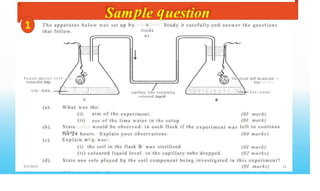
Sam le
a
stude
nt.
uestion
set up by Study
T h e a p p ar a t u s b e l o w
that follow.
w a s it careful ly a n d an swe r th e q u est i o n s
, Sterilised soil in muslin
bag
F r e s h m o i s t s o i l - f ! •
inmuslin bag
[ ? j
A
_" + ' ' •
' , · e , · · . ,
L i e w a s . ' ? ? ' j : ? ? ? : : ? '
B
L i e w a t e r
capillary tube co ntainin g
coloured liquid
(a). W h a t w a s
(i)
(ii)
S t at e
wh a t
the:
aim o f th e ex peri ment . (0I mark)
(0I mark)
left to con tinue
u s e o f th e l im e wate r in t h e setup
wo ul d b e o bserv ed in each fl ask if th e
(b). e x p e r i m e n t w a s
for 2 4 hours. Explain your observations.
Exp l ai n w h y was :
(i) the soil in the flask B w a s sterilised
(ii) coloured liquid level in the capillary tube dropped.
(04 ma rk s)
(c).
( 0 I
(02
ma rk )
ma rk s)
(d). S tate one ro le pl ayed b y the s oi l co mp on ent b ein g in ves t i gat ed in thi s exp erimen t?
(0I marks)
8/3/2023 54
IMPORTANCE OF AIR AND WATER IN
SOIL TO
a)AIR
LIVING ORGANISMS
•
VProvides oxygen for respiration of soil organisms and plant roots
✓Oxygen is also needed for the decay that produces humus
VProvide nitrogen for fixation by nitrogen- fixing bacteria in the
soil, the nitrogen absorbed is needed in the formation of nitrates
and
proteins
✓Carbon dioxide present in the air helps in increasing the soil
acidity
which favors proper growth of some plants
✓Carbon dioxide present in the air dissolves in water to form
carbonic
acid for weathering
b)WATER
It moistens soil and keeps it humid/ moist, making it favorable for
survival of micro organisms
It dissolves mineral salts making them available for plants to take
in
It dissolves carbon dioxide produced by living organisms to form
carbonic acid which causes chemical weathering of rocks
It is a raw material for photosynthesis
►Water absorbed from the soil allows plant cells to be rigid (turgid),
and this is very important for support of the plant, particularly
herbaceous plant
c) Organic matter
VIt is food for soil organisms
Vit moderates temperature of the soil
EXERCISE
• At home you have; a garden which normally gets dry
has rained. The crops have even started to dry up
due drainage
a) which soil type makes up the highest composition
your garden?
shortly after
to such high
it
• of the soil in
• b) which challenge are the crops likely to face apart from lack of
enough water?
c) how can you improve the water drainage of your garden?
•
soln
•
•
•
a)
b)
c)
sandy soil
shortage of nutrients
adding humus, mulching and planting trees and cover
crops
Activity of integration
• Soil types in Uganda vary from place to place. The people in Kirark,
activities. Some are;
o Commercial farmers who cultivate crops in pots
oBuilders who plaster houses in the village
oPotters who make stoves
a
village in your neighborhood are individuals engaging in different
These individuals have been using soil from a certain mining site in the
loose in a very short period of time and falls off, the potters' products
crack
them to worry as their businesses are nearly collapsing. You have been
individuals can do to sustain their businesses
neighboring village. However the plaster which the builders use gets too
while drying while the farmers' crops produce poor yields. This has made
contacted by the village leaders who are seeking for advice on what the
Task
• Using your knowledge of physical and chemical properties of soil,
write a speech you will deliver to the individuals for them to
understand the soil type each one needs to save his businesses
S u p p o r t M a t e r i a l
A•
"
I
I
I
F a r n n e r s
o f 0 e a / v3a4g°
f i g u r e 4 8 . A 6
8/3/2023
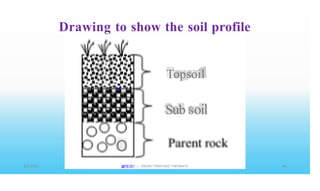
SOIL PROFILE
• This is the vertical arrangement of the various soil layers called
horizons.
It represents the different layers at various stages of soil development.
•
as mature
A soil with distinguished soil layers is known
without clear profile is immature or young.
The profile consists of the fallowing:
i) Top soil
ii) Sub soil
iii) Parent or underlying rock
and that
•
•
•
•
Drawing to show the soil profile
Topsoil
Sub soil
o
@PETER .L. OKION 778001502/ 758795415
Features offertile soil
• Fertile soil is one which can provide adequate amounts of nutrients for
plant growth, resulting into better crop yields and quality
Soil fertility is the ability of the soil to sustain plant growth and
optimize crop yield
The healthy plants are grown in soil which has adequate water,
•
•
humus, mineral salts and is well aerated for proper plant growth
the soil with unhealthy plants might be lacking some of
these constituents.
while
SOIL EROSION AND CONSERVATION
•
•
•
What is soil erosion?
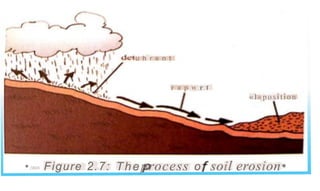
Process of soil erosion
This involves loosening of soil particles (detachment), moving
of particles (movement) and placement of soil particles
(deposition)
soil
u h r e n t
r a p w r t
«l«posi ti on
Theprocess soil erosion•
Figure 2.7:
• o
Questions:
a)
b)
c)
give the 5 types of soil erosion
identify 10 causes of soil erosion
what are the impacts of soil erosion?
Soln
• a)
►Sheet, splash, rill, wind, gully
b)
VDeep slopes of land coupled with intense rainfall
✓Overgrazing of animals which removes the
grass water erosion
VDeforestation
.Bush burning
✓Over cropping and ploughing
cover and opens the soil to
c)
>Nutrients and soil organisms are carried away in the top soil
►The soil left behind is unproductive
►Fields may be cut into irregular pieces by rill and gully
erosion
►Floods carry away or submerge and suffocate crops and soil
.
organ1sms
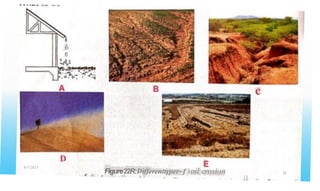
Types of soil erosion
• QN: Have you witnessed eroded fields in your community,
you think could have caused that erosion?
It might be the agents of erosion e.g
• • • • • • • • • • • • • • • • • • • • •
what do
• and
• When heavy winds blow away top soil, wind erosion occurs and
this is referred to as
when
.
running water carries away the top soil,
• erosion is classified depending on the
water carries away the top soil
mechanism by which
6
6
'
c
B
D
E
8/3/2023
Figure22R:Differenttyper~f soil erosion
.l a
72
t i. • a . h . u lt
d
Forms of water erosion
• Sheet erosion: is the uniform removal of soil particles from an area
without the development of clear water channels
Rill erosion: is one that produces narrow shallow wavy channels
called RILLS
Gully erosion: is one that produces wide deep steep-sided
channels water continues to flow down the rills deepening them
•
• as
• Splash erosion: this is the first stage of the erosion process. It occurs
when raindrops hit the bare soil. The explosive impact breaks up soil
aggregates so that individual soil particles are "splashed" onto the
soil surface.
Factors that lead to soil erosion
• Type of surface cover: bare soils allow surface runoff carrying large
volume of soil while soils covered with grass have a low rate of
erosion and the speed of running water is reduced
Gradient of the slope: steep slopes allow fast surface runoff
carrying larger volumes of soil with it.
Type of soils: more loose soils are easily carried away by water than
less loose soils
•
•
Reducing soil fertility
• Many times, farmers have complained about the reduced
and they mostly attribute this to reduced soil fertility.
What do you think could be the cause of the reduced
soil
crop harvests
• fertility ?
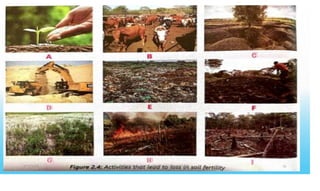
• Use the images below
c
D
G H I 76
8/3 20
ctd
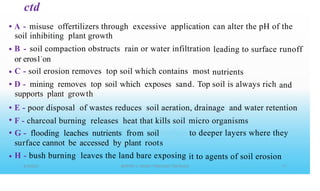
• A -
soil
B -
misuse offertilizers through excessive application
inhibiting plant growth
soil compaction obstructs rain or water infiltration
can alter the pH of the
• leading to surface runoff
or eros1•
on
C - soil erosion removes top soil which contains most
D - mining removes top soil which exposes sand. Top
supports plant growth
•
•
nutrients
soil is always rich and
•
•
•
E - poor disposal of wastes reduces soil aeration, drainage and water retention
F - charcoal burning releases heat that kills soil
G - flooding leaches nutrients from soil
surface cannot be accessed by plant roots
H - bush burning leaves the land bare exposing
micro organisms
to deeper layers where they
• it to agents of soil erosion
Ctd
• I - deforestation leaves land bare
• Other activities include;
✓Over cultivation
.Monocropping
exposing it to agents of soil erosion
✓And other poor farming practices like clean weeding
Conserving our soil
•
•
Soil is a valuable resource. What do you think makes soil valuable ?
The great pressure on land is due to the increasing human population
that has resulted to soil degradation. This is because of the various
human activities carried out on land, which have resulted into soil
erosion e.g. deforestation
QN: what is soil degradation?
This is the reduction or loss of the biological or economic
productivity and complexity of land, resulting from natural or human
activities
•
•
Activity
• In your groups, discuss the steps or methods that the farmers and
gardeners in your locality take to maintain the fertility of their
soils
(lOmarks)
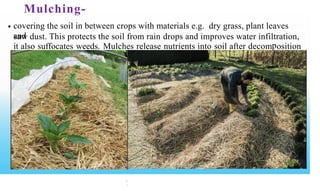
Mulching-
covering the soil in between crops with materials e.g. dry grass, plant leaves
and
•
saw dust. This protects the soil from rain drops and improves water infiltration,
it also suffocates weeds. Mulches release nutrients into soil after decom osition
=.
« ad
5
R
s
i ' r » •
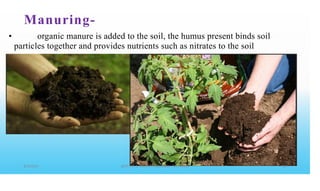
Manuring-
• organic manure is added to the soil, the humus present binds soil
particles together and provides nutrients such as nitrates to the soil
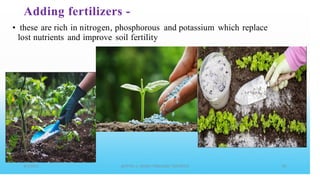
Adding fertilizers -
• these are rich in nitrogen, phosphorous and potassium which replace
lost nutrients and improve soil fertility
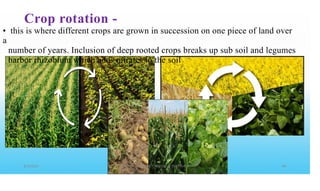
Crop rotation -
• this is where different crops are grown in succession on one piece of land over
a
number of years. Inclusion of deep rooted crops breaks up sub soil and legumes
harbor rhizobium which adds nitrates to the soil
Composting -
• waste materials, leaves, weeds and grass cuttings are piled and left to decay
forming compost which is dug into the soil hence adding nutrients to the soil
lntercropping -
• crops with poor ground cover e.g. maize are planted with beans that
effectively cover the ground. This reduces the speed of water runoff and also
suppresses weeds
Agroforestry -
• farmers manage and integrate crops, trees and/or livestock on the same plot of
land. This conserves soil through controlling water runoff and soil erosion
ctd
• Wind breaks - trees are planted in rows across the direction of the prevailing
wind to act as wind barriers hence reducing the effect of wind erosion
• Read and make notes
►Terracing
contour cultivation
►Minimum tillage
►Fallowing
►Irrigation
about the following;
►Cover crops
►Soil testing, this is
done
soil
to ascertain what nutrients are in poor supply in the
Water Balance
Plants consume some of rainfall n
regions, and part of the water
evaporates from the soil The
rest
runs off the surface or recharges
groundwater.
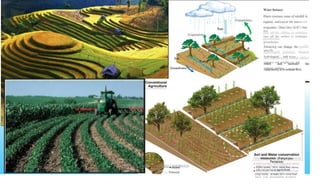
Transpiration
Evaporation
Terracin g can change the
specific
hydrological path ways,
increase soil roughn ess and
vertical surface
relief, and decrease the
connectivity of overland flow.
-
Soil and Water conservation
measures (Fanya-juu
Terraces)
a SOM Levels: -35% more than farms
with conventional agnicfure'
Crop Yields.: at least 25% more than
farms with enrwantinnal arrienltre'
} o
8/3/2023
- - - T r e n c h
Importance of micro organisms in Nitrogen
and other cycles that keep soil fertile
• Some of these organisms are large (macroscopic organisms) and can
be seen with unaided eyes while others are very small (microscopic)
and can only be seen under a microscope.
• QN: What are the examples of soil microorganisms?
Note:
• Decomposers break down
compounds in dead plants
environment. These are
in
chemical nutrients like carbon and nitrogen
and animals to release them back into the
tum released back into soil, there by
improving soil fertility. These nutrients are then absorbed by plant
roots for plant growth. Animals are able to obtain these nutrients
when they eat plants. Activities of decomposers contribute to the
cycling of carbon and nitrogen within the environment.
□The process by which dead organic substances are broken down into
simpler organic or inorganic matter such as carbon dioxide, water,
simple sugars and mineral salts is called DECOMPOSITION
THE NITROGEN CYCLE
•
•
•
Nitrogen makes up the largest percentage ofAIR.
QN: what is the percentage composition of Nitrogen in air?
Surprisingly, much as nitrogen exists in abundance in air, it cannot be
readily utilized by living organisms! This is because, for it to be used
by living organisms it must be changed into various absorbable forms
in a cycle of events called Nitrogen cycle. this describes how
nitrogen circulates between plants, animals, the atmosphere and soil
in the
ground
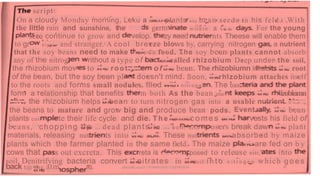
script:
a cloudy Monday morning, Leku a
On
the
f a r m e r plants soy bean seeds in his feld. With
little rain and sunshine, the
seec
germ w i t h i n a f e w For the young
to continue to grow and nts Theese will enable them
velop. zy need
b i g g e r and stranger. A cool breeze
to gr blows by, carrying nitrogen a nutrient
h e i r own food. The soy bean plants cannot absorb
that the soy beans need to make
any of the nitrog
the rhizobium mov
a type t e r i a called rhizobium Deep under the soil,
rithout
to t h e
of
o f t h e bean. t h e root
The rhizobiumn inhao
root s y s t
of the
to the
bean, but
roots and
soy bean pl Soon, t h e rhizobium attaches itself
the doesn't mind.
forms small nodules. flled The bax
w i t h n i t r o g e
izobiumn
form a relationship that benefits m both As the bean plar t h e
t h e bean to turn nitrogen gas into a
a l i v e , the rhizobium helps usable
Event
nutrient N o w ,
t h e bean
the beans to mature and grow big and produce bean pods.
te their life cycle and die. T h e f a r m e r c o m e s his field of
t h e plant
plants coi vests
a n d
beans, chopping up t h e dead plants in t h e s o i l . u e o n osers break daw
ts into t h e < o i l . These nut a r e absorbed by maize
materials, releasing nut
plants which the farmer planted in the same field. The maize n t s are fed on b y
cows that s out excreta. This posed to release into
reta is nitr,
a - o r
soil. Denitrifying bacteria convert t h e soil i n t o n i t r o g e n which g o e s
t h e nitrates in
back t@'the atm re. ePereR.to«ov 778001502/ 758795415 93
QUESTIONS
•
•
•
1.
2.
3.
how did the bacteria help the plant?
can all plants get their nutrients from the soil, like the bean did?
how did the farmer use plants to make his soil healthy? Explain how
planting different crops help to replace nutrients in the soil.
4. what would happen if the farmer only grew maize in his field,
year after year?
•
Processes involved in the nitrogen cycle
_ ,
· - • D E N I T R I rN
4 - A .
• T O N
[
w t a g e r f i x i n g
'a
] tac
I
V t 3
r t r i f y w r w
to e ++@RETER .L. ORT N
778001502/ 7 58795415
8/3/2023
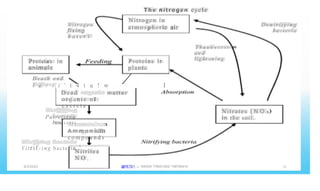
cycle
T h e n i t r o g e n
Nitrogen in
Deniritying
b a c t e r i a
N i t r o g e n
fixing
h a t e r i
air
at mo sp he r ic
T h u u n « e r s t !
a n d
lig ht en i n g
Proteins in
animals
D e a t h a n d
P r o t e i n s
plants
i r
I
l e / i t ' t 4 t u ! w
D e a d
o r g a n i c n l
e x c r e t a
Putrefying
hew' t e r i t
A m m o n ium
c o m p o u n d s
Vitrifying bacteria
m a t t e r
Nitrates ( N O
in t h e s o i l .
. . a .
Nitrites
N O ,
8/3/2023 @PETER .L. OKION 778001502/ 758795415 96
Nitrogen fixation can occur through:
• 1) lightening: this breaks down nitrogen molecules into free nitrogen atoms
that combine with oxygen, forming Nitrogen oxides. The oxides dissolve in
rain and are washed into the soil where they form nitrates.
2) manufact ure of artif icial fertilizers: nit rogen and hydrogen react in
an industrial chemical process, forming ammonia. The ammonia is used
to make ammonium salt s and nit rat es, which are sold as fertilizers.
QN: What examples of nit rogen containing fertilizers do farmers use in
your area?
3) action of nitrogen fixing bacteria: these bacteria include; Rhizobium,
•
•
•
Azotobacter and
spaces in the soil
Clostridium. These bacteria use nitrogen gas from the air
and bind it with other substances to make nitrates and
other compounds. QN: Which bacteria is found in root nodules of
Leguminous plants?
Ctd
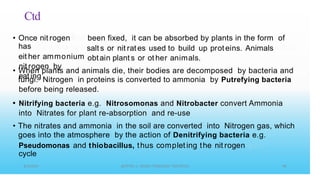
• Once nit rogen
has
eit her ammonium
nit rogen by
eat ing
been fixed, it can be absorbed by plants in the form of
salt s or nit rates used to build up proteins. Animals
obtain plant s or ot her animals.
• When plants and animals die, their bodies are decomposed by bacteria and
fungi. Nitrogen in proteins is converted to ammonia by Putrefying bacteria
before being released.
Nitrifying bacteria e.g. Nitrosomonas and Nitrobacter convert Ammonia
into Nitrates for plant re-absorption and re-use
•
• The nitrates and ammonia in
goes into the atmosphere by
the soil are converted into Nitrogen gas, which
the action of Denitrifying bacteria e.g.
Pseudomonas and thiobacillus, thus complet ing the nit rogen
cycle
Sam le uestion
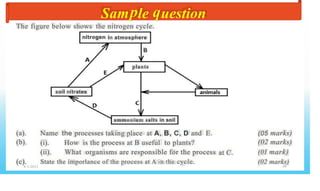
The figure below shows the
nitrogen
nitrogen cycle.
in atmosphere
B
plants
soil nitrates
ammonium salts in soil
(05 marks)
(02 marks)
(0I mark)
(02 marks)
99
(a).
(b).
Name the processes taking place at A, B, C, D and E.
(i).
(ii).
State
How is the process at B useful to plants?
What organisms are responsible for the process
the imporlance of the process at A in the cycle.
at C.
(c).
8/3/2023
Sam le uestion
T h e n i t r o g e n c y c l e .
f i g u r e b e l o w s h o w s t h e
i n a t m o s p h e r e
F r e e n i t r o g e n
P r o d u c t 3
N i t r o g e n d i o x i d e
1
A i v
P r o d u c t 2
Nitric acid
-
N i t
r i t
e s
P r o d u c t 1
(03 '% m a r k s)
( 0 1 m a r k s )
(02 m a r k s )
( a )
( b )
( e )
( d )
s / 6 9 )
N a m e
N a m e
t h e
t h e
p r o c e s s e s t a k i n g p l a c e a t A t o G .
a n d 3 .
o f t h e b a c t e r i a r e p r e s e n t e d b y i t o i v .
p r o d u c t s 1, 2
G i v e t h e g e n e r a l n a m e s
L i s t 4 d i f f e r e n t w a y s i n w h i c h n i t ro g e n m a y b e lo s t f r o m th e s o i l . (02 m a r k s)
(02 m a r k s )
E x p l a i n w h y w a t e r l o g g e d s o i l s a r e u s u a l l y d e f i c i e n t i n n i t r a t e s . 100
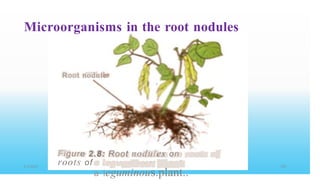
Microorganisms in the root nodules
Root nodule
P
Figure 2.8: Root nodules on
roots of
a leguminous.plant..
8/3/2023 0
Ctd
• When you uproot a bean or soya bean plant, you notice round
swellings on the roots .
QN: what are they called ?
Are the swellings on these roots important to the plant? What do
the above features contain?
•
•
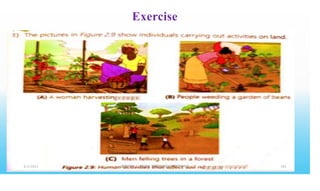
Exercise
7
g c r o p s
. . .
-
t r o w c e r t
8/3/2023 103
Ctd
• a) which activities are likely to improve on the nitrogen content of the
soil? How?
b) which activities are/is likely to reduce on the nitrogen content of
the soil? How?
2) how can each of the following activities affect the nitrogen content
of the soil;
•
•
a) use of chemicals to spray fields
b) rearing a cattle on a piece of land
c) burning of bushes to prepare land for planting
crops
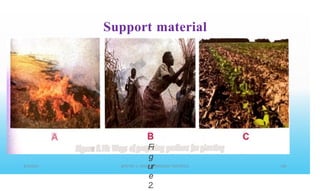
Activity of integration
At the beginning of each growing season, the farmers
prepare their seed gardens by;
in your area
•
•
•
Collecting and burning the plant remains
Gathering plant remains and using them to make boundaries
Planting crops while with plant remains are still in the
garden
Support material
B
Fi
g
ur
e
2.
C
A
Task
• Design a poster you will use to advise the people in your home area,
on the potential risks or benefits of their activities towards
maintaining soil fertility and conservation
TEST YOURSELF
indicators of a fertile soil
each of the following is involved in soil erosion
•
•
1. mention four
2.
a)
3.
describe how
Detachment b) Transport c) Deposition
• Suggest how the following conditions are likely to affect the rate of soil
er0s1•
on
a) area with light soils
4. state how soil fertility
Uganda;
a) Lake Victoria basin
c) Kigezi highlands
b) hilly areas c) soil with much vegetation
• can be conserved in the following regions of
b) Karamoja region
The figure below represents the Nitrogen cycle
Ni•
trogen •
in•
air
b
'
+ ]
Plants Animals
·«
Nitrates
e
f
l
Ammonium
compounds
Figure
2.11:
Nitrites
The nitrogen cycle
@PETER .L. OKION 778001502/ 758795415
8/3/2023
QNS.
•
•
•
a)
b)
c)
name the processes a to f
how do the processes a and b affect fertility of
soil identify the microorganisms involved in
processes
a, b, d and f
SENIOR TWO SOIL presentations For Ugandan schools

SENIOR TWO SOIL presentations For Ugandan schools

  • 1.
  • 3.
    , ' t - 11, ..,·_ .' , + ..• ... ' 4 _ 4 ' · . , _- .. ~ - - . ~ - L,~ . . . . .. • . t @PETER .L. OKION 778001502/ 758795415
  • 4.
    SOIL • • Soil is thetop most layer of the earth's crust. OR The finely divided material covering the earth's surface. It is normally treated as dirt Soil is the most essential natural resource on earth, and without it, there would be no home and food for all organisms on earth. •
  • 6.
    8/3/2023 @PETER .L.OKION 778001502/ 758795415 6
  • 7.
    Foo r Co 8/3/2023 @PETER .L.OKION 778001502/ 758795415 7
  • 8.
    The decaving plant and animalmatter help give structure to the soil to hold the plant place. roots in "y r b ( ' -, » % ' / 4s «" ) ~ l ----- l f ! . 0 I ( r • @PETER .L. OKION 778001502/ 758795415 8/3/2023
  • 9.
    Importance of soil •Soil provides nutrients e.g. water and minerals to plants which are the chief producers offood in the environment. Soil is a habitat (home) for many organisms such as earth worms, termites, bacteria fungi and arthropods. Soil provides a medium through which man and all other animals dispose of their wastes. Soil is an important natural resource which provides construction materials, supports agriculture, craft and art materials. • • •
  • 10.
    TYPES OF SOIL •The appearance of soil varies from place to place. • Question: are soils from the swamps similar to those do the two soils differ? from hills?, how
  • 11.
    ctd • Soils differin color, texture and size of the particles. The difference in this properties determines the type of the soil. • The type of soil determines the use of the soil, which soil types are common in your area?, what are the main uses of the soil types in your community?
  • 12.
  • 13.
    @PETER .L. OKION778001502/ 758795415 8/3/2023
  • 14.
    .,,, J ' t . I ' , '' • ' ., t ' ' ! ... 6f ~ 4 ' 4 ' . • ,. I'', , 4 I + ' .'j:, 4 J1 : I f ,. I , 6 ; e. . « d t 1 ., ·. (" 'I ~ a • i J l ' 0 - I, ~ ~ I d ... ~ .- - f t f , . 4 ., . 1 ' $ i ' 4 J t f 4 /- F .I CLAY particles are packed together tightly. It is sticky when wet and has the finest texture. 8/3/2023 LOAM Is a mixtureofsand SAND particles andclay. It contains large amountofdecaying are coarse and loose and plants animals. It has afinetexture. @PETER .L. OKION 778001502/ 758795415
  • 15.
  • 16.
    ctd LOAM SOIL, thisis a mixture of sand(about 40%), clay(15%) and organic matter. It is dark and has a stable crumb structure. Usually found almost everywhere especially in gardens, near compost pits and dumping areas. SANDY SOIL, it is light and has a gritty feel when wet. Found on lake shores and hilly areas. CLAY SOIL, it is heavy and has fine particles with a sticky feel when wet. found in swamps and anthills. • • •
  • 17.
    CHARACTERISTICS OF SOIL • • • A)COLOUR Have you noticed that different soils have different colors? Do you know the color of loam soil? Why do you think it is that color?
  • 18.
    ctd • The colorof soil is usually determined by the mineral present and by the organic matter that covers the surface of the soil particles. • Black soils are generally more fertile than lighter soils because they tend to have higher organic matter content. • • • B)TEXTURE this is how rough or how smooth a particular soil sample is. The texture of sand, silt, clay analysis chart, fine-textured. a soil sample is determined by the relative proportions of and particle sizes present in the soil, e.g. using soil texture we see that sandy soils are coarse-textured and clay soils are
  • 19.
    C l ay S Ity c l a y t o a m S a n d y lo a mn c l a y C l a y S a n d y l o a m S a n d y s i i t t o a r S i l t l o a m S a n d I n c r e a s i n g s a n d L L u t e d i u m s o il l s H e a v y s o i l s t e « i v silt . 2 o 2 3 @PETER .L. OKION 778001502/ 758795415 19
  • 20.
    ctd • • C) PARTICLE SIZE soilparticles can be categorized into 4 terms of average diameter of a particle, types based on their size in different types of soil are made up of different soil more particles particles; most soils have a combination of 3 or Particle Gravel Sand Silt Clay size Average diameter Greater than 2.0mm 0.02-2.0mm 0.002-0.02mm Less than 0. 002mm PETER .L. OKION 778001502 758795415
  • 21.
    m Water a OrganicMatter A I A 'g Water & Air in direct proportion to each other 8 3/2023 PETER L OK ON 778001502/ 758795 15
  • 22.
    CONSTITUENTS OF SOIL •Soil constituents are materials that living and non-living things e.g ............................. ' combine to form soil. They include , ' ......................................... • • • • • • • • • • • • • • • • • • • • • • • • • • • • • • • • • • • • • • • • • And
  • 23.
  • 24.
    PROPERTIES OF SOIL •Different soils have different properties. The properties can be categorized into physical and chemical properties. PHYSICAL PROPERTIES, are qualities that can be perceived • by body senses like seeing, feeling and tasting E.g. water retention, drainage, color, texture and particle size. A) WATER RETENTION If plants are to obtain water from the soil, then the soil ability to retain water in its particles. • • must have the • Qn. Do all the soils have the same capacity to retain water?
  • 25.
    ctd • Soils thatretain more water are said to have a High water retention capacity while soils that retain less water are said to have • • • • • • • • • • • • • • • • • • • • • • • • • • • • • • • • • • • • • Experiment Comparing water retention capacity of clay, loam and sandy soil Procedure a) Measure an equal volume of each soil sample. b) Fold filter papers properly and put one in each funnel. other funnel. same time pour an equal volume of water on each of the soil samples as • • c) Then place clay soil in the filter paper in one funnel and the sand in the d) Place the funnels with their contents over measuring cylinders and at the shown in the diagrams.
  • 26.
    Setup San d Loam Clav ;J Filterfunnel . 3·• 'I ··I:, ,. . . 0 0 0 0 Measuring cylinder s - - - - i i i i i •
  • 27.
    Observation • Water passesthrough sandy soil faster than it does in loam and clay soils. Sandy soil gives the first drop of water and clay soil gives the last. • • So much water is water is collected collected in the cylinder with sandy soil and the least in the cylinder with clay soil. • CONCLUSION, Clay soil holds more water than loam and sandy soil
  • 28.
    explanation • Sandy soilhas large air spaces which enable water to pass through more rapidly and on the other hand , clay soil retains more water than sandy and loam soils. This is because clay soil has many small particles with small air spaces thereby retaining more water Loam soil has medium retention B) DRAINAGE • • • After rain, some places dry immediately while others remain water logged. What is the reason for this? The ability of the soil to let water move through it is called soil • • • • • • • • • • • • • • •
  • 29.
    ctd Soil drai nage soil parti cles. to have go through it •depends on the size of the particles and air spaces between the The soil type that easily allows water to pass through it is said drainage while the soil type that does not allow water to easily is said to have drainage . • Poor soil drainage leads to water logging that destroys property and crops. • • Experiment to compare drainage of sandy, loam and clay soils. NB: For procedure and setup, refer to experiment on water retention
  • 30.
    observation • Water passesfaster through sandy soil than through loam and clay soils. Sandy soil gives the first drop of water and clay soil gives the last drop • So much water is water is collected collected in the cylinder with sandy soil and the least in the cylinder with clay soil. • CONCLUSION, sandy soil drains faster than loam and clay soil
  • 31.
    explanation • Sandy soilhas larger air spaces which enable water to drain through more more space s rapidly and on the other hand, clay soil has low because drainage and retains water than sandy and loam soil. This and small particles. Loam soil has a medium drainage is clay soil has few air • • • C) CAPILLARITY Qn. At a construction site, you have seen builders use a black polythene sheet to cover the slab after laying the foundation. Why do you think this is necessary before continuing the construction of the wall?
  • 32.
    ctd • The riseof water from the bottom layers to the top layers through the soil particles is called It also depends on the size of the soil particles. Imagine sipping NOVIDA using a straw • •
  • 33.
    Experiment to comparecapillarity of sandy, loam and clay soils • Procedure a) Tie a muslin sheath tightly at the end of the glass tubes. b) Fill one glass tube with dry sample of sand soil and pack it ensuring that there are no spaces in the soil. c) Repeat this with clay and loam soils. well d) The sheath e) The shown glass tubes are stood vertically with the ends tied with immersed in a glass trough containing enough water. muslin glass tubes are supported upright with retort stands and clamps in the diagram below. as
  • 34.
    Setup Sand Loam = a a -a a Clay a o m i Glass tube i I i i i i i i i i i i i I • • • i i i ii i i i II 11 1 1 II I II II 4 .a a ii i i i ii ii I • • t Ii Ii a i i i a a I Trough Cotton wool Water i i • ■l ■ i II I I I i d ii ' a ' a . " · · . . - " · + - - - m
  • 35.
    Observation Water rises fasterbut to a lower level in sandy soil while in clay soil, water rises slowly but to higher levels. In loam soil water rises moderately to a moderate level. CONCLUSION; Clay soil has the highest capillarity while sandy soil has the lowest capillarity and loam soil has medium water capillarity. EXPLANATION: Water rises fastest during early stages of the experiment in sandy soil because sand has large spaces that enable water to rise rapidly Clay soil has the highest water capillarity because it is composed of tiny soil particles which present a large surface are over which water molecules cling. Water rises at a slow rate in clay soil because clay has small spaces between its particles. • • • • • •
  • 36.
    Application • Clay mixedwith water, oil and honey can be used to make clay masks that ladies apply on their faces to maintain beauty. • Basing on clay's property of being sticky when wet, it germs on the surface of the skin and deep in the pores dried up germs to the surface of the skin to be washed binds with and brings the away • Pottery, brick making .
  • 37.
    Chemical properties ofsoil • SOIL PH, IS the degree of acidity or alkalinity of the soil. Most soils in the tropics are acidic. The pH of soil can be determined using universal indicator or litmus solution. a • • Qn. Why do you think it is important to know the pH of soil? SOLN. Helps one to know the crops can grow well in a given soil or land type. Qn. What would happen if you grew crops in soils with unsuitable pH? PH scale range from Oto 14. • •
  • 38.
    ctd Soils with pHabove 7 are basic or alkaline while soils with pH below 7 acidic. A soil type with a pH 7 is neither acidic nor basic, it is neutral. The pH of soil depends on its parent rock (rock from which the soil was • are • formed). pH controls which nutrients are available for plant use • • NB: PH is Potential of Hydrogen Examples of crops that grow well in acidic soils include; beans, onions, tomatoes, sweet potatoes . • Crops that grow well in alkaline soils include; pumpkin, cabbages .....
  • 39.
    QUICK TIP cidic soilsare found • • in places where the rainfall is very high poor. and drainage is Why is this s o ?
  • 40.
    PERCENTAGE COMPOSITION OF SOILCONSTITUENTS • Experiment to determine the percentage of air in the soil Apparatus: Measuring cylinders (2), dry soil sample, water, Method 1. Measure about 50 cm3 of dry soil in a measuring cylinder container to level out the soil. and glass rod. and tap the 2. 3. 4. Measure 50 cm3 of water in another measuring cylinder. Add the two together (observe carefully as you pour the water onto the soil) Allow the mixture to stand until no more bubbles appear. Read and record the final level of water plus soil in the measuring cylinder. Calculate the air content in terms of percentage.
  • 41.
    Example • Volume ofsoil == 50cm3 Volume of water == 50cm3 Final volume of water+ soil after mixing== 85cm3 Volume of air in soil ( 100 - 85) = = 15cm3 air== volume of air 100 Percentage of x volume of soil air =15 x 100 50 used Percentage of Percentage of air == 30%
  • 42.
    NB • The finalvolume of the mixture after stirring is lower than the initial volume of the mixture before stirring due to displacement of air around soil particles by water Expected volume == volume of water + volume of soil • • Volume of air == Expected volume - Actual volume observed
  • 43.
    exerci• se • Bosco, asenior two student carried out an investigation to determine the percentage of air in a given soil sample and obtained values: Volume of soil used == 40cm3 Volume of water added to the soil== 50cm3 Final volume of water + soil after mixing == 80cm3 a) determine the volume of air in the soil sample. b) calculate the percentage of air in the soil sample the following • • • • •
  • 44.
    Experiment to determinethe percentage of water a soil sample Apparatus: Evaporating dish, fresh soil, weighing scale and oven or Bunsen burner. Procedure: in • a) Weigh a clean evaporating dish and record its weigh. (Let the weight be Xg). b) Fill the evaporating dish with soil and record the weight of the soil plus the evaporating dish. (Let the weight be Y g). c) d) to e) f) Dry the soil by heating it gently over a Bunsen burner flame for about 30 minutes. Heating and weighing is repeated until a constant mass is achieved. (Take care not burn the soil to produce smoke). Re-weigh the soil and the evaporating dish. (Let it be Z g). Then calculate the water content in the soil sample as shown below; Note: You should cool in a desiccator before weighing. This ensures that no fresh vapor enters the soil.
  • 45.
    Results of the evaporatingdish== X • Weight Weight Weight Weight Weight of of of of soil+ evaporating dish== Y soil+ evaporating dish after heating== soil sample== Y-X water in the soil sample == Y-Z Z • Percentage of water== amount of water amount of fresh X 100 soil Percentage of air== Y-Z Y-X • X 100
  • 46.
    EXERCISE • 1. Inan investigation, 80g of fresh soil was heated in a crucible. After repeated heating and cooling, the constant mass of the soil was found to be 65g. Calculate the percentage of water in the soil sample. • 2. which factors affect the water content of any given soil?
  • 47.
    Experiment to determinethe percentage of humus (organic matter) in the soil • Apparatus: Crucible, soil sample, tripod stand, pipe clay triangle Procedure: a) Weigh a clean empty crucible and b) Fill the crucible with soil halfway crucible on weighing scale (X g). weighing scale, heat source, wire, • • • record its weight (W g). and record the weight of soil plus • c) Dry the soil by heating it in an oven at 105 degrees C to constant weight (Y g) - the loss in weight of soil at this temperature is due to the water driven out by evaporation. d) Reweigh the soil and crucible and record the weight. e) Heat the dried soil on a crucible to redness in an oven, then weigh the soil after cooling and record its weight. Repeat this till a constant weight is achieved (Z g). • •
  • 48.
    RESULTS • • • • • • • • • Weight of crucible== W g Weight of crucible + fresh soil == X g Constant weight of soil + crucible after heating at 1050C ==Y g Constant weight of soil + crucible after heating to redness == Z g Weight Weight Weight Weight of fresh soil == X - W of dry soil of dry soil of humus == Y - W after burning off humus == Z - W == Y - Z g Percentage of humus = @mount of humus amount of fresh X100 soil Percentage of humus == Y-Z x-w • Xl00
  • 49.
    Exercise obtained by a studenta given soil sample ; • The following data was percentage of humus in while determining the • • • Weight of the crucible Weight of the crucible = = 1 00g containing fresh soil 156g == Constant weight of the crucible containing soil after heating at 105 degrees Celsius == 143g • Constant weight 128g, calculate; of the crucible containing soil after heating to redness == • • • • a) b) c) d) weight weight weight of the of the of the fresh soil dry soil humus percentage of the humus in the soil sample
  • 50.
    NB: • Humus bumsoff into carbon di oxide and water vapor causing change in color, smell and emergency of smoke
  • 51.
    Experiment to investigatepresence of living organisms in the soil • Requirements: muslin bag, soil from compost or top soil, 2 corks, lime water/bicarbonate indicator solution • Procedure: ✓Collect a handful of fresh top soil and divide it into 2 equal portions V Sterilize one portion of the soil sample by heating strongly on a crucible for 30minutes. Leave it to cool and place it in a muslin bag VPlace the remaining portion of the fresh soil sample in another muslin bag ✓Add equal amounts of lime water/ bicarbonate indicator in the conical flasks and then suspend the muslin bags with soil in the conical flasks as shown in the set up ✓Allow the conical flasks to stand for about 2days and observe the appearance of lime water/ bicarbonate indicator conical flasks, 2
  • 52.
  • 53.
    Observation • Lime waterturns milky or bicarbonate indicator solution turns yellow in the conical flask A but remains clear in test conical flask B CONCLUTION Carbon dioxide was produced in conical flask A during respiration indicating the presence of living organisms Lime water remained clear in conical flask B because the living organisms in soil in conical flask B were killed by heating • • •
  • 54.
    Sam le a stude nt. uestion set upby Study T h e a p p ar a t u s b e l o w that follow. w a s it careful ly a n d an swe r th e q u est i o n s , Sterilised soil in muslin bag F r e s h m o i s t s o i l - f ! • inmuslin bag [ ? j A _" + ' ' • ' , · e , · · . , L i e w a s . ' ? ? ' j : ? ? ? : : ? ' B L i e w a t e r capillary tube co ntainin g coloured liquid (a). W h a t w a s (i) (ii) S t at e wh a t the: aim o f th e ex peri ment . (0I mark) (0I mark) left to con tinue u s e o f th e l im e wate r in t h e setup wo ul d b e o bserv ed in each fl ask if th e (b). e x p e r i m e n t w a s for 2 4 hours. Explain your observations. Exp l ai n w h y was : (i) the soil in the flask B w a s sterilised (ii) coloured liquid level in the capillary tube dropped. (04 ma rk s) (c). ( 0 I (02 ma rk ) ma rk s) (d). S tate one ro le pl ayed b y the s oi l co mp on ent b ein g in ves t i gat ed in thi s exp erimen t? (0I marks) 8/3/2023 54
  • 55.
    IMPORTANCE OF AIRAND WATER IN SOIL TO a)AIR LIVING ORGANISMS • VProvides oxygen for respiration of soil organisms and plant roots ✓Oxygen is also needed for the decay that produces humus VProvide nitrogen for fixation by nitrogen- fixing bacteria in the soil, the nitrogen absorbed is needed in the formation of nitrates and proteins ✓Carbon dioxide present in the air helps in increasing the soil acidity which favors proper growth of some plants ✓Carbon dioxide present in the air dissolves in water to form carbonic acid for weathering
  • 56.
    b)WATER It moistens soiland keeps it humid/ moist, making it favorable for survival of micro organisms It dissolves mineral salts making them available for plants to take in It dissolves carbon dioxide produced by living organisms to form carbonic acid which causes chemical weathering of rocks It is a raw material for photosynthesis ►Water absorbed from the soil allows plant cells to be rigid (turgid), and this is very important for support of the plant, particularly herbaceous plant
  • 57.
    c) Organic matter VItis food for soil organisms Vit moderates temperature of the soil
  • 58.
    EXERCISE • At homeyou have; a garden which normally gets dry has rained. The crops have even started to dry up due drainage a) which soil type makes up the highest composition your garden? shortly after to such high it • of the soil in • b) which challenge are the crops likely to face apart from lack of enough water? c) how can you improve the water drainage of your garden? •
  • 59.
    soln • • • a) b) c) sandy soil shortage ofnutrients adding humus, mulching and planting trees and cover crops
  • 60.
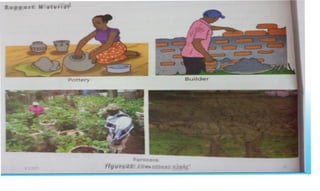
    Activity of integration •Soil types in Uganda vary from place to place. The people in Kirark, activities. Some are; o Commercial farmers who cultivate crops in pots oBuilders who plaster houses in the village oPotters who make stoves a village in your neighborhood are individuals engaging in different These individuals have been using soil from a certain mining site in the loose in a very short period of time and falls off, the potters' products crack them to worry as their businesses are nearly collapsing. You have been individuals can do to sustain their businesses neighboring village. However the plaster which the builders use gets too while drying while the farmers' crops produce poor yields. This has made contacted by the village leaders who are seeking for advice on what the
  • 61.
    Task • Using yourknowledge of physical and chemical properties of soil, write a speech you will deliver to the individuals for them to understand the soil type each one needs to save his businesses
  • 62.
    S u pp o r t M a t e r i a l A• " I I I F a r n n e r s o f 0 e a / v3a4g° f i g u r e 4 8 . A 6 8/3/2023
  • 63.
    SOIL PROFILE • Thisis the vertical arrangement of the various soil layers called horizons. It represents the different layers at various stages of soil development. • as mature A soil with distinguished soil layers is known without clear profile is immature or young. The profile consists of the fallowing: i) Top soil ii) Sub soil iii) Parent or underlying rock and that • • • •
  • 64.
    Drawing to showthe soil profile Topsoil Sub soil o @PETER .L. OKION 778001502/ 758795415
  • 65.
    Features offertile soil •Fertile soil is one which can provide adequate amounts of nutrients for plant growth, resulting into better crop yields and quality Soil fertility is the ability of the soil to sustain plant growth and optimize crop yield The healthy plants are grown in soil which has adequate water, • • humus, mineral salts and is well aerated for proper plant growth the soil with unhealthy plants might be lacking some of these constituents. while
  • 66.
    SOIL EROSION ANDCONSERVATION • • • What is soil erosion? Process of soil erosion This involves loosening of soil particles (detachment), moving of particles (movement) and placement of soil particles (deposition) soil
  • 67.
    u h re n t r a p w r t «l«posi ti on Theprocess soil erosion• Figure 2.7: • o
  • 68.
    Questions: a) b) c) give the 5types of soil erosion identify 10 causes of soil erosion what are the impacts of soil erosion?
  • 69.
    Soln • a) ►Sheet, splash,rill, wind, gully b) VDeep slopes of land coupled with intense rainfall ✓Overgrazing of animals which removes the grass water erosion VDeforestation .Bush burning ✓Over cropping and ploughing cover and opens the soil to
  • 70.
    c) >Nutrients and soilorganisms are carried away in the top soil ►The soil left behind is unproductive ►Fields may be cut into irregular pieces by rill and gully erosion ►Floods carry away or submerge and suffocate crops and soil . organ1sms
  • 71.
    Types of soilerosion • QN: Have you witnessed eroded fields in your community, you think could have caused that erosion? It might be the agents of erosion e.g • • • • • • • • • • • • • • • • • • • • • what do • and • When heavy winds blow away top soil, wind erosion occurs and this is referred to as when . running water carries away the top soil, • erosion is classified depending on the water carries away the top soil mechanism by which
  • 72.
  • 73.
    Forms of watererosion • Sheet erosion: is the uniform removal of soil particles from an area without the development of clear water channels Rill erosion: is one that produces narrow shallow wavy channels called RILLS Gully erosion: is one that produces wide deep steep-sided channels water continues to flow down the rills deepening them • • as • Splash erosion: this is the first stage of the erosion process. It occurs when raindrops hit the bare soil. The explosive impact breaks up soil aggregates so that individual soil particles are "splashed" onto the soil surface.
  • 74.
    Factors that leadto soil erosion • Type of surface cover: bare soils allow surface runoff carrying large volume of soil while soils covered with grass have a low rate of erosion and the speed of running water is reduced Gradient of the slope: steep slopes allow fast surface runoff carrying larger volumes of soil with it. Type of soils: more loose soils are easily carried away by water than less loose soils • •
  • 75.
    Reducing soil fertility •Many times, farmers have complained about the reduced and they mostly attribute this to reduced soil fertility. What do you think could be the cause of the reduced soil crop harvests • fertility ? • Use the images below
  • 76.
    c D G H I76 8/3 20
  • 77.
    ctd • A - soil B- misuse offertilizers through excessive application inhibiting plant growth soil compaction obstructs rain or water infiltration can alter the pH of the • leading to surface runoff or eros1• on C - soil erosion removes top soil which contains most D - mining removes top soil which exposes sand. Top supports plant growth • • nutrients soil is always rich and • • • E - poor disposal of wastes reduces soil aeration, drainage and water retention F - charcoal burning releases heat that kills soil G - flooding leaches nutrients from soil surface cannot be accessed by plant roots H - bush burning leaves the land bare exposing micro organisms to deeper layers where they • it to agents of soil erosion
  • 78.
    Ctd • I -deforestation leaves land bare • Other activities include; ✓Over cultivation .Monocropping exposing it to agents of soil erosion ✓And other poor farming practices like clean weeding
  • 79.
    Conserving our soil • • Soilis a valuable resource. What do you think makes soil valuable ? The great pressure on land is due to the increasing human population that has resulted to soil degradation. This is because of the various human activities carried out on land, which have resulted into soil erosion e.g. deforestation QN: what is soil degradation? This is the reduction or loss of the biological or economic productivity and complexity of land, resulting from natural or human activities • •
  • 80.
    Activity • In yourgroups, discuss the steps or methods that the farmers and gardeners in your locality take to maintain the fertility of their soils (lOmarks)
  • 81.
    Mulching- covering the soilin between crops with materials e.g. dry grass, plant leaves and • saw dust. This protects the soil from rain drops and improves water infiltration, it also suffocates weeds. Mulches release nutrients into soil after decom osition =. « ad 5 R s i ' r » •
  • 82.
    Manuring- • organic manureis added to the soil, the humus present binds soil particles together and provides nutrients such as nitrates to the soil
  • 83.
    Adding fertilizers - •these are rich in nitrogen, phosphorous and potassium which replace lost nutrients and improve soil fertility
  • 84.
    Crop rotation - •this is where different crops are grown in succession on one piece of land over a number of years. Inclusion of deep rooted crops breaks up sub soil and legumes harbor rhizobium which adds nitrates to the soil
  • 85.
    Composting - • wastematerials, leaves, weeds and grass cuttings are piled and left to decay forming compost which is dug into the soil hence adding nutrients to the soil
  • 86.
    lntercropping - • cropswith poor ground cover e.g. maize are planted with beans that effectively cover the ground. This reduces the speed of water runoff and also suppresses weeds
  • 87.
    Agroforestry - • farmersmanage and integrate crops, trees and/or livestock on the same plot of land. This conserves soil through controlling water runoff and soil erosion
  • 88.
    ctd • Wind breaks- trees are planted in rows across the direction of the prevailing wind to act as wind barriers hence reducing the effect of wind erosion • Read and make notes ►Terracing contour cultivation ►Minimum tillage ►Fallowing ►Irrigation about the following; ►Cover crops ►Soil testing, this is done soil to ascertain what nutrients are in poor supply in the
  • 89.
    Water Balance Plants consumesome of rainfall n regions, and part of the water evaporates from the soil The rest runs off the surface or recharges groundwater. Transpiration Evaporation Terracin g can change the specific hydrological path ways, increase soil roughn ess and vertical surface relief, and decrease the connectivity of overland flow. - Soil and Water conservation measures (Fanya-juu Terraces) a SOM Levels: -35% more than farms with conventional agnicfure' Crop Yields.: at least 25% more than farms with enrwantinnal arrienltre' } o 8/3/2023 - - - T r e n c h
  • 90.
    Importance of microorganisms in Nitrogen and other cycles that keep soil fertile • Some of these organisms are large (macroscopic organisms) and can be seen with unaided eyes while others are very small (microscopic) and can only be seen under a microscope. • QN: What are the examples of soil microorganisms?
  • 91.
    Note: • Decomposers breakdown compounds in dead plants environment. These are in chemical nutrients like carbon and nitrogen and animals to release them back into the tum released back into soil, there by improving soil fertility. These nutrients are then absorbed by plant roots for plant growth. Animals are able to obtain these nutrients when they eat plants. Activities of decomposers contribute to the cycling of carbon and nitrogen within the environment. □The process by which dead organic substances are broken down into simpler organic or inorganic matter such as carbon dioxide, water, simple sugars and mineral salts is called DECOMPOSITION

  • 92.
    THE NITROGEN CYCLE • • • Nitrogenmakes up the largest percentage ofAIR. QN: what is the percentage composition of Nitrogen in air? Surprisingly, much as nitrogen exists in abundance in air, it cannot be readily utilized by living organisms! This is because, for it to be used by living organisms it must be changed into various absorbable forms in a cycle of events called Nitrogen cycle. this describes how nitrogen circulates between plants, animals, the atmosphere and soil in the ground
  • 93.
    script: a cloudy Mondaymorning, Leku a On the f a r m e r plants soy bean seeds in his feld. With little rain and sunshine, the seec germ w i t h i n a f e w For the young to continue to grow and nts Theese will enable them velop. zy need b i g g e r and stranger. A cool breeze to gr blows by, carrying nitrogen a nutrient h e i r own food. The soy bean plants cannot absorb that the soy beans need to make any of the nitrog the rhizobium mov a type t e r i a called rhizobium Deep under the soil, rithout to t h e of o f t h e bean. t h e root The rhizobiumn inhao root s y s t of the to the bean, but roots and soy bean pl Soon, t h e rhizobium attaches itself the doesn't mind. forms small nodules. flled The bax w i t h n i t r o g e izobiumn form a relationship that benefits m both As the bean plar t h e t h e bean to turn nitrogen gas into a a l i v e , the rhizobium helps usable Event nutrient N o w , t h e bean the beans to mature and grow big and produce bean pods. te their life cycle and die. T h e f a r m e r c o m e s his field of t h e plant plants coi vests a n d beans, chopping up t h e dead plants in t h e s o i l . u e o n osers break daw ts into t h e < o i l . These nut a r e absorbed by maize materials, releasing nut plants which the farmer planted in the same field. The maize n t s are fed on b y cows that s out excreta. This posed to release into reta is nitr, a - o r soil. Denitrifying bacteria convert t h e soil i n t o n i t r o g e n which g o e s t h e nitrates in back t@'the atm re. ePereR.to«ov 778001502/ 758795415 93
  • 94.
    QUESTIONS • • • 1. 2. 3. how did thebacteria help the plant? can all plants get their nutrients from the soil, like the bean did? how did the farmer use plants to make his soil healthy? Explain how planting different crops help to replace nutrients in the soil. 4. what would happen if the farmer only grew maize in his field, year after year? •
  • 95.
    Processes involved inthe nitrogen cycle _ , · - • D E N I T R I rN 4 - A . • T O N [ w t a g e r f i x i n g 'a ] tac I V t 3 r t r i f y w r w to e ++@RETER .L. ORT N 778001502/ 7 58795415 8/3/2023
  • 96.
    cycle T h en i t r o g e n Nitrogen in Deniritying b a c t e r i a N i t r o g e n fixing h a t e r i air at mo sp he r ic T h u u n « e r s t ! a n d lig ht en i n g Proteins in animals D e a t h a n d P r o t e i n s plants i r I l e / i t ' t 4 t u ! w D e a d o r g a n i c n l e x c r e t a Putrefying hew' t e r i t A m m o n ium c o m p o u n d s Vitrifying bacteria m a t t e r Nitrates ( N O in t h e s o i l . . . a . Nitrites N O , 8/3/2023 @PETER .L. OKION 778001502/ 758795415 96
  • 97.
    Nitrogen fixation canoccur through: • 1) lightening: this breaks down nitrogen molecules into free nitrogen atoms that combine with oxygen, forming Nitrogen oxides. The oxides dissolve in rain and are washed into the soil where they form nitrates. 2) manufact ure of artif icial fertilizers: nit rogen and hydrogen react in an industrial chemical process, forming ammonia. The ammonia is used to make ammonium salt s and nit rat es, which are sold as fertilizers. QN: What examples of nit rogen containing fertilizers do farmers use in your area? 3) action of nitrogen fixing bacteria: these bacteria include; Rhizobium, • • • Azotobacter and spaces in the soil Clostridium. These bacteria use nitrogen gas from the air and bind it with other substances to make nitrates and other compounds. QN: Which bacteria is found in root nodules of Leguminous plants?
  • 98.
    Ctd • Once nitrogen has eit her ammonium nit rogen by eat ing been fixed, it can be absorbed by plants in the form of salt s or nit rates used to build up proteins. Animals obtain plant s or ot her animals. • When plants and animals die, their bodies are decomposed by bacteria and fungi. Nitrogen in proteins is converted to ammonia by Putrefying bacteria before being released. Nitrifying bacteria e.g. Nitrosomonas and Nitrobacter convert Ammonia into Nitrates for plant re-absorption and re-use • • The nitrates and ammonia in goes into the atmosphere by the soil are converted into Nitrogen gas, which the action of Denitrifying bacteria e.g. Pseudomonas and thiobacillus, thus complet ing the nit rogen cycle
  • 99.
    Sam le uestion Thefigure below shows the nitrogen nitrogen cycle. in atmosphere B plants soil nitrates ammonium salts in soil (05 marks) (02 marks) (0I mark) (02 marks) 99 (a). (b). Name the processes taking place at A, B, C, D and E. (i). (ii). State How is the process at B useful to plants? What organisms are responsible for the process the imporlance of the process at A in the cycle. at C. (c). 8/3/2023
  • 100.
    Sam le uestion Th e n i t r o g e n c y c l e . f i g u r e b e l o w s h o w s t h e i n a t m o s p h e r e F r e e n i t r o g e n P r o d u c t 3 N i t r o g e n d i o x i d e 1 A i v P r o d u c t 2 Nitric acid - N i t r i t e s P r o d u c t 1 (03 '% m a r k s) ( 0 1 m a r k s ) (02 m a r k s ) ( a ) ( b ) ( e ) ( d ) s / 6 9 ) N a m e N a m e t h e t h e p r o c e s s e s t a k i n g p l a c e a t A t o G . a n d 3 . o f t h e b a c t e r i a r e p r e s e n t e d b y i t o i v . p r o d u c t s 1, 2 G i v e t h e g e n e r a l n a m e s L i s t 4 d i f f e r e n t w a y s i n w h i c h n i t ro g e n m a y b e lo s t f r o m th e s o i l . (02 m a r k s) (02 m a r k s ) E x p l a i n w h y w a t e r l o g g e d s o i l s a r e u s u a l l y d e f i c i e n t i n n i t r a t e s . 100
  • 101.
    Microorganisms in theroot nodules Root nodule P Figure 2.8: Root nodules on roots of a leguminous.plant.. 8/3/2023 0
  • 102.
    Ctd • When youuproot a bean or soya bean plant, you notice round swellings on the roots . QN: what are they called ? Are the swellings on these roots important to the plant? What do the above features contain? • •
  • 103.
    Exercise 7 g c ro p s . . . - t r o w c e r t 8/3/2023 103
  • 104.
    Ctd • a) whichactivities are likely to improve on the nitrogen content of the soil? How? b) which activities are/is likely to reduce on the nitrogen content of the soil? How? 2) how can each of the following activities affect the nitrogen content of the soil; • • a) use of chemicals to spray fields b) rearing a cattle on a piece of land c) burning of bushes to prepare land for planting crops
  • 105.
    Activity of integration Atthe beginning of each growing season, the farmers prepare their seed gardens by; in your area • • • Collecting and burning the plant remains Gathering plant remains and using them to make boundaries Planting crops while with plant remains are still in the garden
  • 106.
  • 107.
    Task • Design aposter you will use to advise the people in your home area, on the potential risks or benefits of their activities towards maintaining soil fertility and conservation
  • 108.
    TEST YOURSELF indicators ofa fertile soil each of the following is involved in soil erosion • • 1. mention four 2. a) 3. describe how Detachment b) Transport c) Deposition • Suggest how the following conditions are likely to affect the rate of soil er0s1• on a) area with light soils 4. state how soil fertility Uganda; a) Lake Victoria basin c) Kigezi highlands b) hilly areas c) soil with much vegetation • can be conserved in the following regions of b) Karamoja region
  • 109.
    The figure belowrepresents the Nitrogen cycle Ni• trogen • in• air b ' + ] Plants Animals ·« Nitrates e f l Ammonium compounds Figure 2.11: Nitrites The nitrogen cycle @PETER .L. OKION 778001502/ 758795415 8/3/2023
  • 110.
    QNS. • • • a) b) c) name the processesa to f how do the processes a and b affect fertility of soil identify the microorganisms involved in processes a, b, d and f