PAH’s and PCB’s pollution in soil
ecosystem
PRESENTED BY
S.BARATHKUMAR
2022520004
Polycyclic Aromatic Hydrocarbons (PAHs):
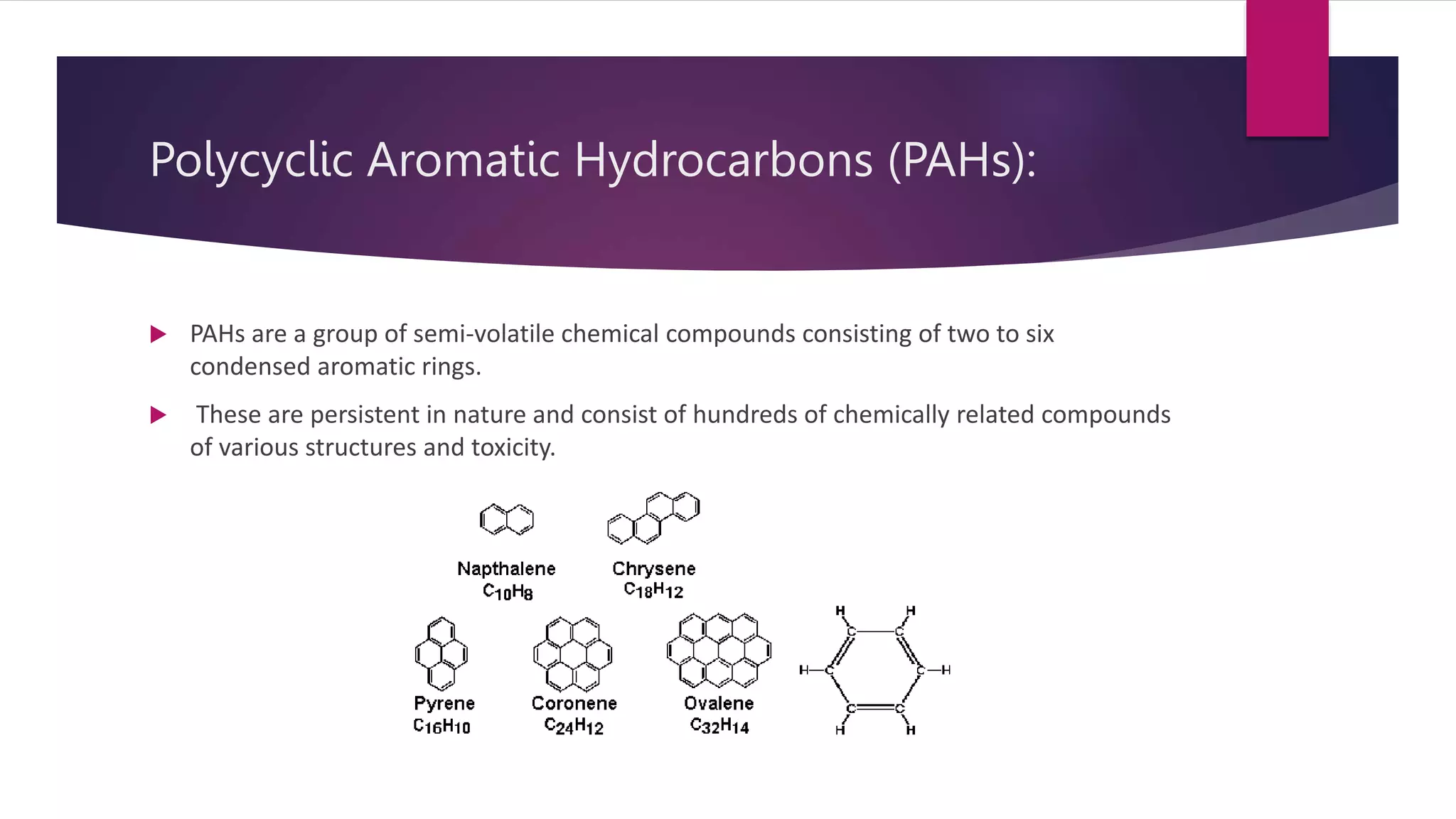
 PAHs are a group of semi-volatile chemical compounds consisting of two to six
condensed aromatic rings.
 These are persistent in nature and consist of hundreds of chemically related compounds
of various structures and toxicity.
Properties of PAH:
 Of the hundreds of PAHs, sixteen were identified as priority pollutants by the
Environmental Protection Agency of the United States of America .
 Some PAHs may be associated with certain pollution sources.
 PAHs are non- polar organic compounds .
 Composed of two or more fused benzene rings.
 They are hydrophobic substances.
 It has high coefficient octanol-water; generally, with increasing number of benzene
rings.
 The molecular weight is high .
 Decreases their water solubility, biodegradability and volatility, increasing toxicity
Polychlorinated biphenyls (PCBs)
 Polychlorinated biphenyls (PCBs) – a group of synthetic organic chemicals known as
chlorinated hydrocarbons which include any chemical substance of the biphenyl
molecule that has been chlorinated to varying degrees.
 PCBs have high heat capacity, low conductance, they are inert to acids and alkali,
have good solubility in fats, oils and organic solvents, and are explosion-proof.
 With chlorine content from 19 to 43 %, the products have a crystalline form, 43–56
% – oil-shaped, 57–69 % – semisolid and resin-shaped, and from 67 to 70 % -
crystalline again.
 Long-term exposure to PCBs can cause certain cancers and birth defects. It can
damage the central nervous system, immune and reproductive systems, and also
affect the food chain.
Sources of PAHs and PCBs:
 Natural sources:
1. Forest fires
2. Volcanoes
 Man-made sources:
1. burning fuels such as coal, wood, petroleum, petroleum products, or oil,
2. burning refuse, used tires, polypropylene, or polystyrene
3. coke production, and
4. motor vehicle exhaust.
5. E-waste
Benzo(a)pyrene, a potent carcinogen, is commonly used as an environmental indicator
for PAHs.
Contd.,
Industrial process:
 PAHs are found in industries that produce or use coal tar, coke, or bitumen
(asphalt). Coal tar pitch and creosote, which are complex mixtures of liquid and
solid aromatic hydrocarbons produced in coke ovens, contain significant
amounts of benzo(a)pyrene and other PAHs. PAHs are produced in
 coal gasification plants
 municipal incinerators
 smokehouses and
 some aluminium production facilities.
TREATMENTS OF CONTAMINATED SOIL
1. Physical treatment
2. Thermal treatment
3. Biological treatment
4. Chemical treatment
1)Physical treatment
Solvent extraction/soil washing:
 Solvent extraction/soil washing is a separation or cleanup technique which is used to
separate compounds based on their solubility.
 This technique can be used for PAH removal from contaminated soil. The extraction of
PAHs from soils is a two-step process.
 The first step is desorption of compounds from soil .
 second step involves leaching of desorbed compound.
 Eg:The solvent mixture 1-pentanol (5%), water (10%) and ethanol (85%).
Organic and mineral soil amendments:
 The organic and mineral soil amendment is an important process for reclamation of
contaminated soils.
 These amendments in the contaminated soils help attaining high remediation efficiency
as many biological, chemical and physical processes start after these amendments.
 Compost, manures, organic by products, etc., are organic amendments and foundry sand,
gypsum, coal combustion products, volcanic ashes, etc., are mineral amendments which
are found to be useful for pollutant degradation.
 activated carbon and olive mill waste compost were used as amendments for PAH
contaminated soil
3)Chemical treatment:
Chemical oxidation:
 Chemical oxidation treatment involves redox (oxidation/reduction) reactions that involve
electron transfer from one chemical to other chemicals. This treatment converts
hazardous contaminants into less toxic or non-hazardous compounds.
 Different types of oxidants such as hydrogen peroxide, persulfate, ozone, Fenton’s
reagent, persulfate, peroxymonosulfate, and potassium permanganate.
 Chemical oxidation reactions have been used for treatment of oil or PAH contaminated
soils.
Thermal treatment:
 Thermal treatment for soil remediation uses heat to destroy contaminants.
 Organic chemicals such as PAHs can be destroyed or volatilize by heat, these
contaminants changes into gases which results in increased mobility and these gases can
be collected in wells for ex situ treatment.
 Different techniques have been used under thermal remediation such as thermal
desorption, microwave frequency heating and vitrification
3)Biological treatment
 Bioremediation: role of microbes in PAH degradation
 Insitu bioremediation
 Bioaugmentation
 Biostimulation
 Bioventing
 Exsitu bioremediation
 Landfarming
 Composting
 Phytoremediation
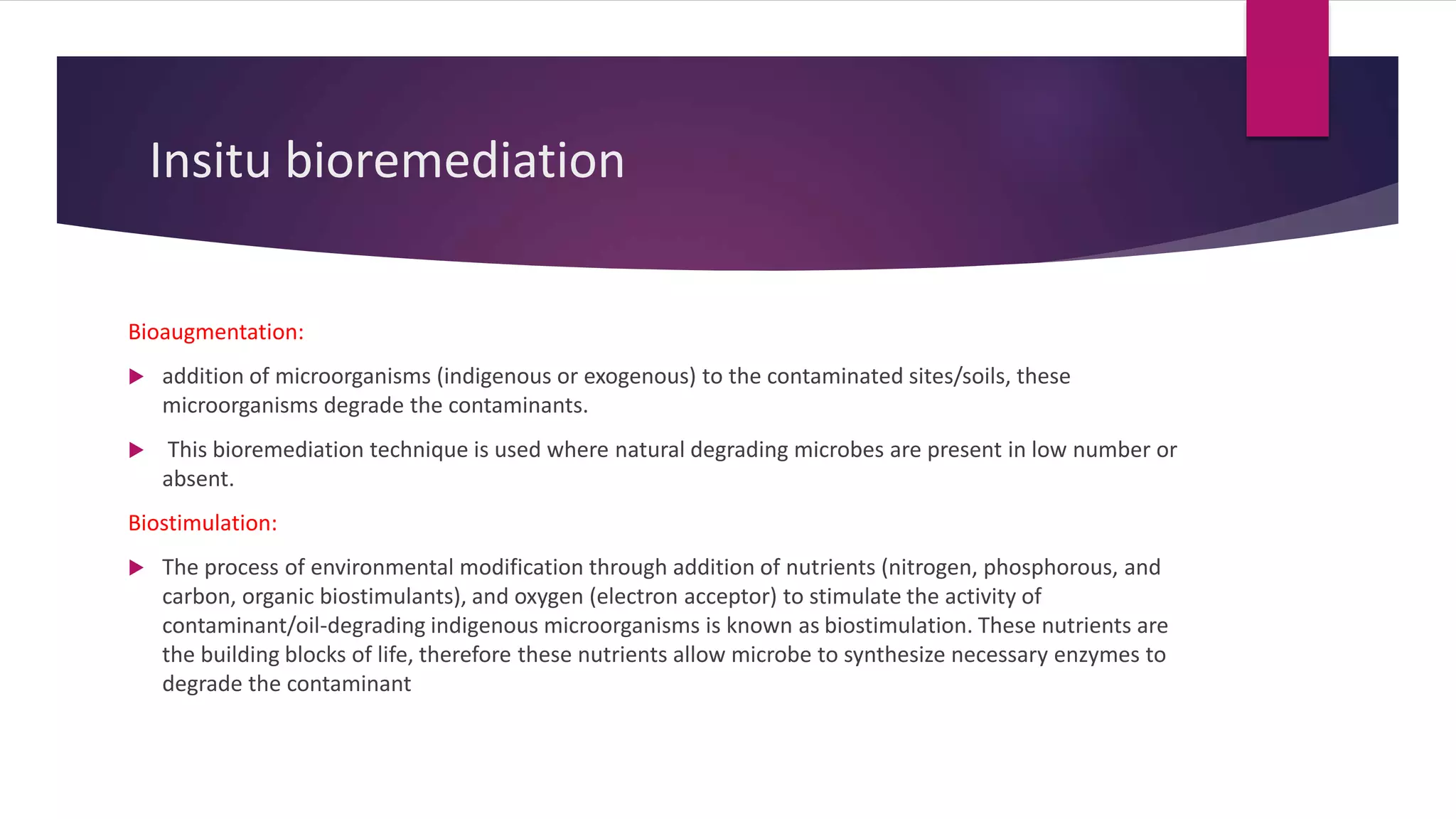
Insitu bioremediation
Bioaugmentation:
 addition of microorganisms (indigenous or exogenous) to the contaminated sites/soils, these
microorganisms degrade the contaminants.
 This bioremediation technique is used where natural degrading microbes are present in low number or
absent.
Biostimulation:
 The process of environmental modification through addition of nutrients (nitrogen, phosphorous, and
carbon, organic biostimulants), and oxygen (electron acceptor) to stimulate the activity of
contaminant/oil-degrading indigenous microorganisms is known as biostimulation. These nutrients are
the building blocks of life, therefore these nutrients allow microbe to synthesize necessary enzymes to
degrade the contaminant
Bioventing :
 It is the most common insitu remediation treatment that involves supplying air or oxygen
through wells to contaminated soil (in the unsaturated zone) to stimulate growth of the
indigenous microorganisms. Soils contaminated by petroleum hydrocarbons have been
successfully remediated using this technique .
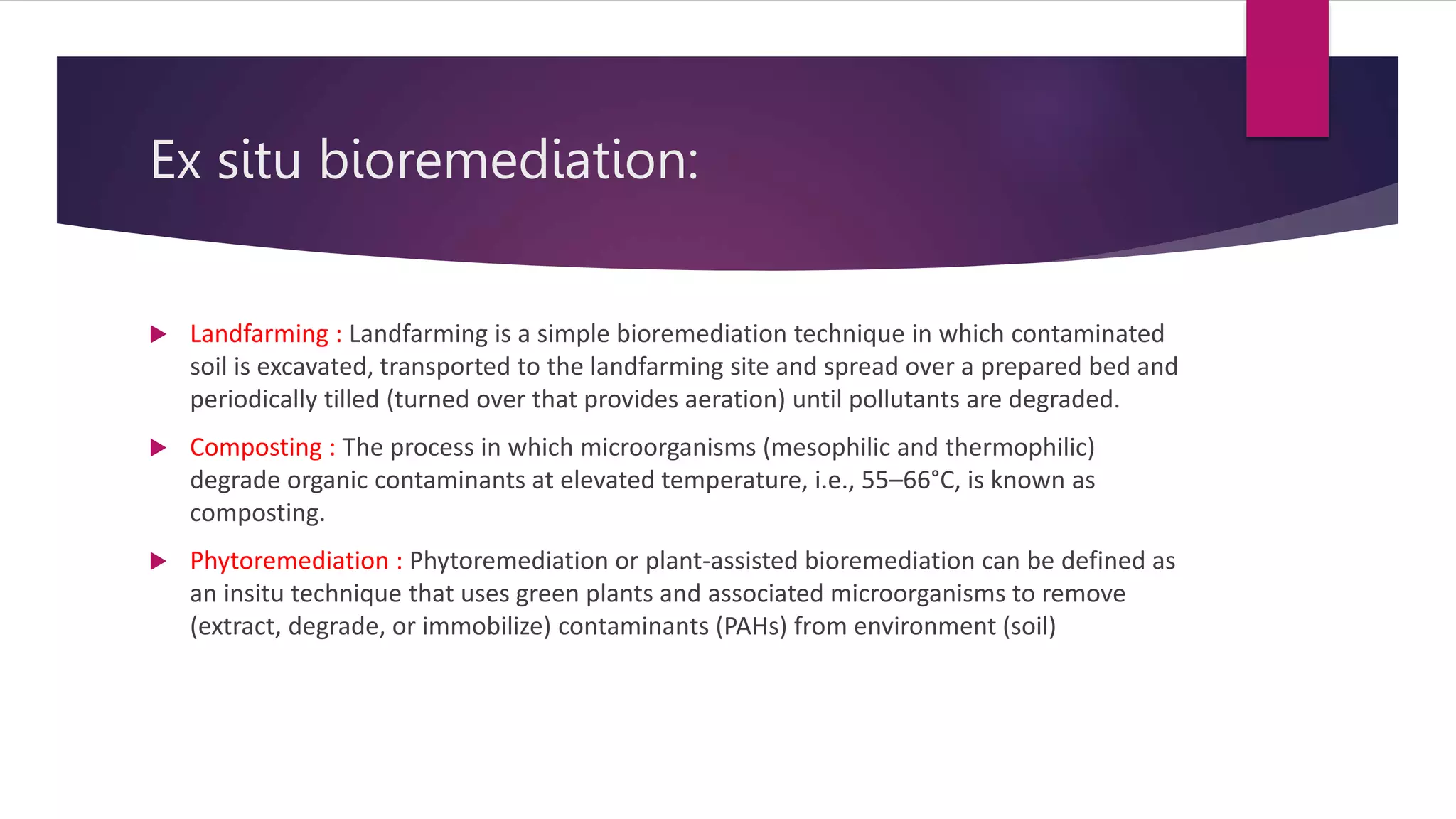
Ex situ bioremediation:
 Landfarming : Landfarming is a simple bioremediation technique in which contaminated
soil is excavated, transported to the landfarming site and spread over a prepared bed and
periodically tilled (turned over that provides aeration) until pollutants are degraded.
 Composting : The process in which microorganisms (mesophilic and thermophilic)
degrade organic contaminants at elevated temperature, i.e., 55–66°C, is known as
composting.
 Phytoremediation : Phytoremediation or plant-assisted bioremediation can be defined as
an insitu technique that uses green plants and associated microorganisms to remove
(extract, degrade, or immobilize) contaminants (PAHs) from environment (soil)
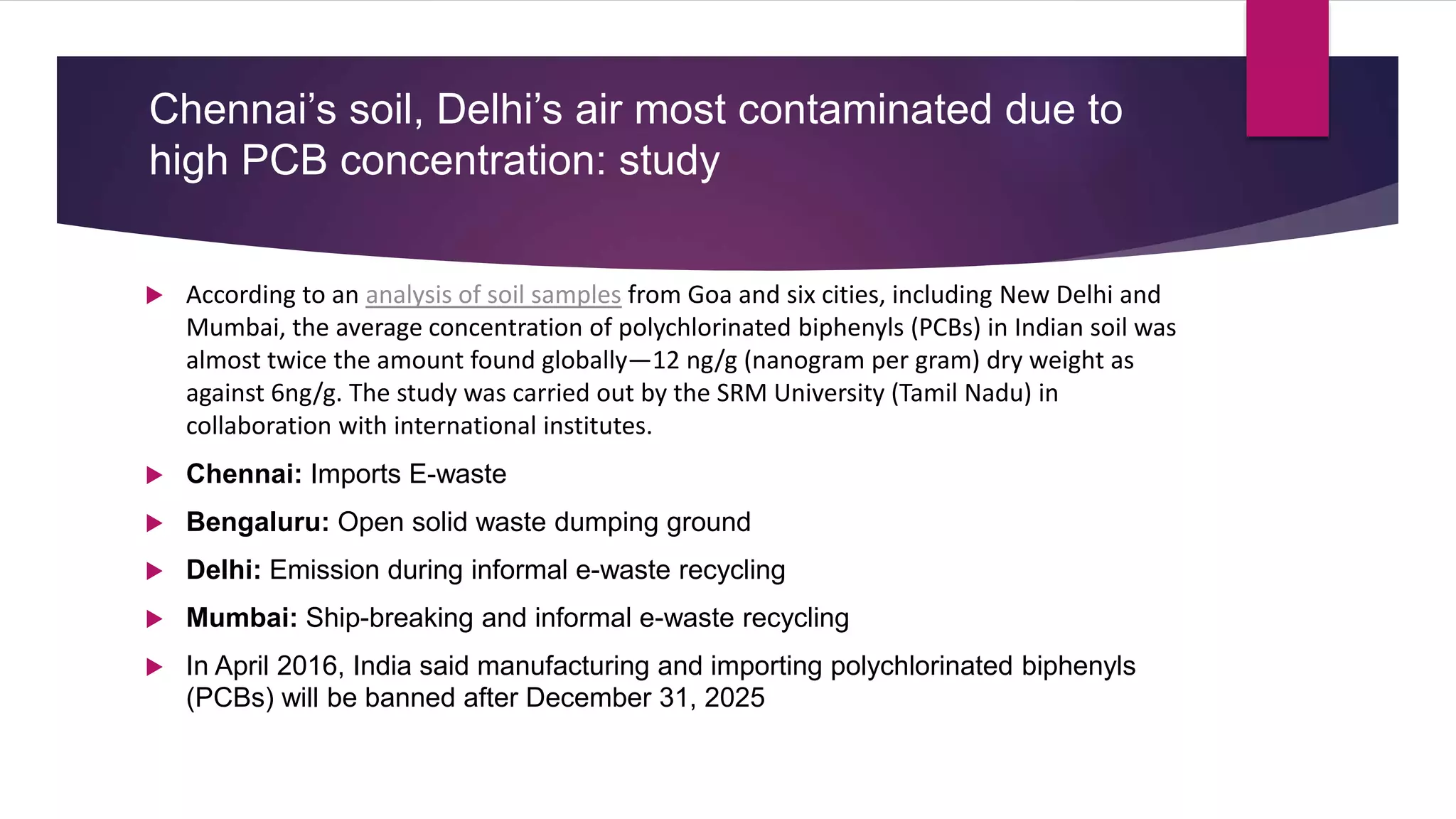
Chennai’s soil, Delhi’s air most contaminated due to
high PCB concentration: study
 According to an analysis of soil samples from Goa and six cities, including New Delhi and
Mumbai, the average concentration of polychlorinated biphenyls (PCBs) in Indian soil was
almost twice the amount found globally—12 ng/g (nanogram per gram) dry weight as
against 6ng/g. The study was carried out by the SRM University (Tamil Nadu) in
collaboration with international institutes.
 Chennai: Imports E-waste
 Bengaluru: Open solid waste dumping ground
 Delhi: Emission during informal e-waste recycling
 Mumbai: Ship-breaking and informal e-waste recycling
 In April 2016, India said manufacturing and importing polychlorinated biphenyls
(PCBs) will be banned after December 31, 2025
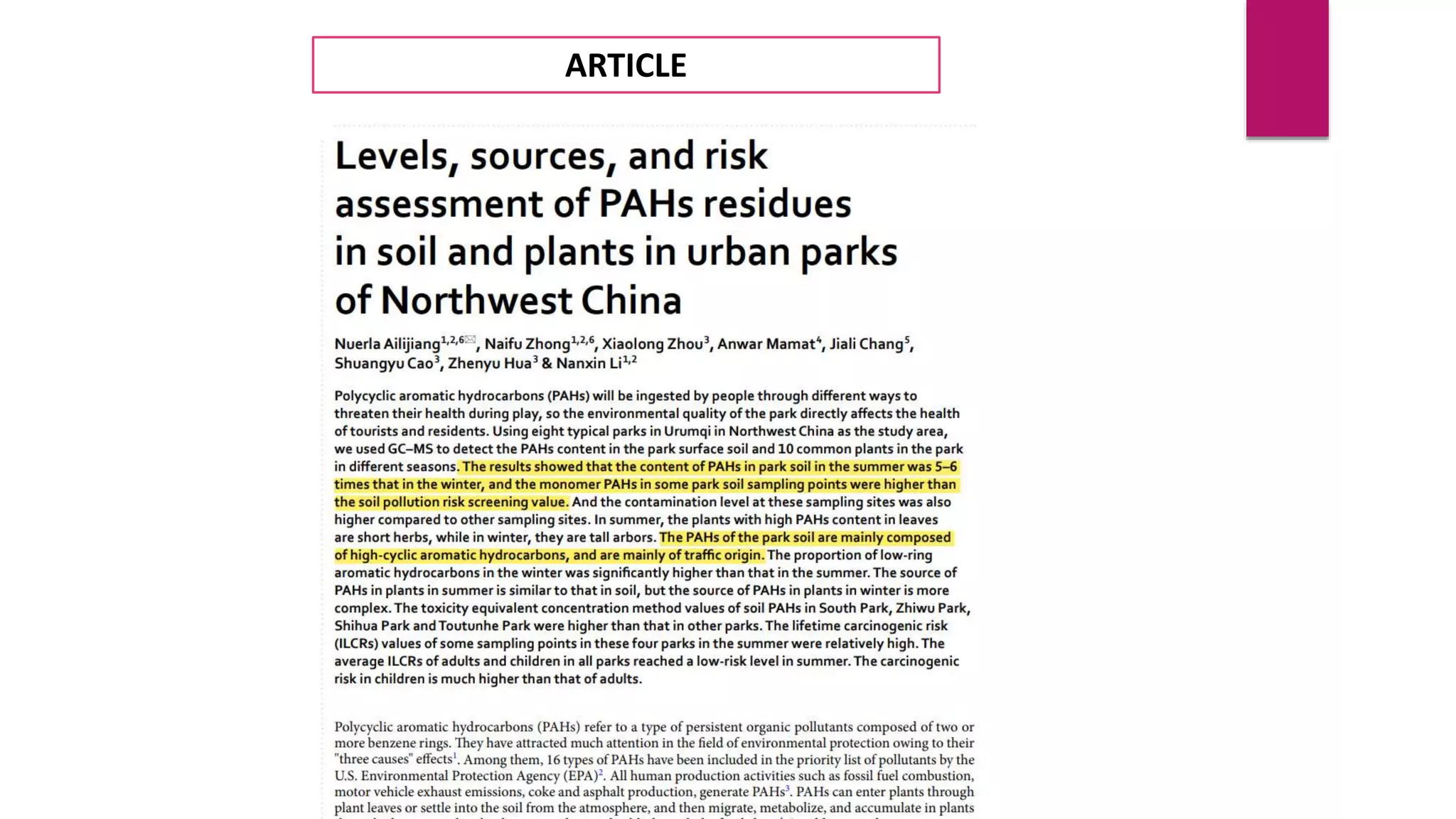
ARTICLE
THANK YOU

PAH’s and PCB’s pollution in soil ecosystem.pptx

  • 1.
    PAH’s and PCB’spollution in soil ecosystem PRESENTED BY S.BARATHKUMAR 2022520004
  • 2.
    Polycyclic Aromatic Hydrocarbons(PAHs):  PAHs are a group of semi-volatile chemical compounds consisting of two to six condensed aromatic rings.  These are persistent in nature and consist of hundreds of chemically related compounds of various structures and toxicity.
  • 3.
    Properties of PAH: Of the hundreds of PAHs, sixteen were identified as priority pollutants by the Environmental Protection Agency of the United States of America .  Some PAHs may be associated with certain pollution sources.  PAHs are non- polar organic compounds .  Composed of two or more fused benzene rings.  They are hydrophobic substances.  It has high coefficient octanol-water; generally, with increasing number of benzene rings.  The molecular weight is high .  Decreases their water solubility, biodegradability and volatility, increasing toxicity
  • 4.
    Polychlorinated biphenyls (PCBs) Polychlorinated biphenyls (PCBs) – a group of synthetic organic chemicals known as chlorinated hydrocarbons which include any chemical substance of the biphenyl molecule that has been chlorinated to varying degrees.  PCBs have high heat capacity, low conductance, they are inert to acids and alkali, have good solubility in fats, oils and organic solvents, and are explosion-proof.  With chlorine content from 19 to 43 %, the products have a crystalline form, 43–56 % – oil-shaped, 57–69 % – semisolid and resin-shaped, and from 67 to 70 % - crystalline again.  Long-term exposure to PCBs can cause certain cancers and birth defects. It can damage the central nervous system, immune and reproductive systems, and also affect the food chain.
  • 5.
    Sources of PAHsand PCBs:  Natural sources: 1. Forest fires 2. Volcanoes  Man-made sources: 1. burning fuels such as coal, wood, petroleum, petroleum products, or oil, 2. burning refuse, used tires, polypropylene, or polystyrene 3. coke production, and 4. motor vehicle exhaust. 5. E-waste Benzo(a)pyrene, a potent carcinogen, is commonly used as an environmental indicator for PAHs.
  • 6.
    Contd., Industrial process:  PAHsare found in industries that produce or use coal tar, coke, or bitumen (asphalt). Coal tar pitch and creosote, which are complex mixtures of liquid and solid aromatic hydrocarbons produced in coke ovens, contain significant amounts of benzo(a)pyrene and other PAHs. PAHs are produced in  coal gasification plants  municipal incinerators  smokehouses and  some aluminium production facilities.
  • 7.
    TREATMENTS OF CONTAMINATEDSOIL 1. Physical treatment 2. Thermal treatment 3. Biological treatment 4. Chemical treatment
  • 8.
    1)Physical treatment Solvent extraction/soilwashing:  Solvent extraction/soil washing is a separation or cleanup technique which is used to separate compounds based on their solubility.  This technique can be used for PAH removal from contaminated soil. The extraction of PAHs from soils is a two-step process.  The first step is desorption of compounds from soil .  second step involves leaching of desorbed compound.  Eg:The solvent mixture 1-pentanol (5%), water (10%) and ethanol (85%).
  • 9.
    Organic and mineralsoil amendments:  The organic and mineral soil amendment is an important process for reclamation of contaminated soils.  These amendments in the contaminated soils help attaining high remediation efficiency as many biological, chemical and physical processes start after these amendments.  Compost, manures, organic by products, etc., are organic amendments and foundry sand, gypsum, coal combustion products, volcanic ashes, etc., are mineral amendments which are found to be useful for pollutant degradation.  activated carbon and olive mill waste compost were used as amendments for PAH contaminated soil
  • 10.
    3)Chemical treatment: Chemical oxidation: Chemical oxidation treatment involves redox (oxidation/reduction) reactions that involve electron transfer from one chemical to other chemicals. This treatment converts hazardous contaminants into less toxic or non-hazardous compounds.  Different types of oxidants such as hydrogen peroxide, persulfate, ozone, Fenton’s reagent, persulfate, peroxymonosulfate, and potassium permanganate.  Chemical oxidation reactions have been used for treatment of oil or PAH contaminated soils.
  • 11.
    Thermal treatment:  Thermaltreatment for soil remediation uses heat to destroy contaminants.  Organic chemicals such as PAHs can be destroyed or volatilize by heat, these contaminants changes into gases which results in increased mobility and these gases can be collected in wells for ex situ treatment.  Different techniques have been used under thermal remediation such as thermal desorption, microwave frequency heating and vitrification
  • 12.
    3)Biological treatment  Bioremediation:role of microbes in PAH degradation  Insitu bioremediation  Bioaugmentation  Biostimulation  Bioventing  Exsitu bioremediation  Landfarming  Composting  Phytoremediation
  • 13.
    Insitu bioremediation Bioaugmentation:  additionof microorganisms (indigenous or exogenous) to the contaminated sites/soils, these microorganisms degrade the contaminants.  This bioremediation technique is used where natural degrading microbes are present in low number or absent. Biostimulation:  The process of environmental modification through addition of nutrients (nitrogen, phosphorous, and carbon, organic biostimulants), and oxygen (electron acceptor) to stimulate the activity of contaminant/oil-degrading indigenous microorganisms is known as biostimulation. These nutrients are the building blocks of life, therefore these nutrients allow microbe to synthesize necessary enzymes to degrade the contaminant
  • 14.
    Bioventing :  Itis the most common insitu remediation treatment that involves supplying air or oxygen through wells to contaminated soil (in the unsaturated zone) to stimulate growth of the indigenous microorganisms. Soils contaminated by petroleum hydrocarbons have been successfully remediated using this technique .
  • 15.
    Ex situ bioremediation: Landfarming : Landfarming is a simple bioremediation technique in which contaminated soil is excavated, transported to the landfarming site and spread over a prepared bed and periodically tilled (turned over that provides aeration) until pollutants are degraded.  Composting : The process in which microorganisms (mesophilic and thermophilic) degrade organic contaminants at elevated temperature, i.e., 55–66°C, is known as composting.  Phytoremediation : Phytoremediation or plant-assisted bioremediation can be defined as an insitu technique that uses green plants and associated microorganisms to remove (extract, degrade, or immobilize) contaminants (PAHs) from environment (soil)
  • 16.
    Chennai’s soil, Delhi’sair most contaminated due to high PCB concentration: study  According to an analysis of soil samples from Goa and six cities, including New Delhi and Mumbai, the average concentration of polychlorinated biphenyls (PCBs) in Indian soil was almost twice the amount found globally—12 ng/g (nanogram per gram) dry weight as against 6ng/g. The study was carried out by the SRM University (Tamil Nadu) in collaboration with international institutes.  Chennai: Imports E-waste  Bengaluru: Open solid waste dumping ground  Delhi: Emission during informal e-waste recycling  Mumbai: Ship-breaking and informal e-waste recycling  In April 2016, India said manufacturing and importing polychlorinated biphenyls (PCBs) will be banned after December 31, 2025
  • 17.
  • 18.