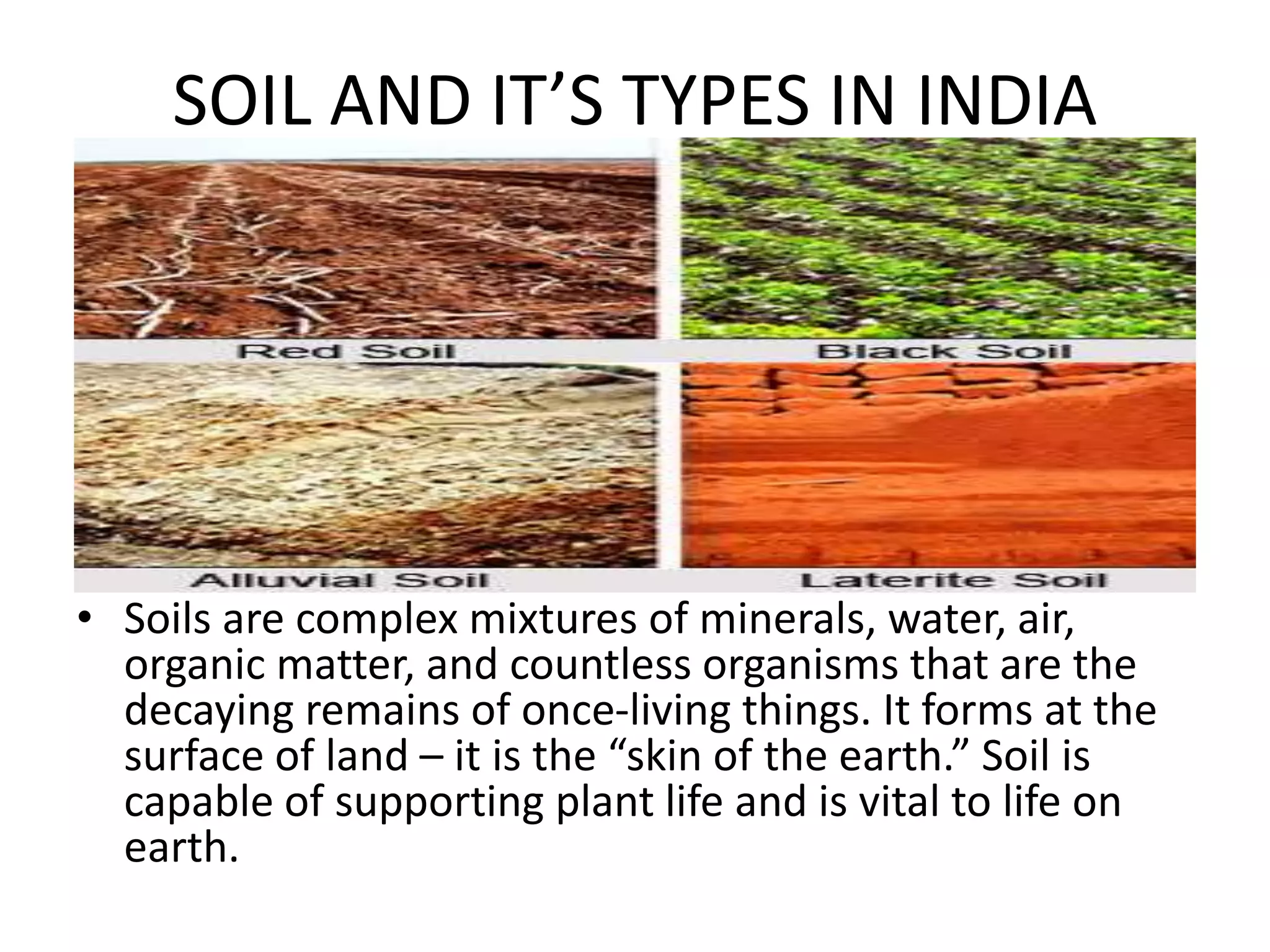

SOIL AND IT’S TYPES IN INDIA
• Soils are complex mixtures of minerals, water, air,
organic matter, and countless organisms that are the
decaying remains of once-living things. It forms at the
surface of land – it is the “skin of the earth.” Soil is
capable of supporting plant life and is vital to life on
earth.
Six Different Types of Soils Found in
India
1. Alluvial soil: Materials deposited by
rivers, winds, glaciers and sea waves are called
alluvium and soils made up of alluvium are
alluvial soils. In India alluvial soils are mainly
found on the Indo-Ganga Brahmaputra Plains,
Coastal Plains and the broad river valleys of
South India. They are also found along the river
basins of some plateau and mountain regions.
• These soils are made up of volcanic rocks and lava-flow. It is
concentrated over Deccan Lava Tract which includes parts of
Maharashtra, Chhattisgarh, Madhya Pradesh, Gujarat, Andhra
Pradesh and Tamil Nadu. It consists of Lime, Iron, Magnesium
and also Potash but lacks in Phosphorus, Nitrogen and Organic
matter.
2. BLACK SOIL
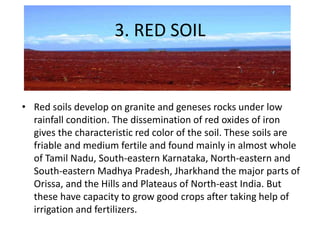
3. RED SOIL
• Red soils develop on granite and geneses rocks under low
rainfall condition. The dissemination of red oxides of iron
gives the characteristic red color of the soil. These soils are
friable and medium fertile and found mainly in almost whole
of Tamil Nadu, South-eastern Karnataka, North-eastern and
South-eastern Madhya Pradesh, Jharkhand the major parts of
Orissa, and the Hills and Plateaus of North-east India. But
these have capacity to grow good crops after taking help of
irrigation and fertilizers.
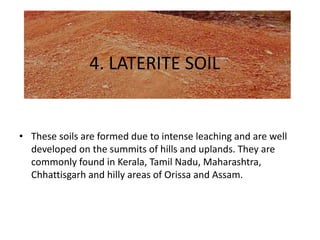
4. LATERITE SOIL
• These soils are formed due to intense leaching and are well
developed on the summits of hills and uplands. They are
commonly found in Kerala, Tamil Nadu, Maharashtra,
Chhattisgarh and hilly areas of Orissa and Assam.
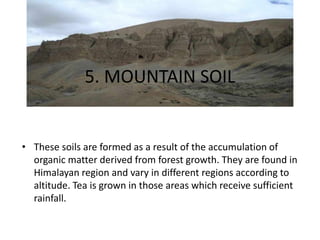
5. MOUNTAIN SOIL
• These soils are formed as a result of the accumulation of
organic matter derived from forest growth. They are found in
Himalayan region and vary in different regions according to
altitude. Tea is grown in those areas which receive sufficient
rainfall.
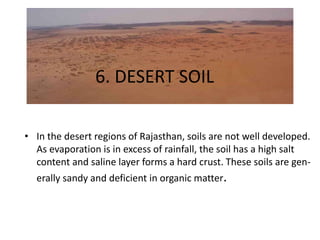
6. DESERT SOIL
• In the desert regions of Rajasthan, soils are not well developed.
As evaporation is in excess of rainfall, the soil has a high salt
content and saline layer forms a hard crust. These soils are gen-
erally sandy and deficient in organic matter.
IMPORTANCE OF SHEAR STRENTH OF
SOIL
• In the design of foundations the evaluation of
bearing capacity is dependent on the shear
strength.
• For the design of embankments for dams, roads,
pavements, excavations, levees etc. The analysis
of the stability of the slope is done using shear
strength.
• In the design of earth retaining structures like
retaining walls, sheet pile coffer dams, bulks
heads, and other underground structures etc.
THANK YOU 
BY :
HARISH PRADHAN
R680215030
B.TECH CIVIL
4th SEM

Soil and it’s types in india

  • 1.
    SOIL AND IT’STYPES IN INDIA • Soils are complex mixtures of minerals, water, air, organic matter, and countless organisms that are the decaying remains of once-living things. It forms at the surface of land – it is the “skin of the earth.” Soil is capable of supporting plant life and is vital to life on earth.
  • 2.
    Six Different Typesof Soils Found in India 1. Alluvial soil: Materials deposited by rivers, winds, glaciers and sea waves are called alluvium and soils made up of alluvium are alluvial soils. In India alluvial soils are mainly found on the Indo-Ganga Brahmaputra Plains, Coastal Plains and the broad river valleys of South India. They are also found along the river basins of some plateau and mountain regions.
  • 3.
    • These soilsare made up of volcanic rocks and lava-flow. It is concentrated over Deccan Lava Tract which includes parts of Maharashtra, Chhattisgarh, Madhya Pradesh, Gujarat, Andhra Pradesh and Tamil Nadu. It consists of Lime, Iron, Magnesium and also Potash but lacks in Phosphorus, Nitrogen and Organic matter. 2. BLACK SOIL
  • 4.
    3. RED SOIL •Red soils develop on granite and geneses rocks under low rainfall condition. The dissemination of red oxides of iron gives the characteristic red color of the soil. These soils are friable and medium fertile and found mainly in almost whole of Tamil Nadu, South-eastern Karnataka, North-eastern and South-eastern Madhya Pradesh, Jharkhand the major parts of Orissa, and the Hills and Plateaus of North-east India. But these have capacity to grow good crops after taking help of irrigation and fertilizers.
  • 5.
    4. LATERITE SOIL •These soils are formed due to intense leaching and are well developed on the summits of hills and uplands. They are commonly found in Kerala, Tamil Nadu, Maharashtra, Chhattisgarh and hilly areas of Orissa and Assam.
  • 6.
    5. MOUNTAIN SOIL •These soils are formed as a result of the accumulation of organic matter derived from forest growth. They are found in Himalayan region and vary in different regions according to altitude. Tea is grown in those areas which receive sufficient rainfall.
  • 7.
    6. DESERT SOIL •In the desert regions of Rajasthan, soils are not well developed. As evaporation is in excess of rainfall, the soil has a high salt content and saline layer forms a hard crust. These soils are gen- erally sandy and deficient in organic matter.
  • 8.
    IMPORTANCE OF SHEARSTRENTH OF SOIL • In the design of foundations the evaluation of bearing capacity is dependent on the shear strength. • For the design of embankments for dams, roads, pavements, excavations, levees etc. The analysis of the stability of the slope is done using shear strength. • In the design of earth retaining structures like retaining walls, sheet pile coffer dams, bulks heads, and other underground structures etc.
  • 9.
    THANK YOU  BY: HARISH PRADHAN R680215030 B.TECH CIVIL 4th SEM