.OUR PRIME AND NATURAL RESOURCE
ON EARTH.
.INDIAN SOILS– 6 DIFFERENT TYPES
.DIFFER IN COMPOSITION AND
STRUCTURE.
SOIL
SOILS IN INDIA
• Valuable resource of India
• .Indian agriculture depends upon the extent and
qualities of soil.
• Weathering prepares loose materials on the
surface of the Earth and mixed with decayed
organic matters it forms soil.
 India witnesses diverse range of climatic and other
natural conditions.
 Climate, natural vegetation and rocks all influence
the nature of soil in a place
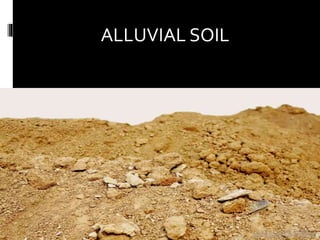
ALLUVIAL SOIL
•PECULIARITIES
 Formed by deposition of fine silt sediments (alluvium)
by rivers
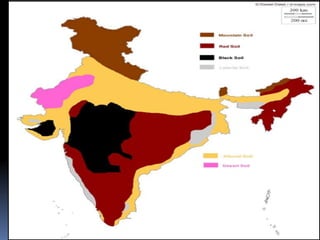
 Old alluvium (khadar) and new alluvium (bangar)
 Contains potash, phosphoric acid and lime.
 Rich in humus and hence fertile
 Found in Great Northern Plains, lower valleys
of rivers Narmada andTapti and in Northern Gujarat.
 Good for growth of sugarcane,rice, wheat
and pulses
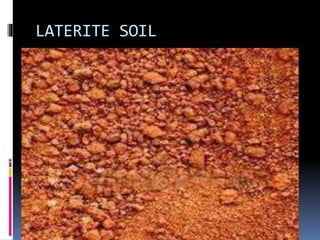
LATERITE SOIL
PECULIARITIES
 Formed due to intense leaching and
weathering of parent rocks
 Rich in iron oxide hence rusty red in colour
and not much fertile.
 Commonly found in Kerala,Tamil Nadu,
 Maharashtra, Chhattisgarh and hilly areas of
Orissa and Assam.
 Some plants like tea, coffee, coconut, areca
nut, etc. can be grown .
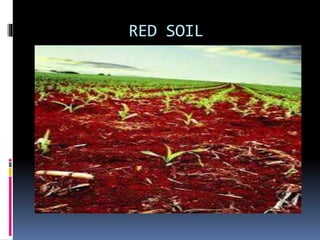
RED SOIL
PECULIARITIES
 Develop on granite and geneses rocks under low rainfall
condition.
 Dissemination of red oxides of iron gives the characteristic
red color .
 Friable and medium fertile
 Found mainly in almost whole ofTamil Nadu, South-
eastern Karnataka, North-eastern and South-eastern
Madhya Pradesh, Jharkhand the major parts of Orissa, and
the Hills and Plateaus of North-east India.
 Good growth of crops after taking help of irrigation and
fertilizers.
 Wheat, rice, millets, gram, pulses, oil-seeds and cotton are
cultivated.
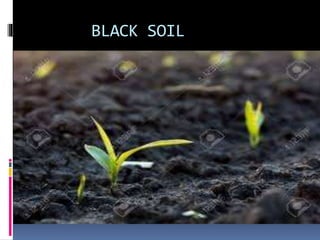
BLACK SOIL
PECULIARITIES
 Developed extensively upon the Lava Plateaus of
Maharashtra, Gujarat, Madhya Pradesh mainly
Malwa.
 Clayey and very sticky when wet.
 High water holding capacity and fertile.
 Have high percentage of lime and a moderate
amount of potash.
 Well suited for cultivation of cotton , hence
called ‘black cotton soil.
 Sugarcane, wheat, and groundnut are
cultivated
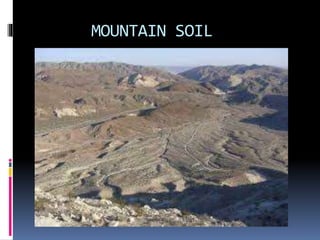
MOUNTAIN SOIL
PECULIARITIES
 Rich in humus but poor in potash and lime
 Found in mountains and hill tops .
 Seen in Jammu and Kashmir, U.P.,West Bengal
in the Himalayan tracts.
 The Himalayas, the North-eastern Hills,
mountains and hills in India show a variety of
soils.
 In the drier areas of deciduous forest belt,
brown soils are found, rich in humus and deep
and good for orchard crops.
 In coniferous forest belts in Jammu and
Kashmir, Himachal Pradesh, Uttarakhand,
Sikkim, etc., brown forest soils called Podzol
are good for growing maize, barley, wheat
and fruits.
 In the Alpine Zone of the Himalayas lie Alpine
Meadow soils.
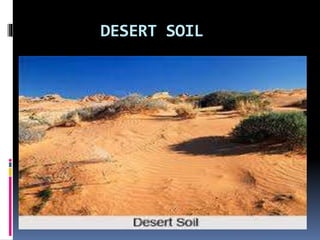
DESERT SOIL
PECULIARITIES
 Gritty and sandy.
 Drains well but does not contain so many nutrients
 Shift and blow away with the wind as it is very light
 Found in Rajasthan, Haryana and the South Punjab
areas.
 Become saline and rather unfit for cultivation in the
absence of rain.
 Cultivation can be carried on with the help of
modern irrigation.
 Wheat, bajra, groundnut, etc. can be grown.
THANK YOU

Soils in india

  • 2.
    .OUR PRIME ANDNATURAL RESOURCE ON EARTH. .INDIAN SOILS– 6 DIFFERENT TYPES .DIFFER IN COMPOSITION AND STRUCTURE. SOIL
  • 4.
    SOILS IN INDIA •Valuable resource of India • .Indian agriculture depends upon the extent and qualities of soil. • Weathering prepares loose materials on the surface of the Earth and mixed with decayed organic matters it forms soil.  India witnesses diverse range of climatic and other natural conditions.  Climate, natural vegetation and rocks all influence the nature of soil in a place
  • 5.
  • 6.
    •PECULIARITIES  Formed bydeposition of fine silt sediments (alluvium) by rivers  Old alluvium (khadar) and new alluvium (bangar)  Contains potash, phosphoric acid and lime.  Rich in humus and hence fertile  Found in Great Northern Plains, lower valleys of rivers Narmada andTapti and in Northern Gujarat.  Good for growth of sugarcane,rice, wheat and pulses
  • 7.
  • 8.
    PECULIARITIES  Formed dueto intense leaching and weathering of parent rocks  Rich in iron oxide hence rusty red in colour and not much fertile.  Commonly found in Kerala,Tamil Nadu,  Maharashtra, Chhattisgarh and hilly areas of Orissa and Assam.  Some plants like tea, coffee, coconut, areca nut, etc. can be grown .
  • 9.
  • 10.
    PECULIARITIES  Develop ongranite and geneses rocks under low rainfall condition.  Dissemination of red oxides of iron gives the characteristic red color .  Friable and medium fertile  Found mainly in almost whole ofTamil Nadu, South- eastern Karnataka, North-eastern and South-eastern Madhya Pradesh, Jharkhand the major parts of Orissa, and the Hills and Plateaus of North-east India.  Good growth of crops after taking help of irrigation and fertilizers.  Wheat, rice, millets, gram, pulses, oil-seeds and cotton are cultivated.
  • 11.
  • 12.
    PECULIARITIES  Developed extensivelyupon the Lava Plateaus of Maharashtra, Gujarat, Madhya Pradesh mainly Malwa.  Clayey and very sticky when wet.  High water holding capacity and fertile.  Have high percentage of lime and a moderate amount of potash.  Well suited for cultivation of cotton , hence called ‘black cotton soil.  Sugarcane, wheat, and groundnut are cultivated
  • 13.
  • 14.
    PECULIARITIES  Rich inhumus but poor in potash and lime  Found in mountains and hill tops .  Seen in Jammu and Kashmir, U.P.,West Bengal in the Himalayan tracts.  The Himalayas, the North-eastern Hills, mountains and hills in India show a variety of soils.
  • 15.
     In thedrier areas of deciduous forest belt, brown soils are found, rich in humus and deep and good for orchard crops.  In coniferous forest belts in Jammu and Kashmir, Himachal Pradesh, Uttarakhand, Sikkim, etc., brown forest soils called Podzol are good for growing maize, barley, wheat and fruits.  In the Alpine Zone of the Himalayas lie Alpine Meadow soils.
  • 16.
  • 17.
    PECULIARITIES  Gritty andsandy.  Drains well but does not contain so many nutrients  Shift and blow away with the wind as it is very light  Found in Rajasthan, Haryana and the South Punjab areas.  Become saline and rather unfit for cultivation in the absence of rain.  Cultivation can be carried on with the help of modern irrigation.  Wheat, bajra, groundnut, etc. can be grown.
  • 18.