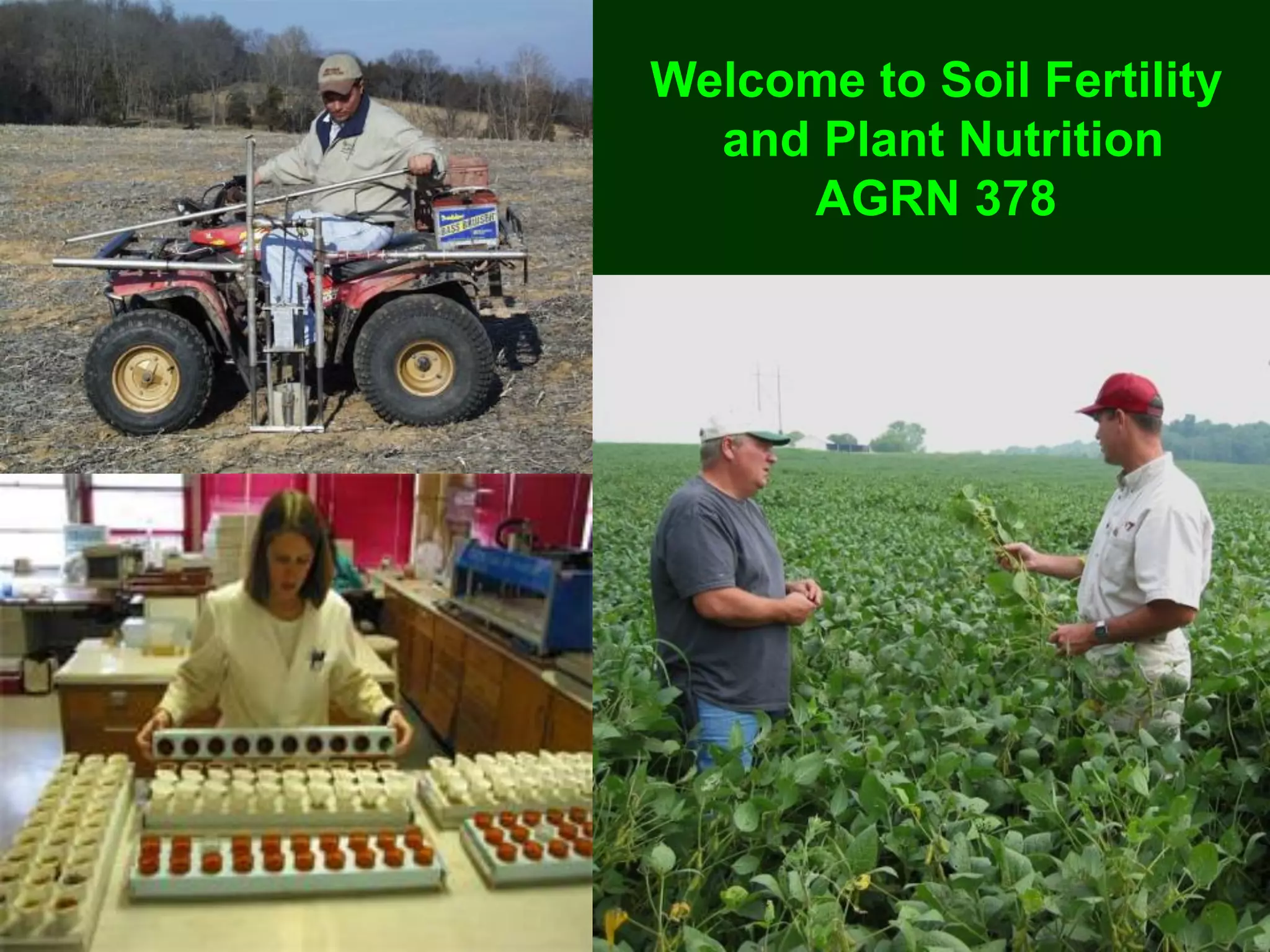
Welcome to Soil Fertility
  and Plant Nutrition
     AGRN 378
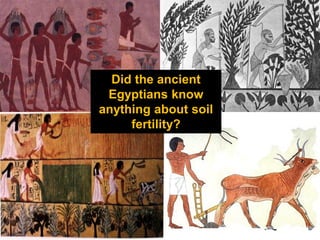
Did the ancient
 Egyptians know
anything about soil
     fertility?
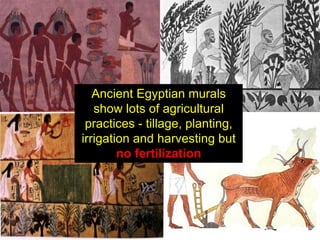
Ancient Egyptian murals
   show lots of agricultural
 practices - tillage, planting,
irrigation and harvesting but
        no fertilization
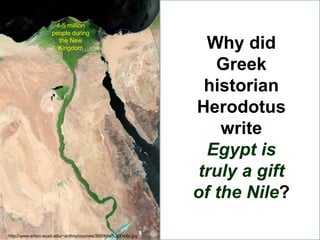
4-5 million
                     people during
                       the New
                       Kingdom                                       Why did
                                                                      Greek
                                                                    historian
                                                                   Herodotus
                                                                       write
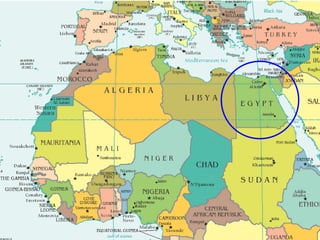
                                                                    Egypt is
                                                                   truly a gift
                                                                   of the Nile?

http://www.artsci.wustl.edu/~anthro/courses/306/Nile%20Delta.jpg   http://lexicorient.com/e.o/atlas/maps/nile.gif
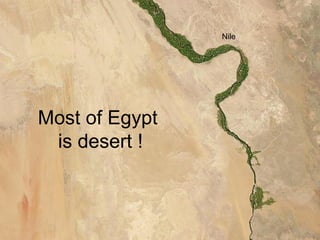
Nile


Most of Egypt
 is desert !
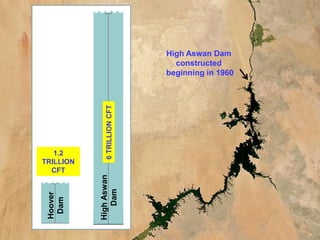
High Aswan Dam
                                 constructed
                               beginning in 1960


              6 TRILLION CFT


   1.2
TRILLION
  CFT
           High Aswan
              Dam
 Hoover
  Dam
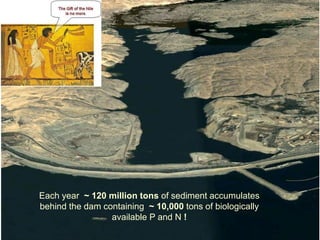
Each year ~ 120 million tons of sediment accumulates
behind the dam containing ~ 10,000 tons of biologically
                 available P and N !
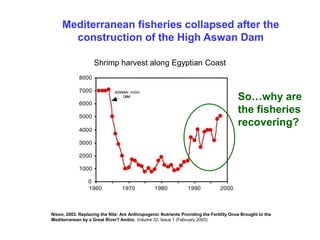
Mediterranean fisheries collapsed after the
       construction of the High Aswan Dam

                    Shrimp harvest along Egyptian Coast


                                                                                        So…why are
                                                                                        the fisheries
                                                                                        recovering?


Nixon, 2003. Replacing the Nile: Are Anthropogenic Nutrients Providing the Fertility Once Brought to the
Mediterranean by a Great River? Ambio. Volume 32, Issue 1 (February 2003)
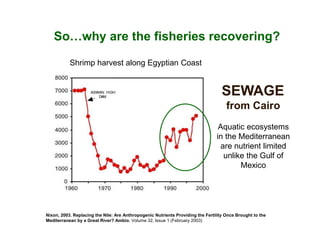
So…why are the fisheries recovering?

           Shrimp harvest along Egyptian Coast


                                                                                   SEWAGE
                                                                                     from Cairo
                                                                                 Aquatic ecosystems
                                                                                in the Mediterranean
                                                                                 are nutrient limited
                                                                                  unlike the Gulf of
                                                                                       Mexico


Nixon, 2003. Replacing the Nile: Are Anthropogenic Nutrients Providing the Fertility Once Brought to the
Mediterranean by a Great River? Ambio. Volume 32, Issue 1 (February 2003)
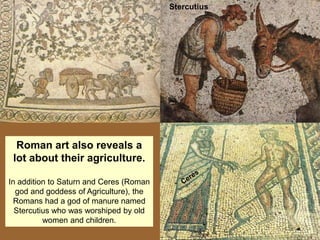
Stercutius


  Roman art also reveals a
 lot about their agriculture.

In addition to Saturn and Ceres (Roman
  god and goddess of Agriculture), the
  Romans had a god of manure named
  Stercutius who was worshiped by old
          women and children.
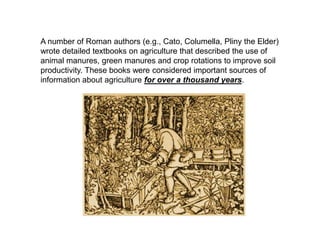
A number of Roman authors (e.g., Cato, Columella, Pliny the Elder)
wrote detailed textbooks on agriculture that described the use of
animal manures, green manures and crop rotations to improve soil
productivity. These books were considered important sources of
information about agriculture for over a thousand years.
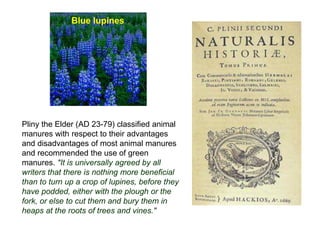
Blue lupines


Pliny the Elder (AD 23-79) classified animal
manures with respect to their advantages
and disadvantages of most animal manures
and recommended the use of green
manures. "It is universally agreed by all
writers that there is nothing more beneficial
than to turn up a crop of lupines, before they
have podded, either with the plough or the
fork, or else to cut them and bury them in
heaps at the roots of trees and vines."
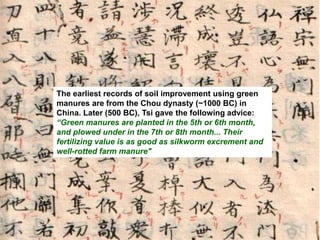
The earliest records of soil improvement using green
manures are from the Chou dynasty (~1000 BC) in
China. Later (500 BC), Tsi gave the following advice:
“Green manures are planted in the 5th or 6th month,
and plowed under in the 7th or 8th month... Their
fertilizing value is as good as silkworm excrement and
well-rotted farm manure"
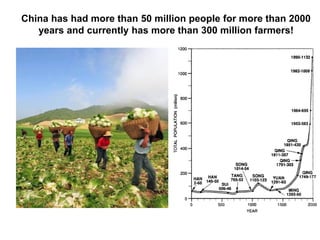
China has had more than 50 million people for more than 2000
   years and currently has more than 300 million farmers!
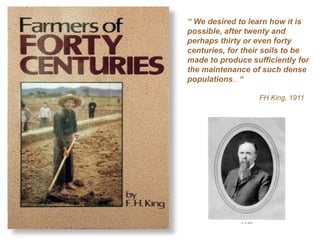
“ We desired to learn how it is
possible, after twenty and
perhaps thirty or even forty
centuries, for their soils to be
made to produce sufficiently for
the maintenance of such dense
populations.. “

                  FH King, 1911
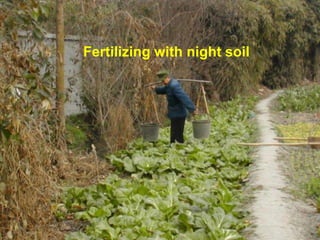
Fertilizing with night soil
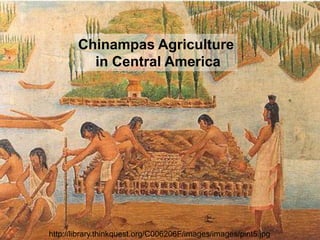
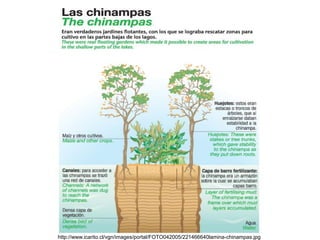
Chinampas Agriculture
          in Central America


http://library.thinkquest.org/C006206F/images/images/pint5.jpg
http://www.icarito.cl/vgn/images/portal/FOTO042005/221466640lamina-chinampas.jpg
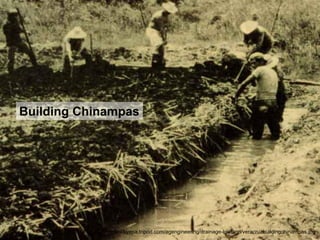
Building Chinampas


             http://kyapa.tripod.com/agengineering/drainage-lowland/veracruzbuildingchinampas.jpg
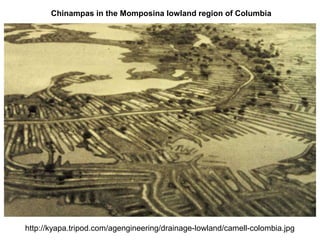
Chinampas in the Momposina lowland region of Columbia


http://kyapa.tripod.com/agengineering/drainage-lowland/camell-colombia.jpg
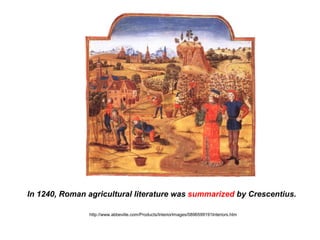
In 1240, Roman agricultural literature was summarized by Crescentius.

               http://www.abbeville.com/Products/InteriorImages/0896599191Interiors.htm
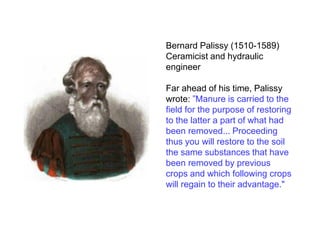
Bernard Palissy (1510-1589)
Ceramicist and hydraulic
engineer

Far ahead of his time, Palissy
wrote: ”Manure is carried to the
field for the purpose of restoring
to the latter a part of what had
been removed... Proceeding
thus you will restore to the soil
the same substances that have
been removed by previous
crops and which following crops
will regain to their advantage."
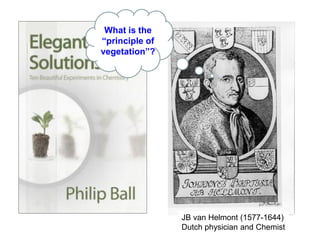
What is the
“principle of
vegetation”?


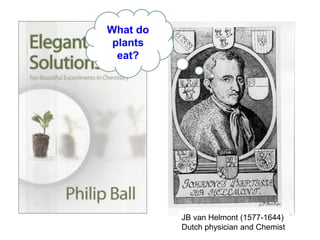
                JB van Helmont (1577-1644)
                Dutch physician and Chemist
What isdo
 What the
“principle of
  plants
vegetation”?
    eat?


                JB van Helmont (1577-1644)
                Dutch physician and Chemist
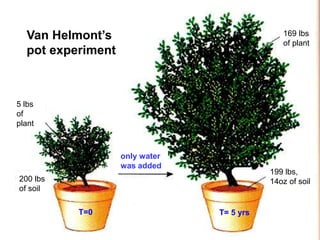
Van Helmont’s                               169 lbs
                                              of plant
  pot experiment


5 lbs
of
plant


                   only water
                   was added
                                           199 lbs,
200 lbs                                    14oz of soil
of soil

          T=0                   T= 5 yrs
Van Helmont also performed
experiments that involved combusting
 charcoal and reported that 62 lbs of
   charcoal produced 1 lb of ash.

He wrote that the other 61 lbs consisted
 of the "spirit of the wood," which he
              called "gas".
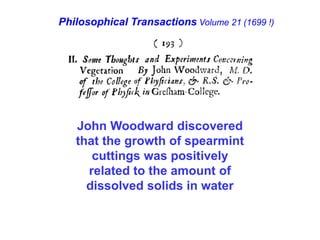
Philosophical Transactions Volume 21 (1699 !)


   John Woodward discovered
   that the growth of spearmint
      cuttings was positively
     related to the amount of
     dissolved solids in water
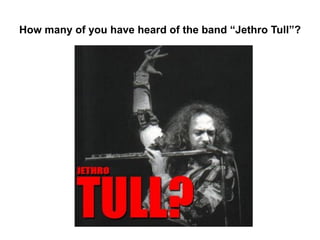
How many of you have heard of the band “Jethro Tull”?
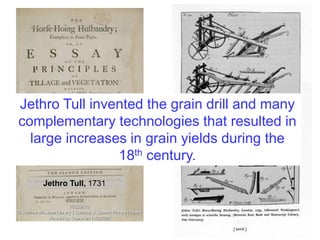
Jethro Tull invented the grain drill and many
complementary technologies that resulted in
  large increases in grain yields during the
                18th century.
    Jethro Tull, 1731
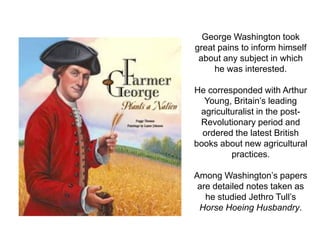
George Washington took
great pains to inform himself
 about any subject in which
     he was interested.

He corresponded with Arthur
  Young, Britain’s leading
 agriculturalist in the post-
 Revolutionary period and
  ordered the latest British
books about new agricultural
         practices.

Among Washington’s papers
 are detailed notes taken as
   he studied Jethro Tull’s
 Horse Hoeing Husbandry.
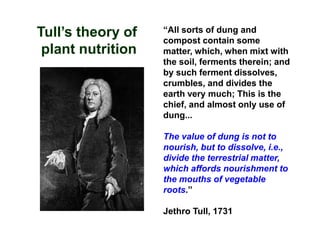
Tull’s theory of   “All sorts of dung and
                   compost contain some
 plant nutrition   matter, which, when mixt with
                   the soil, ferments therein; and
                   by such ferment dissolves,
                   crumbles, and divides the
                   earth very much; This is the
                   chief, and almost only use of
                   dung...

                   The value of dung is not to
                   nourish, but to dissolve, i.e.,
                   divide the terrestrial matter,
                   which affords nourishment to
                   the mouths of vegetable
                   roots.”

                   Jethro Tull, 1731
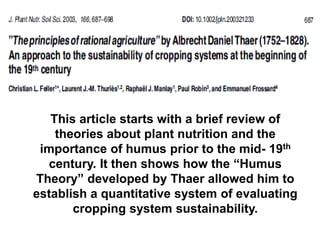
This article starts with a brief review of
    theories about plant nutrition and the
 importance of humus prior to the mid- 19th
  century. It then shows how the “Humus
Theory” developed by Thaer allowed him to
establish a quantitative system of evaluating
       cropping system sustainability.
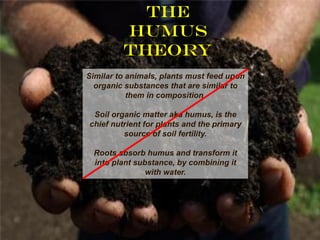
The
         humus
         theory
Similar to animals, plants must feed upon
  organic substances that are similar to
           them in composition.

 Soil organic matter aka humus, is the
chief nutrient for plants and the primary
         source of soil fertility.

 Roots absorb humus and transform it
 into plant substance, by combining it
               with water.
In the early 1800s, Swiss chemist and plant physiologist
    Nicolas-Théodore De Saussure rejected most of the
    principle of vegetation concepts of his predecessors
     and arrived at many ground breaking conclusions:

           1) soil, not air, supplies plants with N

2) roots are active and selective absorbers of water and salts

 3) plants only absorb CO2 and release O2 when exposed to
                           sunlight

4) All plant tissues including seeds and roots consume O2 and
                            give off CO2

         but did not fully reject the humus theory
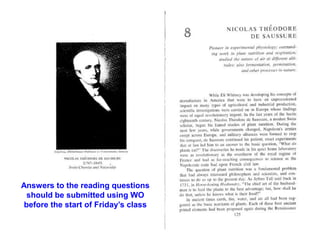
Answers to the reading questions
  should be submitted using WO
 before the start of Friday’s class
Reading questions

1) The article includes an interesting quote from Jethro Tull:
   “The chief art of the husbandman is to feed the plants to best advantage; but,
   how shall he do that, unless he knows what is their food?”
   Identify the contrasting views about plant nutrition contained in the article. Be
   sure to mention the proponents of each view.

2) Discuss de Saussure’s relationship with his father. Has anyone in your life
   helped to spark or encourage your interest in the Agricultural Sciences?
   Explain.

3) De Saussure made many impressive discoveries about plant respiration and
   nutrition. Briefly discuss 3 discoveries that you think were particularly
   interesting.

4a) Calculate how much a typical corn seed weighs in grams (1 lb = 454 g).
Hint: look up the weight of a bushel of corn and # of seeds in a bushel of corn.
4b) Estimate the total weight of a mature corn plant in grams.
             SHOW YOUR WORK!!!!
Assume the following: corn population = 30,000 plants/ac, yield = 200 bu/ac,
weight of grain = weight of stover = weight of roots
4c) Calculate how much the corn seed’s weight multiplied during a full season of
   growth.
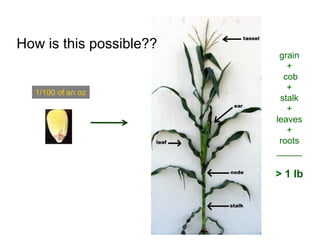
How is this possible??
                          grain
                            +
                           cob
                            +
  1/100 of an oz
                          stalk
                            +
                         leaves
                            +
                          roots
                         _____

                         > 1 lb
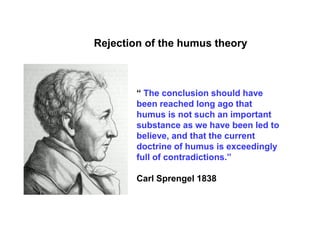
Rejection of the humus theory


        “ The conclusion should have
        been reached long ago that
        humus is not such an important
        substance as we have been led to
        believe, and that the current
        doctrine of humus is exceedingly
        full of contradictions.”

        Carl Sprengel 1838
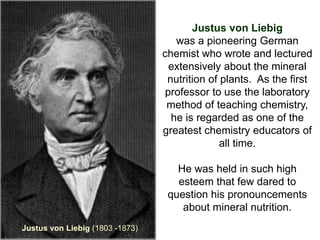
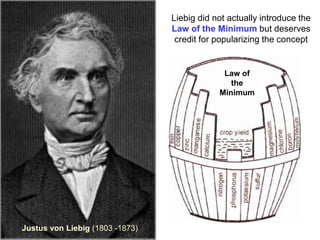
Justus von Liebig
                                    was a pioneering German
                                 chemist who wrote and lectured
                                   extensively about the mineral
                                  nutrition of plants. As the first
                                  professor to use the laboratory
                                  method of teaching chemistry,
                                   he is regarded as one of the
                                 greatest chemistry educators of
                                               all time.

                                    He was held in such high
                                    esteem that few dared to
                                  question his pronouncements
                                     about mineral nutrition.
Justus von Liebig (1803 -1873)
Liebig did not actually introduce the
                                 Law of the Minimum but deserves
                                  credit for popularizing the concept


                                              Law of
                                                the
                                             Minimum


Justus von Liebig (1803 -1873)
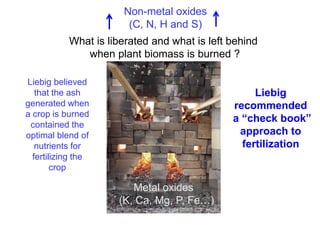
Non-metal oxides
                       (C, N, H and S)
           What is liberated and what is left behind
              when plant biomass is burned ?

Liebig believed
   that the ash                                    Liebig
generated when                                recommended
a crop is burned
                                              a “check book”
 contained the
optimal blend of                               approach to
   nutrients for                                fertilization
  fertilizing the
        crop

                        Metal oxides
                     (K, Ca, Mg, P, Fe…)
Some of Liebig’s theories were not
    supported by experimental evidence but
   few were willing to publicly question them.
Liebig wrote: ‘Agricultural crops receive quite sufficient
             nitrogen from the atmosphere ...’

Sir John Lawes, a British contemporary of Liebig was bold
       enough to declare: ‘There can not be a more
              erroneous opinion than this.’
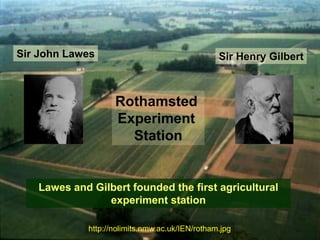
Sir John Lawes                                  Sir Henry Gilbert


                   Rothamsted
                   Experiment
                     Station


   Lawes and Gilbert founded the first agricultural
                experiment station

            http://nolimits.nmw.ac.uk/IEN/rotham.jpg
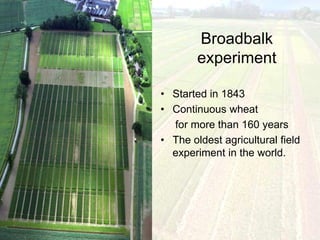
Broadbalk
        experiment

• Started in 1843
• Continuous wheat
  for more than 160 years
• The oldest agricultural field
  experiment in the world.
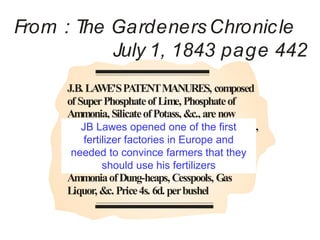
From : T Gardeners Chronic le
        he
           July 1, 1843 page 442
     J.B. LA WE'S PA   TENT MANURES, composed
     of Super Phosphate of Lime, Phosphate of
     Ammonia, Silicate of Potass, &c., are now
     for JB Lawes opened one of the first
         sale at his Factory, Deptford-creek, London,
     price 4s. 6d. per bushel.These substances can
          fertilizer factories in Europe and
     be had seperately; the Super Phosphatethey
      needed to convince farmers that of
     Lime alone is recommended for fixing the
               should use his fertilizers
     Ammonia of Dung-heaps, Cesspools, Gas
     Liquor, &c. Price 4s. 6d. per bushel
Broadbalk demonstrated the value
     of N and P fertilizer and that
    manure was not necessary to
       produce high crop yields
               however
the plots receiving both manure and
     fertilizer often produced the
              highest yields
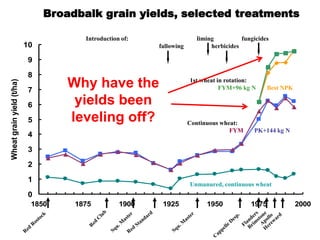
Broadbalk grain yields, selected treatments

                                       Introduction of:                 liming          fungicides
                           10                             fallowing          herbicides

                            9

                            8
                                    Why have the                      1st wheat in rotation:
Wheat grain yield (t/ha)


                            7                                                    FYM+96 kg N     Best NPK

                            6        yields been
                            5       leveling off?                     Continuous wheat:
                                                                                    FYM     PK+144 kg N
                            4

                            3

                            2

                            1
                                                                      Unmanured, continuous wheat
                            0
                            1850     1875          1900    1925            1950            1975             2000
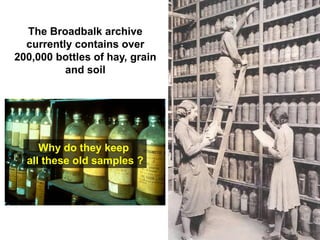
The Broadbalk archive
  currently contains over
200,000 bottles of hay, grain
          and soil


     Why do they keep
  all these old samples ?
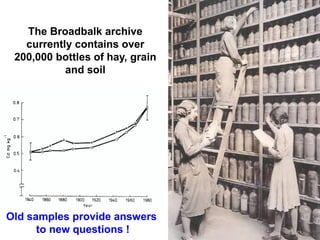
The Broadbalk archive
   currently contains over
 200,000 bottles of hay, grain
           and soil


      Why do they keep
   all these old samples ?


Old samples provide answers
      to new questions !
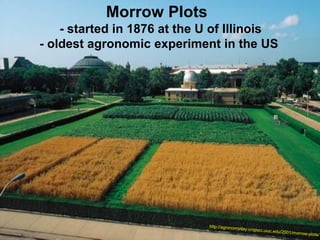
Morrow Plots
    - started in 1876 at the U of Illinois
- oldest agronomic experiment in the US
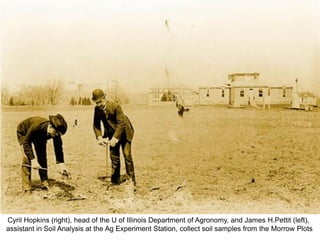
Cyril Hopkins (right), head of the U of Illinois Department of Agronomy, and James H.Pettit (left),
assistant in Soil Analysis at the Ag Experiment Station, collect soil samples from the Morrow Plots
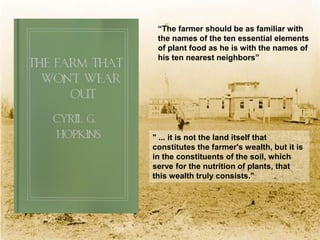
“The farmer should be as familiar with
 the names of the ten essential elements
 of plant food as he is with the names of
 his ten nearest neighbors”


" ... it is not the land itself that
constitutes the farmer's wealth, but it is
in the constituents of the soil, which
serve for the nutrition of plants, that
this wealth truly consists."
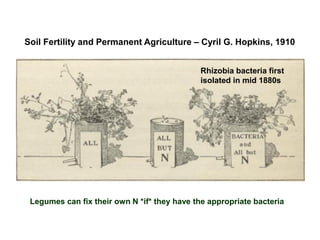
Soil Fertility and Permanent Agriculture – Cyril G. Hopkins, 1910


                                                     Rhizobia bacteria first
“In recent years, Whitney and Cameron have revived the theory of toxic
                                                     isolated in mid 1880s
excreta from plant roots, in support of a more radical theory announced by
them, to the effect that soils do not wear out or become depleted by cultivation
or cropping.

While this theory is advanced with no adequate foundation and in direct
opposition to practical experience and to so many facts of mathematics,
chemistry, and geology, that it is in itself quite unworthy of further
consideration, the fact is that it has been promoted by Professor Whitney as
Chief of the United States Bureau of Soils, and by Doctor Cameron as the
chief chemist of the same Bureau; and, consequently, it cannot be ignored”


   Legumes can fix their own N *if* they have the appropriate bacteria
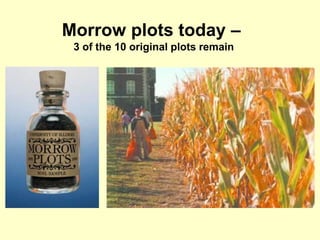
Morrow plots today –
 3 of the 10 original plots remain
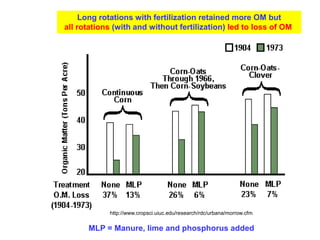
Impact of nutrients and rotation moreSOM
  Long rotations with fertilization retained on OM but
all rotations (with and without fertilization) led to loss of OM


            http://www.cropsci.uiuc.edu/research/rdc/urbana/morrow.cfm

      MLP = Manure, lime and phosphorus added
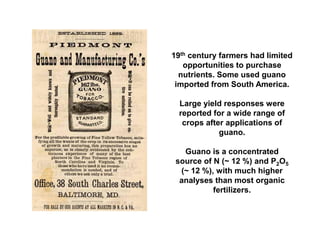
19th century farmers had limited
   opportunities to purchase
  nutrients. Some used guano
 imported from South America.

  Large yield responses were
  reported for a wide range of
   crops after applications of
             guano.

   Guano is a concentrated
 source of N (~ 12 %) and P2O5
  (~ 12 %), with much higher
  analyses than most organic
           fertilizers.
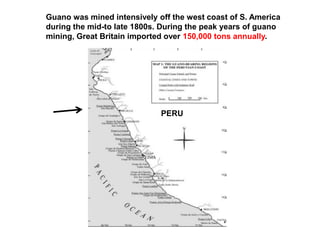
Guano was mined intensively off the west coast of S. America
during the mid-to late 1800s. During the peak years of guano
mining, Great Britain imported over 150,000 tons annually.


                             PERU
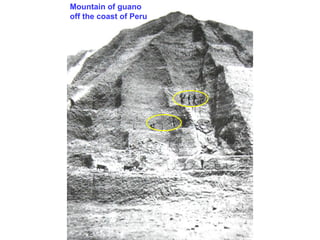
Mountain of guano
off the coast of Peru
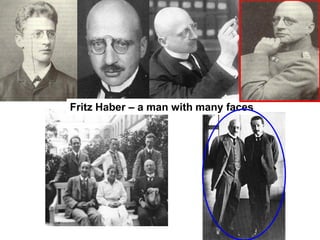
Fritz Haber – a man with many faces
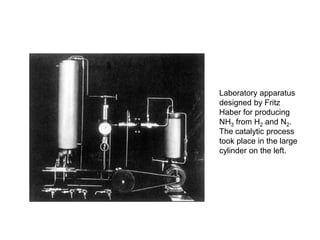
Laboratory apparatus
designed by Fritz
Haber for producing
NH3 from H2 and N2.
The catalytic process
took place in the large
cylinder on the left.
Founded in 1865, BASF is the world's largest chemical
company, ahead of Dow and DuPont, ~ 100,000 employees,
>80 billion in sales in 2007.

Karl Bosch worked for BASF and developed the technology
for upscaling Haber’s method of NH3 production.

Nitrates and ammonia made up 59 percent of BASF sales in
1919.
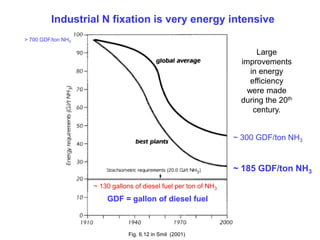
Industrial N fixation is very energy intensive
> 700 GDF/ton NH3

                                                                        Large
                                                                   improvements
                                                                      in energy
                                                                      efficiency
                                                                     were made
                                                                   during the 20th
                                                                       century.


                                                                  ~ 300 GDF/ton NH3


                                                                  ~ 185 GDF/ton NH3
                    ~ 130 gallons of diesel fuel per ton of NH3
                        GDF = gallon of diesel fuel


                                Fig. 6.12 in Smil (2001)
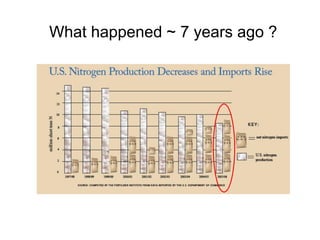
What happened ~ 7 years ago ?
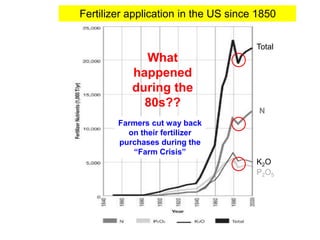
Fertilizer application in the US since 1850


                                      Total
             What
           happened
           during the
             80s??
                                       N
        Farmers cut way back
          on their fertilizer
        purchases during the
           “Farm Crisis”
                                      K2O
                                      P2O5
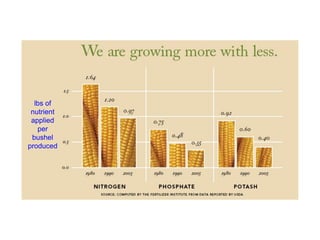
lbs of
 nutrient
 applied
   per
 bushel
produced
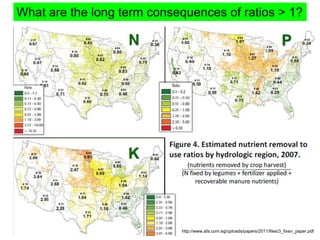
What are the long term consequences of ratios > 1?


                            http://www.afa.com.eg/uploads/papers/2011/files/3_fixen_paper.pdf
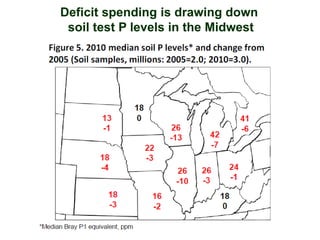
Deficit spending is drawing down
 soil test P levels in the Midwest
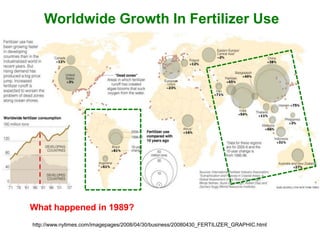
Worldwide Growth In Fertilizer Use


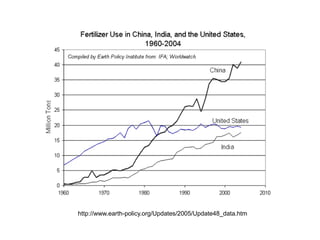
What happened in 1989?
http://www.nytimes.com/imagepages/2008/04/30/business/20080430_FERTILIZER_GRAPHIC.html
http://www.earth-policy.org/Updates/2005/Update48_data.htm
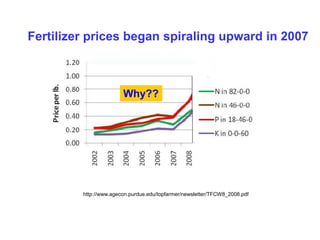
Fertilizer prices began spiraling upward in 2007


                        Why??


         http://www.agecon.purdue.edu/topfarmer/newsletter/TFCW8_2008.pdf
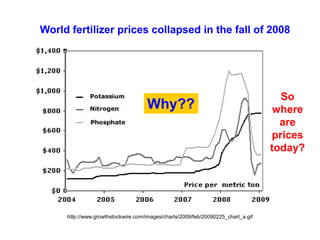
World fertilizer prices collapsed in the fall of 2008


                                                                                    So
                                    Why??                                          where
                                                                                    are
                                                                                  prices
                                                                                  today?


     http://www.growthstockwire.com/images/charts/2009/feb/20090225_chart_a.gif
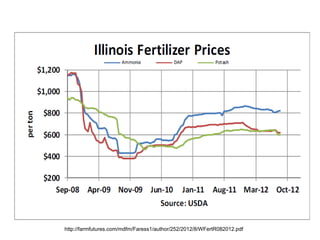
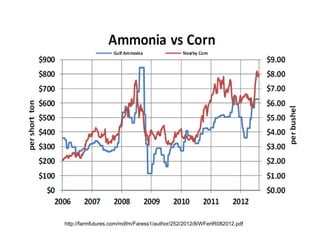
http://farmfutures.com/mdfm/Faress1/author/252/2012/8/WFertR082012.pdf

History soil fertility

  • 1.
    Welcome to SoilFertility and Plant Nutrition AGRN 378
  • 3.
    Did the ancient Egyptians know anything about soil fertility?
  • 4.
    Ancient Egyptian murals show lots of agricultural practices - tillage, planting, irrigation and harvesting but no fertilization
  • 5.
    4-5 million people during the New Kingdom Why did Greek historian Herodotus write Egypt is truly a gift of the Nile? http://www.artsci.wustl.edu/~anthro/courses/306/Nile%20Delta.jpg http://lexicorient.com/e.o/atlas/maps/nile.gif
  • 6.
  • 7.
    High Aswan Dam constructed beginning in 1960 6 TRILLION CFT 1.2 TRILLION CFT High Aswan Dam Hoover Dam
  • 8.
    Each year ~120 million tons of sediment accumulates behind the dam containing ~ 10,000 tons of biologically available P and N !
  • 9.
    Mediterranean fisheries collapsedafter the construction of the High Aswan Dam Shrimp harvest along Egyptian Coast So…why are the fisheries recovering? Nixon, 2003. Replacing the Nile: Are Anthropogenic Nutrients Providing the Fertility Once Brought to the Mediterranean by a Great River? Ambio. Volume 32, Issue 1 (February 2003)
  • 10.
    So…why are thefisheries recovering? Shrimp harvest along Egyptian Coast SEWAGE from Cairo Aquatic ecosystems in the Mediterranean are nutrient limited unlike the Gulf of Mexico Nixon, 2003. Replacing the Nile: Are Anthropogenic Nutrients Providing the Fertility Once Brought to the Mediterranean by a Great River? Ambio. Volume 32, Issue 1 (February 2003)
  • 11.
    Stercutius Romanart also reveals a lot about their agriculture. In addition to Saturn and Ceres (Roman god and goddess of Agriculture), the Romans had a god of manure named Stercutius who was worshiped by old women and children.
  • 12.
    A number ofRoman authors (e.g., Cato, Columella, Pliny the Elder) wrote detailed textbooks on agriculture that described the use of animal manures, green manures and crop rotations to improve soil productivity. These books were considered important sources of information about agriculture for over a thousand years.
  • 13.
    Blue lupines Pliny theElder (AD 23-79) classified animal manures with respect to their advantages and disadvantages of most animal manures and recommended the use of green manures. "It is universally agreed by all writers that there is nothing more beneficial than to turn up a crop of lupines, before they have podded, either with the plough or the fork, or else to cut them and bury them in heaps at the roots of trees and vines."
  • 14.
    The earliest recordsof soil improvement using green manures are from the Chou dynasty (~1000 BC) in China. Later (500 BC), Tsi gave the following advice: “Green manures are planted in the 5th or 6th month, and plowed under in the 7th or 8th month... Their fertilizing value is as good as silkworm excrement and well-rotted farm manure"
  • 15.
    China has hadmore than 50 million people for more than 2000 years and currently has more than 300 million farmers!
  • 16.
    “ We desiredto learn how it is possible, after twenty and perhaps thirty or even forty centuries, for their soils to be made to produce sufficiently for the maintenance of such dense populations.. “ FH King, 1911
  • 17.
  • 18.
    Chinampas Agriculture in Central America http://library.thinkquest.org/C006206F/images/images/pint5.jpg
  • 19.
  • 20.
    Building Chinampas http://kyapa.tripod.com/agengineering/drainage-lowland/veracruzbuildingchinampas.jpg
  • 21.
    Chinampas in theMomposina lowland region of Columbia http://kyapa.tripod.com/agengineering/drainage-lowland/camell-colombia.jpg
  • 22.
    In 1240, Romanagricultural literature was summarized by Crescentius. http://www.abbeville.com/Products/InteriorImages/0896599191Interiors.htm
  • 23.
    Bernard Palissy (1510-1589) Ceramicistand hydraulic engineer Far ahead of his time, Palissy wrote: ”Manure is carried to the field for the purpose of restoring to the latter a part of what had been removed... Proceeding thus you will restore to the soil the same substances that have been removed by previous crops and which following crops will regain to their advantage."
  • 24.
    What is the “principleof vegetation”? JB van Helmont (1577-1644) Dutch physician and Chemist
  • 25.
    What isdo Whatthe “principle of plants vegetation”? eat? JB van Helmont (1577-1644) Dutch physician and Chemist
  • 26.
    Van Helmont’s 169 lbs of plant pot experiment 5 lbs of plant only water was added 199 lbs, 200 lbs 14oz of soil of soil T=0 T= 5 yrs
  • 27.
    Van Helmont alsoperformed experiments that involved combusting charcoal and reported that 62 lbs of charcoal produced 1 lb of ash. He wrote that the other 61 lbs consisted of the "spirit of the wood," which he called "gas".
  • 28.
    Philosophical Transactions Volume21 (1699 !) John Woodward discovered that the growth of spearmint cuttings was positively related to the amount of dissolved solids in water
  • 29.
    How many ofyou have heard of the band “Jethro Tull”?
  • 30.
    Jethro Tull inventedthe grain drill and many complementary technologies that resulted in large increases in grain yields during the 18th century. Jethro Tull, 1731
  • 31.
    George Washington took greatpains to inform himself about any subject in which he was interested. He corresponded with Arthur Young, Britain’s leading agriculturalist in the post- Revolutionary period and ordered the latest British books about new agricultural practices. Among Washington’s papers are detailed notes taken as he studied Jethro Tull’s Horse Hoeing Husbandry.
  • 32.
    Tull’s theory of “All sorts of dung and compost contain some plant nutrition matter, which, when mixt with the soil, ferments therein; and by such ferment dissolves, crumbles, and divides the earth very much; This is the chief, and almost only use of dung... The value of dung is not to nourish, but to dissolve, i.e., divide the terrestrial matter, which affords nourishment to the mouths of vegetable roots.” Jethro Tull, 1731
  • 33.
    This article startswith a brief review of theories about plant nutrition and the importance of humus prior to the mid- 19th century. It then shows how the “Humus Theory” developed by Thaer allowed him to establish a quantitative system of evaluating cropping system sustainability.
  • 34.
    The humus theory Similar to animals, plants must feed upon organic substances that are similar to them in composition. Soil organic matter aka humus, is the chief nutrient for plants and the primary source of soil fertility. Roots absorb humus and transform it into plant substance, by combining it with water.
  • 35.
    In the early1800s, Swiss chemist and plant physiologist Nicolas-Théodore De Saussure rejected most of the principle of vegetation concepts of his predecessors and arrived at many ground breaking conclusions: 1) soil, not air, supplies plants with N 2) roots are active and selective absorbers of water and salts 3) plants only absorb CO2 and release O2 when exposed to sunlight 4) All plant tissues including seeds and roots consume O2 and give off CO2 but did not fully reject the humus theory
  • 36.
    Answers to thereading questions should be submitted using WO before the start of Friday’s class
  • 37.
    Reading questions 1) Thearticle includes an interesting quote from Jethro Tull: “The chief art of the husbandman is to feed the plants to best advantage; but, how shall he do that, unless he knows what is their food?” Identify the contrasting views about plant nutrition contained in the article. Be sure to mention the proponents of each view. 2) Discuss de Saussure’s relationship with his father. Has anyone in your life helped to spark or encourage your interest in the Agricultural Sciences? Explain. 3) De Saussure made many impressive discoveries about plant respiration and nutrition. Briefly discuss 3 discoveries that you think were particularly interesting. 4a) Calculate how much a typical corn seed weighs in grams (1 lb = 454 g). Hint: look up the weight of a bushel of corn and # of seeds in a bushel of corn. 4b) Estimate the total weight of a mature corn plant in grams. SHOW YOUR WORK!!!! Assume the following: corn population = 30,000 plants/ac, yield = 200 bu/ac, weight of grain = weight of stover = weight of roots 4c) Calculate how much the corn seed’s weight multiplied during a full season of growth.
  • 38.
    How is thispossible?? grain + cob + 1/100 of an oz stalk + leaves + roots _____ > 1 lb
  • 39.
    Rejection of thehumus theory “ The conclusion should have been reached long ago that humus is not such an important substance as we have been led to believe, and that the current doctrine of humus is exceedingly full of contradictions.” Carl Sprengel 1838
  • 40.
    Justus von Liebig was a pioneering German chemist who wrote and lectured extensively about the mineral nutrition of plants. As the first professor to use the laboratory method of teaching chemistry, he is regarded as one of the greatest chemistry educators of all time. He was held in such high esteem that few dared to question his pronouncements about mineral nutrition. Justus von Liebig (1803 -1873)
  • 41.
    Liebig did notactually introduce the Law of the Minimum but deserves credit for popularizing the concept Law of the Minimum Justus von Liebig (1803 -1873)
  • 42.
    Non-metal oxides (C, N, H and S) What is liberated and what is left behind when plant biomass is burned ? Liebig believed that the ash Liebig generated when recommended a crop is burned a “check book” contained the optimal blend of approach to nutrients for fertilization fertilizing the crop Metal oxides (K, Ca, Mg, P, Fe…)
  • 43.
    Some of Liebig’stheories were not supported by experimental evidence but few were willing to publicly question them. Liebig wrote: ‘Agricultural crops receive quite sufficient nitrogen from the atmosphere ...’ Sir John Lawes, a British contemporary of Liebig was bold enough to declare: ‘There can not be a more erroneous opinion than this.’
  • 44.
    Sir John Lawes Sir Henry Gilbert Rothamsted Experiment Station Lawes and Gilbert founded the first agricultural experiment station http://nolimits.nmw.ac.uk/IEN/rotham.jpg
  • 45.
    Broadbalk experiment • Started in 1843 • Continuous wheat for more than 160 years • The oldest agricultural field experiment in the world.
  • 46.
    From : TGardeners Chronic le he July 1, 1843 page 442 J.B. LA WE'S PA TENT MANURES, composed of Super Phosphate of Lime, Phosphate of Ammonia, Silicate of Potass, &c., are now for JB Lawes opened one of the first sale at his Factory, Deptford-creek, London, price 4s. 6d. per bushel.These substances can fertilizer factories in Europe and be had seperately; the Super Phosphatethey needed to convince farmers that of Lime alone is recommended for fixing the should use his fertilizers Ammonia of Dung-heaps, Cesspools, Gas Liquor, &c. Price 4s. 6d. per bushel
  • 47.
    Broadbalk demonstrated thevalue of N and P fertilizer and that manure was not necessary to produce high crop yields however the plots receiving both manure and fertilizer often produced the highest yields
  • 48.
    Broadbalk grain yields,selected treatments Introduction of: liming fungicides 10 fallowing herbicides 9 8 Why have the 1st wheat in rotation: Wheat grain yield (t/ha) 7 FYM+96 kg N Best NPK 6 yields been 5 leveling off? Continuous wheat: FYM PK+144 kg N 4 3 2 1 Unmanured, continuous wheat 0 1850 1875 1900 1925 1950 1975 2000
  • 49.
    The Broadbalk archive currently contains over 200,000 bottles of hay, grain and soil Why do they keep all these old samples ?
  • 50.
    The Broadbalk archive currently contains over 200,000 bottles of hay, grain and soil Why do they keep all these old samples ? Old samples provide answers to new questions !
  • 52.
    Morrow Plots - started in 1876 at the U of Illinois - oldest agronomic experiment in the US
  • 53.
    Cyril Hopkins (right),head of the U of Illinois Department of Agronomy, and James H.Pettit (left), assistant in Soil Analysis at the Ag Experiment Station, collect soil samples from the Morrow Plots
  • 54.
    “The farmer shouldbe as familiar with the names of the ten essential elements of plant food as he is with the names of his ten nearest neighbors” " ... it is not the land itself that constitutes the farmer's wealth, but it is in the constituents of the soil, which serve for the nutrition of plants, that this wealth truly consists."
  • 55.
    Soil Fertility andPermanent Agriculture – Cyril G. Hopkins, 1910 Rhizobia bacteria first “In recent years, Whitney and Cameron have revived the theory of toxic isolated in mid 1880s excreta from plant roots, in support of a more radical theory announced by them, to the effect that soils do not wear out or become depleted by cultivation or cropping. While this theory is advanced with no adequate foundation and in direct opposition to practical experience and to so many facts of mathematics, chemistry, and geology, that it is in itself quite unworthy of further consideration, the fact is that it has been promoted by Professor Whitney as Chief of the United States Bureau of Soils, and by Doctor Cameron as the chief chemist of the same Bureau; and, consequently, it cannot be ignored” Legumes can fix their own N *if* they have the appropriate bacteria
  • 56.
    Morrow plots today– 3 of the 10 original plots remain
  • 57.
    Impact of nutrientsand rotation moreSOM Long rotations with fertilization retained on OM but all rotations (with and without fertilization) led to loss of OM http://www.cropsci.uiuc.edu/research/rdc/urbana/morrow.cfm MLP = Manure, lime and phosphorus added
  • 58.
    19th century farmershad limited opportunities to purchase nutrients. Some used guano imported from South America. Large yield responses were reported for a wide range of crops after applications of guano. Guano is a concentrated source of N (~ 12 %) and P2O5 (~ 12 %), with much higher analyses than most organic fertilizers.
  • 59.
    Guano was minedintensively off the west coast of S. America during the mid-to late 1800s. During the peak years of guano mining, Great Britain imported over 150,000 tons annually. PERU
  • 60.
    Mountain of guano offthe coast of Peru
  • 62.
    Fritz Haber –a man with many faces
  • 63.
    Laboratory apparatus designed byFritz Haber for producing NH3 from H2 and N2. The catalytic process took place in the large cylinder on the left.
  • 64.
    Founded in 1865,BASF is the world's largest chemical company, ahead of Dow and DuPont, ~ 100,000 employees, >80 billion in sales in 2007. Karl Bosch worked for BASF and developed the technology for upscaling Haber’s method of NH3 production. Nitrates and ammonia made up 59 percent of BASF sales in 1919.
  • 65.
    Industrial N fixationis very energy intensive > 700 GDF/ton NH3 Large improvements in energy efficiency were made during the 20th century. ~ 300 GDF/ton NH3 ~ 185 GDF/ton NH3 ~ 130 gallons of diesel fuel per ton of NH3 GDF = gallon of diesel fuel Fig. 6.12 in Smil (2001)
  • 66.
    What happened ~7 years ago ?
  • 67.
    Fertilizer application inthe US since 1850 Total What happened during the 80s?? N Farmers cut way back on their fertilizer purchases during the “Farm Crisis” K2O P2O5
  • 68.
    lbs of nutrient applied per bushel produced
  • 69.
    What are thelong term consequences of ratios > 1? http://www.afa.com.eg/uploads/papers/2011/files/3_fixen_paper.pdf
  • 70.
    Deficit spending isdrawing down soil test P levels in the Midwest
  • 71.
    Worldwide Growth InFertilizer Use What happened in 1989? http://www.nytimes.com/imagepages/2008/04/30/business/20080430_FERTILIZER_GRAPHIC.html
  • 72.
  • 76.
    Fertilizer prices beganspiraling upward in 2007 Why?? http://www.agecon.purdue.edu/topfarmer/newsletter/TFCW8_2008.pdf
  • 77.
    World fertilizer pricescollapsed in the fall of 2008 So Why?? where are prices today? http://www.growthstockwire.com/images/charts/2009/feb/20090225_chart_a.gif
  • 78.
  • 79.