Testing
Outline
 Terminology
 Types of errors
 Dealing with errors
 Quality assurance vs Testing
 Component Testing
 Unit testing
 Integration testing

 Testing Strategy
 Design Patterns & Testing

2

AMBIKA J Asst.Professor Kings College Of Engineering

 System testing
 Function testing
 Structure Testing
 Performance testing
 Acceptance testing
 Installation testing
Some Observations
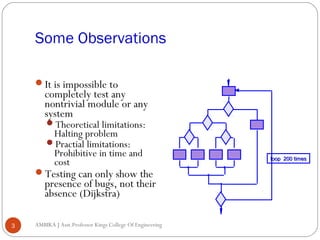
It is impossible to

completely test any
nontrivial module or any
system
Theoretical limitations:

Halting problem
Practial limitations:
Prohibitive in time and
cost

Testing can only show the

presence of bugs, not their
absence (Dijkstra)

3

AMBIKA J Asst.Professor Kings College Of Engineering

loop 200 times
Testing Activities
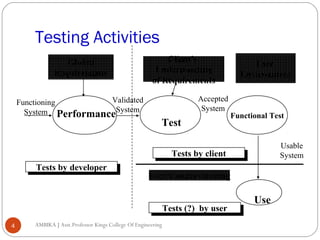
Global
Requirements
Validated
Functioning
System PerformanceSystem

Client’s
Understanding
of Requirements

User
Environment

Accepted
System

Test

Functional Test

Usable
System

Tests by client
Tests by client
Tests by developer
Tests by developer

User’s understanding

Tests (?) by user
Tests (?) by user
4

AMBIKA J Asst.Professor Kings College Of Engineering

Use
Level of abstraction

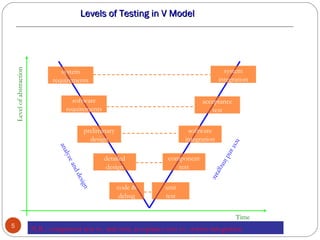
Levels of Testing in V Model

system
integration

system
requirements
software
requirements

acceptance
test
software
integration

an

nd
ea
lyz
ana

tes
t

preliminary
design

component
test

te

ig
des

di
n
teg
ra

detailed
design
n

code &
debug

unit
test
Time

5

AMBIKA J Asst.Professor Kings College Of Engineering

N.B.: component test vs. unit test; acceptance test vs. system integration
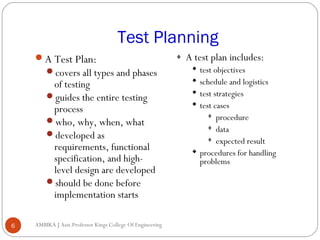
Test Planning
A Test Plan:
covers all types and phases

of testing
guides the entire testing
process
who, why, when, what
developed as
requirements, functional
specification, and highlevel design are developed
should be done before
implementation starts
6

AMBIKA J Asst.Professor Kings College Of Engineering

♦

A test plan includes:
 test objectives
 schedule and logistics
 test strategies
 test cases
 procedure
 data
 expected result
 procedures for handling
problems
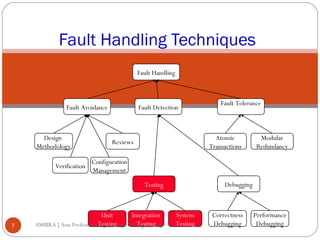
Fault Handling Techniques
Fault Handling

Fault Avoidance

Design
Methodology
Verification

Fault Detection

Atomic
Transactions

Reviews

Modular
Redundancy

Configuration
Management
Debugging

Testing

7

Fault Tolerance

Integration
Unit
Testing
Testing
AMBIKA J Asst.Professor Kings College Of Engineering

System
Testing

Correctness
Debugging

Performance
Debugging
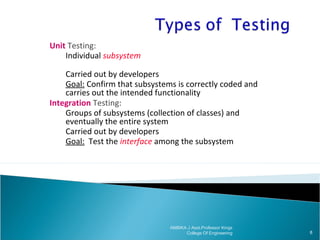
Unit Testing:
Individual subsystem
Carried out by developers
Goal: Confirm that subsystems is correctly coded and
carries out the intended functionality
Integration Testing:
Groups of subsystems (collection of classes) and
eventually the entire system
Carried out by developers
Goal: Test the interface among the subsystem

AMBIKA J Asst.Professor Kings
College Of Engineering

8
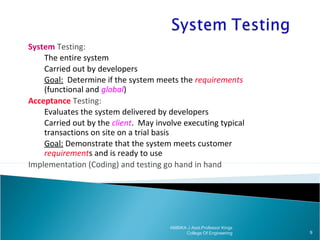
System Testing:
The entire system
Carried out by developers
Goal: Determine if the system meets the requirements
(functional and global)
Acceptance Testing:
Evaluates the system delivered by developers
Carried out by the client. May involve executing typical
transactions on site on a trial basis
Goal: Demonstrate that the system meets customer
requirements and is ready to use
Implementation (Coding) and testing go hand in hand

AMBIKA J Asst.Professor Kings
College Of Engineering

9
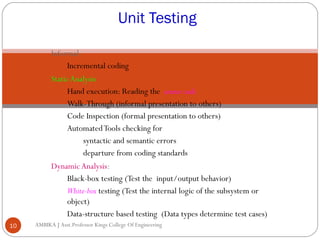
Unit Testing
Informal:
Incremental coding
Static Analysis:
Hand execution: Reading the source code
Walk-Through (informal presentation to others)
Code Inspection (formal presentation to others)
Automated Tools checking for
syntactic and semantic errors
departure from coding standards
Dynamic Analysis:
Black-box testing (Test the input/output behavior)
White-box testing (Test the internal logic of the subsystem or
object)
Data-structure based testing (Data types determine test cases)
10

AMBIKA J Asst.Professor Kings College Of Engineering
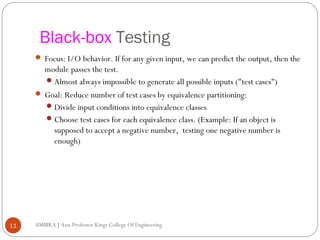
Black-box Testing
 Focus: I/O behavior. If for any given input, we can predict the output, then the

module passes the test.
 Almost always impossible to generate all possible inputs ("test cases")
 Goal: Reduce number of test cases by equivalence partitioning:
 Divide input conditions into equivalence classes
 Choose test cases for each equivalence class. (Example: If an object is
supposed to accept a negative number, testing one negative number is
enough)

11

AMBIKA J Asst.Professor Kings College Of Engineering
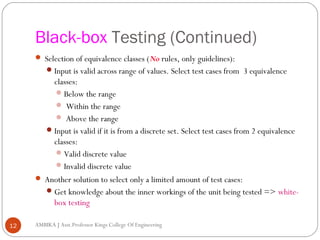
Black-box Testing (Continued)
 Selection of equivalence classes (No rules, only guidelines):
 Input is valid across range of values. Select test cases from 3 equivalence

classes:
 Below the range
 Within the range
 Above the range
 Input is valid if it is from a discrete set. Select test cases from 2 equivalence
classes:
 Valid discrete value
 Invalid discrete value
 Another solution to select only a limited amount of test cases:
 Get knowledge about the inner workings of the unit being tested => whitebox testing
12

AMBIKA J Asst.Professor Kings College Of Engineering
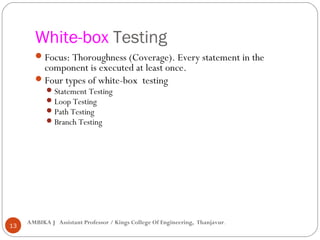
White-box Testing
 Focus: Thoroughness (Coverage). Every statement in the

component is executed at least once.
 Four types of white-box testing
 Statement Testing
 Loop Testing
 Path Testing
 Branch Testing

13

AMBIKA J Assistant Professor / Kings College Of Engineering, Thanjavur.
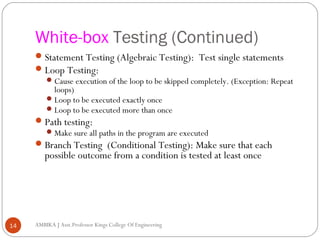
White-box Testing (Continued)
 Statement Testing (Algebraic Testing): Test single statements
 Loop Testing:
 Cause execution of the loop to be skipped completely. (Exception: Repeat
loops)
 Loop to be executed exactly once
 Loop to be executed more than once
 Path testing:
 Make sure all paths in the program are executed
 Branch Testing (Conditional Testing): Make sure that each

possible outcome from a condition is tested at least once

14

AMBIKA J Asst.Professor Kings College Of Engineering
White-Box Testing

Loop Testing
[Pressman]

Simple
loop
Nested
Loops
Concatenated
Loops
15

AMBIKA J Asst.Professor Kings College Of Engineering
Why is loop testing important?

Unstructured
Loops
THANK U

16

AMBIKA J Asst.Professor Kings College Of Engineering

Software testing- an introduction

  • 1.
  • 2.
    Outline  Terminology  Typesof errors  Dealing with errors  Quality assurance vs Testing  Component Testing  Unit testing  Integration testing  Testing Strategy  Design Patterns & Testing 2 AMBIKA J Asst.Professor Kings College Of Engineering  System testing  Function testing  Structure Testing  Performance testing  Acceptance testing  Installation testing
  • 3.
    Some Observations It isimpossible to completely test any nontrivial module or any system Theoretical limitations: Halting problem Practial limitations: Prohibitive in time and cost Testing can only show the presence of bugs, not their absence (Dijkstra) 3 AMBIKA J Asst.Professor Kings College Of Engineering loop 200 times
  • 4.
    Testing Activities Global Requirements Validated Functioning System PerformanceSystem Client’s Understanding ofRequirements User Environment Accepted System Test Functional Test Usable System Tests by client Tests by client Tests by developer Tests by developer User’s understanding Tests (?) by user Tests (?) by user 4 AMBIKA J Asst.Professor Kings College Of Engineering Use
  • 5.
    Level of abstraction Levelsof Testing in V Model system integration system requirements software requirements acceptance test software integration an nd ea lyz ana tes t preliminary design component test te ig des di n teg ra detailed design n code & debug unit test Time 5 AMBIKA J Asst.Professor Kings College Of Engineering N.B.: component test vs. unit test; acceptance test vs. system integration
  • 6.
    Test Planning A TestPlan: covers all types and phases of testing guides the entire testing process who, why, when, what developed as requirements, functional specification, and highlevel design are developed should be done before implementation starts 6 AMBIKA J Asst.Professor Kings College Of Engineering ♦ A test plan includes:  test objectives  schedule and logistics  test strategies  test cases  procedure  data  expected result  procedures for handling problems
  • 7.
    Fault Handling Techniques FaultHandling Fault Avoidance Design Methodology Verification Fault Detection Atomic Transactions Reviews Modular Redundancy Configuration Management Debugging Testing 7 Fault Tolerance Integration Unit Testing Testing AMBIKA J Asst.Professor Kings College Of Engineering System Testing Correctness Debugging Performance Debugging
  • 8.
    Unit Testing: Individual subsystem Carriedout by developers Goal: Confirm that subsystems is correctly coded and carries out the intended functionality Integration Testing: Groups of subsystems (collection of classes) and eventually the entire system Carried out by developers Goal: Test the interface among the subsystem AMBIKA J Asst.Professor Kings College Of Engineering 8
  • 9.
    System Testing: The entiresystem Carried out by developers Goal: Determine if the system meets the requirements (functional and global) Acceptance Testing: Evaluates the system delivered by developers Carried out by the client. May involve executing typical transactions on site on a trial basis Goal: Demonstrate that the system meets customer requirements and is ready to use Implementation (Coding) and testing go hand in hand AMBIKA J Asst.Professor Kings College Of Engineering 9
  • 10.
    Unit Testing Informal: Incremental coding StaticAnalysis: Hand execution: Reading the source code Walk-Through (informal presentation to others) Code Inspection (formal presentation to others) Automated Tools checking for syntactic and semantic errors departure from coding standards Dynamic Analysis: Black-box testing (Test the input/output behavior) White-box testing (Test the internal logic of the subsystem or object) Data-structure based testing (Data types determine test cases) 10 AMBIKA J Asst.Professor Kings College Of Engineering
  • 11.
    Black-box Testing  Focus:I/O behavior. If for any given input, we can predict the output, then the module passes the test.  Almost always impossible to generate all possible inputs ("test cases")  Goal: Reduce number of test cases by equivalence partitioning:  Divide input conditions into equivalence classes  Choose test cases for each equivalence class. (Example: If an object is supposed to accept a negative number, testing one negative number is enough) 11 AMBIKA J Asst.Professor Kings College Of Engineering
  • 12.
    Black-box Testing (Continued) Selection of equivalence classes (No rules, only guidelines):  Input is valid across range of values. Select test cases from 3 equivalence classes:  Below the range  Within the range  Above the range  Input is valid if it is from a discrete set. Select test cases from 2 equivalence classes:  Valid discrete value  Invalid discrete value  Another solution to select only a limited amount of test cases:  Get knowledge about the inner workings of the unit being tested => whitebox testing 12 AMBIKA J Asst.Professor Kings College Of Engineering
  • 13.
    White-box Testing  Focus:Thoroughness (Coverage). Every statement in the component is executed at least once.  Four types of white-box testing  Statement Testing  Loop Testing  Path Testing  Branch Testing 13 AMBIKA J Assistant Professor / Kings College Of Engineering, Thanjavur.
  • 14.
    White-box Testing (Continued) Statement Testing (Algebraic Testing): Test single statements  Loop Testing:  Cause execution of the loop to be skipped completely. (Exception: Repeat loops)  Loop to be executed exactly once  Loop to be executed more than once  Path testing:  Make sure all paths in the program are executed  Branch Testing (Conditional Testing): Make sure that each possible outcome from a condition is tested at least once 14 AMBIKA J Asst.Professor Kings College Of Engineering
  • 15.
    White-Box Testing Loop Testing [Pressman] Simple loop Nested Loops Concatenated Loops 15 AMBIKAJ Asst.Professor Kings College Of Engineering Why is loop testing important? Unstructured Loops
  • 16.
    THANK U 16 AMBIKA JAsst.Professor Kings College Of Engineering