Introduction to
Software Testing
[Reading assignment: Chapter 1, pp. 9-22]
What is a computer bug?
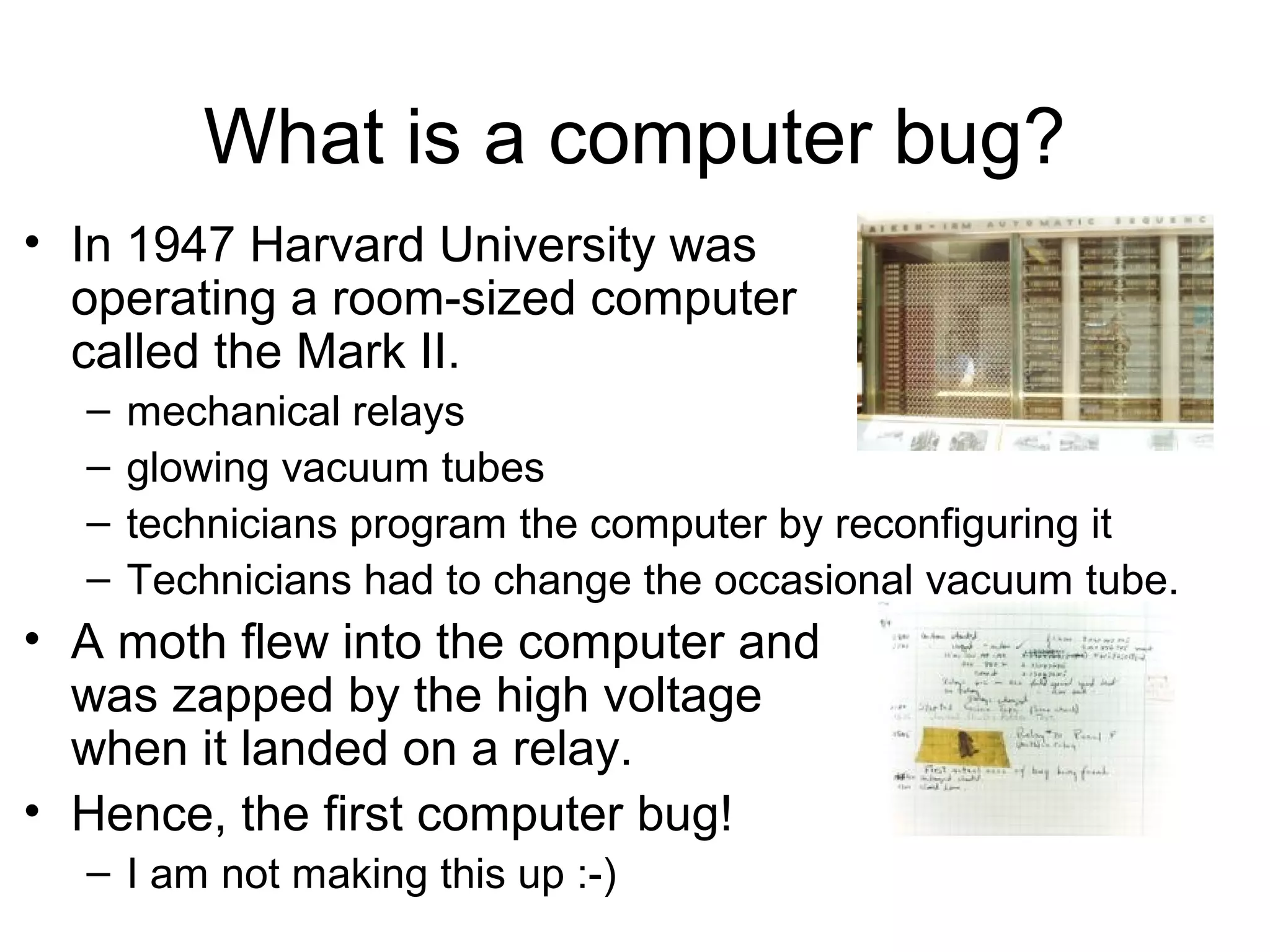
• In 1947 Harvard University was
operating a room-sized computer
called the Mark II.
– mechanical relays
– glowing vacuum tubes
– technicians program the computer by reconfiguring it
– Technicians had to change the occasional vacuum tube.
• A moth flew into the computer and
was zapped by the high voltage
when it landed on a relay.
• Hence, the first computer bug!
– I am not making this up :-)
Bugs a.k.a. …
• Defect
• Fault
• Problem
• Error
• Incident
• Anomaly
• Variance
• Failure
• Inconsistency
• Product
Anomaly
• Product
Incidence
• Feature :-)
Defective Software
• We develop programs that contain
defects
– How many? What kind?
• Hard to predict the future, however…
it is highly likely, that the software we
(including you!) will develop in the
future will not be significantly better.
Sources of Problems
• Requirements Definition: Erroneous, incomplete,
inconsistent requirements.
• Design: Fundamental design flaws in the software.
• Implementation: Mistakes in chip fabrication, wiring,
programming faults, malicious code.
• Support Systems: Poor programming languages,
faulty compilers and debuggers, misleading
development tools.
Sources of Problems (Cont’d)
• Inadequate Testing of Software:
Incomplete testing, poor verification,
mistakes in debugging.
• Evolution: Sloppy redevelopment or
maintenance, introduction of new flaws
in attempts to fix old flaws, incremental
escalation to inordinate complexity.
Adverse Effects of
Faulty Software
• Communications: Loss or corruption
of communication media, non delivery
of data.
• Space Applications: Lost lives, launch
delays.
• Defense and Warfare: Misidentification
of friend or foe.
Adverse Effects of Faulty
Software (Cont’d)
• Transportation: Deaths, delays,
sudden acceleration, inability to brake.
• Safety-critical Applications: Death,
injuries.
• Electric Power: Death, injuries, power
outages, long-term health hazards
(radiation).
Adverse Effects of Faulty
Software (Cont’d)
• Money Management: Fraud, violation of
privacy, shutdown of stock exchanges and
banks, negative interest rates.
• Control of Elections: Wrong results
(intentional or non-intentional).
• Control of Jails: Technology-aided escape
attempts and successes, accidental release
of inmates, failures in software controlled
locks.
• Law Enforcement: False arrests and
imprisonments.
Bug in Space Code
• Project Mercury’s FORTRAN code had the
following fault:
DO I=1.10 instead of ... DO I=1,10
• The fault was discovered in an analysis of
why the software did not seem to generate
results that were sufficiently accurate.
• The erroneous 1.10 would cause the loop to
be executed exactly once!
Military Aviation Problems
• An F-18 crashed because of a missing
exception condition:
if ... then ... without the else clause
that was thought could not possibly
arise.
• In simulation, an F-16 program bug
caused the virtual plane to flip over
whenever it crossed the equator, as a
result of a missing minus sign to
indicate south latitude.
Year Ambiguities
• In 1992, Mary Bandar received an
invitation to attend a kindergarten in
Winona, Minnesota, along with others
born in '88.
• Mary was 104 years old at the time.
Year Ambiguities (Cont’d)
• Mr. Blodgett’s auto insurance rate
tripled when he turned 101.
• He was the computer program’s first
driver over 100, and his age was
interpreted as 1.
• This is a double blunder because the
program’s definition of a teenager is
someone under 20!
Dates, Times, and Integers
• The number 32,768 = has caused
all sorts of grief from the overflowing of
16-bit words.
• A Washington D.C. hospital computer
system collapsed on September 19,
1989, days after January 1, 1900,
forcing a lengthy period of manual
operation.
15
2
15
2
Dates, Times, and Integers
(Cont’d)
• COBOL uses a two-character date field
…
• The Linux term program, which allows
simultaneous multiple sessions over a
single modem dialup connection, died
word wide on October 26, 1993.
• The cause was the overflow of an int
variable that should have been defined
as an unsigned int.
Shaky Math
• In the US, five nuclear power plants
were shut down in 1979 because of a
program fault in a simulation program
used to design nuclear reactor to
withstand earthquakes.
• This program fault was, unfortunately,
discovered after the power plants were
built!
Shaky Math (Cont’d)
• Apparently, the arithmetic sum of a set
of numbers was taken, instead of the
sum of the absolute values.
• The five reactors would probably not
have survived an earthquake that was
as strong as the strongest earthquake
ever recorded in the area.
Therac-25 Radiation
“Therapy”
• In Texas, 1986, a man received between
16,500-25,000 rads in less than 1 sec, over
an area of about 1 cm.
• He lost his left arm, and died of complications
5 months later.
• In Texas, 1986, a man received at least 4,000
rads in the right temporal lobe of his brain.
• The patient eventually died as a result of the
overdose.
Therac-25 Radiation
“Therapy” (Cont’d)
• In Washington, 1987, a patient received
8,000-10,000 rads instead of the
prescribed 86 rads.
• The patient died of complications of the
radiation overdose.
AT&T Bug: Hello? ... Hello?
• In mid-December 1989, AT&T installed
new software in 114 electronic
switching systems.
• On January 15, 1990, 5 million calls
were blocked during a 9 hour period
nationwide.
AT&T Bug (Cont’d)
• The bug was traced to a C program that
contained a break statement within an
switch clause nested within a loop.
• The switch clause was part of a loop.
Initially, the loop contained only if
clauses with break statements to exit
the loop.
• When the control logic became
complicated, a switch clause was
added to improve the readability of the
code ...
Bank Generosity
• A Norwegian bank ATM consistently
dispersed 10 times the amount
required.
• Many people joyously joined the
queues as the word spread.
Bank Generosity (Cont’d)
• A software flaw caused a UK bank to
duplicate every transfer payment
request for half an hour. The bank lost
2 billion British pounds!
• The bank eventually recovered the
funds but lost half a million pounds in
potential interest.
Making Rupee!
• An Australian man purchased $104,500
worth of Sri Lankan Rupees.
• The next day he sold the Rupees to
another bank for $440,258.
• The first bank’s software had displayed
a bogus exchange rate in the Rupee
position!
• A judge ruled that the man had acted
without intended fraud and could keep
the extra $335,758!
Bug in BoNY Software
• The Bank of New York (BoNY) had a
$32 billion overdraft as the result of a
16-bit integer counter that went
unchecked.
• BoNY was unable to process the
incoming credits from security transfers,
while the NY Federal Reserve
automatically debited BoNY’s cash
account.
Bug in BoNY Software
(Cont’d)
• BoNY had to borrow $24 billion to cover
itself for 1 day until the software was
fixed.
• The bug cost BoNY $5 million in interest
payments.
Discussion …
• Have you heard of other software
bugs?
– In the media?
– From personal experience?
• Does this embarrass you as a future
software engineer?
Specification
“if you can’t say it, you can’t do it”
• You have to know what your product is before
you can say if it has a bug.
• A specification defines the product being
created and includes:
– Functional requirements that describes the
features the product will support. E.g., on a word
processor
• Save, print, check spelling, change font, …
– Non-functional requirements are constraints on
the product. E.g,
• Security, reliability, user friendliness, platform, …
A software bug occurs when at
least one of these rules is true
• The software does not do something that the
specification says it should do.
• The software does something that the
specification says it should not do.
• The software does something that the
specification does not mention.
• The software does not do something that the
product specification does not mention but
should.
• The software is difficult to understand, hard to
use, slow …
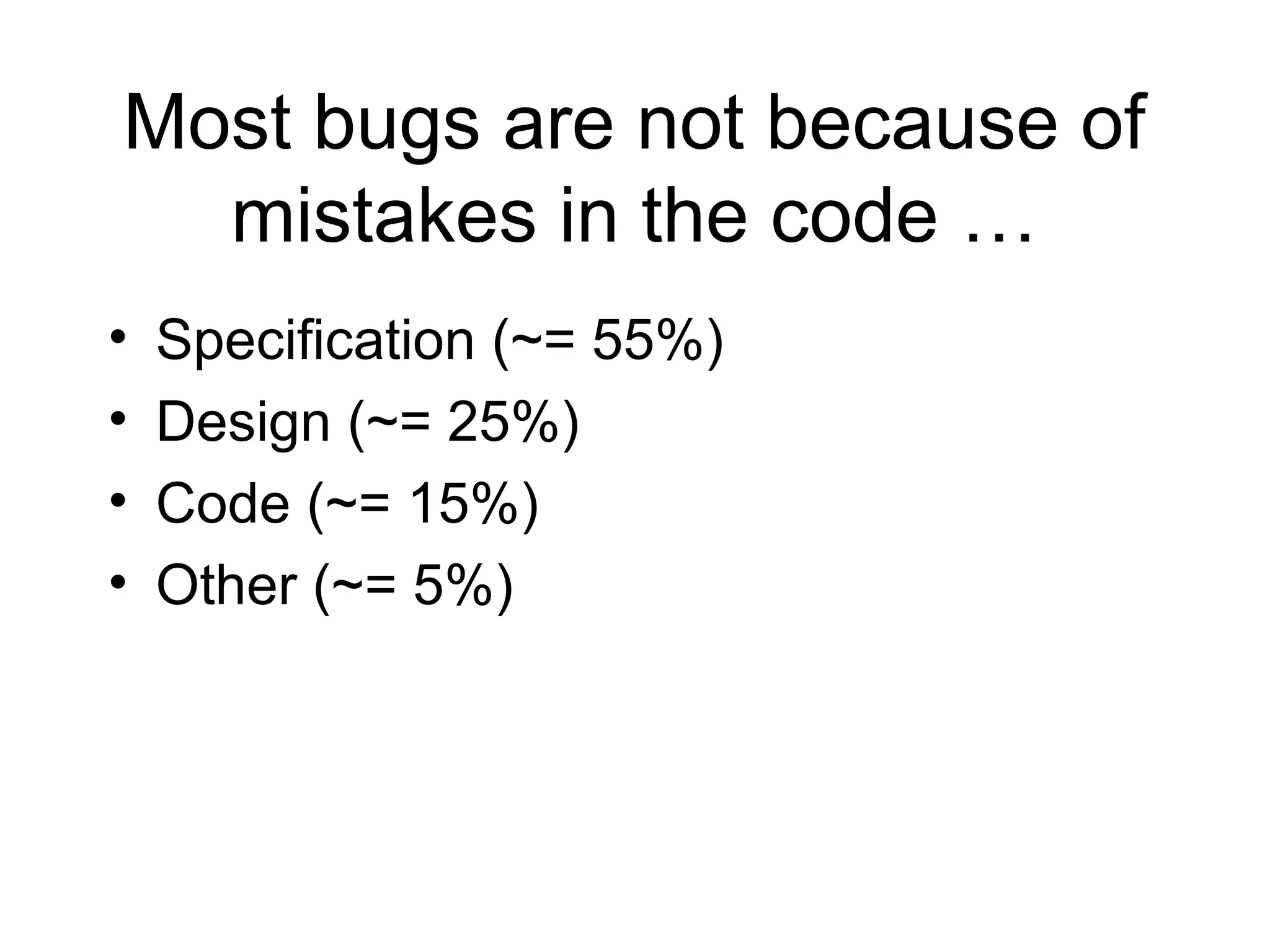
Most bugs are not because of
mistakes in the code …
• Specification (~= 55%)
• Design (~= 25%)
• Code (~= 15%)
• Other (~= 5%)
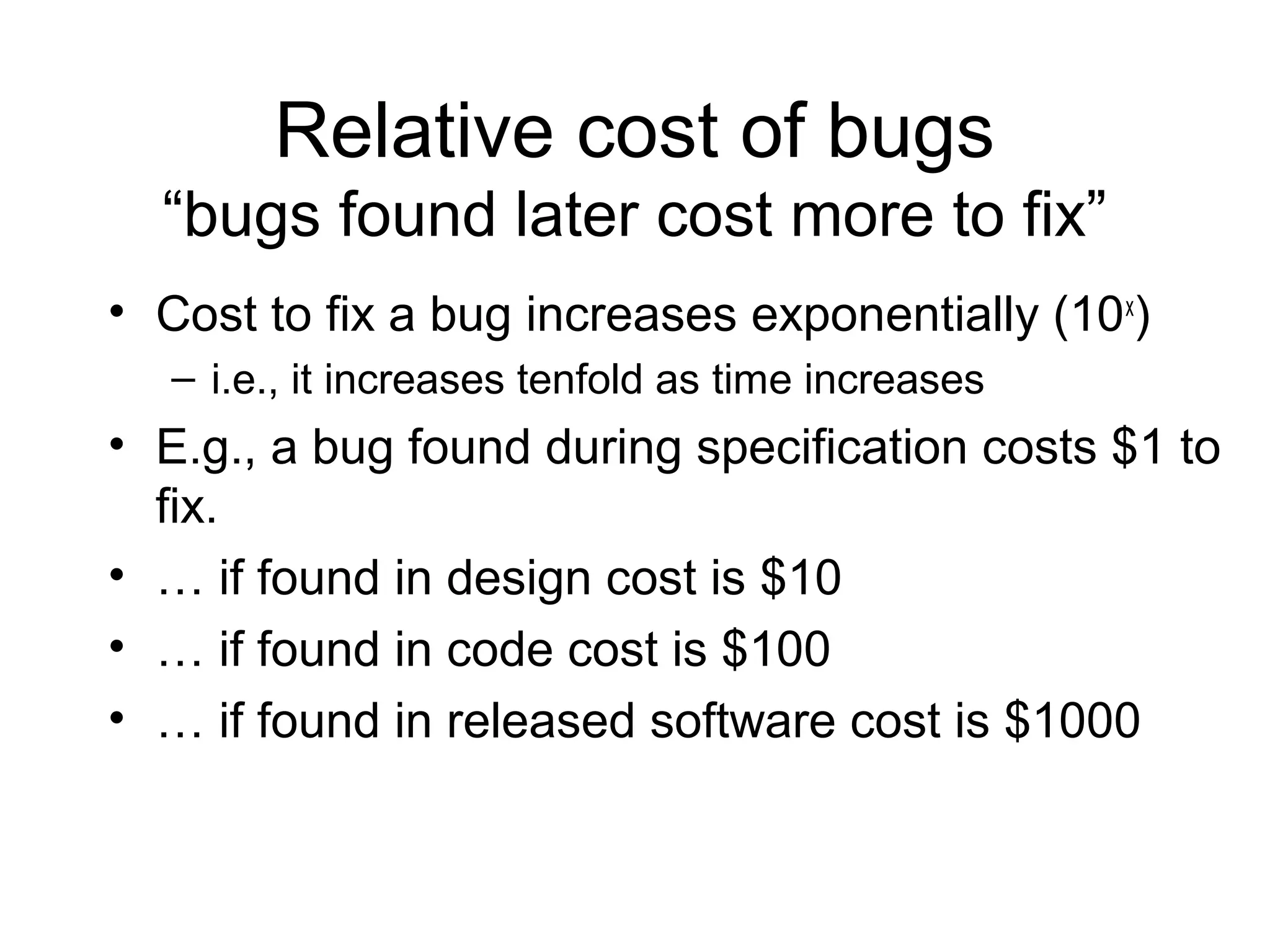
Relative cost of bugs
“bugs found later cost more to fix”
• Cost to fix a bug increases exponentially (10x
)
– i.e., it increases tenfold as time increases
• E.g., a bug found during specification costs $1 to
fix.
• … if found in design cost is $10
• … if found in code cost is $100
• … if found in released software cost is $1000
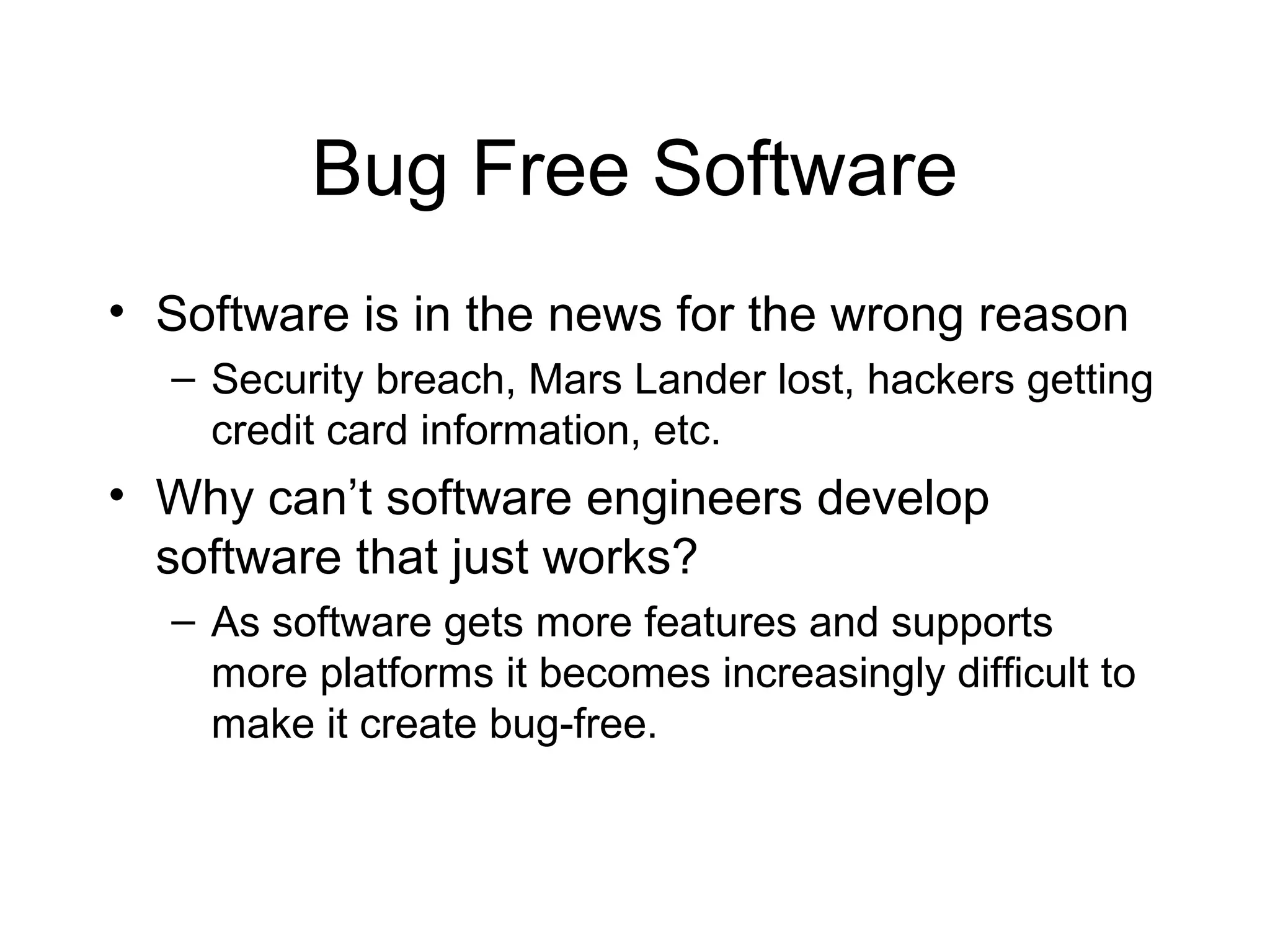
Bug Free Software
• Software is in the news for the wrong reason
– Security breach, Mars Lander lost, hackers getting
credit card information, etc.
• Why can’t software engineers develop
software that just works?
– As software gets more features and supports
more platforms it becomes increasingly difficult to
make it create bug-free.
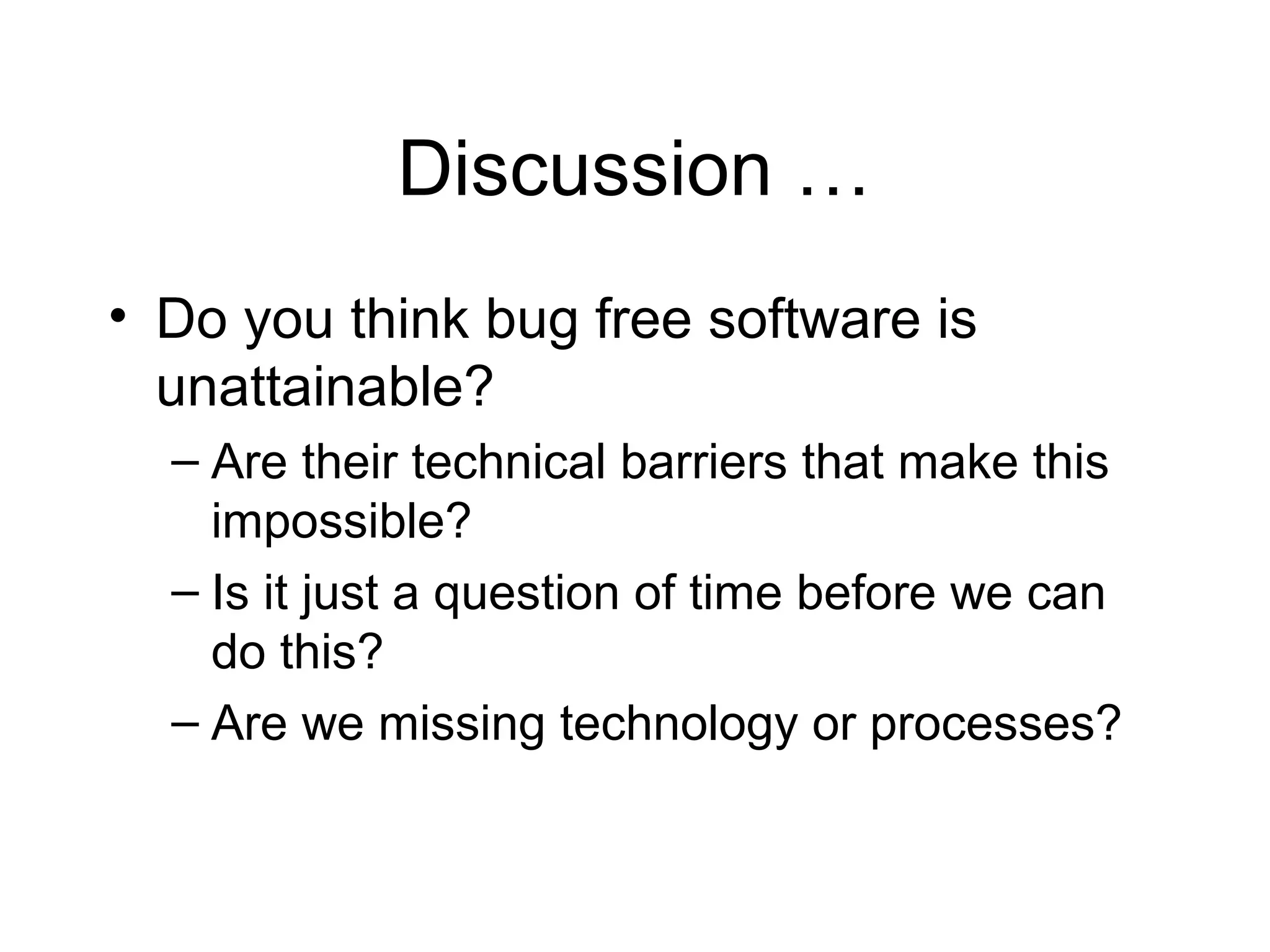
Discussion …
• Do you think bug free software is
unattainable?
– Are their technical barriers that make this
impossible?
– Is it just a question of time before we can
do this?
– Are we missing technology or processes?
Goal of a software tester
• … to find bugs
• … as early in the software development
processes as possible
• … and make sure they get fixed.
• Advice: Be careful not to get get
caught in the dangerous spiral of
unattainable perfection.
What to look for when interviewing
someone for the position of software tester
• Are they explorers?
• Are they troubleshooters?
• Are they relentless?
• Are they creative?
• Are they perfectionists (within reason)?
• Do they exercise good judgment?
• Are they tactful and diplomatic?
• Are they persuasive?
You now know …
• … what is a bug
• … the relationship between specification and
bugs
• … the cost of a bug relative to when it is
found
• … the unattainable goal of perfect software
• … the goal of the software tester
• … valuable attributes of a software tester
The Software
Development Process
[Reading assignment: Chapter 2, pp. 23-36]
Software is …
• requirements specification documents
• design documents
• source code
• test suites and test plans
• interfaces to hardware and software operating
environment
• internal and external documentation
• executable programs and their persistent
data
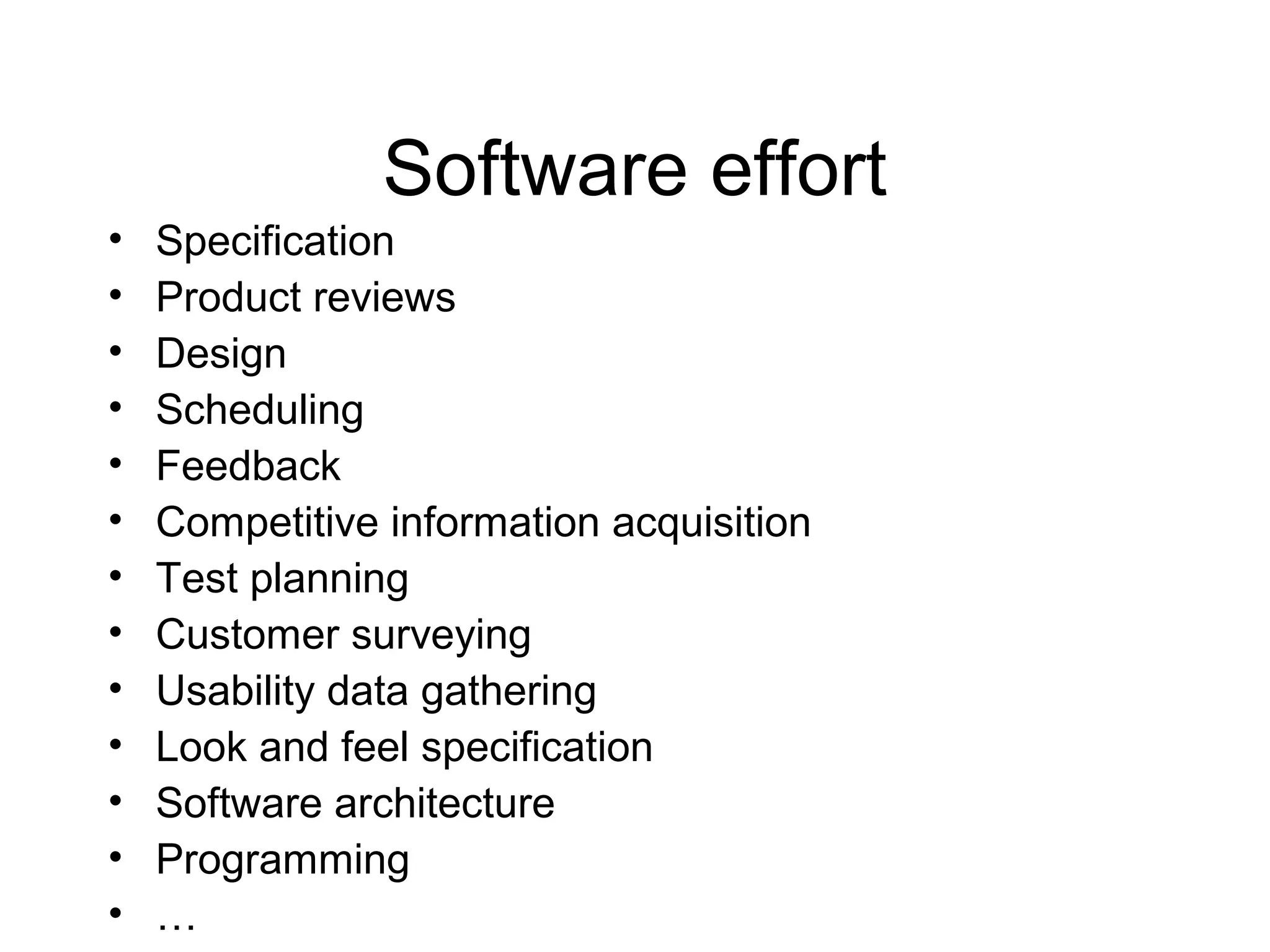
Software effort
• Specification
• Product reviews
• Design
• Scheduling
• Feedback
• Competitive information acquisition
• Test planning
• Customer surveying
• Usability data gathering
• Look and feel specification
• Software architecture
• Programming
• …
Discussion …
• What is software engineering?
• Where does testing occur in the
software development process?
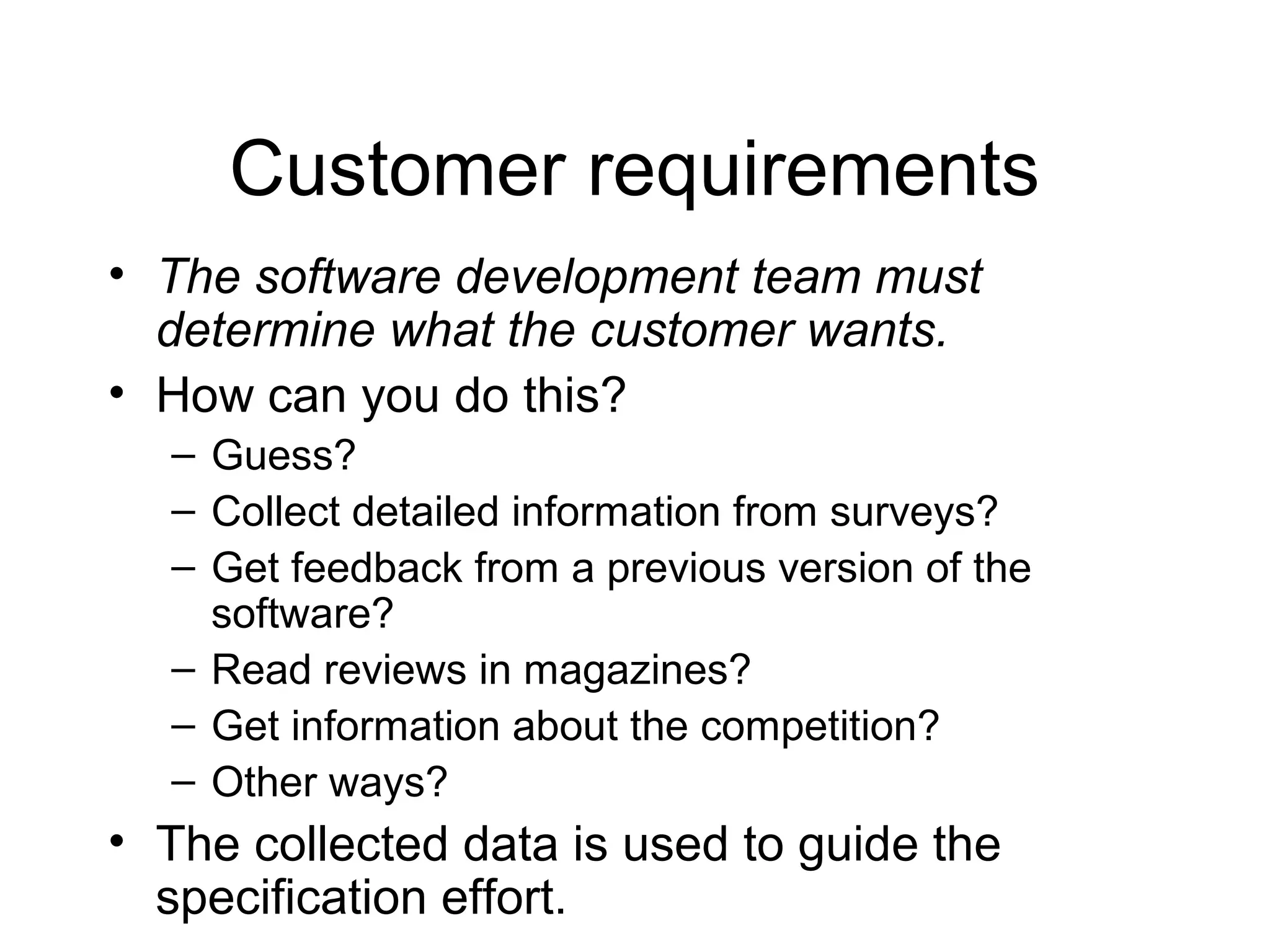
Customer requirements
• The software development team must
determine what the customer wants.
• How can you do this?
– Guess?
– Collect detailed information from surveys?
– Get feedback from a previous version of the
software?
– Read reviews in magazines?
– Get information about the competition?
– Other ways?
• The collected data is used to guide the
specification effort.
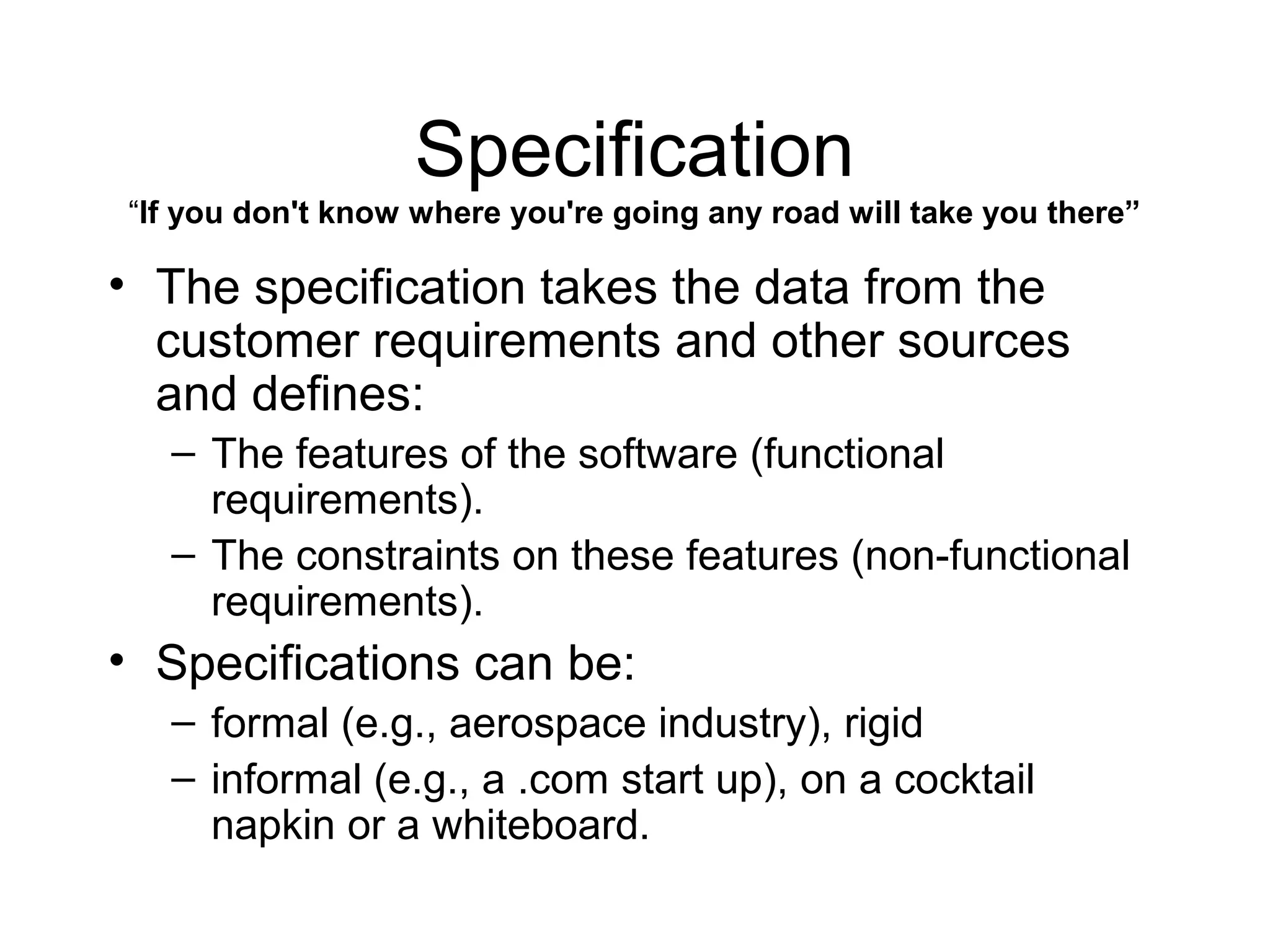
Specification
“If you don't know where you're going any road will take you there”
• The specification takes the data from the
customer requirements and other sources
and defines:
– The features of the software (functional
requirements).
– The constraints on these features (non-functional
requirements).
• Specifications can be:
– formal (e.g., aerospace industry), rigid
– informal (e.g., a .com start up), on a cocktail
napkin or a whiteboard.
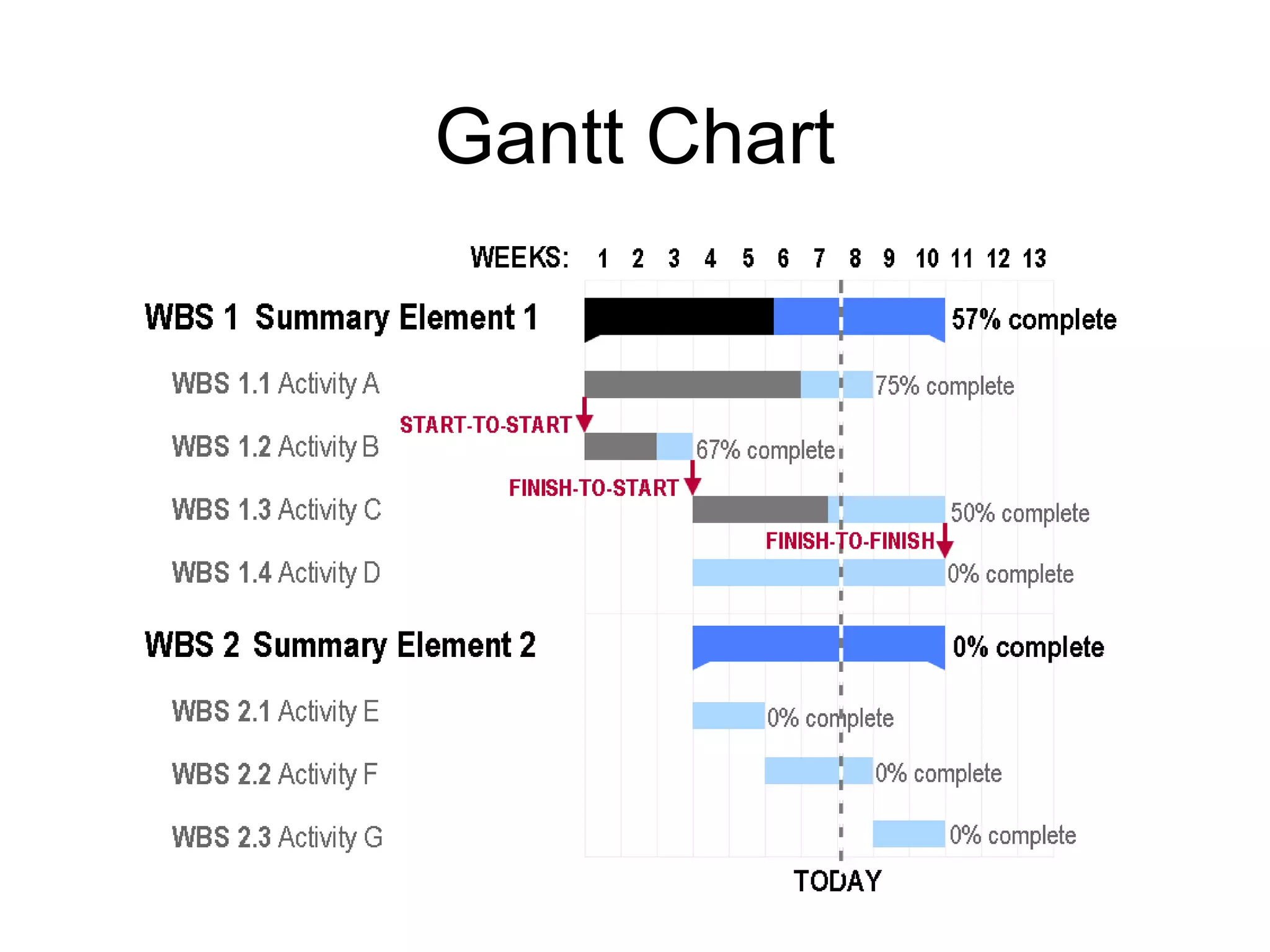
Schedules
• The goals of scheduling are to know:
– What work needs to be completed?
– How much work is left to do?
– When will the work be finished?
– Who will finish each task?
– Other measurable queries.
• A Gantt chart is a popular type of bar chart
that illustrates a project schedule.
Gantt Chart
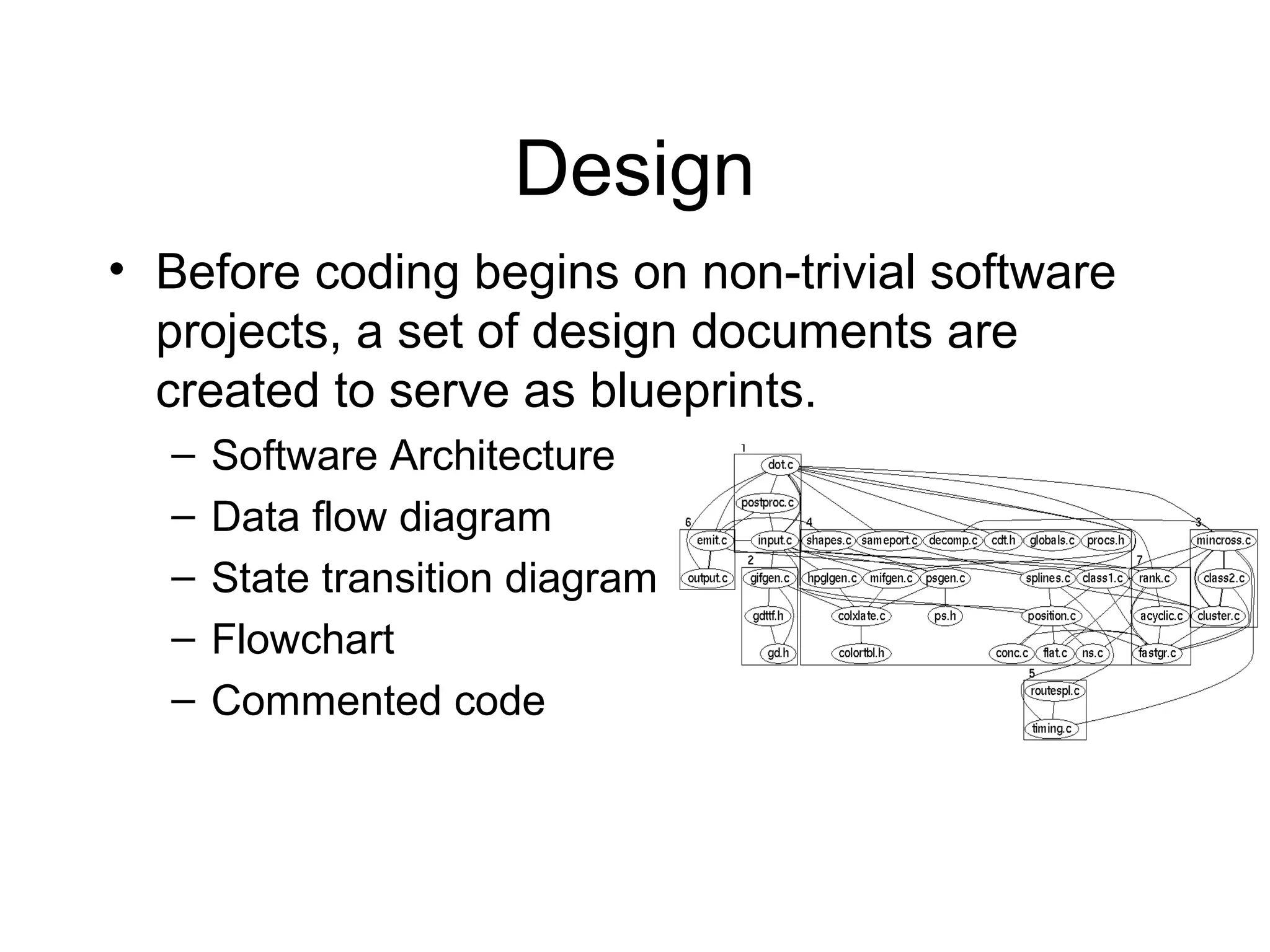
Design
• Before coding begins on non-trivial software
projects, a set of design documents are
created to serve as blueprints.
– Software Architecture
– Data flow diagram
– State transition diagram
– Flowchart
– Commented code
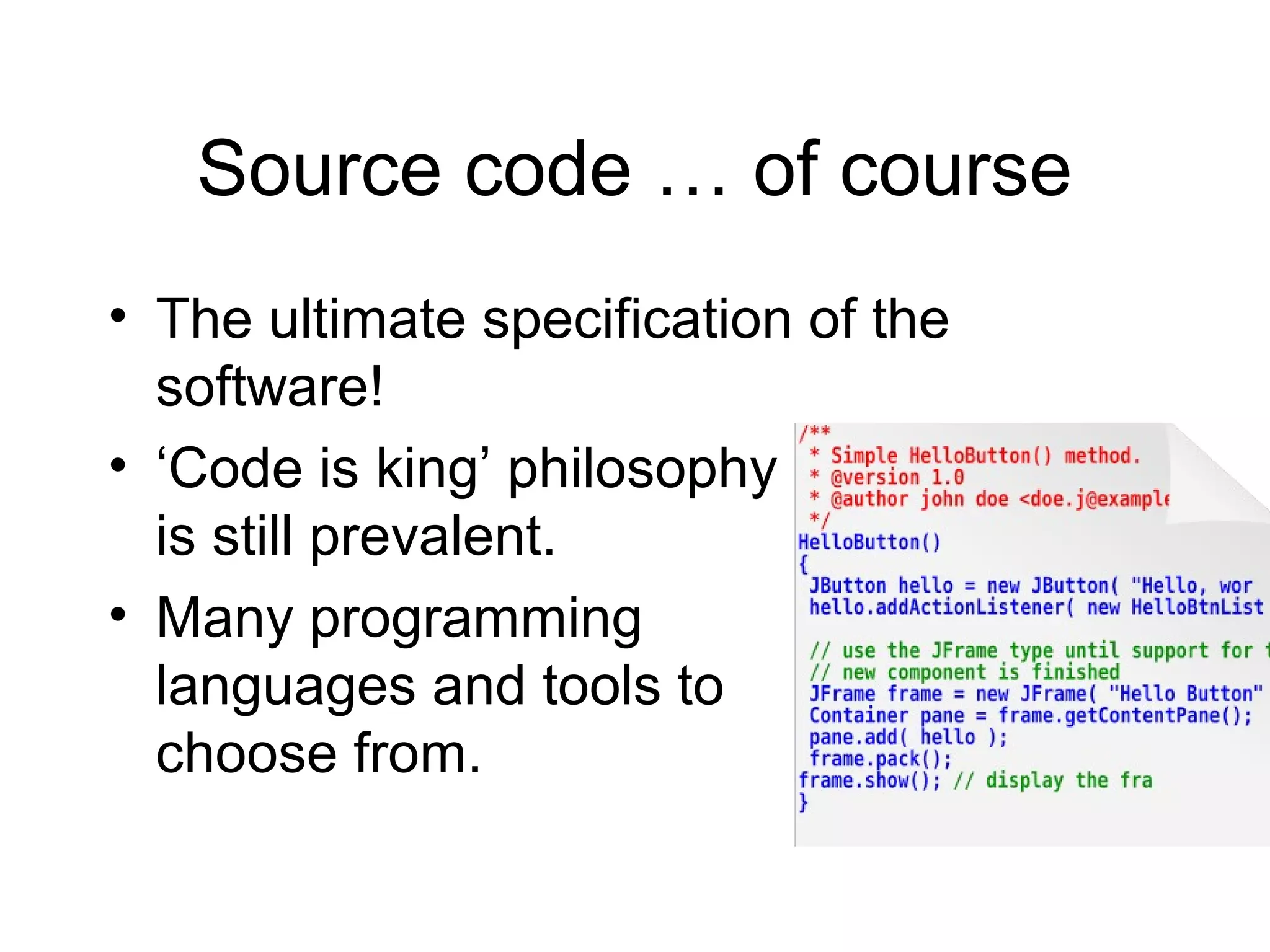
Source code … of course
• The ultimate specification of the
software!
• ‘Code is king’ philosophy
is still prevalent.
• Many programming
languages and tools to
choose from.
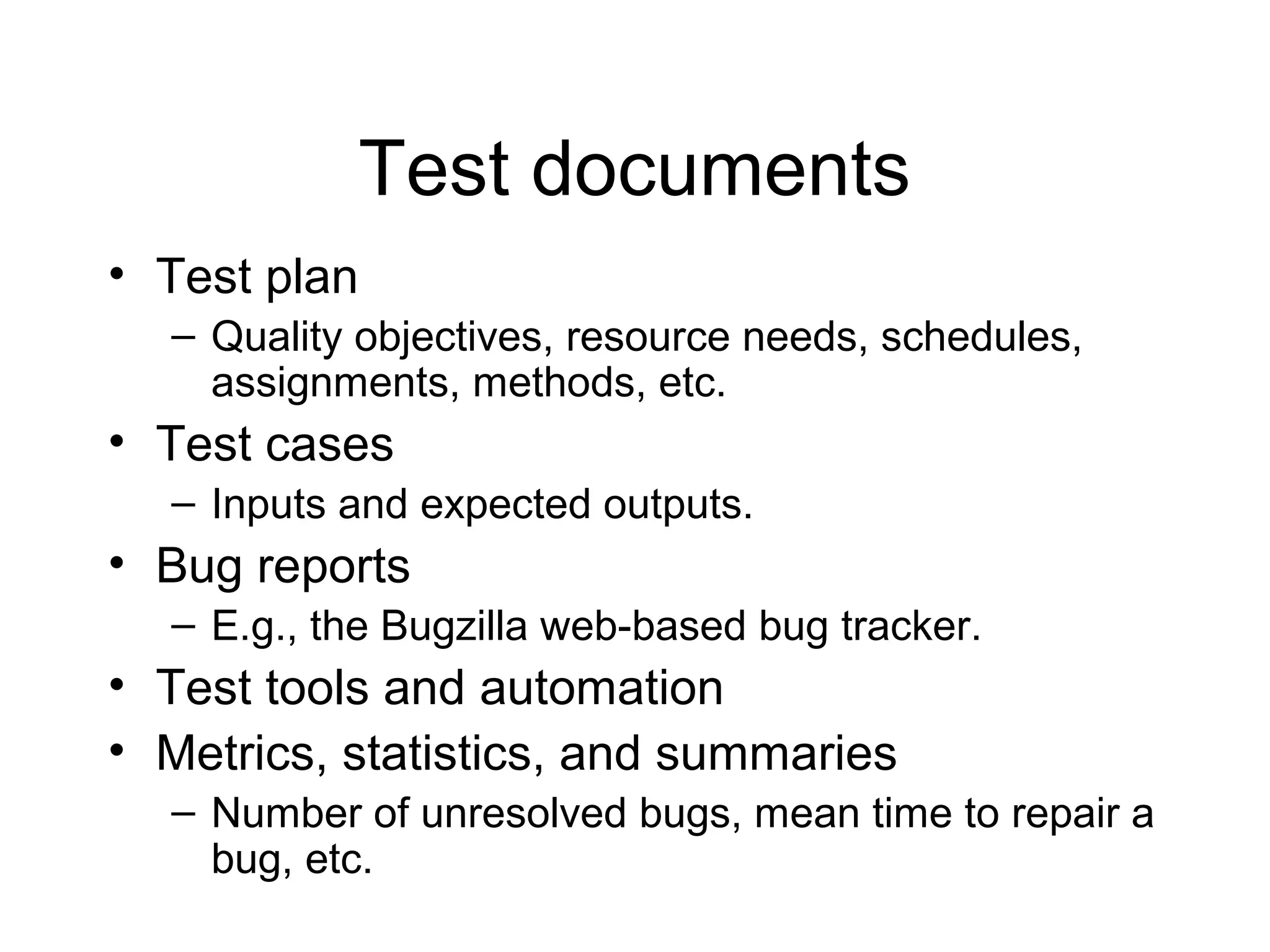
Test documents
• Test plan
– Quality objectives, resource needs, schedules,
assignments, methods, etc.
• Test cases
– Inputs and expected outputs.
• Bug reports
– E.g., the Bugzilla web-based bug tracker.
• Test tools and automation
• Metrics, statistics, and summaries
– Number of unresolved bugs, mean time to repair a
bug, etc.
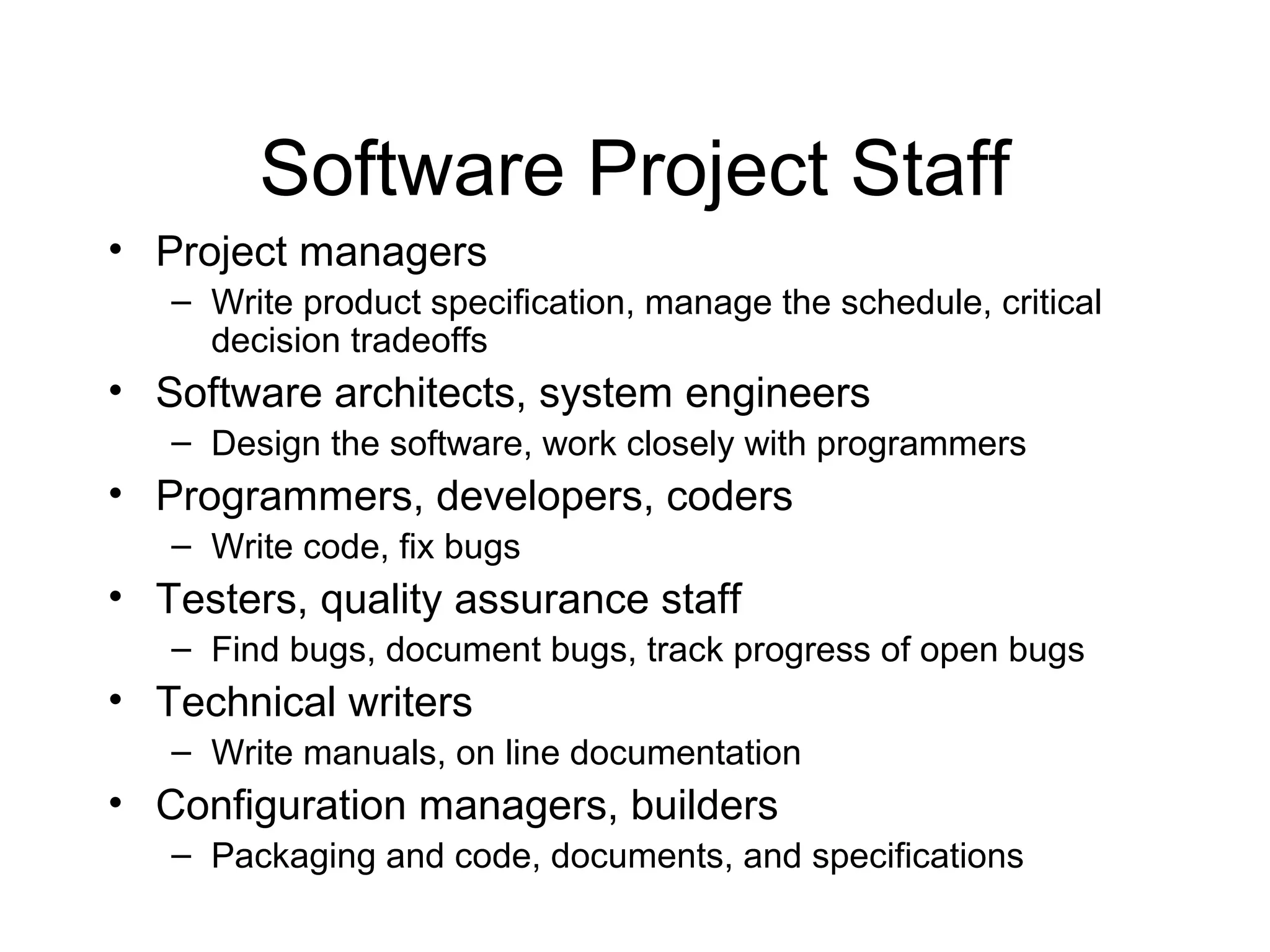
Software Project Staff
• Project managers
– Write product specification, manage the schedule, critical
decision tradeoffs
• Software architects, system engineers
– Design the software, work closely with programmers
• Programmers, developers, coders
– Write code, fix bugs
• Testers, quality assurance staff
– Find bugs, document bugs, track progress of open bugs
• Technical writers
– Write manuals, on line documentation
• Configuration managers, builders
– Packaging and code, documents, and specifications
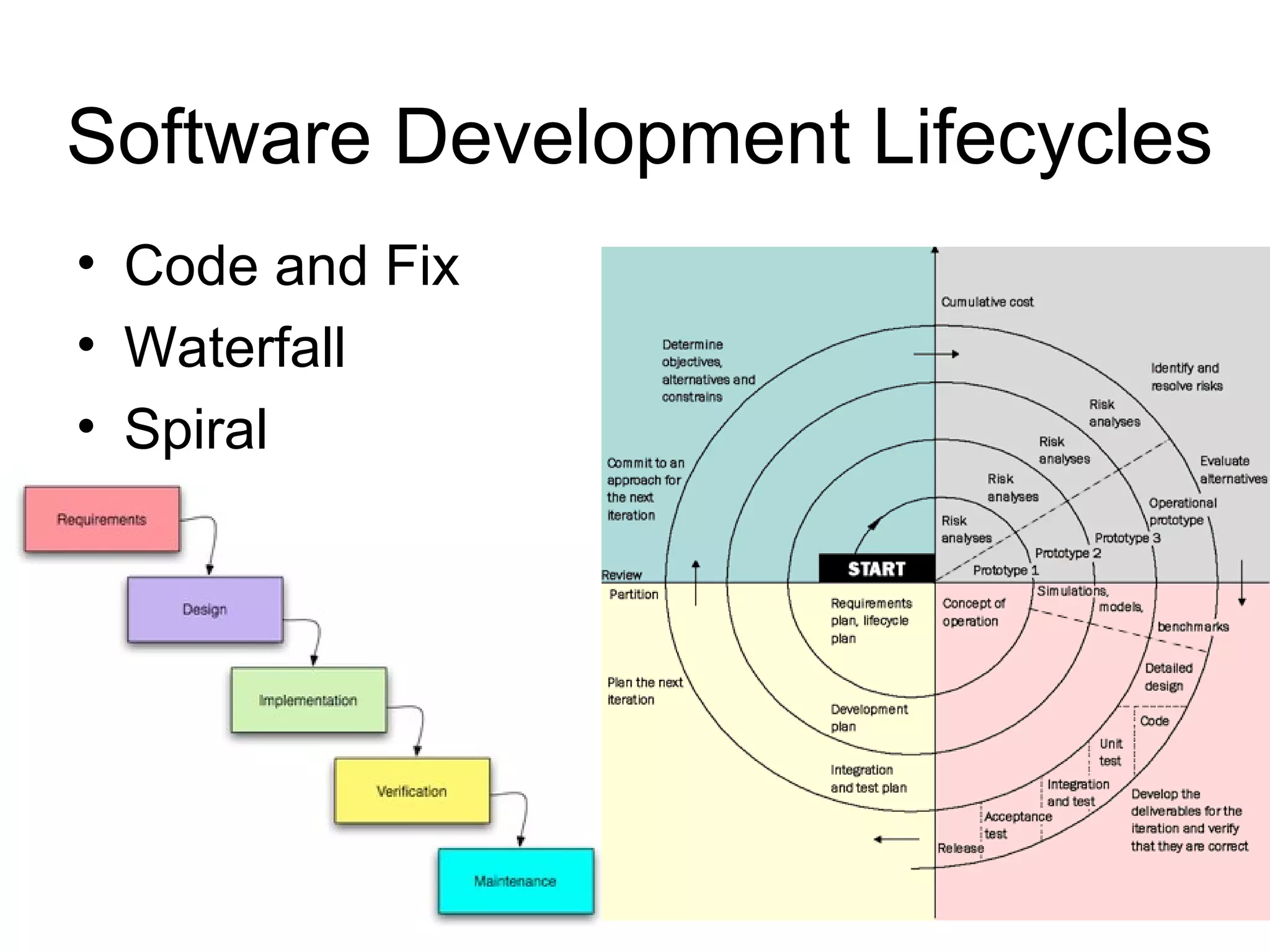
Software Development Lifecycles
• Code and Fix
• Waterfall
• Spiral
You now know …
• … what is software
• … what is software engineering
• … what is the composition of a software
development organization
• … what are the major phases of a software
development project
• … how major phased are organized

Introduction to software testing

  • 1.
    Introduction to Software Testing [Readingassignment: Chapter 1, pp. 9-22]
  • 2.
    What is acomputer bug? • In 1947 Harvard University was operating a room-sized computer called the Mark II. – mechanical relays – glowing vacuum tubes – technicians program the computer by reconfiguring it – Technicians had to change the occasional vacuum tube. • A moth flew into the computer and was zapped by the high voltage when it landed on a relay. • Hence, the first computer bug! – I am not making this up :-)
  • 3.
    Bugs a.k.a. … •Defect • Fault • Problem • Error • Incident • Anomaly • Variance • Failure • Inconsistency • Product Anomaly • Product Incidence • Feature :-)
  • 4.
    Defective Software • Wedevelop programs that contain defects – How many? What kind? • Hard to predict the future, however… it is highly likely, that the software we (including you!) will develop in the future will not be significantly better.
  • 5.
    Sources of Problems •Requirements Definition: Erroneous, incomplete, inconsistent requirements. • Design: Fundamental design flaws in the software. • Implementation: Mistakes in chip fabrication, wiring, programming faults, malicious code. • Support Systems: Poor programming languages, faulty compilers and debuggers, misleading development tools.
  • 6.
    Sources of Problems(Cont’d) • Inadequate Testing of Software: Incomplete testing, poor verification, mistakes in debugging. • Evolution: Sloppy redevelopment or maintenance, introduction of new flaws in attempts to fix old flaws, incremental escalation to inordinate complexity.
  • 7.
    Adverse Effects of FaultySoftware • Communications: Loss or corruption of communication media, non delivery of data. • Space Applications: Lost lives, launch delays. • Defense and Warfare: Misidentification of friend or foe.
  • 8.
    Adverse Effects ofFaulty Software (Cont’d) • Transportation: Deaths, delays, sudden acceleration, inability to brake. • Safety-critical Applications: Death, injuries. • Electric Power: Death, injuries, power outages, long-term health hazards (radiation).
  • 9.
    Adverse Effects ofFaulty Software (Cont’d) • Money Management: Fraud, violation of privacy, shutdown of stock exchanges and banks, negative interest rates. • Control of Elections: Wrong results (intentional or non-intentional). • Control of Jails: Technology-aided escape attempts and successes, accidental release of inmates, failures in software controlled locks. • Law Enforcement: False arrests and imprisonments.
  • 10.
    Bug in SpaceCode • Project Mercury’s FORTRAN code had the following fault: DO I=1.10 instead of ... DO I=1,10 • The fault was discovered in an analysis of why the software did not seem to generate results that were sufficiently accurate. • The erroneous 1.10 would cause the loop to be executed exactly once!
  • 11.
    Military Aviation Problems •An F-18 crashed because of a missing exception condition: if ... then ... without the else clause that was thought could not possibly arise. • In simulation, an F-16 program bug caused the virtual plane to flip over whenever it crossed the equator, as a result of a missing minus sign to indicate south latitude.
  • 12.
    Year Ambiguities • In1992, Mary Bandar received an invitation to attend a kindergarten in Winona, Minnesota, along with others born in '88. • Mary was 104 years old at the time.
  • 13.
    Year Ambiguities (Cont’d) •Mr. Blodgett’s auto insurance rate tripled when he turned 101. • He was the computer program’s first driver over 100, and his age was interpreted as 1. • This is a double blunder because the program’s definition of a teenager is someone under 20!
  • 14.
    Dates, Times, andIntegers • The number 32,768 = has caused all sorts of grief from the overflowing of 16-bit words. • A Washington D.C. hospital computer system collapsed on September 19, 1989, days after January 1, 1900, forcing a lengthy period of manual operation. 15 2 15 2
  • 15.
    Dates, Times, andIntegers (Cont’d) • COBOL uses a two-character date field … • The Linux term program, which allows simultaneous multiple sessions over a single modem dialup connection, died word wide on October 26, 1993. • The cause was the overflow of an int variable that should have been defined as an unsigned int.
  • 16.
    Shaky Math • Inthe US, five nuclear power plants were shut down in 1979 because of a program fault in a simulation program used to design nuclear reactor to withstand earthquakes. • This program fault was, unfortunately, discovered after the power plants were built!
  • 17.
    Shaky Math (Cont’d) •Apparently, the arithmetic sum of a set of numbers was taken, instead of the sum of the absolute values. • The five reactors would probably not have survived an earthquake that was as strong as the strongest earthquake ever recorded in the area.
  • 18.
    Therac-25 Radiation “Therapy” • InTexas, 1986, a man received between 16,500-25,000 rads in less than 1 sec, over an area of about 1 cm. • He lost his left arm, and died of complications 5 months later. • In Texas, 1986, a man received at least 4,000 rads in the right temporal lobe of his brain. • The patient eventually died as a result of the overdose.
  • 19.
    Therac-25 Radiation “Therapy” (Cont’d) •In Washington, 1987, a patient received 8,000-10,000 rads instead of the prescribed 86 rads. • The patient died of complications of the radiation overdose.
  • 20.
    AT&T Bug: Hello?... Hello? • In mid-December 1989, AT&T installed new software in 114 electronic switching systems. • On January 15, 1990, 5 million calls were blocked during a 9 hour period nationwide.
  • 21.
    AT&T Bug (Cont’d) •The bug was traced to a C program that contained a break statement within an switch clause nested within a loop. • The switch clause was part of a loop. Initially, the loop contained only if clauses with break statements to exit the loop. • When the control logic became complicated, a switch clause was added to improve the readability of the code ...
  • 22.
    Bank Generosity • ANorwegian bank ATM consistently dispersed 10 times the amount required. • Many people joyously joined the queues as the word spread.
  • 23.
    Bank Generosity (Cont’d) •A software flaw caused a UK bank to duplicate every transfer payment request for half an hour. The bank lost 2 billion British pounds! • The bank eventually recovered the funds but lost half a million pounds in potential interest.
  • 24.
    Making Rupee! • AnAustralian man purchased $104,500 worth of Sri Lankan Rupees. • The next day he sold the Rupees to another bank for $440,258. • The first bank’s software had displayed a bogus exchange rate in the Rupee position! • A judge ruled that the man had acted without intended fraud and could keep the extra $335,758!
  • 25.
    Bug in BoNYSoftware • The Bank of New York (BoNY) had a $32 billion overdraft as the result of a 16-bit integer counter that went unchecked. • BoNY was unable to process the incoming credits from security transfers, while the NY Federal Reserve automatically debited BoNY’s cash account.
  • 26.
    Bug in BoNYSoftware (Cont’d) • BoNY had to borrow $24 billion to cover itself for 1 day until the software was fixed. • The bug cost BoNY $5 million in interest payments.
  • 27.
    Discussion … • Haveyou heard of other software bugs? – In the media? – From personal experience? • Does this embarrass you as a future software engineer?
  • 28.
    Specification “if you can’tsay it, you can’t do it” • You have to know what your product is before you can say if it has a bug. • A specification defines the product being created and includes: – Functional requirements that describes the features the product will support. E.g., on a word processor • Save, print, check spelling, change font, … – Non-functional requirements are constraints on the product. E.g, • Security, reliability, user friendliness, platform, …
  • 29.
    A software bugoccurs when at least one of these rules is true • The software does not do something that the specification says it should do. • The software does something that the specification says it should not do. • The software does something that the specification does not mention. • The software does not do something that the product specification does not mention but should. • The software is difficult to understand, hard to use, slow …
  • 30.
    Most bugs arenot because of mistakes in the code … • Specification (~= 55%) • Design (~= 25%) • Code (~= 15%) • Other (~= 5%)
  • 31.
    Relative cost ofbugs “bugs found later cost more to fix” • Cost to fix a bug increases exponentially (10x ) – i.e., it increases tenfold as time increases • E.g., a bug found during specification costs $1 to fix. • … if found in design cost is $10 • … if found in code cost is $100 • … if found in released software cost is $1000
  • 32.
    Bug Free Software •Software is in the news for the wrong reason – Security breach, Mars Lander lost, hackers getting credit card information, etc. • Why can’t software engineers develop software that just works? – As software gets more features and supports more platforms it becomes increasingly difficult to make it create bug-free.
  • 33.
    Discussion … • Doyou think bug free software is unattainable? – Are their technical barriers that make this impossible? – Is it just a question of time before we can do this? – Are we missing technology or processes?
  • 34.
    Goal of asoftware tester • … to find bugs • … as early in the software development processes as possible • … and make sure they get fixed. • Advice: Be careful not to get get caught in the dangerous spiral of unattainable perfection.
  • 35.
    What to lookfor when interviewing someone for the position of software tester • Are they explorers? • Are they troubleshooters? • Are they relentless? • Are they creative? • Are they perfectionists (within reason)? • Do they exercise good judgment? • Are they tactful and diplomatic? • Are they persuasive?
  • 36.
    You now know… • … what is a bug • … the relationship between specification and bugs • … the cost of a bug relative to when it is found • … the unattainable goal of perfect software • … the goal of the software tester • … valuable attributes of a software tester
  • 37.
    The Software Development Process [Readingassignment: Chapter 2, pp. 23-36]
  • 38.
    Software is … •requirements specification documents • design documents • source code • test suites and test plans • interfaces to hardware and software operating environment • internal and external documentation • executable programs and their persistent data
  • 39.
    Software effort • Specification •Product reviews • Design • Scheduling • Feedback • Competitive information acquisition • Test planning • Customer surveying • Usability data gathering • Look and feel specification • Software architecture • Programming • …
  • 40.
    Discussion … • Whatis software engineering? • Where does testing occur in the software development process?
  • 41.
    Customer requirements • Thesoftware development team must determine what the customer wants. • How can you do this? – Guess? – Collect detailed information from surveys? – Get feedback from a previous version of the software? – Read reviews in magazines? – Get information about the competition? – Other ways? • The collected data is used to guide the specification effort.
  • 42.
    Specification “If you don'tknow where you're going any road will take you there” • The specification takes the data from the customer requirements and other sources and defines: – The features of the software (functional requirements). – The constraints on these features (non-functional requirements). • Specifications can be: – formal (e.g., aerospace industry), rigid – informal (e.g., a .com start up), on a cocktail napkin or a whiteboard.
  • 43.
    Schedules • The goalsof scheduling are to know: – What work needs to be completed? – How much work is left to do? – When will the work be finished? – Who will finish each task? – Other measurable queries. • A Gantt chart is a popular type of bar chart that illustrates a project schedule.
  • 44.
  • 45.
    Design • Before codingbegins on non-trivial software projects, a set of design documents are created to serve as blueprints. – Software Architecture – Data flow diagram – State transition diagram – Flowchart – Commented code
  • 46.
    Source code …of course • The ultimate specification of the software! • ‘Code is king’ philosophy is still prevalent. • Many programming languages and tools to choose from.
  • 47.
    Test documents • Testplan – Quality objectives, resource needs, schedules, assignments, methods, etc. • Test cases – Inputs and expected outputs. • Bug reports – E.g., the Bugzilla web-based bug tracker. • Test tools and automation • Metrics, statistics, and summaries – Number of unresolved bugs, mean time to repair a bug, etc.
  • 48.
    Software Project Staff •Project managers – Write product specification, manage the schedule, critical decision tradeoffs • Software architects, system engineers – Design the software, work closely with programmers • Programmers, developers, coders – Write code, fix bugs • Testers, quality assurance staff – Find bugs, document bugs, track progress of open bugs • Technical writers – Write manuals, on line documentation • Configuration managers, builders – Packaging and code, documents, and specifications
  • 49.
    Software Development Lifecycles •Code and Fix • Waterfall • Spiral
  • 50.
    You now know… • … what is software • … what is software engineering • … what is the composition of a software development organization • … what are the major phases of a software development project • … how major phased are organized