


Try Harder 2 Be Yourself
        Individuality is Key
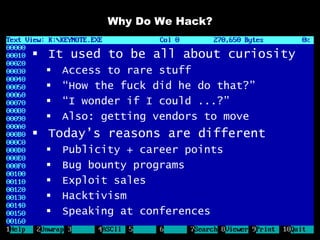
Why Do We Hack?


 It used to be all about curiosity
    Access to rare stuff
    “How the fuck did he do that?”
    “I wonder if I could ...?”
    Also: getting vendors to move
 Today’s reasons are different
    Publicity + career points
    Bug bounty programs
    Exploit sales
    Hacktivism
    Speaking at conferences
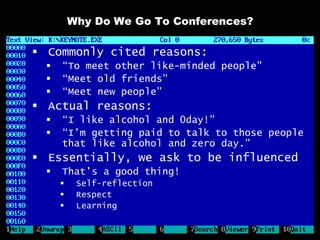
Why Do We Go To Conferences?

 Commonly cited reasons:
     “To meet other like-minded people”
     “Meet old friends”
     “Meet new people”
 Actual reasons:
     “I like alcohol and 0day!”
     “I’m getting paid to talk to those people
      that like alcohol and zero day.”
 Essentially, we ask to be influenced
     That’s a good thing!
          Self-reflection
          Respect
          Learning
What Speaking Means (to me)

 Not speaking:
  Do strange research you love
  vs.
 Speaking:
  Do strange research you love
  and present it to people smarter
  than yourself
   The people in the audience are
    offering you an hour of their life
    time to review your shit!
   This might be embarrassing
     Halvar to me: “You fucked up every Turing
      reference you did. So give me a cigarette.”
How Hacking Is Done
     Know Your History
Hacking in the 1960


 Username: system
  Password: manager
Hacking in the 1980s


   UNIX r-services
   NFS exports
   RPC services
   Anonymous FTP servers
   Default passwords
     Or none at all for SGI Irix
 Password guessing (“GOD”)
 Sendmail .forward pipes
Hacking in the 1990s


 Read BugTraq, hack sendmail (again)
 ping -l 65510
     Microsoft Windows 9x and NT
     Sun Solaris
     SCO UNIX
     Novell Netware
     Apple Mac
 cd ~/some/open/source && grep
  strcpy *.c
 Also: Port Scanning!!1!
Hacking in the 2000s


 cd ~/some/open/source && grep –E –e
  ‘printfs*([^”]+[,)]’ *.c
 7350 x2
 Solaris sadmind
 Cisco UDP echo
 Worms!!1!
 Heap Spraying
 Fuzzing
 Rise of the client-side attacks
 Rise of the web application bugs
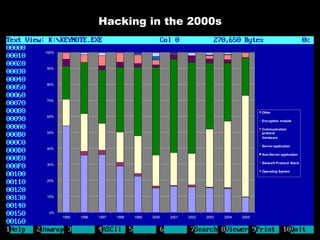
Hacking in the 2000s

100%


90%


80%


70%


                                                                                    Other
60%
                                                                                    Encryption module

                                                                                    Communication
50%                                                                                 protocol
                                                                                    Hardware

                                                                                    Server application
40%
                                                                                    Non-Server application

                                                                                    Network Protocol Stack
30%
                                                                                    Operating System

20%


10%


 0%
       1995   1996   1997   1998   1999   2000   2001   2002   2003   2004   2005
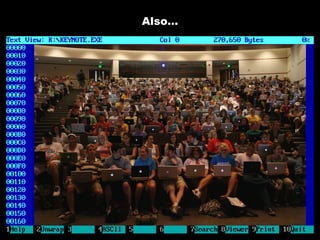
Also…
Hacking in the 2010s

 W^X, DEP, ASLR, KASLR, Safe-SEH,
  stack cookies, fortify source
     ROP goes mainstream
   Jailbreaks
   Kingcope’s BSD telnetd Remote Root
   Java client side bugs
   for i in $(cat emails.txt);do(cat
    fish.txt|mail –s “Facebook Account
    Verification” $i);done
     Google, Dropbox, Amazon, iCloud
 Anonymous!!1!
And Now?
Where Are We Heading?
What Is Big Right Now: The Cloud

 The Cloud™ means Virtualization
  technologies everywhere
     OS virtualization
     Network virtualization
     Storage virtualization
     Several metric tons of management
 The change in “ownership” is
  important for the researcher
   Even if you don’t “own” the software,
    testing, fuzzing and debugging a local
    copy is pretty hard to prevent
   Testing and playing with the cloud can
    land you in jail pretty quickly
        Plus, you might hand your 0day over the moment
         you find it
   Few clouds allow testing (e.g. Microsoft)
What Is Big Right Now: The Cloud

 The Cloud™ means that hacking goes
  back to a mainframe host scenario
   There are two reasons that mainframe
    exploits are so rare:
    1. They were actually designed and built with a
       lot of security in mind
    2. They were pretty hard to get to
 IMHO, hacking PAS and SAS will tend
  to be much more observation centric
  than testing centric
   Observation is hard to prevent
   Few and far between testing is hard to
    detect
 IAS comes down to finding Xen
  breakouts and building the image
What Is Big Right Now: Mobile Devices

 Mobile devices are the natural
  counter-point to Cloud services
 The security models differ
  significantly depending on the goal
  of the vendor
   Apple protects their business model
   Google protects the user’s believes
 Mobile Apps roll software security
  back to the 90s
   Written by former Adobe Flash coders
   Mass produced in numbers never seen before
   Objective-C is a programming language that
    could not have been designed worse if it
    were intentional
 Many underestimated attack vectors
What Is Big Right Now: SCADA !!1!

 SCADA and ICS are the new hotness
  after Stuxnet was discovered
 SCADA has a couple of fun aspects:
   Most environments are un-patchable
   Most vendors consider software security as
    something Microsoft must do
   Most ICS engineers consider themselves
    invincible to any hacker due to their
    arcane domain knowledge
   A lot of protocols are transported and
    proxied over TCP/IP now (see Metasploit)
 ICS are very interesting things to
  learn about, if you have patience
   You will also find dancing monkeys
Also…
Military Hacking

 Military and intelligence hacking is
  nothing new
   Neither the practice nor the targets
 Stuxnet, Gaus, Flame etc. only allowed
  the general public a glimpse
 The difference is in the resources,
  tactics and techniques
   The military industrial complex now invests
    more in attack technologies than the
    cybercrime market
   This opens a lot of possibilities for the
    attackers in terms of R&D
      Case in point: Nobody pulls a new MD5 collision
       attack out of their ass
   Depending on international developments, it
    might also be the only area of unpunished in-
    the-wild hacking for a while
What Might Get Big

 Cryptography Bugs
   Cryptography is still considered fairy
    dust: Have crypto, be secure!
   Check Greg’s excellent talk “Non-obvious
    bugs by example”
 Parallel Execution Bugs
   Very hard to spot in source code
   Almost impossible to find by fuzzing
   Almost everything today has multiple cores
    or CPUs or both
 Lower level processors
     Trusted by the application CPU
     Already started with GSM Baseband research
     System Management Controllers, ILO, etc.
     There is a ton of this in today’s devices
When Bug Count Isn’t Everything

 When hacking, I believe one can also
  do something for the common good:
   Before Barnaby Jack publicly hacked
    insulin pumps, only one medical device
    vendor cared
   Before Dillon Beresford took a deeper look
    at Siemens PLCs, no vendor cared about
    their base operating system
     Now Siemens is the only one not caring
   Nils’ PinPadPwn demonstration should
    change quite a few payment systems
 While hackers, we are also humans
   At some point, even you and me will have
    to use a PIN-Pad to pay for stuff
When Bug Count Isn’t Everything


 Product Security is a cost center
  for the vendor – it makes no money
   They need a Backup-Effect in order to
    justify the expenses to do it:
    Only when data is lost do people care
    about and invest in backups.
 This is called passion!
   Maybe money isn’t everything?
 A hacker does for love what others
  can’t even do for money.
Target Selection
 Where Individuality Shines
Stay NaÏve

 Naivety was always an important part
  of hacking
   Remember the movie “Hackers”? The kiddy
    was the one hacking the Gibson.
 Whether you think that you will find
  a vulnerability or not, you will be
  right.
 Stubbornness is pretty useful
   It also compensates for talent ;)
 Hacking is often about frustration
  resilience more than anything else
   Or about not getting frustrated in the
    first place, a.k.a. expectation management
Target Selection


 It helps to find targets that
  genuinely interest you
   Targets that are boring you to death are
    missing the inherent motivation
   Rage can be pretty motivating
 Don’t hack things just because
  everyone else is hacking them
   Unless you are hunting for bug bounties
 Understand whether your target
  environment is competitive by nature
   Act accordingly
Size Does Matter


 Bigger targets are usually juicier
   More code =
   More attack surface =
   More chances for vulnerabilities
 Average of vulnerability per lines
  of source code is relatively stable
 Bigger targets are admin bitches
   Harder to set up and configure right
   Your tools will have a harder time
   More code to wade through, because
    it’s not relevant
Means To An End


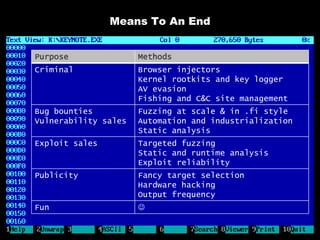
Purpose               Methods
Criminal              Browser injectors
                      Kernel rootkits and key logger
                      AV evasion
                      Fishing and C&C site management
Bug bounties          Fuzzing at scale & in .fi style
Vulnerability sales   Automation and industrialization
                      Static analysis
Exploit sales         Targeted fuzzing
                      Static and runtime analysis
                      Exploit reliability
Publicity             Fancy target selection
                      Hardware hacking
                      Output frequency
Fun                   
A Word About Fuzzing

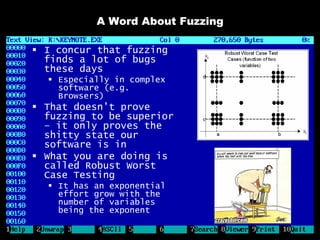
 I concur that fuzzing
  finds a lot of bugs
  these days
   Especially in complex
    software (e.g.
    Browsers)
 That doesn’t prove
  fuzzing to be superior
  – it only proves the
  shitty state our
  software is in
 What you are doing is
  called Robust Worst
  Case Testing
   It has an exponential
    effort grow with the
    number of variables
    being the exponent
Method Selection

 There are many ways to find
  vulnerabilities:
     Manual testing
     Fuzzing
     Static source code analysis
     Static binary code analysis
     Runtime analysis
     Diffing
     Reading Specifications
 The key is to do what suites you best
   Not everyone reads code like Halvar
   Not everyone breaks crypto like Greg
 Be individual!
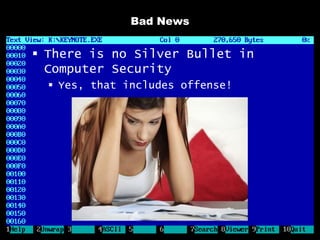
Bad News


 There is no Silver Bullet in
  Computer Security
   Yes, that includes offense!
And You?
Where Do You Stand?
Don’t Let Anyone Tell You What To Do


 Most people that lecture you on
  ethics don’t follow those themselves
   Digital human rights activists who also
    head companies selling to military or
    criminal mob
   People bashing Microsoft while sitting at
    their campus getting paid by them
   People writing spy software for oppressive
    governments while claiming to be left wing
    activists
   Do you think Adrian Lamo is an exception?
 There are many aspects to consider
   Other people’s opinion isn’t one of them
To Sell or Not To Sell?

 Is selling exploits like selling
  weapons?
   Do you think it should be illegal?
   Do you think you can control what your
    exploit is used for?
   Do you care?
   What about regulating use?
   Is it better or worse than leaking
    docs to Wikileaks?
 „Do whatever you want. Trust your
  guts, your humanly feelings, your
  very limited knowledge. This is
  best effort.” – Julio Auto
Vendor Communication?

 Should you talk to the vendor?
     Do they even have a contact address?
     Did you consider their previous track record?
     Maybe ask someone with prior experience?
     If in doubt, hand it off to a CERT.
 How much time should you allow for a fix?
   RFPolicy 2.0 calls for 2 weeks warning
   Most fix times declared by vendors are bullshit
        Some are not
        Use your best judgment and gut feeling
   Can you accept being beaten by someone else
    releasing before you?
        If the vendor half-releases, that’s going to happen
 Don’t let a vendor scare you away from
  disclosure with legal threats
   I have not heard of a successful legal action
    that didn’t have another aspect
        If you violated NDAs, you are fucked anyway
To Anonymous or Not To Anonymous?


 Which Anonymous are we talking about?
   Many independent groups
   Probably as many goals as “members”
   Difficult to assess
 Considerable risk
   See The Grugq’s talk
   Obvious and hence high priority target for
    law enforcement
     Consider that LEO people have KPIs too
 A highly personal decision
   One that should probably be kept private
   One that can have significant consequences
To Cyberwar or Not To Cyberwar?

 Militaries and intelligence services
  around the world are dying for skilled
  personal
   Their demand probably exceeds the currently
    available global supply
 Not everyone’s favorite idea of a
  working place
   “Plush Bunker”
 Depending on your country, quitting
  might not be an option
   Once intelligence, always intelligence
   Security clearances can become chain on your
    leg for life
 Still, a surprising number of people
  choose this path
   See Military Hacking
Why I Always Stayed Legal & Public


 It’s easier to reason with others
   Defends against politician's arguments
 It’s better paid
   No need to monetize but plenty of options
   It’s a global business, no need to sell
    locally
 It’s more relaxing
   OpSec is pretty annoying over time
   When you get older, you want it easy
 You get to talk to other people
  without being worried that they fuck
  you over
Some Things Cannot
 Be Individualized
    Why I loved PTS-DOS,
  but don’t like Kaspersky.
Know Your Basics


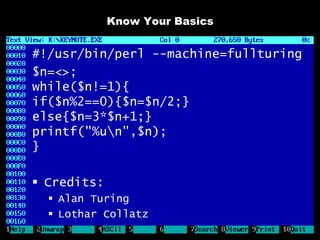
#!/usr/bin/perl --machine=fullturing
$n=<>;
while($n!=1){
if($n%2==0){$n=$n/2;}
else{$n=3*$n+1;}
printf("%un",$n);
}

 Credits:
   Alan Turing
   Lothar Collatz
Know Your Basics


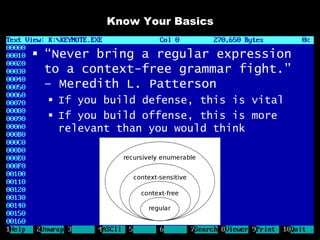
 “Never bring a regular expression
  to a context-free grammar fight.”
  – Meredith L. Patterson
   If you build defense, this is vital
   If you build offense, this is more
    relevant than you would think
Know Your Basics


 If you ignore proven facts, you will
  keep looking for the philosopher’s
  stone of hacking
   “I have build this automated fuzzing
    framework that will use coverage testing
    to run every code path with my input!”
   “Iterating through all possible inputs
    that match this regular expression will
    find me all possible bugs in this code!”
 Those are the only things that should
  limit your individuality
   Unless, of course, you can prove them
    wrong ;)
Be Yourself
And (optionally) get paid for it.
You And The Community


 Cultivate relations to others with
  respect for them
   It’s OK to loose the respect later if
    they don’t deserve it
   Respect is a symmetric connection:
    priority and limits work both ways
 Most people share your ideals
   But they might have other needs,
    motivations or interests
Working in InfoSec

 Working in InfoSec is often said to
  suck monkey balls
   I call bullshit
 In a professional environment, the
  rules change a little
   Be fair and professional
   Don’t let anyone use you
   Don’t fool yourself into submission
     “The job sucks but the team is so nice!”
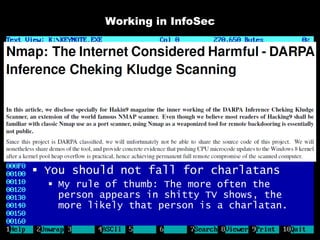
 You should not fall for charlatans
   My rule of thumb: The more often the
    person appears in shitty TV shows, the
    more likely that person is a charlatan.
Working in InfoSec


 In every work environment, you find
  100 types of people:
     00:   asshole
     01:   asshole considered nice
     10:   nice considered asshole
     11:   nice
 That doesn’t make InfoSec any
  better or worse than other jobs
 Also: If you find yourself in a
  hole, stop digging.
   If a job sucks, find a new one
Working in InfoSec


 A good company fosters your
  development as an individual to the
  same extend that you foster the
  development of the overall team
 Figure out your motivation and find
  a company that shares it
 If in doubt, start you own
Done.

Thanks for listening


Greetz and Shouts:
Phenoelit, Phonoelit, Halvar Flake, HD Moore

Keynote fx try harder 2 be yourself

  • 1.
    Try Harder 2Be Yourself Individuality is Key
  • 2.
    Why Do WeHack?  It used to be all about curiosity  Access to rare stuff  “How the fuck did he do that?”  “I wonder if I could ...?”  Also: getting vendors to move  Today’s reasons are different  Publicity + career points  Bug bounty programs  Exploit sales  Hacktivism  Speaking at conferences
  • 6.
    Why Do WeGo To Conferences?  Commonly cited reasons:  “To meet other like-minded people”  “Meet old friends”  “Meet new people”  Actual reasons:  “I like alcohol and 0day!”  “I’m getting paid to talk to those people that like alcohol and zero day.”  Essentially, we ask to be influenced  That’s a good thing!  Self-reflection  Respect  Learning
  • 7.
    What Speaking Means(to me)  Not speaking: Do strange research you love vs.  Speaking: Do strange research you love and present it to people smarter than yourself  The people in the audience are offering you an hour of their life time to review your shit!  This might be embarrassing  Halvar to me: “You fucked up every Turing reference you did. So give me a cigarette.”
  • 8.
    How Hacking IsDone Know Your History
  • 9.
    Hacking in the1960  Username: system Password: manager
  • 10.
    Hacking in the1980s  UNIX r-services  NFS exports  RPC services  Anonymous FTP servers  Default passwords  Or none at all for SGI Irix  Password guessing (“GOD”)  Sendmail .forward pipes
  • 11.
    Hacking in the1990s  Read BugTraq, hack sendmail (again)  ping -l 65510  Microsoft Windows 9x and NT  Sun Solaris  SCO UNIX  Novell Netware  Apple Mac  cd ~/some/open/source && grep strcpy *.c  Also: Port Scanning!!1!
  • 12.
    Hacking in the2000s  cd ~/some/open/source && grep –E –e ‘printfs*([^”]+[,)]’ *.c  7350 x2  Solaris sadmind  Cisco UDP echo  Worms!!1!  Heap Spraying  Fuzzing  Rise of the client-side attacks  Rise of the web application bugs
  • 13.
    Hacking in the2000s 100% 90% 80% 70% Other 60% Encryption module Communication 50% protocol Hardware Server application 40% Non-Server application Network Protocol Stack 30% Operating System 20% 10% 0% 1995 1996 1997 1998 1999 2000 2001 2002 2003 2004 2005
  • 14.
  • 15.
    Hacking in the2010s  W^X, DEP, ASLR, KASLR, Safe-SEH, stack cookies, fortify source  ROP goes mainstream  Jailbreaks  Kingcope’s BSD telnetd Remote Root  Java client side bugs  for i in $(cat emails.txt);do(cat fish.txt|mail –s “Facebook Account Verification” $i);done  Google, Dropbox, Amazon, iCloud  Anonymous!!1!
  • 16.
    And Now? Where AreWe Heading?
  • 17.
    What Is BigRight Now: The Cloud  The Cloud™ means Virtualization technologies everywhere  OS virtualization  Network virtualization  Storage virtualization  Several metric tons of management  The change in “ownership” is important for the researcher  Even if you don’t “own” the software, testing, fuzzing and debugging a local copy is pretty hard to prevent  Testing and playing with the cloud can land you in jail pretty quickly  Plus, you might hand your 0day over the moment you find it  Few clouds allow testing (e.g. Microsoft)
  • 18.
    What Is BigRight Now: The Cloud  The Cloud™ means that hacking goes back to a mainframe host scenario  There are two reasons that mainframe exploits are so rare: 1. They were actually designed and built with a lot of security in mind 2. They were pretty hard to get to  IMHO, hacking PAS and SAS will tend to be much more observation centric than testing centric  Observation is hard to prevent  Few and far between testing is hard to detect  IAS comes down to finding Xen breakouts and building the image
  • 19.
    What Is BigRight Now: Mobile Devices  Mobile devices are the natural counter-point to Cloud services  The security models differ significantly depending on the goal of the vendor  Apple protects their business model  Google protects the user’s believes  Mobile Apps roll software security back to the 90s  Written by former Adobe Flash coders  Mass produced in numbers never seen before  Objective-C is a programming language that could not have been designed worse if it were intentional  Many underestimated attack vectors
  • 20.
    What Is BigRight Now: SCADA !!1!  SCADA and ICS are the new hotness after Stuxnet was discovered  SCADA has a couple of fun aspects:  Most environments are un-patchable  Most vendors consider software security as something Microsoft must do  Most ICS engineers consider themselves invincible to any hacker due to their arcane domain knowledge  A lot of protocols are transported and proxied over TCP/IP now (see Metasploit)  ICS are very interesting things to learn about, if you have patience  You will also find dancing monkeys
  • 21.
  • 22.
    Military Hacking  Militaryand intelligence hacking is nothing new  Neither the practice nor the targets  Stuxnet, Gaus, Flame etc. only allowed the general public a glimpse  The difference is in the resources, tactics and techniques  The military industrial complex now invests more in attack technologies than the cybercrime market  This opens a lot of possibilities for the attackers in terms of R&D  Case in point: Nobody pulls a new MD5 collision attack out of their ass  Depending on international developments, it might also be the only area of unpunished in- the-wild hacking for a while
  • 23.
    What Might GetBig  Cryptography Bugs  Cryptography is still considered fairy dust: Have crypto, be secure!  Check Greg’s excellent talk “Non-obvious bugs by example”  Parallel Execution Bugs  Very hard to spot in source code  Almost impossible to find by fuzzing  Almost everything today has multiple cores or CPUs or both  Lower level processors  Trusted by the application CPU  Already started with GSM Baseband research  System Management Controllers, ILO, etc.  There is a ton of this in today’s devices
  • 24.
    When Bug CountIsn’t Everything  When hacking, I believe one can also do something for the common good:  Before Barnaby Jack publicly hacked insulin pumps, only one medical device vendor cared  Before Dillon Beresford took a deeper look at Siemens PLCs, no vendor cared about their base operating system  Now Siemens is the only one not caring  Nils’ PinPadPwn demonstration should change quite a few payment systems  While hackers, we are also humans  At some point, even you and me will have to use a PIN-Pad to pay for stuff
  • 25.
    When Bug CountIsn’t Everything  Product Security is a cost center for the vendor – it makes no money  They need a Backup-Effect in order to justify the expenses to do it: Only when data is lost do people care about and invest in backups.  This is called passion!  Maybe money isn’t everything?  A hacker does for love what others can’t even do for money.
  • 26.
    Target Selection WhereIndividuality Shines
  • 27.
    Stay NaÏve  Naivetywas always an important part of hacking  Remember the movie “Hackers”? The kiddy was the one hacking the Gibson.  Whether you think that you will find a vulnerability or not, you will be right.  Stubbornness is pretty useful  It also compensates for talent ;)  Hacking is often about frustration resilience more than anything else  Or about not getting frustrated in the first place, a.k.a. expectation management
  • 28.
    Target Selection  Ithelps to find targets that genuinely interest you  Targets that are boring you to death are missing the inherent motivation  Rage can be pretty motivating  Don’t hack things just because everyone else is hacking them  Unless you are hunting for bug bounties  Understand whether your target environment is competitive by nature  Act accordingly
  • 29.
    Size Does Matter Bigger targets are usually juicier  More code =  More attack surface =  More chances for vulnerabilities  Average of vulnerability per lines of source code is relatively stable  Bigger targets are admin bitches  Harder to set up and configure right  Your tools will have a harder time  More code to wade through, because it’s not relevant
  • 30.
    Means To AnEnd Purpose Methods Criminal Browser injectors Kernel rootkits and key logger AV evasion Fishing and C&C site management Bug bounties Fuzzing at scale & in .fi style Vulnerability sales Automation and industrialization Static analysis Exploit sales Targeted fuzzing Static and runtime analysis Exploit reliability Publicity Fancy target selection Hardware hacking Output frequency Fun 
  • 31.
    A Word AboutFuzzing  I concur that fuzzing finds a lot of bugs these days  Especially in complex software (e.g. Browsers)  That doesn’t prove fuzzing to be superior – it only proves the shitty state our software is in  What you are doing is called Robust Worst Case Testing  It has an exponential effort grow with the number of variables being the exponent
  • 32.
    Method Selection  Thereare many ways to find vulnerabilities:  Manual testing  Fuzzing  Static source code analysis  Static binary code analysis  Runtime analysis  Diffing  Reading Specifications  The key is to do what suites you best  Not everyone reads code like Halvar  Not everyone breaks crypto like Greg  Be individual!
  • 33.
    Bad News  Thereis no Silver Bullet in Computer Security  Yes, that includes offense!
  • 34.
  • 35.
    Don’t Let AnyoneTell You What To Do  Most people that lecture you on ethics don’t follow those themselves  Digital human rights activists who also head companies selling to military or criminal mob  People bashing Microsoft while sitting at their campus getting paid by them  People writing spy software for oppressive governments while claiming to be left wing activists  Do you think Adrian Lamo is an exception?  There are many aspects to consider  Other people’s opinion isn’t one of them
  • 36.
    To Sell orNot To Sell?  Is selling exploits like selling weapons?  Do you think it should be illegal?  Do you think you can control what your exploit is used for?  Do you care?  What about regulating use?  Is it better or worse than leaking docs to Wikileaks?  „Do whatever you want. Trust your guts, your humanly feelings, your very limited knowledge. This is best effort.” – Julio Auto
  • 37.
    Vendor Communication?  Shouldyou talk to the vendor?  Do they even have a contact address?  Did you consider their previous track record?  Maybe ask someone with prior experience?  If in doubt, hand it off to a CERT.  How much time should you allow for a fix?  RFPolicy 2.0 calls for 2 weeks warning  Most fix times declared by vendors are bullshit  Some are not  Use your best judgment and gut feeling  Can you accept being beaten by someone else releasing before you?  If the vendor half-releases, that’s going to happen  Don’t let a vendor scare you away from disclosure with legal threats  I have not heard of a successful legal action that didn’t have another aspect  If you violated NDAs, you are fucked anyway
  • 38.
    To Anonymous orNot To Anonymous?  Which Anonymous are we talking about?  Many independent groups  Probably as many goals as “members”  Difficult to assess  Considerable risk  See The Grugq’s talk  Obvious and hence high priority target for law enforcement  Consider that LEO people have KPIs too  A highly personal decision  One that should probably be kept private  One that can have significant consequences
  • 39.
    To Cyberwar orNot To Cyberwar?  Militaries and intelligence services around the world are dying for skilled personal  Their demand probably exceeds the currently available global supply  Not everyone’s favorite idea of a working place  “Plush Bunker”  Depending on your country, quitting might not be an option  Once intelligence, always intelligence  Security clearances can become chain on your leg for life  Still, a surprising number of people choose this path  See Military Hacking
  • 40.
    Why I AlwaysStayed Legal & Public  It’s easier to reason with others  Defends against politician's arguments  It’s better paid  No need to monetize but plenty of options  It’s a global business, no need to sell locally  It’s more relaxing  OpSec is pretty annoying over time  When you get older, you want it easy  You get to talk to other people without being worried that they fuck you over
  • 41.
    Some Things Cannot Be Individualized Why I loved PTS-DOS, but don’t like Kaspersky.
  • 42.
    Know Your Basics #!/usr/bin/perl--machine=fullturing $n=<>; while($n!=1){ if($n%2==0){$n=$n/2;} else{$n=3*$n+1;} printf("%un",$n); }  Credits:  Alan Turing  Lothar Collatz
  • 43.
    Know Your Basics “Never bring a regular expression to a context-free grammar fight.” – Meredith L. Patterson  If you build defense, this is vital  If you build offense, this is more relevant than you would think
  • 44.
    Know Your Basics If you ignore proven facts, you will keep looking for the philosopher’s stone of hacking  “I have build this automated fuzzing framework that will use coverage testing to run every code path with my input!”  “Iterating through all possible inputs that match this regular expression will find me all possible bugs in this code!”  Those are the only things that should limit your individuality  Unless, of course, you can prove them wrong ;)
  • 45.
  • 46.
    You And TheCommunity  Cultivate relations to others with respect for them  It’s OK to loose the respect later if they don’t deserve it  Respect is a symmetric connection: priority and limits work both ways  Most people share your ideals  But they might have other needs, motivations or interests
  • 47.
    Working in InfoSec Working in InfoSec is often said to suck monkey balls  I call bullshit  In a professional environment, the rules change a little  Be fair and professional  Don’t let anyone use you  Don’t fool yourself into submission  “The job sucks but the team is so nice!”  You should not fall for charlatans  My rule of thumb: The more often the person appears in shitty TV shows, the more likely that person is a charlatan.
  • 48.
    Working in InfoSec In every work environment, you find 100 types of people:  00: asshole  01: asshole considered nice  10: nice considered asshole  11: nice  That doesn’t make InfoSec any better or worse than other jobs  Also: If you find yourself in a hole, stop digging.  If a job sucks, find a new one
  • 49.
    Working in InfoSec A good company fosters your development as an individual to the same extend that you foster the development of the overall team  Figure out your motivation and find a company that shares it  If in doubt, start you own
  • 50.
    Done. Thanks for listening Greetzand Shouts: Phenoelit, Phonoelit, Halvar Flake, HD Moore