ARTIFICIAL INTELLIGENCE
Not just understand how we think, also built intelligent entities
DEFINITION
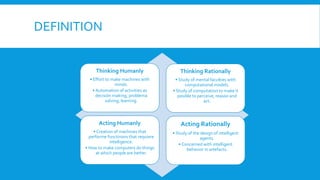
Thinking Humanly
• Effort to make machines with
minds.
• Automation of activities as
decisión making, problema
solving, learning.
Thinking Rationally
• Study of mental faculties with
computational models.
• Study of computation to make it
posible to perceive, reason and
act.
Acting Humanly
• Creation of machines that
performe functinons that requiere
intelligence.
• How to make computers do things
at which people are better.
Acting Rationally
• Study of the design of intelligent
agents.
• Concerned with intelligent
behavior in artefacts.
ACTING HUMANLY
THETURINGTEST APPROACH
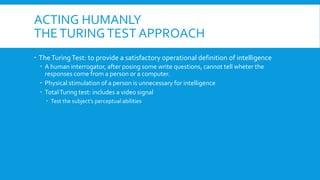
 TheTuringTest: to provide a satisfactory operational definition of intelligence
 A human interrogator, after posing some write questions, cannot tell wheter the
responses come from a person or a computer.
 Physical stimulation of a person is unnecessary for intelligence
 TotalTuring test: includes a video signal
 Test the subject’s perceptual abilities
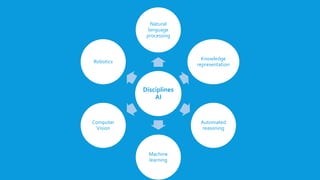
Disciplines
AI
Natural
language
processing
Knowledge
representation
Automated
reasoning
Machine
learning
Computer
Vision
Robotics
THINKING HUMANLY
THE COGNITIVE MODELING APPROACH
 Determine how humans think through
 Introspection
 Psychological experiments
 Brain imaging
 Cognitive science
 Brings together computer models from AI and experimental techniques from
psychology to constructe precise and testable theories of the human mind
 “an algorithm performs well on a task and that it is therefore a good model of
human performance, or viceversa the cognitive modeling approach”
THINKING RATIONALLY
THE “LAWS OFTHOUGHT” APPROACH
 Syllogism: patterns of argument structures that always yielded correct
conclusions when given correct premises
 Govern the operation of mind
 Logic: study of syllogisms
 Logicist tradition within AI hopes to build programs… to create intelligent systems
 Solve any solvable problem described in logical notation (if no solution exists, the
program might loop forever)
 Obstacles
 It’s not easy to take informal knowledge and state it in the formal terms required by logical
notation
 There is a big difference between solving a problema “in principle” and solving it in practice
ACTING RATIONALLY
THE RATIONAL AGENT APPROACH
 Agent: something that acts
 Computer agent
 Operate autonomously
 Perceive its environment
 Adapt to change
 Create and persue goals
 Rational agent
 Acts to achieve the best outcome or the best expected outcome (when there is uncertainty)
 Making correct inferences is sometimes part of being a rational agent, but it’s not all of rationallity, sometimes there is no
correct thing to do, but something must still be donde.
 Advantages
 More general than laws of thought
 More amenable to scientific approaches
 The standard of rationality is mathematically well defined and completely general and can be “unpacked”
 Limited rationallity: acting appropriately when there is not enough time to do all the computations one might like

Artificial Intelligence.pptx

  • 1.
    ARTIFICIAL INTELLIGENCE Not justunderstand how we think, also built intelligent entities
  • 2.
    DEFINITION Thinking Humanly • Effortto make machines with minds. • Automation of activities as decisión making, problema solving, learning. Thinking Rationally • Study of mental faculties with computational models. • Study of computation to make it posible to perceive, reason and act. Acting Humanly • Creation of machines that performe functinons that requiere intelligence. • How to make computers do things at which people are better. Acting Rationally • Study of the design of intelligent agents. • Concerned with intelligent behavior in artefacts.
  • 3.
    ACTING HUMANLY THETURINGTEST APPROACH TheTuringTest: to provide a satisfactory operational definition of intelligence  A human interrogator, after posing some write questions, cannot tell wheter the responses come from a person or a computer.  Physical stimulation of a person is unnecessary for intelligence  TotalTuring test: includes a video signal  Test the subject’s perceptual abilities
  • 4.
  • 5.
    THINKING HUMANLY THE COGNITIVEMODELING APPROACH  Determine how humans think through  Introspection  Psychological experiments  Brain imaging  Cognitive science  Brings together computer models from AI and experimental techniques from psychology to constructe precise and testable theories of the human mind  “an algorithm performs well on a task and that it is therefore a good model of human performance, or viceversa the cognitive modeling approach”
  • 6.
    THINKING RATIONALLY THE “LAWSOFTHOUGHT” APPROACH  Syllogism: patterns of argument structures that always yielded correct conclusions when given correct premises  Govern the operation of mind  Logic: study of syllogisms  Logicist tradition within AI hopes to build programs… to create intelligent systems  Solve any solvable problem described in logical notation (if no solution exists, the program might loop forever)  Obstacles  It’s not easy to take informal knowledge and state it in the formal terms required by logical notation  There is a big difference between solving a problema “in principle” and solving it in practice
  • 7.
    ACTING RATIONALLY THE RATIONALAGENT APPROACH  Agent: something that acts  Computer agent  Operate autonomously  Perceive its environment  Adapt to change  Create and persue goals  Rational agent  Acts to achieve the best outcome or the best expected outcome (when there is uncertainty)  Making correct inferences is sometimes part of being a rational agent, but it’s not all of rationallity, sometimes there is no correct thing to do, but something must still be donde.  Advantages  More general than laws of thought  More amenable to scientific approaches  The standard of rationality is mathematically well defined and completely general and can be “unpacked”  Limited rationallity: acting appropriately when there is not enough time to do all the computations one might like