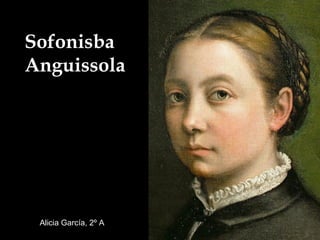
Sofonisba
Anguissola
Alicia García, 2º A
INDEX
1. Introduction
2. Childhood
3. Teachers
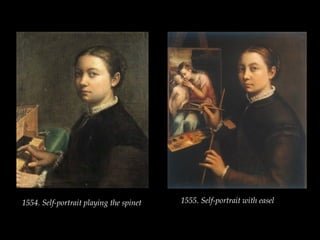
4. Familiar scenes and self-portraits
5. In Felipe's II Court
6. Death of the queen Isabel of Valois
7. Last portraits in the Court
8. Marriage
9. Genova
10. Palermo
11. Anonymous work
12. The painter in Prado Museum
13. Bibliography
1. Introduction
Sofonisba Anguissola is one of the most important
female painters of the Renaissance.
She was the painting teacher of the Court of Felipe
II and she made many portraits for the Spanish
royal family.
Some of her works were copied by great painters
(like Rubens).
She is one of the few female painters that has
paintings exhibited in the Prado Museum.
2. Childhood
Sofonisba was born in Cremona (Italy) in 1532.
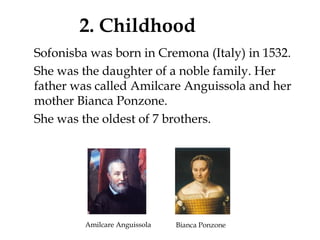
She was the daughter of a noble family. Her
father was called Amilcare Anguissola and her
mother Bianca Ponzone.
She was the oldest of 7 brothers.
Amilcare Anguissola Bianca Ponzone
3. Teachers
Anguissola couldn't study human anatomy or
paint images like nude paintings because of
being woman.
Her main teachers were:
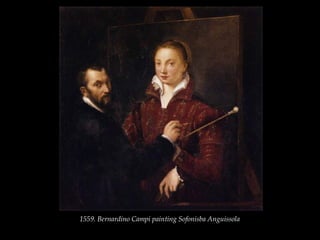
Bernardino Campi
In 1543, Sofonisba began to receive painting
classes with 11 years approximately.
Her father enrolled her in the workshop of
Bernardino Campi (the most famous school in
Cremona).
1559. Bernardino Campi painting Sofonisba Anguissola
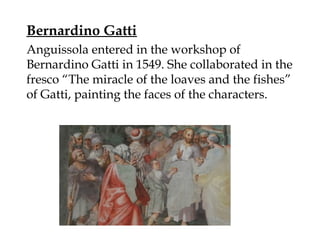
Bernardino Gatti
Anguissola entered in the workshop of
Bernardino Gatti in 1549. She collaborated in the
fresco “The miracle of the loaves and the fishes”
of Gatti, painting the faces of the characters.
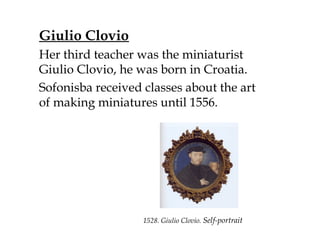
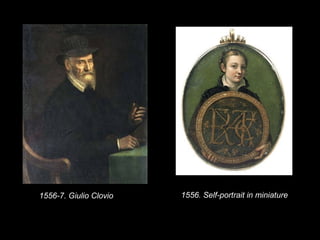
Giulio Clovio
Her third teacher was the miniaturist
Giulio Clovio, he was born in Croatia.
Sofonisba received classes about the art
of making miniatures until 1556.
1528. Giulio Clovio. Self-portrait 
1556-7. Giulio Clovio 1556. Self-portrait in miniature
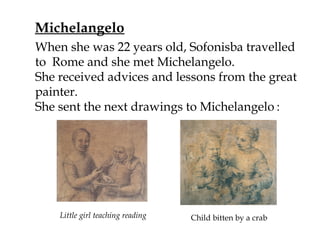
Michelangelo
Little girl teaching reading Child bitten by a crab
When she was 22 years old, Sofonisba travelled
to Rome and she met Michelangelo.
She received advices and lessons from the great
painter.
She sent the next drawings to Michelangelo :
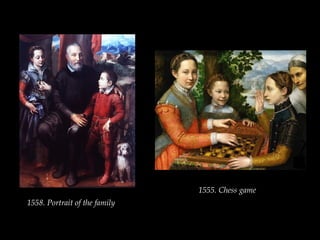
4. Familiar scenes and self-
portraits
At this time she made paintings of familiar
scenes in which she portrayed her brothers, her
father or her.
They are scenes of daily life, with intimate and
very human gestures.
Another of the favourite themes of that period
were the portraits.
1558. Portrait of the family
1555. Chess game
1555. Self-portrait with easel1554. Self-portrait playing the spinet
5. In Felipe's II Court
With help of the Duke of Alba, Anguissola went
to the Spanish Court to be the painting teacher
and the bridesmaid of Isabel of Valois (third
wife of Felipe II).
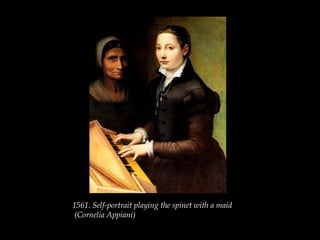
With 27 years, the painter arrived to Guadalajara
with her maid, Cornelia Appiani, after a trip of
forty days.
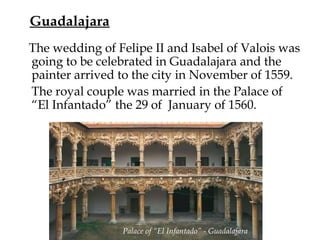
Guadalajara
The wedding of Felipe II and Isabel of Valois was
going to be celebrated in Guadalajara and the
painter arrived to the city in November of 1559. 
The royal couple was married in the Palace of
“El Infantado” the 29 of January of 1560.
Palace of “El Infantado” - Guadalajara
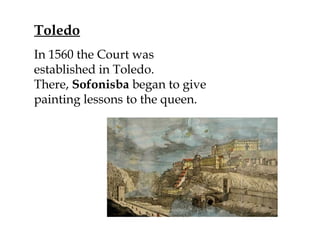
Toledo
In 1560 the Court was
established in Toledo.
There, Sofonisba began to give
painting lessons to the queen.
Cuadro realizado en España para
enviar a su familia
1561. Self-portrait playing the spinet with a maid
(Cornelia Appiani)
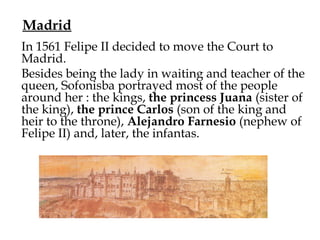
Madrid
In 1561 Felipe II decided to move the Court to
Madrid.
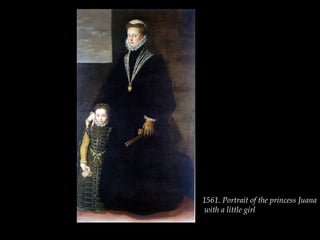
Besides being the lady in waiting and teacher of the
queen, Sofonisba portrayed most of the people
around her : the kings, the princess Juana (sister of
the king), the prince Carlos (son of the king and
heir to the throne), Alejandro Farnesio (nephew of
Felipe II) and, later, the infantas.
 
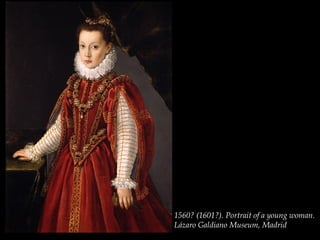
1560? (1601?). Portrait of a young woman.
Lázaro Galdiano Museum, Madrid
1561. Portrait of the princess Juana
with a little girl
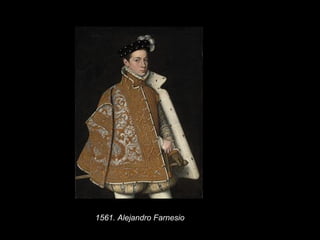
1561. Alejandro Farnesio
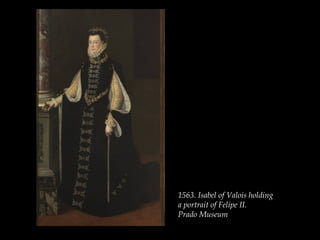
1563. Isabel of Valois holding
a portrait of Felipe II.
Prado Museum 
6. Death of the queen Isabel of
Valois
In 1568 Felipe II accused his son, the prince Carlos, of
betrayal, and he imprisoned him in the Alcazar of Madrid,
where he died.
The queen also died the same year (with 22 year).
In 1569 the king got married  for the fourth time with his
niece Ana of Austria.
  The situation of Anguissola didn't change and he took care
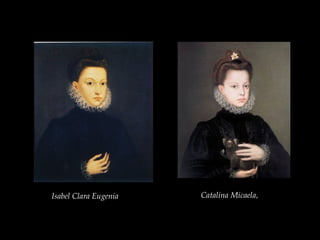
of the education of the infantas Isabel Clara Eugenia and
Catalina Micaela (daughters of Felipe II and Isabel of
Valois).
The portraits of the girls were very demanded because in
that moment they occupied the first place in the succession
of the throne.
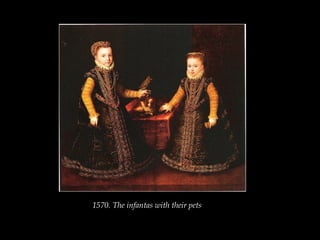
1570. The infantas with their pets
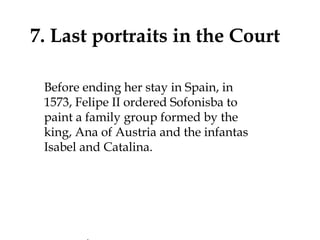
7. Last portraits in the Court
Before ending her stay in Spain, in
1573, Felipe II ordered Sofonisba to
paint a family group formed by the
king, Ana of Austria and the infantas
Isabel and Catalina. 
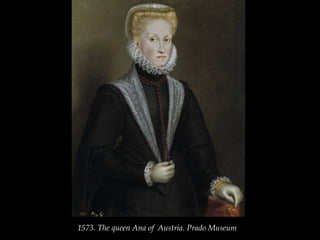
1573. The queen Ana of Austria. Prado Museum
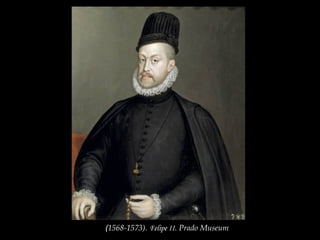
(1568-1573). Felipe II. Prado Museum
Isabel Clara Eugenia Catalina Micaela,
8. Marriage
In 1573 Anguissola got married with Fabrizio
Moncada, brother of the viceroy of Sicily and
finished her stay in Spain. She moved to Sicily.
Her husband died and she got married again in
1579, with Orazio Lomellino. She installed in
Genova and then in Palermo.
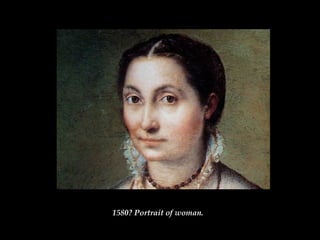
1580? Portrait of woman. 
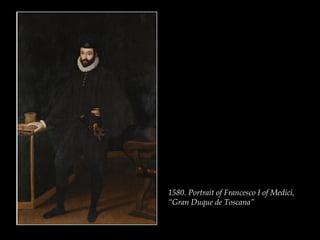
1580. Portrait of Francesco I of Medici,
“Gran Duque de Toscana”
9. Genova
During the years that Sofonisba lived in Genova she
continued painting and received visits from
younger painters who wanted to learn from her.
She mantained contact with the Spanish Court.
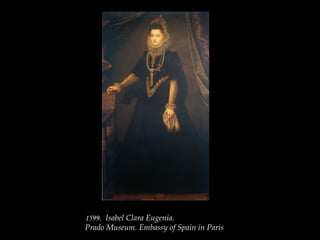
She painted a portrait of Isabel Clara Eugenia (she
was the governor of Flanders).
She also portrayed Catalina Micaela.
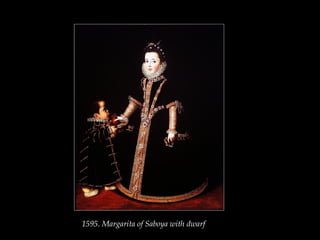
After the death of Catalina Micaela, Sofonisba
portrayed her oldest daughter Margarita of
Saboya.
1599.  Isabel Clara Eugenia.
Prado Museum. Embassy of Spain in Paris
1595. Margarita of Saboya with dwarf
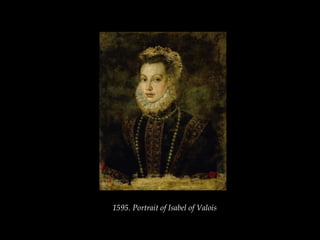
1595. Portrait of Isabel of Valois
10. Palermo
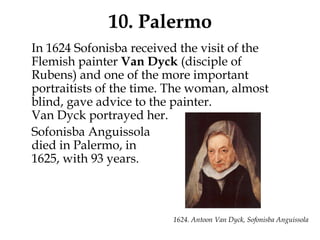
In 1624 Sofonisba received the visit of the
Flemish painter Van Dyck (disciple of
Rubens) and one of the more important
portraitists of the time. The woman, almost
blind, gave advice to the painter.
Van Dyck portrayed her.
Sofonisba Anguissola
died in Palermo, in
1625, with 93 years.
1624. Antoon Van Dyck, Sofonisba Anguissola
11. Anonymous work
The court painters of the king Felipe II were:
Antonio Moro, Alonso Sánchez
Coello and Juan Pantoja de la Cruz.
Sofonisba wasn´t a court painter, she never
signed her paintings and she never earned
money from them, although she accepted gifts.
Many of her paintings have been lost.
Other pictures were adjudicated to other painters
of the time.
In the last years, after making studies and
analysis, it was discovered that the paintings are
of Sofonisba.
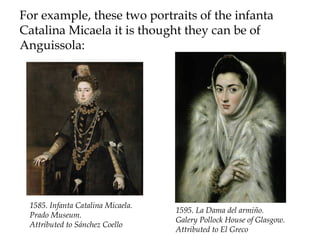
For example, these two portraits of the infanta
Catalina Micaela it is thought they can be of
Anguissola:
1585. Infanta Catalina Micaela.
Prado Museum.
Attributed to Sánchez Coello
1595. La Dama del armiño.
Galery Pollock House of Glasgow.
Attributed to El Greco
12. The painter in
Prado Museum
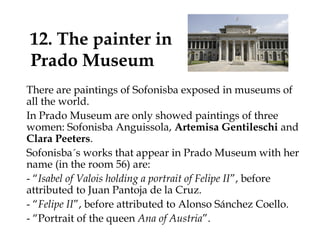
There are paintings of Sofonisba exposed in museums of
all the world.
In Prado Museum are only showed paintings of three
women: Sofonisba Anguissola, Artemisa Gentileschi and
Clara Peeters.
Sofonisba´s works that appear in Prado Museum with her
name (in the room 56) are:
- “Isabel of Valois holding a portrait of Felipe II”, before
attributed to Juan Pantoja de la Cruz.
- “Felipe II”, before attributed to Alonso Sánchez Coello.
- “Portrait of the queen Ana of Austria”.
13. Bibliography
 www.museodelprado.es
 Cristian Mielost. “Sofonisba Anguissola:
historia de una artista”. En: Revista Atticus,
2015, p. 47-57.
 cuadernodesofonisba.blogspot.com.es

Sofonisba Anguissola

  • 1.
  • 2.
    INDEX 1. Introduction 2. Childhood 3.Teachers 4. Familiar scenes and self-portraits 5. In Felipe's II Court 6. Death of the queen Isabel of Valois 7. Last portraits in the Court 8. Marriage 9. Genova 10. Palermo 11. Anonymous work 12. The painter in Prado Museum 13. Bibliography
  • 3.
    1. Introduction Sofonisba Anguissolais one of the most important female painters of the Renaissance. She was the painting teacher of the Court of Felipe II and she made many portraits for the Spanish royal family. Some of her works were copied by great painters (like Rubens). She is one of the few female painters that has paintings exhibited in the Prado Museum.
  • 4.
    2. Childhood Sofonisba wasborn in Cremona (Italy) in 1532. She was the daughter of a noble family. Her father was called Amilcare Anguissola and her mother Bianca Ponzone. She was the oldest of 7 brothers. Amilcare Anguissola Bianca Ponzone
  • 5.
    3. Teachers Anguissola couldn'tstudy human anatomy or paint images like nude paintings because of being woman. Her main teachers were: Bernardino Campi In 1543, Sofonisba began to receive painting classes with 11 years approximately. Her father enrolled her in the workshop of Bernardino Campi (the most famous school in Cremona).
  • 6.
    1559. Bernardino Campipainting Sofonisba Anguissola
  • 7.
    Bernardino Gatti Anguissola enteredin the workshop of Bernardino Gatti in 1549. She collaborated in the fresco “The miracle of the loaves and the fishes” of Gatti, painting the faces of the characters.
  • 8.
    Giulio Clovio Her thirdteacher was the miniaturist Giulio Clovio, he was born in Croatia. Sofonisba received classes about the art of making miniatures until 1556. 1528. Giulio Clovio. Self-portrait 
  • 9.
    1556-7. Giulio Clovio1556. Self-portrait in miniature
  • 10.
    Michelangelo Little girl teachingreading Child bitten by a crab When she was 22 years old, Sofonisba travelled to Rome and she met Michelangelo. She received advices and lessons from the great painter. She sent the next drawings to Michelangelo :
  • 11.
    4. Familiar scenesand self- portraits At this time she made paintings of familiar scenes in which she portrayed her brothers, her father or her. They are scenes of daily life, with intimate and very human gestures. Another of the favourite themes of that period were the portraits.
  • 12.
    1558. Portrait ofthe family 1555. Chess game
  • 13.
    1555. Self-portrait witheasel1554. Self-portrait playing the spinet
  • 14.
    5. In Felipe'sII Court With help of the Duke of Alba, Anguissola went to the Spanish Court to be the painting teacher and the bridesmaid of Isabel of Valois (third wife of Felipe II). With 27 years, the painter arrived to Guadalajara with her maid, Cornelia Appiani, after a trip of forty days.
  • 15.
    Guadalajara The wedding ofFelipe II and Isabel of Valois was going to be celebrated in Guadalajara and the painter arrived to the city in November of 1559.  The royal couple was married in the Palace of “El Infantado” the 29 of January of 1560. Palace of “El Infantado” - Guadalajara
  • 16.
    Toledo In 1560 theCourt was established in Toledo. There, Sofonisba began to give painting lessons to the queen.
  • 17.
    Cuadro realizado enEspaña para enviar a su familia 1561. Self-portrait playing the spinet with a maid (Cornelia Appiani)
  • 18.
    Madrid In 1561 FelipeII decided to move the Court to Madrid. Besides being the lady in waiting and teacher of the queen, Sofonisba portrayed most of the people around her : the kings, the princess Juana (sister of the king), the prince Carlos (son of the king and heir to the throne), Alejandro Farnesio (nephew of Felipe II) and, later, the infantas.  
  • 19.
    1560? (1601?). Portraitof a young woman. Lázaro Galdiano Museum, Madrid
  • 20.
    1561. Portrait ofthe princess Juana with a little girl
  • 21.
  • 22.
    1563. Isabel ofValois holding a portrait of Felipe II. Prado Museum 
  • 23.
    6. Death ofthe queen Isabel of Valois In 1568 Felipe II accused his son, the prince Carlos, of betrayal, and he imprisoned him in the Alcazar of Madrid, where he died. The queen also died the same year (with 22 year). In 1569 the king got married  for the fourth time with his niece Ana of Austria.   The situation of Anguissola didn't change and he took care of the education of the infantas Isabel Clara Eugenia and Catalina Micaela (daughters of Felipe II and Isabel of Valois). The portraits of the girls were very demanded because in that moment they occupied the first place in the succession of the throne.
  • 24.
    1570. The infantaswith their pets
  • 25.
    7. Last portraitsin the Court Before ending her stay in Spain, in 1573, Felipe II ordered Sofonisba to paint a family group formed by the king, Ana of Austria and the infantas Isabel and Catalina. 
  • 26.
    1573. The queenAna of Austria. Prado Museum
  • 27.
  • 28.
    Isabel Clara EugeniaCatalina Micaela,
  • 29.
    8. Marriage In 1573Anguissola got married with Fabrizio Moncada, brother of the viceroy of Sicily and finished her stay in Spain. She moved to Sicily. Her husband died and she got married again in 1579, with Orazio Lomellino. She installed in Genova and then in Palermo.
  • 30.
  • 31.
    1580. Portrait ofFrancesco I of Medici, “Gran Duque de Toscana”
  • 32.
    9. Genova During theyears that Sofonisba lived in Genova she continued painting and received visits from younger painters who wanted to learn from her. She mantained contact with the Spanish Court. She painted a portrait of Isabel Clara Eugenia (she was the governor of Flanders). She also portrayed Catalina Micaela. After the death of Catalina Micaela, Sofonisba portrayed her oldest daughter Margarita of Saboya.
  • 33.
    1599.  Isabel ClaraEugenia. Prado Museum. Embassy of Spain in Paris
  • 34.
    1595. Margarita ofSaboya with dwarf
  • 35.
    1595. Portrait ofIsabel of Valois
  • 36.
    10. Palermo In 1624Sofonisba received the visit of the Flemish painter Van Dyck (disciple of Rubens) and one of the more important portraitists of the time. The woman, almost blind, gave advice to the painter. Van Dyck portrayed her. Sofonisba Anguissola died in Palermo, in 1625, with 93 years. 1624. Antoon Van Dyck, Sofonisba Anguissola
  • 37.
    11. Anonymous work Thecourt painters of the king Felipe II were: Antonio Moro, Alonso Sánchez Coello and Juan Pantoja de la Cruz. Sofonisba wasn´t a court painter, she never signed her paintings and she never earned money from them, although she accepted gifts. Many of her paintings have been lost. Other pictures were adjudicated to other painters of the time. In the last years, after making studies and analysis, it was discovered that the paintings are of Sofonisba.
  • 38.
    For example, thesetwo portraits of the infanta Catalina Micaela it is thought they can be of Anguissola: 1585. Infanta Catalina Micaela. Prado Museum. Attributed to Sánchez Coello 1595. La Dama del armiño. Galery Pollock House of Glasgow. Attributed to El Greco
  • 39.
    12. The painterin Prado Museum There are paintings of Sofonisba exposed in museums of all the world. In Prado Museum are only showed paintings of three women: Sofonisba Anguissola, Artemisa Gentileschi and Clara Peeters. Sofonisba´s works that appear in Prado Museum with her name (in the room 56) are: - “Isabel of Valois holding a portrait of Felipe II”, before attributed to Juan Pantoja de la Cruz. - “Felipe II”, before attributed to Alonso Sánchez Coello. - “Portrait of the queen Ana of Austria”.
  • 40.
    13. Bibliography  www.museodelprado.es Cristian Mielost. “Sofonisba Anguissola: historia de una artista”. En: Revista Atticus, 2015, p. 47-57.  cuadernodesofonisba.blogspot.com.es