Von Willebrand Disease

    Gerald A Soff, MD
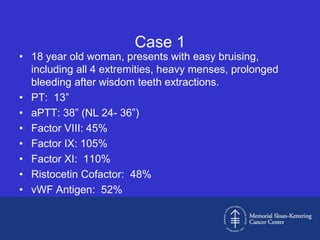
Case 1
• 18 year old woman, presents with easy bruising,
  including all 4 extremities, heavy menses, prolonged
  bleeding after wisdom teeth extractions.
• PT: 13”
• aPTT: 38” (NL 24- 36”)
• Factor VIII: 45%
• Factor IX: 105%
• Factor XI: 110%
• Ristocetin Cofactor: 48%
• vWF Antigen: 52%
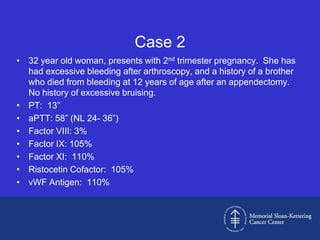
Case 2
• 32 year old woman, presents with 2nd trimester pregnancy. She has
  had excessive bleeding after arthroscopy, and a history of a brother
  who died from bleeding at 12 years of age after an appendectomy.
  No history of excessive bruising.
• PT: 13”
• aPTT: 58” (NL 24- 36”)
• Factor VIII: 3%
• Factor IX: 105%
• Factor XI: 110%
• Ristocetin Cofactor: 105%
• vWF Antigen: 110%
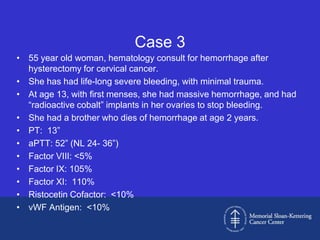
Case 3
• 55 year old woman, hematology consult for hemorrhage after
  hysterectomy for cervical cancer.
• She has had life-long severe bleeding, with minimal trauma.
• At age 13, with first menses, she had massive hemorrhage, and had
  “radioactive cobalt” implants in her ovaries to stop bleeding.
• She had a brother who dies of hemorrhage at age 2 years.
• PT: 13”
• aPTT: 52” (NL 24- 36”)
• Factor VIII: <5%
• Factor IX: 105%
• Factor XI: 110%
• Ristocetin Cofactor: <10%
• vWF Antigen: <10%
All Three Cases Have “von
         Willebrand Disease”
Case 1: Type I
All Three Cases Have “von
        Willebrand Disease”
• Case 1: Type I
• Case 2: vWD Normandy
All Three Cases Have “von
        Willebrand Disease”
Case 1: Type I
Case 2: vWD Normandy
Case 3: Type III
Von Willebrand’s Disease
 Definition; An autosomally inherited hemorrhagic
  disorder
   – Defective platelet adhesion
   – Reduced Factor VIII levels
   – A mucocutaneous pattern of bleeding
 First described by the Finnish physician Erik von
  Willebrand in 1926
 Many members of a large family from the Aland Islands in
  the Gulf of Bothnia had a bleeding disorder with a distinct
  inherited pattern.
von Willebrand Disease (VWD):
                Overview
   Common inherited bleeding disorder
   Characterized by deficiency of von Willebrand factor (VWF)
   Variable clinical manifestations
   A group of disorders, (Different types).

    – Ewenstein B. Annu Rev Med. 1997;48:525-542;
    – Hambleton J. Curr Opin Hematol. 2001;8:306-311;
    – Murray E, Lillicrap D. Transfus Med Rev. 1996;10:93-110.
VWD Prevalence
• Von Willebrand disease (VWD) is the most common
  congenital bleeding disorder.
• It is estimated to occur at a frequency of 1-3%, but is
  symptomatic in only about one in 10,000.
• Caused by mutations in von Willebrand factor (VWF).
• The gene for von Willebrand Factor is located on
  chromosome 12, and the disease is inherited in an
  autosomal manner.
Von Willebrand Factor
• vWF is a large adhesive glycoprotein that is present in
  the circulation as a heterogeneous population of
  disulfide-linked multimers of 250,000 molecular weight
  subunit, ranging from a dimer (Mr about 500,000) to a
  polymer of about 80 subunits (Mr about 20 x 106 ).
• Human vWF is synthesized as preprovWF (Mr
  approximately 350,000) comprising a 22-residue signal
  sequence, a 741-residue propeptide, and a 2050-residue
  polypeptide that represents the basic subunit of the
  mature protein
Von Willebrand Factor
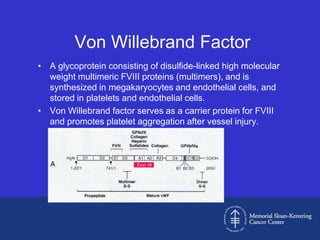
• A glycoprotein consisting of disulfide-linked high molecular
  weight multimeric FVIII proteins (multimers), and is
  synthesized in megakaryocytes and endothelial cells, and
  stored in platelets and endothelial cells.
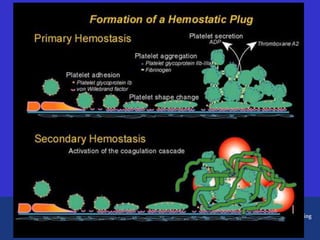
• Von Willebrand factor serves as a carrier protein for FVIII
  and promotes platelet aggregation after vessel injury.
Von Willebrand Factor


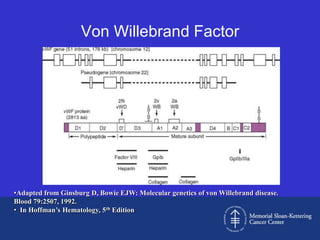
•Adapted from Ginsburg D, Bowie EJW: Molecular genetics of von Willebrand disease.
Blood 79:2507, 1992.
• In Hoffman’s Hematology, 5th Edition
The sites of cellular biosynthesis
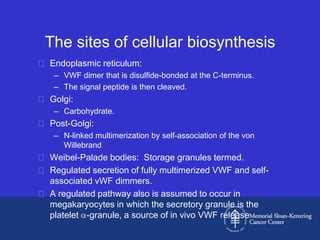
 Endoplasmic reticulum:
   – VWF dimer that is disulfide-bonded at the C-terminus.
   – The signal peptide is then cleaved.
 Golgi:
   – Carbohydrate.
 Post-Golgi:
   – N-linked multimerization by self-association of the von
     Willebrand
 Weibel-Palade bodies: Storage granules termed.
 Regulated secretion of fully multimerized VWF and self-
  associated vWF dimmers.
 A regulated pathway also is assumed to occur in
  megakaryocytes in which the secretory granule is the
  platelet -granule, a source of in vivo VWF release
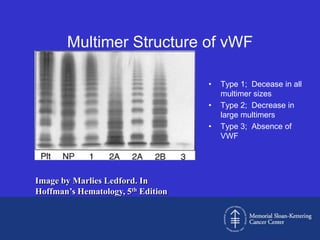
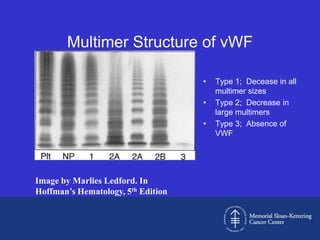
Multimer Structure of vWF

                                    •   Type 1; Decease in all
                                        multimer sizes
                                    •   Type 2; Decrease in
                                        large multimers
                                    •   Type 3; Absence of
                                        VWF


Image by Marlies Ledford. In
Hoffman’s Hematology, 5th Edition
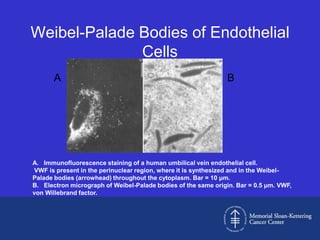
Weibel-Palade Bodies of Endothelial
              Cells
       A                                                       B


A. Immunofluorescence staining of a human umbilical vein endothelial cell.
VWF is present in the perinuclear region, where it is synthesized and in the Weibel-
Palade bodies (arrowhead) throughout the cytoplasm. Bar = 10 μm.
B. Electron micrograph of Weibel-Palade bodies of the same origin. Bar = 0.5 μm. VWF,
von Willebrand factor.
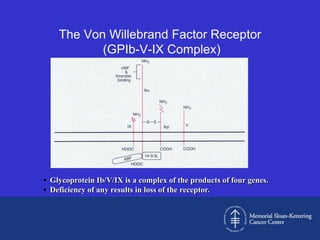
The Von Willebrand Factor Receptor
           (GPIb-V-IX Complex)


• Glycoprotein Ib/V/IX is a complex of the products of four genes.
• Deficiency of any results in loss of the receptor.
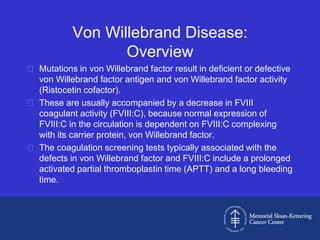
Von Willebrand Disease:
                  Overview
 Mutations in von Willebrand factor result in deficient or defective
  von Willebrand factor antigen and von Willebrand factor activity
  (Ristocetin cofactor).
 These are usually accompanied by a decrease in FVIII
  coagulant activity (FVIII:C), because normal expression of
  FVIII:C in the circulation is dependent on FVIII:C complexing
  with its carrier protein, von Willebrand factor.
 The coagulation screening tests typically associated with the
  defects in von Willebrand factor and FVIII:C include a prolonged
  activated partial thromboplastin time (APTT) and a long bleeding
  time.
Symptoms of vWD; Mucocutaneous
            Bleeding
• Easy bruising
• Epistaxis
• Postoperative or Posttraumatic bleeding
• Mucosal Bleeding
   – Gastrointestinal
   – Genitourinary tracts.
• Menorrhagia.
• Rare for hemarthrosis, deep bleeds.
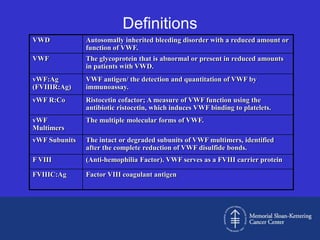
Definitions
VWD            Autosomally inherited bleeding disorder with a reduced amount or
               function of VWF.
VWF            The glycoprotein that is abnormal or present in reduced amounts
               in patients with VWD.
vWF:Ag         VWF antigen/ the detection and quantitation of VWF by
(FVIIIR:Ag)    immunoassay.
vWF R:Co       Ristocetin cofactor; A measure of VWF function using the
               antibiotic ristocetin, which induces VWF binding to platelets.
vWF            The multiple molecular forms of VWF.
Multimers
vWF Subunits   The intact or degraded subunits of VWF multimers, identified
               after the complete reduction of VWF disulfide bonds.
F VIII         (Anti-hemophilia Factor). VWF serves as a FVIII carrier protein

FVIIIC:Ag      Factor VIII coagulant antigen
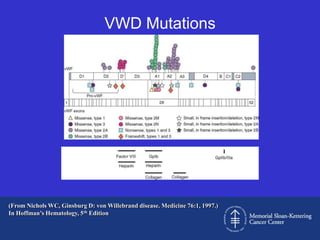
VWD Mutations


(From Nichols WC, Ginsburg D: von Willebrand disease. Medicine 76:1, 1997.)
In Hoffman’s Hematology, 5th Edition
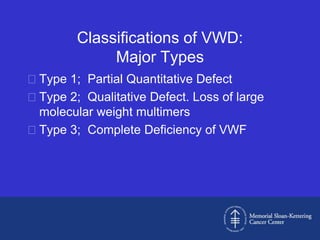
Classifications of VWD:
             Major Types
Type 1; Partial Quantitative Defect
Type 2; Qualitative Defect. Loss of large
 molecular weight multimers
Type 3; Complete Deficiency of VWF
Multimer Structure of vWF

                                    •   Type 1; Decease in all
                                        multimer sizes
                                    •   Type 2; Decrease in
                                        large multimers
                                    •   Type 3; Absence of
                                        VWF


Image by Marlies Ledford. In
Hoffman’s Hematology, 5th Edition
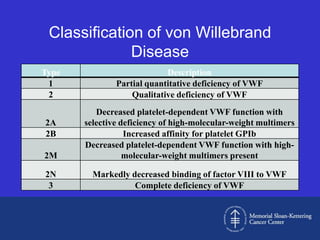
Classification of von Willebrand
              Disease
Type                        Description
 1             Partial quantitative deficiency of VWF
 2                 Qualitative deficiency of VWF
          Decreased platelet-dependent VWF function with
2A     selective deficiency of high-molecular-weight multimers
2B                Increased affinity for platelet GPIb
       Decreased platelet-dependent VWF function with high-
2M                molecular-weight multimers present

2N       Markedly decreased binding of factor VIII to VWF
 3                 Complete deficiency of VWF
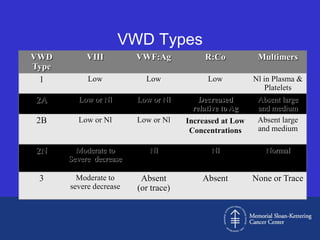
VWD Types
VWD         VIII         VWF:Ag            R:Co           Multimers
Type
 1          Low            Low              Low          Nl in Plasma &
                                                             Platelets
2A       Low or Nl       Low or Nl       Decreased        Absent large
                                       relative to Ag     and medium
 2B      Low or Nl       Low or Nl    Increased at Low    Absent large
                                       Concentrations     and medium

2N       Moderate to        Nl              Nl              Normal
       Severe decrease

 3       Moderate to      Absent          Absent         None or Trace
       severe decrease   (or trace)
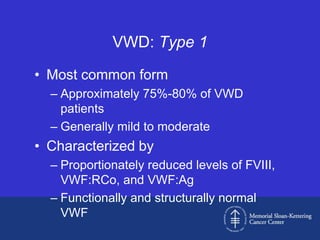
VWD: Type 1

• Most common form
  – Approximately 75%-80% of VWD
    patients
  – Generally mild to moderate
• Characterized by
  – Proportionately reduced levels of FVIII,
    VWF:RCo, and VWF:Ag
  – Functionally and structurally normal
    VWF
VWD: Type 2 Variants

• Approximately 15%-21% of
  patients with VWD
• Qualitative VWF abnormality
• Most common variants are 2A, 2B,
  2M, 2N
VWD: Type 2A

Absence of large and intermediate-
 sized
 VWF multimers
10%-12% of all VWD patients
Mutations result in either
  – Increased proteolysis or
  – Decreased cellular processing and
    release
VWD: Type 2B

• Increased VWF affinity for platelet
  GPlb and secondary clearance of
  large-sized multimers
• 3%-5% of all VWD patients
• Thrombocytopenia may be present.
VWD: Type 2N
• Also called VWD Normandy and autosomal
  hemophilia
• 1%-2% of all VWD patients
• Mutation in region of FVIII binding
• Autosomal recessive inheritance
• Compound heterozygotes with type 1 VWD or
  true homozygotes are those that are clinically
  affected
• Sometimes misdiagnosed as mild hemophilia
VWD: Type 2M

• Characterized by decreased
  binding to platelet GPIb
• 1%-2% of all VWD patients
• Abnormal multimers, but not
  associated with selective loss of
  large molecular weight forms.
VWD: Type 3
• 1%-3% of all VWD patients
• Characterized by virtually no detectable VWF:Ag
  and markedly decreased FVIII:C (< 5 U/dL)
• Patients suffer from severe, spontaneous bleeds
   – Mucosal bleeds are common
   – May experience joint bleeds similar to
       hemophilia
• Inhibitors to VWF may develop following
  replacement therapy.
Approach to the Assessment of vWD

 Bleeding history
   – Family History
 Complete blood cell count
 vWD profile testing
   – vWF:Ag
   – vWF:RCo
   – fVIII:C
 ABO Blood Type
Diagnosing VWD:
               Initial Evaluation
 Detailed personal and family history is key
 Screening laboratory values are often normal
   – Platelet count
   – Prothrombin time (PT)
   – Activated partial thromboplastin time (aPTT)
 Bleeding time (BT) is an insensitive screening tool for
  type 1 disease

 Hambleton J. Curr Opin Hematol. 2001;8:306-311.
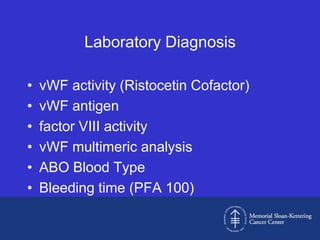
Laboratory Diagnosis

•   vWF activity (Ristocetin Cofactor)
•   vWF antigen
•   factor VIII activity
•   vWF multimeric analysis
•   ABO Blood Type
•   Bleeding time (PFA 100)
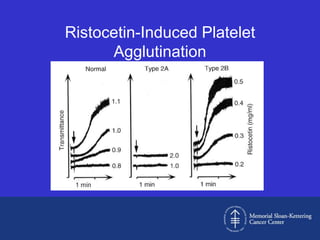
Ristocetin-Induced Platelet
      Agglutination
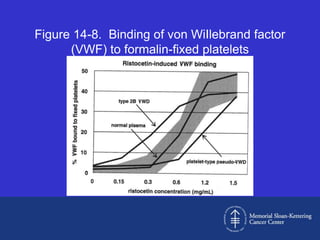
Figure 14-8. Binding of von WiIlebrand factor
      (VWF) to formalin-fixed platelets
Effects of ABO Blood Group on
                  vWF Levels
    ABO Type            N         Mean (%)        Mean +/- 2 SD
                                                       (%)
        O              456            74.8         (35.6-157.0)
        A              240           105.9         (48.0-233.9)
        B              196           116.9         (56.8-241.0)
        AB             109           123.3         (63.8-238.2)
Gill JC, Endres-Brooks J, Bauer PJ, et al: The effect of ABO blood group
on the diagnosis of von Willebrand disease. Blood 1987; 69:1691.
Modifying Conditions
•   Conditions associated with higher VWF levels
     –   Age
     –   Acute and chronic inflammation
     –   Diabetes
     –   Malignancy
     –   Pregnancy or oral contraceptive use
     –   Stress; exercise
     –   Hyperthyroidism
•   Conditions associated with reduced VWF levels
     –   Hypothyroidism
     –   O Blood type
Treatment of vWD
Treatment of vWD
 DDAVP; 0.3 ug/kg IV daily for 1-2 doses
   – (Stimate by nasal spray, 100 ug/spray. 10%
     bioavailability)
   – Good for mild or prophylactic therapy
   – Can worsen Type 2B (Thrombocytopenia) and no good
     for type 3
   – Best to test dose in nonemergent setting.
 Humate P (F VIII Concentrate with large multimers)
   – Minor bleed; 15-20 Un/kg IV, and repeat q 24 as
     needed.
   – Major bleeds; 40-50 U/Kg, then 20-30 U/kg q 12 hr.
   – (Dose based on R:Co activity, 0.5 R:Co/1.0 FVIII
     Units)
Treatment: Mild VWD
• Specific therapies include
  – DDAVP (synthetic derivative of
    vasopressin)
     • Parenteral (IV or SQ)
     • Intranasal (high concentrations)
  – Plasma-derived FVIII products containing
    high concentrations of VWF
     • Humate-P (FDA approved), Alphanate, Koate
     • DO NOT use cryoprecipiate
Treatment: VWD

• Adjuvant therapies
  – Antifibrinolytics
     • Amicar, cyklocapron
  – Fibrin glue
  – PO or parenteral estrogen
DDAVP
• A synthetic version of vasopressin
• Increases plasma VWF concentrations
  by stimulating its release from
  intracellular stores in endothelial cells
• Treatment of choice for type 1
• Variable response in types 2A, 2B, and
  2M
• Ineffective in type 3
                                         (cont)
DDAVP
• Side effects include
  – Flushing
  – Hyponatremia, seizures
  – Headache
  – Abdominal cramps
  – Alteration in blood pressure
• Tachyphylaxis may occur if dosed too
  frequently
DDAVP: Indications
 Generally used as treatment for spontaneous or
  trauma-induced injuries in patients with mild to
  moderate VWD
 Frequently used to treat
   – Mucosal bleeding
   – Menorrhagia
   – Minor surgical procedures after documenting
      patient response
 Contraindicated in individuals with known
  hypersensitivity or significant side effects
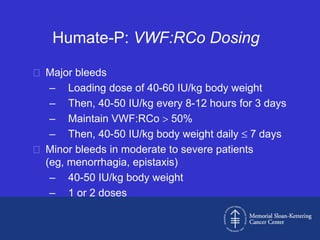
Humate-P: VWF:RCo Dosing

 Major bleeds
   – Loading dose of 40-60 IU/kg body weight
   – Then, 40-50 IU/kg every 8-12 hours for 3 days
   – Maintain VWF:RCo 50%
   – Then, 40-50 IU/kg body weight daily 7 days
 Minor bleeds in moderate to severe patients
  (eg, menorrhagia, epistaxis)
   – 40-50 IU/kg body weight
   – 1 or 2 doses
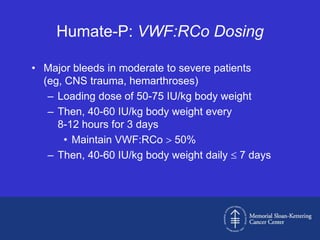
Humate-P: VWF:RCo Dosing

• Major bleeds in moderate to severe patients
  (eg, CNS trauma, hemarthroses)
   – Loading dose of 50-75 IU/kg body weight
   – Then, 40-60 IU/kg body weight every
     8-12 hours for 3 days
       • Maintain VWF:RCo 50%
   – Then, 40-60 IU/kg body weight daily 7 days
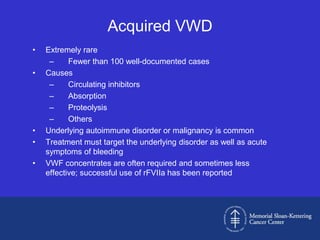
Acquired VWD
•   Extremely rare
     –     Fewer than 100 well-documented cases
•   Causes
     –     Circulating inhibitors
     –     Absorption
     –     Proteolysis
     –     Others
•   Underlying autoimmune disorder or malignancy is common
•   Treatment must target the underlying disorder as well as acute
    symptoms of bleeding
•   VWF concentrates are often required and sometimes less
    effective; successful use of rFVIIa has been reported
Pseudo-VWD

• Rare disorder characterized by an intrinsic
  platelet defect with increased affinity of
  GPIb/IX for VWF
• Increased aggregation on RIPA as with
  subtype 2B
• Distinction that the patient has a platelet
  disorder as opposed to VWD is determined
  by additional testing
vWD

vWD

  • 1.
    Von Willebrand Disease Gerald A Soff, MD
  • 2.
    Case 1 • 18year old woman, presents with easy bruising, including all 4 extremities, heavy menses, prolonged bleeding after wisdom teeth extractions. • PT: 13” • aPTT: 38” (NL 24- 36”) • Factor VIII: 45% • Factor IX: 105% • Factor XI: 110% • Ristocetin Cofactor: 48% • vWF Antigen: 52%
  • 3.
    Case 2 • 32year old woman, presents with 2nd trimester pregnancy. She has had excessive bleeding after arthroscopy, and a history of a brother who died from bleeding at 12 years of age after an appendectomy. No history of excessive bruising. • PT: 13” • aPTT: 58” (NL 24- 36”) • Factor VIII: 3% • Factor IX: 105% • Factor XI: 110% • Ristocetin Cofactor: 105% • vWF Antigen: 110%
  • 4.
    Case 3 • 55year old woman, hematology consult for hemorrhage after hysterectomy for cervical cancer. • She has had life-long severe bleeding, with minimal trauma. • At age 13, with first menses, she had massive hemorrhage, and had “radioactive cobalt” implants in her ovaries to stop bleeding. • She had a brother who dies of hemorrhage at age 2 years. • PT: 13” • aPTT: 52” (NL 24- 36”) • Factor VIII: <5% • Factor IX: 105% • Factor XI: 110% • Ristocetin Cofactor: <10% • vWF Antigen: <10%
  • 5.
    All Three CasesHave “von Willebrand Disease” Case 1: Type I
  • 6.
    All Three CasesHave “von Willebrand Disease” • Case 1: Type I • Case 2: vWD Normandy
  • 7.
    All Three CasesHave “von Willebrand Disease” Case 1: Type I Case 2: vWD Normandy Case 3: Type III
  • 8.
    Von Willebrand’s Disease Definition; An autosomally inherited hemorrhagic disorder – Defective platelet adhesion – Reduced Factor VIII levels – A mucocutaneous pattern of bleeding  First described by the Finnish physician Erik von Willebrand in 1926  Many members of a large family from the Aland Islands in the Gulf of Bothnia had a bleeding disorder with a distinct inherited pattern.
  • 9.
    von Willebrand Disease(VWD): Overview  Common inherited bleeding disorder  Characterized by deficiency of von Willebrand factor (VWF)  Variable clinical manifestations  A group of disorders, (Different types). – Ewenstein B. Annu Rev Med. 1997;48:525-542; – Hambleton J. Curr Opin Hematol. 2001;8:306-311; – Murray E, Lillicrap D. Transfus Med Rev. 1996;10:93-110.
  • 10.
    VWD Prevalence • VonWillebrand disease (VWD) is the most common congenital bleeding disorder. • It is estimated to occur at a frequency of 1-3%, but is symptomatic in only about one in 10,000. • Caused by mutations in von Willebrand factor (VWF). • The gene for von Willebrand Factor is located on chromosome 12, and the disease is inherited in an autosomal manner.
  • 11.
    Von Willebrand Factor •vWF is a large adhesive glycoprotein that is present in the circulation as a heterogeneous population of disulfide-linked multimers of 250,000 molecular weight subunit, ranging from a dimer (Mr about 500,000) to a polymer of about 80 subunits (Mr about 20 x 106 ). • Human vWF is synthesized as preprovWF (Mr approximately 350,000) comprising a 22-residue signal sequence, a 741-residue propeptide, and a 2050-residue polypeptide that represents the basic subunit of the mature protein
  • 12.
    Von Willebrand Factor •A glycoprotein consisting of disulfide-linked high molecular weight multimeric FVIII proteins (multimers), and is synthesized in megakaryocytes and endothelial cells, and stored in platelets and endothelial cells. • Von Willebrand factor serves as a carrier protein for FVIII and promotes platelet aggregation after vessel injury.
  • 13.
    Von Willebrand Factor •Adaptedfrom Ginsburg D, Bowie EJW: Molecular genetics of von Willebrand disease. Blood 79:2507, 1992. • In Hoffman’s Hematology, 5th Edition
  • 14.
    The sites ofcellular biosynthesis  Endoplasmic reticulum: – VWF dimer that is disulfide-bonded at the C-terminus. – The signal peptide is then cleaved.  Golgi: – Carbohydrate.  Post-Golgi: – N-linked multimerization by self-association of the von Willebrand  Weibel-Palade bodies: Storage granules termed.  Regulated secretion of fully multimerized VWF and self- associated vWF dimmers.  A regulated pathway also is assumed to occur in megakaryocytes in which the secretory granule is the platelet -granule, a source of in vivo VWF release
  • 15.
    Multimer Structure ofvWF • Type 1; Decease in all multimer sizes • Type 2; Decrease in large multimers • Type 3; Absence of VWF Image by Marlies Ledford. In Hoffman’s Hematology, 5th Edition
  • 16.
    Weibel-Palade Bodies ofEndothelial Cells A B A. Immunofluorescence staining of a human umbilical vein endothelial cell. VWF is present in the perinuclear region, where it is synthesized and in the Weibel- Palade bodies (arrowhead) throughout the cytoplasm. Bar = 10 μm. B. Electron micrograph of Weibel-Palade bodies of the same origin. Bar = 0.5 μm. VWF, von Willebrand factor.
  • 17.
    The Von WillebrandFactor Receptor (GPIb-V-IX Complex) • Glycoprotein Ib/V/IX is a complex of the products of four genes. • Deficiency of any results in loss of the receptor.
  • 19.
    Von Willebrand Disease: Overview  Mutations in von Willebrand factor result in deficient or defective von Willebrand factor antigen and von Willebrand factor activity (Ristocetin cofactor).  These are usually accompanied by a decrease in FVIII coagulant activity (FVIII:C), because normal expression of FVIII:C in the circulation is dependent on FVIII:C complexing with its carrier protein, von Willebrand factor.  The coagulation screening tests typically associated with the defects in von Willebrand factor and FVIII:C include a prolonged activated partial thromboplastin time (APTT) and a long bleeding time.
  • 20.
    Symptoms of vWD;Mucocutaneous Bleeding • Easy bruising • Epistaxis • Postoperative or Posttraumatic bleeding • Mucosal Bleeding – Gastrointestinal – Genitourinary tracts. • Menorrhagia. • Rare for hemarthrosis, deep bleeds.
  • 21.
    Definitions VWD Autosomally inherited bleeding disorder with a reduced amount or function of VWF. VWF The glycoprotein that is abnormal or present in reduced amounts in patients with VWD. vWF:Ag VWF antigen/ the detection and quantitation of VWF by (FVIIIR:Ag) immunoassay. vWF R:Co Ristocetin cofactor; A measure of VWF function using the antibiotic ristocetin, which induces VWF binding to platelets. vWF The multiple molecular forms of VWF. Multimers vWF Subunits The intact or degraded subunits of VWF multimers, identified after the complete reduction of VWF disulfide bonds. F VIII (Anti-hemophilia Factor). VWF serves as a FVIII carrier protein FVIIIC:Ag Factor VIII coagulant antigen
  • 22.
    VWD Mutations (From NicholsWC, Ginsburg D: von Willebrand disease. Medicine 76:1, 1997.) In Hoffman’s Hematology, 5th Edition
  • 23.
    Classifications of VWD: Major Types Type 1; Partial Quantitative Defect Type 2; Qualitative Defect. Loss of large molecular weight multimers Type 3; Complete Deficiency of VWF
  • 24.
    Multimer Structure ofvWF • Type 1; Decease in all multimer sizes • Type 2; Decrease in large multimers • Type 3; Absence of VWF Image by Marlies Ledford. In Hoffman’s Hematology, 5th Edition
  • 25.
    Classification of vonWillebrand Disease Type Description 1 Partial quantitative deficiency of VWF 2 Qualitative deficiency of VWF Decreased platelet-dependent VWF function with 2A selective deficiency of high-molecular-weight multimers 2B Increased affinity for platelet GPIb Decreased platelet-dependent VWF function with high- 2M molecular-weight multimers present 2N Markedly decreased binding of factor VIII to VWF 3 Complete deficiency of VWF
  • 26.
    VWD Types VWD VIII VWF:Ag R:Co Multimers Type 1 Low Low Low Nl in Plasma & Platelets 2A Low or Nl Low or Nl Decreased Absent large relative to Ag and medium 2B Low or Nl Low or Nl Increased at Low Absent large Concentrations and medium 2N Moderate to Nl Nl Normal Severe decrease 3 Moderate to Absent Absent None or Trace severe decrease (or trace)
  • 27.
    VWD: Type 1 •Most common form – Approximately 75%-80% of VWD patients – Generally mild to moderate • Characterized by – Proportionately reduced levels of FVIII, VWF:RCo, and VWF:Ag – Functionally and structurally normal VWF
  • 28.
    VWD: Type 2Variants • Approximately 15%-21% of patients with VWD • Qualitative VWF abnormality • Most common variants are 2A, 2B, 2M, 2N
  • 29.
    VWD: Type 2A Absenceof large and intermediate- sized VWF multimers 10%-12% of all VWD patients Mutations result in either – Increased proteolysis or – Decreased cellular processing and release
  • 30.
    VWD: Type 2B •Increased VWF affinity for platelet GPlb and secondary clearance of large-sized multimers • 3%-5% of all VWD patients • Thrombocytopenia may be present.
  • 31.
    VWD: Type 2N •Also called VWD Normandy and autosomal hemophilia • 1%-2% of all VWD patients • Mutation in region of FVIII binding • Autosomal recessive inheritance • Compound heterozygotes with type 1 VWD or true homozygotes are those that are clinically affected • Sometimes misdiagnosed as mild hemophilia
  • 32.
    VWD: Type 2M •Characterized by decreased binding to platelet GPIb • 1%-2% of all VWD patients • Abnormal multimers, but not associated with selective loss of large molecular weight forms.
  • 33.
    VWD: Type 3 •1%-3% of all VWD patients • Characterized by virtually no detectable VWF:Ag and markedly decreased FVIII:C (< 5 U/dL) • Patients suffer from severe, spontaneous bleeds – Mucosal bleeds are common – May experience joint bleeds similar to hemophilia • Inhibitors to VWF may develop following replacement therapy.
  • 34.
    Approach to theAssessment of vWD  Bleeding history – Family History  Complete blood cell count  vWD profile testing – vWF:Ag – vWF:RCo – fVIII:C  ABO Blood Type
  • 35.
    Diagnosing VWD: Initial Evaluation  Detailed personal and family history is key  Screening laboratory values are often normal – Platelet count – Prothrombin time (PT) – Activated partial thromboplastin time (aPTT)  Bleeding time (BT) is an insensitive screening tool for type 1 disease  Hambleton J. Curr Opin Hematol. 2001;8:306-311.
  • 36.
    Laboratory Diagnosis • vWF activity (Ristocetin Cofactor) • vWF antigen • factor VIII activity • vWF multimeric analysis • ABO Blood Type • Bleeding time (PFA 100)
  • 37.
  • 38.
    Figure 14-8. Bindingof von WiIlebrand factor (VWF) to formalin-fixed platelets
  • 39.
    Effects of ABOBlood Group on vWF Levels ABO Type N Mean (%) Mean +/- 2 SD (%) O 456 74.8 (35.6-157.0) A 240 105.9 (48.0-233.9) B 196 116.9 (56.8-241.0) AB 109 123.3 (63.8-238.2) Gill JC, Endres-Brooks J, Bauer PJ, et al: The effect of ABO blood group on the diagnosis of von Willebrand disease. Blood 1987; 69:1691.
  • 40.
    Modifying Conditions • Conditions associated with higher VWF levels – Age – Acute and chronic inflammation – Diabetes – Malignancy – Pregnancy or oral contraceptive use – Stress; exercise – Hyperthyroidism • Conditions associated with reduced VWF levels – Hypothyroidism – O Blood type
  • 41.
  • 42.
    Treatment of vWD DDAVP; 0.3 ug/kg IV daily for 1-2 doses – (Stimate by nasal spray, 100 ug/spray. 10% bioavailability) – Good for mild or prophylactic therapy – Can worsen Type 2B (Thrombocytopenia) and no good for type 3 – Best to test dose in nonemergent setting.  Humate P (F VIII Concentrate with large multimers) – Minor bleed; 15-20 Un/kg IV, and repeat q 24 as needed. – Major bleeds; 40-50 U/Kg, then 20-30 U/kg q 12 hr. – (Dose based on R:Co activity, 0.5 R:Co/1.0 FVIII Units)
  • 43.
    Treatment: Mild VWD •Specific therapies include – DDAVP (synthetic derivative of vasopressin) • Parenteral (IV or SQ) • Intranasal (high concentrations) – Plasma-derived FVIII products containing high concentrations of VWF • Humate-P (FDA approved), Alphanate, Koate • DO NOT use cryoprecipiate
  • 44.
    Treatment: VWD • Adjuvanttherapies – Antifibrinolytics • Amicar, cyklocapron – Fibrin glue – PO or parenteral estrogen
  • 45.
    DDAVP • A syntheticversion of vasopressin • Increases plasma VWF concentrations by stimulating its release from intracellular stores in endothelial cells • Treatment of choice for type 1 • Variable response in types 2A, 2B, and 2M • Ineffective in type 3 (cont)
  • 46.
    DDAVP • Side effectsinclude – Flushing – Hyponatremia, seizures – Headache – Abdominal cramps – Alteration in blood pressure • Tachyphylaxis may occur if dosed too frequently
  • 47.
    DDAVP: Indications  Generallyused as treatment for spontaneous or trauma-induced injuries in patients with mild to moderate VWD  Frequently used to treat – Mucosal bleeding – Menorrhagia – Minor surgical procedures after documenting patient response  Contraindicated in individuals with known hypersensitivity or significant side effects
  • 48.
    Humate-P: VWF:RCo Dosing Major bleeds – Loading dose of 40-60 IU/kg body weight – Then, 40-50 IU/kg every 8-12 hours for 3 days – Maintain VWF:RCo 50% – Then, 40-50 IU/kg body weight daily 7 days  Minor bleeds in moderate to severe patients (eg, menorrhagia, epistaxis) – 40-50 IU/kg body weight – 1 or 2 doses
  • 49.
    Humate-P: VWF:RCo Dosing •Major bleeds in moderate to severe patients (eg, CNS trauma, hemarthroses) – Loading dose of 50-75 IU/kg body weight – Then, 40-60 IU/kg body weight every 8-12 hours for 3 days • Maintain VWF:RCo 50% – Then, 40-60 IU/kg body weight daily 7 days
  • 50.
    Acquired VWD • Extremely rare – Fewer than 100 well-documented cases • Causes – Circulating inhibitors – Absorption – Proteolysis – Others • Underlying autoimmune disorder or malignancy is common • Treatment must target the underlying disorder as well as acute symptoms of bleeding • VWF concentrates are often required and sometimes less effective; successful use of rFVIIa has been reported
  • 51.
    Pseudo-VWD • Rare disordercharacterized by an intrinsic platelet defect with increased affinity of GPIb/IX for VWF • Increased aggregation on RIPA as with subtype 2B • Distinction that the patient has a platelet disorder as opposed to VWD is determined by additional testing