Interpretations of Socio-Technical
             Systems:
two stories and the narrative of an
            organisation
      Frances Abraham and David Drabble
Our encounters
         David – Beginning late 2000s, with a new Director who attempted
         to bring together evaluation and consultancy

         Fiddy – Beginning late 1970s with Jebson’s, worked with STS for
         35 years


Interpretations of Socio-Technical Systems
First encounter

     Beginning late 2000s, new Director, attempt to bring together evaluation
     and consultancy


     Discussing TIHR with my Masters supervisor before accepting role


Interpretations of Socio-Technical Systems
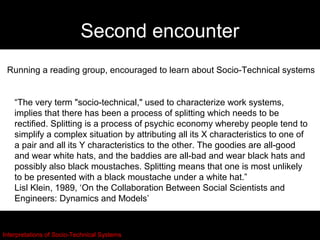
Second encounter
 Running a reading group, encouraged to learn about Socio-Technical systems


    “The very term "socio-technical," used to characterize work systems,
    implies that there has been a process of splitting which needs to be
    rectified. Splitting is a process of psychic economy whereby people tend to
    simplify a complex situation by attributing all its X characteristics to one of
    a pair and all its Y characteristics to the other. The goodies are all-good
    and wear white hats, and the baddies are all-bad and wear black hats and
    possibly also black moustaches. Splitting means that one is most unlikely
    to be presented with a black moustache under a white hat.”
    Lisl Klein, 1989, ‘On the Collaboration Between Social Scientists and
    Engineers: Dynamics and Models’


Interpretations of Socio-Technical Systems
Third encounter
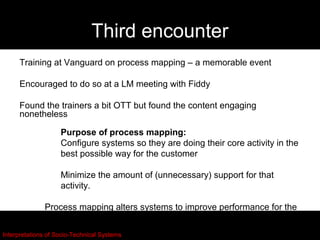
     Training at Vanguard on process mapping – a memorable event

     Encouraged to do so at a LM meeting with Fiddy

     Found the trainers a bit OTT but found the content engaging
     nonetheless

                    Purpose of process mapping:
                    Configure systems so they are doing their core activity in the
                    best possible way for the customer

                    Minimize the amount of (unnecessary) support for that
                    activity.

              Process mapping alters systems to improve performance for the
              customer.
Interpretations of Socio-Technical Systems
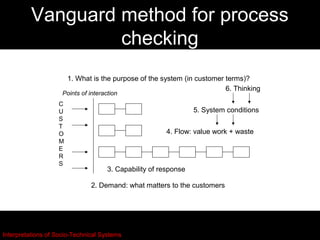
Vanguard method for process
                   checking
                       1. What is the purpose of the system (in customer terms)?
                                                                         6. Thinking
                     Points of interaction
                   C
                   U                                              5. System conditions
                   S
                   T
                   O                                    4. Flow: value work + waste
                   M
                   E
                   R
                   S
                                      3. Capability of response

                                2. Demand: what matters to the customers


Interpretations of Socio-Technical Systems
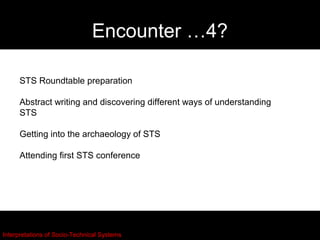
Encounter …4?

     STS Roundtable preparation

     Abstract writing and discovering different ways of understanding
     STS

     Getting into the archaeology of STS

     Attending first STS conference


Interpretations of Socio-Technical Systems
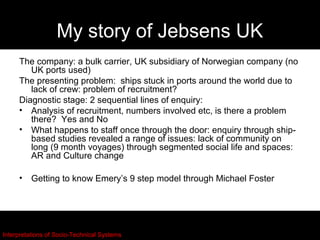
My story of Jebsens UK
     The company: a bulk carrier, UK subsidiary of Norwegian company (no
        UK ports used)
     The presenting problem: ships stuck in ports around the world due to
        lack of crew: problem of recruitment?
     Diagnostic stage: 2 sequential lines of enquiry:
     • Analysis of recruitment, numbers involved etc, is there a problem
        there? Yes and No
     • What happens to staff once through the door: enquiry through ship-
        based studies revealed a range of issues: lack of community on
        long (9 month voyages) through segmented social life and spaces:
        AR and Culture change

     •    Getting to know Emery’s 9 step model through Michael Foster


Interpretations of Socio-Technical Systems
Action research to improve
                shipboard life: main features
     •    Steering Group of Jebsens SMT, NUS, MNAOA, action researchers
          (PQ, ES, FA)
     •    Large scale simulation of issues leading to
     •    Piloting a shipboard community: ship’s company (selected by CEO)
          + SG conference start-up
     •    Developing ownership through the fleet
     •    Redesigning back-office functions
     •    Re-designing ships’ social spaces
     •    Whole systems conference for industry


Interpretations of Socio-Technical Systems
Definitions and issues for practice
     Socio-technical systems design: takes work processes as its starting
       point, maps how work crosses organizational and departmental
       boundaries, expects to design/redesign boundaries around the
       social and technical requirements of work processes eg team
       working – can be used as an expert practice, can get stuck at the
       lower levels, can be captured by Taylorists
     Action research: deploys a cycle of planning, taking action, collecting
       data about that action to support: can emphasize research or can
       emphasize action
     Participatory action research: involves the actors in the enquiry
       participating as enquirers, can lose intended focus, dissipate into
       terms and conditions


Interpretations of Socio-Technical Systems
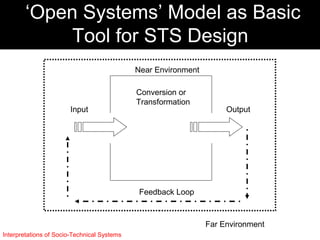
‘Open Systems’ Model as Basic
             Tool for STS Design
                                             Near Environment

                                             Conversion or
                                             Transformation
                       Input                                         Output


                                              Feedback Loop


                                                                Far Environment
Interpretations of Socio-Technical Systems
My notions of STS Approach:
              STS and the psycho-social
      (based on Miller & Rice, via Michael Foster)
•   Three types of organisation are required for conversion or
    transformation of input to output
      – Perform and manage primary task
      – Meet sentient needs of belonging and identity
      – Regulate the balance between task and sentient needs
•   STS boundaries are drawn at points of discontinuity (interfaces)
      – Within the boundaries are continuities
          • Operating, managing, controlling, servicing the primary task
          • This is a first order differentiation
      – In relation to the first order, there is a second order
        differentiation
          • Operating, managing, controlling, servicing those who are in
            first order
      – A manager can only be held accountable for what happens
        within the boundaries of their differentiated part of the
        organisation
Questions

     Does a concern for the psycho-social bring humanity to designing
     work?


     What other approaches do that?


     How do your starting points shape your understanding of STS and
     how has that changed through your experience of it?


Interpretations of Socio-Technical Systems

Sts roundtable for slideshare

  • 1.
    Interpretations of Socio-Technical Systems: two stories and the narrative of an organisation Frances Abraham and David Drabble
  • 2.
    Our encounters David – Beginning late 2000s, with a new Director who attempted to bring together evaluation and consultancy Fiddy – Beginning late 1970s with Jebson’s, worked with STS for 35 years Interpretations of Socio-Technical Systems
  • 3.
    First encounter Beginning late 2000s, new Director, attempt to bring together evaluation and consultancy Discussing TIHR with my Masters supervisor before accepting role Interpretations of Socio-Technical Systems
  • 4.
    Second encounter Runninga reading group, encouraged to learn about Socio-Technical systems “The very term "socio-technical," used to characterize work systems, implies that there has been a process of splitting which needs to be rectified. Splitting is a process of psychic economy whereby people tend to simplify a complex situation by attributing all its X characteristics to one of a pair and all its Y characteristics to the other. The goodies are all-good and wear white hats, and the baddies are all-bad and wear black hats and possibly also black moustaches. Splitting means that one is most unlikely to be presented with a black moustache under a white hat.” Lisl Klein, 1989, ‘On the Collaboration Between Social Scientists and Engineers: Dynamics and Models’ Interpretations of Socio-Technical Systems
  • 5.
    Third encounter Training at Vanguard on process mapping – a memorable event Encouraged to do so at a LM meeting with Fiddy Found the trainers a bit OTT but found the content engaging nonetheless Purpose of process mapping: Configure systems so they are doing their core activity in the best possible way for the customer Minimize the amount of (unnecessary) support for that activity. Process mapping alters systems to improve performance for the customer. Interpretations of Socio-Technical Systems
  • 6.
    Vanguard method forprocess checking 1. What is the purpose of the system (in customer terms)? 6. Thinking Points of interaction C U 5. System conditions S T O 4. Flow: value work + waste M E R S 3. Capability of response 2. Demand: what matters to the customers Interpretations of Socio-Technical Systems
  • 7.
    Encounter …4? STS Roundtable preparation Abstract writing and discovering different ways of understanding STS Getting into the archaeology of STS Attending first STS conference Interpretations of Socio-Technical Systems
  • 8.
    My story ofJebsens UK The company: a bulk carrier, UK subsidiary of Norwegian company (no UK ports used) The presenting problem: ships stuck in ports around the world due to lack of crew: problem of recruitment? Diagnostic stage: 2 sequential lines of enquiry: • Analysis of recruitment, numbers involved etc, is there a problem there? Yes and No • What happens to staff once through the door: enquiry through ship- based studies revealed a range of issues: lack of community on long (9 month voyages) through segmented social life and spaces: AR and Culture change • Getting to know Emery’s 9 step model through Michael Foster Interpretations of Socio-Technical Systems
  • 9.
    Action research toimprove shipboard life: main features • Steering Group of Jebsens SMT, NUS, MNAOA, action researchers (PQ, ES, FA) • Large scale simulation of issues leading to • Piloting a shipboard community: ship’s company (selected by CEO) + SG conference start-up • Developing ownership through the fleet • Redesigning back-office functions • Re-designing ships’ social spaces • Whole systems conference for industry Interpretations of Socio-Technical Systems
  • 10.
    Definitions and issuesfor practice Socio-technical systems design: takes work processes as its starting point, maps how work crosses organizational and departmental boundaries, expects to design/redesign boundaries around the social and technical requirements of work processes eg team working – can be used as an expert practice, can get stuck at the lower levels, can be captured by Taylorists Action research: deploys a cycle of planning, taking action, collecting data about that action to support: can emphasize research or can emphasize action Participatory action research: involves the actors in the enquiry participating as enquirers, can lose intended focus, dissipate into terms and conditions Interpretations of Socio-Technical Systems
  • 11.
    ‘Open Systems’ Modelas Basic Tool for STS Design Near Environment Conversion or Transformation Input Output Feedback Loop Far Environment Interpretations of Socio-Technical Systems
  • 12.
    My notions ofSTS Approach: STS and the psycho-social (based on Miller & Rice, via Michael Foster) • Three types of organisation are required for conversion or transformation of input to output – Perform and manage primary task – Meet sentient needs of belonging and identity – Regulate the balance between task and sentient needs • STS boundaries are drawn at points of discontinuity (interfaces) – Within the boundaries are continuities • Operating, managing, controlling, servicing the primary task • This is a first order differentiation – In relation to the first order, there is a second order differentiation • Operating, managing, controlling, servicing those who are in first order – A manager can only be held accountable for what happens within the boundaries of their differentiated part of the organisation
  • 13.
    Questions Does a concern for the psycho-social bring humanity to designing work? What other approaches do that? How do your starting points shape your understanding of STS and how has that changed through your experience of it? Interpretations of Socio-Technical Systems