Interpretative sociology and qualitative methods

There are essentially two ways of ‘doing’ sociology:
    1) A top down approach – looks at society and attempt to discover how it influences
        individuals. According to Durkheim society was a thing that is best studied in a similar way
        to the natural sciences, it was beyond the control of individuals.
    2) A bottom-up approach – starts with the individual and work up to a societal level – this
        approach is guided by approaches such as labelling theory, phenomenological approaches
        and interpretative methods. The focus according to Bryman (2004) is to empathise and
        understand the forces acting upon individuals.
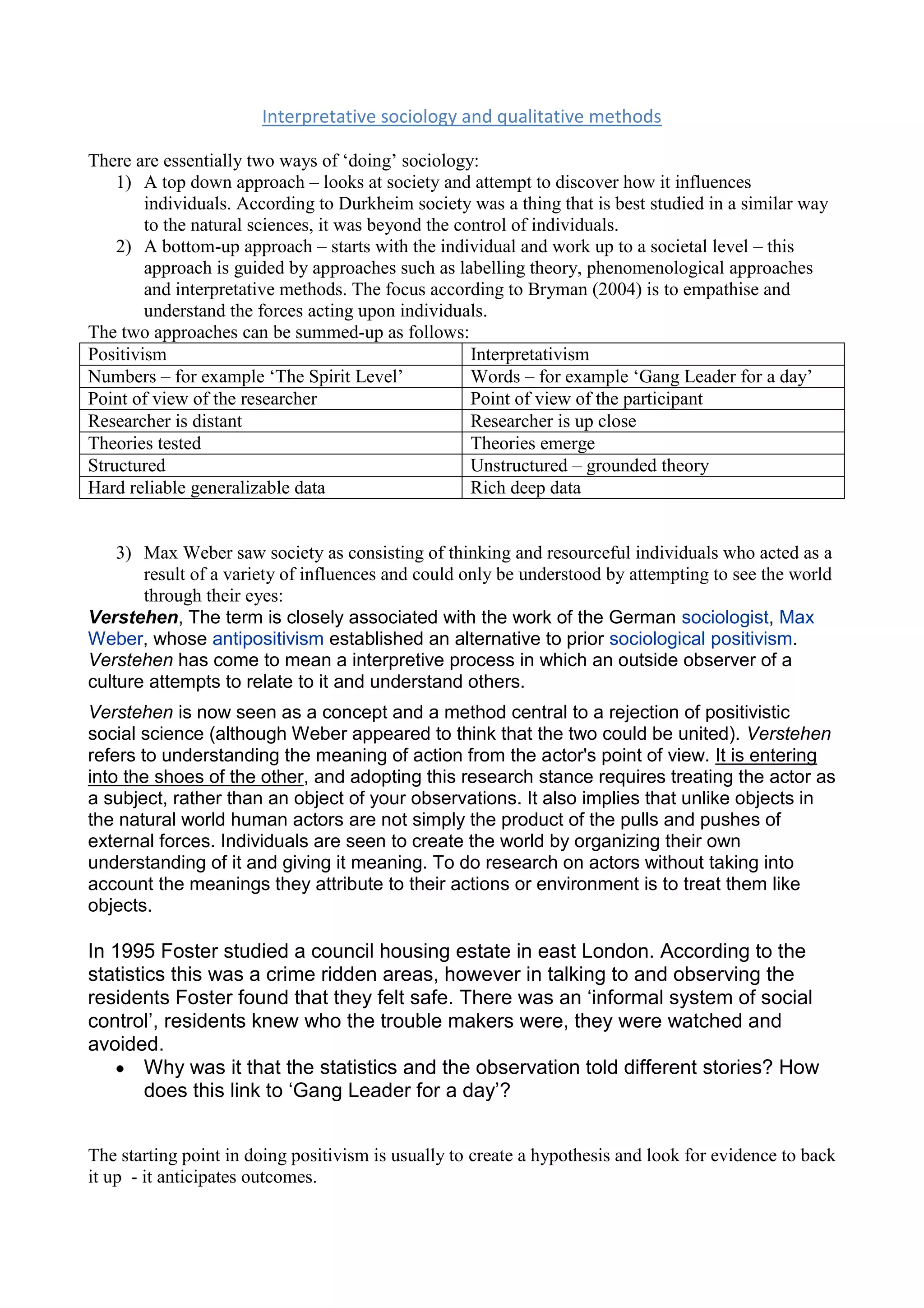
The two approaches can be summed-up as follows:
Positivism                                           Interpretativism
Numbers – for example ‘The Spirit Level’             Words – for example ‘Gang Leader for a day’
Point of view of the researcher                      Point of view of the participant
Researcher is distant                                Researcher is up close
Theories tested                                      Theories emerge
Structured                                           Unstructured – grounded theory
Hard reliable generalizable data                     Rich deep data


    3) Max Weber saw society as consisting of thinking and resourceful individuals who acted as a
       result of a variety of influences and could only be understood by attempting to see the world
       through their eyes:
Verstehen, The term is closely associated with the work of the German sociologist, Max
Weber, whose antipositivism established an alternative to prior sociological positivism.
Verstehen has come to mean a interpretive process in which an outside observer of a
culture attempts to relate to it and understand others.
Verstehen is now seen as a concept and a method central to a rejection of positivistic
social science (although Weber appeared to think that the two could be united). Verstehen
refers to understanding the meaning of action from the actor's point of view. It is entering
into the shoes of the other, and adopting this research stance requires treating the actor as
a subject, rather than an object of your observations. It also implies that unlike objects in
the natural world human actors are not simply the product of the pulls and pushes of
external forces. Individuals are seen to create the world by organizing their own
understanding of it and giving it meaning. To do research on actors without taking into
account the meanings they attribute to their actions or environment is to treat them like
objects.

In 1995 Foster studied a council housing estate in east London. According to the
statistics this was a crime ridden areas, however in talking to and observing the
residents Foster found that they felt safe. There was an ‘informal system of social
control’, residents knew who the trouble makers were, they were watched and
avoided.
        Why was it that the statistics and the observation told different stories? How
        does this link to ‘Gang Leader for a day’?


The starting point in doing positivism is usually to create a hypothesis and look for evidence to back
it up - it anticipates outcomes.
In doing qualitative research the researcher often starts with an interest and sees where is leads. A
‘without blinkers’ approach can lead to fresh ideas. Daniel Burdsay ‘British Asians and football –
culture, identity and exclusion’ wanted why despite a huge interest in football amongst Asians in
Britain they were not ‘making it’ as players. He hung around Asian leagues, talked to people and
allowed his research to take him to areas of interest. This snowball approach, he describes as the
best time of his professional career as a sociologist – the researcher must have a deep interest in the
issue.

In doing ethnographic research Gold (1958) says there are four possible approaches:

Complete participant – a member of the group working in a covert role.
Participant observer – the researcher is overt about their role.
Observer as a participant – the researcher is mainly there to interview and observe.
Complete observer – the researcher simply observes what is taking place and makes no attempt to
interview or discuss.
        Where do Eileen Barker and SudhirVenkatesh fit into this?


Participant observation is usually undertaken on closed group which are marginal to society.
        Such as ?

Getting into the group is often via the Gatekeeper, the next stage is to accepted and close to the
group, this is usually determined by C.A.G.E/religion.

[see examples of participant observation and non-participant observation Moore A2 Sociology for
AQA – and advantages and disadvantages of participant observation page 291]

Examples of some well known studies using participant observation:
Howard Parker 'A View from the Boys' (1947). In this study Parker covertly participated to
find out about the lives of a gang of adolescent boys from Liverpool. He arguably went
native when he gave legal advice when one was caught stealing a car.

James Patrick - "James Patrick" was a pseudonym. In the late 1950s this young sociologist
obtained entry into a Maryhill area Glaswegian gang for four months, joining in twelve times
(arguably short periods of time for participant observation). James Patrick left Glasgow quickly
when the violence became too unacceptable for him and he felt threatened. By memory after the
events he reproduced rich data on the speech and ways of the gang although the research itself was
presented in a neutral and academic style. He was afraid of the gang and waited years before
publishing; this was also to protect their identities.

Bourgois (2003) wrote to his wife in 1973 ‘ I regualarly stayed out all night on the streets and in
the crack houses for many years. I hope that it is not one of the reasons we are no longer together. If
it is I regret it profoundly.’ See You Tube: Next door but invisible: The world of homelessness and
addiction. (http://www.youtube.com/watch?v=lT1PjDvL6cs)

Laud Humpreys - Tearoom Trade (1970) - a study of homosexual encounters in public places,
especially public toilets. Humphreys revealed his role to some of those he observed, but he noted
that those who tended to talk with him openly were better educated; as he continued his research, he
decided to conceal his identity in order to avoid response bias. Humphreys' rationale was that
because of public stigma associated with the homosexual activities in question, and his subjects'
desires to keep their activities secret; many were unlikely to allow him an opportunity for
observation and follow-up interview were he to reveal himself as a researcher.
Humphreys' study has been criticized on ethical grounds in that he observed acts of homosexuality
by masquerading as a voyeur, did not get his subjects’ consent, used their license plate numbers to
track them down, and interviewed them in disguise without revealing the true intent of his studies
(he claimed to be a health service interviewer, and asked them questions about their race, marital
status, occupation, and so on). "Tearoom Trade" has been criticized for privacy violations, and
deceit - both in the initial setting, and in the follow-up interviews. After the study was published,
the controversy in Humphreys' own department at Washington University resulted in about half the
faculty leaving the department.
Many have defended "Tearoom Trade," pointing out that participants were conducting their
activities in a public place and that the deceit was harmless, since Humphreys designed the study
with respect for their individual privacy, not identifying them in his published work.
See You Tube clip - Laud Humphreys' Tearoom Trade - "Once Upon A Time"
http://www.youtube.com/watch?v=aSwicg3k_rM

The main problem with such small scale research in generalizability and getting too involved with
those being studied. To overcome these problems most researchers triangulate or take a realist
approach. To properly uncover what is happening in society requires both a micro and macro
approach.

SociologyExchange.co.uk Shared Resource

  • 1.
    Interpretative sociology andqualitative methods There are essentially two ways of ‘doing’ sociology: 1) A top down approach – looks at society and attempt to discover how it influences individuals. According to Durkheim society was a thing that is best studied in a similar way to the natural sciences, it was beyond the control of individuals. 2) A bottom-up approach – starts with the individual and work up to a societal level – this approach is guided by approaches such as labelling theory, phenomenological approaches and interpretative methods. The focus according to Bryman (2004) is to empathise and understand the forces acting upon individuals. The two approaches can be summed-up as follows: Positivism Interpretativism Numbers – for example ‘The Spirit Level’ Words – for example ‘Gang Leader for a day’ Point of view of the researcher Point of view of the participant Researcher is distant Researcher is up close Theories tested Theories emerge Structured Unstructured – grounded theory Hard reliable generalizable data Rich deep data 3) Max Weber saw society as consisting of thinking and resourceful individuals who acted as a result of a variety of influences and could only be understood by attempting to see the world through their eyes: Verstehen, The term is closely associated with the work of the German sociologist, Max Weber, whose antipositivism established an alternative to prior sociological positivism. Verstehen has come to mean a interpretive process in which an outside observer of a culture attempts to relate to it and understand others. Verstehen is now seen as a concept and a method central to a rejection of positivistic social science (although Weber appeared to think that the two could be united). Verstehen refers to understanding the meaning of action from the actor's point of view. It is entering into the shoes of the other, and adopting this research stance requires treating the actor as a subject, rather than an object of your observations. It also implies that unlike objects in the natural world human actors are not simply the product of the pulls and pushes of external forces. Individuals are seen to create the world by organizing their own understanding of it and giving it meaning. To do research on actors without taking into account the meanings they attribute to their actions or environment is to treat them like objects. In 1995 Foster studied a council housing estate in east London. According to the statistics this was a crime ridden areas, however in talking to and observing the residents Foster found that they felt safe. There was an ‘informal system of social control’, residents knew who the trouble makers were, they were watched and avoided. Why was it that the statistics and the observation told different stories? How does this link to ‘Gang Leader for a day’? The starting point in doing positivism is usually to create a hypothesis and look for evidence to back it up - it anticipates outcomes.
  • 2.
    In doing qualitativeresearch the researcher often starts with an interest and sees where is leads. A ‘without blinkers’ approach can lead to fresh ideas. Daniel Burdsay ‘British Asians and football – culture, identity and exclusion’ wanted why despite a huge interest in football amongst Asians in Britain they were not ‘making it’ as players. He hung around Asian leagues, talked to people and allowed his research to take him to areas of interest. This snowball approach, he describes as the best time of his professional career as a sociologist – the researcher must have a deep interest in the issue. In doing ethnographic research Gold (1958) says there are four possible approaches: Complete participant – a member of the group working in a covert role. Participant observer – the researcher is overt about their role. Observer as a participant – the researcher is mainly there to interview and observe. Complete observer – the researcher simply observes what is taking place and makes no attempt to interview or discuss. Where do Eileen Barker and SudhirVenkatesh fit into this? Participant observation is usually undertaken on closed group which are marginal to society. Such as ? Getting into the group is often via the Gatekeeper, the next stage is to accepted and close to the group, this is usually determined by C.A.G.E/religion. [see examples of participant observation and non-participant observation Moore A2 Sociology for AQA – and advantages and disadvantages of participant observation page 291] Examples of some well known studies using participant observation: Howard Parker 'A View from the Boys' (1947). In this study Parker covertly participated to find out about the lives of a gang of adolescent boys from Liverpool. He arguably went native when he gave legal advice when one was caught stealing a car. James Patrick - "James Patrick" was a pseudonym. In the late 1950s this young sociologist obtained entry into a Maryhill area Glaswegian gang for four months, joining in twelve times (arguably short periods of time for participant observation). James Patrick left Glasgow quickly when the violence became too unacceptable for him and he felt threatened. By memory after the events he reproduced rich data on the speech and ways of the gang although the research itself was presented in a neutral and academic style. He was afraid of the gang and waited years before publishing; this was also to protect their identities. Bourgois (2003) wrote to his wife in 1973 ‘ I regualarly stayed out all night on the streets and in the crack houses for many years. I hope that it is not one of the reasons we are no longer together. If it is I regret it profoundly.’ See You Tube: Next door but invisible: The world of homelessness and addiction. (http://www.youtube.com/watch?v=lT1PjDvL6cs) Laud Humpreys - Tearoom Trade (1970) - a study of homosexual encounters in public places, especially public toilets. Humphreys revealed his role to some of those he observed, but he noted that those who tended to talk with him openly were better educated; as he continued his research, he decided to conceal his identity in order to avoid response bias. Humphreys' rationale was that because of public stigma associated with the homosexual activities in question, and his subjects' desires to keep their activities secret; many were unlikely to allow him an opportunity for observation and follow-up interview were he to reveal himself as a researcher.
  • 3.
    Humphreys' study hasbeen criticized on ethical grounds in that he observed acts of homosexuality by masquerading as a voyeur, did not get his subjects’ consent, used their license plate numbers to track them down, and interviewed them in disguise without revealing the true intent of his studies (he claimed to be a health service interviewer, and asked them questions about their race, marital status, occupation, and so on). "Tearoom Trade" has been criticized for privacy violations, and deceit - both in the initial setting, and in the follow-up interviews. After the study was published, the controversy in Humphreys' own department at Washington University resulted in about half the faculty leaving the department. Many have defended "Tearoom Trade," pointing out that participants were conducting their activities in a public place and that the deceit was harmless, since Humphreys designed the study with respect for their individual privacy, not identifying them in his published work. See You Tube clip - Laud Humphreys' Tearoom Trade - "Once Upon A Time" http://www.youtube.com/watch?v=aSwicg3k_rM The main problem with such small scale research in generalizability and getting too involved with those being studied. To overcome these problems most researchers triangulate or take a realist approach. To properly uncover what is happening in society requires both a micro and macro approach.