The social construction of
crime and deviance
Other useful resources
Shared
Drive
also – Trobe Notes/MissRobinson weblink
What are the questions about?
• How social reality is constructed in our
minds and does not exist externally
• How society defines certain acts as deviant
and acts on these
• How society can make deviance greater
rather than reduce it
• How deviance is not caused by external
social forces, ie)culture/poverty etc
Areas of focus:
• The origins of labelling theory
• How society defines what is deviant? (Deviance as a
relative concept)
• Rule creation (additional ppt)
• The Process of labelling (how it happens)
• The effects of labelling (ppt mental illness)
• The role of the media (deviance amplification) (ppt)
• Methodological issues
• Evaluation
Concepts you need to know…
• Selective policing
• Master status
• Societal reaction
• Primary/secondary
deviance
• Labels
• Self concept
• Self fulfilling
prophecy
• Stigma
• Sensitisation
• Deviance
amplification
• Relative deviance
• Folk devils & moral
panics
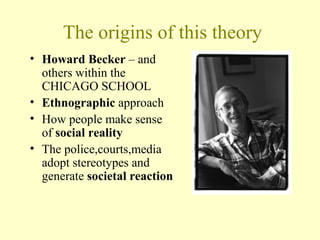
The origins of this theory
• Howard Becker – and
others within the
CHICAGO SCHOOL
• Ethnographic approach
• How people make sense
of social reality
• The police,courts,media
adopt stereotypes and
generate societal reaction
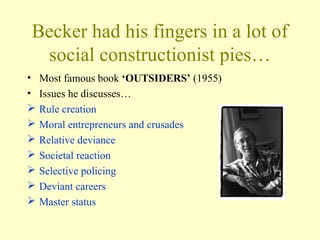
Becker had his fingers in a lot of
social constructionist pies…
• Most famous book ‘OUTSIDERS’ (1955)
• Issues he discusses…
 Rule creation
 Moral entrepreneurs and crusades
 Relative deviance
 Societal reaction
 Selective policing
 Deviant careers
 Master status
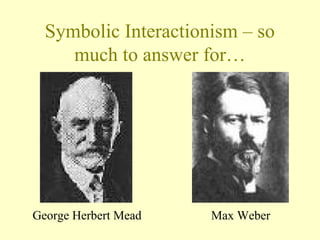
Symbolic Interactionism – so
much to answer for…
George Herbert Mead Max Weber
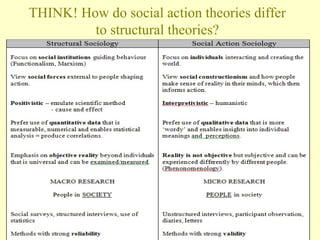
THINK! How do social action theories differ
to structural theories?
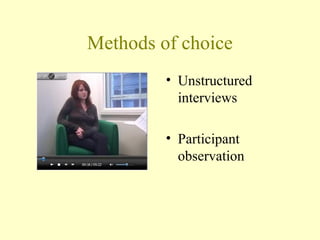
Methods of choice
• Unstructured
interviews
• Participant
observation
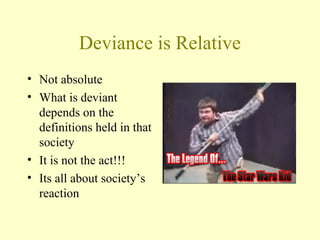
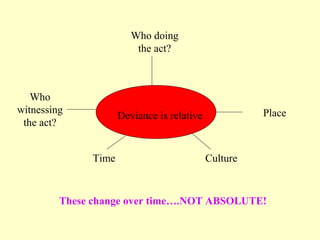
Deviance is Relative
• Not absolute
• What is deviant
depends on the
definitions held in that
society
• It is not the act!!!
• Its all about society’s
reaction
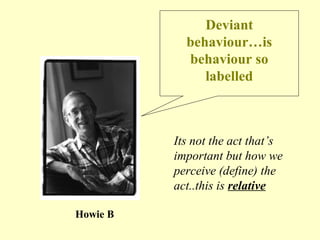
Deviant
behaviour…is
behaviour so
labelled
Howie B
Its not the act that’s
important but how we
perceive (define) the
act..this is relative
Deviance is relative
Time
Place
Who doing
the act?
Who
witnessing
the act?
Culture
These change over time….NOT ABSOLUTE!
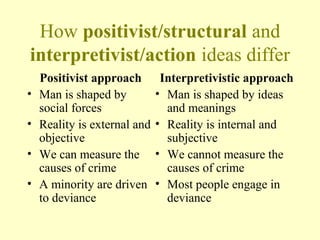
How positivist/structural and
interpretivist/action ideas differ
Positivist approach
• Man is shaped by
social forces
• Reality is external and
objective
• We can measure the
causes of crime
• A minority are driven
to deviance
Interpretivistic approach
• Man is shaped by ideas
and meanings
• Reality is internal and
subjective
• We cannot measure the
causes of crime
• Most people engage in
deviance
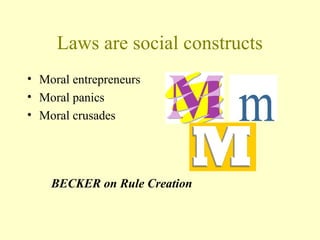
Laws are social constructs
• Moral entrepreneurs
• Moral panics
• Moral crusades
BECKER on Rule Creation
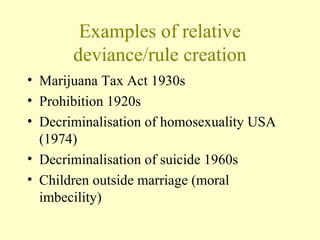
Examples of relative
deviance/rule creation
• Marijuana Tax Act 1930s
• Prohibition 1920s
• Decriminalisation of homosexuality USA
(1974)
• Decriminalisation of suicide 1960s
• Children outside marriage (moral
imbecility)
The process of labelling
• Stereotypical criminal/deviant
• Sensitisation
• Selective policing –
Lambert/Sutherland/Becker/
Cicourel/Kalven and Zaesel
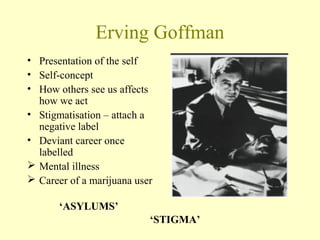
Erving Goffman
• Presentation of the self
• Self-concept
• How others see us affects
how we act
• Stigmatisation – attach a
negative label
• Deviant career once
labelled
 Mental illness
 Career of a marijuana user
‘ASYLUMS’
‘STIGMA’
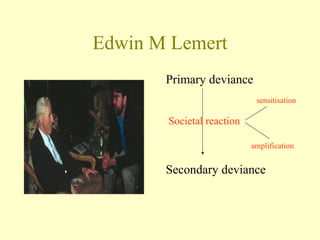
Edwin M Lemert
Primary deviance
Secondary deviance
Societal reaction
sensitisation
amplification
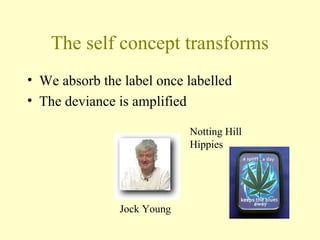
The self concept transforms
• We absorb the label once labelled
• The deviance is amplified
Jock Young
Notting Hill
Hippies
The effects of labelling
• Influences the self-concept
• ‘looking glass self’ (Charles Cooley)
• Self fulfilling prophecy
• The master status and SFP
• Primary/secondary deviance
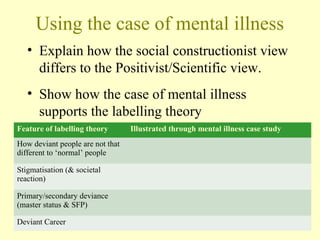
Using the case of mental illness
• Explain how the social constructionist view
differs to the Positivist/Scientific view.
• Show how the case of mental illness
supports the labelling theory
Feature of labelling theory Illustrated through mental illness case study
How deviant people are not that
different to ‘normal’ people
Stigmatisation (& societal
reaction)
Primary/secondary deviance
(master status & SFP)
Deviant Career
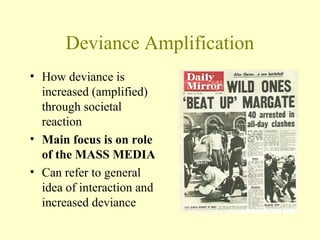
Deviance Amplification
• How deviance is
increased (amplified)
through societal
reaction
• Main focus is on role
of the MASS MEDIA
• Can refer to general
idea of interaction and
increased deviance
The implications of the deviance
amplification idea
• Society creates greater levels of deviance
• The mass media are a problem
• The mass media are not neutral and they
sensationalise
• The mass media influences public opinion, the
role of police, courts and politicians
• The mass media affects an individual’s self
concept
• The individual deviant is not to blame – there are
no single causes like poverty, socialisation etc
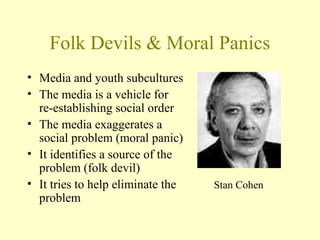
Folk Devils & Moral Panics
• Media and youth subcultures
• The media is a vehicle for
re-establishing social order
• The media exaggerates a
social problem (moral panic)
• It identifies a source of the
problem (folk devil)
• It tries to help eliminate the
problem
Stan Cohen
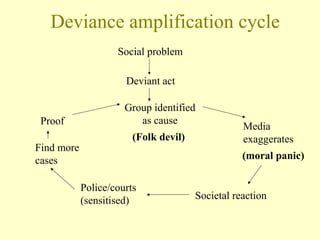
Deviance amplification cycle
Deviant act
Media
exaggerates
Societal reaction
Social problem
Group identified
as cause
(Folk devil)
(moral panic)
Police/courts
(sensitised)
Find more
cases
Proof
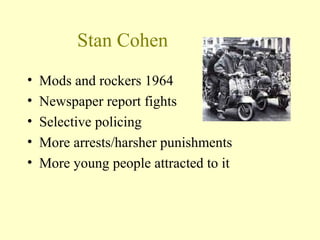
Stan Cohen
• Mods and rockers 1964
• Newspaper report fights
• Selective policing
• More arrests/harsher punishments
• More young people attracted to it
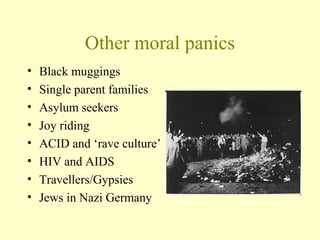
Other moral panics
• Black muggings
• Single parent families
• Asylum seekers
• Joy riding
• ACID and ‘rave culture’
• HIV and AIDS
• Travellers/Gypsies
• Jews in Nazi Germany
Find out for yerself!! (FofY)
1. Take one of the following case studies and produce a
presentation on the moral panic that surrounded it.
2. Also explain how it reflects labelling theory ideas, ie)
who were the folk devil? etc
3. Add images and key facts/points
• ACID RAVE SCENE
• ASYLUM SEEKERS
• AIDS
As a starting point – you should all read the
article by Mathew Wood ‘Moral Panics’
Further studies
• Armstrong and Fishman – Glasgow election
• Fishman – New York Muggings
• Stuart Hall – Policing the Crisis
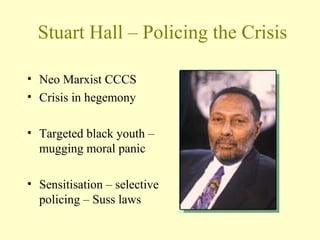
Stuart Hall – Policing the Crisis
• Neo Marxist CCCS
• Crisis in hegemony
• Targeted black youth –
mugging moral panic
• Sensitisation – selective
policing – Suss laws
Advantages of Labelling Theory
• It does not treat official statistics as fact
• It rejects the idea that deviants are different to
‘normal’ people
• It questions the effectiveness of policing, the
courts and punishment
• It raises the issue of power
• It considers the impact of the mass media
• It highlights the bias in law enforcement
• It considers societal reaction and the effects on
individuals
Disadvantages of Labelling Theory
• Its over-romantic
• Too much focus on exotic deviance
• Ignores the origins of deviant acts
• There is absolute deviance
• It uses labelling in a deterministic way
• More attention needed on the behaviour that
produced the label
• Deviants can adopt identity without being labelled
• Not explore fully capitalism and economic power
What other theories say…
• Functionalism etc
 Challenge the idea
 Absolute deviance – set normal standards
 Media must dramatise and make public deviance
to reinforce common values
 Police and courts are neutral
 Law making is neutral – reflects shared values
 There are causes of deviance that can be measured
Marxism
• Share idea of biased laws and selective
policing
• Much overlap in Neo-marxism (New
Criminology/CCCS)
• Traditional Marxism is though more
structural and deterministic
• More attention on the economy (capitalism)
needed
Extension – debate
challenge!
Using the A2 textbook p82-83 & classnotes
Functionalists see wider society as important for controlling
levels of deviance in society. The police, the media and other
agencies are vital in identifying deviants, punishing them and
separating them from the rest of normal society.
Imagine you are a labelling theorist…how would you
criticise the role of the police, media, courts and wider
society?
List the main 5 points that you would make AGAINST
Functionalist sociology
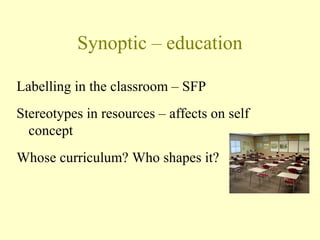
Synoptic – education
Labelling in the classroom – SFP
Stereotypes in resources – affects on self
concept
Whose curriculum? Who shapes it?
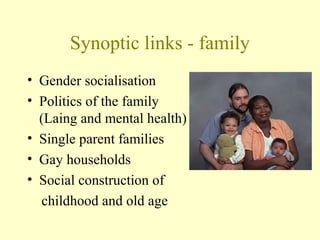
Synoptic links - family
• Gender socialisation
• Politics of the family
(Laing and mental health)
• Single parent families
• Gay households
• Social construction of
childhood and old age
Question….
“ Evaluate the claim that both the
nature and extent of deviance is
socially constructed”

SociologyExchange.co.uk Shared Resource

  • 1.
    The social constructionof crime and deviance
  • 2.
    Other useful resources Shared Drive also– Trobe Notes/MissRobinson weblink
  • 3.
    What are thequestions about? • How social reality is constructed in our minds and does not exist externally • How society defines certain acts as deviant and acts on these • How society can make deviance greater rather than reduce it • How deviance is not caused by external social forces, ie)culture/poverty etc
  • 4.
    Areas of focus: •The origins of labelling theory • How society defines what is deviant? (Deviance as a relative concept) • Rule creation (additional ppt) • The Process of labelling (how it happens) • The effects of labelling (ppt mental illness) • The role of the media (deviance amplification) (ppt) • Methodological issues • Evaluation
  • 5.
    Concepts you needto know… • Selective policing • Master status • Societal reaction • Primary/secondary deviance • Labels • Self concept • Self fulfilling prophecy • Stigma • Sensitisation • Deviance amplification • Relative deviance • Folk devils & moral panics
  • 6.
    The origins ofthis theory • Howard Becker – and others within the CHICAGO SCHOOL • Ethnographic approach • How people make sense of social reality • The police,courts,media adopt stereotypes and generate societal reaction
  • 7.
    Becker had hisfingers in a lot of social constructionist pies… • Most famous book ‘OUTSIDERS’ (1955) • Issues he discusses…  Rule creation  Moral entrepreneurs and crusades  Relative deviance  Societal reaction  Selective policing  Deviant careers  Master status
  • 8.
    Symbolic Interactionism –so much to answer for… George Herbert Mead Max Weber
  • 9.
    THINK! How dosocial action theories differ to structural theories?
  • 10.
    Methods of choice •Unstructured interviews • Participant observation
  • 11.
    Deviance is Relative •Not absolute • What is deviant depends on the definitions held in that society • It is not the act!!! • Its all about society’s reaction
  • 12.
    Deviant behaviour…is behaviour so labelled Howie B Itsnot the act that’s important but how we perceive (define) the act..this is relative
  • 13.
    Deviance is relative Time Place Whodoing the act? Who witnessing the act? Culture These change over time….NOT ABSOLUTE!
  • 14.
    How positivist/structural and interpretivist/actionideas differ Positivist approach • Man is shaped by social forces • Reality is external and objective • We can measure the causes of crime • A minority are driven to deviance Interpretivistic approach • Man is shaped by ideas and meanings • Reality is internal and subjective • We cannot measure the causes of crime • Most people engage in deviance
  • 15.
    Laws are socialconstructs • Moral entrepreneurs • Moral panics • Moral crusades BECKER on Rule Creation
  • 16.
    Examples of relative deviance/rulecreation • Marijuana Tax Act 1930s • Prohibition 1920s • Decriminalisation of homosexuality USA (1974) • Decriminalisation of suicide 1960s • Children outside marriage (moral imbecility)
  • 17.
    The process oflabelling • Stereotypical criminal/deviant • Sensitisation • Selective policing – Lambert/Sutherland/Becker/ Cicourel/Kalven and Zaesel
  • 18.
    Erving Goffman • Presentationof the self • Self-concept • How others see us affects how we act • Stigmatisation – attach a negative label • Deviant career once labelled  Mental illness  Career of a marijuana user ‘ASYLUMS’ ‘STIGMA’
  • 19.
    Edwin M Lemert Primarydeviance Secondary deviance Societal reaction sensitisation amplification
  • 20.
    The self concepttransforms • We absorb the label once labelled • The deviance is amplified Jock Young Notting Hill Hippies
  • 21.
    The effects oflabelling • Influences the self-concept • ‘looking glass self’ (Charles Cooley) • Self fulfilling prophecy • The master status and SFP • Primary/secondary deviance
  • 22.
    Using the caseof mental illness • Explain how the social constructionist view differs to the Positivist/Scientific view. • Show how the case of mental illness supports the labelling theory Feature of labelling theory Illustrated through mental illness case study How deviant people are not that different to ‘normal’ people Stigmatisation (& societal reaction) Primary/secondary deviance (master status & SFP) Deviant Career
  • 23.
    Deviance Amplification • Howdeviance is increased (amplified) through societal reaction • Main focus is on role of the MASS MEDIA • Can refer to general idea of interaction and increased deviance
  • 24.
    The implications ofthe deviance amplification idea • Society creates greater levels of deviance • The mass media are a problem • The mass media are not neutral and they sensationalise • The mass media influences public opinion, the role of police, courts and politicians • The mass media affects an individual’s self concept • The individual deviant is not to blame – there are no single causes like poverty, socialisation etc
  • 25.
    Folk Devils &Moral Panics • Media and youth subcultures • The media is a vehicle for re-establishing social order • The media exaggerates a social problem (moral panic) • It identifies a source of the problem (folk devil) • It tries to help eliminate the problem Stan Cohen

  • 26.
    Deviance amplification cycle Deviantact Media exaggerates Societal reaction Social problem Group identified as cause (Folk devil) (moral panic) Police/courts (sensitised) Find more cases Proof
  • 27.
    Stan Cohen • Modsand rockers 1964 • Newspaper report fights • Selective policing • More arrests/harsher punishments • More young people attracted to it
  • 28.
    Other moral panics •Black muggings • Single parent families • Asylum seekers • Joy riding • ACID and ‘rave culture’ • HIV and AIDS • Travellers/Gypsies • Jews in Nazi Germany
  • 29.
    Find out foryerself!! (FofY) 1. Take one of the following case studies and produce a presentation on the moral panic that surrounded it. 2. Also explain how it reflects labelling theory ideas, ie) who were the folk devil? etc 3. Add images and key facts/points • ACID RAVE SCENE • ASYLUM SEEKERS • AIDS As a starting point – you should all read the article by Mathew Wood ‘Moral Panics’
  • 30.
    Further studies • Armstrongand Fishman – Glasgow election • Fishman – New York Muggings • Stuart Hall – Policing the Crisis
  • 31.
    Stuart Hall –Policing the Crisis • Neo Marxist CCCS • Crisis in hegemony • Targeted black youth – mugging moral panic • Sensitisation – selective policing – Suss laws
  • 32.
    Advantages of LabellingTheory • It does not treat official statistics as fact • It rejects the idea that deviants are different to ‘normal’ people • It questions the effectiveness of policing, the courts and punishment • It raises the issue of power • It considers the impact of the mass media • It highlights the bias in law enforcement • It considers societal reaction and the effects on individuals
  • 33.
    Disadvantages of LabellingTheory • Its over-romantic • Too much focus on exotic deviance • Ignores the origins of deviant acts • There is absolute deviance • It uses labelling in a deterministic way • More attention needed on the behaviour that produced the label • Deviants can adopt identity without being labelled • Not explore fully capitalism and economic power
  • 34.
    What other theoriessay… • Functionalism etc  Challenge the idea  Absolute deviance – set normal standards  Media must dramatise and make public deviance to reinforce common values  Police and courts are neutral  Law making is neutral – reflects shared values  There are causes of deviance that can be measured
  • 35.
    Marxism • Share ideaof biased laws and selective policing • Much overlap in Neo-marxism (New Criminology/CCCS) • Traditional Marxism is though more structural and deterministic • More attention on the economy (capitalism) needed
  • 36.
    Extension – debate challenge! Usingthe A2 textbook p82-83 & classnotes Functionalists see wider society as important for controlling levels of deviance in society. The police, the media and other agencies are vital in identifying deviants, punishing them and separating them from the rest of normal society. Imagine you are a labelling theorist…how would you criticise the role of the police, media, courts and wider society? List the main 5 points that you would make AGAINST Functionalist sociology
  • 37.
    Synoptic – education Labellingin the classroom – SFP Stereotypes in resources – affects on self concept Whose curriculum? Who shapes it?
  • 38.
    Synoptic links -family • Gender socialisation • Politics of the family (Laing and mental health) • Single parent families • Gay households • Social construction of childhood and old age
  • 39.
    Question…. “ Evaluate theclaim that both the nature and extent of deviance is socially constructed”