







SOCIOLOGICAL
Foundations of Educations
Rona De Leon
HISTORICAL DEVELOPMENT
George Herbert Mead
Ernest Watson Burgees
Talcott parsons
Wilfredo Pareto
William Edward B. Du Bois
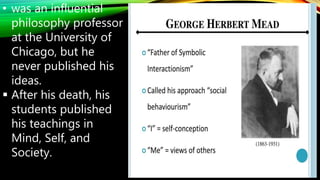
• was an influential
philosophy professor
at the University of
Chicago, but he
never published his
ideas.
 After his death, his
students published
his teachings in
Mind, Self, and
Society.
DISCUSSION OUTLINE
•Interpersonal Communication
•Symbolic Interaction
•Creation of the Self
•Summary
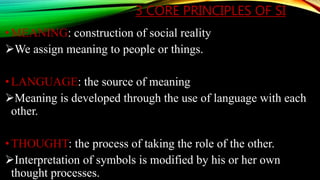
3 CORE PRINCIPLES OF SI
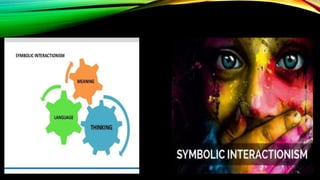
• MEANING: construction of social reality
We assign meaning to people or things.
• LANGUAGE: the source of meaning
Meaning is developed through the use of language with each
other.
• THOUGHT: the process of taking the role of the other.
Interpretation of symbols is modified by his or her own
thought processes.
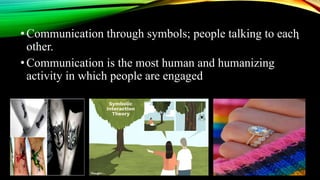
.•Communication through symbols; people talking to each
other.
•Communication is the most human and humanizing
activity in which people are engaged
MINDING
An inner dialogue used to test alternatives, rehearse
actions, and anticipate reactions before responding; self-
talk.
Taking the role of the other
The process of mentally imagining that you are someone
else who is viewing you.
SYMBOLIC INTERACTION THEORY EXPLAIN THE
SYMBOLIC INTERACTIONISM:
There are Non symbolic and symbolic interactions.
The ongoing use of language and gestures in anticipation of
how the other will react; a conversation.
We find ourselves NOT through introspection, but through
interaction with other people.
Symbolic interactionism is how people interact with each
other via symbols.
George Herbert Mead’s influence on symbolic
interactionism was said to be so powerful that other
sociologists regard him as the one “true founder” of the
theory.
But Charles Horton Cooley also contribute for this
theory.
SOCIAL BEHAVIORISM
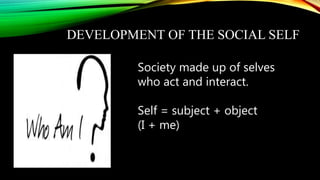
DEVELOPMENT OF THE SOCIAL SELF
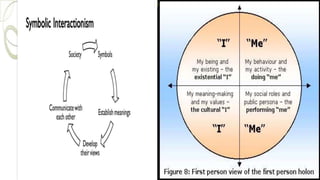
Society made up of selves
who act and interact.
Self = subject + object
(I + me)
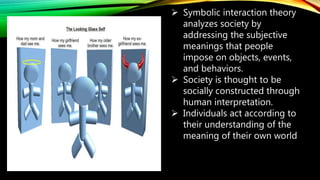
 Symbolic interaction theory
analyzes society by
addressing the subjective
meanings that people
impose on objects, events,
and behaviors.
 Society is thought to be
socially constructed through
human interpretation.
 Individuals act according to
their understanding of the
meaning of their own world
SELF (CONT.)
1. The act
2. The social act
3. Gestures, symbols and meaning
4. The I and the Me
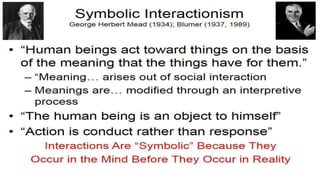
SUMMARY: • “Symbols” are the basis of social life
• Individuals and societies develop through People’s
interaction through symbols
• Individuals develop a sense of themselves as they learn to
use symbols
•Individuals develop a sense of themselves as they learn to
see themselves the way they believe others see them.
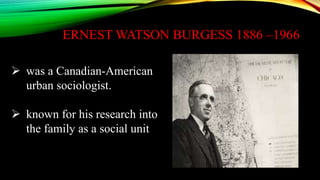
ERNEST WATSON BURGESS 1886 –1966
 was a Canadian-American
urban sociologist.
 known for his research into
the family as a social unit
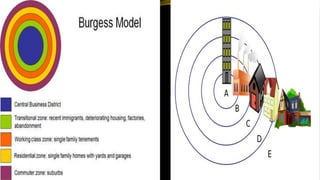
WHAT IS THE CONCENTRIC ZONE
THEORY?
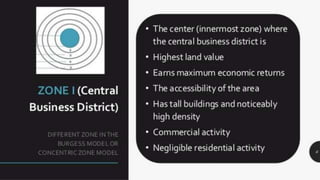
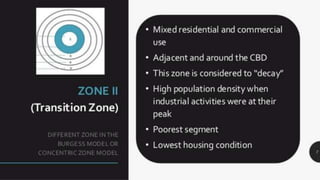
 Social structures extend outward from one central business
area.
 Population density decreases towards outward zones
 Shows correlation between socioeconomic status and the
distance from the central business district
 Also known as the Burgess Model, the Bull’s Eye Model, the
Concentric Ring Model, or the Concentric Circles Model.
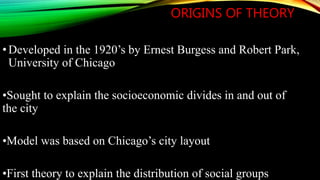
ORIGINS OF THEORY
•Developed in the 1920’s by Ernest Burgess and Robert Park,
University of Chicago
•Sought to explain the socioeconomic divides in and out of
the city
•Model was based on Chicago’s city layout
•First theory to explain the distribution of social groups
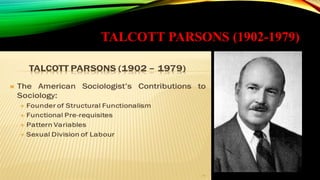
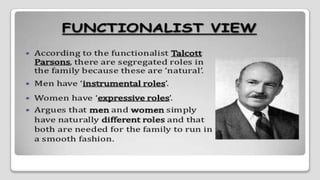
TALCOTT PARSONS (1902-1979)
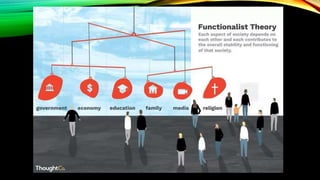
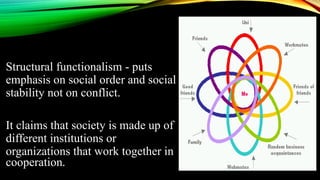
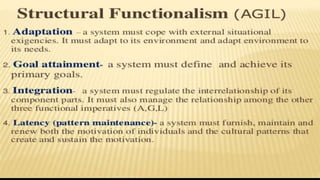
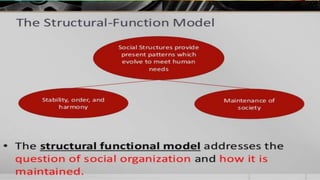
Structural functionalism - puts
emphasis on social order and social
stability not on conflict.
It claims that society is made up of
different institutions or
organizations that work together in
cooperation.
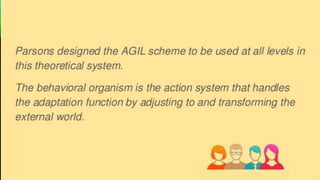
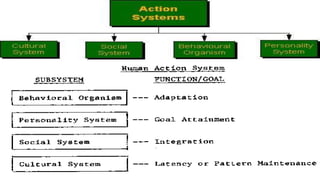
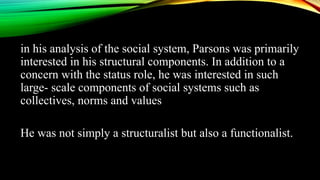
in his analysis of the social system, Parsons was primarily
interested in his structural components. In addition to a
concern with the status role, he was interested in such
large- scale components of social systems such as
collectives, norms and values
He was not simply a structuralist but also a functionalist.
WILLIAM EDWARD BURGHARDT. DU BOIS

Sociological foundation

  • 1.
  • 2.
    HISTORICAL DEVELOPMENT George HerbertMead Ernest Watson Burgees Talcott parsons Wilfredo Pareto William Edward B. Du Bois
  • 3.
    • was aninfluential philosophy professor at the University of Chicago, but he never published his ideas.  After his death, his students published his teachings in Mind, Self, and Society.
  • 4.
    DISCUSSION OUTLINE •Interpersonal Communication •SymbolicInteraction •Creation of the Self •Summary
  • 8.
    3 CORE PRINCIPLESOF SI • MEANING: construction of social reality We assign meaning to people or things. • LANGUAGE: the source of meaning Meaning is developed through the use of language with each other. • THOUGHT: the process of taking the role of the other. Interpretation of symbols is modified by his or her own thought processes.
  • 9.
    .•Communication through symbols;people talking to each other. •Communication is the most human and humanizing activity in which people are engaged
  • 11.
    MINDING An inner dialogueused to test alternatives, rehearse actions, and anticipate reactions before responding; self- talk. Taking the role of the other The process of mentally imagining that you are someone else who is viewing you.
  • 12.
    SYMBOLIC INTERACTION THEORYEXPLAIN THE SYMBOLIC INTERACTIONISM: There are Non symbolic and symbolic interactions. The ongoing use of language and gestures in anticipation of how the other will react; a conversation. We find ourselves NOT through introspection, but through interaction with other people. Symbolic interactionism is how people interact with each other via symbols.
  • 13.
    George Herbert Mead’sinfluence on symbolic interactionism was said to be so powerful that other sociologists regard him as the one “true founder” of the theory. But Charles Horton Cooley also contribute for this theory.
  • 14.
  • 15.
    DEVELOPMENT OF THESOCIAL SELF Society made up of selves who act and interact. Self = subject + object (I + me)
  • 16.
     Symbolic interactiontheory analyzes society by addressing the subjective meanings that people impose on objects, events, and behaviors.  Society is thought to be socially constructed through human interpretation.  Individuals act according to their understanding of the meaning of their own world
  • 17.
    SELF (CONT.) 1. Theact 2. The social act 3. Gestures, symbols and meaning 4. The I and the Me
  • 19.
    SUMMARY: • “Symbols”are the basis of social life • Individuals and societies develop through People’s interaction through symbols • Individuals develop a sense of themselves as they learn to use symbols •Individuals develop a sense of themselves as they learn to see themselves the way they believe others see them.
  • 20.
    ERNEST WATSON BURGESS1886 –1966  was a Canadian-American urban sociologist.  known for his research into the family as a social unit
  • 21.
    WHAT IS THECONCENTRIC ZONE THEORY?
  • 22.
     Social structuresextend outward from one central business area.  Population density decreases towards outward zones  Shows correlation between socioeconomic status and the distance from the central business district  Also known as the Burgess Model, the Bull’s Eye Model, the Concentric Ring Model, or the Concentric Circles Model.
  • 24.
    ORIGINS OF THEORY •Developedin the 1920’s by Ernest Burgess and Robert Park, University of Chicago •Sought to explain the socioeconomic divides in and out of the city •Model was based on Chicago’s city layout •First theory to explain the distribution of social groups
  • 38.
  • 42.
    Structural functionalism -puts emphasis on social order and social stability not on conflict. It claims that society is made up of different institutions or organizations that work together in cooperation.
  • 47.
    in his analysisof the social system, Parsons was primarily interested in his structural components. In addition to a concern with the status role, he was interested in such large- scale components of social systems such as collectives, norms and values He was not simply a structuralist but also a functionalist.
  • 59.