FAMILY

 Is the basic social institution and the primary group
  in society
 Accdg to Murdok, family is a social group
  characterized by common residence, economic
  cooperation and reproduction.
 Accdg to Burges and Locke, family is a group of
  persons united by ties of marriage, blood or
  adoption, constituting a single household,
  interacting and communicating with each other
  in their respective social roles of husband and
  wife, mother and father, son and daughter,
  brother and sister, and creating and
  maintaining a common culture.
                                                    32-1
 Accdg and to Murray and Zentner (1997)
  is a social system and primary
  reference group made up of two or
  more persons living together who are
  related by blood, marriage or adoption
  or who are living together by
  arrangement over a period of time.


                                           32-2
   F   father
   A    and
   M   mother
   I   implying the presence of children where
   L   love must prevail between me and
   Y    you


                                            32-3
CHARACTERISTICS OF A FAMILY

 The family as a social group is universal and is significant
  element in man’s social life.
 It is the first social group to which the individual is exposed.
 Family contact and relationships are repetitive and
  continuous.
 The family is very close and intimate group.
 It is setting of the most intense emotional experiences during
  the life time of the individual.
 The family affects the individual social values, disposition and
  outlook in life.
 The family has the unique position of serving as a link
  between the individual and the larger society.
 The family is also unique in providing continuity of social life.
                                                                 32-4
Functions of Family

   Regulates sexual behavior and reproduction
   Biological maintenance function
   Socialization function
   Provide legitimate children with a status
   Social control function
   Economic function
   Educational, recreational, religious and political
    functions

                                                         32-5
Classification of Family Structure

 Based on Descent
  • Patrilineal- affiliates a person with a group
    of relatives through his or her father.
  • Matrilineal- affiliates a person with a group
    of relatives through his or her mother.
  • Bilateral- affiliates a person with a group of
    relatives related through both his or her
    parents.


                                                     32-6
Classification of Family Structure

 Based on Authority
  • Patriarchial- authority is vested on the
    oldest male in the family, often the father.
  • Matriarchial- authority is vested in the
    mother or mother’s kin.
  • Matricentric- prolonged absence of the
    father gives the mother a dominant position
    in the family, although the father may also
    share with the mother in decision making.

                                                   32-7
Classification of Family Structure

 Based on Internal Organization and
  Membership
  • Nuclear Family. Also known as primary or
    elementary family.
  • Extended Family. Extensions maybe through
    the parent-child relationship or husband-wife
    relationship, as in polygamous marriage.


                                                    32-8
Classification of Family Structure

 Based on Place of Residence
  • Patrilocal- requires the newly wed to reside
    near the groom’s parents.
  • Matrilocal- near the bride’s parents.
  • Bilocal- provides the couple the choice to
    reside on either parents.
  • Neolocal- permits the couple to reside
    independently of their parents.
  • Avunculocal- prescribes the newly wed couple
    to reside with or near the maternal uncle of the
    groom.
                                                  32-9
Family systems theory

 The family is viewed as a system where
  the family members are interdependent
  and are working towards specific
  purposes and goals.
 Families are viewed as open systems
  continually interacting with other
  systems in the community.


                                           32-10
 Families consist of special functional
  subsystems:
      marital subsystem (parents)
      sibling subsytem (children)
      individual parent –child system
  subsystem
 Boundaries regulate the input and output
  to and from other systems that interact
  with the family system.                    32-11
 Boundaries also protect the family from
  demands and influences of other
  systems.
View of a person:
*The person is a member of the family
  system and is also considered a
  subsystem.


                                            32-12
Developmental stage theory
 Families are viewed as ever changing
  and growing; and each family is
  expected to accomplish tasks at every
  stage of development. Accomplishment
  of these tasks is a prerequisite for
  success in achieving the tasks of the
  next stage of development.
 Major task of family: create an
  environment where each member could
  master developmental tasks.
                                          32-13
View of the person:
  * The person is a member of the family
  where each new member adds to the
  complexity of the interaction within the
  family.


                                             32-14
 Accordingly, the main functions of a
  family include the following:
     1. to develop a sense of family
     purpose and affiliation
     2. to add and socialize new members
     3. to provide and distribute care and
     services to members
     4. to organize members and
  resources in meeting family goals.
                                             32-15
View of person:
   *The person is seen as fulfilling roles
within the social system.


                                             32-16
Interactional theory

 The family is defined as a unity of
  interacting personalities with assigned
  position and roles, expectations and
  norms of behavior.
 View of person:
      * The person is capable of interacting
  with other family members and is seen
  as fulfilling roles within the family.

                                               32-17
Role theory

 Family life is structured according to the
  roles that are assumed by the person in
  interaction with others. Roles are learned
  through socialization and there is high
  mutual dependence on division of labor
  within the family.
 Each family member has specialized
  roles.

                                               32-18
View of person:
 The person is seen in terms of roles
  which are specialized or shared and
  depend on age, sex, social norms and
  status.
 A person experiences role reciprocity or
  strain.
 Role reciprocity or mutual exchange of
  responsibilities ensures that personal
  and family needs are almost always met
  and that everyone in the family would
  have a potential for positive growth.      32-19
 Role strain occurs when individual have
  difficulty meeting others’ or their own
  expectations and obligations.
 Role strain may be manifested in two
  ways:
      *Role conflict- unclear, incomplete,
  contradictory elements in role which
  makes the performance of one’s role
  difficult.
                                             32-20
 Role overload- consider the impact of the
  distribution of power among the
  members of the family. Usually, the
  person with less power assumes more
  unwanted burdens while the person with
  more power has less dependency needs.


                                              32-21
Crisis theory
 The family is made up of members when
  individually experience a state of
  disequilibrium from situational or societal
  sources of stress called stress.
 Forms of crisis:
  -Developmental Crisis- transitional
  periods in personality development
  characterized by disturbances in
  cognitive and affective functioning.

                                                32-22
 Situational crisis- sudden, unexpected
  threats to, or loss of basic resources or
  life goals.
 Basic assumptions:
      * All family members are affected by
  the inability of one member to cope.
      * The family assists members with
  coping problems by adopting coping
  mechanisms as a group.
                                              32-23
 View of person:
      *Crisis in a person may take the form
  of illness which may pose a problem to
  the entire family.


                                              32-24
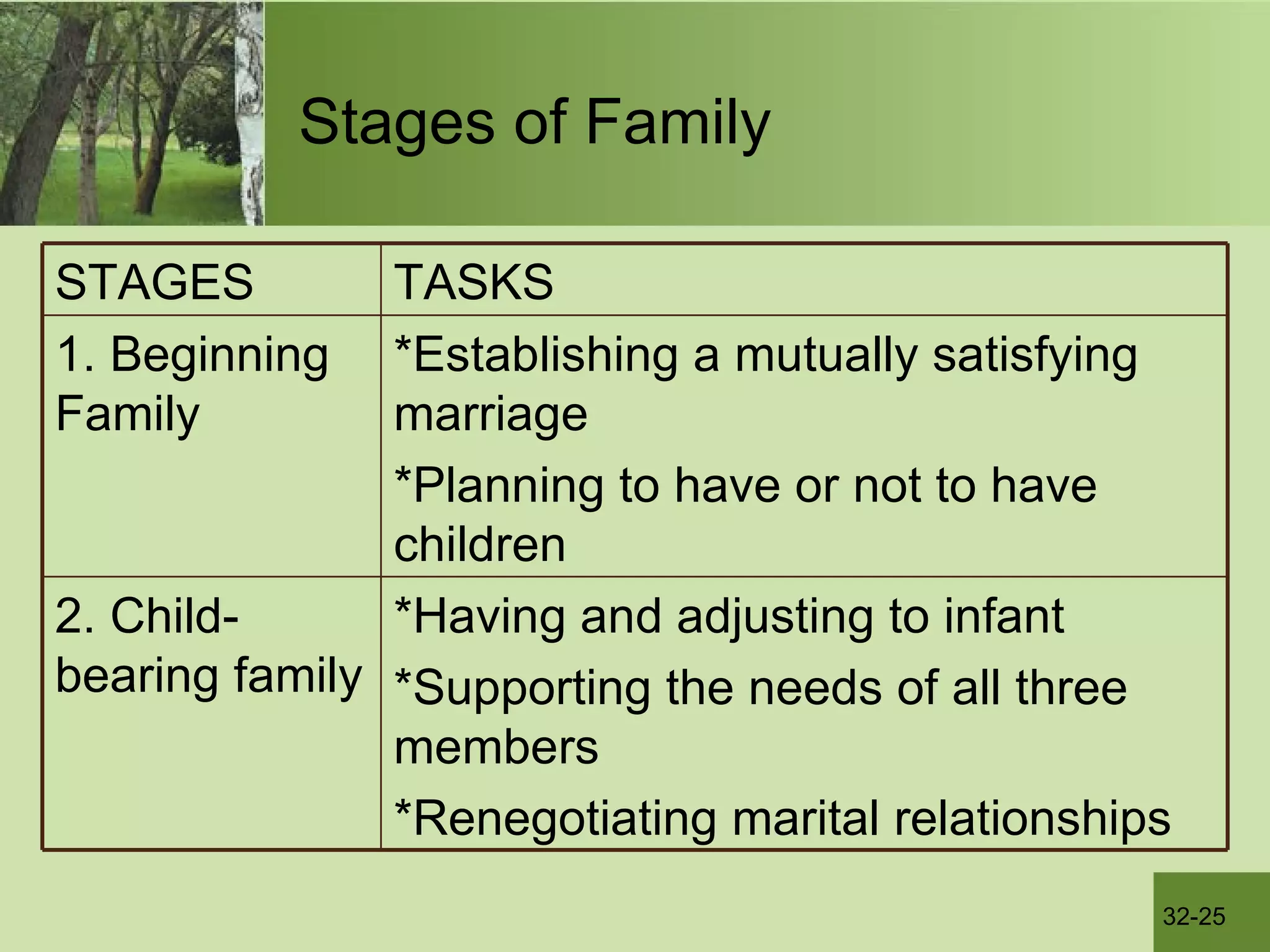
Stages of Family

STAGES         TASKS
1. Beginning   *Establishing a mutually satisfying
Family         marriage
               *Planning to have or not to have
               children
2. Child-      *Having and adjusting to infant
bearing family *Supporting the needs of all three
               members
               *Renegotiating marital relationships
                                                  32-25
Stages of Family

STAGES           TASKS
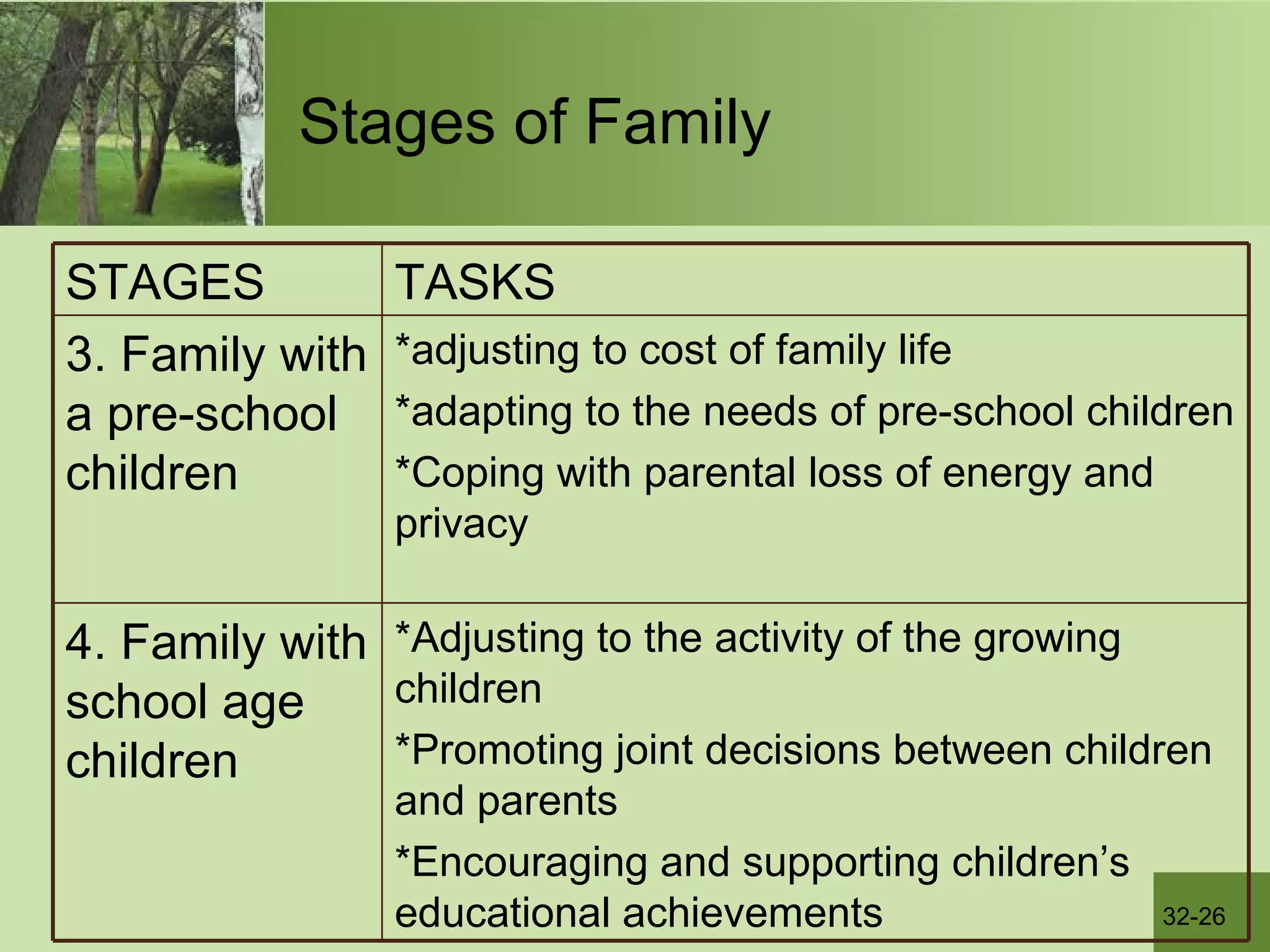
3. Family with   *adjusting to cost of family life
a pre-school     *adapting to the needs of pre-school children
children         *Coping with parental loss of energy and
                 privacy

4. Family with *Adjusting to the activity of the growing
school age     children
children       *Promoting joint decisions between children
                 and parents
                 *Encouraging and supporting children’s
                 educational achievements                 32-26
Stages of Family
STAGES           TASKS
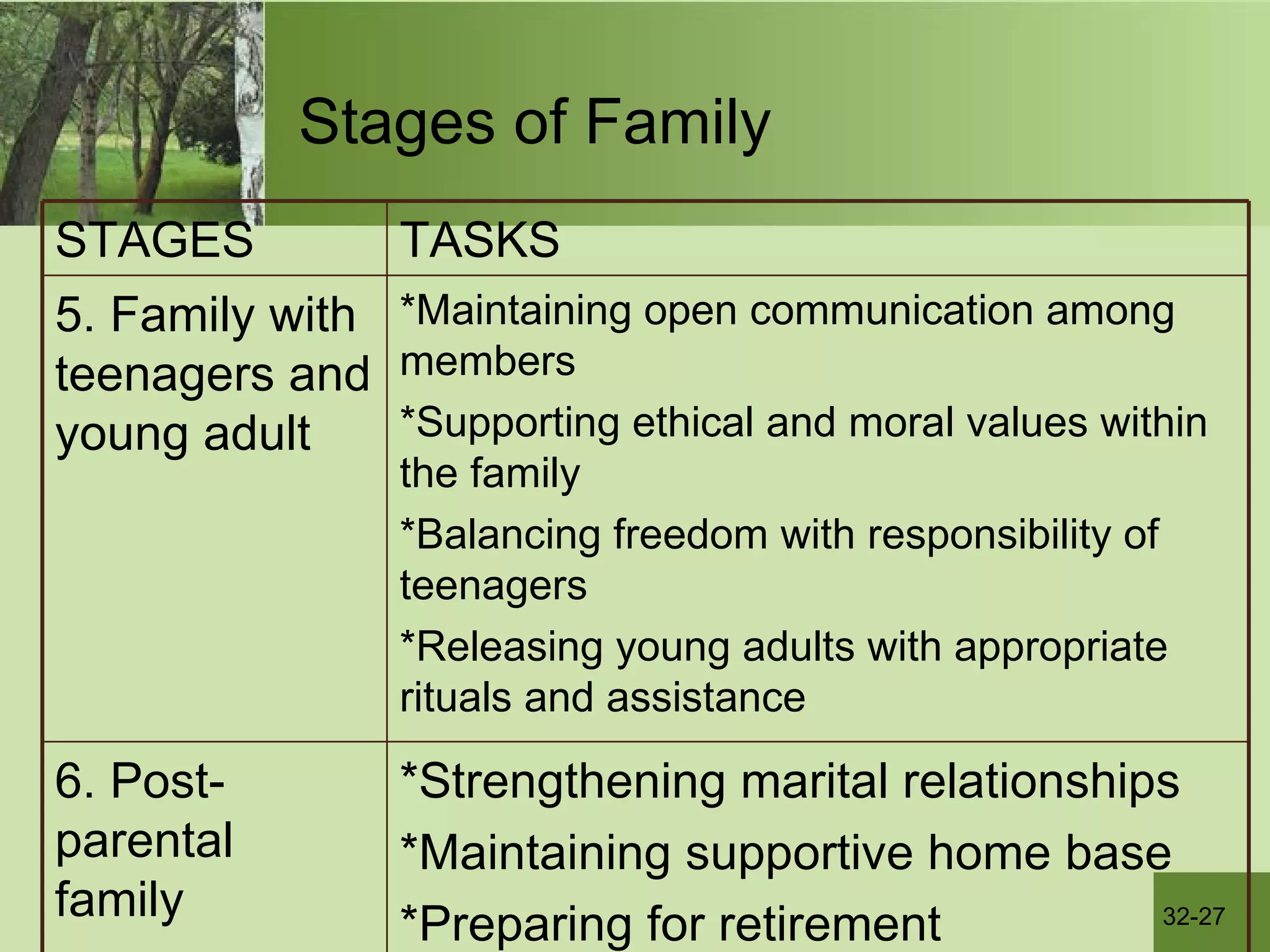
5. Family with *Maintaining open communication among
teenagers and members
young adult    *Supporting ethical and moral values within
                 the family
                 *Balancing freedom with responsibility of
                 teenagers
                 *Releasing young adults with appropriate
                 rituals and assistance

6. Post-         *Strengthening marital relationships
parental         *Maintaining supportive home base
family           *Preparing for retirement          32-27
Stages of Family

STAGES       TASKS
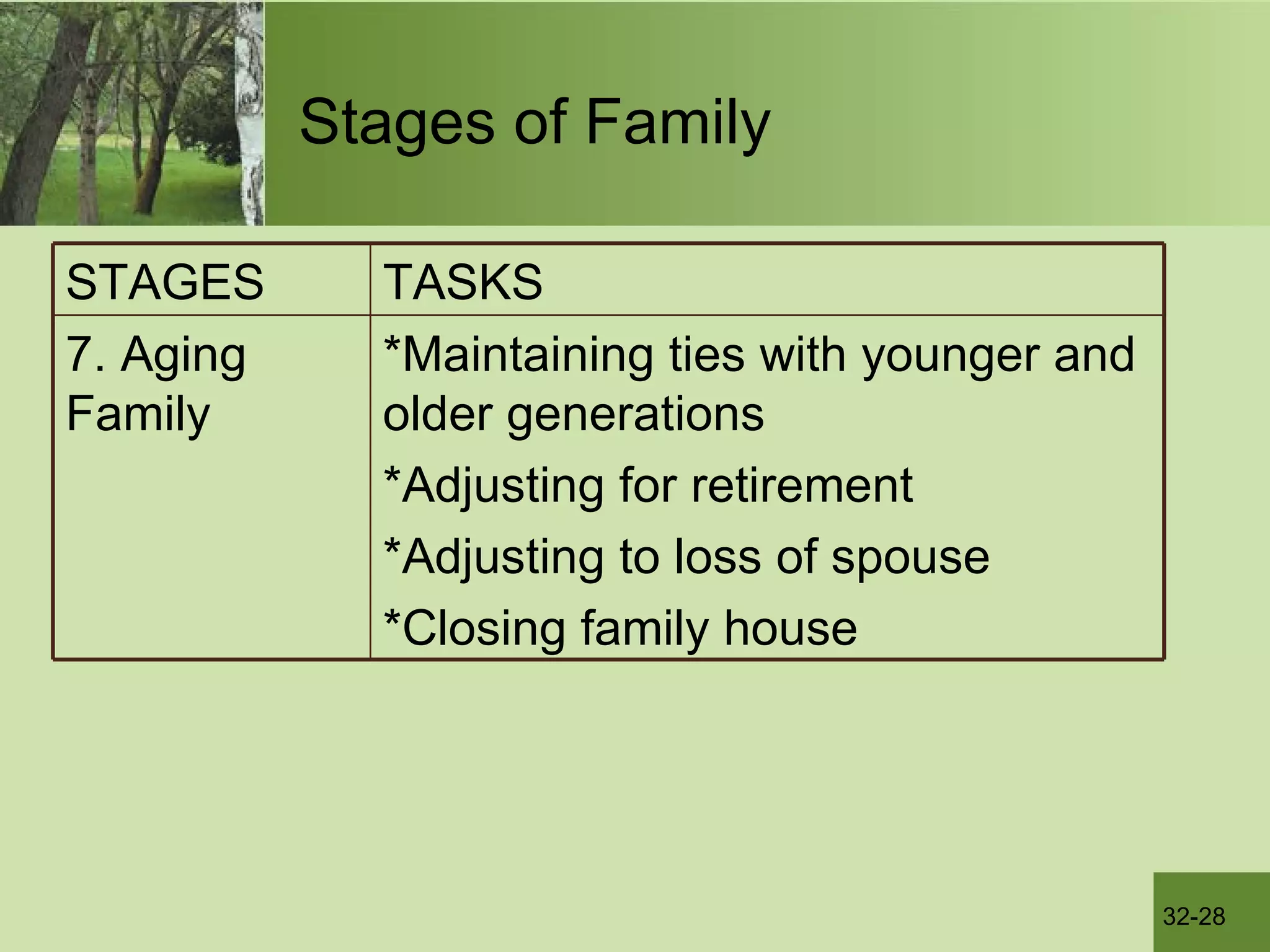
7. Aging     *Maintaining ties with younger and
Family       older generations
             *Adjusting for retirement
             *Adjusting to loss of spouse
             *Closing family house


                                                  32-28
Family Influences on
           Health Care
 Families help determine the following:
  •   Whether or not to seek treatment.
  •   What type of treatment is appropriate.
  •   Who should provide the treatment or care.
  •   Where the treatment or care should be
      provided.


                                                  32-29
Family Influences on
        Health Care
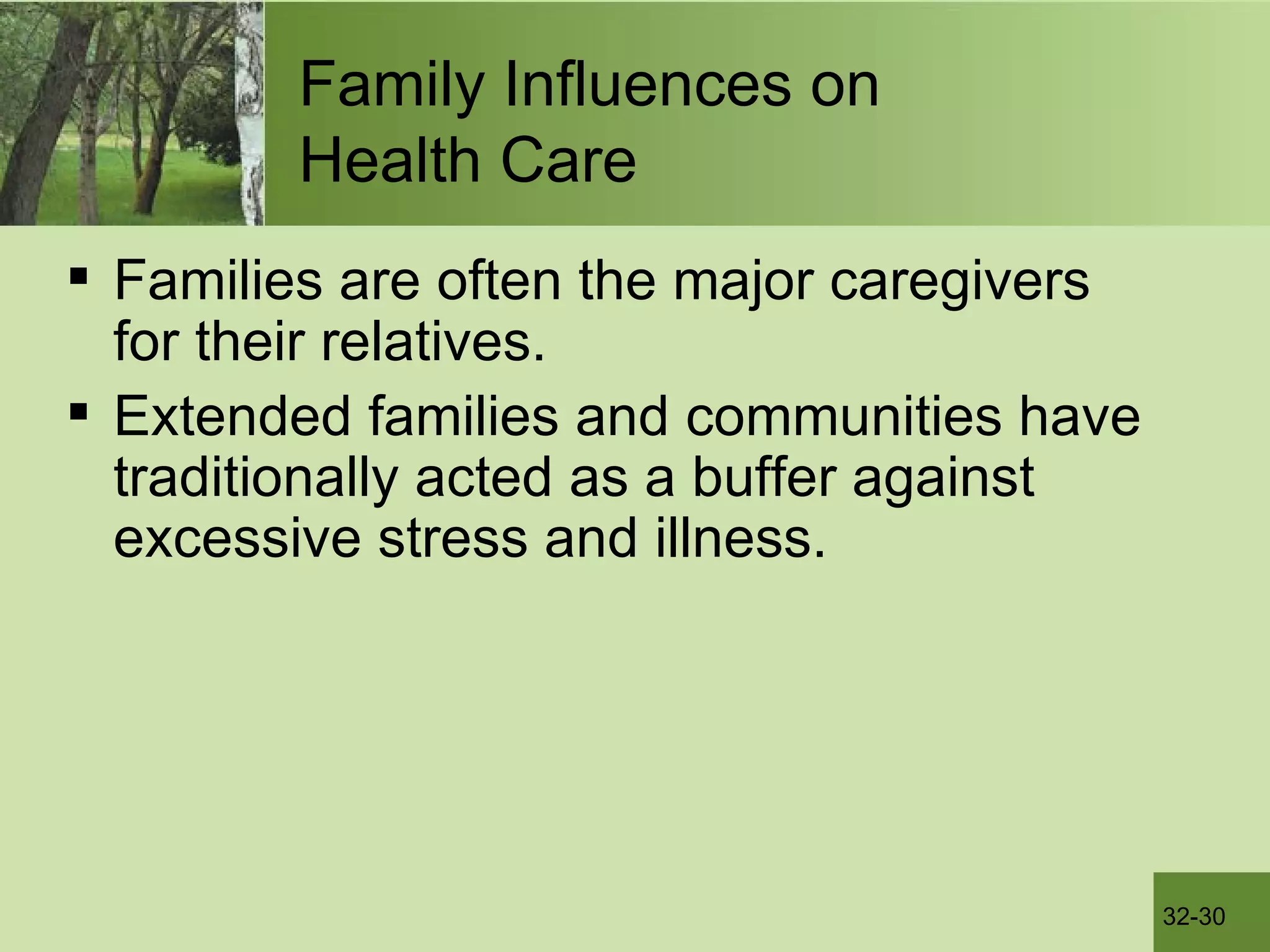
 Families are often the major caregivers
  for their relatives.
 Extended families and communities have
  traditionally acted as a buffer against
  excessive stress and illness.


                                            32-30
Family Influences on
         Health Care
 Lack of social support from family or
  significant others results in psychological
  and spiritual isolation, which may
  negatively impact a person’s
  physiological state.


                                                32-31

family

  • 1.
    FAMILY  Is thebasic social institution and the primary group in society  Accdg to Murdok, family is a social group characterized by common residence, economic cooperation and reproduction.  Accdg to Burges and Locke, family is a group of persons united by ties of marriage, blood or adoption, constituting a single household, interacting and communicating with each other in their respective social roles of husband and wife, mother and father, son and daughter, brother and sister, and creating and maintaining a common culture. 32-1
  • 2.
     Accdg andto Murray and Zentner (1997) is a social system and primary reference group made up of two or more persons living together who are related by blood, marriage or adoption or who are living together by arrangement over a period of time. 32-2
  • 3.
    F father  A and  M mother  I implying the presence of children where  L love must prevail between me and  Y you 32-3
  • 4.
    CHARACTERISTICS OF AFAMILY  The family as a social group is universal and is significant element in man’s social life.  It is the first social group to which the individual is exposed.  Family contact and relationships are repetitive and continuous.  The family is very close and intimate group.  It is setting of the most intense emotional experiences during the life time of the individual.  The family affects the individual social values, disposition and outlook in life.  The family has the unique position of serving as a link between the individual and the larger society.  The family is also unique in providing continuity of social life. 32-4
  • 5.
    Functions of Family  Regulates sexual behavior and reproduction  Biological maintenance function  Socialization function  Provide legitimate children with a status  Social control function  Economic function  Educational, recreational, religious and political functions 32-5
  • 6.
    Classification of FamilyStructure  Based on Descent • Patrilineal- affiliates a person with a group of relatives through his or her father. • Matrilineal- affiliates a person with a group of relatives through his or her mother. • Bilateral- affiliates a person with a group of relatives related through both his or her parents. 32-6
  • 7.
    Classification of FamilyStructure  Based on Authority • Patriarchial- authority is vested on the oldest male in the family, often the father. • Matriarchial- authority is vested in the mother or mother’s kin. • Matricentric- prolonged absence of the father gives the mother a dominant position in the family, although the father may also share with the mother in decision making. 32-7
  • 8.
    Classification of FamilyStructure  Based on Internal Organization and Membership • Nuclear Family. Also known as primary or elementary family. • Extended Family. Extensions maybe through the parent-child relationship or husband-wife relationship, as in polygamous marriage. 32-8
  • 9.
    Classification of FamilyStructure  Based on Place of Residence • Patrilocal- requires the newly wed to reside near the groom’s parents. • Matrilocal- near the bride’s parents. • Bilocal- provides the couple the choice to reside on either parents. • Neolocal- permits the couple to reside independently of their parents. • Avunculocal- prescribes the newly wed couple to reside with or near the maternal uncle of the groom. 32-9
  • 10.
    Family systems theory The family is viewed as a system where the family members are interdependent and are working towards specific purposes and goals.  Families are viewed as open systems continually interacting with other systems in the community. 32-10
  • 11.
     Families consistof special functional subsystems: marital subsystem (parents) sibling subsytem (children) individual parent –child system subsystem  Boundaries regulate the input and output to and from other systems that interact with the family system. 32-11
  • 12.
     Boundaries alsoprotect the family from demands and influences of other systems. View of a person: *The person is a member of the family system and is also considered a subsystem. 32-12
  • 13.
    Developmental stage theory Families are viewed as ever changing and growing; and each family is expected to accomplish tasks at every stage of development. Accomplishment of these tasks is a prerequisite for success in achieving the tasks of the next stage of development.  Major task of family: create an environment where each member could master developmental tasks. 32-13
  • 14.
    View of theperson: * The person is a member of the family where each new member adds to the complexity of the interaction within the family. 32-14
  • 15.
     Accordingly, themain functions of a family include the following: 1. to develop a sense of family purpose and affiliation 2. to add and socialize new members 3. to provide and distribute care and services to members 4. to organize members and resources in meeting family goals. 32-15
  • 16.
    View of person: *The person is seen as fulfilling roles within the social system. 32-16
  • 17.
    Interactional theory  Thefamily is defined as a unity of interacting personalities with assigned position and roles, expectations and norms of behavior.  View of person: * The person is capable of interacting with other family members and is seen as fulfilling roles within the family. 32-17
  • 18.
    Role theory  Familylife is structured according to the roles that are assumed by the person in interaction with others. Roles are learned through socialization and there is high mutual dependence on division of labor within the family.  Each family member has specialized roles. 32-18
  • 19.
    View of person: The person is seen in terms of roles which are specialized or shared and depend on age, sex, social norms and status.  A person experiences role reciprocity or strain.  Role reciprocity or mutual exchange of responsibilities ensures that personal and family needs are almost always met and that everyone in the family would have a potential for positive growth. 32-19
  • 20.
     Role strainoccurs when individual have difficulty meeting others’ or their own expectations and obligations.  Role strain may be manifested in two ways: *Role conflict- unclear, incomplete, contradictory elements in role which makes the performance of one’s role difficult. 32-20
  • 21.
     Role overload-consider the impact of the distribution of power among the members of the family. Usually, the person with less power assumes more unwanted burdens while the person with more power has less dependency needs. 32-21
  • 22.
    Crisis theory  Thefamily is made up of members when individually experience a state of disequilibrium from situational or societal sources of stress called stress.  Forms of crisis: -Developmental Crisis- transitional periods in personality development characterized by disturbances in cognitive and affective functioning. 32-22
  • 23.
     Situational crisis-sudden, unexpected threats to, or loss of basic resources or life goals.  Basic assumptions: * All family members are affected by the inability of one member to cope. * The family assists members with coping problems by adopting coping mechanisms as a group. 32-23
  • 24.
     View ofperson: *Crisis in a person may take the form of illness which may pose a problem to the entire family. 32-24
  • 25.
    Stages of Family STAGES TASKS 1. Beginning *Establishing a mutually satisfying Family marriage *Planning to have or not to have children 2. Child- *Having and adjusting to infant bearing family *Supporting the needs of all three members *Renegotiating marital relationships 32-25
  • 26.
    Stages of Family STAGES TASKS 3. Family with *adjusting to cost of family life a pre-school *adapting to the needs of pre-school children children *Coping with parental loss of energy and privacy 4. Family with *Adjusting to the activity of the growing school age children children *Promoting joint decisions between children and parents *Encouraging and supporting children’s educational achievements 32-26
  • 27.
    Stages of Family STAGES TASKS 5. Family with *Maintaining open communication among teenagers and members young adult *Supporting ethical and moral values within the family *Balancing freedom with responsibility of teenagers *Releasing young adults with appropriate rituals and assistance 6. Post- *Strengthening marital relationships parental *Maintaining supportive home base family *Preparing for retirement 32-27
  • 28.
    Stages of Family STAGES TASKS 7. Aging *Maintaining ties with younger and Family older generations *Adjusting for retirement *Adjusting to loss of spouse *Closing family house 32-28
  • 29.
    Family Influences on Health Care  Families help determine the following: • Whether or not to seek treatment. • What type of treatment is appropriate. • Who should provide the treatment or care. • Where the treatment or care should be provided. 32-29
  • 30.
    Family Influences on Health Care  Families are often the major caregivers for their relatives.  Extended families and communities have traditionally acted as a buffer against excessive stress and illness. 32-30
  • 31.
    Family Influences on Health Care  Lack of social support from family or significant others results in psychological and spiritual isolation, which may negatively impact a person’s physiological state. 32-31