PERSONALITY
DISORDERS
By Riya Jain
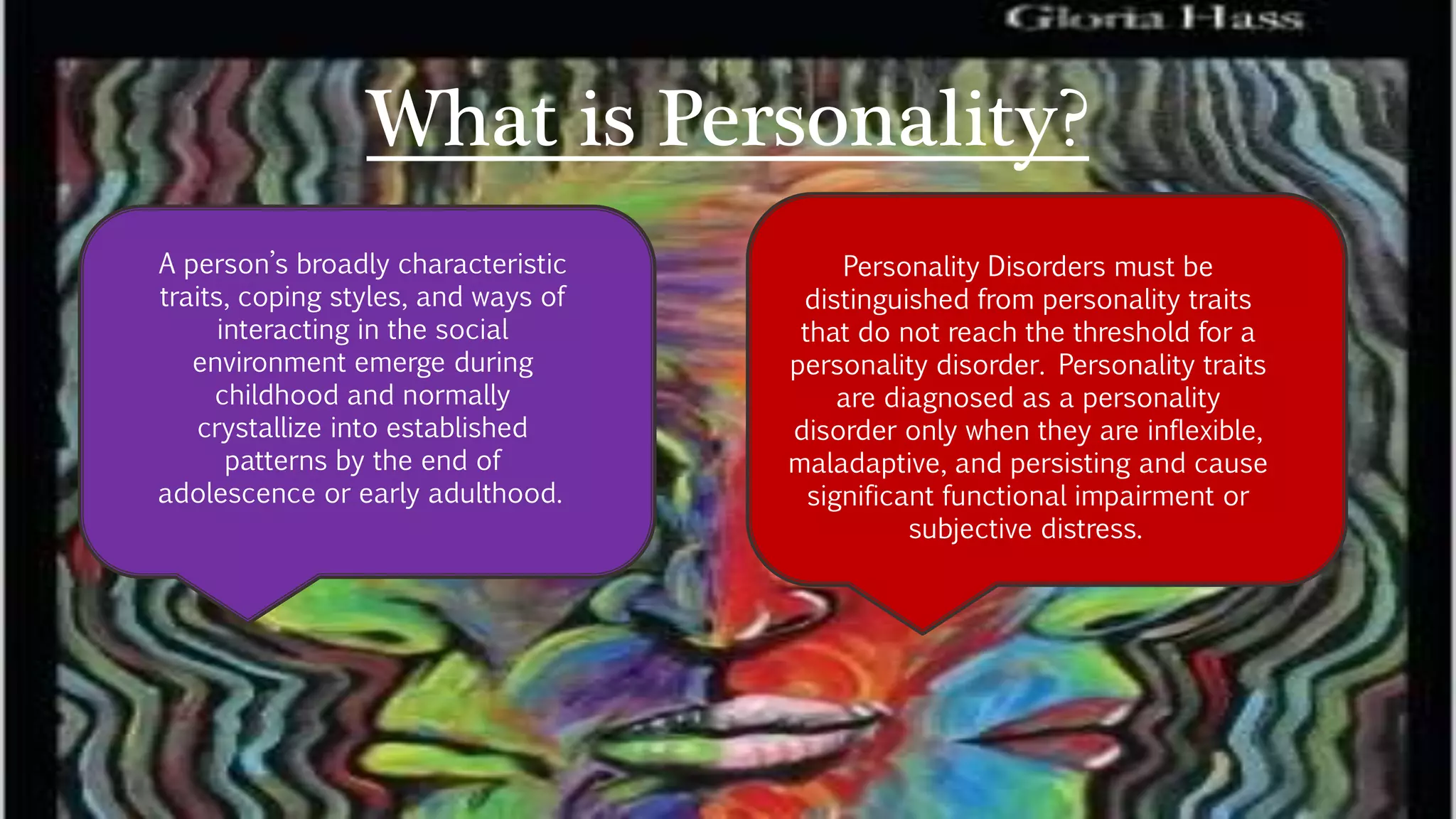
What is Personality?
A person’s broadly characteristic
traits, coping styles, and ways of
interacting in the social
environment emerge during
childhood and normally
crystallize into established
patterns by the end of
adolescence or early adulthood.
Personality Disorders must be
distinguished from personality traits
that do not reach the threshold for a
personality disorder. Personality traits
are diagnosed as a personality
disorder only when they are inflexible,
maladaptive, and persisting and cause
significant functional impairment or
subjective distress.
DIMENSIONAL MODELS
The Five-Factor Model (Goldberg,
1990; John & Naumann, 2008; McCrae &
Costa, 2008)
This model consists of the following five dimensions:
• Neuroticism
• Extroversion versus Introversion
• Openness versus Experience
• Agreeableness versus Antagonism
• Conscientiousness
 Other dimensions that have been studied include
novelty seeking, reward dependence, harm
avoidance, dominance, affiliation, constraint,
persistence, positive emotionality versus negative
emotionality, pleasure seeking versus pain
avoidance, passive accommodation versus active
modification, and self-propagation versus other
nurturance.
DSM-IV-TR’s DIAGNOSTIC CRITERIA
The essential feature of a personality disorder is is an enduring pattern of inner experience and
behavior that deviates markedly from the expectations of the individual’s culture. The definition
of personality disorders in the DSM-IV-TR is based on criteria:
Criteria A
This pattern must be
manifested in at least
two of the following
areas: cognition,
affectivity, interpersonal
functioning, or impulse
control.
Criteria D
The pattern is stable and
of long duration, and its
onset can be traced back
at least to adolescence or
early adulthood.
Criteria E
The pattern is not
better accounted for
as a manifestation or
consequence of
another mental
disorder.
Criteria B
The enduring pattern is
inflexible and pervasive
across a broad range of
personal and social
situations,
Criteria C
The enduring pattern leads to
clinically significant distress or
impairment in social,
occupational, or other
important areas of functioning.
Criteria F
The enduring pattern is
not due to the direct
physiological effects of
a substance or a
general medical
condition.
Overview of Personality Disorders
•Aaron Beck and his colleagues have proposed a useful integrative scheme
that may highlight some of the commonalities and differences among the
personality disorders. (Beck and Freeman,1990; Pretzer & Beck, 1996) .
•In their view people with personality disorders can be characterized on several
different dimensions, including the kinds of interpersonal strategies they use.
•Each personality disorder is also characterized by a different set of behavior
patterns that are overdeveloped, and another set of behavior patterns that are
underdeveloped. In many cases the deficient behaviors are somehow
counterparts to the overdeveloped features. (Beck & Freeman, 1990; Pretzer &
Beck, 1996).
•Finally, Beck and colleagues also propose that each personality disorder is
characterized by different core dysfunctional beliefs that people with
personality disorders have about themselves and the world around them..
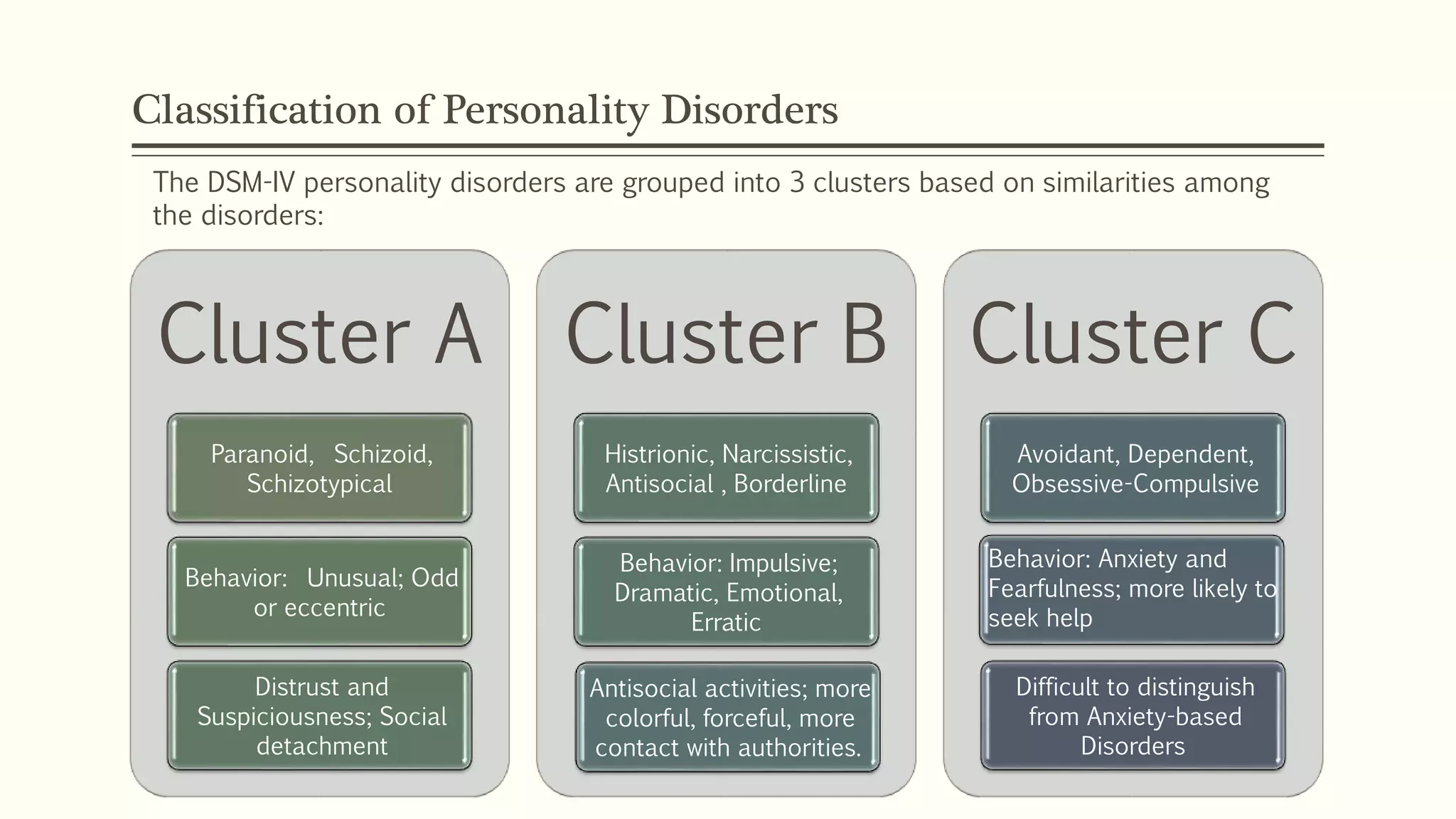
Classification of Personality Disorders
Cluster A
Paranoid, Schizoid,
Schizotypical
Behavior: Unusual; Odd
or eccentric
Distrust and
Suspiciousness; Social
detachment
Cluster B
Histrionic, Narcissistic,
Antisocial , Borderline
Behavior: Impulsive;
Dramatic, Emotional,
Erratic
Antisocial activities; more
colorful, forceful, more
contact with authorities.
Cluster C
Avoidant, Dependent,
Obsessive-Compulsive
Behavior: Anxiety and
Fearfulness; more likely to
seek help
Difficult to distinguish
from Anxiety-based
Disorders
The DSM-IV personality disorders are grouped into 3 clusters based on similarities among
the disorders:
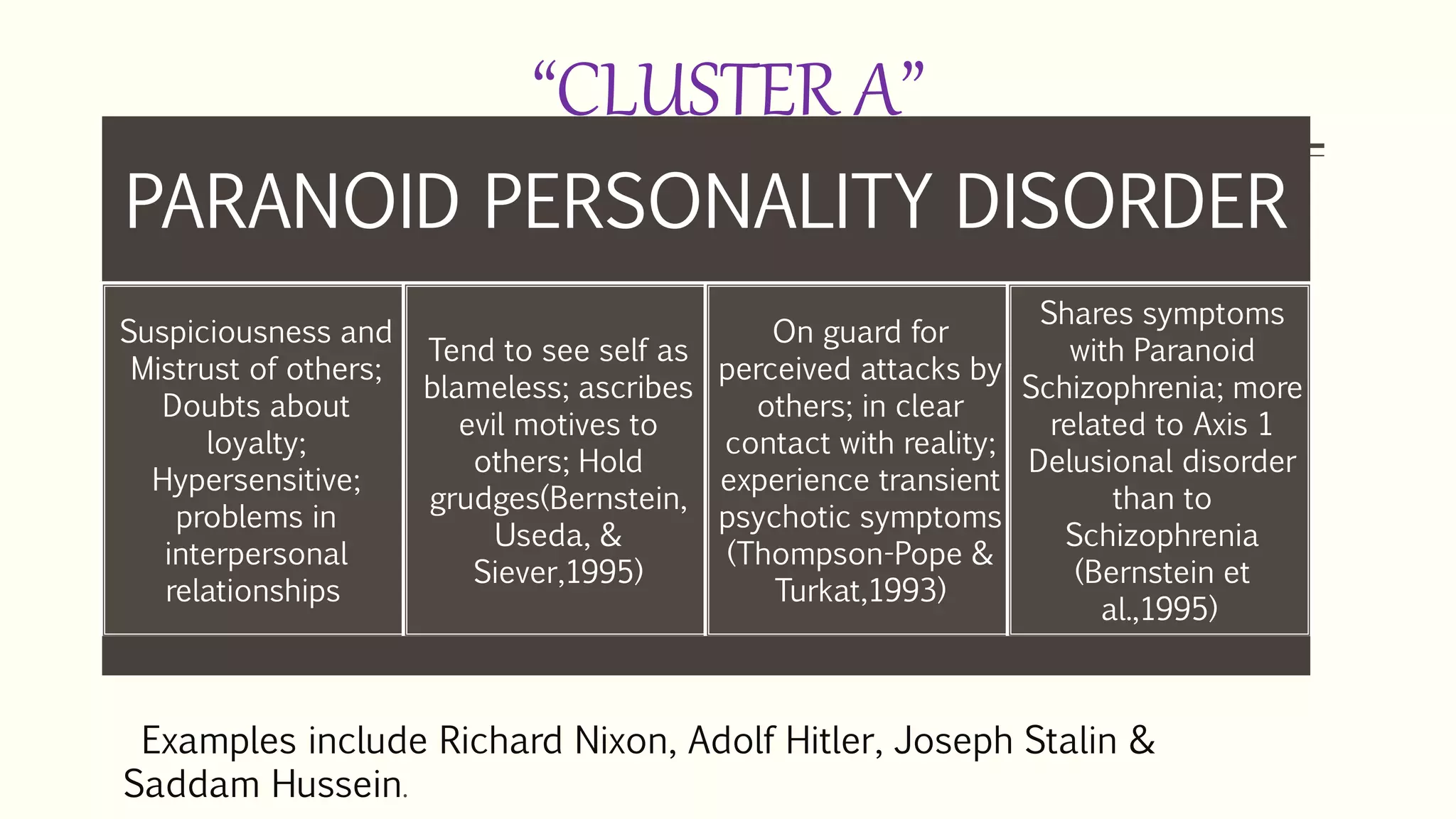
“CLUSTER A”
PARANOID PERSONALITY DISORDER
Suspiciousness and
Mistrust of others;
Doubts about
loyalty;
Hypersensitive;
problems in
interpersonal
relationships
Tend to see self as
blameless; ascribes
evil motives to
others; Hold
grudges(Bernstein,
Useda, &
Siever,1995)
On guard for
perceived attacks by
others; in clear
contact with reality;
experience transient
psychotic symptoms
(Thompson-Pope &
Turkat,1993)
Shares symptoms
with Paranoid
Schizophrenia; more
related to Axis 1
Delusional disorder
than to
Schizophrenia
(Bernstein et
al.,1995)
Examples include Richard Nixon, Adolf Hitler, Joseph Stalin &
Saddam Hussein.
Prevalence and Gender Ratio Estimate
0.5-2%
Males > Females
Schizoid Personality Disorder
Impaired social
relationships; Lack
social skills; Not
emotionally reactive
Inability and lack of
desire to form
attachments to
others; Negative
symptoms of
schizophrenia:
Anhedonia and
Social withdrawal.
Classified as loners
and introverts, with
solitary interests
and occupations
(Widiger &
Frances,1994);
appears cold and
aloof
Neither desire nor
enjoy close
relationships; Need
for love, belonging
and approval fails to
develop.
Examples include Squidward from Sponge Bob Squire Pants and Dexter Morgan
from Dexter (just his personality not the serial killing).
Add a Slide Title - 3
John Nash(A Beautiful Mind)
Peter Green
Mary Todd Lincoln
Charles Darwin
Bill Gates
Isaac Asimov
Bobby Fisher
Karl Marx
Belle for the Beauty and the beast
Sigmund Freud
Prevalence and Gender Ratio Estimate
<1%
Males > Females
Schizotypal Personality Disorder
Peculiar thought
patterns; Excessively
introverted;
Pervasive social and
interpersonal
deficits
Cognitive and
perceptual
distortions and
eccentricities in
their
communication and
behavior(Widiger &
Frances,1994)
Involves oddities of
thought, perception,
or speech; Highly
personalized and
superstitious
thinking; Under
extreme stress:
transient psychotic
symptoms
Attentional Deficits
and Working
memory deficits;
“Schizophrenic
genotype”;Increased
risk for developing
schizophrenia
Magical thinking,
ideas of reference ,
odd speech and
suspicious beliefs;
Shares genetic link
with schizophrenia
(Kendler &
Gardner,1997)
Examples include Kramer from Seinfeld, Doc Brown from Back to the Future and the
characters on the Big Bang Theory, Vincent Van Gogh.
Prevalence and Gender Ratio Estimate
3%
Males > Females
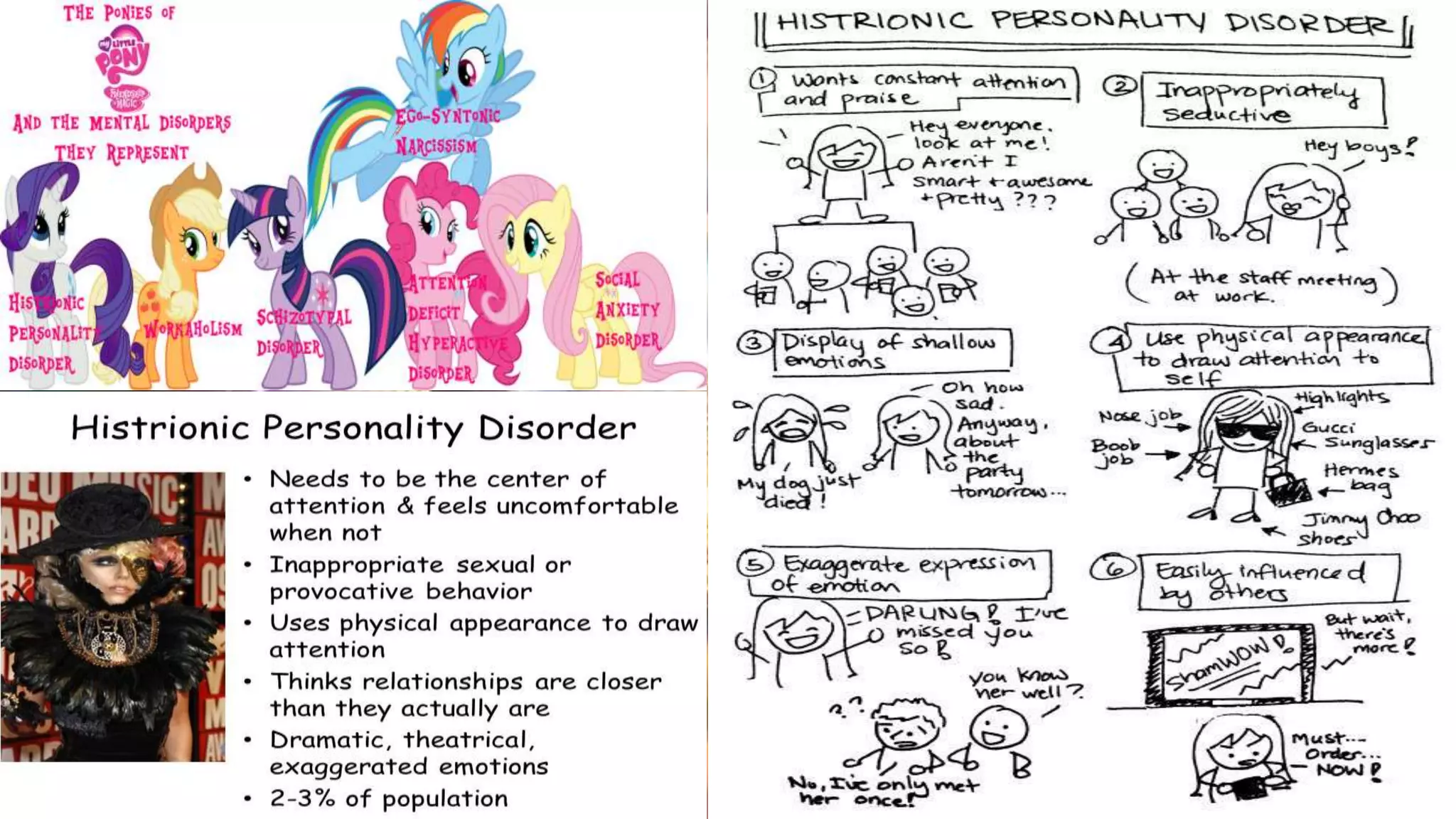
Histrionic Personality Disorder
Excessive
attention-seeking
behavior and
emotionality; self
dramatization;
Seen as overly
reactive, shallow
and insincere.
Tend to feel
unappreciated,
irritated and
tempered if not
the center of
attraction; stormy
interpersonal
relationships
Appearance and
behavior:
Theatrical,
Emotional,
Provocative and
seductive; More in
Women than men
Highly Suggestible
and perceives
relationships to
be closer than
they are; Poor
sexual
adjustment(Apt&
Hurlbert,1994)
“CLUSTER B”
Examples include Madonna, Scarlett O’Hara, Paris Hilton & most reality
TV stars.
Prevalence and Gender Ratio Estimate
2-3%
Males = Females
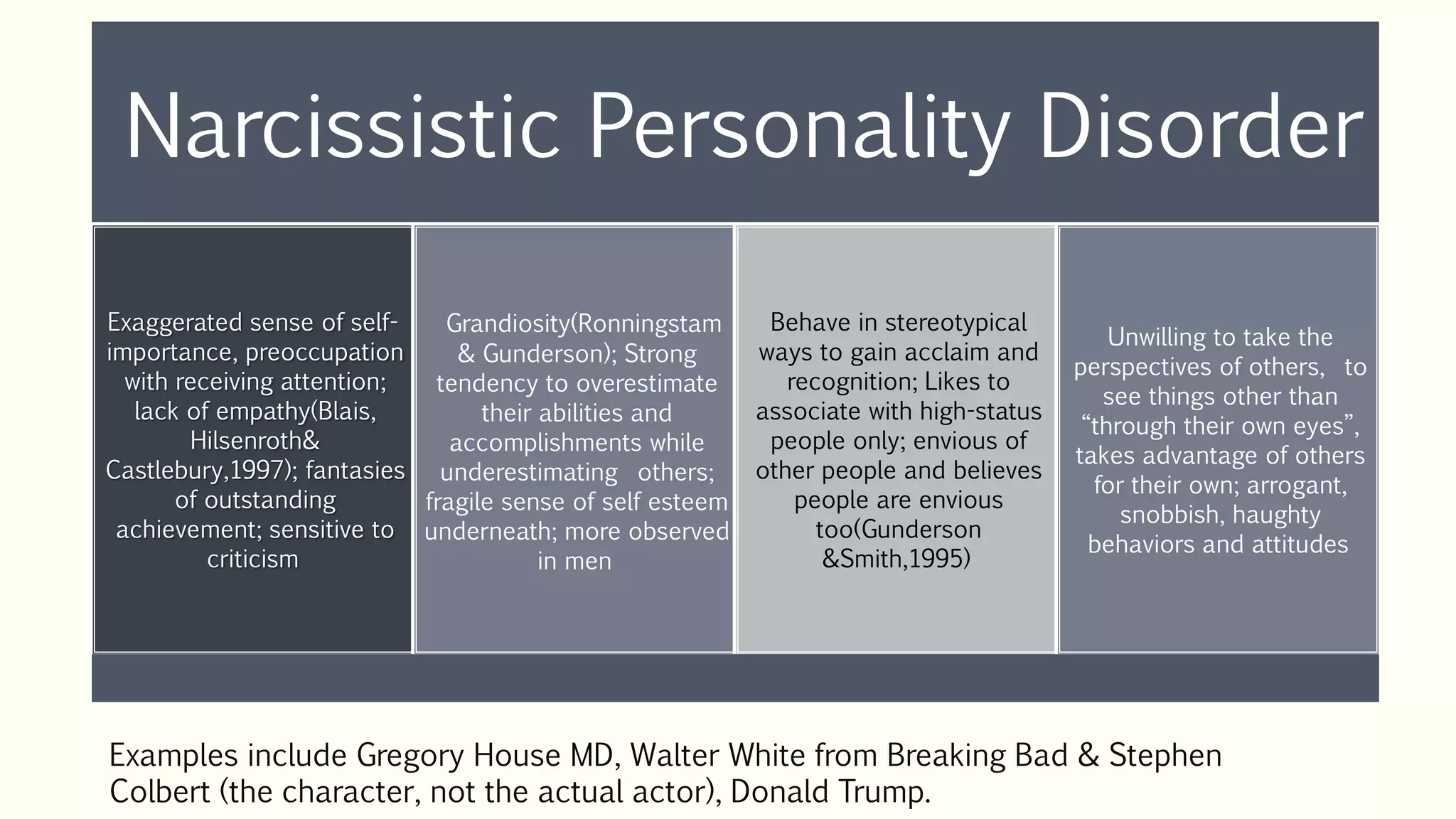
Narcissistic Personality Disorder
Exaggerated sense of self-
importance, preoccupation
with receiving attention;
lack of empathy(Blais,
Hilsenroth&
Castlebury,1997); fantasies
of outstanding
achievement; sensitive to
criticism
Grandiosity(Ronningstam
& Gunderson); Strong
tendency to overestimate
their abilities and
accomplishments while
underestimating others;
fragile sense of self esteem
underneath; more observed
in men
Behave in stereotypical
ways to gain acclaim and
recognition; Likes to
associate with high-status
people only; envious of
other people and believes
people are envious
too(Gunderson
&Smith,1995)
Unwilling to take the
perspectives of others, to
see things other than
“through their own eyes”,
takes advantage of others
for their own; arrogant,
snobbish, haughty
behaviors and attitudes
Examples include Gregory House MD, Walter White from Breaking Bad & Stephen
Colbert (the character, not the actual actor), Donald Trump.
Prevalence and Gender Ratio Estimate
<1%
Males > Females
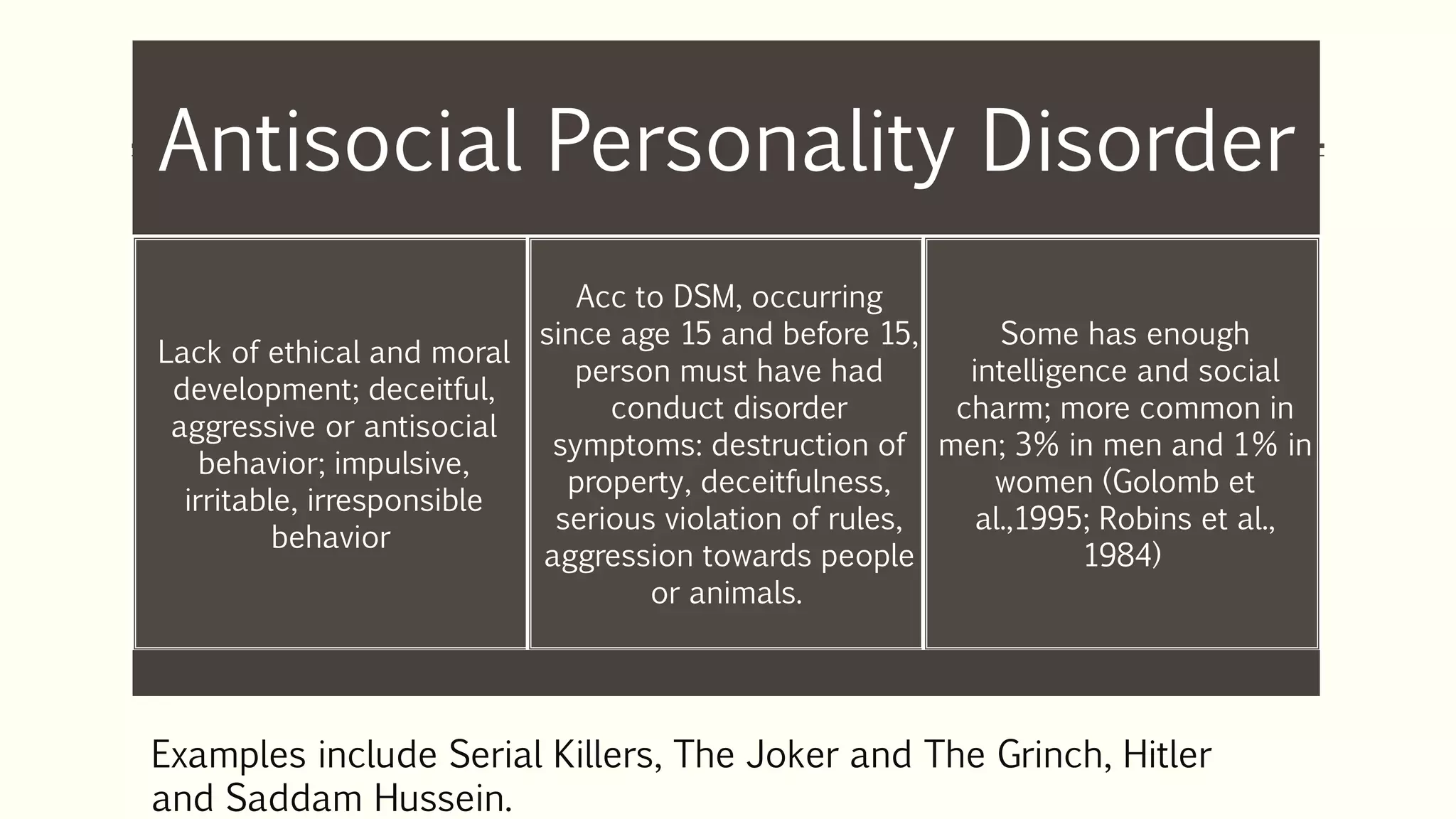
Antisocial Personality Disorder
Lack of ethical and moral
development; deceitful,
aggressive or antisocial
behavior; impulsive,
irritable, irresponsible
behavior
Acc to DSM, occurring
since age 15 and before 15,
person must have had
conduct disorder
symptoms: destruction of
property, deceitfulness,
serious violation of rules,
aggression towards people
or animals.
Some has enough
intelligence and social
charm; more common in
men; 3% in men and 1% in
women (Golomb et
al.,1995; Robins et al.,
1984)
Examples include Serial Killers, The Joker and The Grinch, Hitler
and Saddam Hussein.
Difference between Narcissistic and Histrionic
Personality Disorder
Widiger and Trull(1993) attempted to
summarize the major differences in this way,
“The histrionic tends to be more emotional and
dramatic than the narcissistic, and whereas
both may be promiscuous, the narcissistic is
more dispassionately exploitative, while the
histrionic is more overtly needy. Both will be
exhibitionistic, but the histrionic seeks
attention, whereas the narcissistic seeks
admiration.”
Difference between Narcissistic and Antisocial
Personality Disorder
Widiger and Trull(1993) noted that the most
basic distinction is that “The narcissist’s
exploitation would be more for the purpose
of demonstrating domination, prestige, and
superiority rather than for the personal,
material gain of the antisocial personality”
Prevalence and Gender Ratio Estimate
1% Females
3% Males
Borderline Personality Disorder
Impulsivity and
Instability in
interpersonal
relationships, self-
image and moods;
Highly unstable
mood; intense
outbursts; suicide
and self- mutilation
Feeling slighted;
might become
verbally abusive
toward loved ones
or might threaten
suicide over minor
setbacks; chronic
feelings of
emptiness; self-
destructive beh.,
Involves over
idealization of
friends or lovers;
end in bitter
disappointment or
disillusionment.
Associated with
relief from anxiety
or dysphoria and
analgesia ;
manipulative suicide
attempts
Examples include Princess Diana, Marilyn Monroe, Megan Fox and Adolf Hitler.
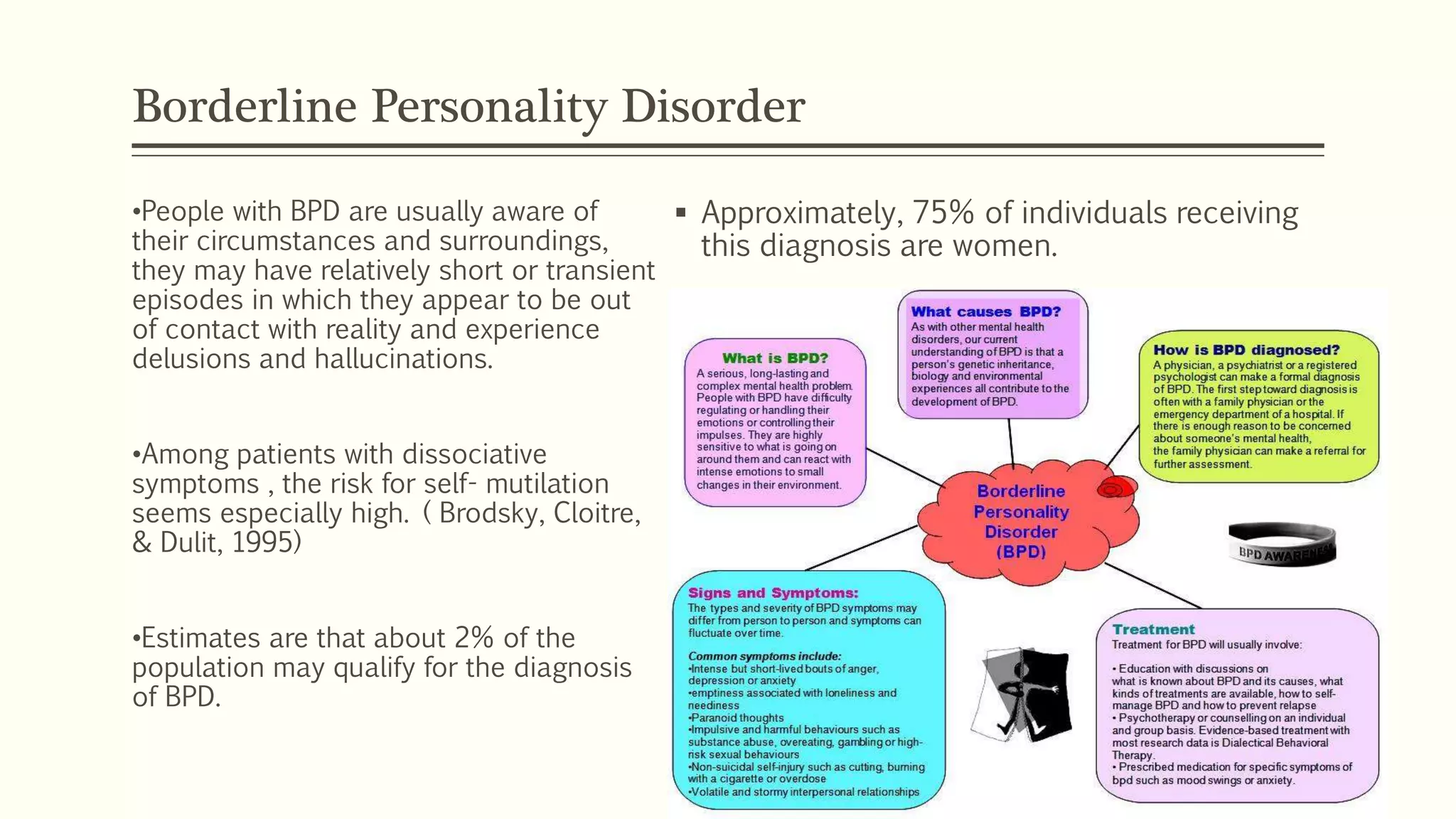
Borderline Personality Disorder
•People with BPD are usually aware of
their circumstances and surroundings,
they may have relatively short or transient
episodes in which they appear to be out
of contact with reality and experience
delusions and hallucinations.
•Among patients with dissociative
symptoms , the risk for self- mutilation
seems especially high. ( Brodsky, Cloitre,
& Dulit, 1995)
•Estimates are that about 2% of the
population may qualify for the diagnosis
of BPD.
 Approximately, 75% of individuals receiving
this diagnosis are women.
Prevalence and Gender Ratio Estimate
2%
Females > Males
(by 3:1)
Avoidant Personality Disorder
Extreme social inhibition
and introversion; limited
social relationships and
reluctance to enter into
social interactions.
Hypersensitivity to rejection
and social derogation; fear
of criticism and rebuff;
desire affection; do not
enjoy aloneness; cannot
face situations of
embarrassment or risk.
Inability to relate
comfortably causes acute
anxiety, low self-esteem,
excessive self-
consciousness; shyness
CLUSTER C
Examples include
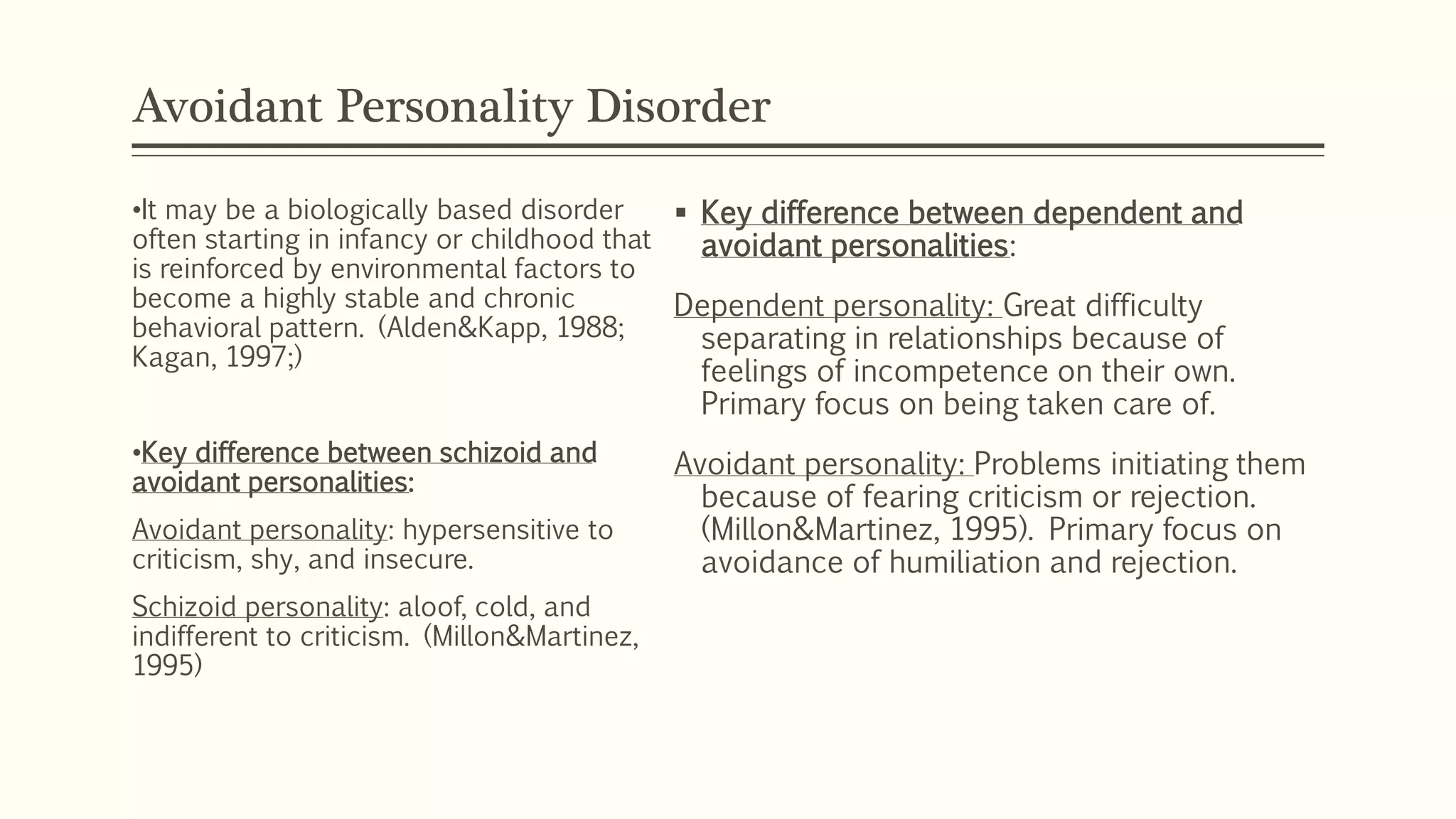
Avoidant Personality Disorder
•It may be a biologically based disorder
often starting in infancy or childhood that
is reinforced by environmental factors to
become a highly stable and chronic
behavioral pattern. (Alden&Kapp, 1988;
Kagan, 1997;)
•Key difference between schizoid and
avoidant personalities:
Avoidant personality: hypersensitive to
criticism, shy, and insecure.
Schizoid personality: aloof, cold, and
indifferent to criticism. (Millon&Martinez,
1995)
 Key difference between dependent and
avoidant personalities:
Dependent personality: Great difficulty
separating in relationships because of
feelings of incompetence on their own.
Primary focus on being taken care of.
Avoidant personality: Problems initiating them
because of fearing criticism or rejection.
(Millon&Martinez, 1995). Primary focus on
avoidance of humiliation and rejection.
Prevalence and Gender Ratio Estimate
0.5-1%
Males = Females
Dependent Personality Disorder
Extreme Dependence on
other people; clinging and
submissive behavior; co-
morbid diagnosis of anxiety
disorders; common with
eating disorders patients
Acute discomfort and panic
at the possibility of
separation or being alone;
excessive reliance on
EMS(Bornstein, 1992,1997)
Indiscriminate selection of
mates; remain in
psychologically or
physically abusive
relationships;
indecisiveness; lacks self
confidence
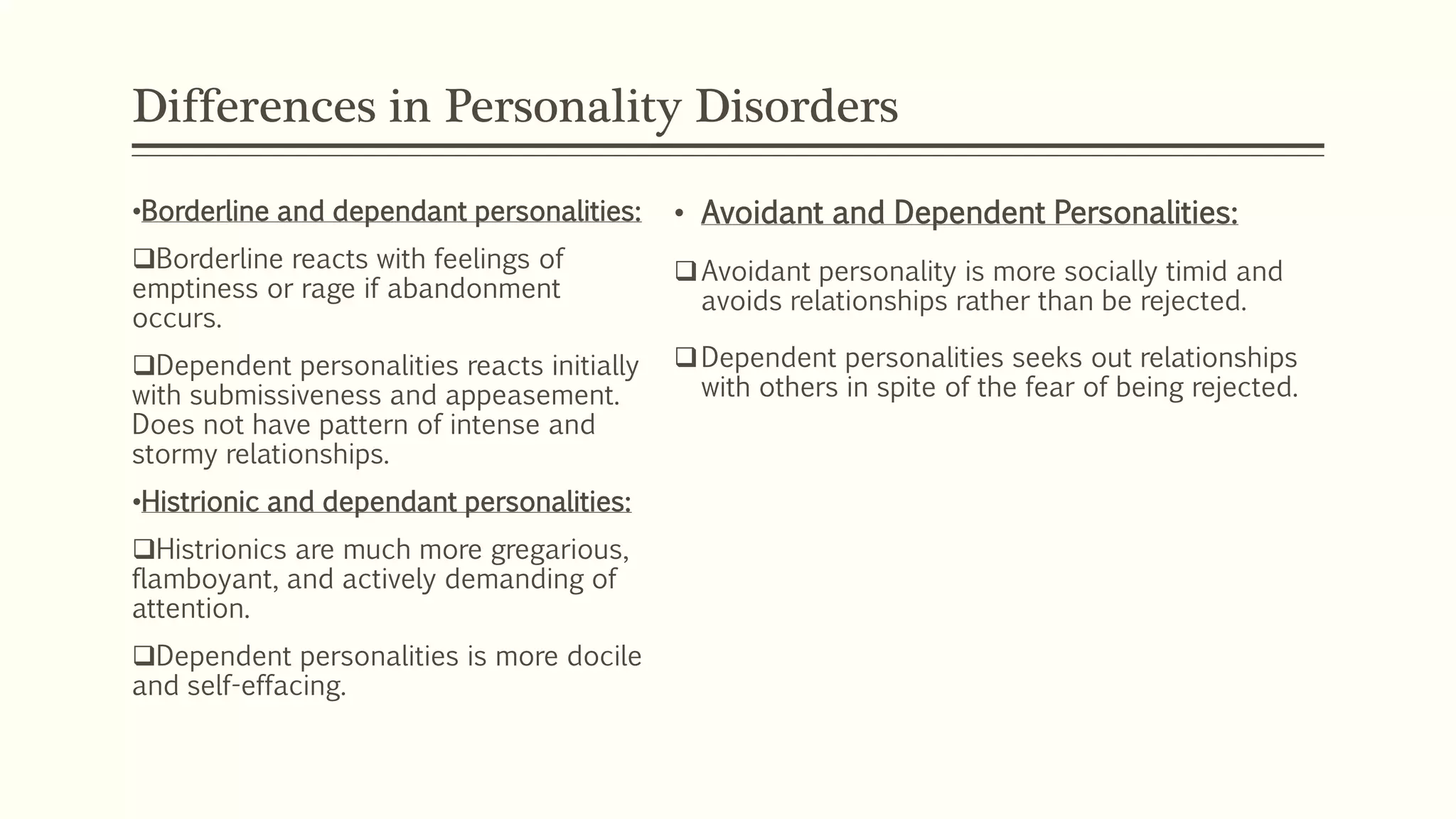
Differences in Personality Disorders
•Borderline and dependant personalities:
Borderline reacts with feelings of
emptiness or rage if abandonment
occurs.
Dependent personalities reacts initially
with submissiveness and appeasement.
Does not have pattern of intense and
stormy relationships.
•Histrionic and dependant personalities:
Histrionics are much more gregarious,
flamboyant, and actively demanding of
attention.
Dependent personalities is more docile
and self-effacing.
• Avoidant and Dependent Personalities:
Avoidant personality is more socially timid and
avoids relationships rather than be rejected.
Dependent personalities seeks out relationships
with others in spite of the fear of being rejected.
Prevalence and Gender Ratio Estimate
2%
Males = Females
Obsessive-Compulsive Personality
Disorder
Perfectionism and an
excessive concern with
maintaining order; difficulty
delegating tasks to others;
quite rigid and stubborn,
over conscientiousness
Maintains mental and
interpersonal control
through careful attention to
rules and schedules,
inflexible about moral and
ethical issues, excessively
devoted to work
Perfectionism is quite
dysfunctional: never
finishing projects; difficult in
relaxing and having
fun(Widiger&Frances,1994)
Differences in Personality Disorders:
•Narcissistic Personality disorder and
OCPD:
Narcissistic personalities are more
grandiose and likely to believe he or she
has achieved perfection.
OC Personality is often quite self-
critical.
•Schizoid Personality Disorder and OCPD:
Schizoids lacks the capacity for close
relationships.
OC Personality has difficulty in
interpersonal relationships because of
excessive devotion to work and because
of difficulty expressing emotions.
Prevalence and Gender Ratio Estimate
1%
Males > Females
(by 2:1)
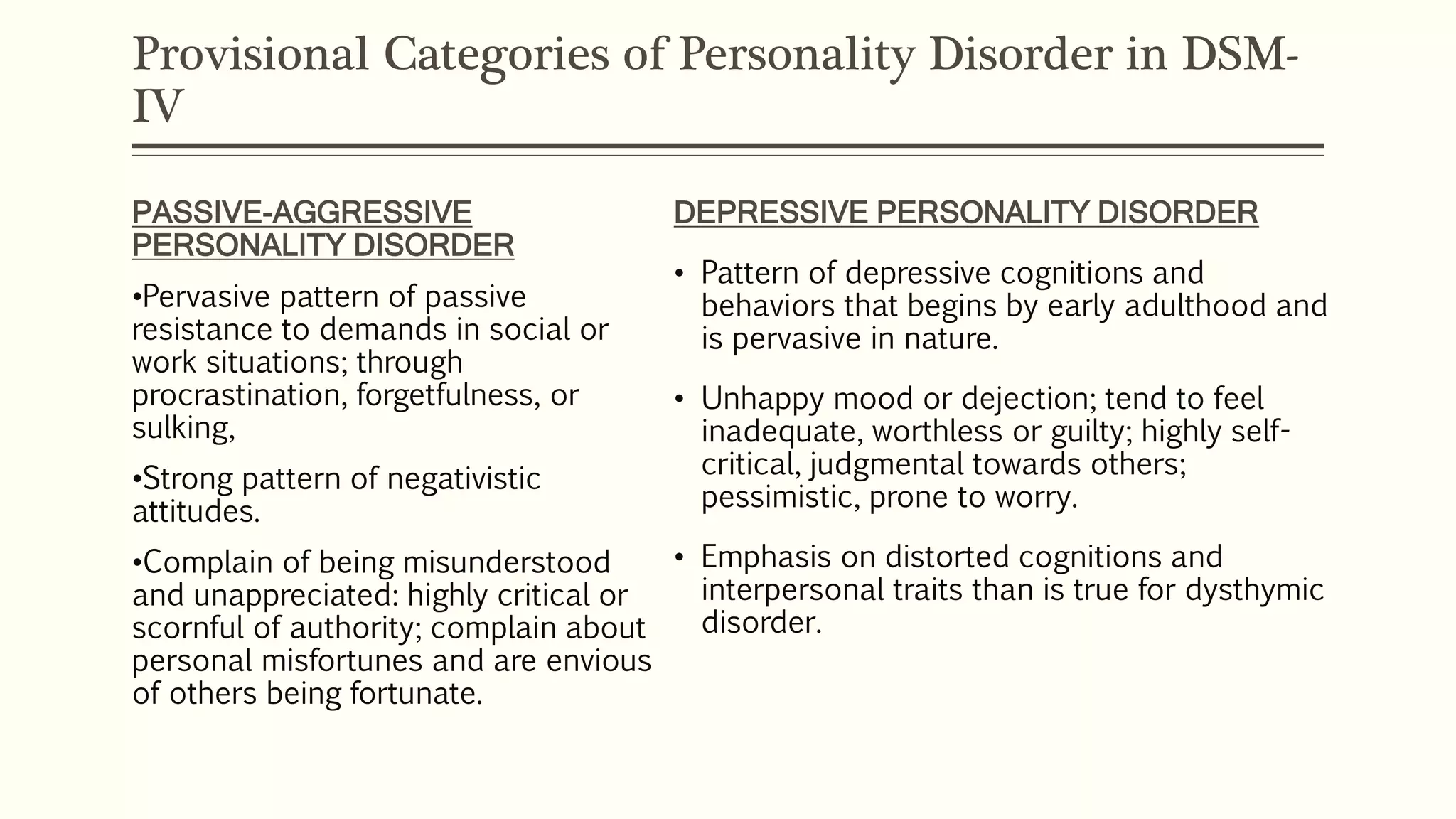
Provisional Categories of Personality Disorder in DSM-
IV
PASSIVE-AGGRESSIVE
PERSONALITY DISORDER
•Pervasive pattern of passive
resistance to demands in social or
work situations; through
procrastination, forgetfulness, or
sulking,
•Strong pattern of negativistic
attitudes.
•Complain of being misunderstood
and unappreciated: highly critical or
scornful of authority; complain about
personal misfortunes and are envious
of others being fortunate.
DEPRESSIVE PERSONALITY DISORDER
• Pattern of depressive cognitions and
behaviors that begins by early adulthood and
is pervasive in nature.
• Unhappy mood or dejection; tend to feel
inadequate, worthless or guilty; highly self-
critical, judgmental towards others;
pessimistic, prone to worry.
• Emphasis on distorted cognitions and
interpersonal traits than is true for dysthymic
disorder.
Epidemiological study
•Prevalence estimates for one or more
personality disorders have ranged
from 4.4 percent to 14.8 percent.
(Grant et al., 2005; Lenzenweger,
2008; Paris, 2010)
•One review averaging across six
relatively small epidemiological
studies estimated that about 13
percent of the population meets
criteria for at least one personality
disorder at some point in their lives
(Mattia & Zimmerman, 2001).
•Several studies from Sweden have
yielded very similar estimates
(Eskelius et al., 2001; Torgersen et al.,
2001).
 One study estimated that about 10 percent
of the population exhibits at least one
personality disorder, with 5.7 percent in
Cluster A, 1.5 percent in Cluster B, and
6 percent in Cluster C.
 One summary of evidence estimated that
about three-quarters of people diagnosed
with a personality disorder also have an Axis
I disorder (Dolan- Sewell et al., 2001).
For example, personality disorders are often
associated with anxiety disorders, mood
disorders, substance-abuse and dependence,
and sexual deviations.(L.A. Clark, 2005, 2007;
Grant, Hasin at al., 2005; Grant, Stinson et al.,
2005; Mattia & Zimmerman, 2001).
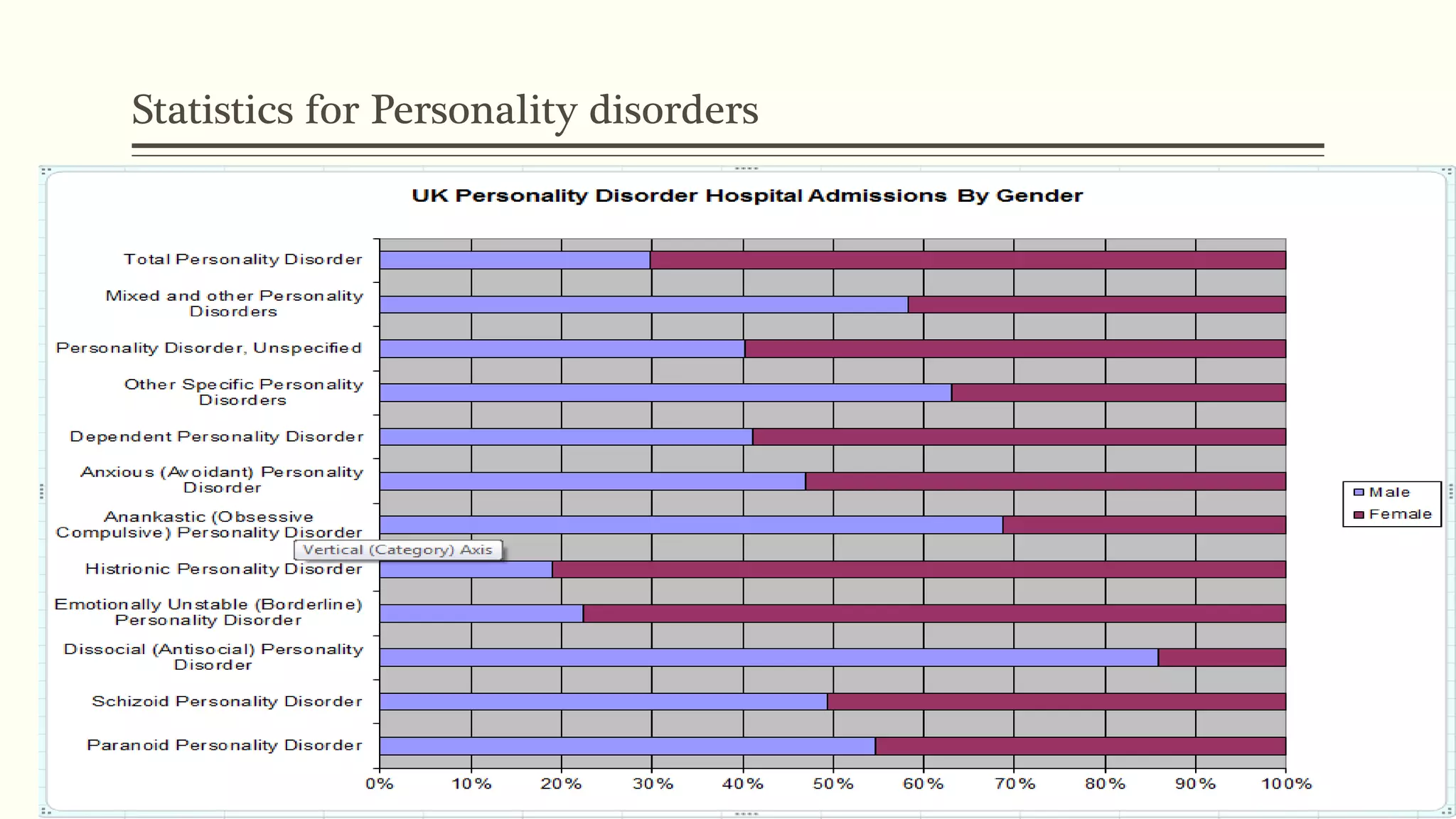
Statistics for Personality disorders
END..

Personality disorders

  • 1.
  • 3.
    What is Personality? Aperson’s broadly characteristic traits, coping styles, and ways of interacting in the social environment emerge during childhood and normally crystallize into established patterns by the end of adolescence or early adulthood. Personality Disorders must be distinguished from personality traits that do not reach the threshold for a personality disorder. Personality traits are diagnosed as a personality disorder only when they are inflexible, maladaptive, and persisting and cause significant functional impairment or subjective distress.
  • 4.
    DIMENSIONAL MODELS The Five-FactorModel (Goldberg, 1990; John & Naumann, 2008; McCrae & Costa, 2008) This model consists of the following five dimensions: • Neuroticism • Extroversion versus Introversion • Openness versus Experience • Agreeableness versus Antagonism • Conscientiousness  Other dimensions that have been studied include novelty seeking, reward dependence, harm avoidance, dominance, affiliation, constraint, persistence, positive emotionality versus negative emotionality, pleasure seeking versus pain avoidance, passive accommodation versus active modification, and self-propagation versus other nurturance.
  • 5.
    DSM-IV-TR’s DIAGNOSTIC CRITERIA Theessential feature of a personality disorder is is an enduring pattern of inner experience and behavior that deviates markedly from the expectations of the individual’s culture. The definition of personality disorders in the DSM-IV-TR is based on criteria: Criteria A This pattern must be manifested in at least two of the following areas: cognition, affectivity, interpersonal functioning, or impulse control. Criteria D The pattern is stable and of long duration, and its onset can be traced back at least to adolescence or early adulthood. Criteria E The pattern is not better accounted for as a manifestation or consequence of another mental disorder. Criteria B The enduring pattern is inflexible and pervasive across a broad range of personal and social situations, Criteria C The enduring pattern leads to clinically significant distress or impairment in social, occupational, or other important areas of functioning. Criteria F The enduring pattern is not due to the direct physiological effects of a substance or a general medical condition.
  • 6.
    Overview of PersonalityDisorders •Aaron Beck and his colleagues have proposed a useful integrative scheme that may highlight some of the commonalities and differences among the personality disorders. (Beck and Freeman,1990; Pretzer & Beck, 1996) . •In their view people with personality disorders can be characterized on several different dimensions, including the kinds of interpersonal strategies they use. •Each personality disorder is also characterized by a different set of behavior patterns that are overdeveloped, and another set of behavior patterns that are underdeveloped. In many cases the deficient behaviors are somehow counterparts to the overdeveloped features. (Beck & Freeman, 1990; Pretzer & Beck, 1996). •Finally, Beck and colleagues also propose that each personality disorder is characterized by different core dysfunctional beliefs that people with personality disorders have about themselves and the world around them..
  • 9.
    Classification of PersonalityDisorders Cluster A Paranoid, Schizoid, Schizotypical Behavior: Unusual; Odd or eccentric Distrust and Suspiciousness; Social detachment Cluster B Histrionic, Narcissistic, Antisocial , Borderline Behavior: Impulsive; Dramatic, Emotional, Erratic Antisocial activities; more colorful, forceful, more contact with authorities. Cluster C Avoidant, Dependent, Obsessive-Compulsive Behavior: Anxiety and Fearfulness; more likely to seek help Difficult to distinguish from Anxiety-based Disorders The DSM-IV personality disorders are grouped into 3 clusters based on similarities among the disorders:
  • 10.
    “CLUSTER A” PARANOID PERSONALITYDISORDER Suspiciousness and Mistrust of others; Doubts about loyalty; Hypersensitive; problems in interpersonal relationships Tend to see self as blameless; ascribes evil motives to others; Hold grudges(Bernstein, Useda, & Siever,1995) On guard for perceived attacks by others; in clear contact with reality; experience transient psychotic symptoms (Thompson-Pope & Turkat,1993) Shares symptoms with Paranoid Schizophrenia; more related to Axis 1 Delusional disorder than to Schizophrenia (Bernstein et al.,1995) Examples include Richard Nixon, Adolf Hitler, Joseph Stalin & Saddam Hussein.
  • 12.
    Prevalence and GenderRatio Estimate 0.5-2% Males > Females
  • 13.
    Schizoid Personality Disorder Impairedsocial relationships; Lack social skills; Not emotionally reactive Inability and lack of desire to form attachments to others; Negative symptoms of schizophrenia: Anhedonia and Social withdrawal. Classified as loners and introverts, with solitary interests and occupations (Widiger & Frances,1994); appears cold and aloof Neither desire nor enjoy close relationships; Need for love, belonging and approval fails to develop. Examples include Squidward from Sponge Bob Squire Pants and Dexter Morgan from Dexter (just his personality not the serial killing).
  • 14.
    Add a SlideTitle - 3 John Nash(A Beautiful Mind) Peter Green Mary Todd Lincoln Charles Darwin Bill Gates Isaac Asimov Bobby Fisher Karl Marx Belle for the Beauty and the beast Sigmund Freud
  • 15.
    Prevalence and GenderRatio Estimate <1% Males > Females
  • 16.
    Schizotypal Personality Disorder Peculiarthought patterns; Excessively introverted; Pervasive social and interpersonal deficits Cognitive and perceptual distortions and eccentricities in their communication and behavior(Widiger & Frances,1994) Involves oddities of thought, perception, or speech; Highly personalized and superstitious thinking; Under extreme stress: transient psychotic symptoms Attentional Deficits and Working memory deficits; “Schizophrenic genotype”;Increased risk for developing schizophrenia Magical thinking, ideas of reference , odd speech and suspicious beliefs; Shares genetic link with schizophrenia (Kendler & Gardner,1997) Examples include Kramer from Seinfeld, Doc Brown from Back to the Future and the characters on the Big Bang Theory, Vincent Van Gogh.
  • 18.
    Prevalence and GenderRatio Estimate 3% Males > Females
  • 19.
    Histrionic Personality Disorder Excessive attention-seeking behaviorand emotionality; self dramatization; Seen as overly reactive, shallow and insincere. Tend to feel unappreciated, irritated and tempered if not the center of attraction; stormy interpersonal relationships Appearance and behavior: Theatrical, Emotional, Provocative and seductive; More in Women than men Highly Suggestible and perceives relationships to be closer than they are; Poor sexual adjustment(Apt& Hurlbert,1994) “CLUSTER B” Examples include Madonna, Scarlett O’Hara, Paris Hilton & most reality TV stars.
  • 21.
    Prevalence and GenderRatio Estimate 2-3% Males = Females
  • 22.
    Narcissistic Personality Disorder Exaggeratedsense of self- importance, preoccupation with receiving attention; lack of empathy(Blais, Hilsenroth& Castlebury,1997); fantasies of outstanding achievement; sensitive to criticism Grandiosity(Ronningstam & Gunderson); Strong tendency to overestimate their abilities and accomplishments while underestimating others; fragile sense of self esteem underneath; more observed in men Behave in stereotypical ways to gain acclaim and recognition; Likes to associate with high-status people only; envious of other people and believes people are envious too(Gunderson &Smith,1995) Unwilling to take the perspectives of others, to see things other than “through their own eyes”, takes advantage of others for their own; arrogant, snobbish, haughty behaviors and attitudes Examples include Gregory House MD, Walter White from Breaking Bad & Stephen Colbert (the character, not the actual actor), Donald Trump.
  • 24.
    Prevalence and GenderRatio Estimate <1% Males > Females
  • 25.
    Antisocial Personality Disorder Lackof ethical and moral development; deceitful, aggressive or antisocial behavior; impulsive, irritable, irresponsible behavior Acc to DSM, occurring since age 15 and before 15, person must have had conduct disorder symptoms: destruction of property, deceitfulness, serious violation of rules, aggression towards people or animals. Some has enough intelligence and social charm; more common in men; 3% in men and 1% in women (Golomb et al.,1995; Robins et al., 1984) Examples include Serial Killers, The Joker and The Grinch, Hitler and Saddam Hussein.
  • 27.
    Difference between Narcissisticand Histrionic Personality Disorder Widiger and Trull(1993) attempted to summarize the major differences in this way, “The histrionic tends to be more emotional and dramatic than the narcissistic, and whereas both may be promiscuous, the narcissistic is more dispassionately exploitative, while the histrionic is more overtly needy. Both will be exhibitionistic, but the histrionic seeks attention, whereas the narcissistic seeks admiration.”
  • 28.
    Difference between Narcissisticand Antisocial Personality Disorder Widiger and Trull(1993) noted that the most basic distinction is that “The narcissist’s exploitation would be more for the purpose of demonstrating domination, prestige, and superiority rather than for the personal, material gain of the antisocial personality”
  • 29.
    Prevalence and GenderRatio Estimate 1% Females 3% Males
  • 30.
    Borderline Personality Disorder Impulsivityand Instability in interpersonal relationships, self- image and moods; Highly unstable mood; intense outbursts; suicide and self- mutilation Feeling slighted; might become verbally abusive toward loved ones or might threaten suicide over minor setbacks; chronic feelings of emptiness; self- destructive beh., Involves over idealization of friends or lovers; end in bitter disappointment or disillusionment. Associated with relief from anxiety or dysphoria and analgesia ; manipulative suicide attempts Examples include Princess Diana, Marilyn Monroe, Megan Fox and Adolf Hitler.
  • 31.
    Borderline Personality Disorder •Peoplewith BPD are usually aware of their circumstances and surroundings, they may have relatively short or transient episodes in which they appear to be out of contact with reality and experience delusions and hallucinations. •Among patients with dissociative symptoms , the risk for self- mutilation seems especially high. ( Brodsky, Cloitre, & Dulit, 1995) •Estimates are that about 2% of the population may qualify for the diagnosis of BPD.  Approximately, 75% of individuals receiving this diagnosis are women.
  • 33.
    Prevalence and GenderRatio Estimate 2% Females > Males (by 3:1)
  • 34.
    Avoidant Personality Disorder Extremesocial inhibition and introversion; limited social relationships and reluctance to enter into social interactions. Hypersensitivity to rejection and social derogation; fear of criticism and rebuff; desire affection; do not enjoy aloneness; cannot face situations of embarrassment or risk. Inability to relate comfortably causes acute anxiety, low self-esteem, excessive self- consciousness; shyness CLUSTER C Examples include
  • 35.
    Avoidant Personality Disorder •Itmay be a biologically based disorder often starting in infancy or childhood that is reinforced by environmental factors to become a highly stable and chronic behavioral pattern. (Alden&Kapp, 1988; Kagan, 1997;) •Key difference between schizoid and avoidant personalities: Avoidant personality: hypersensitive to criticism, shy, and insecure. Schizoid personality: aloof, cold, and indifferent to criticism. (Millon&Martinez, 1995)  Key difference between dependent and avoidant personalities: Dependent personality: Great difficulty separating in relationships because of feelings of incompetence on their own. Primary focus on being taken care of. Avoidant personality: Problems initiating them because of fearing criticism or rejection. (Millon&Martinez, 1995). Primary focus on avoidance of humiliation and rejection.
  • 37.
    Prevalence and GenderRatio Estimate 0.5-1% Males = Females
  • 38.
    Dependent Personality Disorder ExtremeDependence on other people; clinging and submissive behavior; co- morbid diagnosis of anxiety disorders; common with eating disorders patients Acute discomfort and panic at the possibility of separation or being alone; excessive reliance on EMS(Bornstein, 1992,1997) Indiscriminate selection of mates; remain in psychologically or physically abusive relationships; indecisiveness; lacks self confidence
  • 40.
    Differences in PersonalityDisorders •Borderline and dependant personalities: Borderline reacts with feelings of emptiness or rage if abandonment occurs. Dependent personalities reacts initially with submissiveness and appeasement. Does not have pattern of intense and stormy relationships. •Histrionic and dependant personalities: Histrionics are much more gregarious, flamboyant, and actively demanding of attention. Dependent personalities is more docile and self-effacing. • Avoidant and Dependent Personalities: Avoidant personality is more socially timid and avoids relationships rather than be rejected. Dependent personalities seeks out relationships with others in spite of the fear of being rejected.
  • 41.
    Prevalence and GenderRatio Estimate 2% Males = Females
  • 42.
    Obsessive-Compulsive Personality Disorder Perfectionism andan excessive concern with maintaining order; difficulty delegating tasks to others; quite rigid and stubborn, over conscientiousness Maintains mental and interpersonal control through careful attention to rules and schedules, inflexible about moral and ethical issues, excessively devoted to work Perfectionism is quite dysfunctional: never finishing projects; difficult in relaxing and having fun(Widiger&Frances,1994)
  • 44.
    Differences in PersonalityDisorders: •Narcissistic Personality disorder and OCPD: Narcissistic personalities are more grandiose and likely to believe he or she has achieved perfection. OC Personality is often quite self- critical. •Schizoid Personality Disorder and OCPD: Schizoids lacks the capacity for close relationships. OC Personality has difficulty in interpersonal relationships because of excessive devotion to work and because of difficulty expressing emotions.
  • 45.
    Prevalence and GenderRatio Estimate 1% Males > Females (by 2:1)
  • 46.
    Provisional Categories ofPersonality Disorder in DSM- IV PASSIVE-AGGRESSIVE PERSONALITY DISORDER •Pervasive pattern of passive resistance to demands in social or work situations; through procrastination, forgetfulness, or sulking, •Strong pattern of negativistic attitudes. •Complain of being misunderstood and unappreciated: highly critical or scornful of authority; complain about personal misfortunes and are envious of others being fortunate. DEPRESSIVE PERSONALITY DISORDER • Pattern of depressive cognitions and behaviors that begins by early adulthood and is pervasive in nature. • Unhappy mood or dejection; tend to feel inadequate, worthless or guilty; highly self- critical, judgmental towards others; pessimistic, prone to worry. • Emphasis on distorted cognitions and interpersonal traits than is true for dysthymic disorder.
  • 47.
    Epidemiological study •Prevalence estimatesfor one or more personality disorders have ranged from 4.4 percent to 14.8 percent. (Grant et al., 2005; Lenzenweger, 2008; Paris, 2010) •One review averaging across six relatively small epidemiological studies estimated that about 13 percent of the population meets criteria for at least one personality disorder at some point in their lives (Mattia & Zimmerman, 2001). •Several studies from Sweden have yielded very similar estimates (Eskelius et al., 2001; Torgersen et al., 2001).  One study estimated that about 10 percent of the population exhibits at least one personality disorder, with 5.7 percent in Cluster A, 1.5 percent in Cluster B, and 6 percent in Cluster C.  One summary of evidence estimated that about three-quarters of people diagnosed with a personality disorder also have an Axis I disorder (Dolan- Sewell et al., 2001). For example, personality disorders are often associated with anxiety disorders, mood disorders, substance-abuse and dependence, and sexual deviations.(L.A. Clark, 2005, 2007; Grant, Hasin at al., 2005; Grant, Stinson et al., 2005; Mattia & Zimmerman, 2001).
  • 48.
  • 49.

Editor's Notes

  • #2 NOTE: To change the image on this slide, select the picture and delete it. Then click the Pictures icon in the placeholder to insert your own image.