Social Web 2.0 Implications of Social Technologies for Digital Media Shelly Farnham, Ph.D. Com 597 Winter 2007
Week 3 Identity and Online Match Making
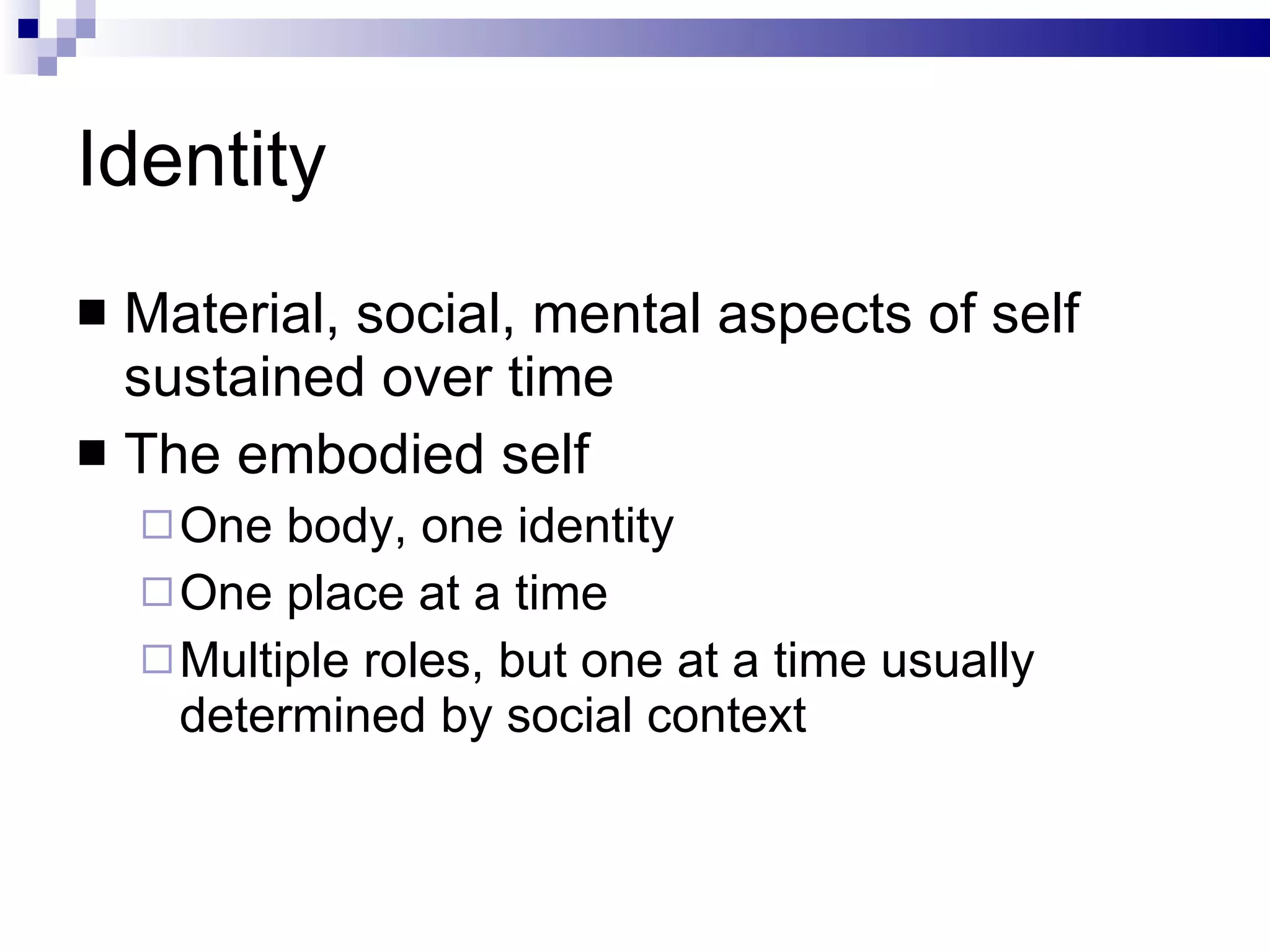
Identity Material, social, mental aspects of self sustained over time The embodied self One body, one identity One place at a time Multiple roles, but one at a time usually determined by social context
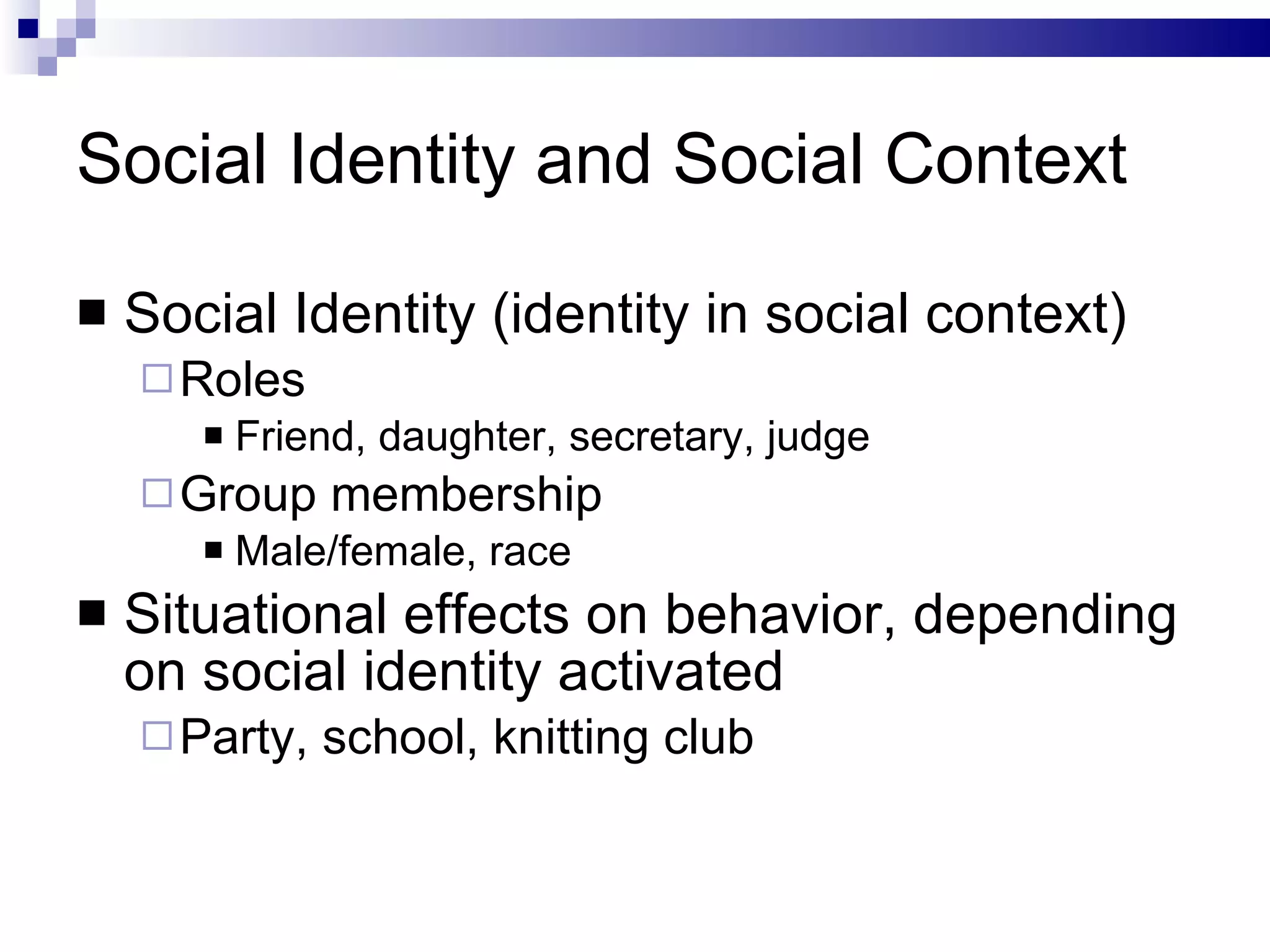
Social Identity and Social Context Social Identity (identity in social context) Roles Friend, daughter, secretary, judge Group membership Male/female, race Situational effects on behavior, depending on social identity activated Party, school, knitting club
Impression Management Self-presentation Any behavior intended to create, modify, maintain impression in minds of others Why? Define nature of social interaction gain material or social rewards self-construction self-enhancement Trade off between  desire to present best impression to achieve social goods Ingratiation, self-promotion, intimidation, exemplification, supplication Need to be accurate, accountable
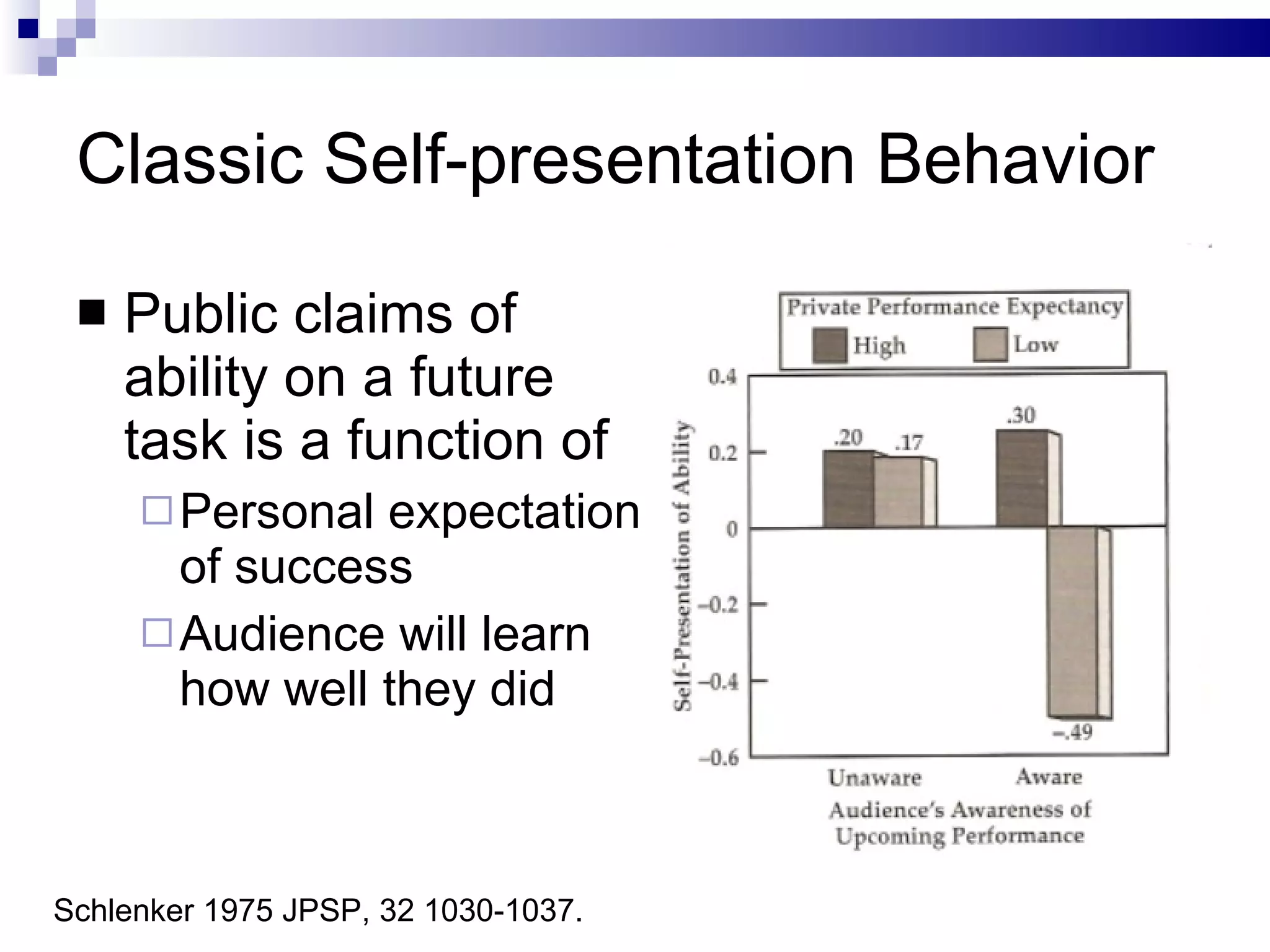
Classic Self-presentation Behavior Public claims of ability on a future task is a function of Personal expectation of success Audience will learn how well they did Schlenker 1975 JPSP, 32 1030-1037.
Disadvantages of Online Identity No centralized, physical presence Limited awareness of, or control over who is your audience Interacting with multiple social contexts at same time Identity asynchronous persists in your absence, so potential access by wrong audience  Online role/situational conflict difficulty keeping role identities separate Stress of having incompatible roles Distrust of anonymous/minimally identified others Fraud, cheat, impersonation Trolling
Advantages of Online Identity Anonymity/Pseudonymity Expose sensitive issues in way can’t do offline Health Alternative life style/sexuality Interpersonal stories Broadcast profile enables access to others Without having to go to bars, job agencies Use sophisticated matchmaking systems Identity play Fraud, cheat, impersonation Trolling
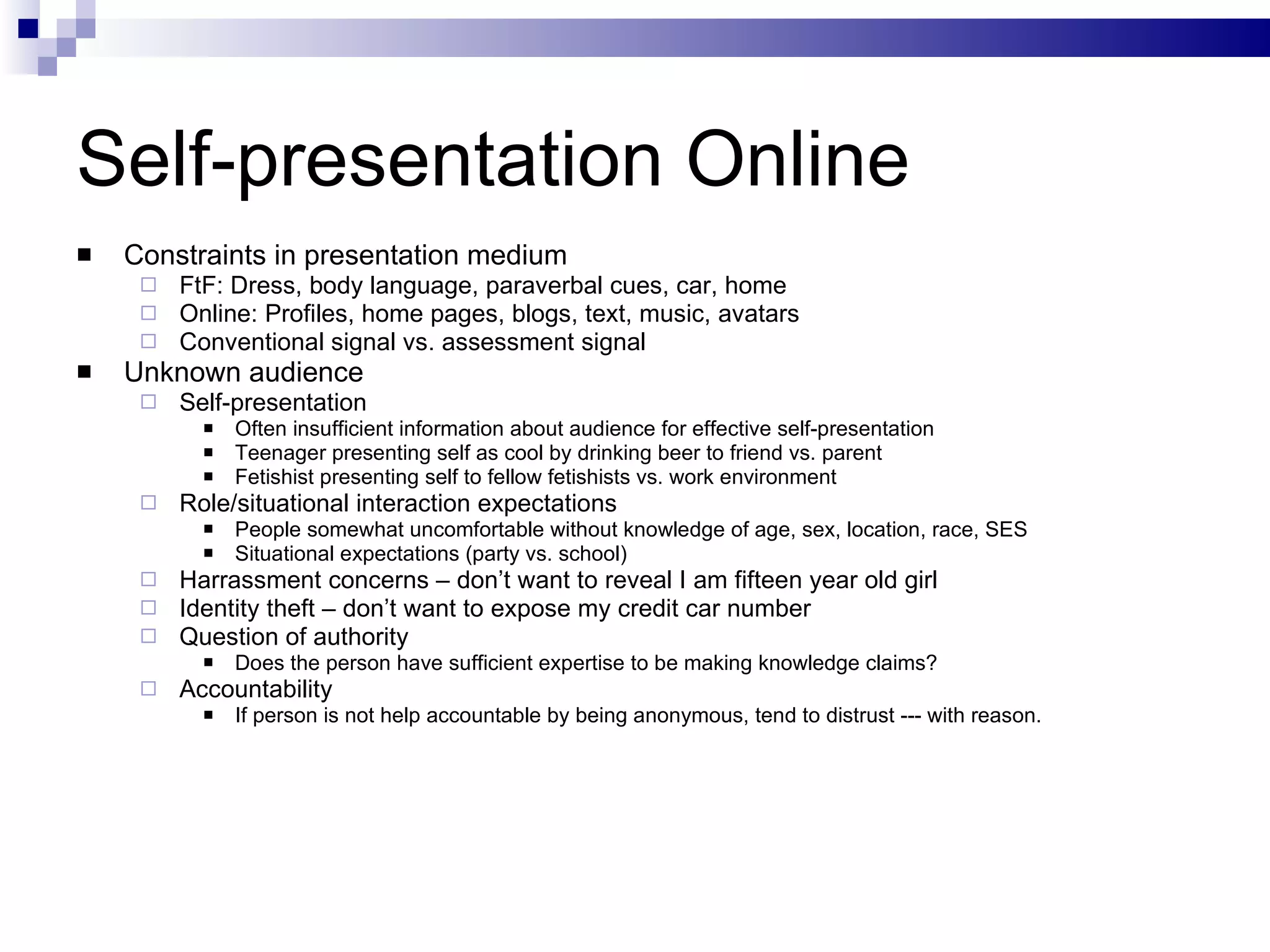
Self-presentation Online Constraints in presentation medium FtF: Dress, body language, paraverbal cues, car, home Online: Profiles, home pages, blogs, text, music, avatars Conventional signal vs. assessment signal Unknown audience Self-presentation Often insufficient information about audience for effective self-presentation  Teenager presenting self as cool by drinking beer to friend vs. parent Fetishist presenting self to fellow fetishists vs. work environment Role/situational interaction expectations People somewhat uncomfortable without knowledge of age, sex, location, race, SES Situational expectations (party vs. school) Harrassment concerns – don’t want to reveal I am fifteen year old girl Identity theft – don’t want to expose my credit car number Question of authority Does the person have sufficient expertise to be making knowledge claims? Accountability If person is not help accountable by being anonymous, tend to distrust --- with reason.
Profiles
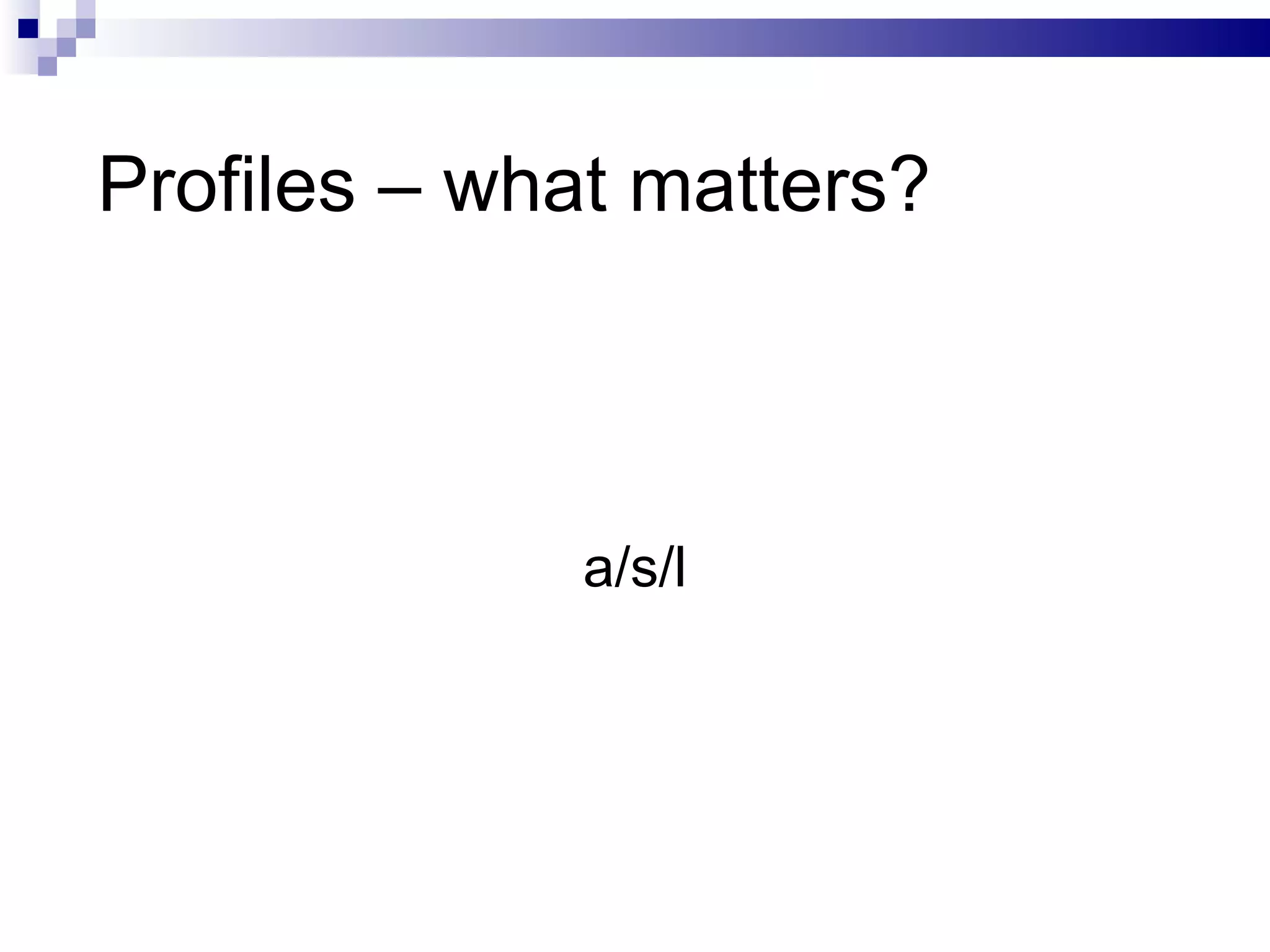
a/s/l Profiles – what matters?
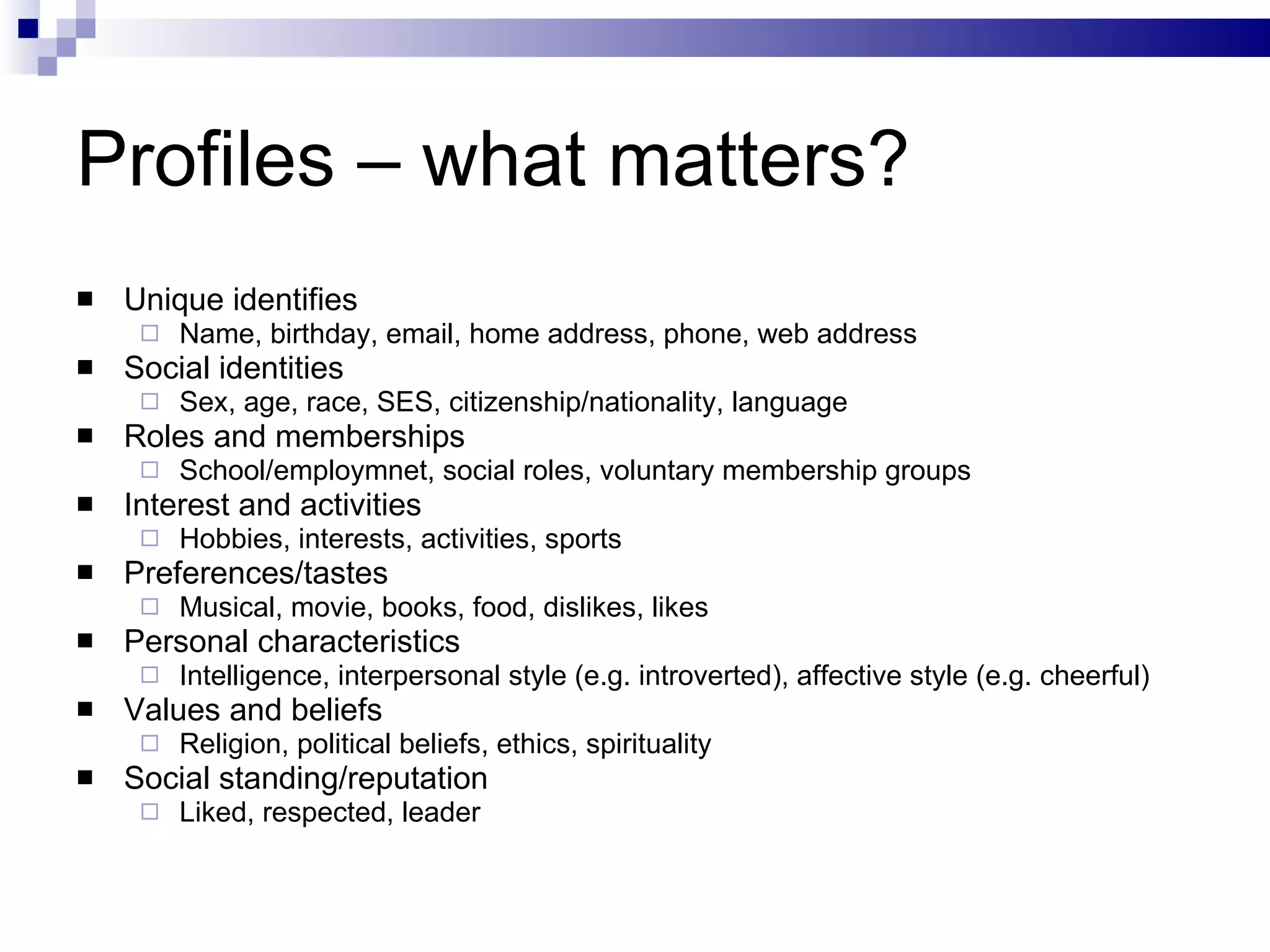
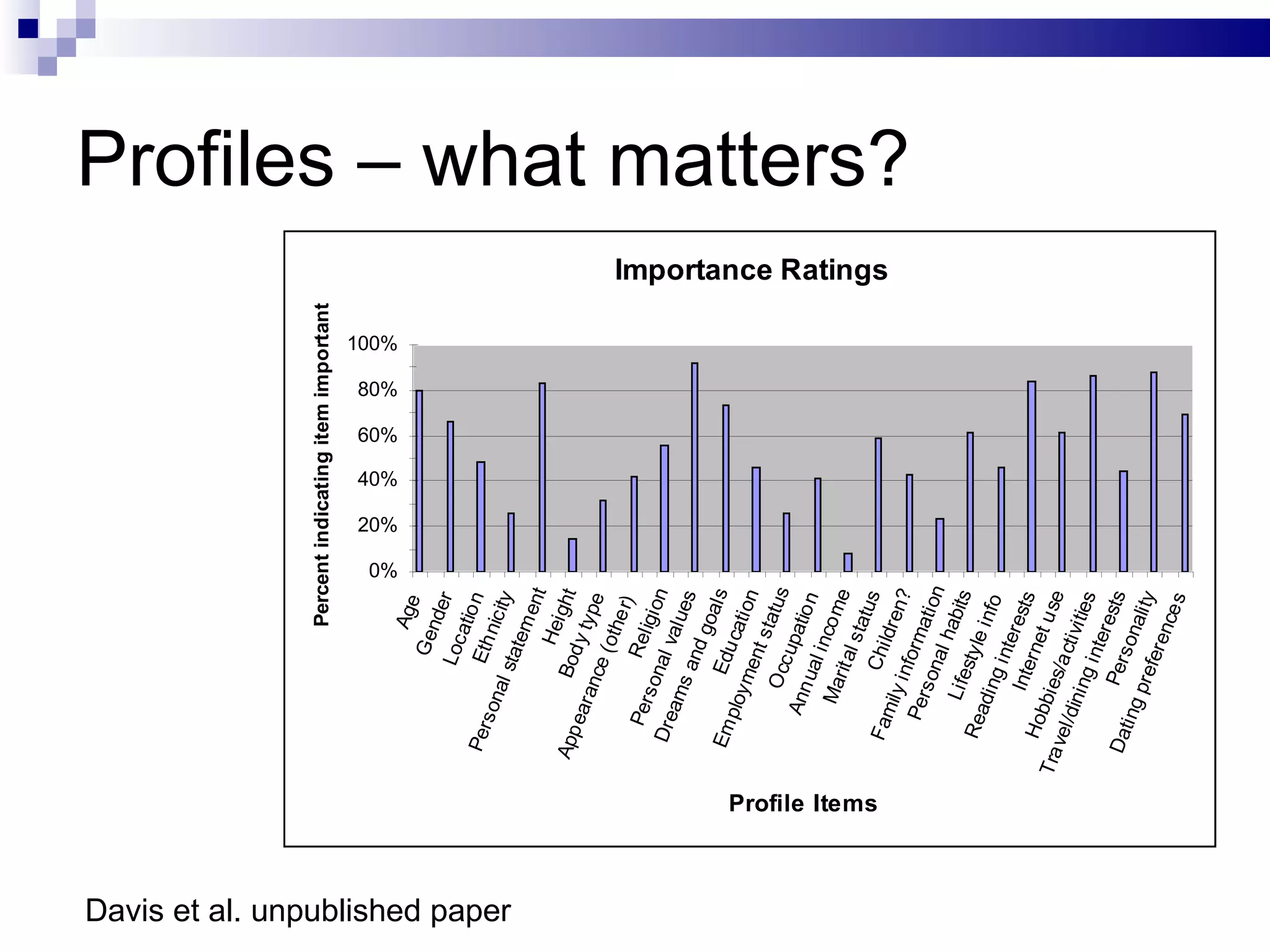
Profiles – what matters? Unique identifies Name, birthday, email, home address, phone, web address Social identities Sex, age, race, SES, citizenship/nationality, language Roles and memberships School/employmnet, social roles, voluntary membership groups Interest and activities Hobbies, interests, activities, sports Preferences/tastes Musical, movie, books, food, dislikes, likes Personal characteristics Intelligence, interpersonal style (e.g. introverted), affective style (e.g. cheerful) Values and beliefs Religion, political beliefs, ethics, spirituality Social standing/reputation Liked, respected, leader
Profiles – what matters? Davis et al. unpublished paper
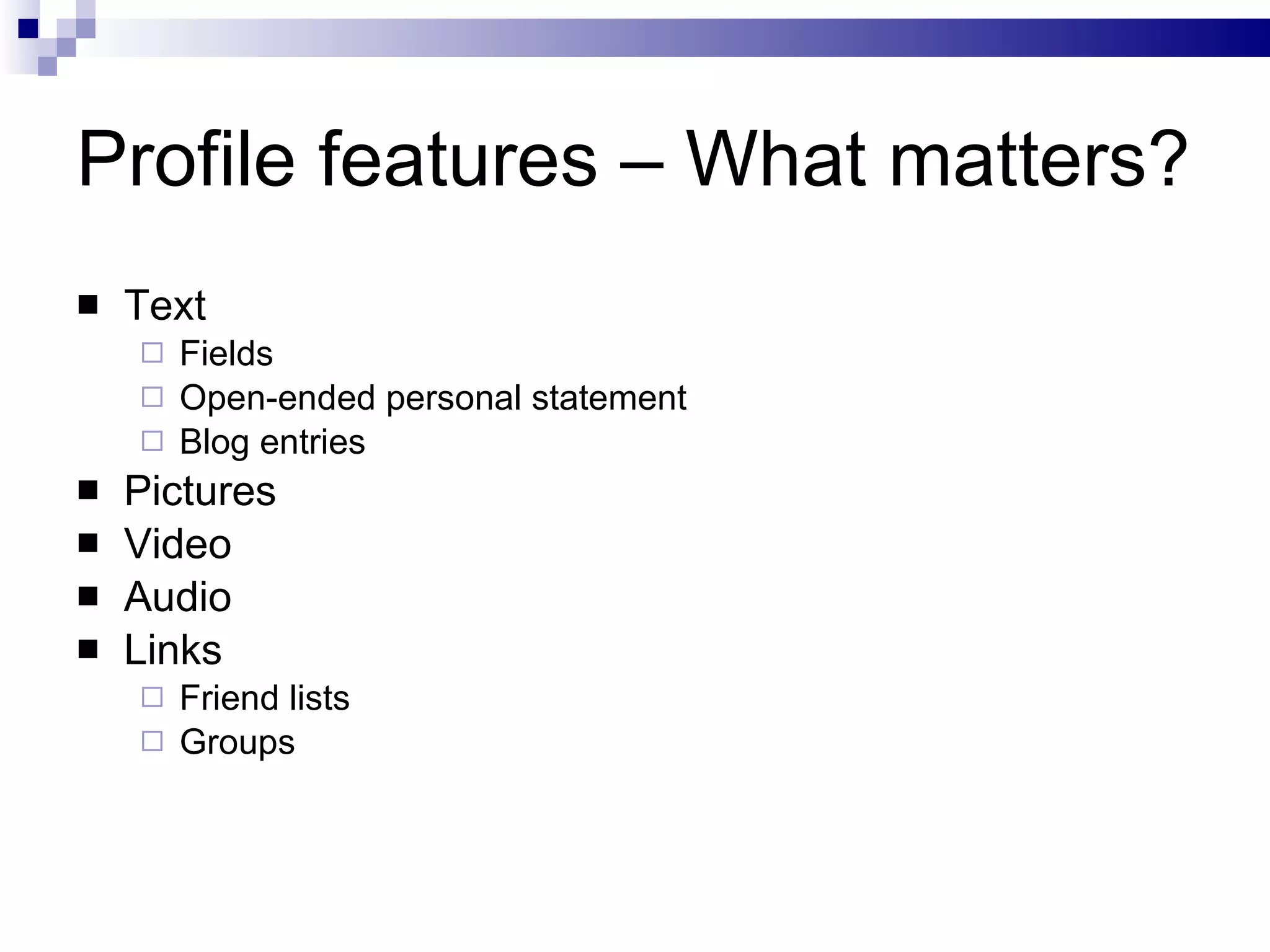
Profile features – What matters? Text Fields Open-ended personal statement Blog entries Pictures Video Audio Links Friend lists Groups
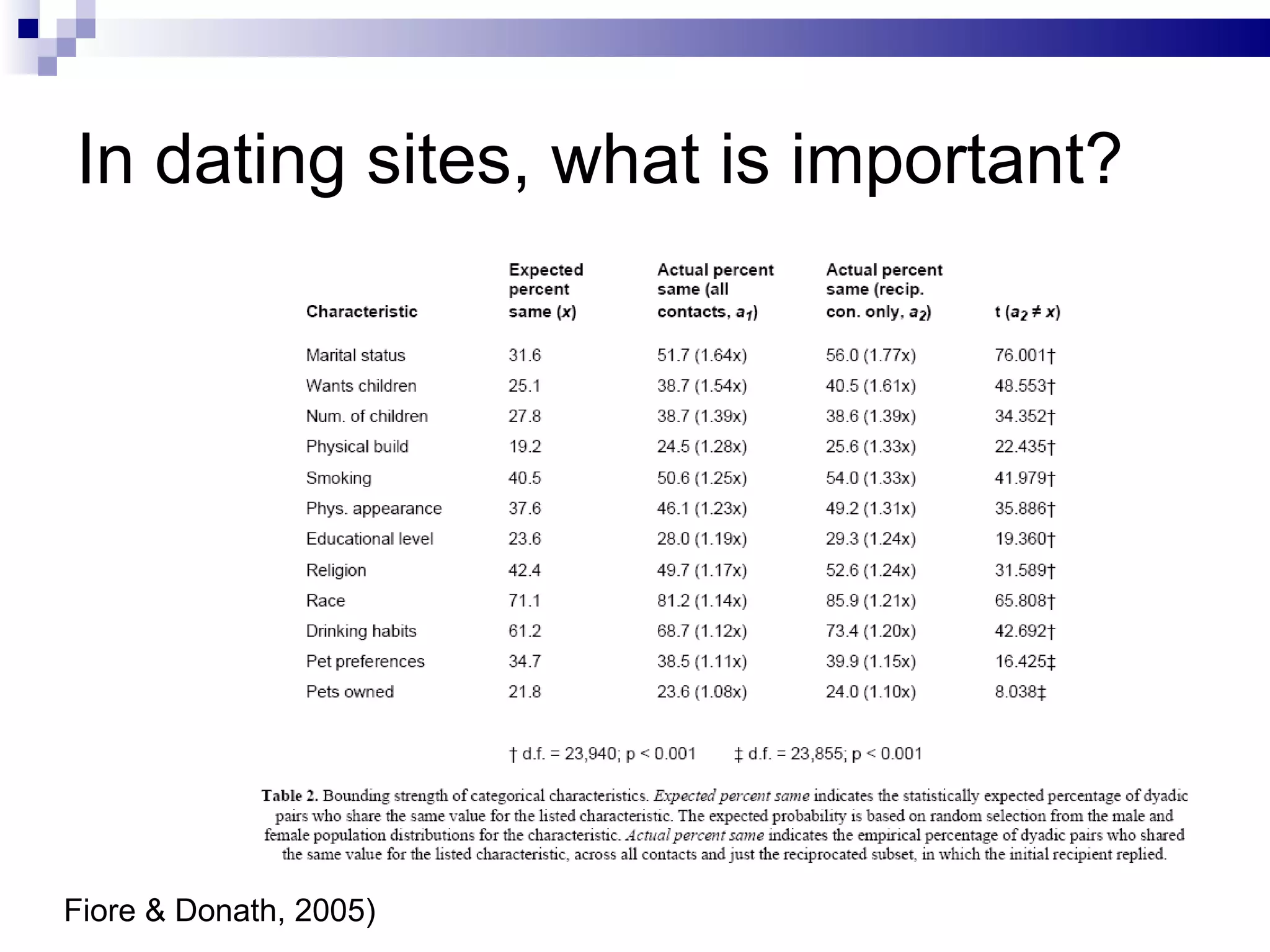
In dating sites, what is important? Fiore & Donath, 2005)
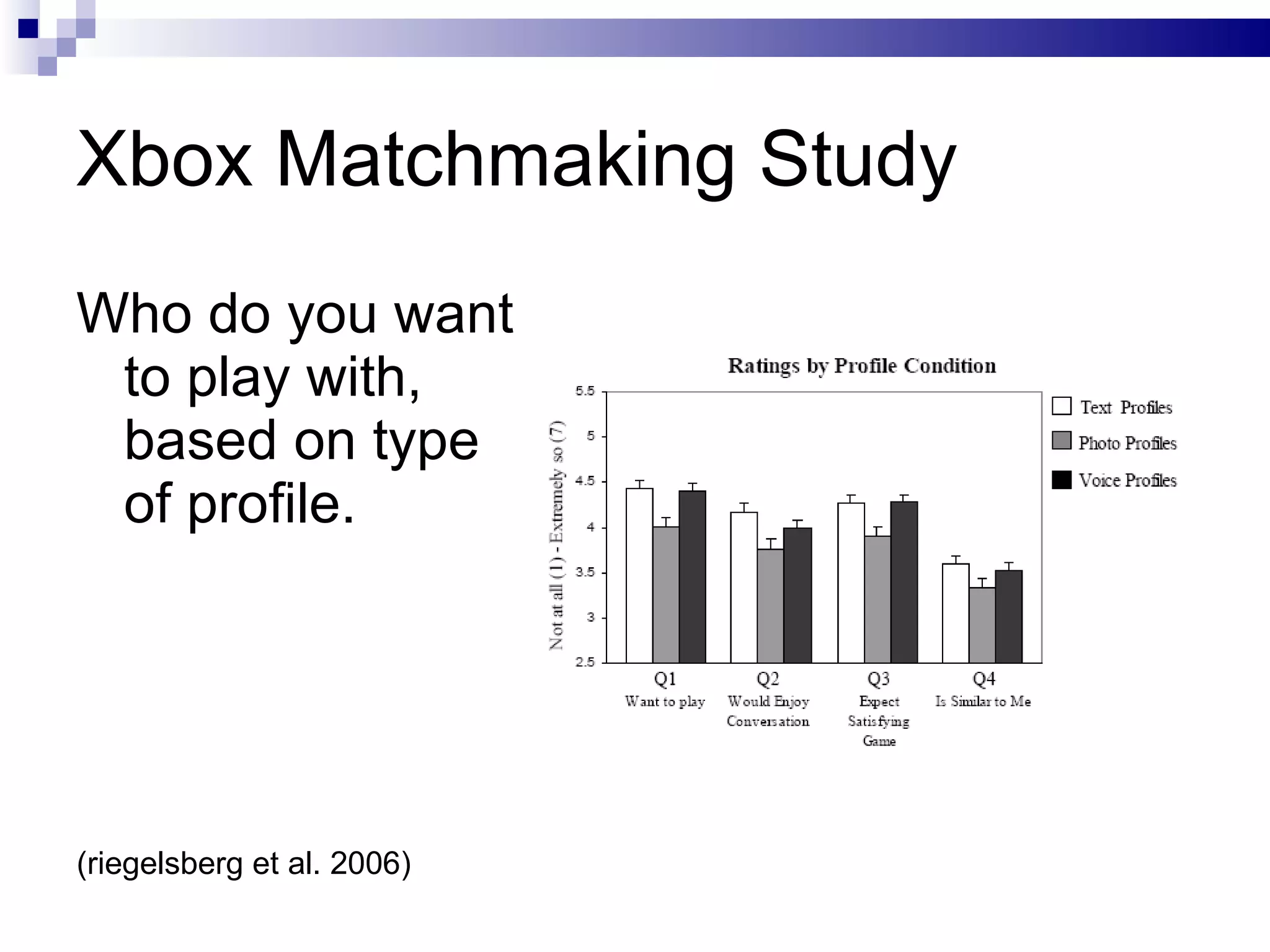
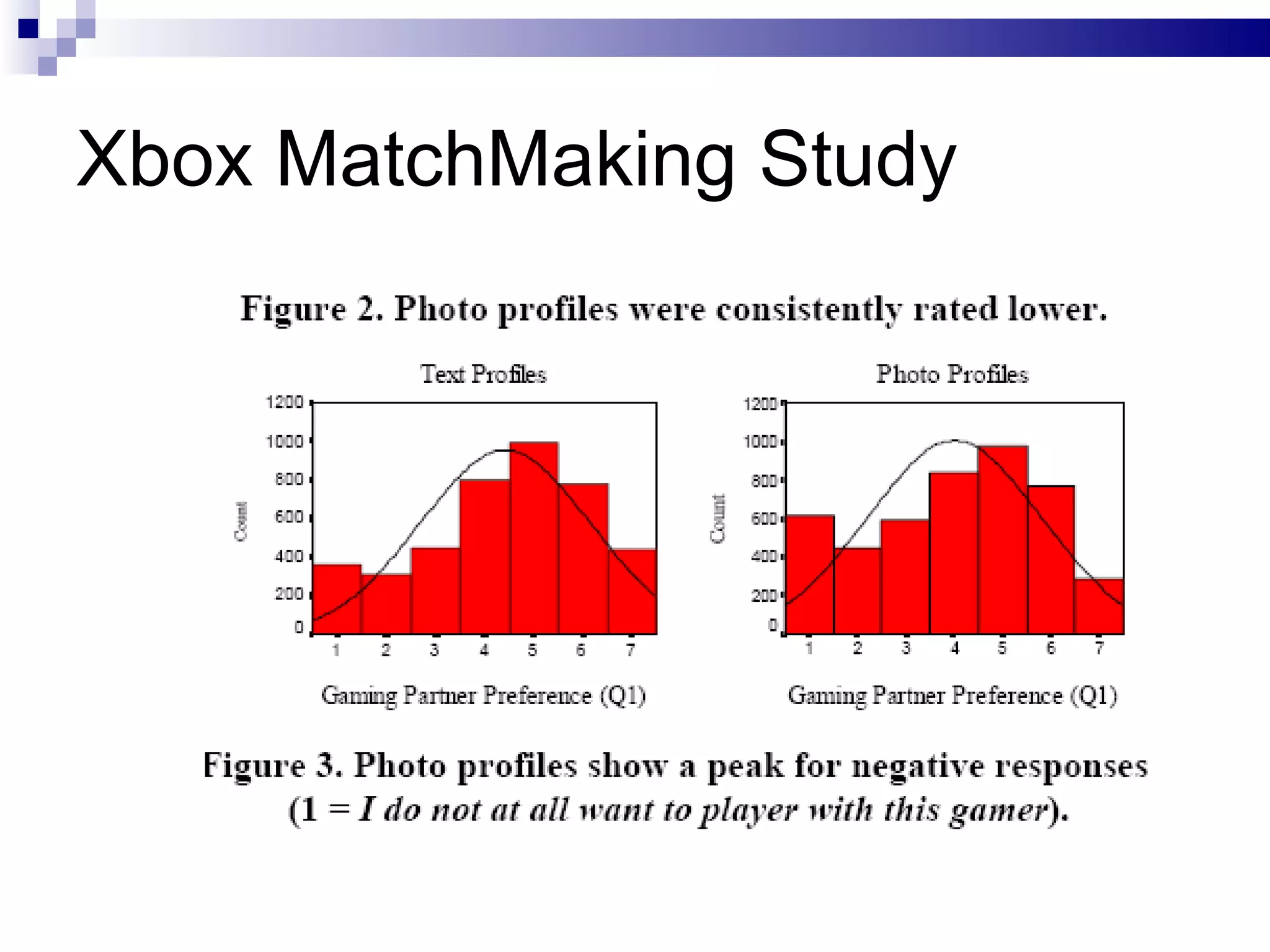
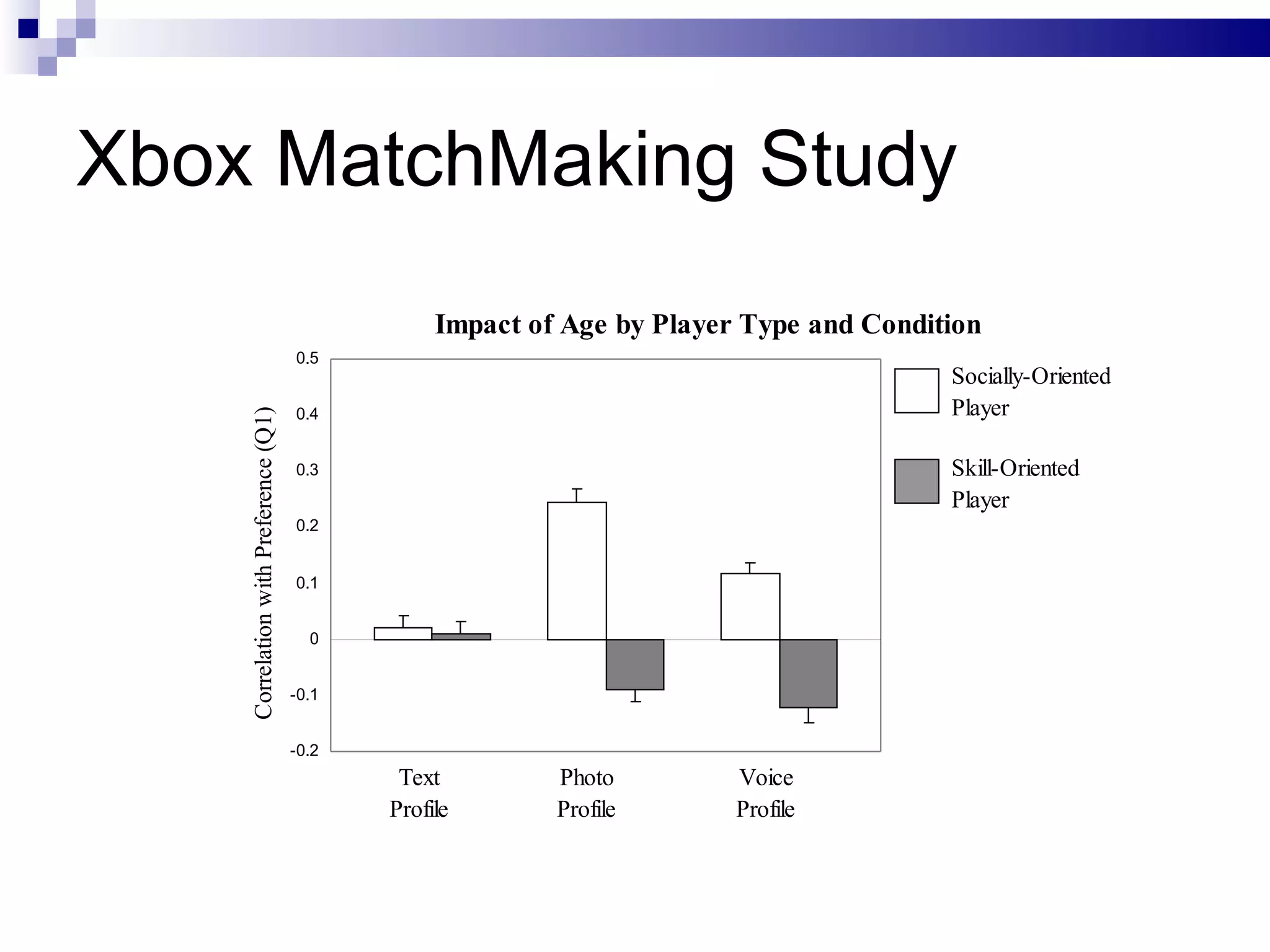
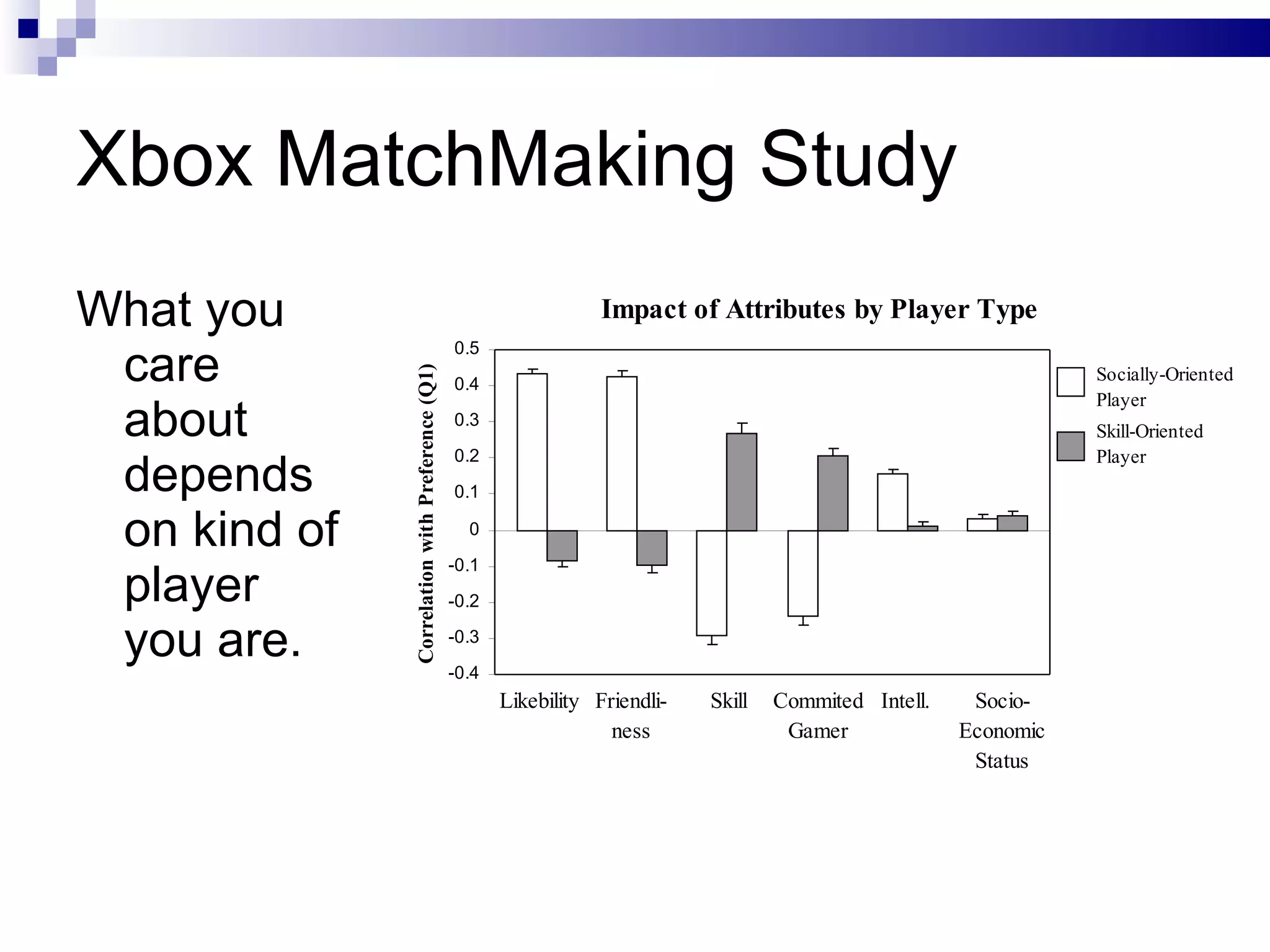
Xbox Matchmaking Study Who do you want to play with, based on type of profile. (riegelsberg et al. 2006)
Xbox MatchMaking Study
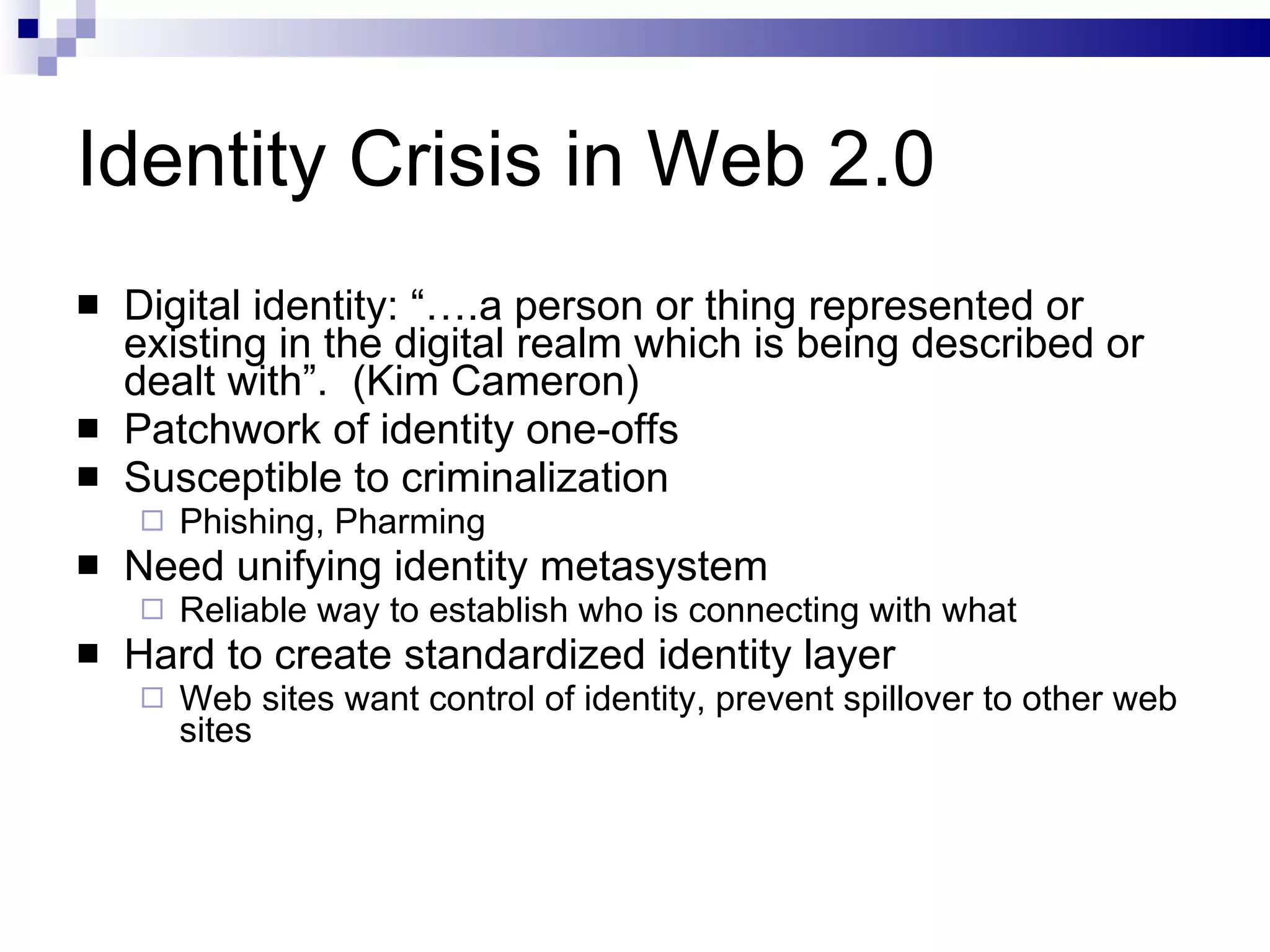
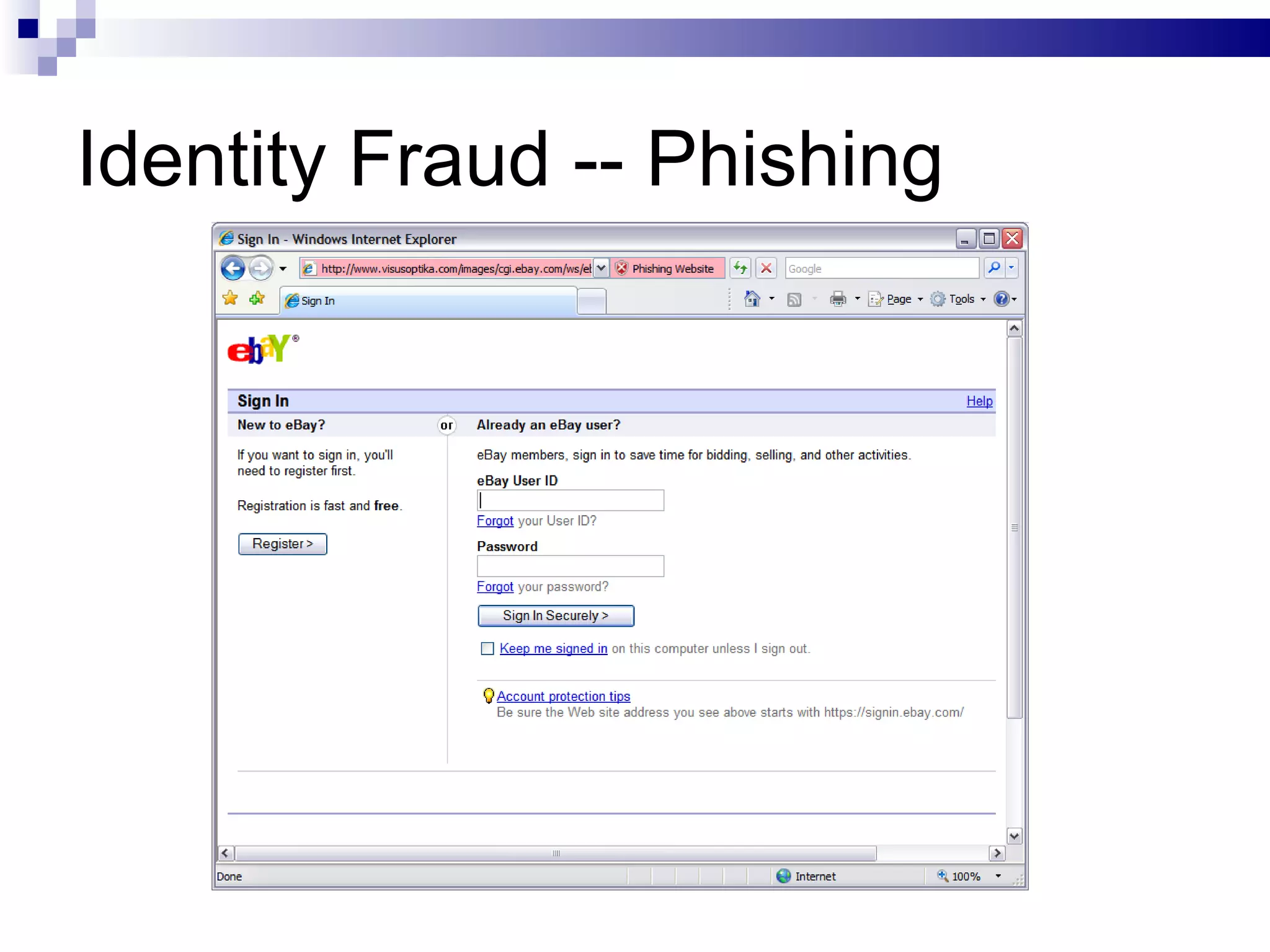
Identity Crisis in Web 2.0 Digital identity: “….a person or thing represented or existing in the digital realm which is being described or dealt with”.  (Kim Cameron) Patchwork of identity one-offs Susceptible to criminalization Phishing, Pharming Need unifying identity metasystem Reliable way to establish who is connecting with what Hard to create standardized identity layer Web sites want control of identity, prevent spillover to other web sites
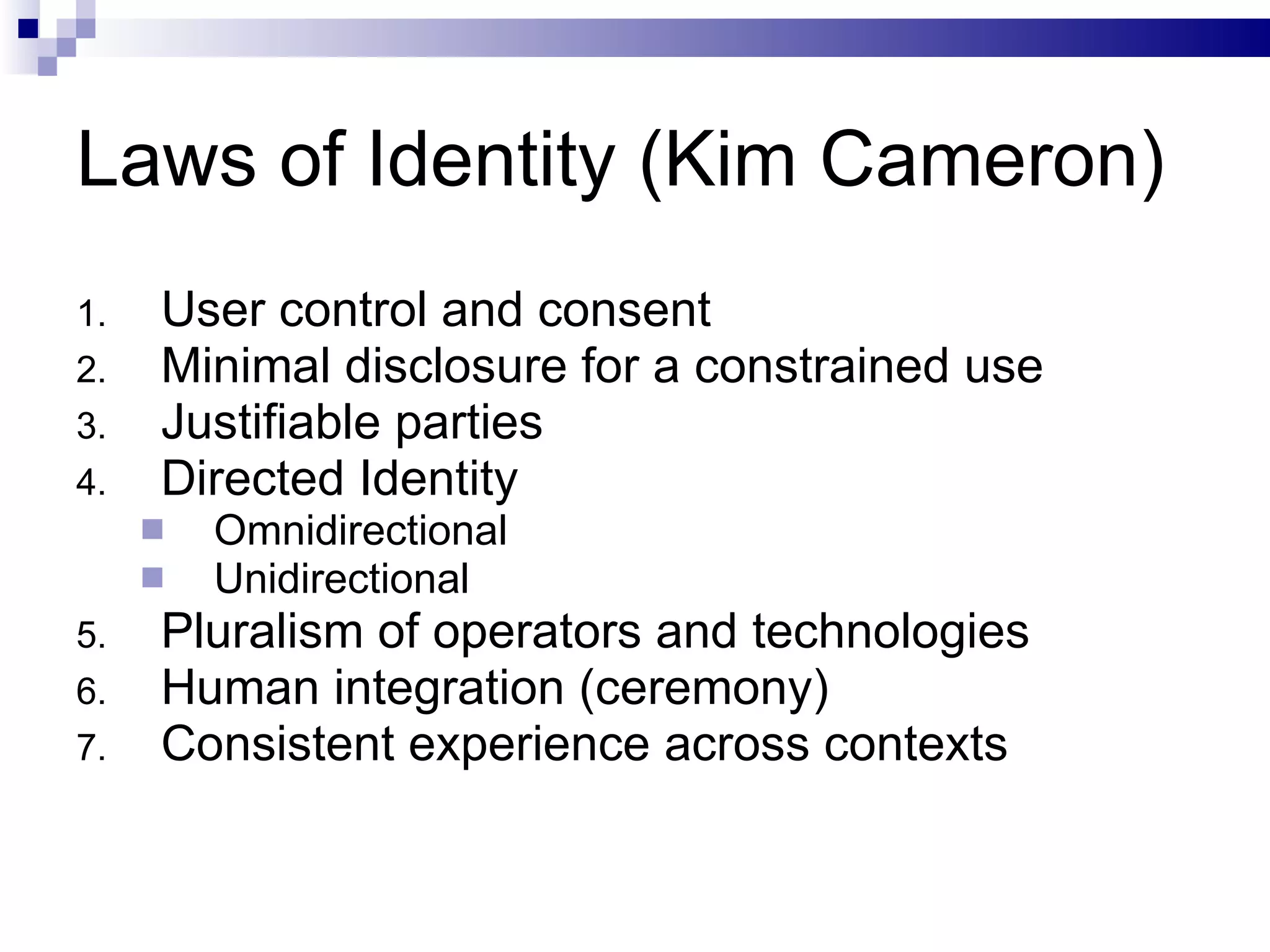
Laws of Identity (Kim Cameron) User control and consent Minimal disclosure for a constrained use Justifiable parties Directed Identity Omnidirectional Unidirectional Pluralism of operators and technologies Human integration (ceremony) Consistent experience across contexts
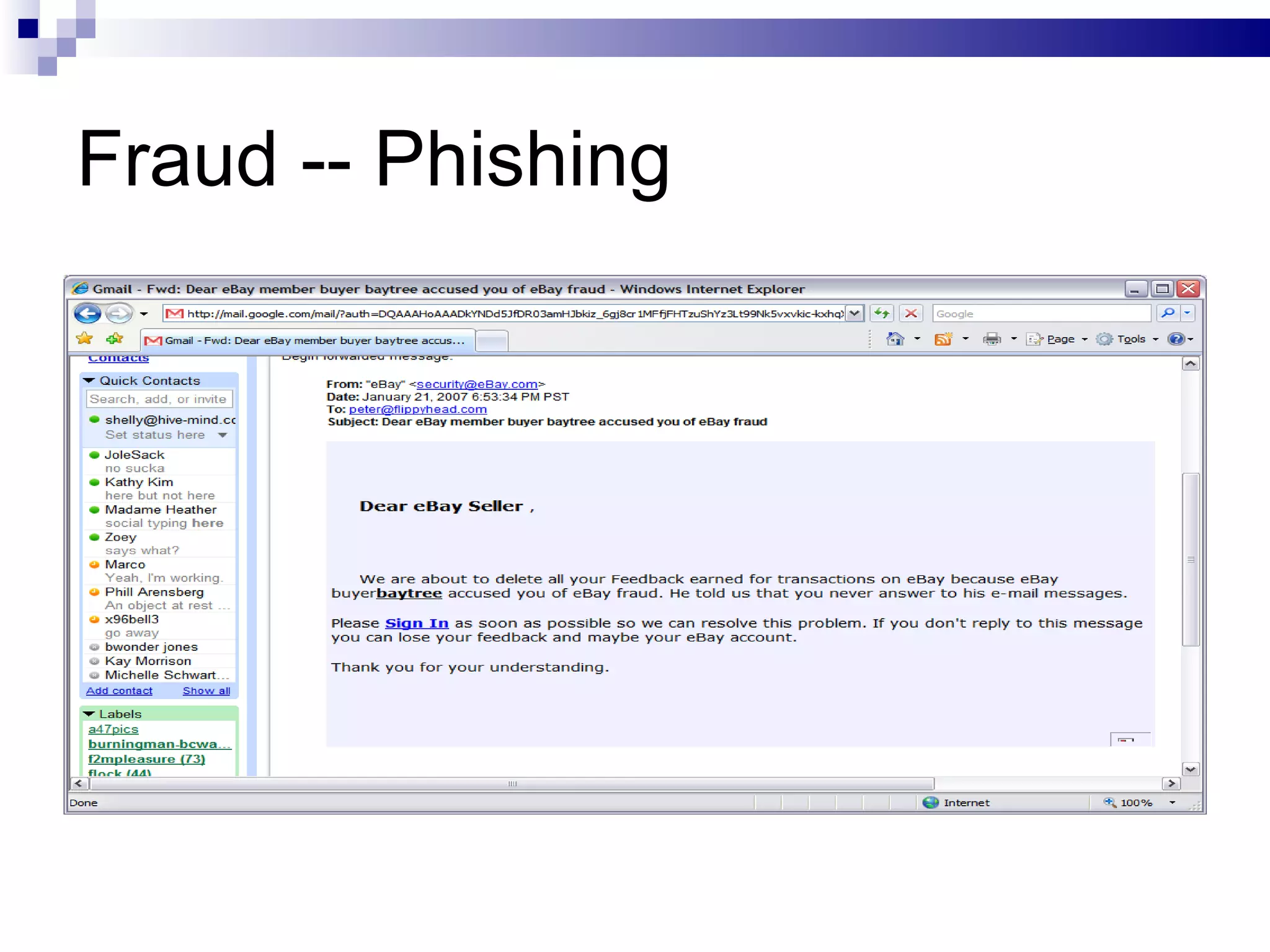
Fraud -- Phishing
Identity Fraud -- Phishing
Identity in an Age of Web 2.0 OpenID ( Http://openid.net/ ) -- opensource Authentication Authorization ACL (Access control list) RBAC (Role based access control) Identity information Single sign (SSO) on across multiple properties
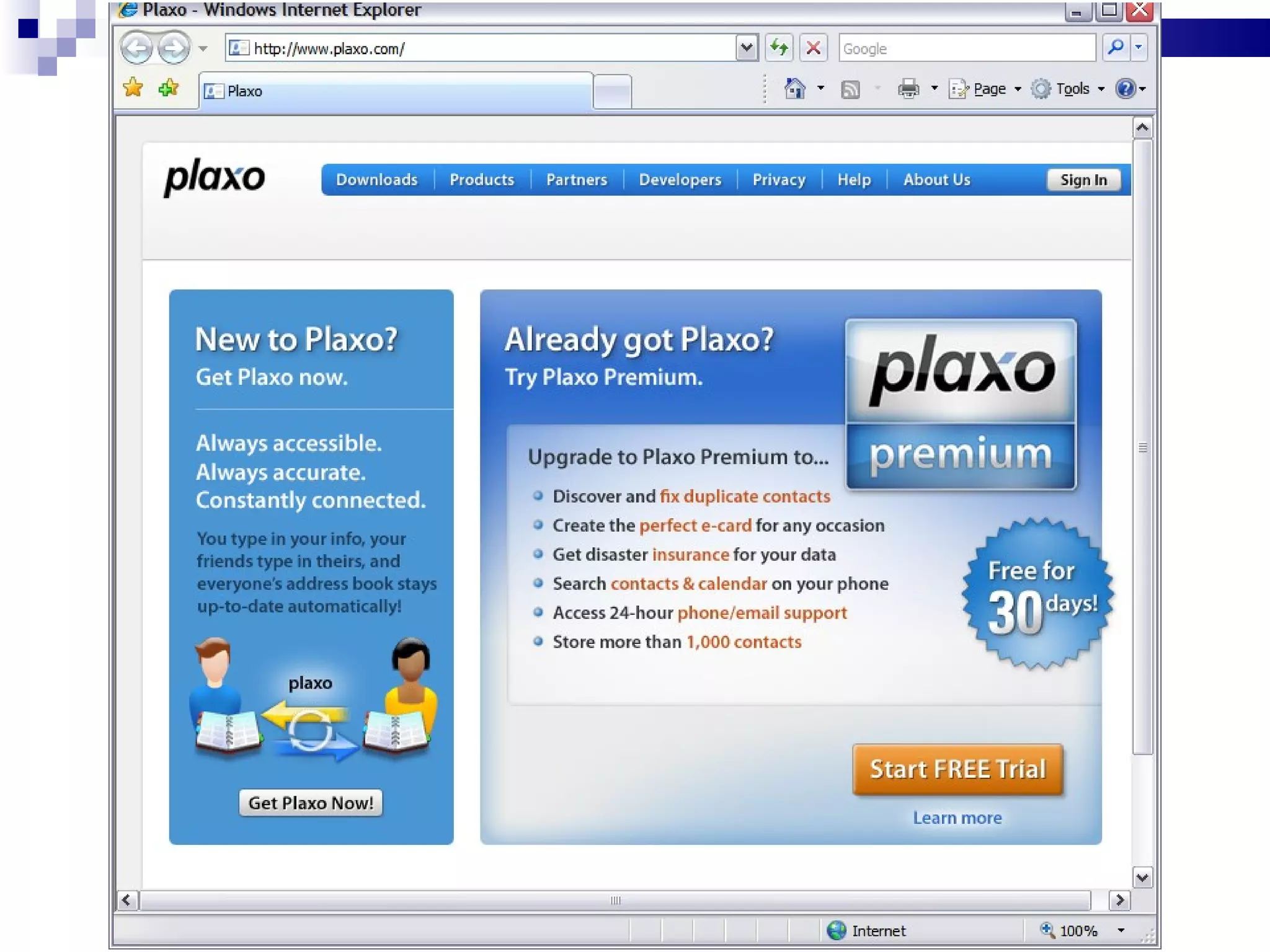
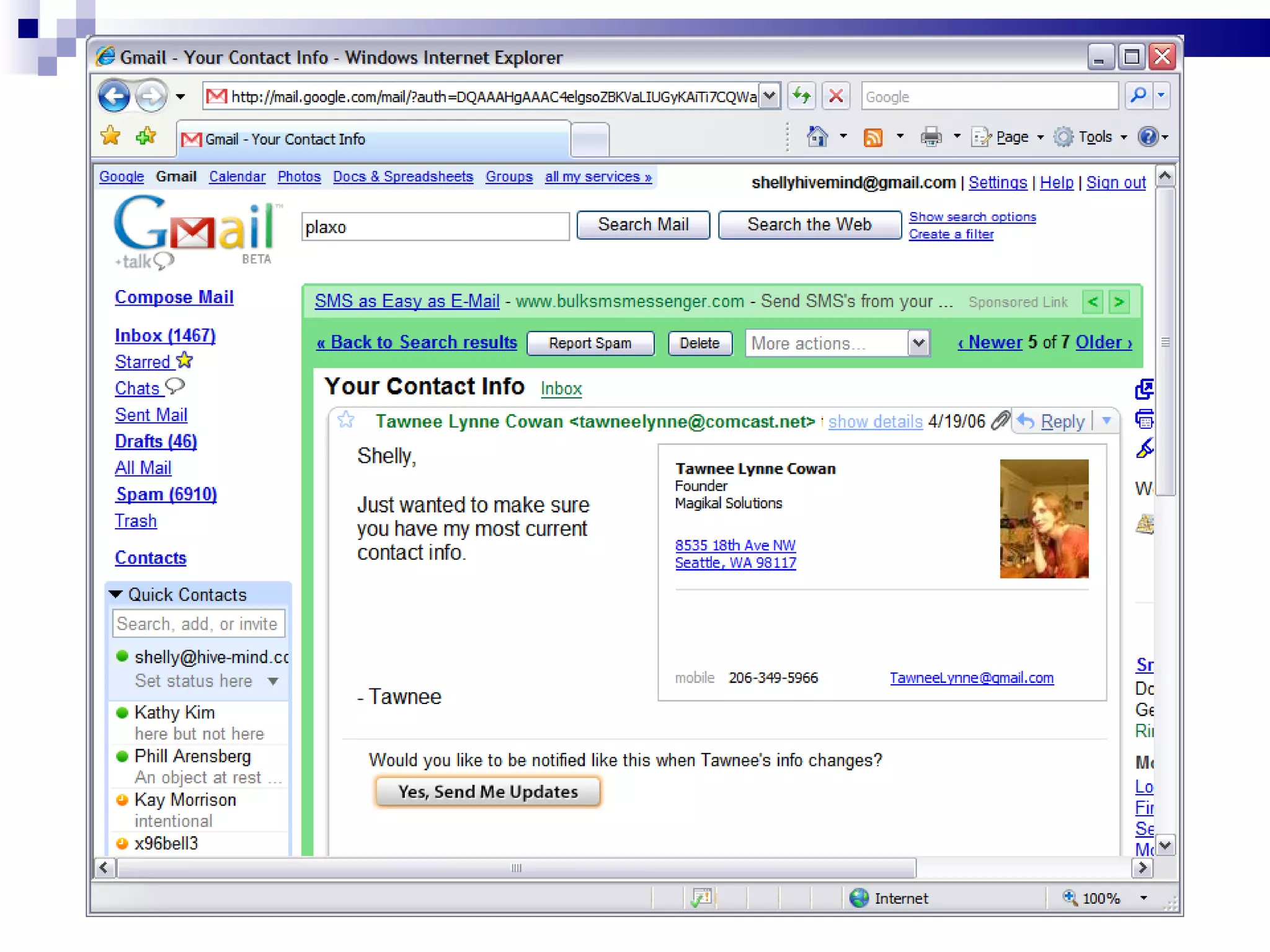
Plaxo Online address book People essentially subscribe to each other’s contact info Syncs with common email systems Updates automatically distributed
 
 
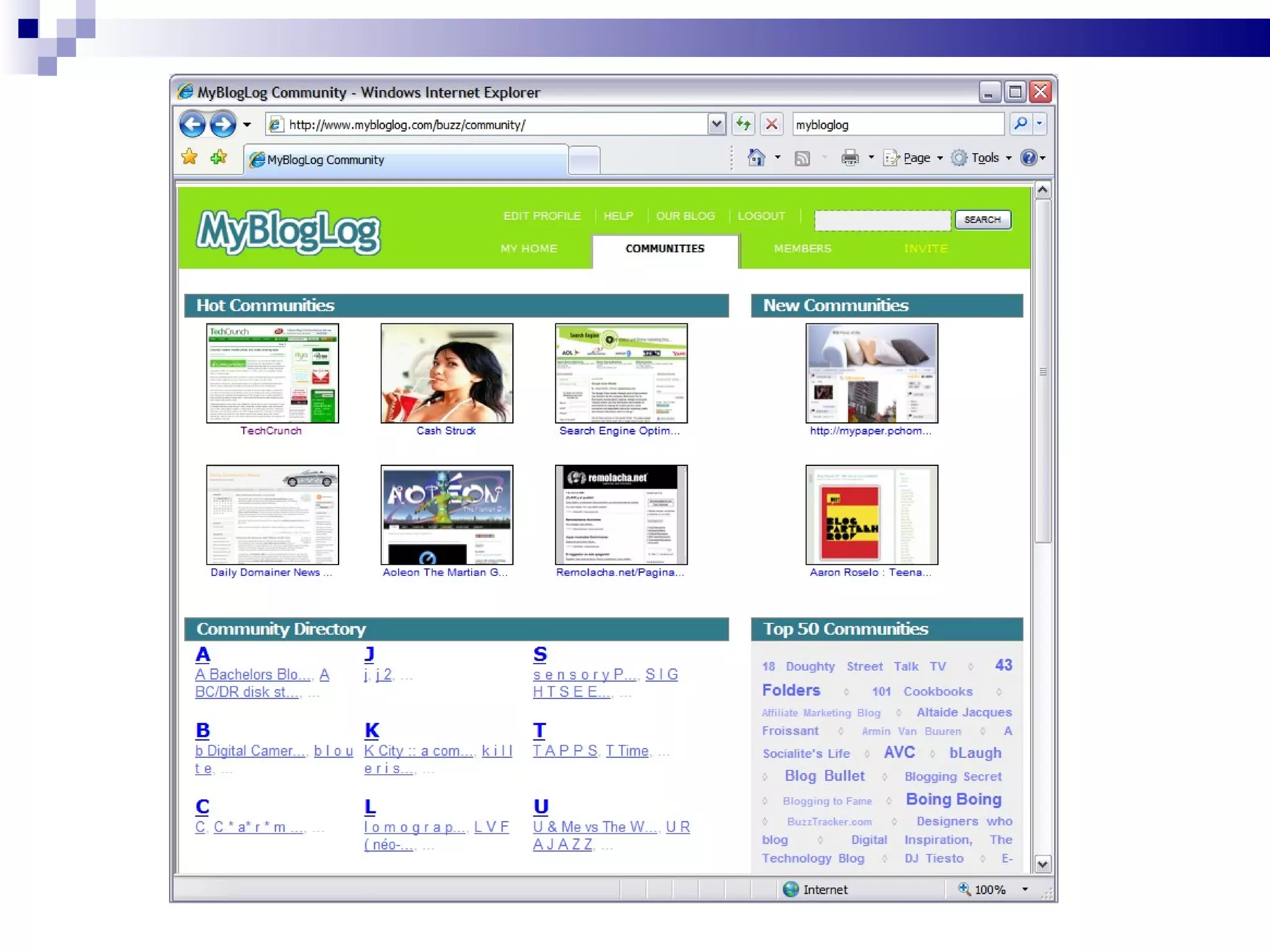
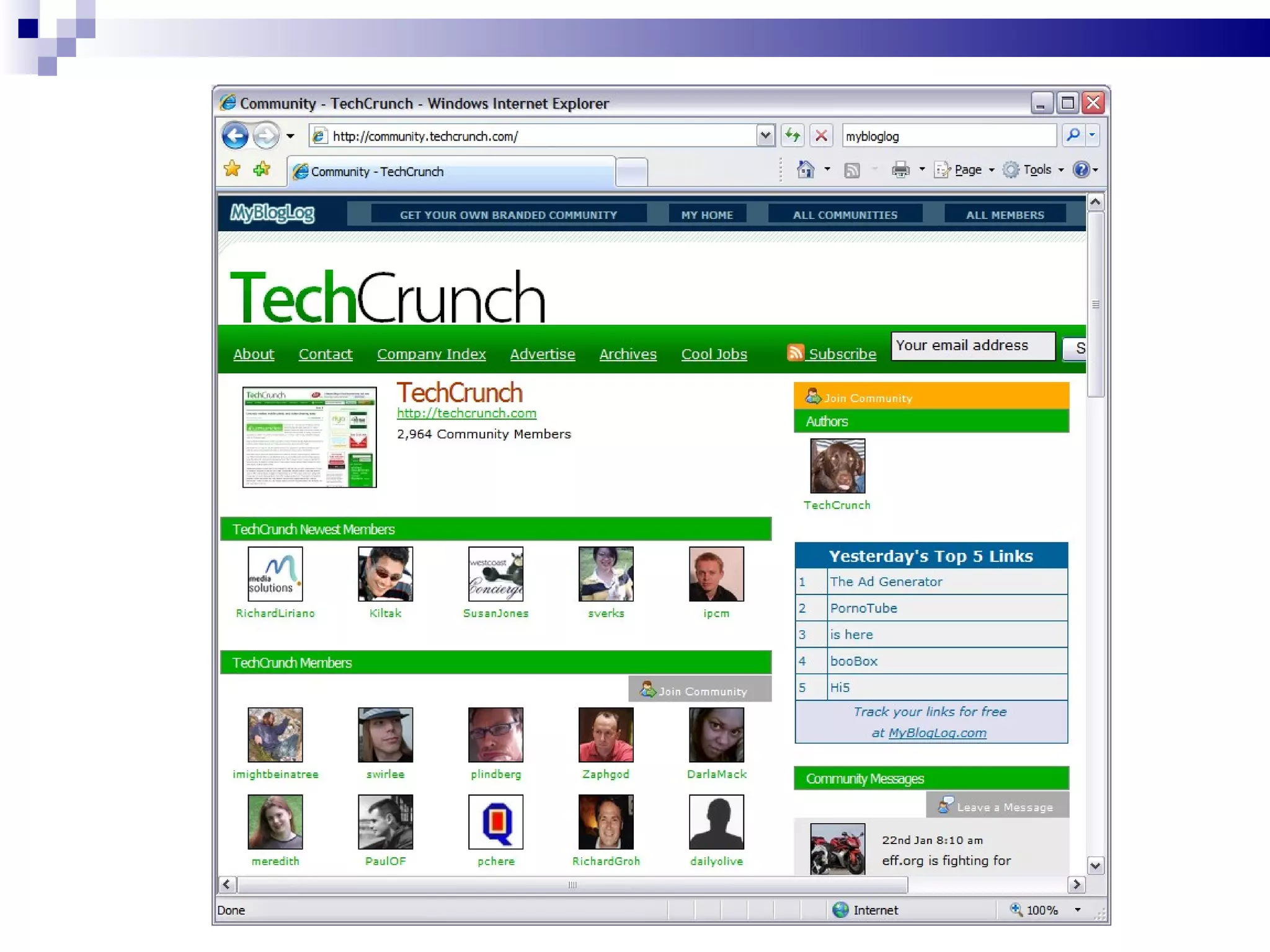
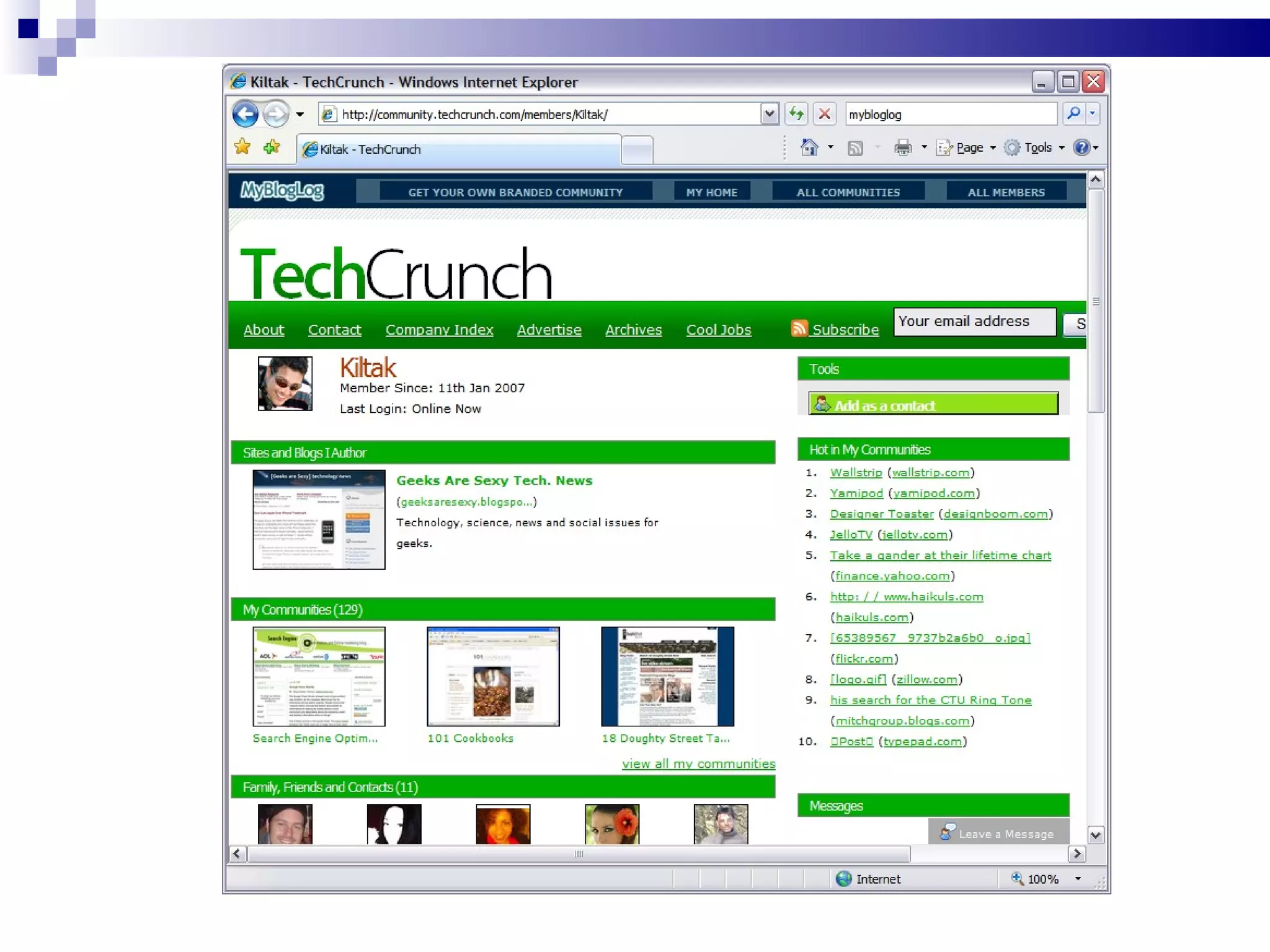
MyBlogLog Profile for conversation in blogosphere so readers are as discoverable as authors Foster awareness around audience, and conversation


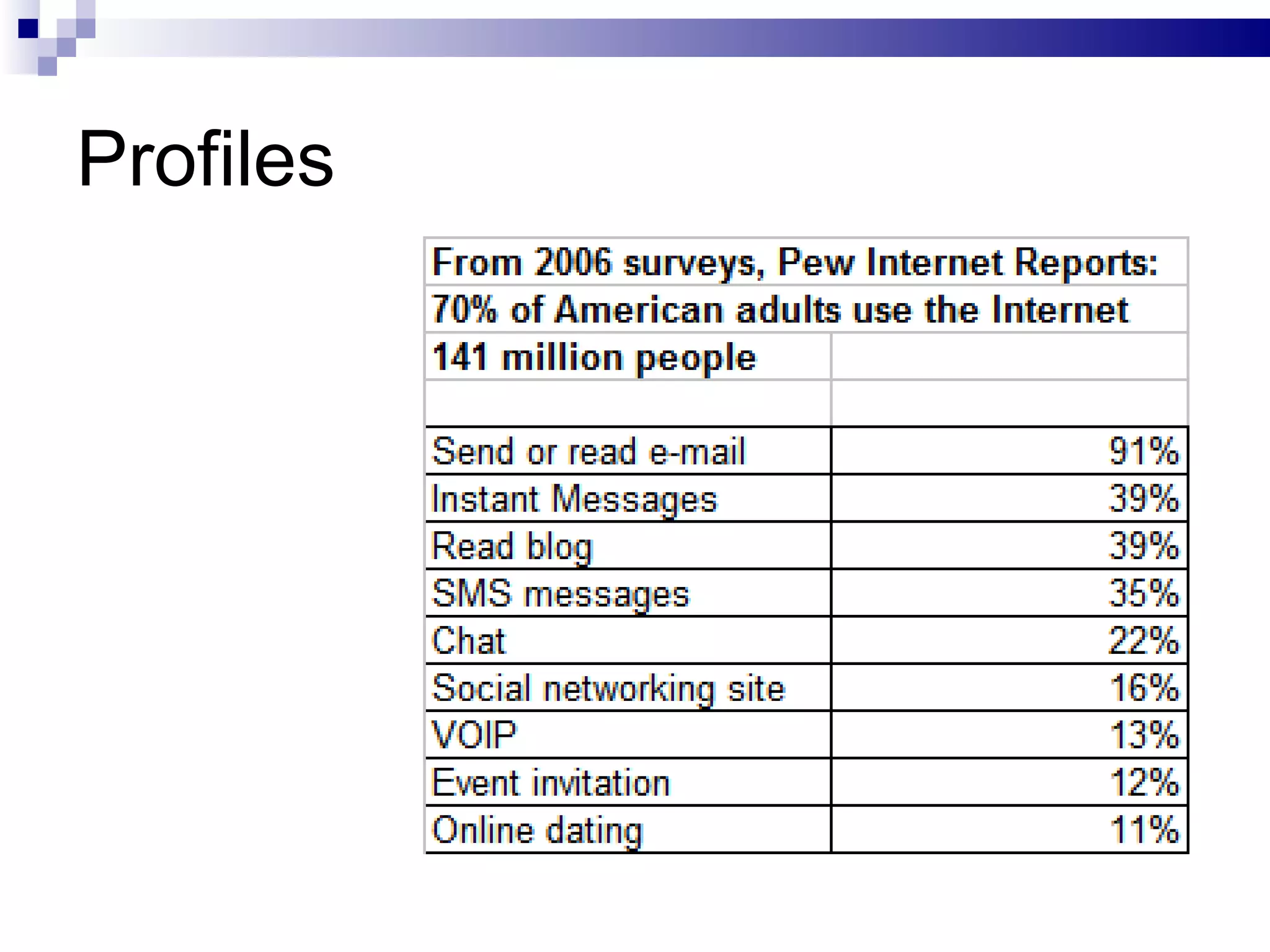
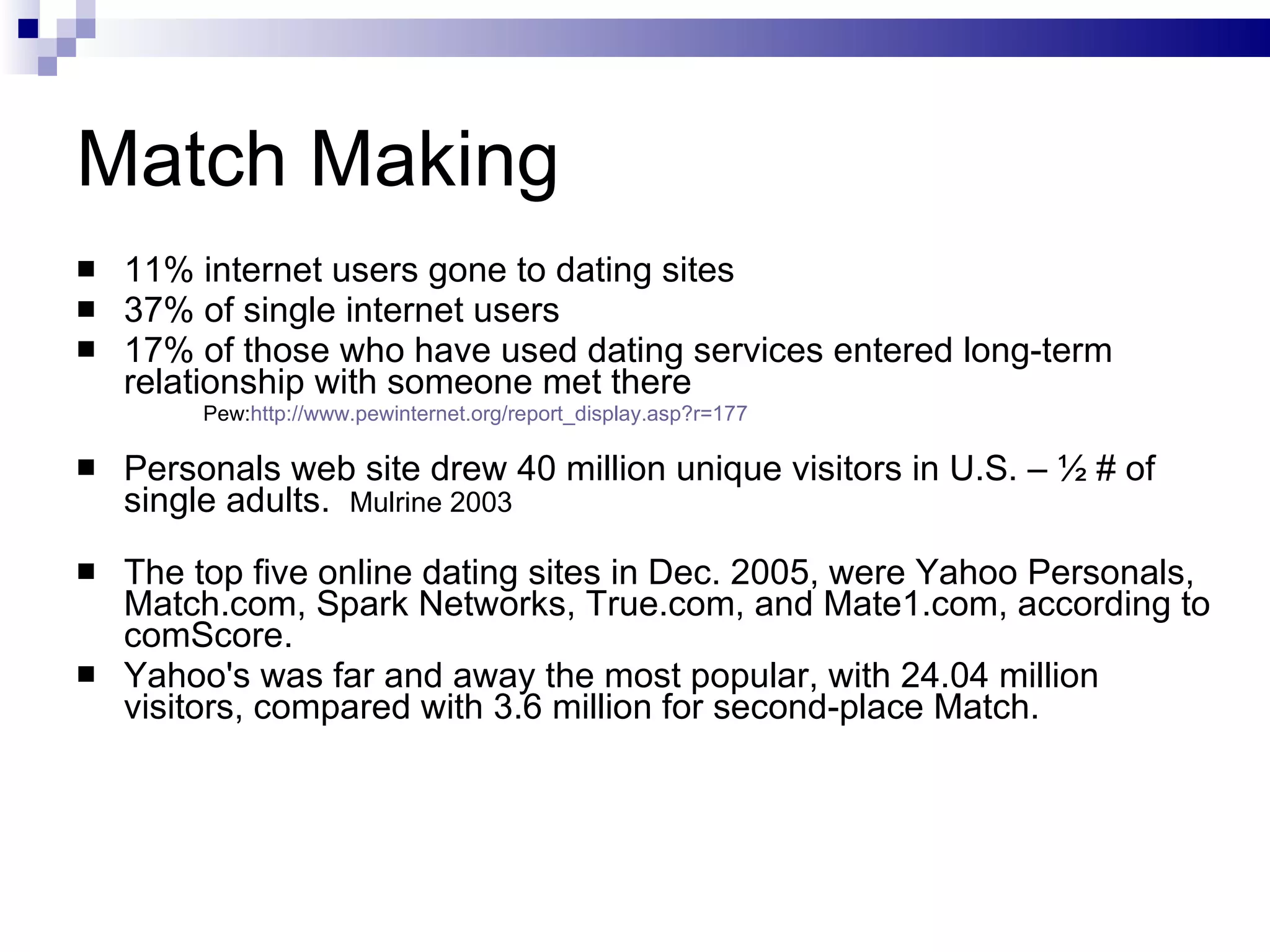
Match Making 11% internet users gone to dating sites 37% of single internet users 17% of those who have used dating services entered long-term relationship with someone met there Pew: http://www.pewinternet.org/report_display.asp?r=177 Personals web site drew 40 million unique visitors in U.S. – ½ # of single adults.  Mulrine 2003 The top five online dating sites in Dec. 2005, were Yahoo Personals, Match.com, Spark Networks, True.com, and Mate1.com, according to comScore.  Yahoo's was far and away the most popular, with 24.04 million visitors, compared with 3.6 million for second-place Match.
Determinants of Attraction Proximity Repeated exposure “mere exposure effect” Physical attractiveness Similarity Birds of a feather…not opposites attract Reciprocation Matching hypothesis – pair off similar in physical attractiveness
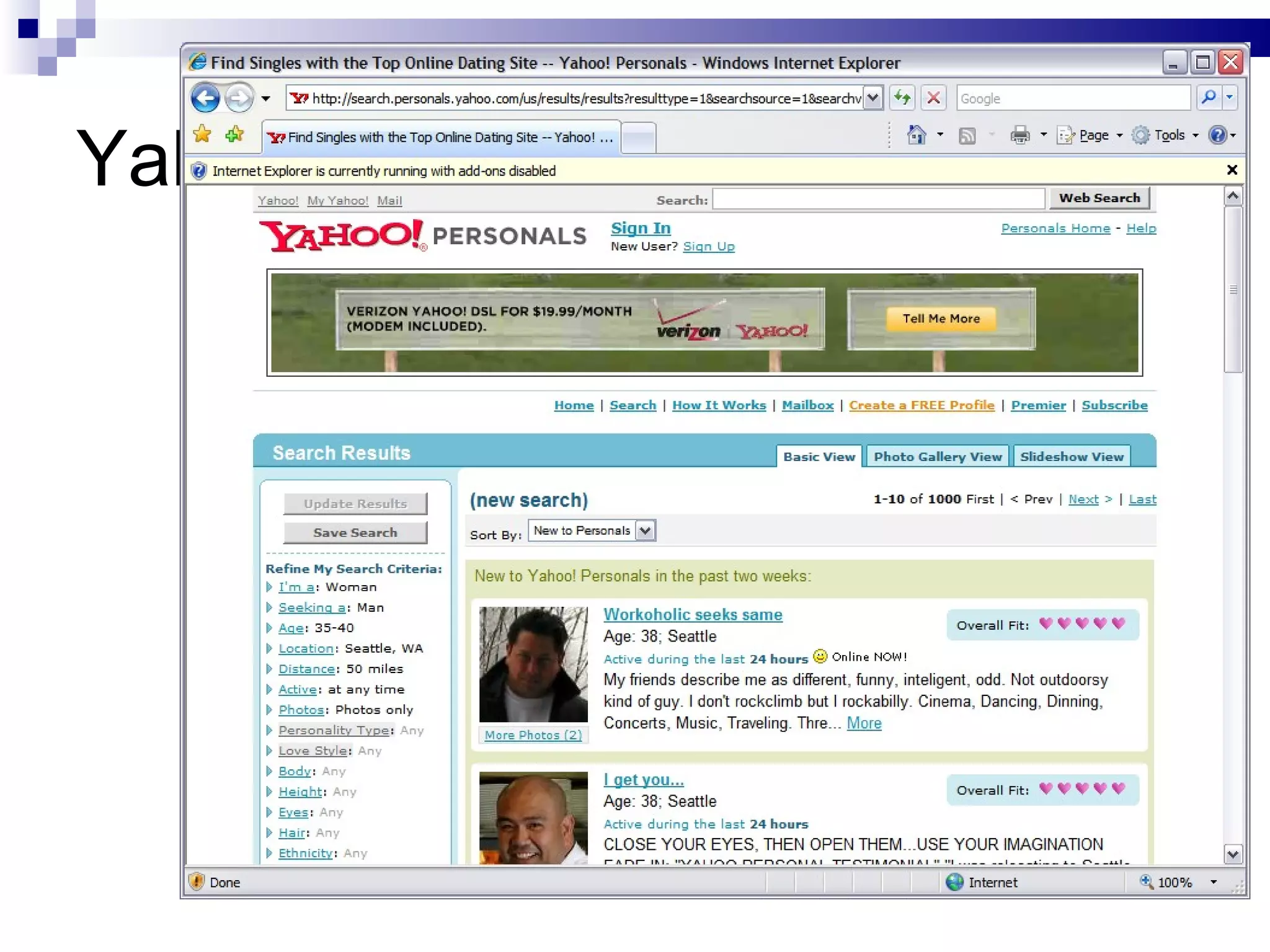
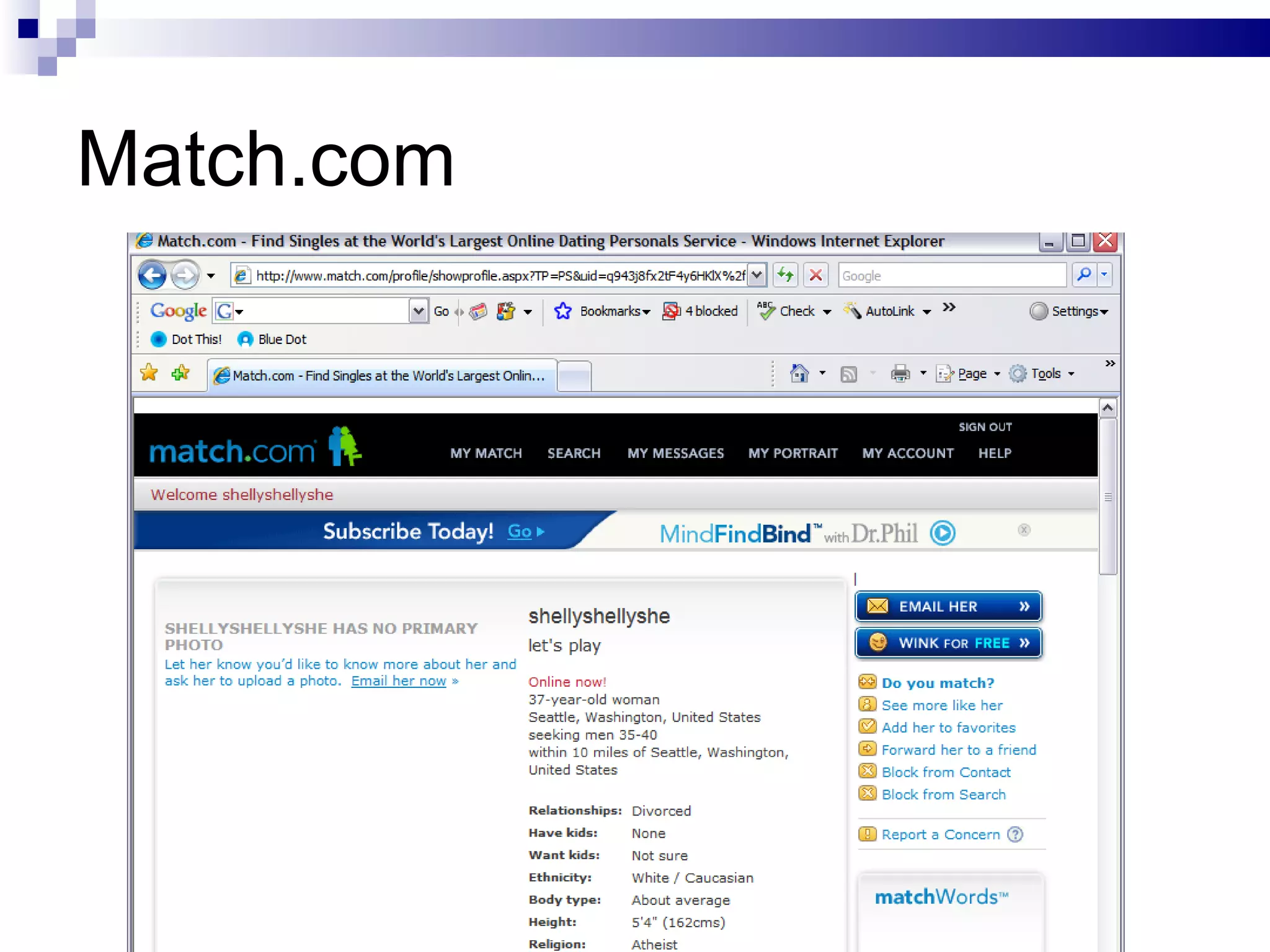
Social Matching Online Matching goals Dating, expertise, gaming partner Types of systems Search/sort/match systems Mainstream (match.com, yahoo) Subpopulation (Jdate.com, manhunt.net) Personality matching Semi-automatic matching Social networks Features Profiles Search Matchmaking algorithms Graduated privacy and communication
Xbox MatchMaking Study  What you care about depends on kind of player you are.
Xbox MatchMaking Study
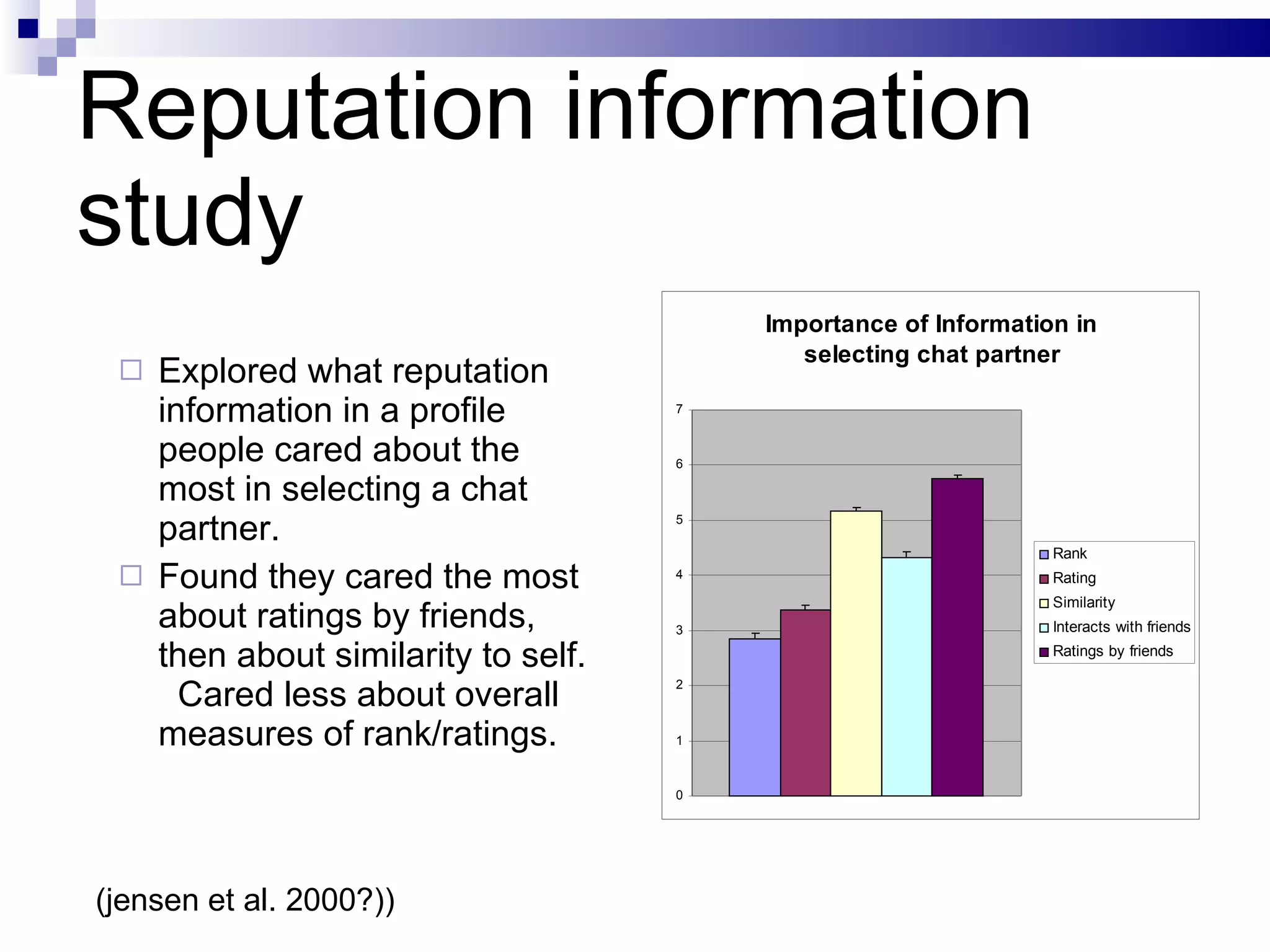
Reputation information study Explored what reputation information in a profile people cared about the most in selecting a chat partner. Found they cared the most about ratings by friends, then about similarity to self.  Cared less about overall measures of rank/ratings. (jensen et al. 2000?))
Yahoo.com
Match.com
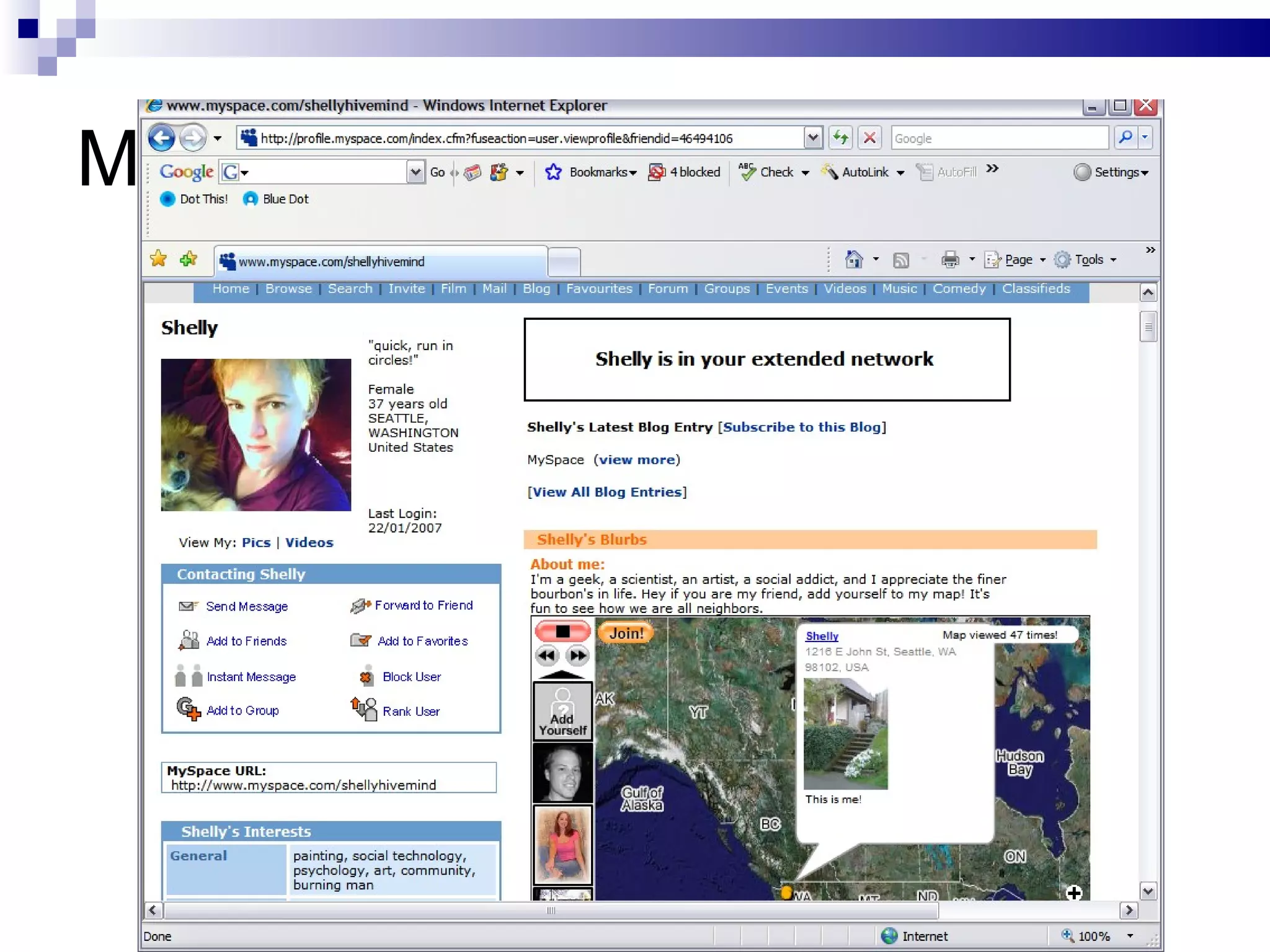
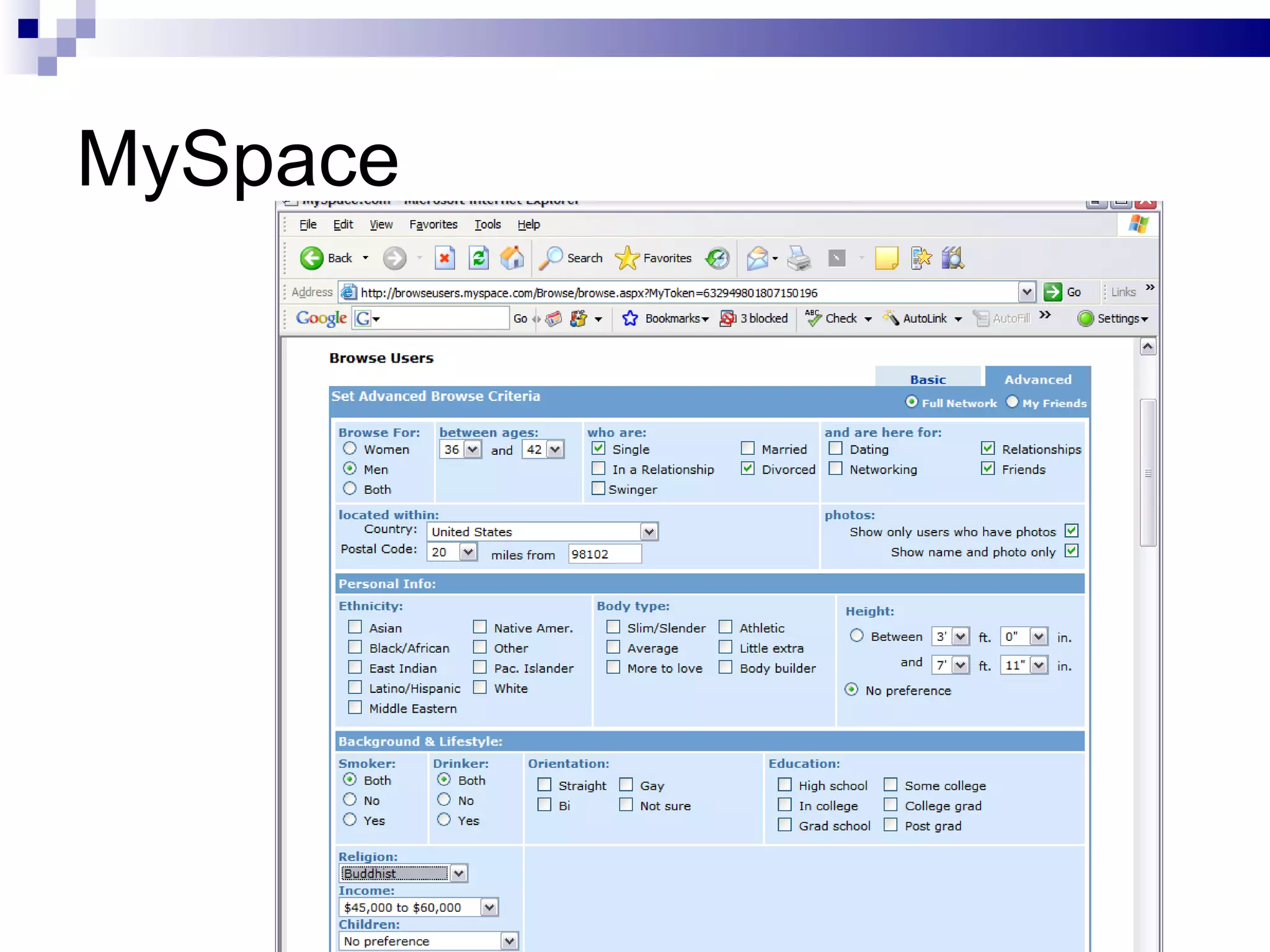
Myspace
MySpace
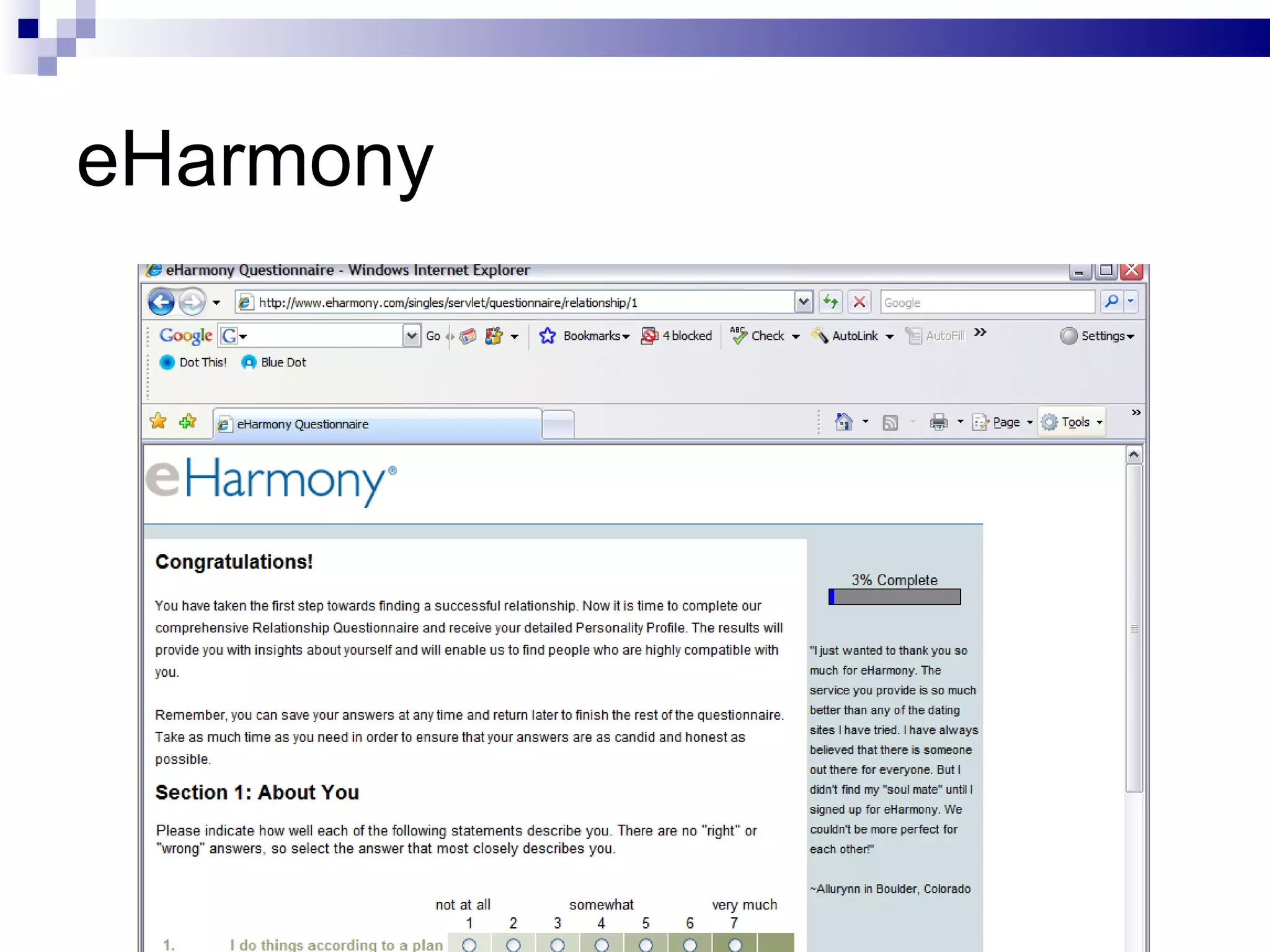
eHarmony
Team projects (3 or 4) The term project allows you to apply what we discuss in class to a real-life situation or issue that you want to explore. Assume your team (of 2 or 3 people) is hired as a consultant for another company that wishes to explore how to use social technologies to enhance user’s experience of some form of digital media (e.g. text, pictures, music, video).  First, you will review related technologies, discussing advantages and disadvantages of each in terms of theory underlying design of social technology systems.  Then, you will identify your client’s target users and their particular social and informational goals.  Finally, you will storyboard and wireframe a social software system incorporating your understanding of underlying theory, your target users, and current trends in the field.  Your system may either newly design or redesign your client’s current system.  You will be expected to present your project as a power point presentation, and in part as a written spec, with the assumption that your client company is the audience of both your presentation and your written spec.
Week 3: Teams formed Week 4: Submit a 250 word abstract of client’s problem Week 5: Provide written draft of literature review Week 6: Provide written draft of technology review Week 7: Provide written draft of assessment of target users Week 8: Provide powerpoint draft of storyboard & wireframe Week 9: Provide powerpoint draft of intro, lit & tech review,  and assessment of target users Week 10:  Provide final draft of written spec, and present project in class.  I will provide feedback at each stage, so for week 10 you are expected to update the final draft of your powerpoint presentation and written spec incorporating the feedback provided.  The written spec should include the bibliography. Schedule (3 or 4)
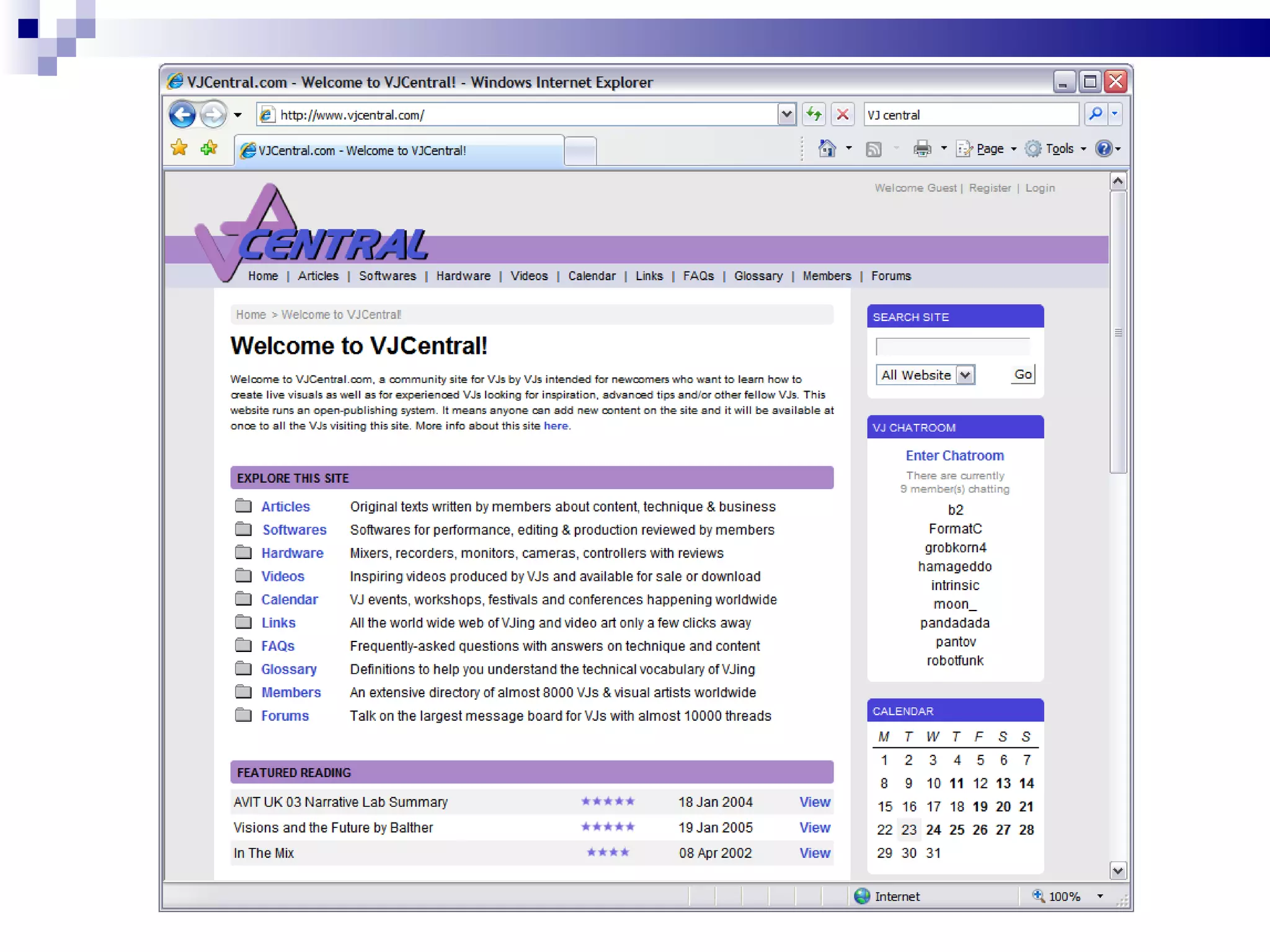
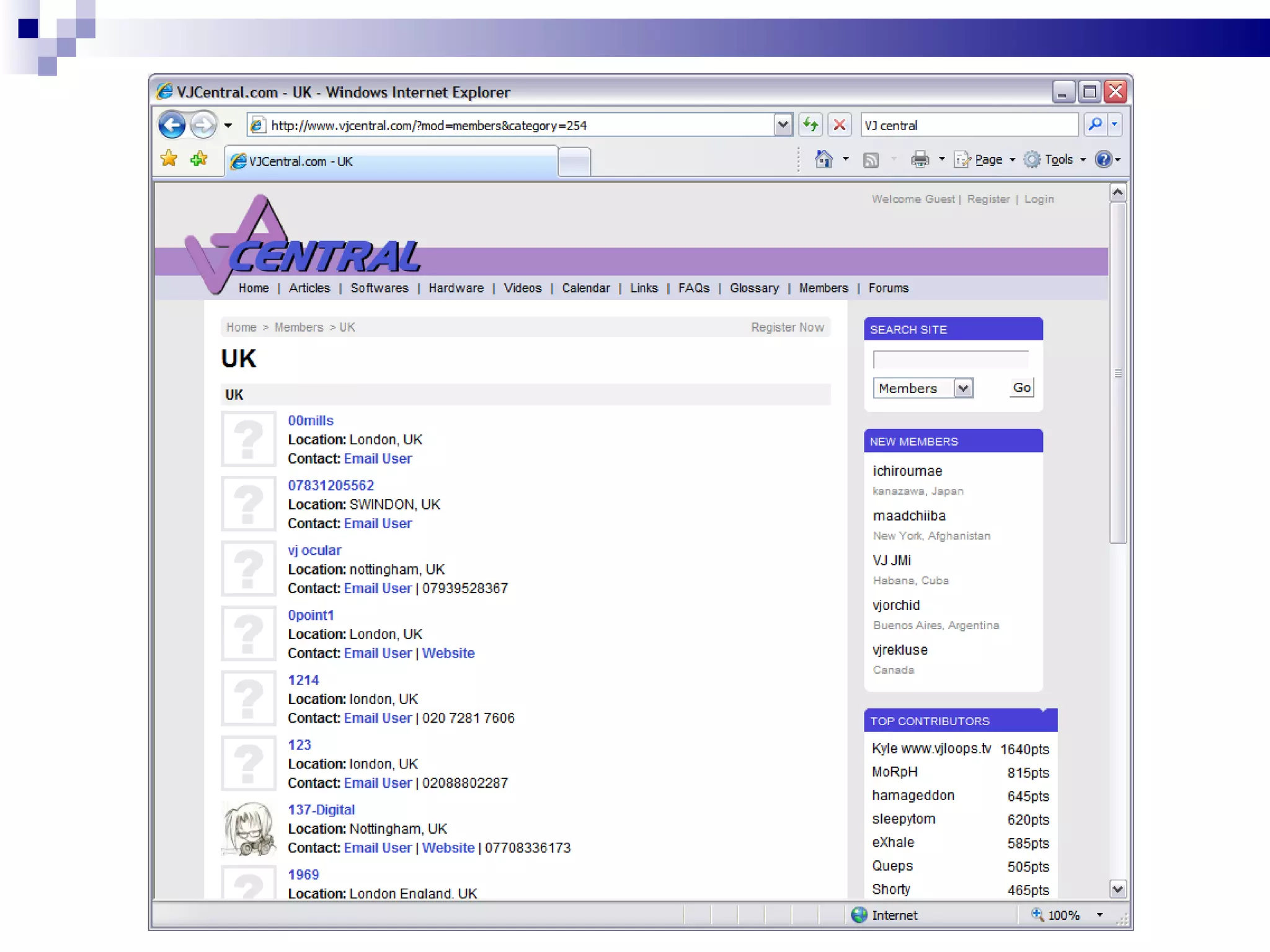
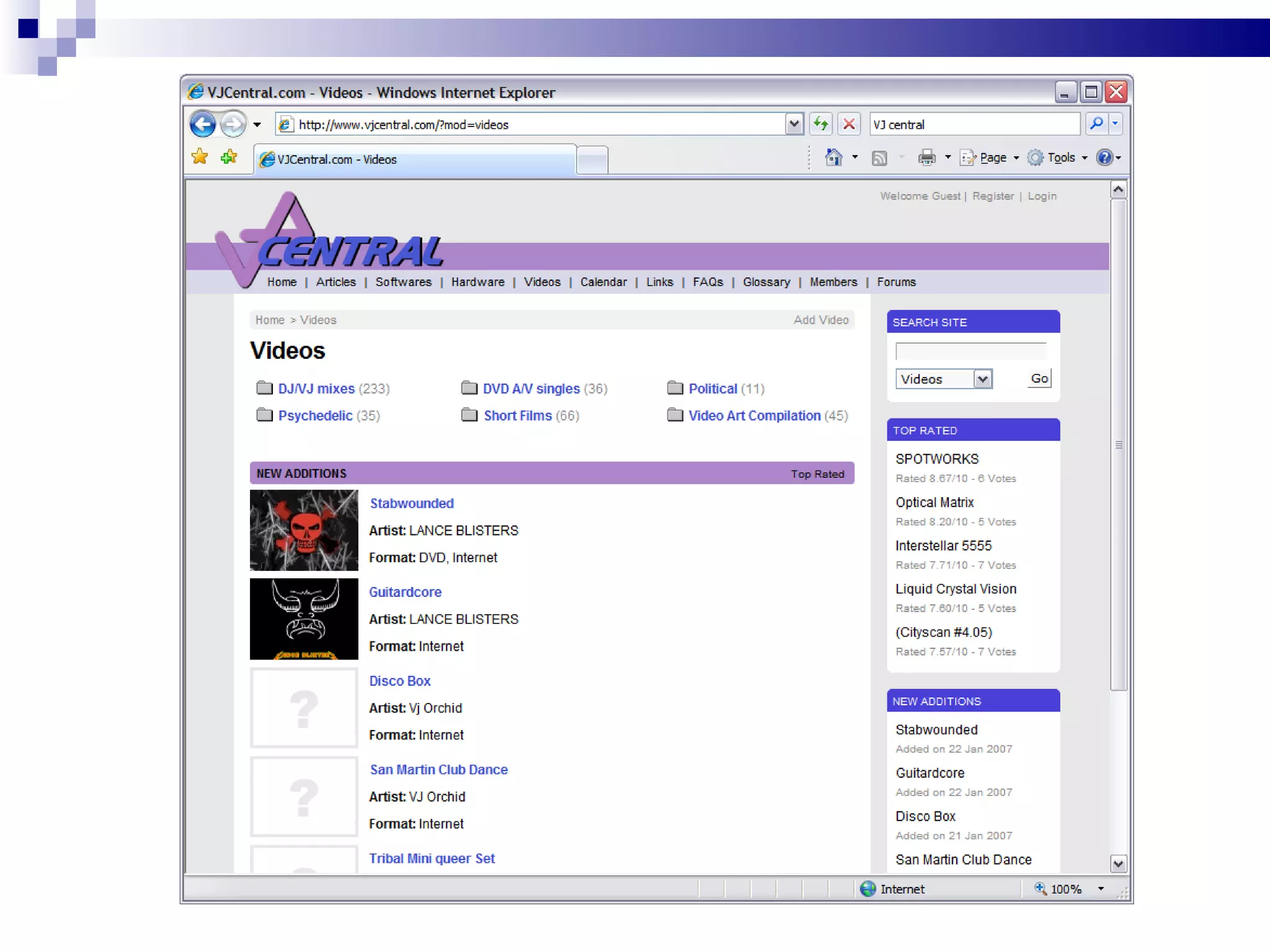
Developing Client Problem Specifying the client problem to be solved, 250 words max. Due next week. Example:  VJ Central is a web site where VJs go to share knowledge, resources and collaborate.  They approached our team because they believe that while VJs are posting some videos, they are not using the site to collaborate by building on each other’s content.  They are interested in improving how their users share video clips that they created through the site, potentially using creative commons licensing.  Our task is to explore issues of sharing videos clips that are specific to VJs, and storyboard a tool that a) allows users to find relevant content from others based on similarity in style and musical interests with a social rating system b) download and modify it, and then c) repost it, such that for any piece of media they can trace how its use has evolved.


Social Web 2.0 Class Week 3: Identity, Online Matchmaking

  • 1.
    Social Web 2.0Implications of Social Technologies for Digital Media Shelly Farnham, Ph.D. Com 597 Winter 2007
  • 2.
    Week 3 Identityand Online Match Making
  • 3.
    Identity Material, social,mental aspects of self sustained over time The embodied self One body, one identity One place at a time Multiple roles, but one at a time usually determined by social context
  • 4.
    Social Identity andSocial Context Social Identity (identity in social context) Roles Friend, daughter, secretary, judge Group membership Male/female, race Situational effects on behavior, depending on social identity activated Party, school, knitting club
  • 5.
    Impression Management Self-presentationAny behavior intended to create, modify, maintain impression in minds of others Why? Define nature of social interaction gain material or social rewards self-construction self-enhancement Trade off between desire to present best impression to achieve social goods Ingratiation, self-promotion, intimidation, exemplification, supplication Need to be accurate, accountable
  • 6.
    Classic Self-presentation BehaviorPublic claims of ability on a future task is a function of Personal expectation of success Audience will learn how well they did Schlenker 1975 JPSP, 32 1030-1037.
  • 7.
    Disadvantages of OnlineIdentity No centralized, physical presence Limited awareness of, or control over who is your audience Interacting with multiple social contexts at same time Identity asynchronous persists in your absence, so potential access by wrong audience Online role/situational conflict difficulty keeping role identities separate Stress of having incompatible roles Distrust of anonymous/minimally identified others Fraud, cheat, impersonation Trolling
  • 8.
    Advantages of OnlineIdentity Anonymity/Pseudonymity Expose sensitive issues in way can’t do offline Health Alternative life style/sexuality Interpersonal stories Broadcast profile enables access to others Without having to go to bars, job agencies Use sophisticated matchmaking systems Identity play Fraud, cheat, impersonation Trolling
  • 9.
    Self-presentation Online Constraintsin presentation medium FtF: Dress, body language, paraverbal cues, car, home Online: Profiles, home pages, blogs, text, music, avatars Conventional signal vs. assessment signal Unknown audience Self-presentation Often insufficient information about audience for effective self-presentation Teenager presenting self as cool by drinking beer to friend vs. parent Fetishist presenting self to fellow fetishists vs. work environment Role/situational interaction expectations People somewhat uncomfortable without knowledge of age, sex, location, race, SES Situational expectations (party vs. school) Harrassment concerns – don’t want to reveal I am fifteen year old girl Identity theft – don’t want to expose my credit car number Question of authority Does the person have sufficient expertise to be making knowledge claims? Accountability If person is not help accountable by being anonymous, tend to distrust --- with reason.
  • 10.
  • 11.
    a/s/l Profiles –what matters?
  • 12.
    Profiles – whatmatters? Unique identifies Name, birthday, email, home address, phone, web address Social identities Sex, age, race, SES, citizenship/nationality, language Roles and memberships School/employmnet, social roles, voluntary membership groups Interest and activities Hobbies, interests, activities, sports Preferences/tastes Musical, movie, books, food, dislikes, likes Personal characteristics Intelligence, interpersonal style (e.g. introverted), affective style (e.g. cheerful) Values and beliefs Religion, political beliefs, ethics, spirituality Social standing/reputation Liked, respected, leader
  • 13.
    Profiles – whatmatters? Davis et al. unpublished paper
  • 14.
    Profile features –What matters? Text Fields Open-ended personal statement Blog entries Pictures Video Audio Links Friend lists Groups
  • 15.
    In dating sites,what is important? Fiore & Donath, 2005)
  • 16.
    Xbox Matchmaking StudyWho do you want to play with, based on type of profile. (riegelsberg et al. 2006)
  • 17.
  • 18.
    Identity Crisis inWeb 2.0 Digital identity: “….a person or thing represented or existing in the digital realm which is being described or dealt with”. (Kim Cameron) Patchwork of identity one-offs Susceptible to criminalization Phishing, Pharming Need unifying identity metasystem Reliable way to establish who is connecting with what Hard to create standardized identity layer Web sites want control of identity, prevent spillover to other web sites
  • 19.
    Laws of Identity(Kim Cameron) User control and consent Minimal disclosure for a constrained use Justifiable parties Directed Identity Omnidirectional Unidirectional Pluralism of operators and technologies Human integration (ceremony) Consistent experience across contexts
  • 20.
  • 21.
  • 22.
    Identity in anAge of Web 2.0 OpenID ( Http://openid.net/ ) -- opensource Authentication Authorization ACL (Access control list) RBAC (Role based access control) Identity information Single sign (SSO) on across multiple properties
  • 23.
    Plaxo Online addressbook People essentially subscribe to each other’s contact info Syncs with common email systems Updates automatically distributed
  • 24.
  • 25.
  • 26.
    MyBlogLog Profile forconversation in blogosphere so readers are as discoverable as authors Foster awareness around audience, and conversation
  • 27.
  • 28.
  • 29.
  • 30.
    Match Making 11%internet users gone to dating sites 37% of single internet users 17% of those who have used dating services entered long-term relationship with someone met there Pew: http://www.pewinternet.org/report_display.asp?r=177 Personals web site drew 40 million unique visitors in U.S. – ½ # of single adults. Mulrine 2003 The top five online dating sites in Dec. 2005, were Yahoo Personals, Match.com, Spark Networks, True.com, and Mate1.com, according to comScore. Yahoo's was far and away the most popular, with 24.04 million visitors, compared with 3.6 million for second-place Match.
  • 31.
    Determinants of AttractionProximity Repeated exposure “mere exposure effect” Physical attractiveness Similarity Birds of a feather…not opposites attract Reciprocation Matching hypothesis – pair off similar in physical attractiveness
  • 32.
    Social Matching OnlineMatching goals Dating, expertise, gaming partner Types of systems Search/sort/match systems Mainstream (match.com, yahoo) Subpopulation (Jdate.com, manhunt.net) Personality matching Semi-automatic matching Social networks Features Profiles Search Matchmaking algorithms Graduated privacy and communication
  • 33.
    Xbox MatchMaking Study What you care about depends on kind of player you are.
  • 34.
  • 35.
    Reputation information studyExplored what reputation information in a profile people cared about the most in selecting a chat partner. Found they cared the most about ratings by friends, then about similarity to self. Cared less about overall measures of rank/ratings. (jensen et al. 2000?))
  • 36.
  • 37.
  • 38.
  • 39.
  • 40.
  • 41.
    Team projects (3or 4) The term project allows you to apply what we discuss in class to a real-life situation or issue that you want to explore. Assume your team (of 2 or 3 people) is hired as a consultant for another company that wishes to explore how to use social technologies to enhance user’s experience of some form of digital media (e.g. text, pictures, music, video). First, you will review related technologies, discussing advantages and disadvantages of each in terms of theory underlying design of social technology systems. Then, you will identify your client’s target users and their particular social and informational goals. Finally, you will storyboard and wireframe a social software system incorporating your understanding of underlying theory, your target users, and current trends in the field. Your system may either newly design or redesign your client’s current system. You will be expected to present your project as a power point presentation, and in part as a written spec, with the assumption that your client company is the audience of both your presentation and your written spec.
  • 42.
    Week 3: Teamsformed Week 4: Submit a 250 word abstract of client’s problem Week 5: Provide written draft of literature review Week 6: Provide written draft of technology review Week 7: Provide written draft of assessment of target users Week 8: Provide powerpoint draft of storyboard & wireframe Week 9: Provide powerpoint draft of intro, lit & tech review, and assessment of target users Week 10: Provide final draft of written spec, and present project in class. I will provide feedback at each stage, so for week 10 you are expected to update the final draft of your powerpoint presentation and written spec incorporating the feedback provided. The written spec should include the bibliography. Schedule (3 or 4)
  • 43.
    Developing Client ProblemSpecifying the client problem to be solved, 250 words max. Due next week. Example: VJ Central is a web site where VJs go to share knowledge, resources and collaborate. They approached our team because they believe that while VJs are posting some videos, they are not using the site to collaborate by building on each other’s content. They are interested in improving how their users share video clips that they created through the site, potentially using creative commons licensing. Our task is to explore issues of sharing videos clips that are specific to VJs, and storyboard a tool that a) allows users to find relevant content from others based on similarity in style and musical interests with a social rating system b) download and modify it, and then c) repost it, such that for any piece of media they can trace how its use has evolved.
  • 44.
  • 45.
  • 46.