Social Web 2.0 Implications of Social Technologies for Digital Media Shelly Farnham, Ph.D. Com 597 Winter 2007
Week 5 Community Reputation Systems Web 2.0 Revenue Models
Community "I define "community" as networks of interpersonal ties that provide sociability, support, information, a sense of belonging, and social identity.”  Barry Wellman (2001). “ A group of people who share a common interest or purpose; who have the ability to get to know each other better over time. There are two pieces to that definition. That second piece — getting to know each other better over time — means that there needs to be some mechanism of identity and communication.” Amy Jo Kim (2001) “ 1) It is interactive and built on the concept of many-to-many communications ...;  2) It is designed to attract and retain community members who become more than superficially involved in community events ... and ... are able to make new friends through the community; 3) It has a single defining focus; ... (that) gives them a reason to return; 4) It provides services to community members, ... that meet community member needs;  5) It has, or has the potential to develop, a strong commercial element...“ From  "Towntalk ," a listserv on online community
Socio-Cultural Context Social dissolution/individualism, lack of traditional community Bob Putnam, “Bowling Alone” Neo-tribalism Use of Internet to access people, coordinate
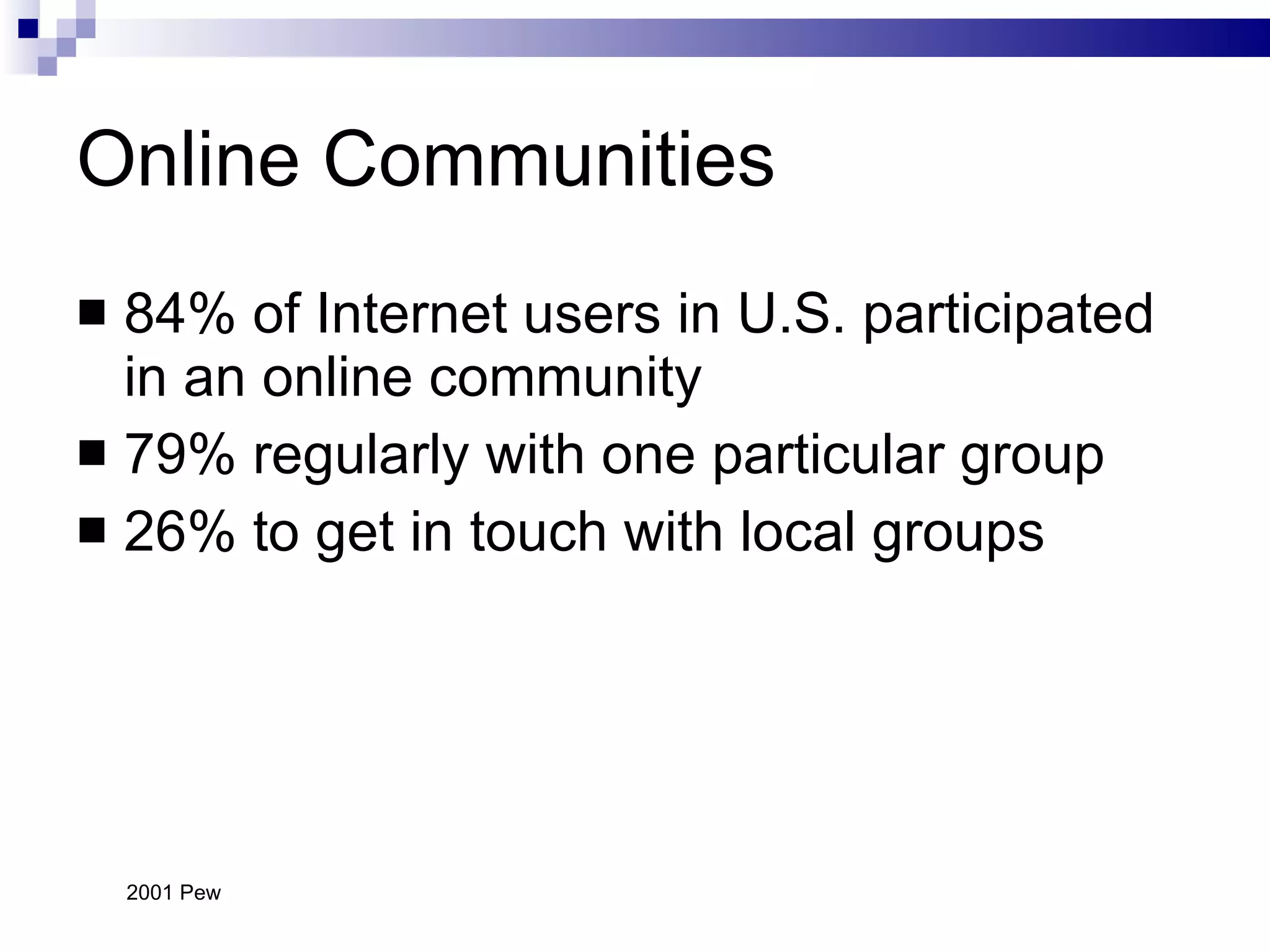
Online Communities 84% of Internet users in U.S. participated in an online community  79% regularly with one particular group 26% to get in touch with local groups 2001 Pew
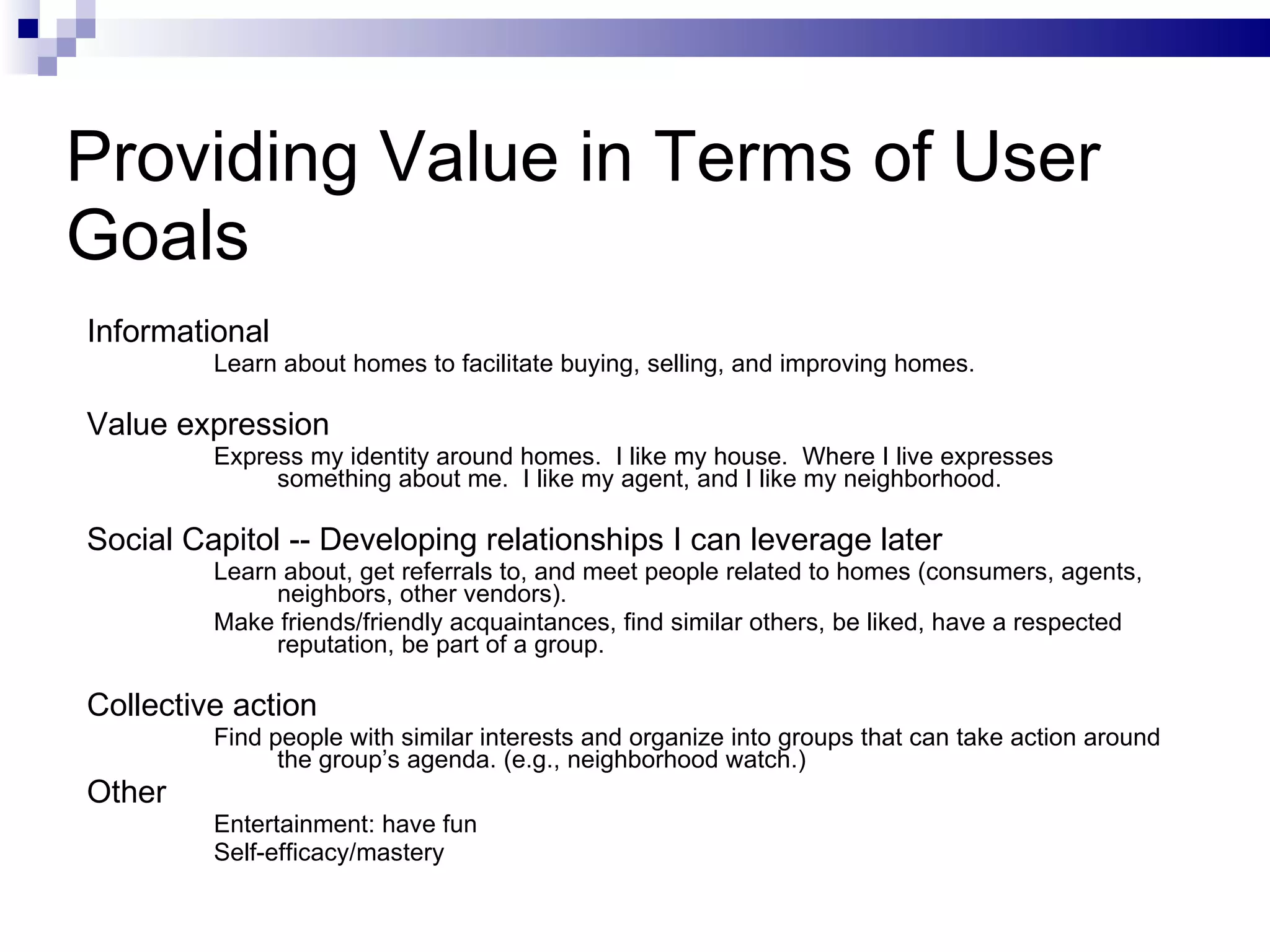
Providing Value in Terms of User Goals Informational Learn about homes to facilitate buying, selling, and improving homes. Value expression  Express my identity around homes.  I like my house.  Where I live expresses something about me.  I like my agent, and I like my neighborhood. Social Capitol -- Developing relationships I can leverage later Learn about, get referrals to, and meet people related to homes (consumers, agents, neighbors, other vendors). Make friends/friendly acquaintances, find similar others, be liked, have a respected reputation, be part of a group. Collective action Find people with similar interests and organize into groups that can take action around the group’s agenda. (e.g., neighborhood watch.) Other Entertainment: have fun Self-efficacy/mastery
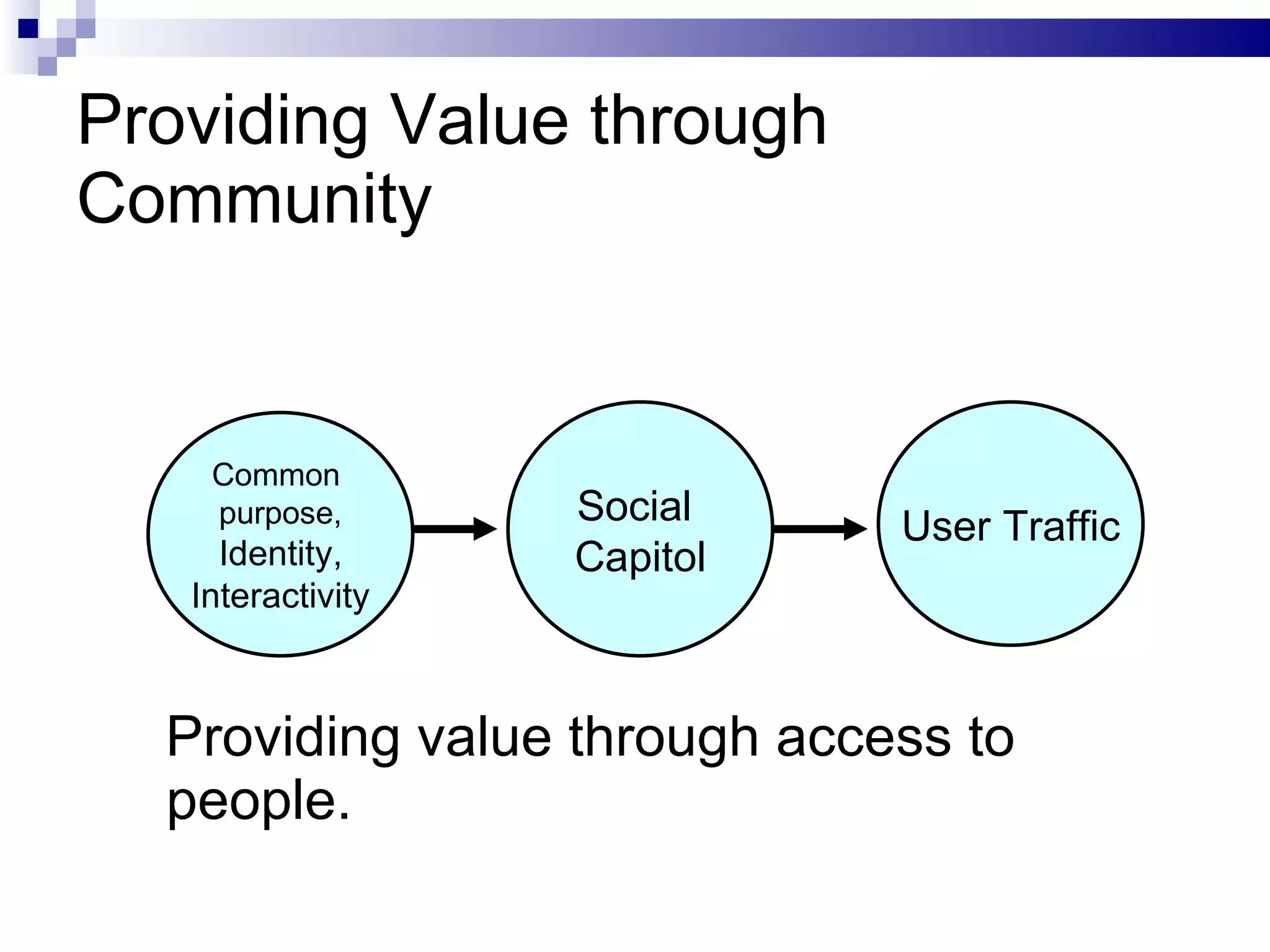
Providing Value through Community Providing value through access to people.  Common  purpose, Identity, Interactivity User Traffic Social  Capitol
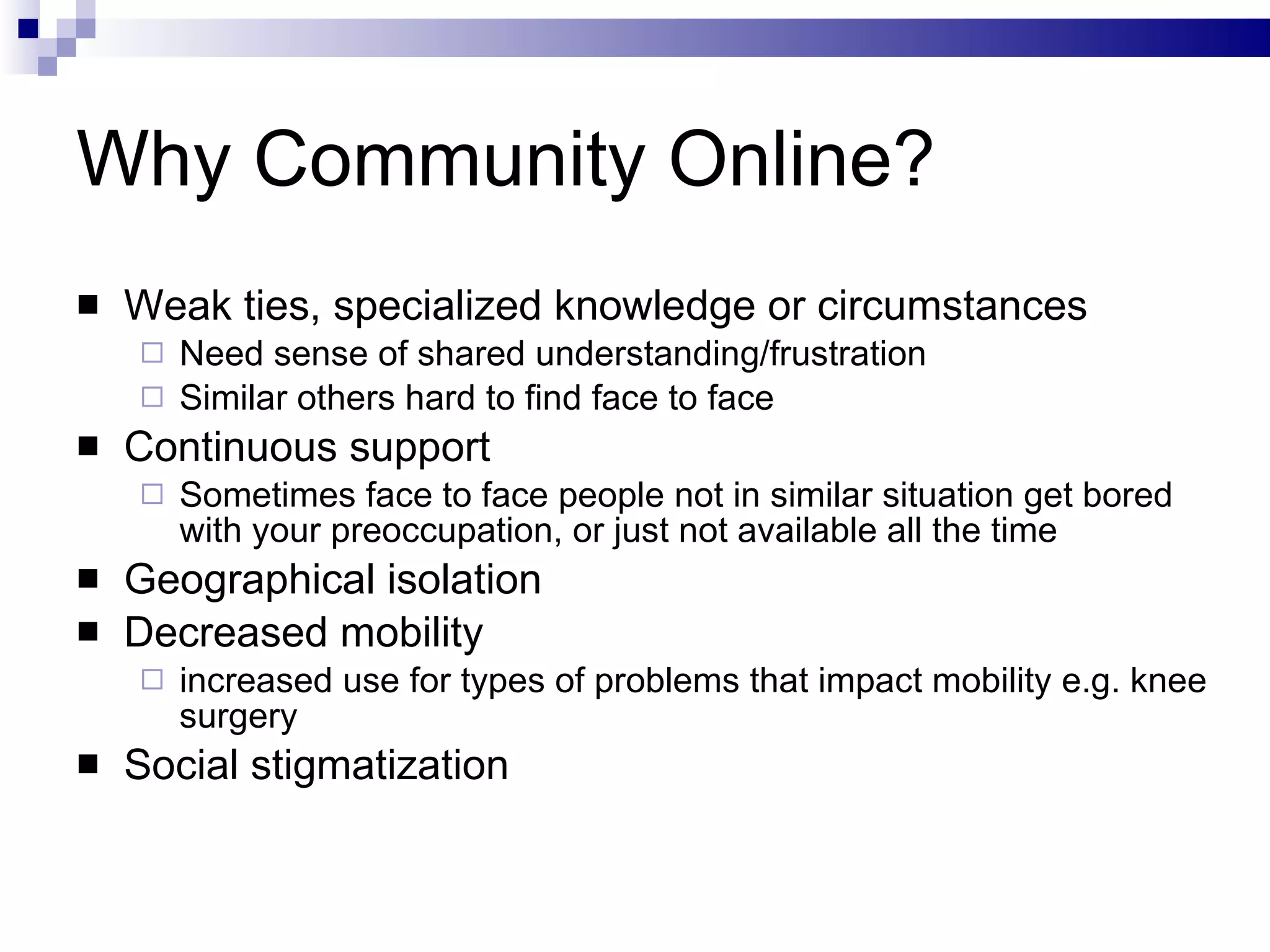
Why Community Online? Weak ties, specialized knowledge or circumstances Need sense of shared understanding/frustration Similar others hard to find face to face Continuous support Sometimes face to face people not in similar situation get bored with your preoccupation, or just not available all the time Geographical isolation Decreased mobility increased use for types of problems that impact mobility e.g. knee surgery Social stigmatization
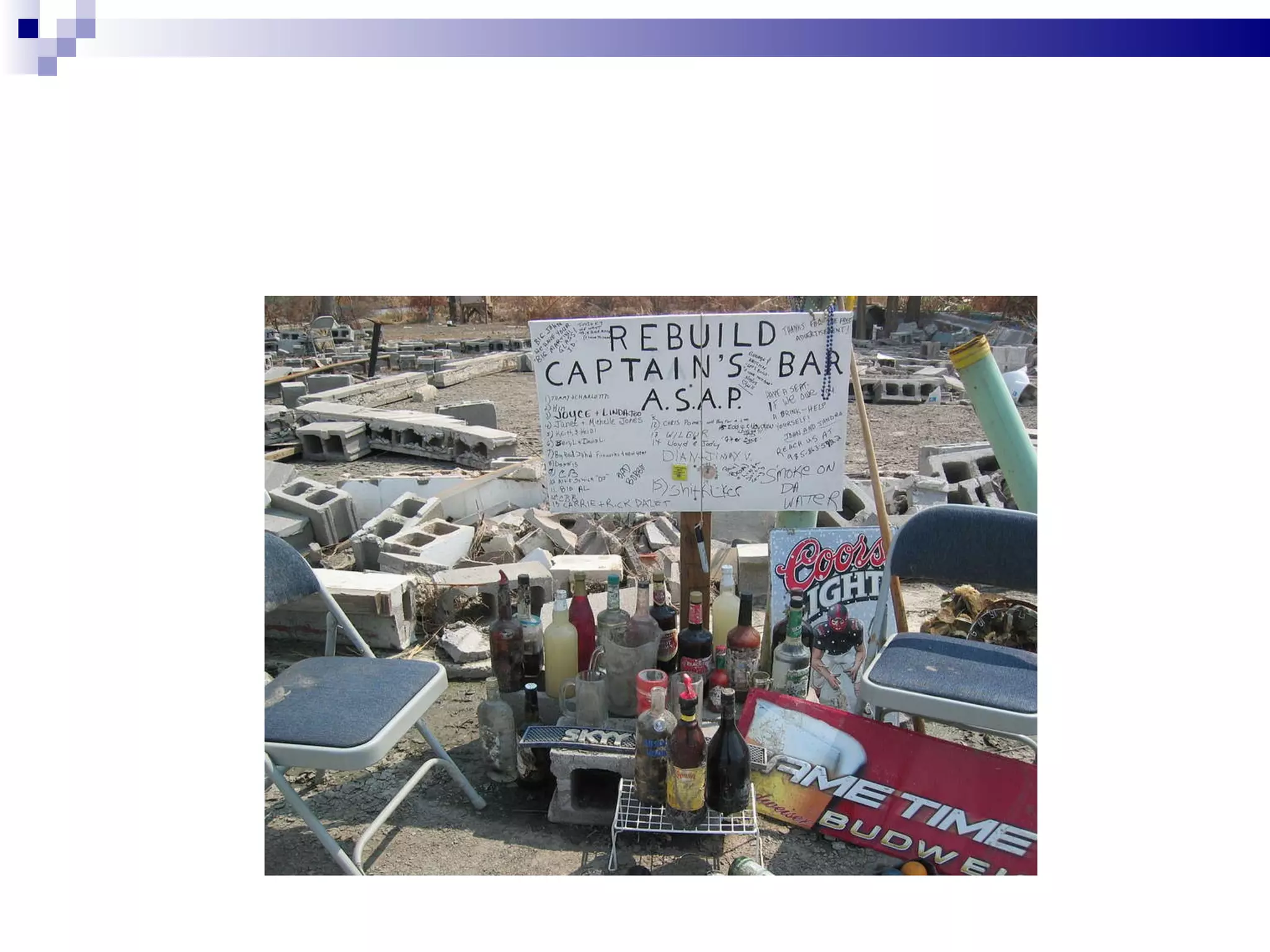
The Virtual Third Place
The Importance of Place Places – specific locations in space that provide an anchor and a meaning to who we are. Orem & Chen, 2003 Proximity primary determinant of liking, through repeated exposure and opportunities for interaction. Social Psychology The great good place, neighborhood hangouts and haunts key to development of community.  Enabling serendipitous interactions. Ray Oldenburg, 1989 “ Eyes on the street.”  Urban planner advocating dense, mixed-use neighborhoods, fostering vibrant urban community and increased security. Jacobs, 1961
A Sense of Place Personal identity Community Past and future Being at home “ Place is a special and unique location…notable for the fact that the regular activities of human beings occur there.  Moreover, because it is a site of such activities, and all which they entail, it may furnish the basis for our sense of identity, as human beings, as well as for our sense of connection to other human beings, in other words, our sense of community.  Place, in other words, is that special site, or sites, in space where people live and work, and where, therefore, they are likely to form intimate and enduring connections.”  Orum & Chen p. 15.
 
Netville Study -- Enabling Neighboring through Technology If neighborhood given the opportunity to interact/exchange information on the Internet, are they more like to develop neighborhood ties? Provided high speed internet to 64 out of 109 neighboring homes, two years 1996-1998, with neighborhood email list Hampton & Wellman, City and Communication: 2:4 December 2003
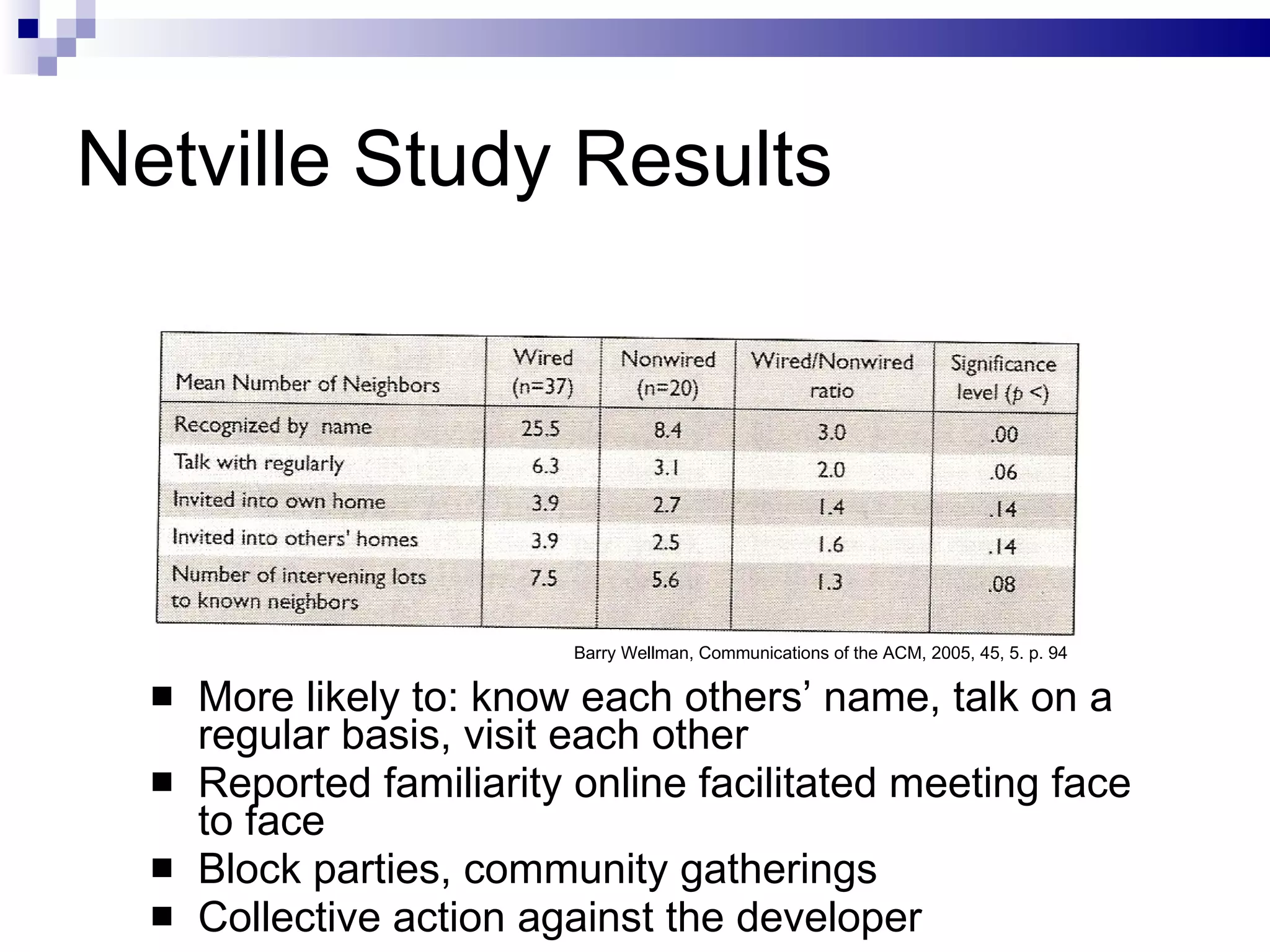
Netville Study Results More likely to: know each others’ name, talk on a regular basis, visit each other Reported familiarity online facilitated meeting face to face Block parties, community gatherings Collective action against the developer Barry Wellman, Communications of the ACM, 2005, 45, 5. p. 94
What did they talk about? Discuss interests of common concern (home construction) Requests for help or advise (e.g. recommendation for a local doctor) Advertise garage sales, local crafts/services Invitations to community events Messages offering such things as job info
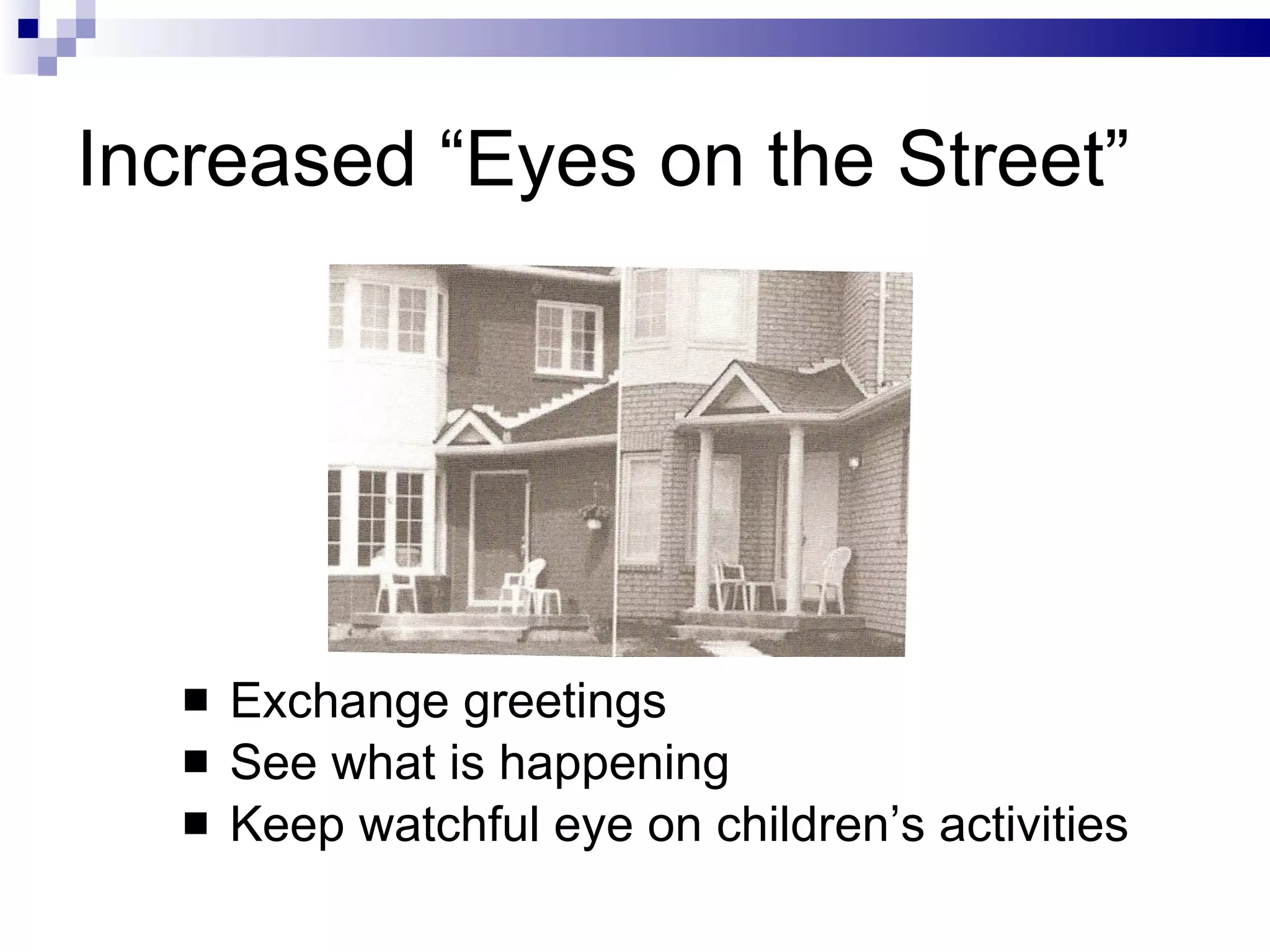
Increased “Eyes on the Street” Exchange greetings See what is happening Keep watchful eye on children’s activities
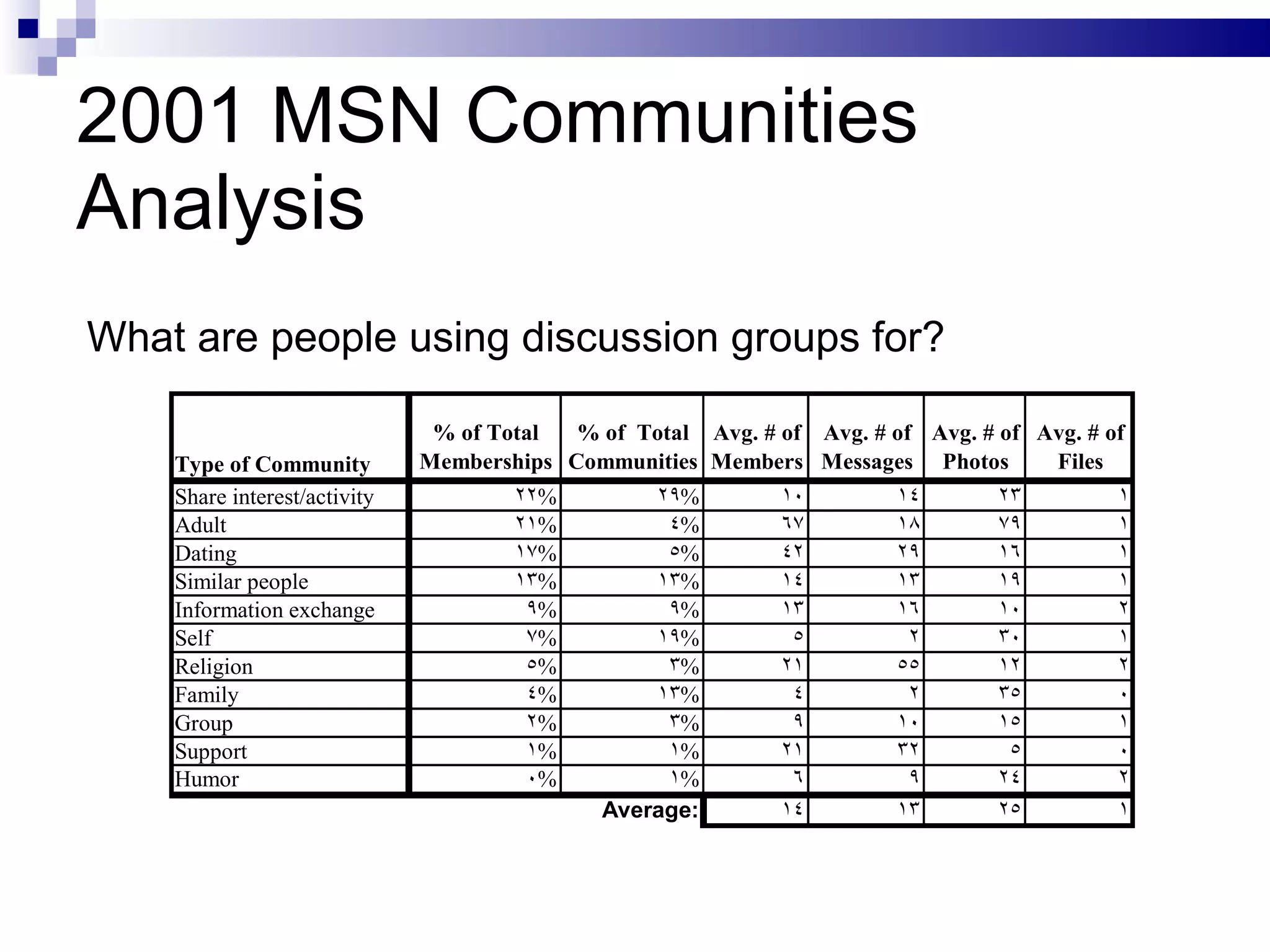
2001 MSN Communities Analysis What are people using discussion groups for?
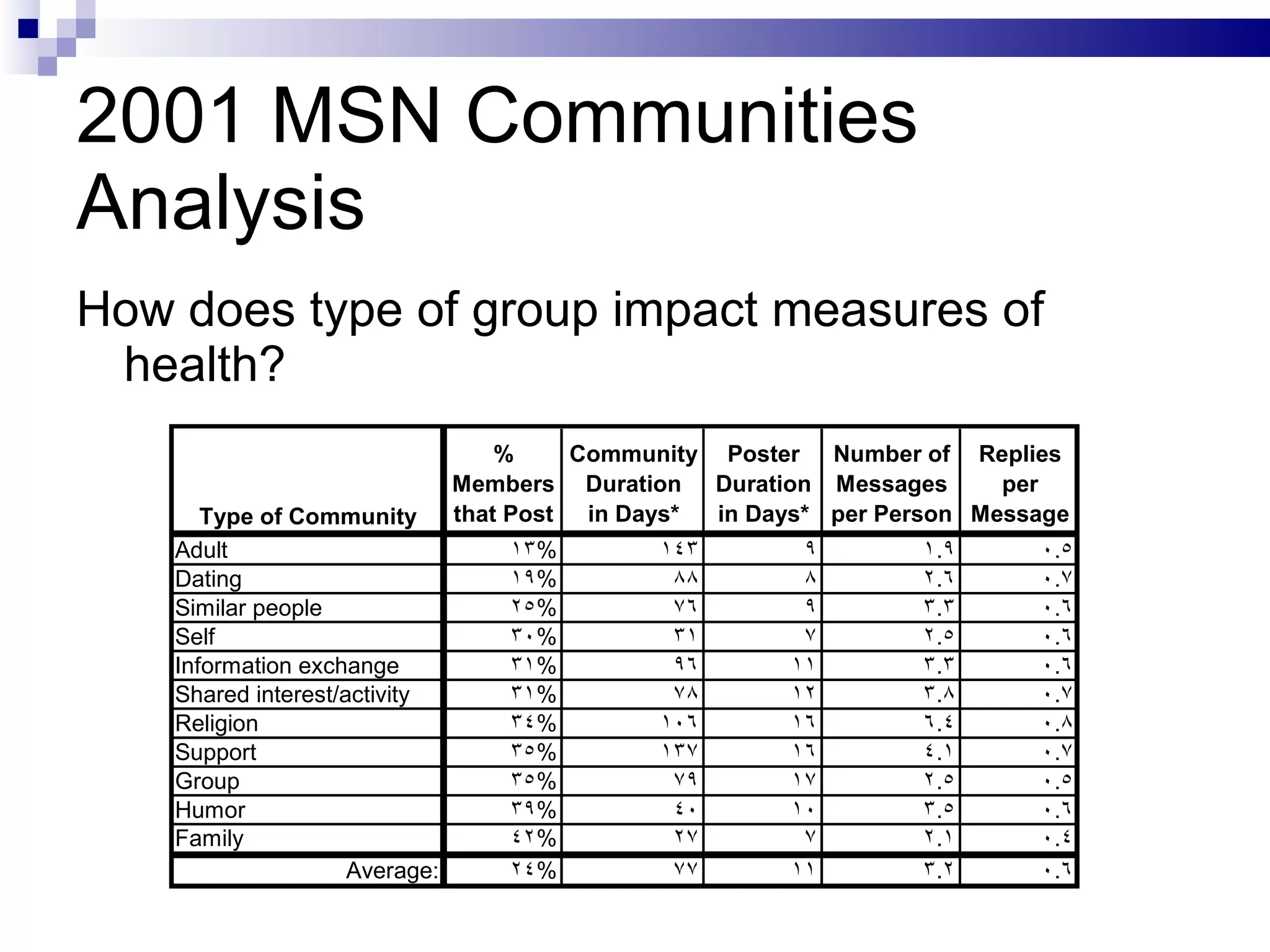
2001 MSN Communities Analysis How does type of group impact measures of health?
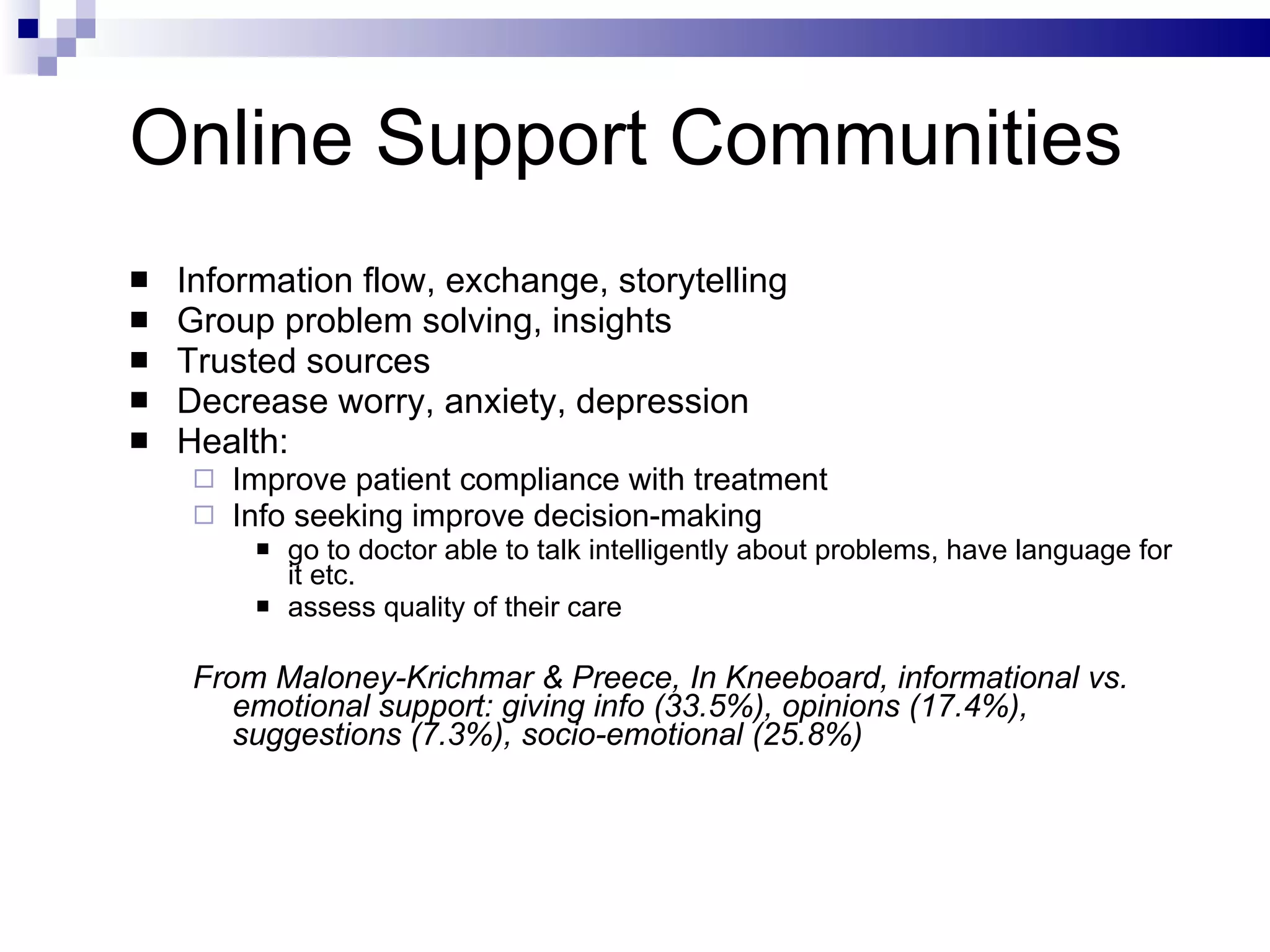
Online Support Communities Information flow, exchange, storytelling Group problem solving, insights Trusted sources Decrease worry, anxiety, depression Health:  Improve patient compliance with treatment Info seeking improve decision-making go to doctor able to talk intelligently about problems, have language for it etc. assess quality of their care From Maloney-Krichmar & Preece, In Kneeboard, informational vs. emotional support: giving info (33.5%), opinions (17.4%), suggestions (7.3%), socio-emotional (25.8%)
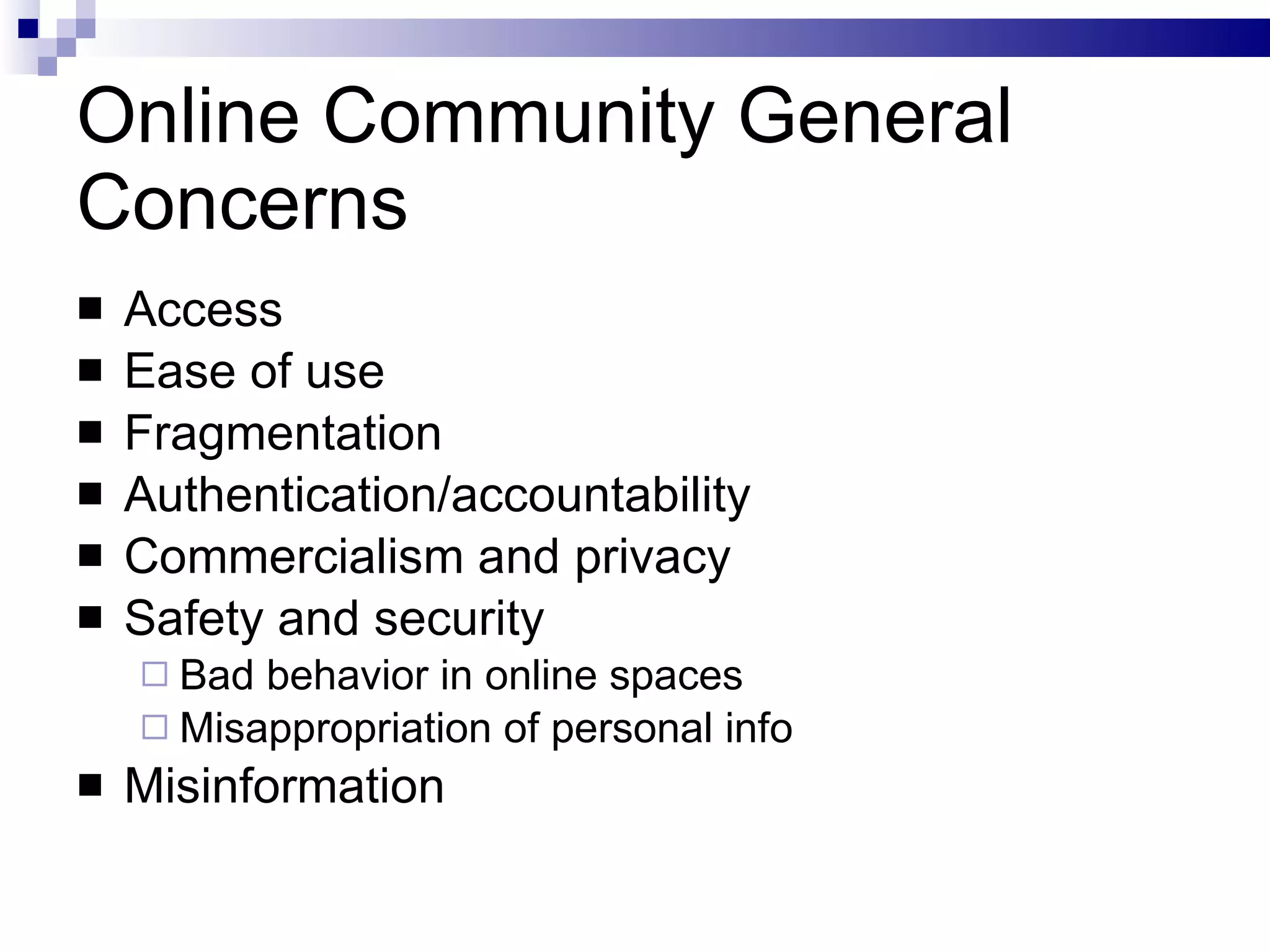
Online Community General Concerns Access Ease of use Fragmentation Authentication/accountability Commercialism and privacy Safety and security  Bad behavior in online spaces Misappropriation of personal info Misinformation
Mailing Lists!
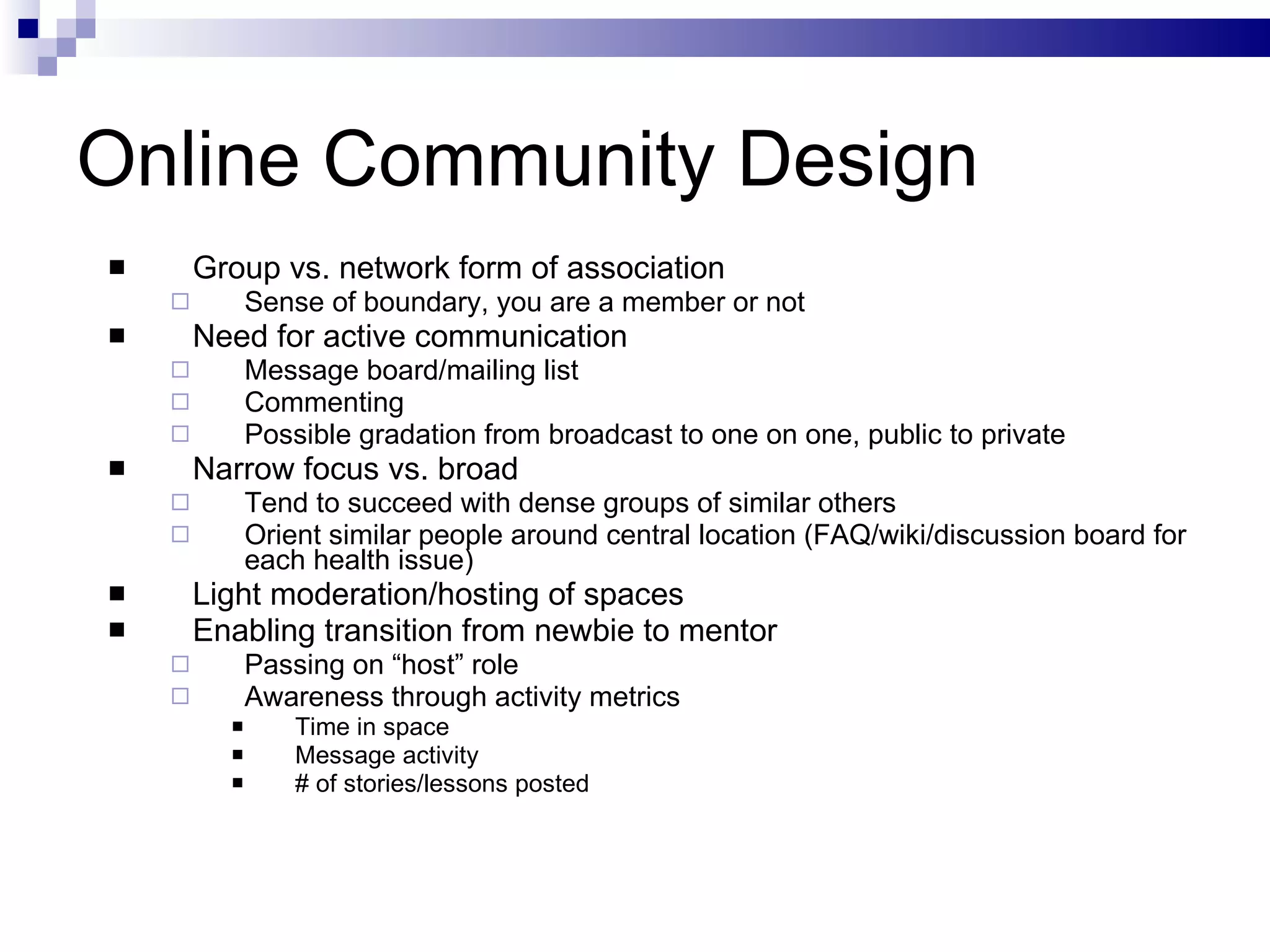
Online Community Design Group vs. network form of association Sense of boundary, you are a member or not Need for active communication Message board/mailing list Commenting Possible gradation from broadcast to one on one, public to private Narrow focus vs. broad Tend to succeed with dense groups of similar others Orient similar people around central location (FAQ/wiki/discussion board for each health issue) Light moderation/hosting of spaces Enabling transition from newbie to mentor Passing on “host” role Awareness through activity metrics Time in space Message activity # of stories/lessons posted
Designing for Sociability Clearly articulated shared purpose Governence, protocols, rituals People Roles Moderators Experts Lurkers Approx 1% leaders, 19% participate, 80% lurkers Size Critical mass:  number of people needed to make a community useful Too few not enough, too many overwhelmed Discussion groups:  25 active participants take up all the air
Fostering cooperation Social dilemma/tragedy of the commons Individual gain vs. collective good Increasing cooperation Will meet again Identification of behavior Record of past behavior
Discovery/Entry Points Search google  Search in system by topic  and  by person: important to find similar others Search/show relevant demo factors (SES indicators through job, college…) Related interests Entry through invitation to join Invite friends/family/cohorts to view stories etc. Link off of other community sites Banner ads
Discovery/Entry Points Importance of First Impressions Need to see there is social interaction (social translucence)  exchange/reciprocity shows interpersonal trust Shadows of social behavior: X members, amount recent activity, new story posts, best story Site trust building: Post self-regulating policies Privacy and security Editorial and advertising Source disclosure Third party seal Branding
Communities as intervention The minimal “intervention”: Define community boundaries Tapping into personal identity, social identity Enable conversation Assessment: Measure community growth, participation Impact on neighborhood
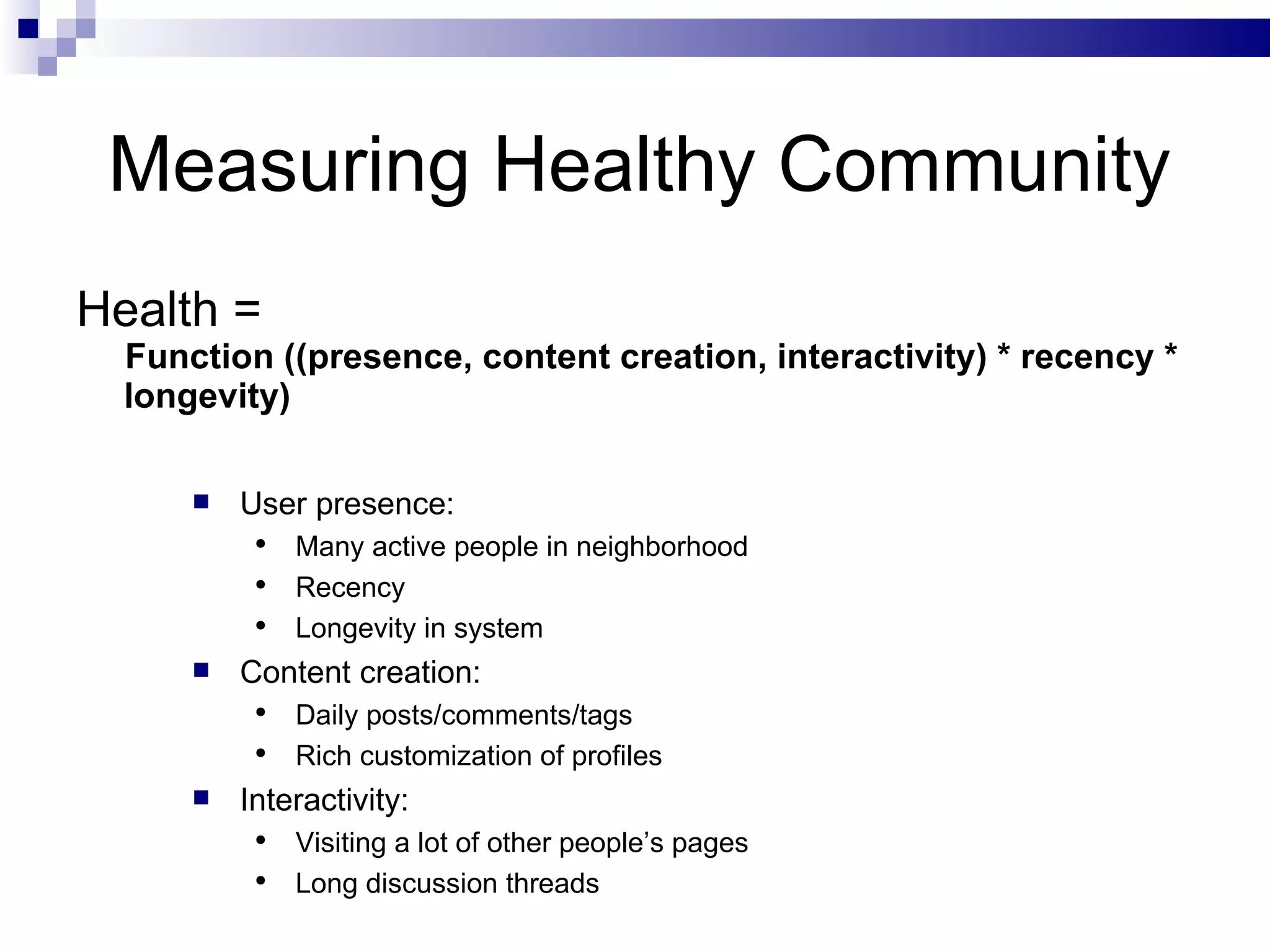
Measuring Healthy Community Health =  Function ((presence, content creation, interactivity) * recency * longevity) User presence: Many active people in neighborhood Recency Longevity in system Content creation: Daily posts/comments/tags Rich customization of profiles Interactivity: Visiting a lot of other people’s pages Long discussion threads
Instrumentation for Social Metadata Treat each behavior as unit of use and record User UserBehavior Timestamp BehaviorContext BehaviorDetails Aggregate info for sorting etc. Always retain original data for later analysis/algorithm development
Trust and Reputation Systems
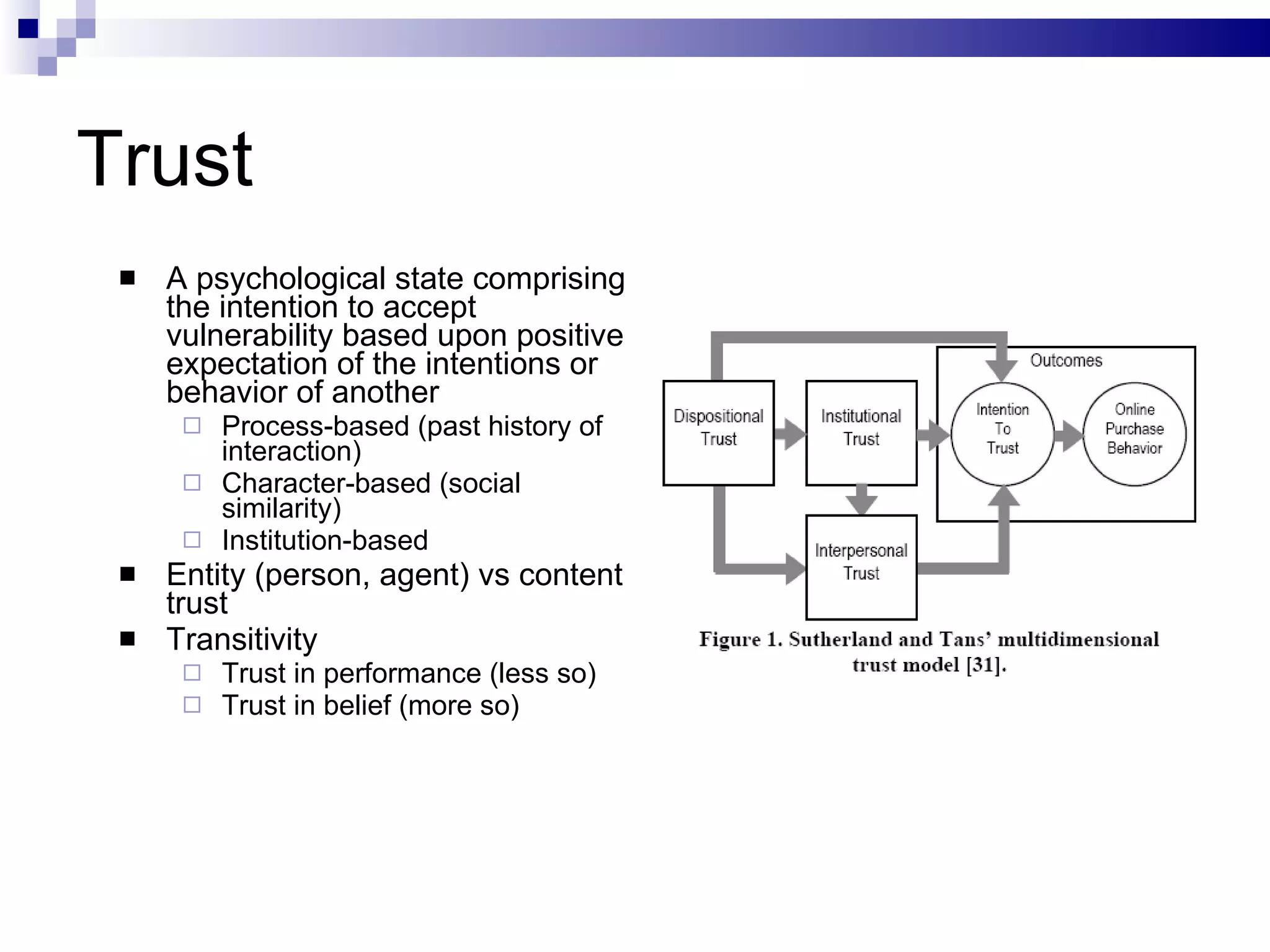
Trust A psychological state comprising the intention to accept vulnerability based upon positive expectation of the intentions or behavior of another Process-based (past history of interaction) Character-based (social similarity) Institution-based Entity (person, agent) vs content trust Transitivity Trust in performance (less so) Trust in belief (more so)
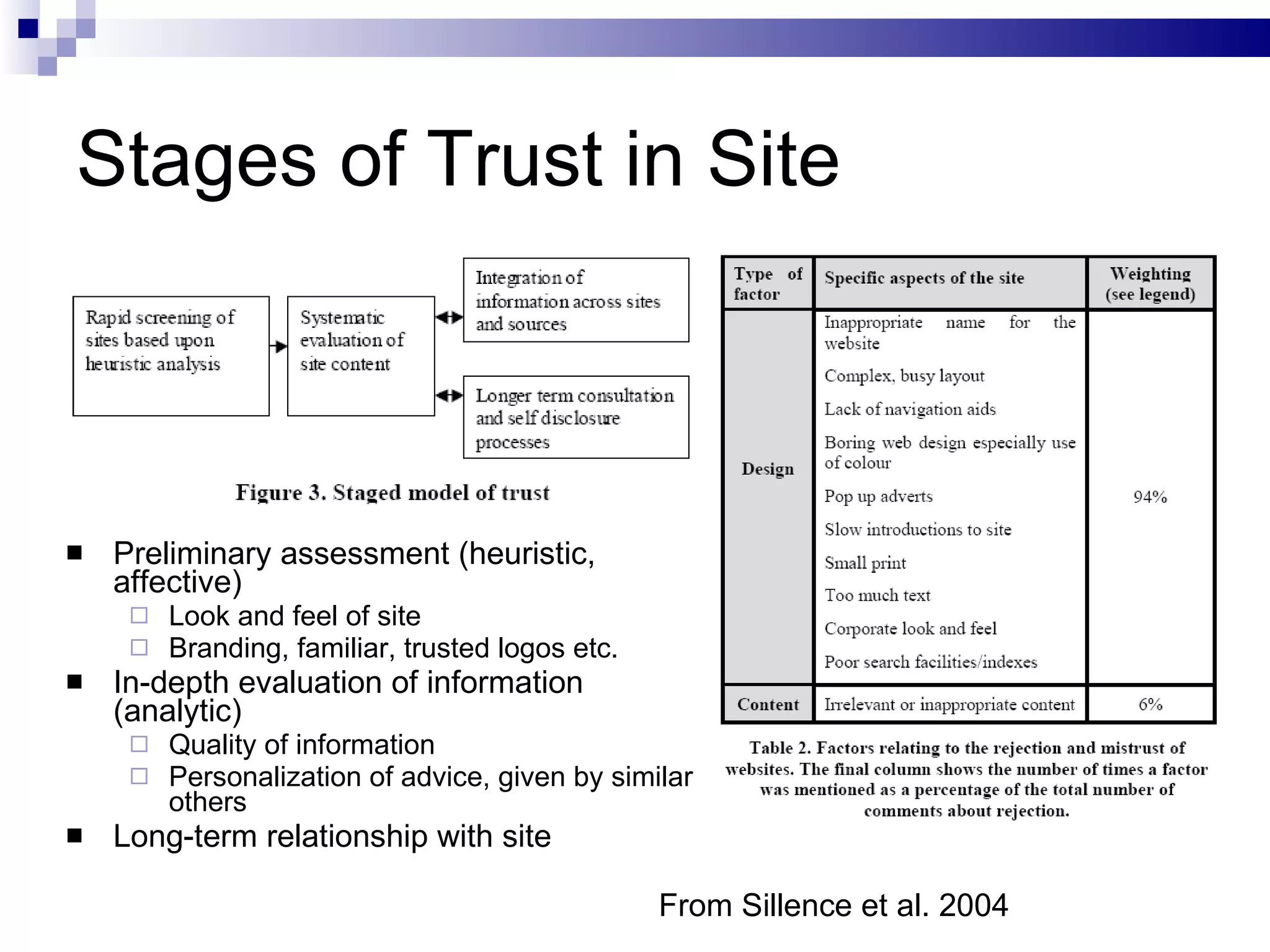
Stages of Trust in Site Preliminary assessment (heuristic, affective) Look and feel of site Branding, familiar, trusted logos etc. In-depth evaluation of information (analytic) Quality of information Personalization of advice, given by similar others Long-term relationship with site From Sillence et al. 2004
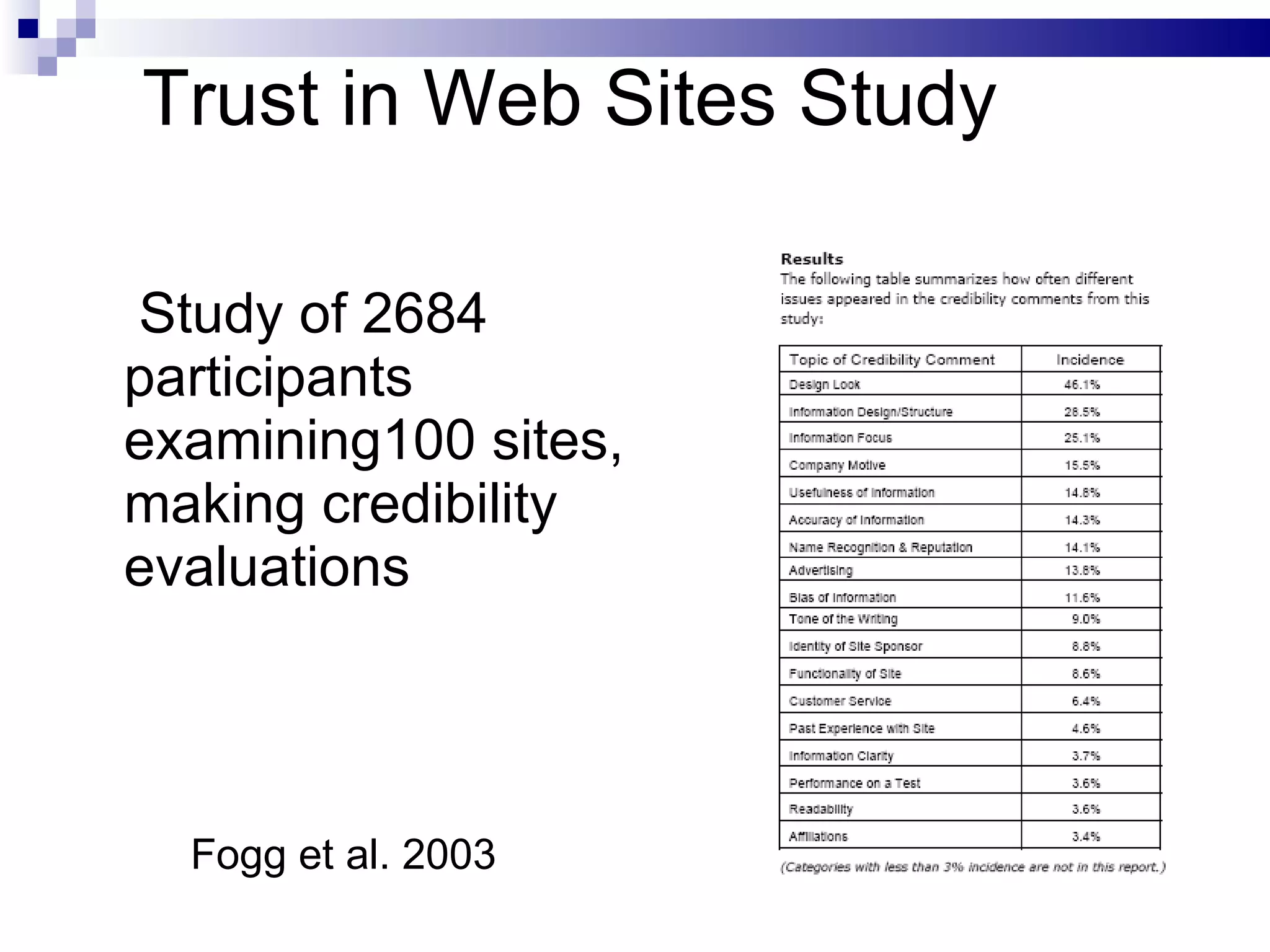
Trust in Web Sites Study Study of 2684 participants examining100 sites, making credibility evaluations Fogg et al. 2003
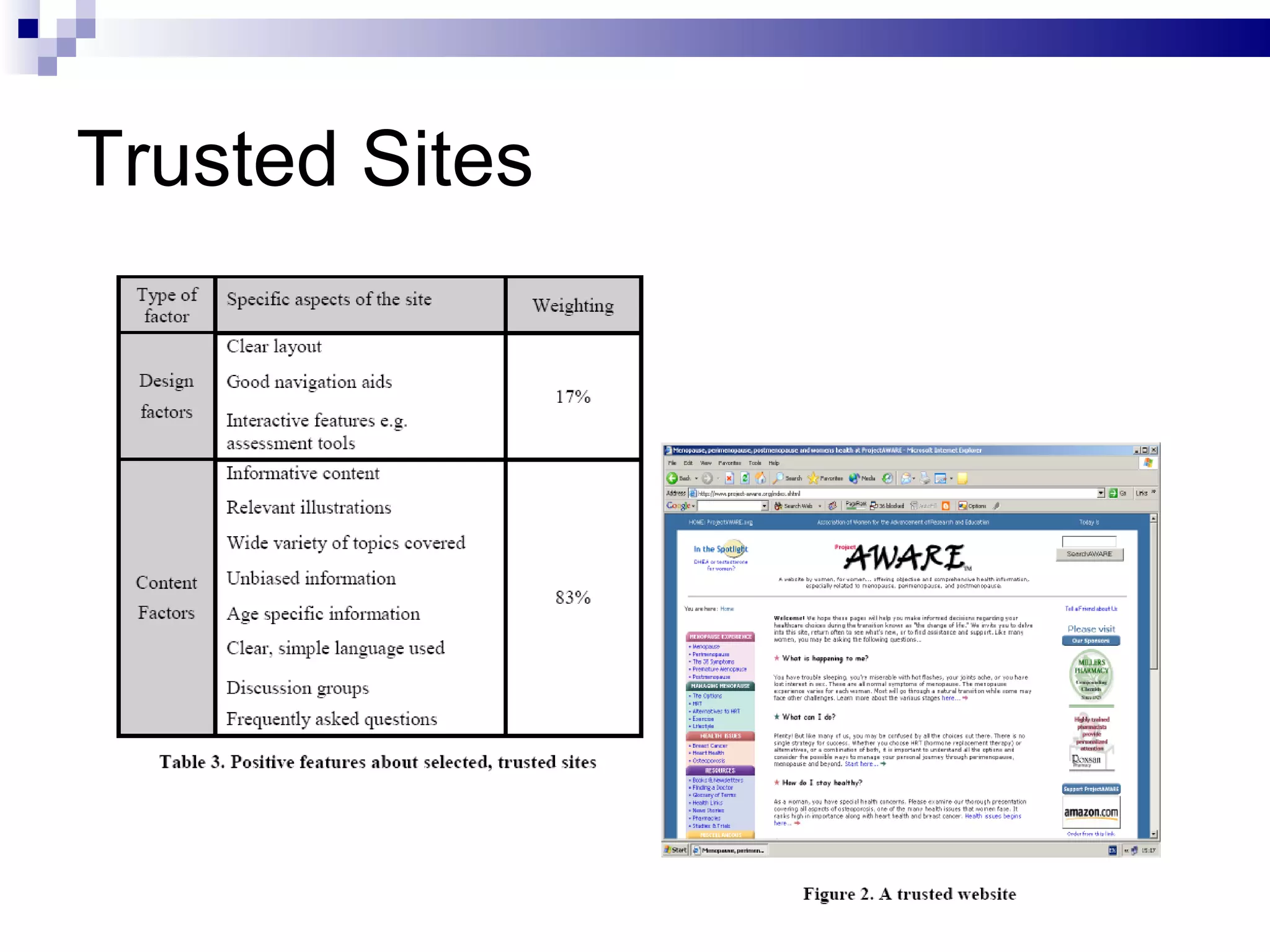
Trusted Sites
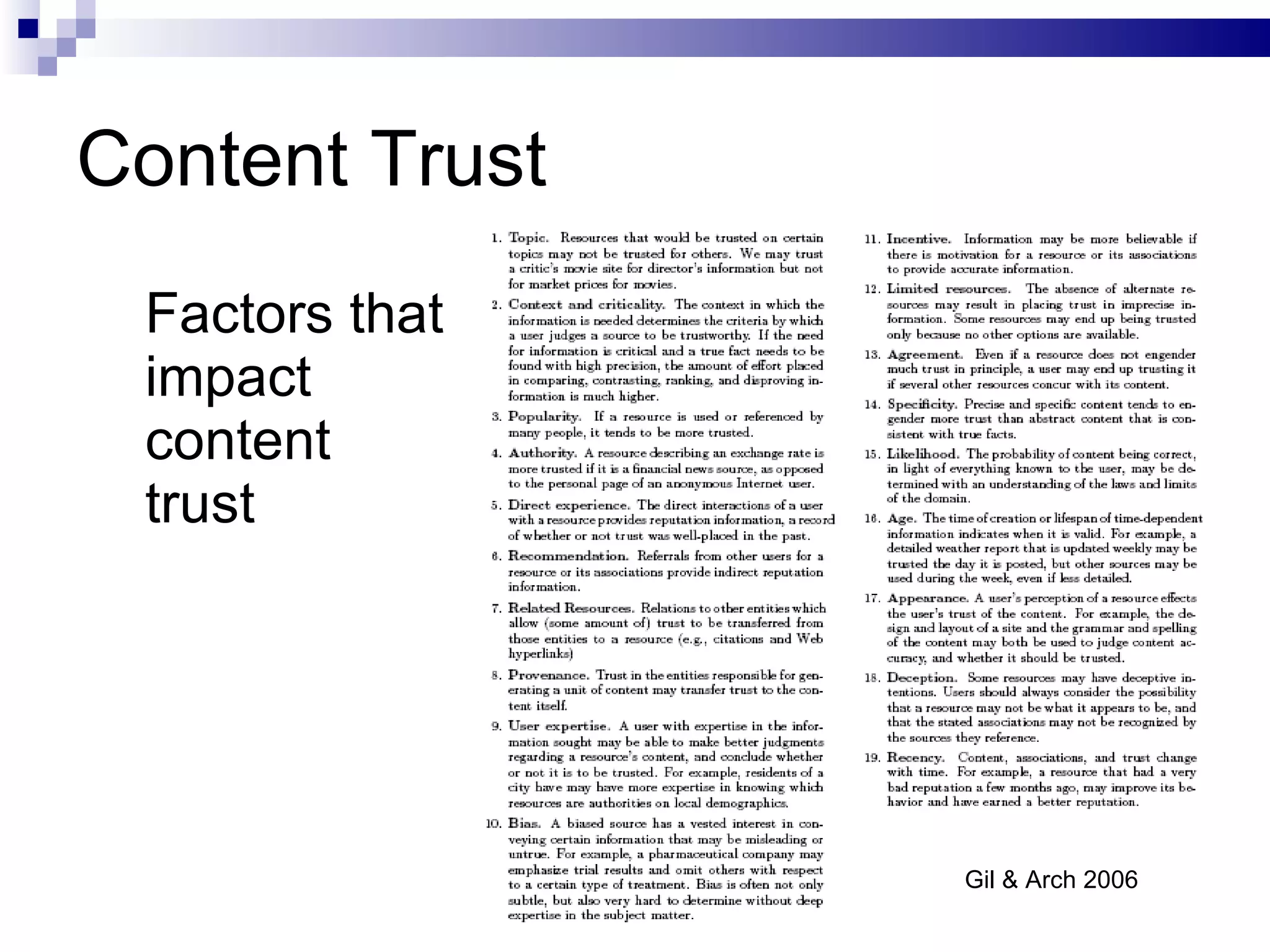
Content Trust Factors that impact content trust Gil & Arch 2006
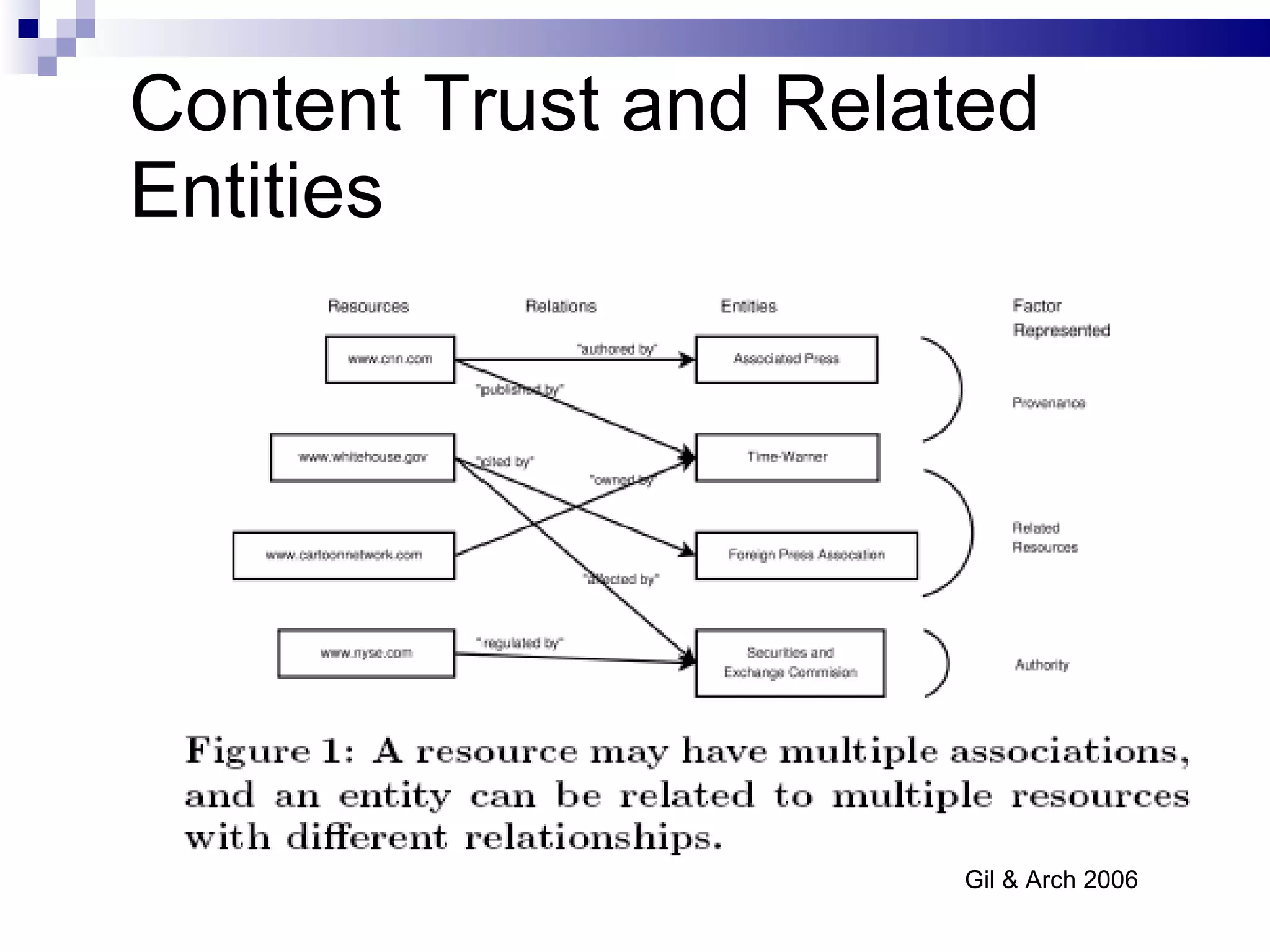
Content Trust and Related Entities Gil & Arch 2006
Reputation Systems Online Online interactions outside usual social constraints (disembodied) Identified behavior History of behavior over time Social context:  face-to-face increases normative behavior People *will* break trust if not held accountable/ prosocial norms not activated by presence of others Reputation History of past interactions informs current expectation of reciprocity or retaliation in future Accountability, trust
Reputation Systems  -- Key Components Long-lived entities that inspire expectation of future interaction Capture and distribution of feedback about current interactions Use of feedback to guide trust decisions Issues: Low incentive to provide feedback People reluctant to provide negative feedback Ensuring honest reports
Types of Ratings Implicit Ranking Time in system, frequency of visits, frequency of posts, etc Explicit Rating Weighted average, explicit rating of object of interest Collaborative filtering People with similar rating patterns rate this highly, so you will probably like Assumes high variability in preferences Peer-based Filter implicit/explicit ratings by relevance to self in network (e.g. friend of friend)
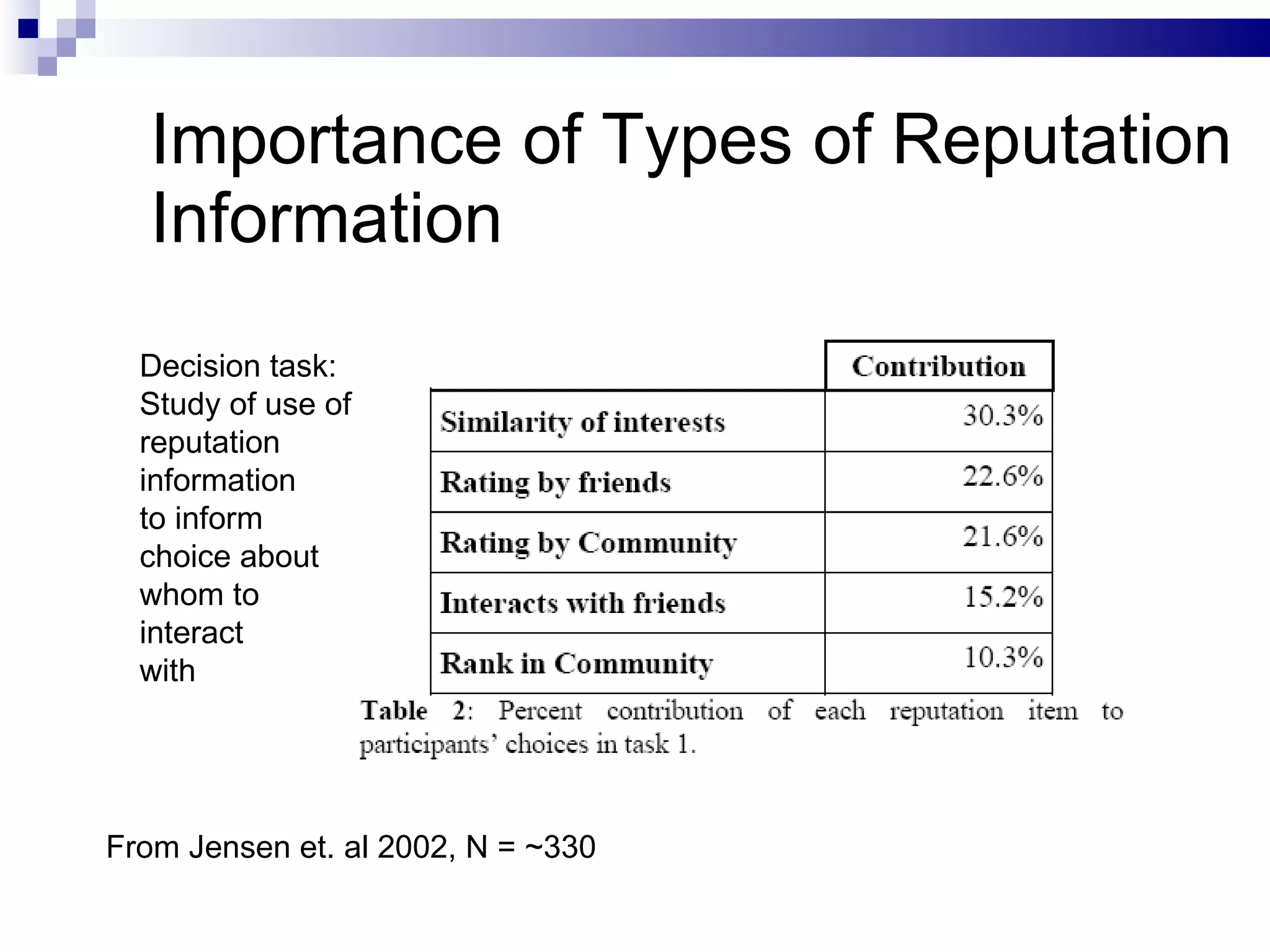
Importance of Types of Reputation Information From Jensen et. al 2002, N = ~330 Decision task: Study of use of reputation information to inform choice about whom to interact with
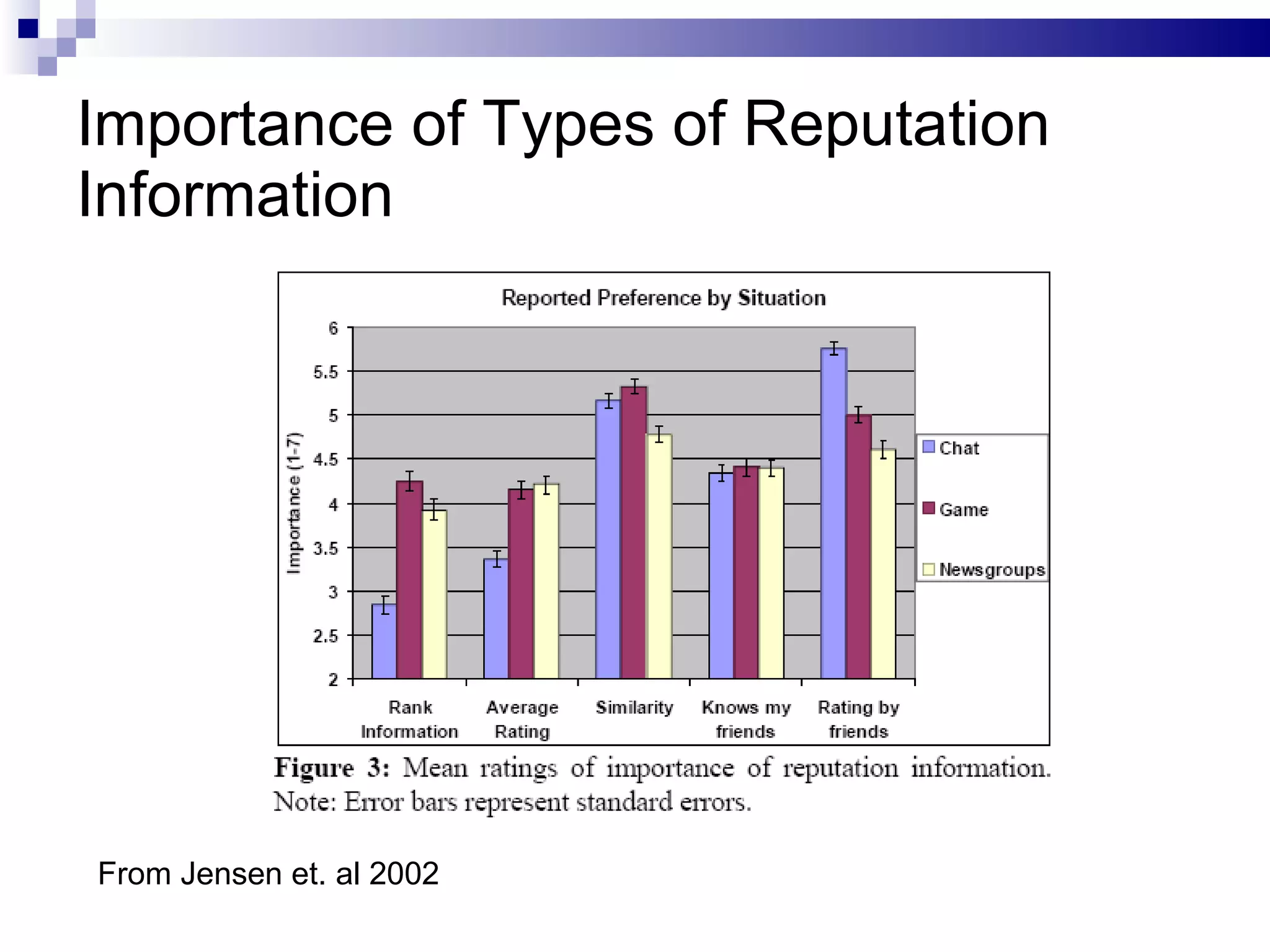
Importance of Types of Reputation Information From Jensen et. al 2002
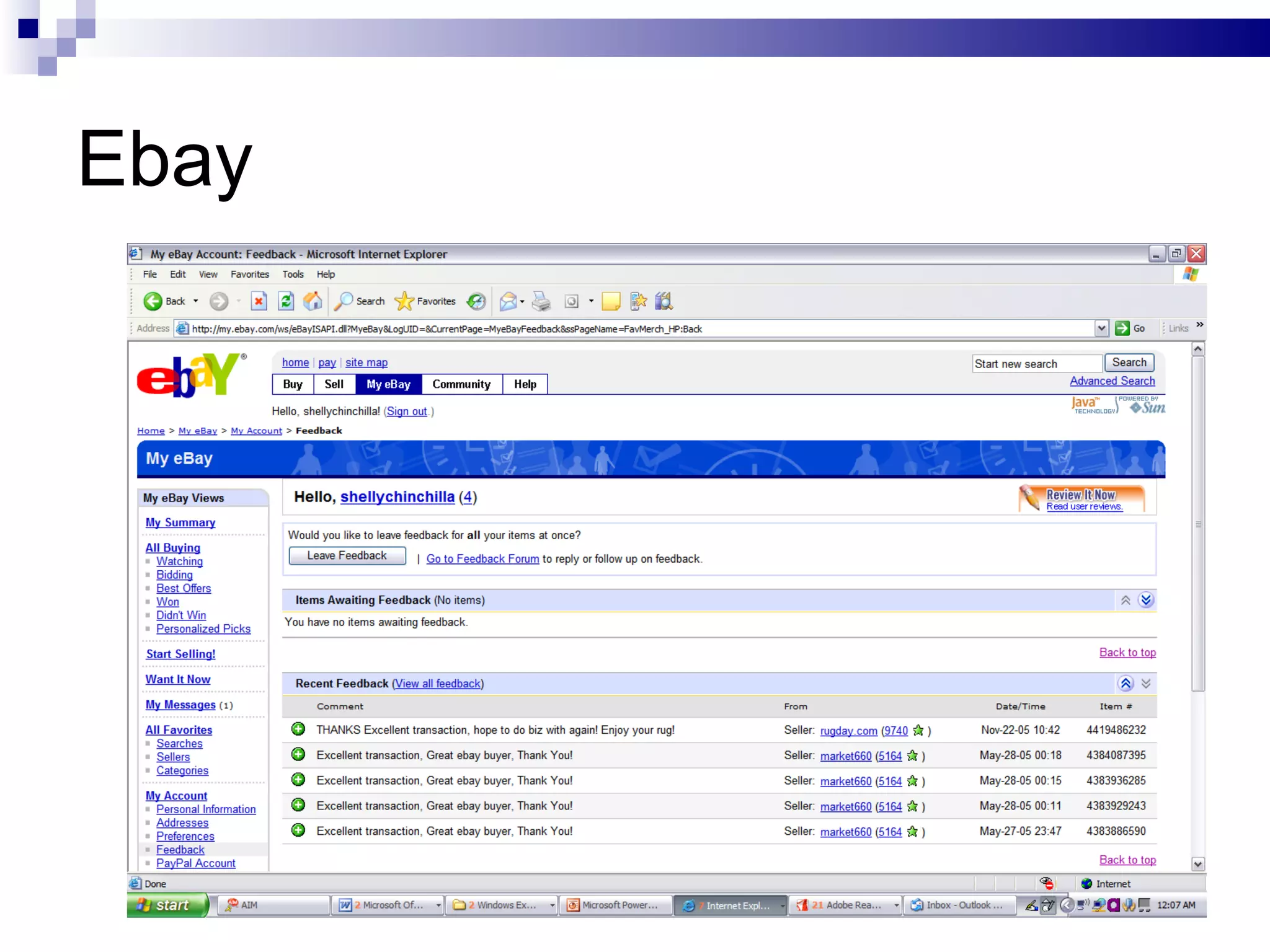
Ebay
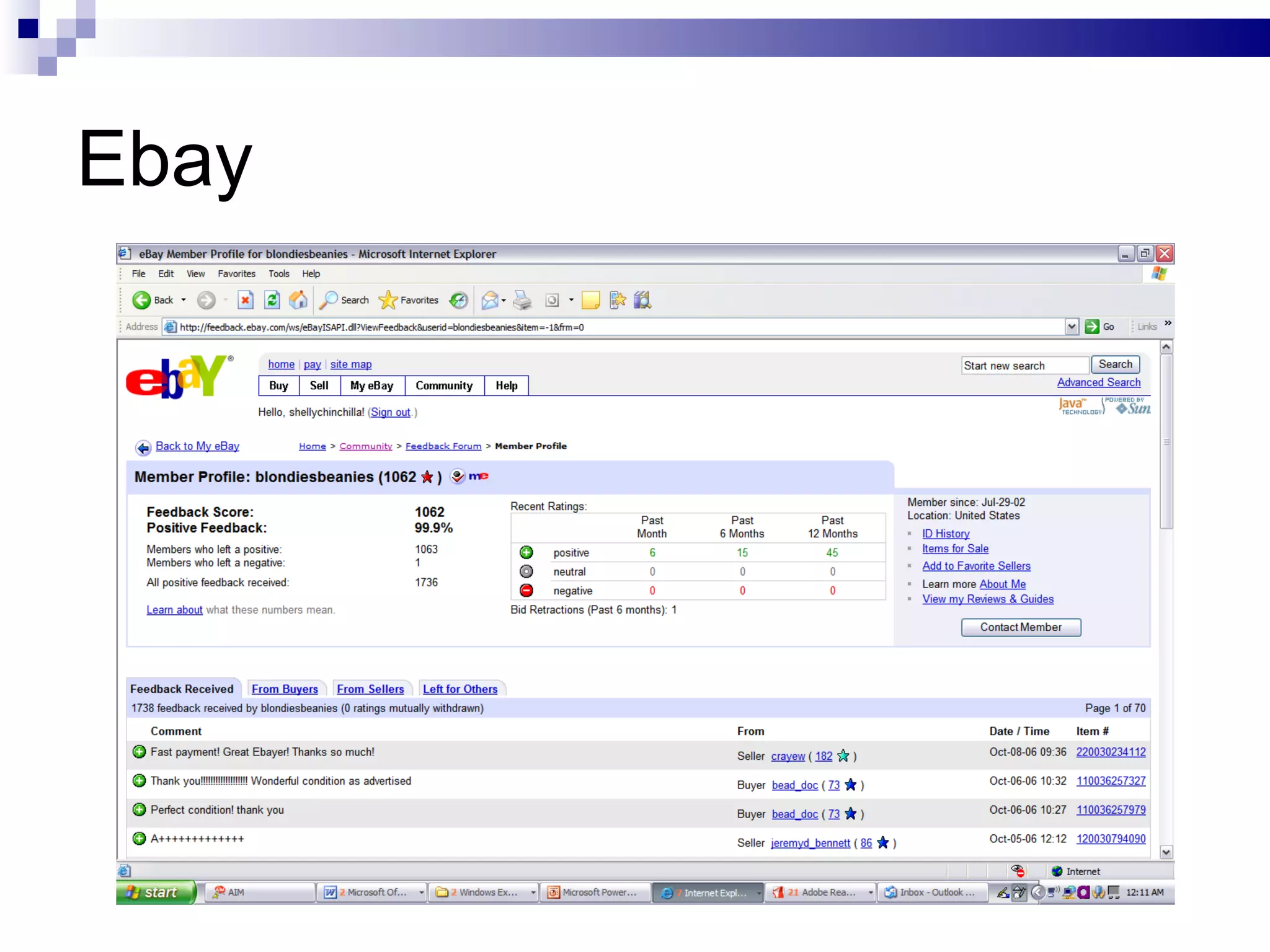
Ebay
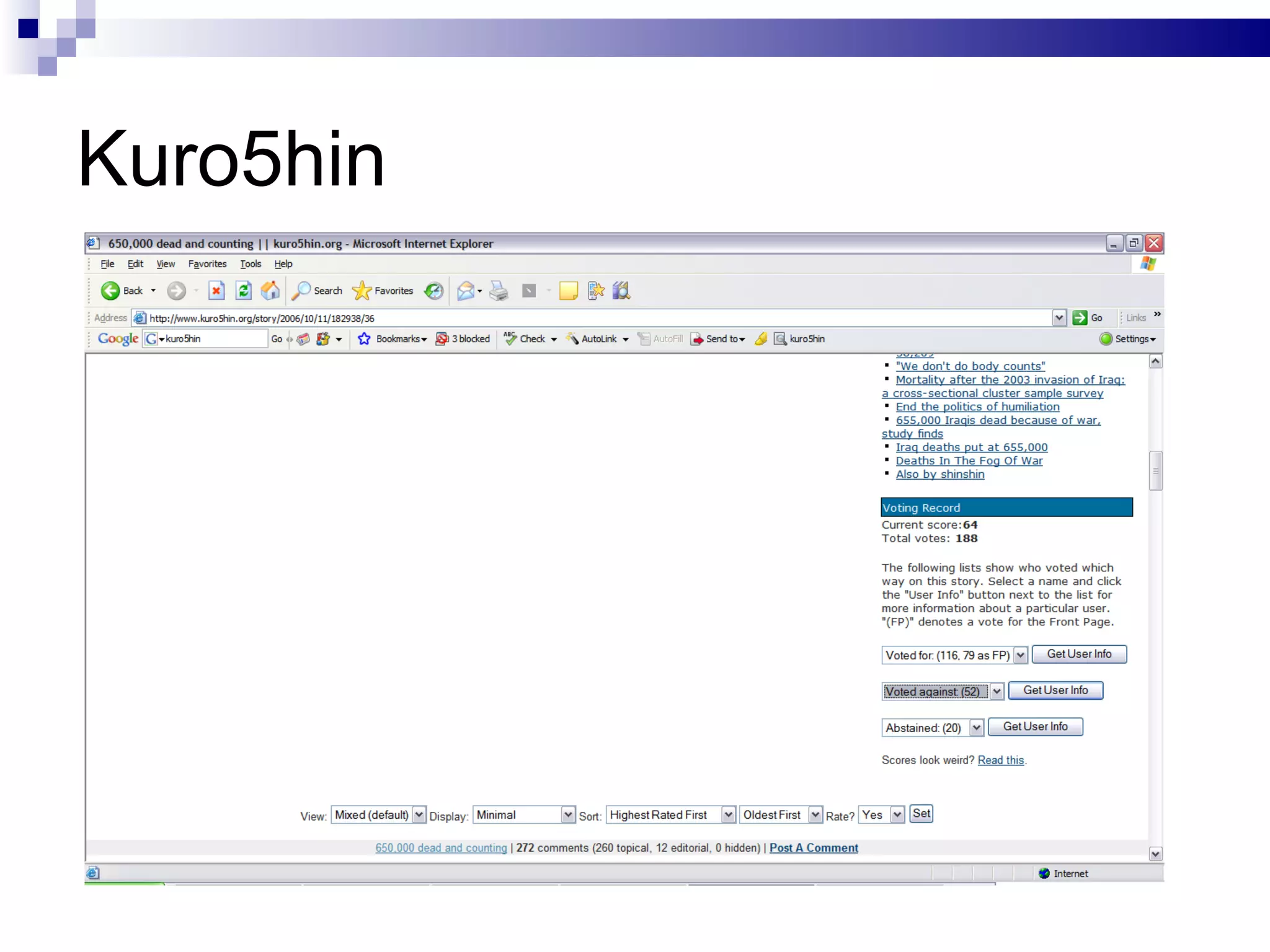
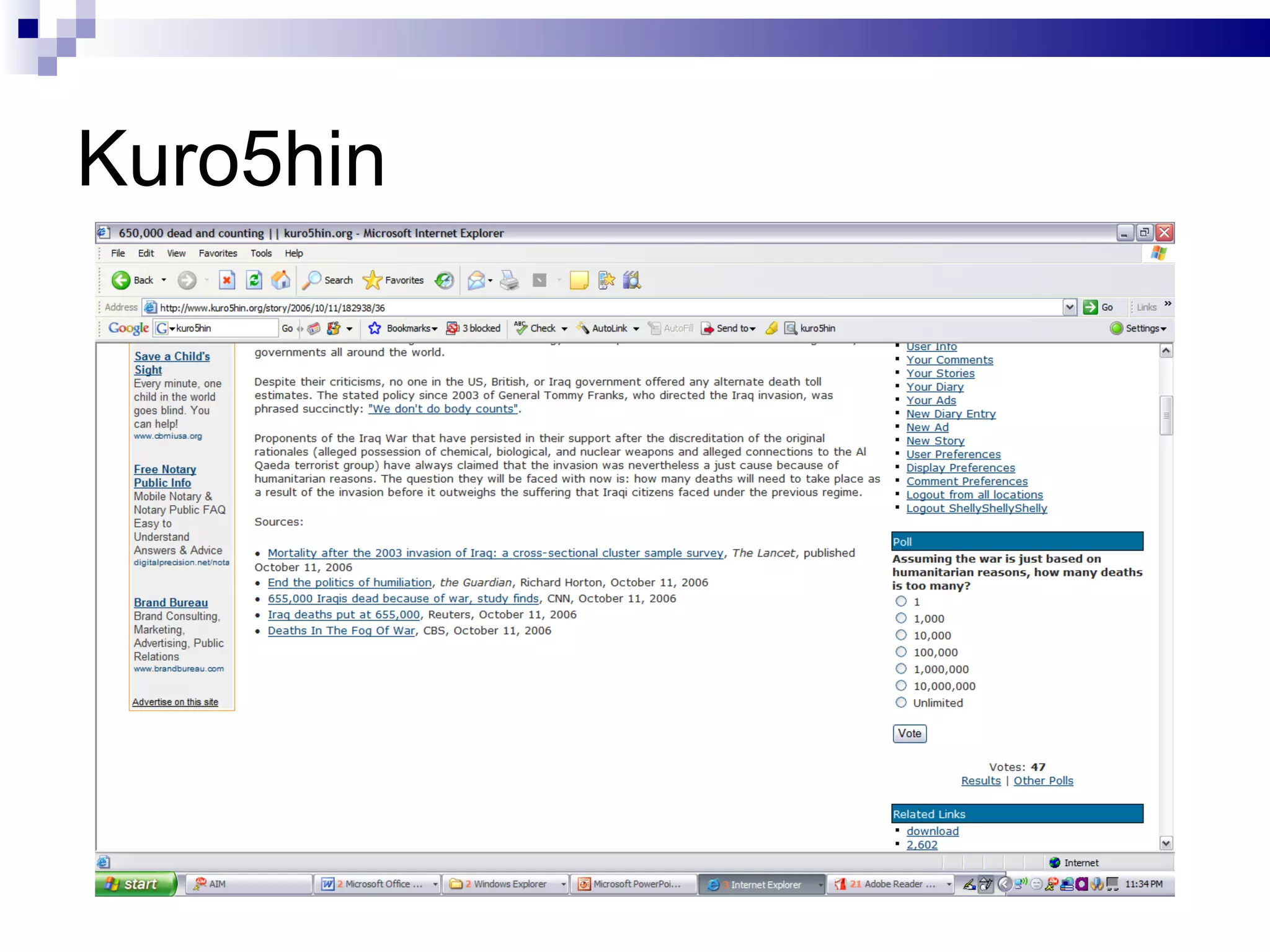
Kuro5hin
Kuro5hin
Kuro5hin
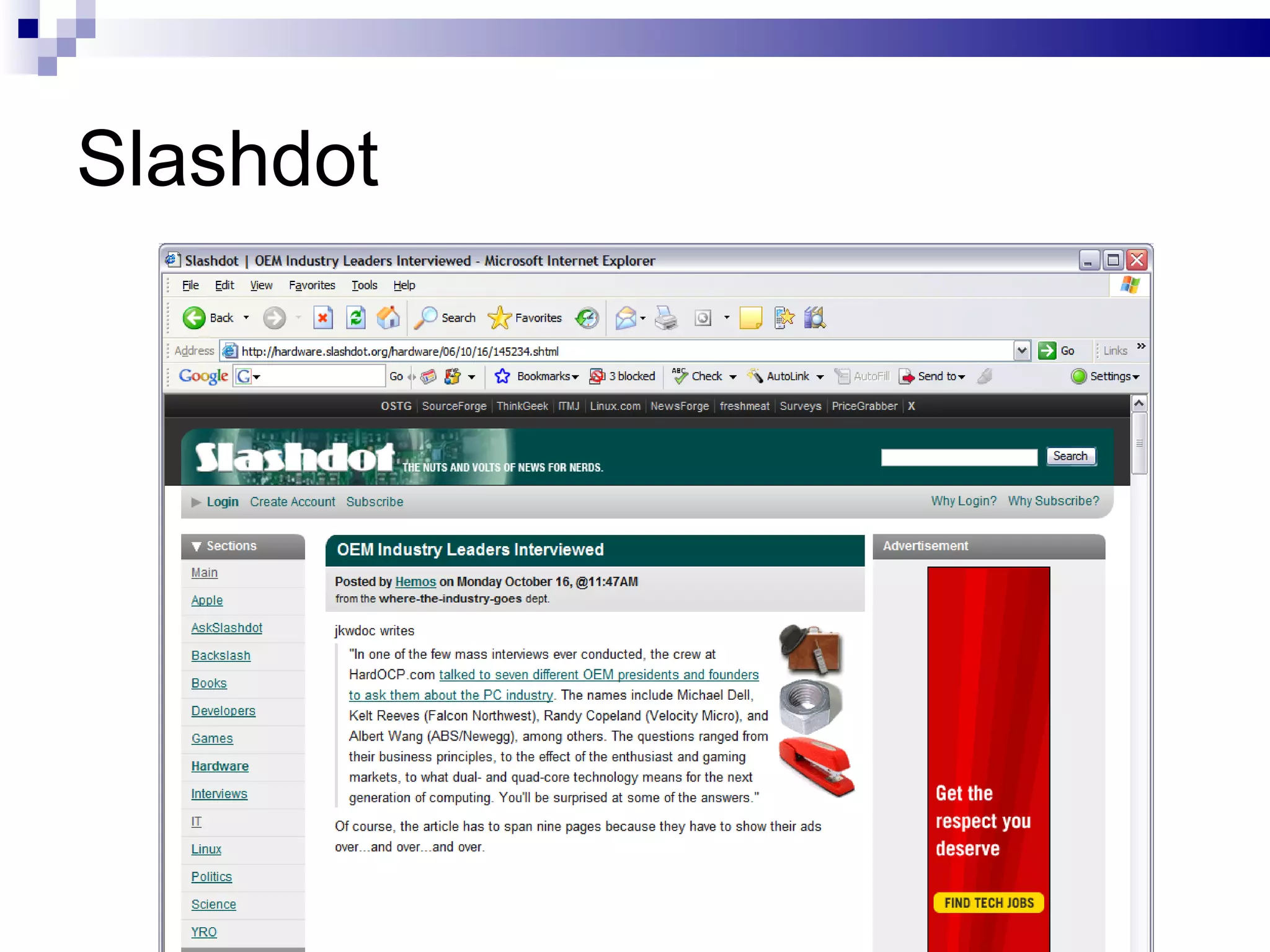
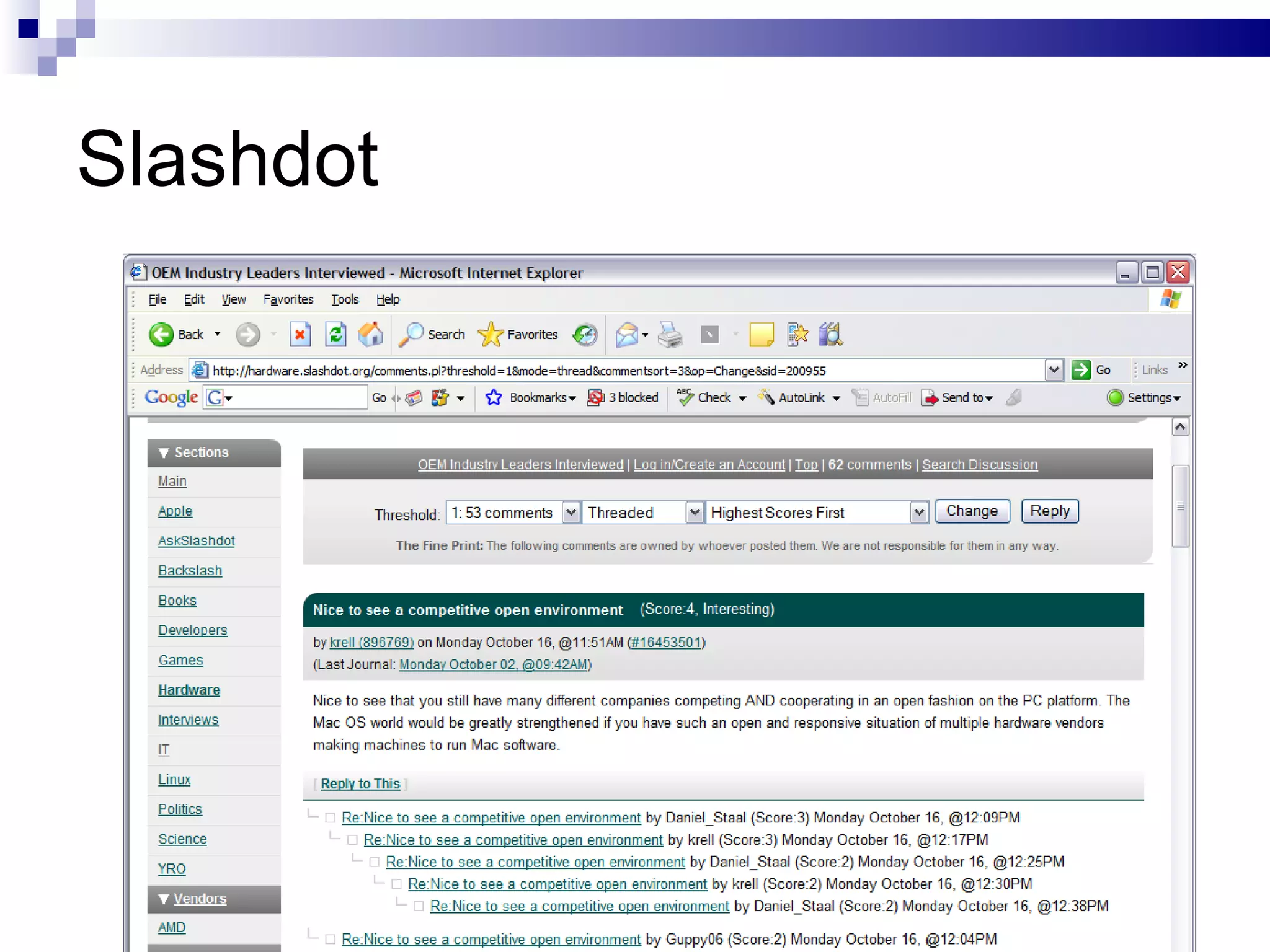
Slashdot
Slashdot
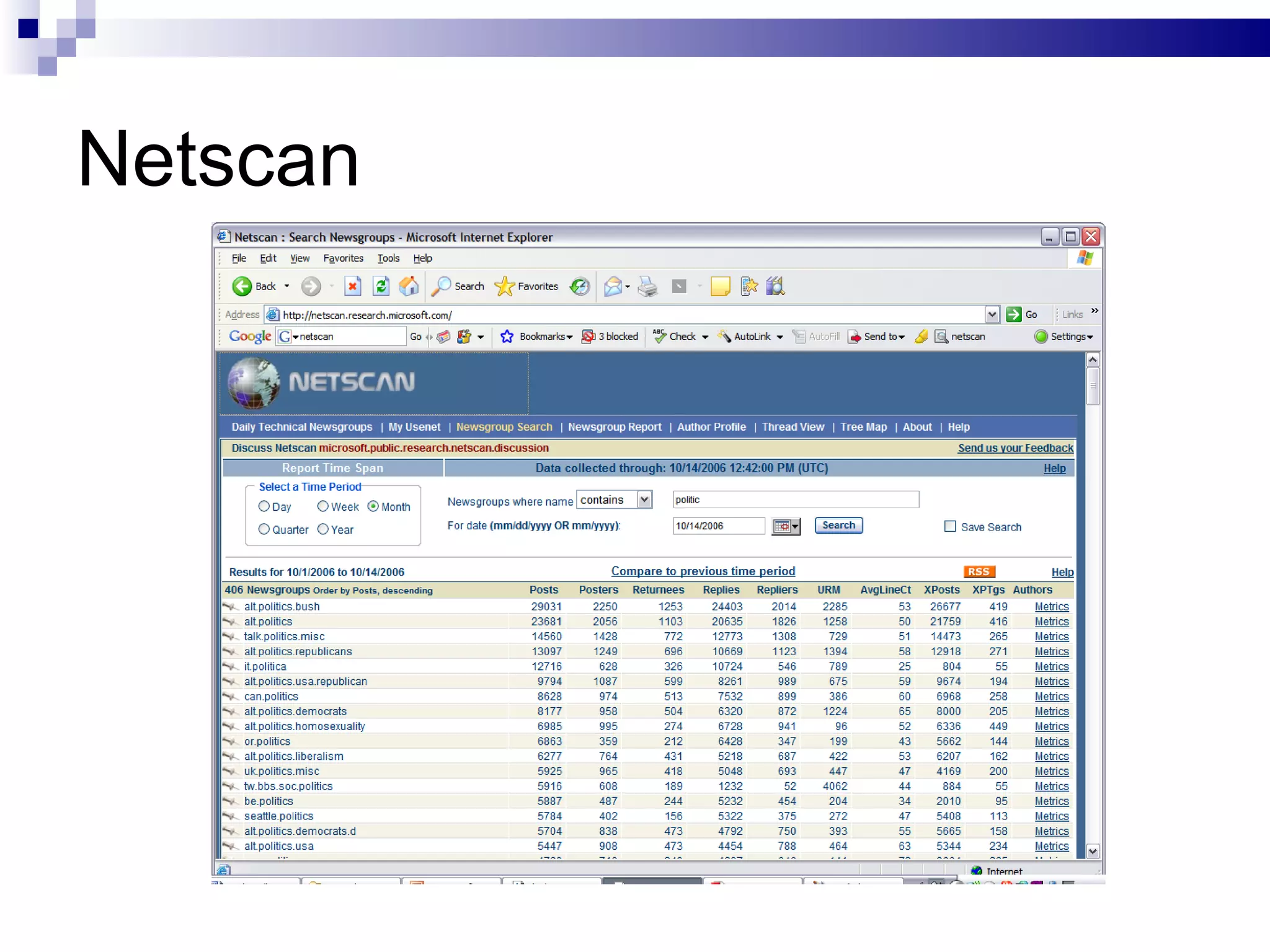
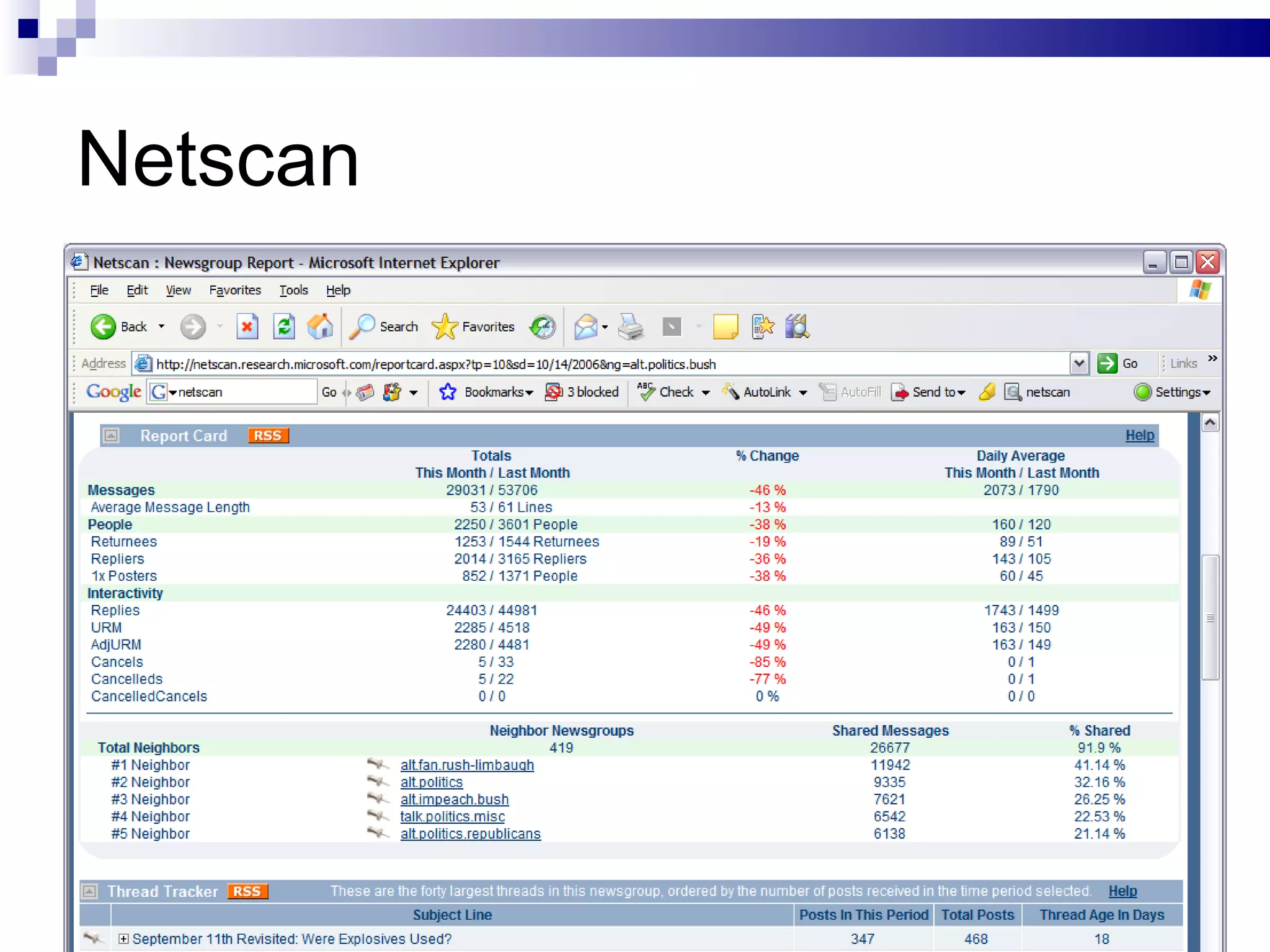
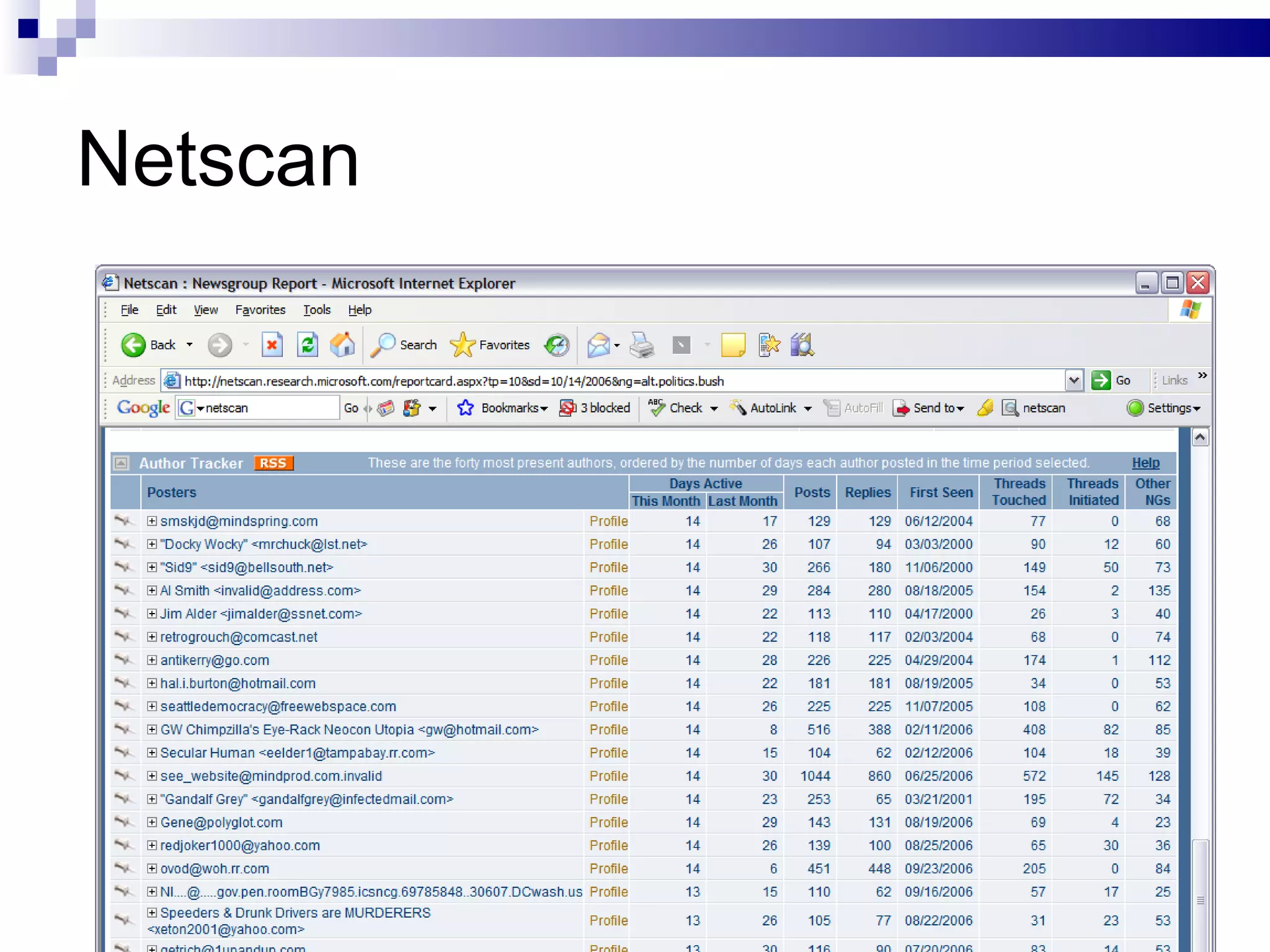
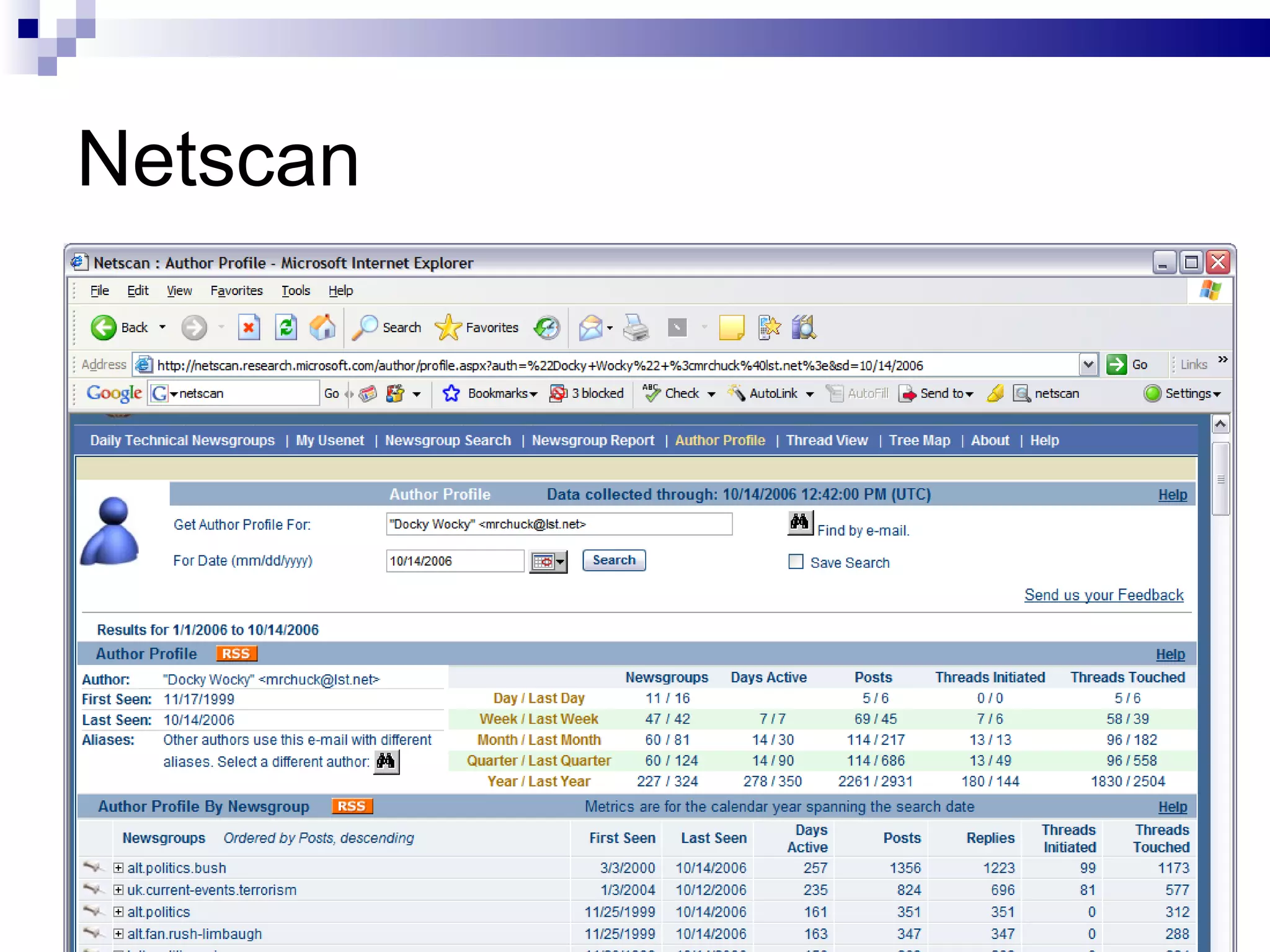
Netscan
Netscan
Netscan
Netscan
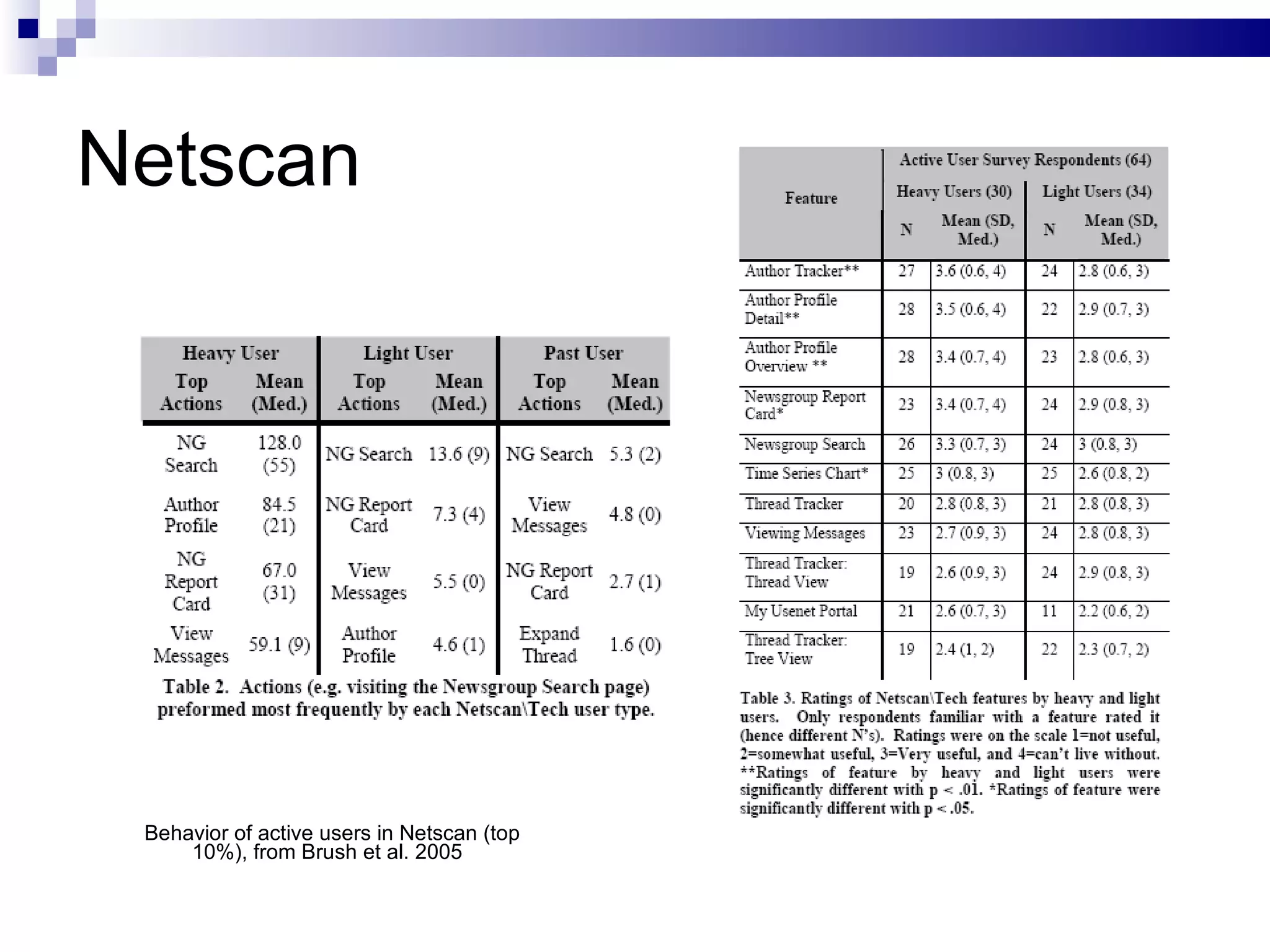
Netscan Behavior of active users in Netscan (top 10%), from Brush et al. 2005
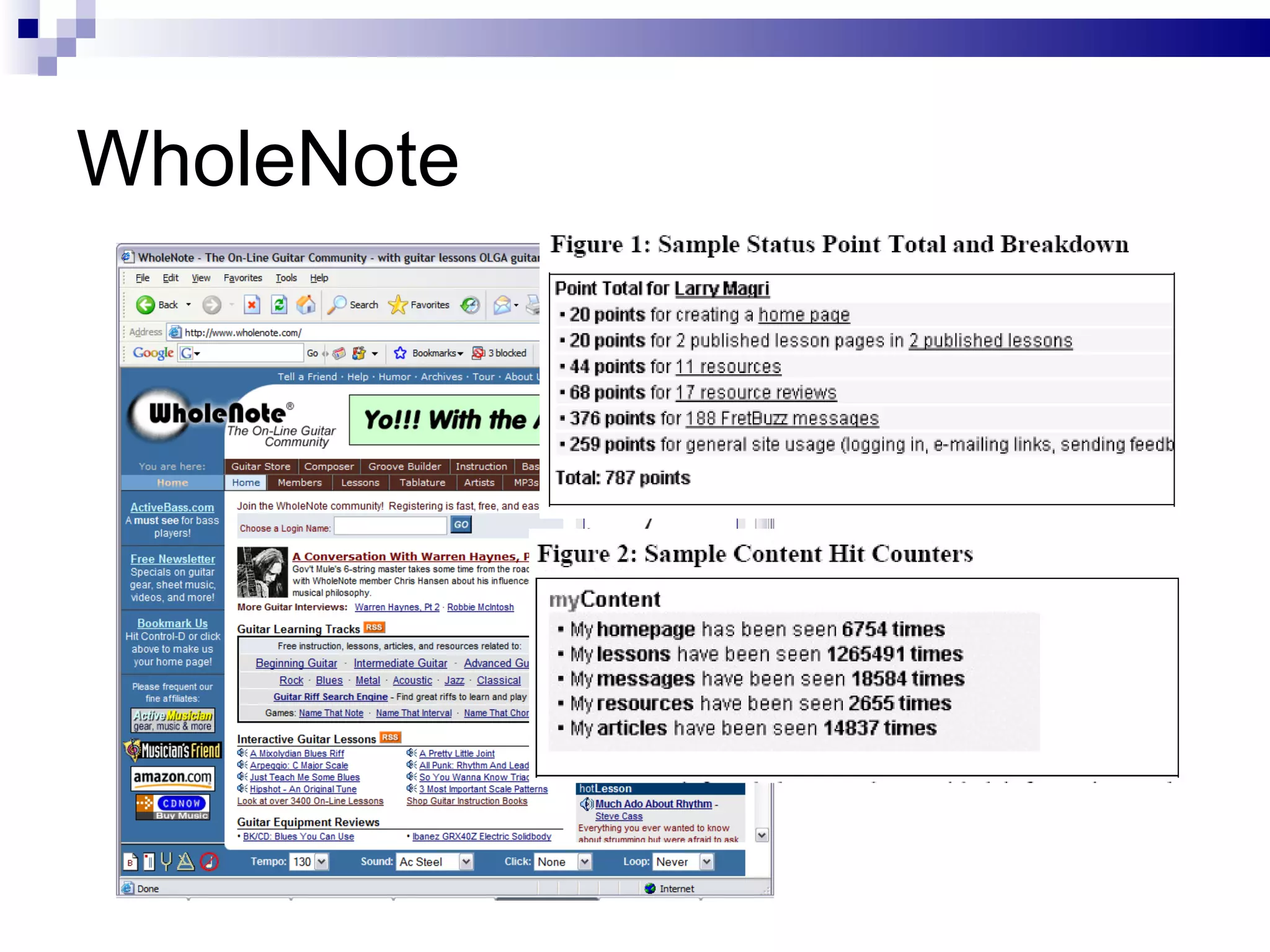
WholeNote
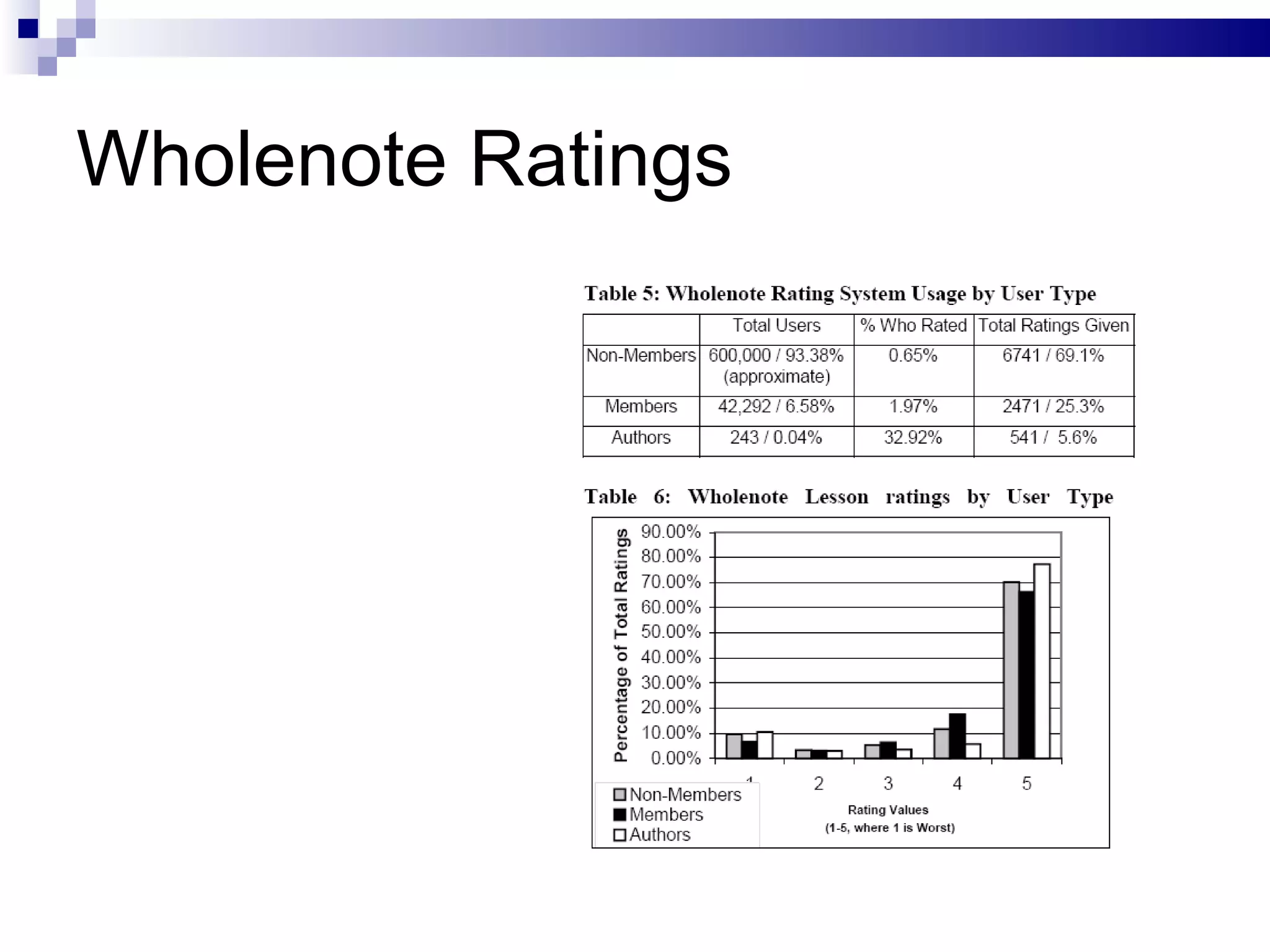
Wholenote Ratings
Design Implications “ Look and feel” matters, at-a-glance judgments impact continuing analysis Expose “related entities” around any content, with indicators of credibility Filter both content and reputation metrics by relevance to self -- emphasizing similarity Often reduced overall average ratings the more information is exposed (voice, picture, profile information): indication of increased discrimination between good/bad, relevant content Include both implicit and explicit ratings/rankings Expect explicit ratings to be positively biased, so “absence of positive” matters Ratings per hit rate for example meaningful Count of ratings overall Binary votes: e.g. “useful” or not Metrics at both level of content and level of author important Rate comments as well as content
Opportunities for Innovation Assessing a person’s/story’s reputation with “others like me” – localized reputation Under the hood assessment of “trustability” of raters, use to influence their influence on aggregate scores, search results Recency in system, deviance, phase of treatment, explicit ratings (ratings of raters) Use interaction history with content to normalize ratings % of positive ratings out of # of people read/hit vs. simple average Search results, able to change sort by: Overall ranking/ratings Ranking/rating in my network Similarity/relevance to me Date updated/posted Author
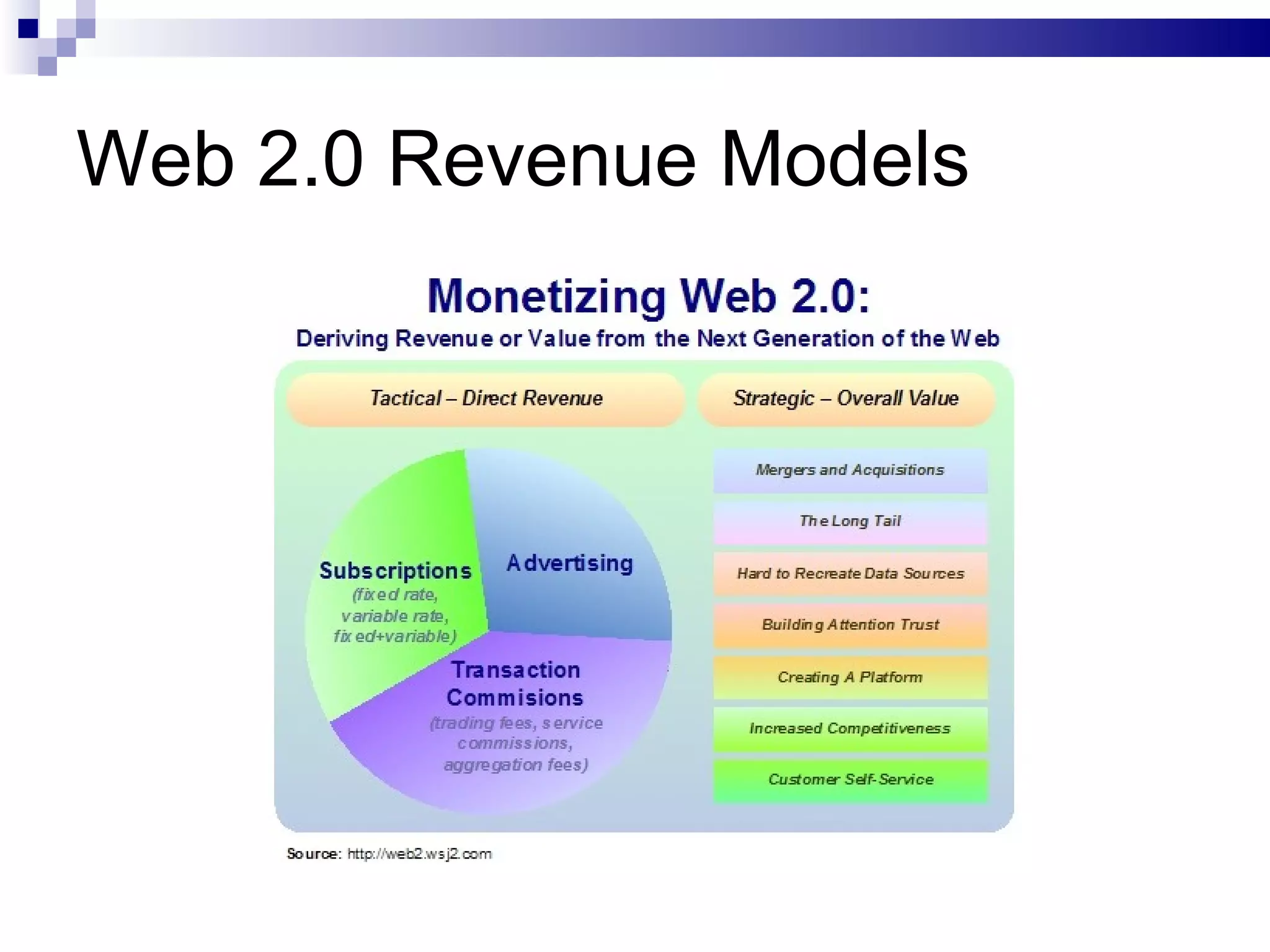
Web 2.0 Revenue Models
Mergers and Acquisitions Startups get purchased by larger organizations With minimal expenditure, create: Unique identity Hip attitude Attract a large user base
 
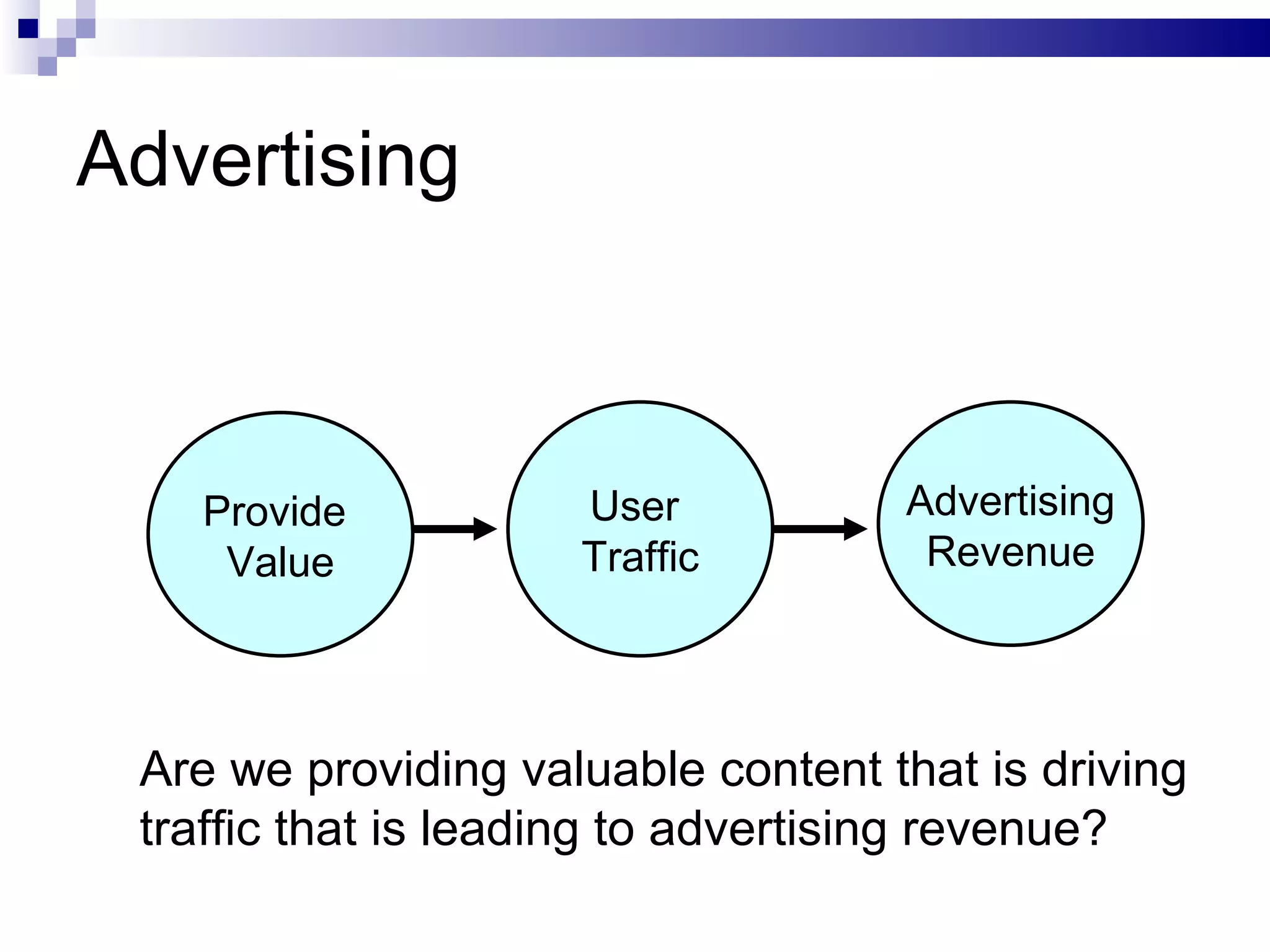
Advertising Provide  Value Advertising Revenue User  Traffic Are we providing valuable content that is driving traffic that is leading to advertising revenue?
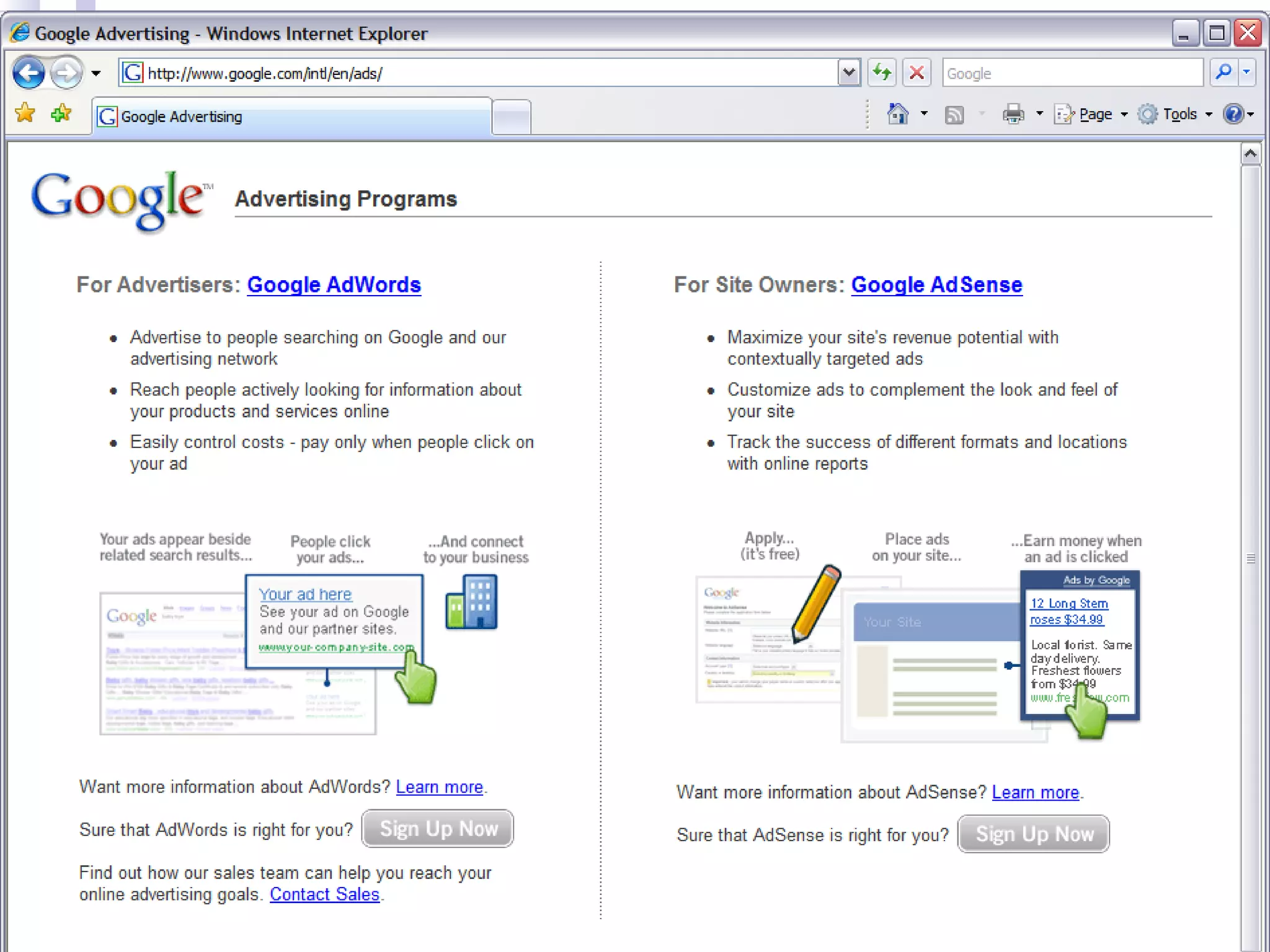
Google Analytics
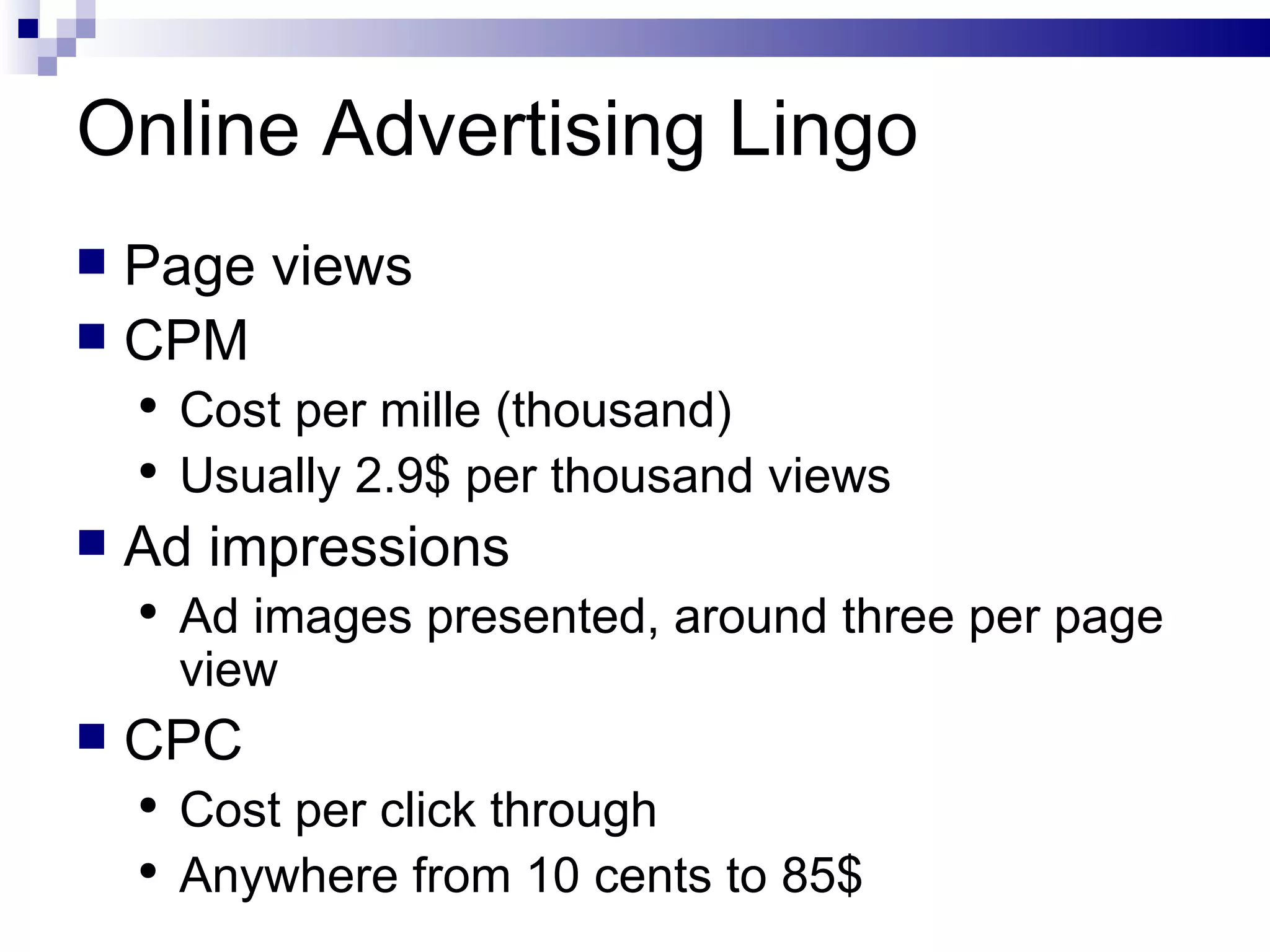
Online Advertising Lingo Page views CPM Cost per mille (thousand) Usually 2.9$ per thousand views Ad impressions Ad images presented, around three per page view CPC Cost per click through Anywhere from 10 cents to 85$
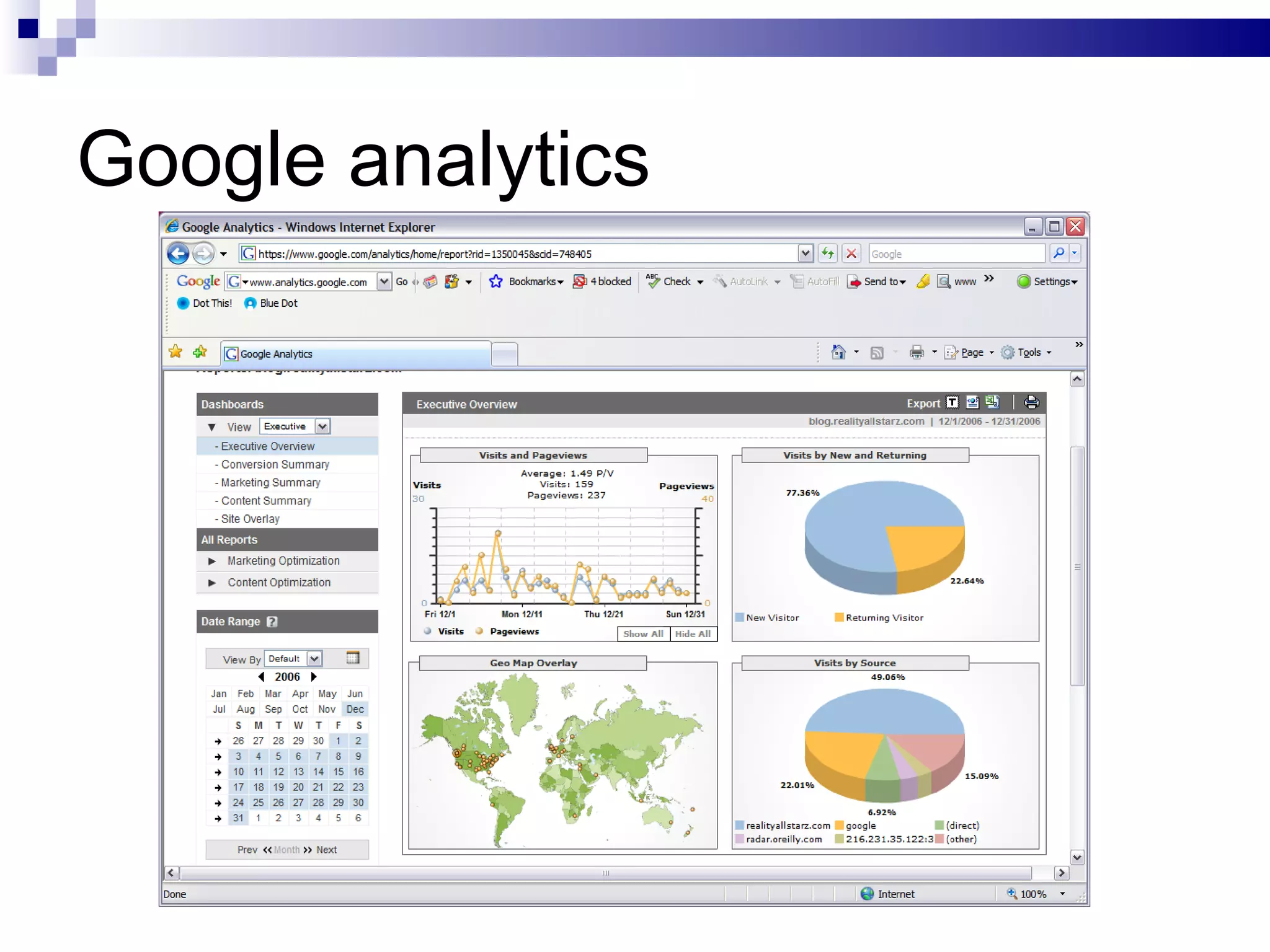
Google analytics
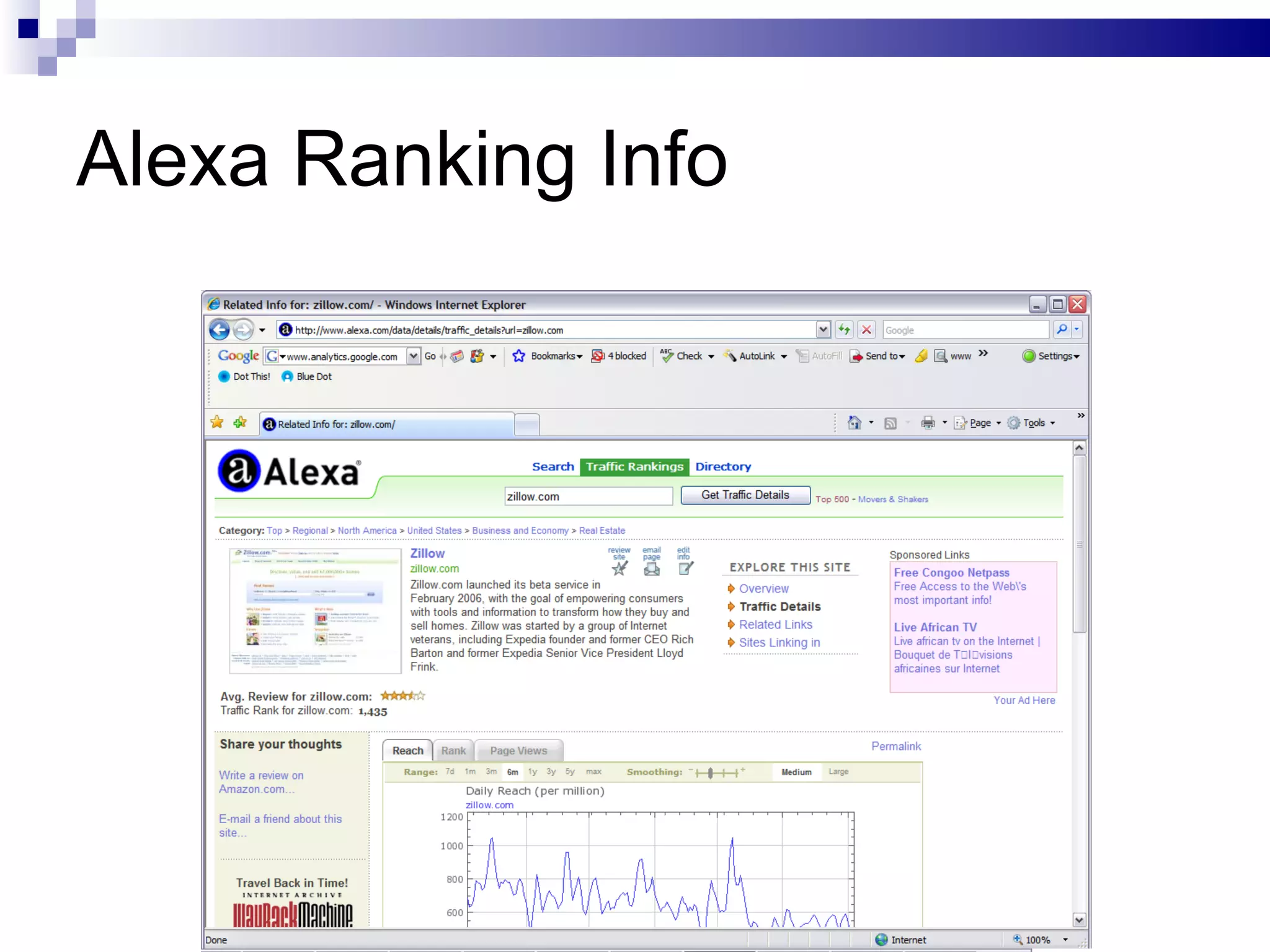
Alexa Ranking Info
Subscription Services Fixed rate Per user per month Variable rate Pay according to level of usage E.g. preferred membership subscriptions (LinkedIn, Biznik), special search and communication features Storage (photo sites, imageevents, ) Fixed plus variable
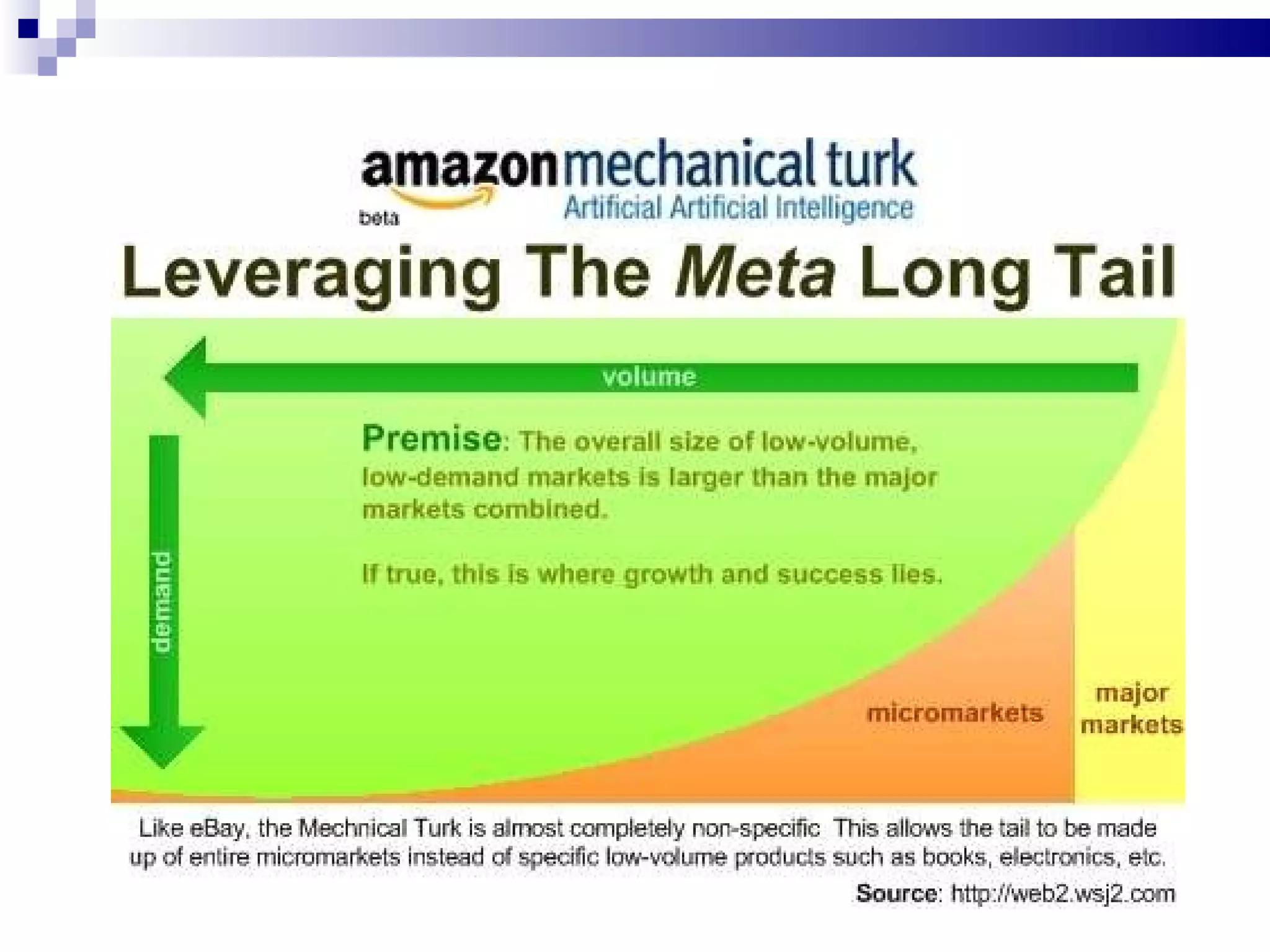
Transaction Commissions Trading fees Ebay auctions Paypal per transaction 2.9% + .30 Service commissions Amazon Mechanical Turk Biznik, % of fee for workshops Aggregation fees ITunes, $ goes to record industry, shave off % per transaction Zazzle/Café Press:  notion of base price: e.g. $8.99 for shirt, designer marks up over and keeps difference Artocracy: 25% of sale (each ~30$) for site
Successful Businesses Keeping market share, critical mass Patented techniques Google Hard to recreate data sources Copyrighted content ITunes, music & video library Secret formulae Google From:  http://web2.wsj2.com/making_web_20_commercially_successful.htm

Social Web 2.0 Class Week 5: Community, Reputation Systems

  • 1.
    Social Web 2.0Implications of Social Technologies for Digital Media Shelly Farnham, Ph.D. Com 597 Winter 2007
  • 2.
    Week 5 CommunityReputation Systems Web 2.0 Revenue Models
  • 3.
    Community "I define"community" as networks of interpersonal ties that provide sociability, support, information, a sense of belonging, and social identity.” Barry Wellman (2001). “ A group of people who share a common interest or purpose; who have the ability to get to know each other better over time. There are two pieces to that definition. That second piece — getting to know each other better over time — means that there needs to be some mechanism of identity and communication.” Amy Jo Kim (2001) “ 1) It is interactive and built on the concept of many-to-many communications ...; 2) It is designed to attract and retain community members who become more than superficially involved in community events ... and ... are able to make new friends through the community; 3) It has a single defining focus; ... (that) gives them a reason to return; 4) It provides services to community members, ... that meet community member needs; 5) It has, or has the potential to develop, a strong commercial element...“ From "Towntalk ," a listserv on online community
  • 4.
    Socio-Cultural Context Socialdissolution/individualism, lack of traditional community Bob Putnam, “Bowling Alone” Neo-tribalism Use of Internet to access people, coordinate
  • 5.
    Online Communities 84%of Internet users in U.S. participated in an online community 79% regularly with one particular group 26% to get in touch with local groups 2001 Pew
  • 6.
    Providing Value inTerms of User Goals Informational Learn about homes to facilitate buying, selling, and improving homes. Value expression Express my identity around homes. I like my house. Where I live expresses something about me. I like my agent, and I like my neighborhood. Social Capitol -- Developing relationships I can leverage later Learn about, get referrals to, and meet people related to homes (consumers, agents, neighbors, other vendors). Make friends/friendly acquaintances, find similar others, be liked, have a respected reputation, be part of a group. Collective action Find people with similar interests and organize into groups that can take action around the group’s agenda. (e.g., neighborhood watch.) Other Entertainment: have fun Self-efficacy/mastery
  • 7.
    Providing Value throughCommunity Providing value through access to people. Common purpose, Identity, Interactivity User Traffic Social Capitol
  • 8.
    Why Community Online?Weak ties, specialized knowledge or circumstances Need sense of shared understanding/frustration Similar others hard to find face to face Continuous support Sometimes face to face people not in similar situation get bored with your preoccupation, or just not available all the time Geographical isolation Decreased mobility increased use for types of problems that impact mobility e.g. knee surgery Social stigmatization
  • 9.
  • 10.
    The Importance ofPlace Places – specific locations in space that provide an anchor and a meaning to who we are. Orem & Chen, 2003 Proximity primary determinant of liking, through repeated exposure and opportunities for interaction. Social Psychology The great good place, neighborhood hangouts and haunts key to development of community. Enabling serendipitous interactions. Ray Oldenburg, 1989 “ Eyes on the street.” Urban planner advocating dense, mixed-use neighborhoods, fostering vibrant urban community and increased security. Jacobs, 1961
  • 11.
    A Sense ofPlace Personal identity Community Past and future Being at home “ Place is a special and unique location…notable for the fact that the regular activities of human beings occur there. Moreover, because it is a site of such activities, and all which they entail, it may furnish the basis for our sense of identity, as human beings, as well as for our sense of connection to other human beings, in other words, our sense of community. Place, in other words, is that special site, or sites, in space where people live and work, and where, therefore, they are likely to form intimate and enduring connections.” Orum & Chen p. 15.
  • 12.
  • 13.
    Netville Study --Enabling Neighboring through Technology If neighborhood given the opportunity to interact/exchange information on the Internet, are they more like to develop neighborhood ties? Provided high speed internet to 64 out of 109 neighboring homes, two years 1996-1998, with neighborhood email list Hampton & Wellman, City and Communication: 2:4 December 2003
  • 14.
    Netville Study ResultsMore likely to: know each others’ name, talk on a regular basis, visit each other Reported familiarity online facilitated meeting face to face Block parties, community gatherings Collective action against the developer Barry Wellman, Communications of the ACM, 2005, 45, 5. p. 94
  • 15.
    What did theytalk about? Discuss interests of common concern (home construction) Requests for help or advise (e.g. recommendation for a local doctor) Advertise garage sales, local crafts/services Invitations to community events Messages offering such things as job info
  • 16.
    Increased “Eyes onthe Street” Exchange greetings See what is happening Keep watchful eye on children’s activities
  • 17.
    2001 MSN CommunitiesAnalysis What are people using discussion groups for?
  • 18.
    2001 MSN CommunitiesAnalysis How does type of group impact measures of health?
  • 19.
    Online Support CommunitiesInformation flow, exchange, storytelling Group problem solving, insights Trusted sources Decrease worry, anxiety, depression Health: Improve patient compliance with treatment Info seeking improve decision-making go to doctor able to talk intelligently about problems, have language for it etc. assess quality of their care From Maloney-Krichmar & Preece, In Kneeboard, informational vs. emotional support: giving info (33.5%), opinions (17.4%), suggestions (7.3%), socio-emotional (25.8%)
  • 20.
    Online Community GeneralConcerns Access Ease of use Fragmentation Authentication/accountability Commercialism and privacy Safety and security Bad behavior in online spaces Misappropriation of personal info Misinformation
  • 21.
  • 22.
    Online Community DesignGroup vs. network form of association Sense of boundary, you are a member or not Need for active communication Message board/mailing list Commenting Possible gradation from broadcast to one on one, public to private Narrow focus vs. broad Tend to succeed with dense groups of similar others Orient similar people around central location (FAQ/wiki/discussion board for each health issue) Light moderation/hosting of spaces Enabling transition from newbie to mentor Passing on “host” role Awareness through activity metrics Time in space Message activity # of stories/lessons posted
  • 23.
    Designing for SociabilityClearly articulated shared purpose Governence, protocols, rituals People Roles Moderators Experts Lurkers Approx 1% leaders, 19% participate, 80% lurkers Size Critical mass: number of people needed to make a community useful Too few not enough, too many overwhelmed Discussion groups: 25 active participants take up all the air
  • 24.
    Fostering cooperation Socialdilemma/tragedy of the commons Individual gain vs. collective good Increasing cooperation Will meet again Identification of behavior Record of past behavior
  • 25.
    Discovery/Entry Points Searchgoogle Search in system by topic and by person: important to find similar others Search/show relevant demo factors (SES indicators through job, college…) Related interests Entry through invitation to join Invite friends/family/cohorts to view stories etc. Link off of other community sites Banner ads
  • 26.
    Discovery/Entry Points Importanceof First Impressions Need to see there is social interaction (social translucence) exchange/reciprocity shows interpersonal trust Shadows of social behavior: X members, amount recent activity, new story posts, best story Site trust building: Post self-regulating policies Privacy and security Editorial and advertising Source disclosure Third party seal Branding
  • 27.
    Communities as interventionThe minimal “intervention”: Define community boundaries Tapping into personal identity, social identity Enable conversation Assessment: Measure community growth, participation Impact on neighborhood
  • 28.
    Measuring Healthy CommunityHealth = Function ((presence, content creation, interactivity) * recency * longevity) User presence: Many active people in neighborhood Recency Longevity in system Content creation: Daily posts/comments/tags Rich customization of profiles Interactivity: Visiting a lot of other people’s pages Long discussion threads
  • 29.
    Instrumentation for SocialMetadata Treat each behavior as unit of use and record User UserBehavior Timestamp BehaviorContext BehaviorDetails Aggregate info for sorting etc. Always retain original data for later analysis/algorithm development
  • 30.
  • 31.
    Trust A psychologicalstate comprising the intention to accept vulnerability based upon positive expectation of the intentions or behavior of another Process-based (past history of interaction) Character-based (social similarity) Institution-based Entity (person, agent) vs content trust Transitivity Trust in performance (less so) Trust in belief (more so)
  • 32.
    Stages of Trustin Site Preliminary assessment (heuristic, affective) Look and feel of site Branding, familiar, trusted logos etc. In-depth evaluation of information (analytic) Quality of information Personalization of advice, given by similar others Long-term relationship with site From Sillence et al. 2004
  • 33.
    Trust in WebSites Study Study of 2684 participants examining100 sites, making credibility evaluations Fogg et al. 2003
  • 34.
  • 35.
    Content Trust Factorsthat impact content trust Gil & Arch 2006
  • 36.
    Content Trust andRelated Entities Gil & Arch 2006
  • 37.
    Reputation Systems OnlineOnline interactions outside usual social constraints (disembodied) Identified behavior History of behavior over time Social context: face-to-face increases normative behavior People *will* break trust if not held accountable/ prosocial norms not activated by presence of others Reputation History of past interactions informs current expectation of reciprocity or retaliation in future Accountability, trust
  • 38.
    Reputation Systems -- Key Components Long-lived entities that inspire expectation of future interaction Capture and distribution of feedback about current interactions Use of feedback to guide trust decisions Issues: Low incentive to provide feedback People reluctant to provide negative feedback Ensuring honest reports
  • 39.
    Types of RatingsImplicit Ranking Time in system, frequency of visits, frequency of posts, etc Explicit Rating Weighted average, explicit rating of object of interest Collaborative filtering People with similar rating patterns rate this highly, so you will probably like Assumes high variability in preferences Peer-based Filter implicit/explicit ratings by relevance to self in network (e.g. friend of friend)
  • 40.
    Importance of Typesof Reputation Information From Jensen et. al 2002, N = ~330 Decision task: Study of use of reputation information to inform choice about whom to interact with
  • 41.
    Importance of Typesof Reputation Information From Jensen et. al 2002
  • 42.
  • 43.
  • 44.
  • 45.
  • 46.
  • 47.
  • 48.
  • 49.
  • 50.
  • 51.
  • 52.
  • 53.
    Netscan Behavior ofactive users in Netscan (top 10%), from Brush et al. 2005
  • 54.
  • 55.
  • 56.
    Design Implications “Look and feel” matters, at-a-glance judgments impact continuing analysis Expose “related entities” around any content, with indicators of credibility Filter both content and reputation metrics by relevance to self -- emphasizing similarity Often reduced overall average ratings the more information is exposed (voice, picture, profile information): indication of increased discrimination between good/bad, relevant content Include both implicit and explicit ratings/rankings Expect explicit ratings to be positively biased, so “absence of positive” matters Ratings per hit rate for example meaningful Count of ratings overall Binary votes: e.g. “useful” or not Metrics at both level of content and level of author important Rate comments as well as content
  • 57.
    Opportunities for InnovationAssessing a person’s/story’s reputation with “others like me” – localized reputation Under the hood assessment of “trustability” of raters, use to influence their influence on aggregate scores, search results Recency in system, deviance, phase of treatment, explicit ratings (ratings of raters) Use interaction history with content to normalize ratings % of positive ratings out of # of people read/hit vs. simple average Search results, able to change sort by: Overall ranking/ratings Ranking/rating in my network Similarity/relevance to me Date updated/posted Author
  • 58.
  • 59.
    Mergers and AcquisitionsStartups get purchased by larger organizations With minimal expenditure, create: Unique identity Hip attitude Attract a large user base
  • 60.
  • 61.
    Advertising Provide Value Advertising Revenue User Traffic Are we providing valuable content that is driving traffic that is leading to advertising revenue?
  • 62.
  • 63.
    Online Advertising LingoPage views CPM Cost per mille (thousand) Usually 2.9$ per thousand views Ad impressions Ad images presented, around three per page view CPC Cost per click through Anywhere from 10 cents to 85$
  • 64.
  • 65.
  • 66.
    Subscription Services Fixedrate Per user per month Variable rate Pay according to level of usage E.g. preferred membership subscriptions (LinkedIn, Biznik), special search and communication features Storage (photo sites, imageevents, ) Fixed plus variable
  • 67.
    Transaction Commissions Tradingfees Ebay auctions Paypal per transaction 2.9% + .30 Service commissions Amazon Mechanical Turk Biznik, % of fee for workshops Aggregation fees ITunes, $ goes to record industry, shave off % per transaction Zazzle/Café Press: notion of base price: e.g. $8.99 for shirt, designer marks up over and keeps difference Artocracy: 25% of sale (each ~30$) for site
  • 68.
    Successful Businesses Keepingmarket share, critical mass Patented techniques Google Hard to recreate data sources Copyrighted content ITunes, music & video library Secret formulae Google From: http://web2.wsj2.com/making_web_20_commercially_successful.htm