Using Social Media Ethically
Maintaining Professional
Responsibility in the Age of TMI
Why?
• According to the 2012 ABA Legal Technology
Survey Report, 95% of lawyers said they are on
LinkedIn.
• “It should now be a matter of professional
competence for attorneys to take the time to
investigate social networking sites.” Griffin v.
State, 192 Md.App. 518 (2010), reversed by
Griffin v. State, 419 Md. 343 (2011).
Definition?
“Social networks are internet-based communities that individuals
use to communicate with each other and view and exchange
information, including photographs, digital recordings and files.
Users create a profile page with personal information that other
users may access online. Users may establish the level of privacy
they wish to employ and may limit those who view their profile
page to “friends” – those who have specifically sent a
computerized request to view their profile page which the user has
accepted. Examples of currently popular social networks include
Facebook, Twitter, MySpace and LinkedIn.”
Association of the Bar of the City of New York Committee on
Professional Ethics, Formal Opinion 2010-2, “Obtaining Evidence
from Social Networking Sites.”
Why Does The Use of Social Media Implicate
the Ethics Rules?
• The ethics rules govern (among other things) how
attorneys
– Publish and communicate information (with
and to their clients, prospective clients, persons
with an interest in their cases, and the public);
– Protect information
• Social media enables instantaneous, ubiquitous
publication and communication of information on
many platforms
8 Word Social Media Policy
Don’t Lie, don’t cheat, don’t
steal, don’t reveal
http://www.forbes.com/sites/davidcoursey/2012/02/27/this-8-word-social-media-
policy-could-save-your-job/
The Bias of a New Tool
(Social Media Platforms)
• External Memory
• More Connections (Weak Ties)
• Communication and Publishing
As You Take Advantage of its Benefits,
Weigh the Ethics Risks
• Existing rules (Communication, Confidentiality)
• More Publication/Communication Means More
Oversight Responsibility
• Dynamic and Not Static (Same)
• Interactive (Nobody Posted to Your Martindale-
Hubbell Listing)
• Information Shared There is Discoverable
Communication (Rule 1.4)
• Does your client fully understand the implications
of sharing case information via social media?
• Security and monitoring concerns (unsecured
interface, employer monitoring)
Consider:
We strongly encourage you to refrain from participating in social media
(Facebook, Twitter, Tumblr, Flickr, Skype, and the like) during the course
of representation. Information found on social media websites is not
private, can be discoverable, and if used as evidence may be potentially
damaging to your interests. Understand that information shared with
others be it verbally; in writing via email, text message or letter; or even
posted online could result in a waiver of the attorney client privilege were
that information to relate in any way to the legal matter that we are
handling for you. In addition, you should not delete or remove information
from any social media website as that could be considered destruction of
evidence, spoliation of evidence, or obstruction of justice.
We also advise you to refrain from communicating with us on any device
provided by your employer or any computer, smart phone, or other device
that is shared with someone else. In addition when communicating with
us, do not use your work email address or a shared email account. You
should only use a private email account that is password protected and
only accessed from your personal smart phone or computer. We reserve
the right to withdraw as counsel if the above advice is not followed.
Confidentiality of Information
(Rule 1.6): Oversharing is Easy, Unlimited,
and Permanent
• Don’t Publish Information Protected by the Attorney-
Client Privilege
• The “Public Record” Standard is a Good One
Publication Could Constitute Legal
Advice/Establish an Attorney-Client
Relationship
• Lots of platforms for you to provide and receive
information.
• Be specific with respect to your licensing
• Be general with respect to the law
• Don’t give specific advice to an individual
(AVVO)
Communications Concerning a Lawyer’s
Services (Rule 7.1) Advertising (Rule 7.2),
Solicitation (Rule 7.3)
• What Hasn’t Changed: Be Truthful, Accurate, and Not
Misleading
– No Unjustified Expectation of Results
– No Comparisons Without Factual Justification
– No Nicknames With Implications
– Appropriate Disclaimers
• In the Matter of Dannitte Mays Dickey (S.C. Supreme Court
2012): “Respondent relied on company representatives who
were lawyers and non-attorney web designers who assured
him that the advertisements would comply with respondent's
ethical requirements. Respondent did not review the
applicable provisions of the South Carolina Rules of
Professional Conduct prior to posting the internet profiles.”
Requirements for Your Social Media
• Once You Claim It, You Own It, and Have a Duty
to Manage it, Even if You Didn’t Post It
– Testimonials and Endorsements on LinkedIn
– South Carolina Bar Ethics Advisory Committee
Opinion 09-10
• Keep it Accurate and Up-to-Date
• Understand the difference between commercial
and political speech (Hunter v. Virginia State Bar)
• Because your “reach” is world-wide, identify the
jurisdictions where you are authorized to practice
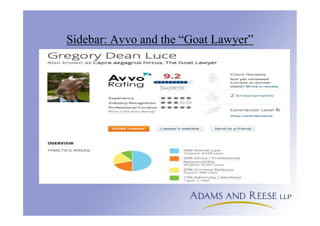
Sidebar: Avvo and the “Goat Lawyer”
Communication of Fields of Practice and
Specialization (Rule 7.4)
• “To avoid confusing or misleading the public and
to protect the objectives of the South Carolina
certified specialization program, any such
advertisement or statements shall be strictly
factual and shall not contain any form of the
words “certified,” “specialist,” “expert,” or
“authority” except as permitted by Rule 7.4(d).”
• LinkedIn “Skills and Expertise”
Application of the RPC to “Social Media
Information-Seeking”
• The Differences between “Public-Facing” Information and Private
Information are Significant when Gathering Social Media Evidence
• Some information deemed private includes:
– Facebook’s private messages, “wall” posts and comments (Crispin v.
Christian Audigier, 717 F.Supp.2d 965 (C.D. Cal. 2010);
– Webmail services (Id.); and
– Private YouTube videos. Viacom International Inc. v. YouTube Inc., 253
F.R.D. 265 (S.D.N.Y. 2008).
• Generally the pursuit of public information (about parties, jurors, or
witnesses) is not likely to trigger ethical concerns, while accessing
private information may be prohibited or limited by ethics rules and/or
various provisions of law
Visiting the Social Networking Site of a Party
Represented by Counsel
• Rule 4.2: “Communication with Person Represented by Counsel”
forbids communication with a person represented by counsel.
• Oregon State Bar Association Formal Opinion No. 2005-164 (August
2005), explains why visiting a website is not “communication.”
Reading a post on a website is no different than “reading a magazine
article . . . written by that adversary.” And reading “information posted
for general public consumption” is purely a one-way flow of
information from the adverse party to the lawyer (not the other way
around) with no interaction.
• Similarly, an opposing attorney’s access of a publically available social
media post created by a party is not considered “communication.” N.Y.
State 843 (2010) (lawyers may access public pages of social networking
websites maintained by any person, including represented parties).
Interacting with a person represented by counsel
to access a social media post
• Rule 4.2 may operate differently in the event
that an attorney sends a “friend request” to a
represented party on Facebook.
• Oregon State Bar Formal Opinion No. 2005-
164 also indicates that “written
communications via the Internet are directly
analogous to written communications via
traditional mail or messenger service . . . .”
Seeking to “Friend” a Witness
Not Represented by Counsel
• Rule 4.1, SCRPC prohibits a lawyer from making
“a false statement of material fact or law to a third
person,”
• Rule 8.4(c) prohibits a lawyer from engaging “in
conduct involving dishonesty, fraud, deceit or
misrepresentation.”
“Friending” a Witness Under
False Pretenses
• Requesting access to a user’s account (and her non-public
information) using a pretext may be a violation of Rule 4.1
and Rule 8.4(c). See New York City Bar Formal Opinion
2010-2 (“A lawyer may not attempt to gain access to a
social networking website under false pretenses, either
directly or through an agent.”).
• On the other hand, using truthful information to obtain
access to a website would not violate these rules.
“Friending” a Witness
Without Disclosing Your Motive
• The NY City Opinion cited above makes a distinction between
affirmative “deception” and failing to disclose the purpose for
the connection: “an attorney or her agent may use her real
name and profile to send a ‘friend request’ to obtain
information from an unrepresented person’s social networking
website without also disclosing the reasons for making the
request.”).
• Similarly, Oregon State Bar Formal Opinion No. 2013-189
concluded that a “lawyer may request access to non-public
information if the person is not represented by counsel in that
matter and no actual representation of disinterest is made by”
the lawyer.
“Friending” a Witness
Without Disclosing Your Motive
• The Philadelphia Bar Association took a different
approach, concluding that the omission of a
“highly material fact” (that the party seeking
access plans to seek and obtain information for use
in a lawsuit) would constitute deceptive conduct
and a violation of Rule 8.4 (c).
Information Security in Using Social Media
• Confidentiality (Rule 1.6) and Safekeeping Property
(Rule 1.15)
• Avoid Sharing Too Much personal information or
client information (“If you are not paying for it, you’re
the product”)
• Keep separate from your work email and network
• Use strong passwords and multi-factor authentication
• Use different passwords for your different platforms.
Juror Social Media Misconduct
• The Arkansas Supreme Court reversed a death sentence
because a juror Tweeted during deliberations.
• The Supreme Court of Tennessee remanded a case for a
hearing where a juror initiated a Facebook conversation
with a trial witness after the witness testified.
• 4th Circuit reversed the convictions of various S.C.
defendants because juror misconduct in researching an
element of the offense on Wikipedia deprived him of his
Sixth Amendment right to a fair trial.
Preventing Juror Social Media
Misconduct
• Instruct early, instruct often
• Consider the Proposed Model Jury
Instructions: The Use of Electronic
Technology to Conduct Research on or
Communicate about a Case:
– Research
– Communication
– The Internet as an Information Source
Briefly on Authentication of ESI
• [T]he inability to get evidence admitted
because of a failure to authenticate is almost
always a self-inflicted injury which can be
avoided by thoughtful advance preparation.
Lorraine v. Markel American Ins. Co., 241
F.R.D. 534, 542 (D.Md.2007).
• In re Vinhnee, 336 B.R. 437, 444 (9th Cir.
BAP 2005)
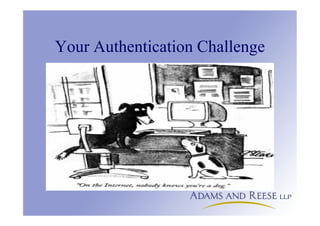
Your Authentication Challenge
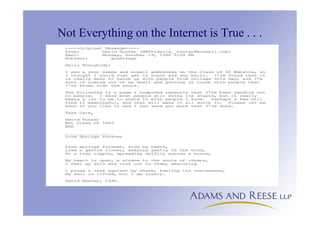
Not Everything on the Internet is True . . .
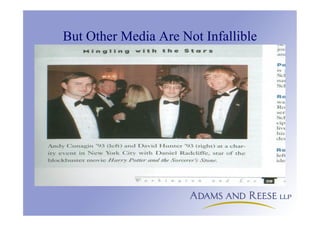
But Other Media Are Not Infallible
Cases Addressing “Circumstantial” Social Media
Authentication
• Griffin v. Maryland, 19 A.3d 415 (Md. 2011)
(photograph, personal information, and references
to the Defendant were inadequate to authenticate
MySpace pages)
• Tienda v. Texas, 358 S.W.3d 633 (Tex. Crim.
App. 2012) (photographs of Defendant including
distinctive characteristics and various references
sufficient to authenticate MySpace pages);
More Cases . . .
• Campbell v. Texas, No. 01-11-00834-CR, 2012
WL 3793431 (Tex. App. August 31, 2012);
• U.S. v. Vayner, 769 F.3d 125 (3rd. Cir. 2014)
(information about individual on “the Russian
equivalent of Facebook” did not suffice to
establish for purposes of Rule 901 that he was the
author of that page); and
• Parker v. State, 85 A.3d 682 (Del. 2014).
(Facebook posts authenticated on the basis of
certain circumstantial facts).
Questions?
Jack Pringle
Adams and Reese LLP
(803) 343-1270
jack.pringle@arlaw.com
@jjpringlesc
http://pringlepracticeblog.blogspot.com
1501 Main Street, 5th Floor
Columbia, SC 29201
www.adamsandreese.com
Citations/Resources
In the Matter of Dannitte Mays Dickey, Opinion No. 20790 (S.C. Supreme Court February 1, 2012)
http://www.sccourts.org/opinions/HTMLFiles/SC/27090.htm
The Association of the Bar of the City of New York Committee on Professional Ethics, Formal Opinion 2010-2, “Obtaining Evidence from Social Networking
Websites”
http://www.nycbar.org/pdf/report/uploads/20071997-FormalOpinion2010-2.pdf
N.Y. State Bar Association Committee on Professional Ethics Opinion #843 (2010)
http://www.nysba.org/CustomTemplates/Content.aspx?id=5162
Oregon State Bar Association Formal Opinion No. 2005-164, “Communicating with Represented Persons: Contact Through Web Sites and the Internet, (August
2005)
http://www.osbar.org/_docs/ethics/2005-164.pdf
Philadelphia Bar Association Professional Guidance Commission Opinion No. 2009-02 (Mar. 2009)
http://www.philadelphiabar.org/WebObjects/PBAReadOnly.woa/Contents/WebServerResources/CMSResources/Opinion_2009-2.pdf
South Carolina Bar Ethics Advisory Committee Opinion 09-10:
http://www.scbar.org/MemberResources/EthicsAdvisoryOpinions/OpinionView/ArticleId/107/Ethics-Advisory-Opinion-09-10.aspx
Social Media and the Attorney-Client Privilege Warning, Mark Bassingthwaighte, ALPS 411, June 17, 2013,
http://www.alps411.com/blog/managing-your-practice---musings-of-a-risk-manager/social-media-and-the-attorney-client-privilege-warning-v2
Hunter v. Virginia State Bar, Ex Rel. Third District Committee, Supreme Court of Virginia (2013)
http://www.courts.state.va.us/opinions/opnscvwp/1121472.pdf
Resources
Locked Down: Information Security for Lawyers, Sharon D. Nelson, David G. Ries, John W. Simek
http://www.amazon.com/Locked-Down-Information-Security-Lawyers/dp/1614383642
“ABA Survey Shows Growth in Lawyers’ Social Media Use,” Robert Ambrogi’s LawSites Blog, August 16, 2012
http://www.lawsitesblog.com/2012/08/aba-survey-shows-growth-in-lawyers-social-media-use.html
“Why the Goat Lawyer Had a ‘Superb’ AVVO Rating,” Sam Glover, Lawyerist Blog, December 10, 2013
http://lawyerist.com/goat-lawyer-great-avvo-rating/
American Bar Association, Formal Opinion 466, “Lawyer Reviewing Jurors’ Internet Presence,” April 24, 2014,
http://www.almd.uscourts.gov/docs/aba_formal_opinion_466.pdf
Arkansas Defendant Saved by the Tweet, Wall Street Journal Law Blog, December 8, 2011, available at
http://blogs.wsj.com/law/2011/12/08/arkansas-defendant-saved-by-the-tweet
Locked Down: Information Security for Lawyers, Sharon D. Nelson, David G. Ries, John W. Simek
http://www.amazon.com/Locked-Down-Information-Security-Lawyers/dp/1614383642
“ABA Survey Shows Growth in Lawyers’ Social Media Use,” Robert Ambrogi’s LawSites Blog, August 16, 2012
http://www.lawsitesblog.com/2012/08/aba-survey-shows-growth-in-lawyers-social-media-use.html
Proposed Model Jury Instructions -The Use of Electronic Technology to Conduct Research on or Communicate about a Case
http://federalevidence.com/downloads/blog/2010/Memorandum.On.Juror.Use.Of.Electronic.Communication.Technologies.pdf
Hon. Amy J. St. Eve and Michael A. Zuckerman, “Ensuring an Impartial Jury in the Age of Social Media,” Duke Law and Technology Review,
Volume 11, available at http://scholarship.law.duke.edu/cgi/viewcontent.cgi?article=1228&context=dltr

Using Social Media Ethically

  • 1.
    Using Social MediaEthically Maintaining Professional Responsibility in the Age of TMI
  • 2.
    Why? • According tothe 2012 ABA Legal Technology Survey Report, 95% of lawyers said they are on LinkedIn. • “It should now be a matter of professional competence for attorneys to take the time to investigate social networking sites.” Griffin v. State, 192 Md.App. 518 (2010), reversed by Griffin v. State, 419 Md. 343 (2011).
  • 3.
    Definition? “Social networks areinternet-based communities that individuals use to communicate with each other and view and exchange information, including photographs, digital recordings and files. Users create a profile page with personal information that other users may access online. Users may establish the level of privacy they wish to employ and may limit those who view their profile page to “friends” – those who have specifically sent a computerized request to view their profile page which the user has accepted. Examples of currently popular social networks include Facebook, Twitter, MySpace and LinkedIn.” Association of the Bar of the City of New York Committee on Professional Ethics, Formal Opinion 2010-2, “Obtaining Evidence from Social Networking Sites.”
  • 4.
    Why Does TheUse of Social Media Implicate the Ethics Rules? • The ethics rules govern (among other things) how attorneys – Publish and communicate information (with and to their clients, prospective clients, persons with an interest in their cases, and the public); – Protect information • Social media enables instantaneous, ubiquitous publication and communication of information on many platforms
  • 6.
    8 Word SocialMedia Policy Don’t Lie, don’t cheat, don’t steal, don’t reveal http://www.forbes.com/sites/davidcoursey/2012/02/27/this-8-word-social-media- policy-could-save-your-job/
  • 7.
    The Bias ofa New Tool (Social Media Platforms) • External Memory • More Connections (Weak Ties) • Communication and Publishing
  • 8.
    As You TakeAdvantage of its Benefits, Weigh the Ethics Risks • Existing rules (Communication, Confidentiality) • More Publication/Communication Means More Oversight Responsibility • Dynamic and Not Static (Same) • Interactive (Nobody Posted to Your Martindale- Hubbell Listing) • Information Shared There is Discoverable
  • 9.
    Communication (Rule 1.4) •Does your client fully understand the implications of sharing case information via social media? • Security and monitoring concerns (unsecured interface, employer monitoring)
  • 10.
    Consider: We strongly encourageyou to refrain from participating in social media (Facebook, Twitter, Tumblr, Flickr, Skype, and the like) during the course of representation. Information found on social media websites is not private, can be discoverable, and if used as evidence may be potentially damaging to your interests. Understand that information shared with others be it verbally; in writing via email, text message or letter; or even posted online could result in a waiver of the attorney client privilege were that information to relate in any way to the legal matter that we are handling for you. In addition, you should not delete or remove information from any social media website as that could be considered destruction of evidence, spoliation of evidence, or obstruction of justice. We also advise you to refrain from communicating with us on any device provided by your employer or any computer, smart phone, or other device that is shared with someone else. In addition when communicating with us, do not use your work email address or a shared email account. You should only use a private email account that is password protected and only accessed from your personal smart phone or computer. We reserve the right to withdraw as counsel if the above advice is not followed.
  • 11.
    Confidentiality of Information (Rule1.6): Oversharing is Easy, Unlimited, and Permanent • Don’t Publish Information Protected by the Attorney- Client Privilege • The “Public Record” Standard is a Good One
  • 12.
    Publication Could ConstituteLegal Advice/Establish an Attorney-Client Relationship • Lots of platforms for you to provide and receive information. • Be specific with respect to your licensing • Be general with respect to the law • Don’t give specific advice to an individual (AVVO)
  • 13.
    Communications Concerning aLawyer’s Services (Rule 7.1) Advertising (Rule 7.2), Solicitation (Rule 7.3) • What Hasn’t Changed: Be Truthful, Accurate, and Not Misleading – No Unjustified Expectation of Results – No Comparisons Without Factual Justification – No Nicknames With Implications – Appropriate Disclaimers • In the Matter of Dannitte Mays Dickey (S.C. Supreme Court 2012): “Respondent relied on company representatives who were lawyers and non-attorney web designers who assured him that the advertisements would comply with respondent's ethical requirements. Respondent did not review the applicable provisions of the South Carolina Rules of Professional Conduct prior to posting the internet profiles.”
  • 14.
    Requirements for YourSocial Media • Once You Claim It, You Own It, and Have a Duty to Manage it, Even if You Didn’t Post It – Testimonials and Endorsements on LinkedIn – South Carolina Bar Ethics Advisory Committee Opinion 09-10 • Keep it Accurate and Up-to-Date • Understand the difference between commercial and political speech (Hunter v. Virginia State Bar) • Because your “reach” is world-wide, identify the jurisdictions where you are authorized to practice
  • 15.
    Sidebar: Avvo andthe “Goat Lawyer”
  • 16.
    Communication of Fieldsof Practice and Specialization (Rule 7.4) • “To avoid confusing or misleading the public and to protect the objectives of the South Carolina certified specialization program, any such advertisement or statements shall be strictly factual and shall not contain any form of the words “certified,” “specialist,” “expert,” or “authority” except as permitted by Rule 7.4(d).” • LinkedIn “Skills and Expertise”
  • 17.
    Application of theRPC to “Social Media Information-Seeking” • The Differences between “Public-Facing” Information and Private Information are Significant when Gathering Social Media Evidence • Some information deemed private includes: – Facebook’s private messages, “wall” posts and comments (Crispin v. Christian Audigier, 717 F.Supp.2d 965 (C.D. Cal. 2010); – Webmail services (Id.); and – Private YouTube videos. Viacom International Inc. v. YouTube Inc., 253 F.R.D. 265 (S.D.N.Y. 2008). • Generally the pursuit of public information (about parties, jurors, or witnesses) is not likely to trigger ethical concerns, while accessing private information may be prohibited or limited by ethics rules and/or various provisions of law
  • 18.
    Visiting the SocialNetworking Site of a Party Represented by Counsel • Rule 4.2: “Communication with Person Represented by Counsel” forbids communication with a person represented by counsel. • Oregon State Bar Association Formal Opinion No. 2005-164 (August 2005), explains why visiting a website is not “communication.” Reading a post on a website is no different than “reading a magazine article . . . written by that adversary.” And reading “information posted for general public consumption” is purely a one-way flow of information from the adverse party to the lawyer (not the other way around) with no interaction. • Similarly, an opposing attorney’s access of a publically available social media post created by a party is not considered “communication.” N.Y. State 843 (2010) (lawyers may access public pages of social networking websites maintained by any person, including represented parties).
  • 19.
    Interacting with aperson represented by counsel to access a social media post • Rule 4.2 may operate differently in the event that an attorney sends a “friend request” to a represented party on Facebook. • Oregon State Bar Formal Opinion No. 2005- 164 also indicates that “written communications via the Internet are directly analogous to written communications via traditional mail or messenger service . . . .”
  • 20.
    Seeking to “Friend”a Witness Not Represented by Counsel • Rule 4.1, SCRPC prohibits a lawyer from making “a false statement of material fact or law to a third person,” • Rule 8.4(c) prohibits a lawyer from engaging “in conduct involving dishonesty, fraud, deceit or misrepresentation.”
  • 21.
    “Friending” a WitnessUnder False Pretenses • Requesting access to a user’s account (and her non-public information) using a pretext may be a violation of Rule 4.1 and Rule 8.4(c). See New York City Bar Formal Opinion 2010-2 (“A lawyer may not attempt to gain access to a social networking website under false pretenses, either directly or through an agent.”). • On the other hand, using truthful information to obtain access to a website would not violate these rules.
  • 22.
    “Friending” a Witness WithoutDisclosing Your Motive • The NY City Opinion cited above makes a distinction between affirmative “deception” and failing to disclose the purpose for the connection: “an attorney or her agent may use her real name and profile to send a ‘friend request’ to obtain information from an unrepresented person’s social networking website without also disclosing the reasons for making the request.”). • Similarly, Oregon State Bar Formal Opinion No. 2013-189 concluded that a “lawyer may request access to non-public information if the person is not represented by counsel in that matter and no actual representation of disinterest is made by” the lawyer.
  • 23.
    “Friending” a Witness WithoutDisclosing Your Motive • The Philadelphia Bar Association took a different approach, concluding that the omission of a “highly material fact” (that the party seeking access plans to seek and obtain information for use in a lawsuit) would constitute deceptive conduct and a violation of Rule 8.4 (c).
  • 24.
    Information Security inUsing Social Media • Confidentiality (Rule 1.6) and Safekeeping Property (Rule 1.15) • Avoid Sharing Too Much personal information or client information (“If you are not paying for it, you’re the product”) • Keep separate from your work email and network • Use strong passwords and multi-factor authentication • Use different passwords for your different platforms.
  • 25.
    Juror Social MediaMisconduct • The Arkansas Supreme Court reversed a death sentence because a juror Tweeted during deliberations. • The Supreme Court of Tennessee remanded a case for a hearing where a juror initiated a Facebook conversation with a trial witness after the witness testified. • 4th Circuit reversed the convictions of various S.C. defendants because juror misconduct in researching an element of the offense on Wikipedia deprived him of his Sixth Amendment right to a fair trial.
  • 26.
    Preventing Juror SocialMedia Misconduct • Instruct early, instruct often • Consider the Proposed Model Jury Instructions: The Use of Electronic Technology to Conduct Research on or Communicate about a Case: – Research – Communication – The Internet as an Information Source
  • 27.
    Briefly on Authenticationof ESI • [T]he inability to get evidence admitted because of a failure to authenticate is almost always a self-inflicted injury which can be avoided by thoughtful advance preparation. Lorraine v. Markel American Ins. Co., 241 F.R.D. 534, 542 (D.Md.2007). • In re Vinhnee, 336 B.R. 437, 444 (9th Cir. BAP 2005)
  • 28.
  • 29.
    Not Everything onthe Internet is True . . .
  • 30.
    But Other MediaAre Not Infallible
  • 31.
    Cases Addressing “Circumstantial”Social Media Authentication • Griffin v. Maryland, 19 A.3d 415 (Md. 2011) (photograph, personal information, and references to the Defendant were inadequate to authenticate MySpace pages) • Tienda v. Texas, 358 S.W.3d 633 (Tex. Crim. App. 2012) (photographs of Defendant including distinctive characteristics and various references sufficient to authenticate MySpace pages);
  • 32.
    More Cases .. . • Campbell v. Texas, No. 01-11-00834-CR, 2012 WL 3793431 (Tex. App. August 31, 2012); • U.S. v. Vayner, 769 F.3d 125 (3rd. Cir. 2014) (information about individual on “the Russian equivalent of Facebook” did not suffice to establish for purposes of Rule 901 that he was the author of that page); and • Parker v. State, 85 A.3d 682 (Del. 2014). (Facebook posts authenticated on the basis of certain circumstantial facts).
  • 33.
    Questions? Jack Pringle Adams andReese LLP (803) 343-1270 jack.pringle@arlaw.com @jjpringlesc http://pringlepracticeblog.blogspot.com 1501 Main Street, 5th Floor Columbia, SC 29201 www.adamsandreese.com
  • 34.
    Citations/Resources In the Matterof Dannitte Mays Dickey, Opinion No. 20790 (S.C. Supreme Court February 1, 2012) http://www.sccourts.org/opinions/HTMLFiles/SC/27090.htm The Association of the Bar of the City of New York Committee on Professional Ethics, Formal Opinion 2010-2, “Obtaining Evidence from Social Networking Websites” http://www.nycbar.org/pdf/report/uploads/20071997-FormalOpinion2010-2.pdf N.Y. State Bar Association Committee on Professional Ethics Opinion #843 (2010) http://www.nysba.org/CustomTemplates/Content.aspx?id=5162 Oregon State Bar Association Formal Opinion No. 2005-164, “Communicating with Represented Persons: Contact Through Web Sites and the Internet, (August 2005) http://www.osbar.org/_docs/ethics/2005-164.pdf Philadelphia Bar Association Professional Guidance Commission Opinion No. 2009-02 (Mar. 2009) http://www.philadelphiabar.org/WebObjects/PBAReadOnly.woa/Contents/WebServerResources/CMSResources/Opinion_2009-2.pdf South Carolina Bar Ethics Advisory Committee Opinion 09-10: http://www.scbar.org/MemberResources/EthicsAdvisoryOpinions/OpinionView/ArticleId/107/Ethics-Advisory-Opinion-09-10.aspx Social Media and the Attorney-Client Privilege Warning, Mark Bassingthwaighte, ALPS 411, June 17, 2013, http://www.alps411.com/blog/managing-your-practice---musings-of-a-risk-manager/social-media-and-the-attorney-client-privilege-warning-v2 Hunter v. Virginia State Bar, Ex Rel. Third District Committee, Supreme Court of Virginia (2013) http://www.courts.state.va.us/opinions/opnscvwp/1121472.pdf
  • 35.
    Resources Locked Down: InformationSecurity for Lawyers, Sharon D. Nelson, David G. Ries, John W. Simek http://www.amazon.com/Locked-Down-Information-Security-Lawyers/dp/1614383642 “ABA Survey Shows Growth in Lawyers’ Social Media Use,” Robert Ambrogi’s LawSites Blog, August 16, 2012 http://www.lawsitesblog.com/2012/08/aba-survey-shows-growth-in-lawyers-social-media-use.html “Why the Goat Lawyer Had a ‘Superb’ AVVO Rating,” Sam Glover, Lawyerist Blog, December 10, 2013 http://lawyerist.com/goat-lawyer-great-avvo-rating/ American Bar Association, Formal Opinion 466, “Lawyer Reviewing Jurors’ Internet Presence,” April 24, 2014, http://www.almd.uscourts.gov/docs/aba_formal_opinion_466.pdf Arkansas Defendant Saved by the Tweet, Wall Street Journal Law Blog, December 8, 2011, available at http://blogs.wsj.com/law/2011/12/08/arkansas-defendant-saved-by-the-tweet Locked Down: Information Security for Lawyers, Sharon D. Nelson, David G. Ries, John W. Simek http://www.amazon.com/Locked-Down-Information-Security-Lawyers/dp/1614383642 “ABA Survey Shows Growth in Lawyers’ Social Media Use,” Robert Ambrogi’s LawSites Blog, August 16, 2012 http://www.lawsitesblog.com/2012/08/aba-survey-shows-growth-in-lawyers-social-media-use.html Proposed Model Jury Instructions -The Use of Electronic Technology to Conduct Research on or Communicate about a Case http://federalevidence.com/downloads/blog/2010/Memorandum.On.Juror.Use.Of.Electronic.Communication.Technologies.pdf Hon. Amy J. St. Eve and Michael A. Zuckerman, “Ensuring an Impartial Jury in the Age of Social Media,” Duke Law and Technology Review, Volume 11, available at http://scholarship.law.duke.edu/cgi/viewcontent.cgi?article=1228&context=dltr