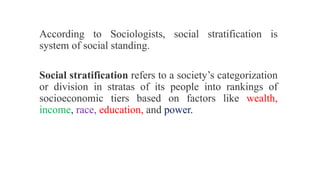
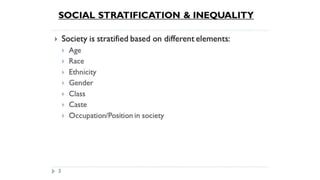
According to Sociologists, social stratification is
system of social standing.
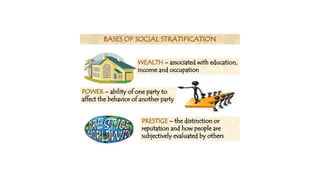
Social stratification refers to a society’s categorization
or division in stratas of its people into rankings of
socioeconomic tiers based on factors like wealth,
income, race, education, and power.
Society’s layers are made of people, and society’s resources
are distributed unevenly throughout the layers. The people
who have more resources represent the top layer of the social
structure of stratification. Other groups of people, with
progressively fewer and fewer resources, represent the lower
layers of our society.
Caste systems are closed stratification systems as people can not change their
caste and they can do little or nothing to change their social standing.
A caste system is one in which people are born into their social standing and
will remain in it their whole lives. People are assigned occupations regardless
of their talents, interests, or potential. There are virtually no opportunities to
improve a person’s social position.
Accepting this social standing was considered a moral duty. Cultural values
reinforced the system. Caste systems promote beliefs in fate, destiny, and the
will of a higher power, rather than promoting individual freedom as a value.
A class system is based on both social factors and individual
achievement. A class consists of a set of people who share similar
status with regard to factors like wealth, income, education, and
occupation.
Unlike caste systems, class systems are open. People are free to gain a
different level of education or employment than their parents. They can
also socialize with and marry members of other classes, which allows
people to move from one class to another.
In a class system, occupation is not fixed at birth. Though family and
other societal models help guide a person toward a career, personal
choice plays a role.
The main features of social stratification are;
1. It is a social and economic categorization of individuals within
a societal framework.
2. It is based on Caste, Class, and Status & Power of a Community
or Section of People within the framework of a society.
3. Social Stratification exists because of natural differences in peoples
abilities.
4. Due to Social Stratification societies tend to be stable and are
held together through consensus.
5. It lessens conflicts & provides structure.
6. Social Stratification is a natural & voluntary separation according to
race, social & economic status.
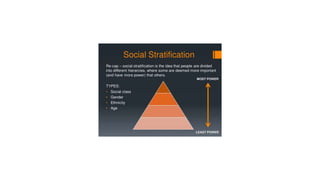
The categories of social stratification are; social class, gender, race and ethnicity and age and
disability.
Some indicative features of these categories are as follows:
a) Social Class
• Distinction between wealth and income and their distribution in society.
• Social mobility and the link between class and life chances.
• Changing nature of class and its relationship to the economy and occupational structure.
b) Gender
• Difference between biological notion of sex and the socially constructed notion of gender.
• Nature and consequences of gender-role socialisation.
• Gender inequalities in terms of occupation, family and social roles and expectations.
Race and Ethnicity
• Nature, size and distribution of different racial and ethnic groups in modern society.
• Inequality relating to race and ethnicity; in particular, discrimination in education, employment
and on life chances.
• Role of the mass media in the formation of stereotypes and the consequences for ethnic groups.
d) Age
• Social construction of the concept of age, including awareness of different notions of childhood,
adolescence and old age in different societies.
• Inequalities as a result of age, such as employment, unemployment, low pay, access to benefits
and restrictions on social behaviour.
• Implications of changes in the age structure of modern society.
e) Disability
• Social construction of disability.
• Inequality relating to disability; in particular, discrimination in education, employment and on
life chances.
• Role of the mass media in the formation of negative stereotypes and the consequences for
disabled individuals and groups.
•Causes of Social Stratification:
There are five basic points which gives clear idea about the causes of
social stratification;
Inequality – Inequality exists because of natural differences
in people’s abilities.
Conflict – Stratification occurs due to conflict between
different classes, with the upper classes using superior power to take
a larger share of the social resources.
Power – Power influences one’s definition of self and the
importance of ideas in defining social situations.
Wealth – Difference in the wealth is also one of the causes of
social stratification.
Instability – Instability in the society being the cause of
social stratification enhances stability and induces members of the
society to work hard.
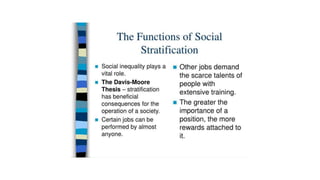
It is a system by which society ranks categories of people in a
hierarchy. Social stratification is based on four basic principles:
(1) Social stratification is a trait of society, not simply a reflection
of individual differences;
(2) Social stratification carries over from generation to
generation;
(3) Social stratification is universal but variable;
(4) Social stratification involves not just inequality but beliefs as
well.
Köhler, Nicholas. 2010. “An Uncommon Princess.” Maclean’s, November 22. Retrieved
January 9, 2012 (http://www2.macleans.ca/2010/11/22/an-uncommon-princess/).
McKee,Victoria. 1996. “Blue Blood and the Color of Money.” NewYorkTimes, June 9.
Marquand, Robert. 2011. “What Kate Middleton’sWedding to PrinceWilliam Could Do
for Britain.” Christian Science Monitor, April 15. Retrieved January 9, 2012
(http://www.csmonitor.com/World/Europe/2011/0415/What-Kate-Middleton-s-
wedding-to-Prince-William-could-do-for-Britain).
Wong, Grace. 2011. "Kate Middleton: A Family BusinessThat Built a Princess." CNN
Money. Retrieved December 22, 2014
(http://money.cnn.com/2011/04/14/smallbusiness/kate-middleton-party-pieces/).

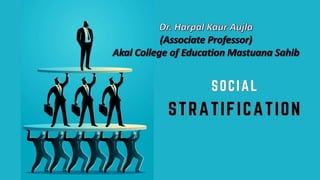
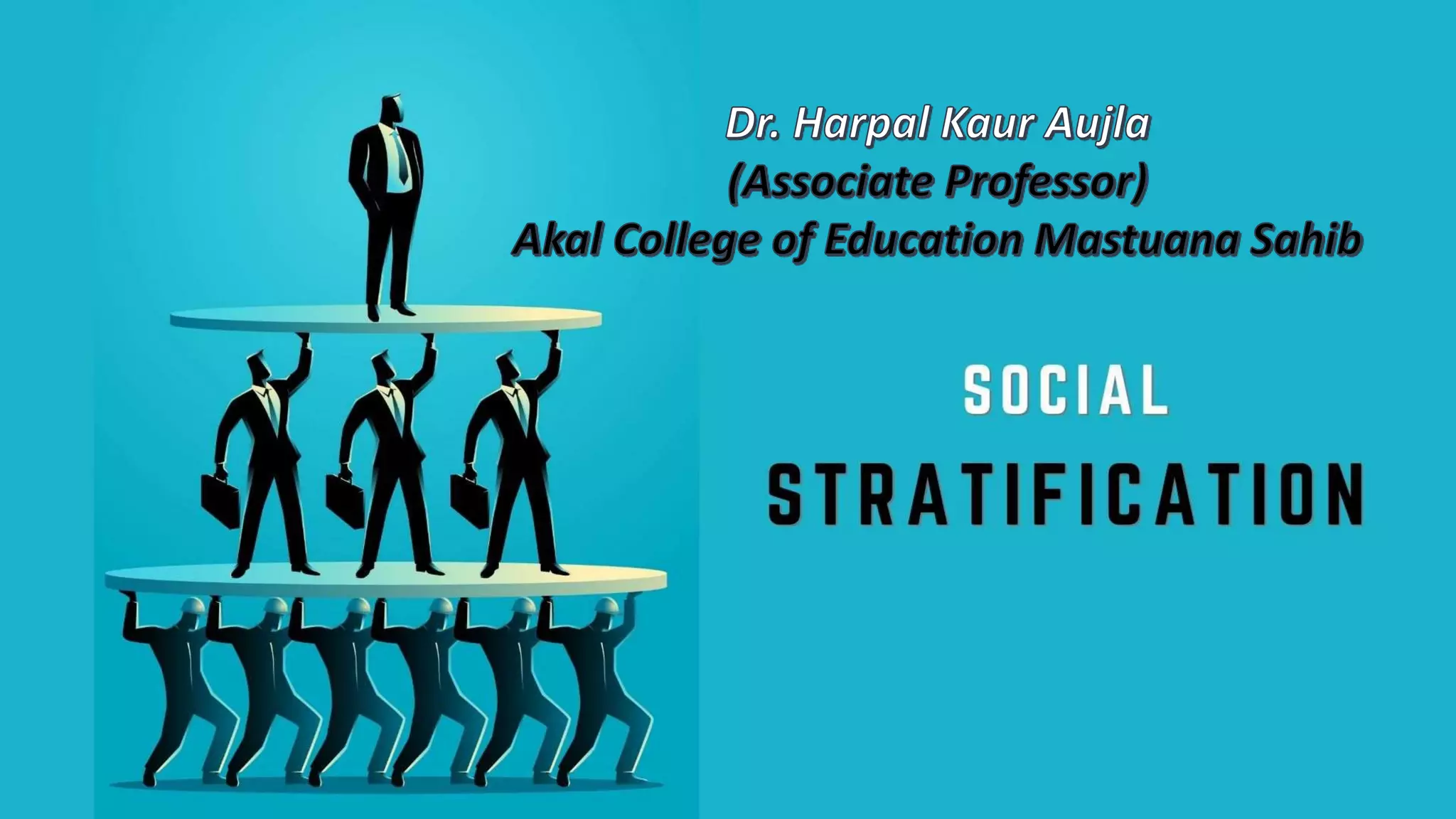
social stratification

  • 2.
    According to Sociologists,social stratification is system of social standing. Social stratification refers to a society’s categorization or division in stratas of its people into rankings of socioeconomic tiers based on factors like wealth, income, race, education, and power.
  • 4.
    Society’s layers aremade of people, and society’s resources are distributed unevenly throughout the layers. The people who have more resources represent the top layer of the social structure of stratification. Other groups of people, with progressively fewer and fewer resources, represent the lower layers of our society.
  • 11.
    Caste systems areclosed stratification systems as people can not change their caste and they can do little or nothing to change their social standing. A caste system is one in which people are born into their social standing and will remain in it their whole lives. People are assigned occupations regardless of their talents, interests, or potential. There are virtually no opportunities to improve a person’s social position. Accepting this social standing was considered a moral duty. Cultural values reinforced the system. Caste systems promote beliefs in fate, destiny, and the will of a higher power, rather than promoting individual freedom as a value.
  • 12.
    A class systemis based on both social factors and individual achievement. A class consists of a set of people who share similar status with regard to factors like wealth, income, education, and occupation. Unlike caste systems, class systems are open. People are free to gain a different level of education or employment than their parents. They can also socialize with and marry members of other classes, which allows people to move from one class to another. In a class system, occupation is not fixed at birth. Though family and other societal models help guide a person toward a career, personal choice plays a role.
  • 13.
    The main featuresof social stratification are; 1. It is a social and economic categorization of individuals within a societal framework. 2. It is based on Caste, Class, and Status & Power of a Community or Section of People within the framework of a society. 3. Social Stratification exists because of natural differences in peoples abilities. 4. Due to Social Stratification societies tend to be stable and are held together through consensus. 5. It lessens conflicts & provides structure. 6. Social Stratification is a natural & voluntary separation according to race, social & economic status.
  • 14.
    The categories ofsocial stratification are; social class, gender, race and ethnicity and age and disability. Some indicative features of these categories are as follows: a) Social Class • Distinction between wealth and income and their distribution in society. • Social mobility and the link between class and life chances. • Changing nature of class and its relationship to the economy and occupational structure. b) Gender • Difference between biological notion of sex and the socially constructed notion of gender. • Nature and consequences of gender-role socialisation. • Gender inequalities in terms of occupation, family and social roles and expectations.
  • 15.
    Race and Ethnicity •Nature, size and distribution of different racial and ethnic groups in modern society. • Inequality relating to race and ethnicity; in particular, discrimination in education, employment and on life chances. • Role of the mass media in the formation of stereotypes and the consequences for ethnic groups. d) Age • Social construction of the concept of age, including awareness of different notions of childhood, adolescence and old age in different societies. • Inequalities as a result of age, such as employment, unemployment, low pay, access to benefits and restrictions on social behaviour. • Implications of changes in the age structure of modern society. e) Disability • Social construction of disability. • Inequality relating to disability; in particular, discrimination in education, employment and on life chances. • Role of the mass media in the formation of negative stereotypes and the consequences for disabled individuals and groups.
  • 16.
    •Causes of SocialStratification: There are five basic points which gives clear idea about the causes of social stratification; Inequality – Inequality exists because of natural differences in people’s abilities. Conflict – Stratification occurs due to conflict between different classes, with the upper classes using superior power to take a larger share of the social resources. Power – Power influences one’s definition of self and the importance of ideas in defining social situations. Wealth – Difference in the wealth is also one of the causes of social stratification. Instability – Instability in the society being the cause of social stratification enhances stability and induces members of the society to work hard.
  • 17.
    It is asystem by which society ranks categories of people in a hierarchy. Social stratification is based on four basic principles: (1) Social stratification is a trait of society, not simply a reflection of individual differences; (2) Social stratification carries over from generation to generation; (3) Social stratification is universal but variable; (4) Social stratification involves not just inequality but beliefs as well.
  • 18.
    Köhler, Nicholas. 2010.“An Uncommon Princess.” Maclean’s, November 22. Retrieved January 9, 2012 (http://www2.macleans.ca/2010/11/22/an-uncommon-princess/). McKee,Victoria. 1996. “Blue Blood and the Color of Money.” NewYorkTimes, June 9. Marquand, Robert. 2011. “What Kate Middleton’sWedding to PrinceWilliam Could Do for Britain.” Christian Science Monitor, April 15. Retrieved January 9, 2012 (http://www.csmonitor.com/World/Europe/2011/0415/What-Kate-Middleton-s- wedding-to-Prince-William-could-do-for-Britain). Wong, Grace. 2011. "Kate Middleton: A Family BusinessThat Built a Princess." CNN Money. Retrieved December 22, 2014 (http://money.cnn.com/2011/04/14/smallbusiness/kate-middleton-party-pieces/).