SOCIAL
STRATIFICATION
by: S.E.SIVAM(19BLB1056)
LEARNING OUTLINE
1 INTRODUCTION
 definition
 Origin
 Causes
 Characteristics
2 IMPACT OF SOCIAL STRATIFICATION
3 FORMS OF STRATIFICATION
SOCIAL STRATIFICATION
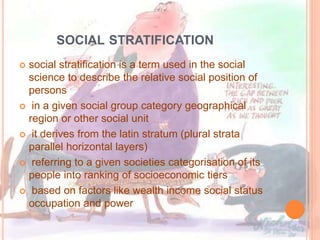
 social stratification is a term used in the social
science to describe the relative social position of
persons
 in a given social group category geographical
region or other social unit
 it derives from the latin stratum (plural strata
parallel horizontal layers)
 referring to a given societies categorisation of its
people into ranking of socioeconomic tiers
 based on factors like wealth income social status
occupation and power
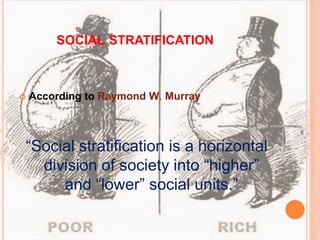
 According to Raymond W. Murray
“Social stratification is a horizontal
division of society into “higher”
and “lower” social units.”
SOCIAL STRATIFICATION
 According to GILBERT
social stratification is the division of
society into permanent groups or
categories linked with each other
by the relationship of Superiority
and subordination
SOCIAL STRATIFICATION
 According to Lundberg
a stratified society is one marked
by inequality by differences
among people that are evaluated
by them as being lower and higher
SOCIAL STRATIFICATION
ORIGINS OF SOCIAL STRATIFICATION
 Hunting and Gathering Societies
 Horticultural, Pastoral, and Agricultural
Societies
 Division of Labour and Job
Specialization
 Industrialized Societies
 The Improvement of Working Conditions
 Postindustrial Societies
CAUSES OF SOCIAL STRATIFICATION
 There are five basic point which give a clear idea
about the causes of social stratification:
1 Inequality
2 Conflict
3 Power
4 Wealth
5 instability
CHARACTERISTICS OF SOCIAL STRATIFICATION
Social stratification may have the following
Characteristics:
 Social stratification is universal
 Stratification is social
 It is ancient
 It is in diverse forms
 Social stratification is Consequential
IMPACT OF STRATIFICATION ON OUR LIFE
It leads to inequality regarding........
Health sector
Education
Bounds individual action
Specification of social role
Societal law
Whom will live or die
HEALTH SECTOR
Expensive healthcare facilities
VIP culture
Different treatment quality
Discriminating attitude of care
providers
unequal distribution of clean water and
save environment in different zones of
a city
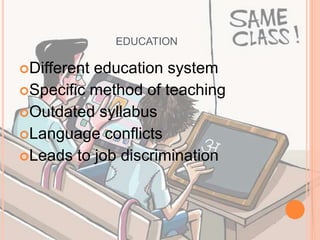
EDUCATION
Different education system
Specific method of teaching
Outdated syllabus
Language conflicts
Leads to job discrimination
BOUNDS INDIVIDUAL ACTION
 Different political affiliation
 Limit our opportunities to work
 Limit our perceptive
 Stereotyping
 Liabialization
 Stops one to ask question
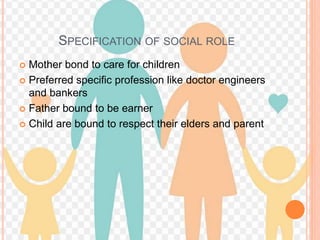
SPECIFICATION OF SOCIAL ROLE
 Mother bond to care for children
 Preferred specific profession like doctor engineers
and bankers
 Father bound to be earner
 Child are bound to respect their elders and parent
SOCIETAL LAW
 Punishment amplification
 Traffic rules
 Bank policies
 Discrimination in journalism
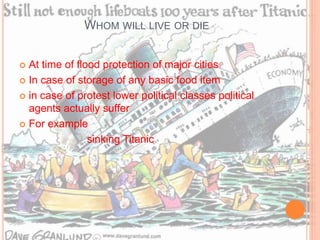
WHOM WILL LIVE OR DIE
 At time of flood protection of major cities
 In case of storage of any basic food item
 in case of protest lower political classes political
agents actually suffer
 For example
sinking Titanic
Forms of Stratification
1. THE SLAVERY SYSTEM
2. THE ESTATE SYSTEM
3. THE CASTE SYSTEM
4. THE CLASS SYSTEM
THE SLAVERY SYSTEM
"It is an extreme form of inequality in which some individuals
are owned by others as their property."
 LT Hobhouse defined slave as a man whom law and custom
regard as the property of another. In extreme cases he is wholly
without rights. He is in lower condition as compared with
freemen. The slaves have no political rights he does not choose
his government, he does not attend the public councils. Socially
he is despised. He is compelled to work
EXAMPLE:
Societies of the ancient world based upon slavery (Greek and
Roman) and southern states of USA in the 18th and19th
centuries.
 according to H J Nieboer the basis of slavery is always economic
because with it emerged a kind of aristocracy which lived upon
slave labour.
THE CASTE SYSTEM
 " A person's location in the social strata is ascribed
by birth rather than based on individual
accomplishments.“
 The system is maintained through,
Endogamous Marriages:
Cultural rules requiring that people
marry only within their own group,
 Apartheid:
law that formalized strict racial
segregation
THE CASTE SYSTEM
 This system of stratification is mostly prominent in India
and the Hindu religion
 , 1. The Brahmins (priests/teachers/healers) From the
most pure
 2. The Kshatriyas (soldiers/warriors)
 3. The Vaishyas (traders/merchants)
 4. The Shudras (servants/labourers)
 5. The Untouchables (social outcastes/impure) To the
least pure.
THE CLASS SYSTEM
 Industrial society gave rise to class based system
of Stratification
"It is based on a combination of ascribed and
achieved statuses."
 Usually synonymous with socioeconomic status,
which is one's social position as determined by
income, wealth, occupational prestige, and
educational attainment,
THE COMMON THREE-STRATUM
MODEL
 The upper class is the social class composed of those who
are wealthy, well-born, or both. They usually wield the greatest
political power
 The middle class is the most contested of the three categories
consisting of the broad group of people in contemporary
society who fall socioeconomically between the lower class
and upper class. Middle class workers are sometimes called
white collar workers.
 The lower or working class is sometimes separated into those
who are employed as wage or hourly workers, and an
underclass those who are long-term unemployed and/or
homeless, especially those receiving welfare from the state
Members of the working class are sometimes called blue
collar workers.
THE ESTATE SYSTEM
"The estate system is synonymous with Feudalism".
Characteristics of Feudal Estate:
 In the first place they were legally defined: each estate
had a status with legal rights and duties. privileges and
obligations
 Secondly the estates represented a broad division of
labor and were regarded as having definite functions.
The nobility were ordained to defend all the clergy to
pray for all and the commons to provide food for all
 Thirdly the feudal estates were political groups. An
assembly of estates possessed political power.
 Thus the three estates clergy, Nobility and commoners
functioned like three political groups.

social stratification

  • 1.
  • 2.
    LEARNING OUTLINE 1 INTRODUCTION definition  Origin  Causes  Characteristics 2 IMPACT OF SOCIAL STRATIFICATION 3 FORMS OF STRATIFICATION
  • 3.
    SOCIAL STRATIFICATION  socialstratification is a term used in the social science to describe the relative social position of persons  in a given social group category geographical region or other social unit  it derives from the latin stratum (plural strata parallel horizontal layers)  referring to a given societies categorisation of its people into ranking of socioeconomic tiers  based on factors like wealth income social status occupation and power
  • 4.
     According toRaymond W. Murray “Social stratification is a horizontal division of society into “higher” and “lower” social units.” SOCIAL STRATIFICATION
  • 5.
     According toGILBERT social stratification is the division of society into permanent groups or categories linked with each other by the relationship of Superiority and subordination SOCIAL STRATIFICATION
  • 6.
     According toLundberg a stratified society is one marked by inequality by differences among people that are evaluated by them as being lower and higher SOCIAL STRATIFICATION
  • 7.
    ORIGINS OF SOCIALSTRATIFICATION  Hunting and Gathering Societies  Horticultural, Pastoral, and Agricultural Societies  Division of Labour and Job Specialization  Industrialized Societies  The Improvement of Working Conditions  Postindustrial Societies
  • 8.
    CAUSES OF SOCIALSTRATIFICATION  There are five basic point which give a clear idea about the causes of social stratification: 1 Inequality 2 Conflict 3 Power 4 Wealth 5 instability
  • 9.
    CHARACTERISTICS OF SOCIALSTRATIFICATION Social stratification may have the following Characteristics:  Social stratification is universal  Stratification is social  It is ancient  It is in diverse forms  Social stratification is Consequential
  • 10.
    IMPACT OF STRATIFICATIONON OUR LIFE It leads to inequality regarding........ Health sector Education Bounds individual action Specification of social role Societal law Whom will live or die
  • 11.
    HEALTH SECTOR Expensive healthcarefacilities VIP culture Different treatment quality Discriminating attitude of care providers unequal distribution of clean water and save environment in different zones of a city
  • 12.
    EDUCATION Different education system Specificmethod of teaching Outdated syllabus Language conflicts Leads to job discrimination
  • 13.
    BOUNDS INDIVIDUAL ACTION Different political affiliation  Limit our opportunities to work  Limit our perceptive  Stereotyping  Liabialization  Stops one to ask question
  • 14.
    SPECIFICATION OF SOCIALROLE  Mother bond to care for children  Preferred specific profession like doctor engineers and bankers  Father bound to be earner  Child are bound to respect their elders and parent
  • 15.
    SOCIETAL LAW  Punishmentamplification  Traffic rules  Bank policies  Discrimination in journalism
  • 16.
    WHOM WILL LIVEOR DIE  At time of flood protection of major cities  In case of storage of any basic food item  in case of protest lower political classes political agents actually suffer  For example sinking Titanic
  • 17.
    Forms of Stratification 1.THE SLAVERY SYSTEM 2. THE ESTATE SYSTEM 3. THE CASTE SYSTEM 4. THE CLASS SYSTEM
  • 18.
    THE SLAVERY SYSTEM "Itis an extreme form of inequality in which some individuals are owned by others as their property."  LT Hobhouse defined slave as a man whom law and custom regard as the property of another. In extreme cases he is wholly without rights. He is in lower condition as compared with freemen. The slaves have no political rights he does not choose his government, he does not attend the public councils. Socially he is despised. He is compelled to work EXAMPLE: Societies of the ancient world based upon slavery (Greek and Roman) and southern states of USA in the 18th and19th centuries.  according to H J Nieboer the basis of slavery is always economic because with it emerged a kind of aristocracy which lived upon slave labour.
  • 19.
    THE CASTE SYSTEM " A person's location in the social strata is ascribed by birth rather than based on individual accomplishments.“  The system is maintained through, Endogamous Marriages: Cultural rules requiring that people marry only within their own group,  Apartheid: law that formalized strict racial segregation
  • 20.
    THE CASTE SYSTEM This system of stratification is mostly prominent in India and the Hindu religion  , 1. The Brahmins (priests/teachers/healers) From the most pure  2. The Kshatriyas (soldiers/warriors)  3. The Vaishyas (traders/merchants)  4. The Shudras (servants/labourers)  5. The Untouchables (social outcastes/impure) To the least pure.
  • 21.
    THE CLASS SYSTEM Industrial society gave rise to class based system of Stratification "It is based on a combination of ascribed and achieved statuses."  Usually synonymous with socioeconomic status, which is one's social position as determined by income, wealth, occupational prestige, and educational attainment,
  • 22.
    THE COMMON THREE-STRATUM MODEL The upper class is the social class composed of those who are wealthy, well-born, or both. They usually wield the greatest political power  The middle class is the most contested of the three categories consisting of the broad group of people in contemporary society who fall socioeconomically between the lower class and upper class. Middle class workers are sometimes called white collar workers.  The lower or working class is sometimes separated into those who are employed as wage or hourly workers, and an underclass those who are long-term unemployed and/or homeless, especially those receiving welfare from the state Members of the working class are sometimes called blue collar workers.
  • 23.
    THE ESTATE SYSTEM "Theestate system is synonymous with Feudalism". Characteristics of Feudal Estate:  In the first place they were legally defined: each estate had a status with legal rights and duties. privileges and obligations  Secondly the estates represented a broad division of labor and were regarded as having definite functions. The nobility were ordained to defend all the clergy to pray for all and the commons to provide food for all  Thirdly the feudal estates were political groups. An assembly of estates possessed political power.  Thus the three estates clergy, Nobility and commoners functioned like three political groups.