

Social Welfare,
Social Development and
Sustainable Development
Presentors:
CRYSTAL A.
AGUILAR ALMERA Y. ALLER
20XX presentation title 2
SOCIAL WELFARE
Social Welfare
"Social welfare as on organized concern of all people for all
people."
-Gertrude Wilson
"The organized system of social services and institution,
designed to aid individuals and groups to attain satisfying
standards of life and health "
- Walter Friedlander
"Social welfare includes those laws, programs, benefits and
services which assure or strengthen provisions for meeting social
needs recognized as basic to the well-being of the population
and the better functioning of the social order.“
-Elizabeth Wickenden
(Source: Orange Book page.1)
3
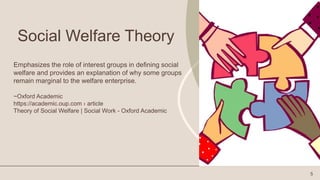
Social Welfare Theory
Emphasizes the role of interest groups in defining social
welfare and provides an explanation of why some groups
remain marginal to the welfare enterprise.
~Oxford Academic
https://academic.oup.com › article
Theory of Social Welfare | Social Work - Oxford Academic
5
PROCESS
1. Assessment: This is the initial step where a social worker or case manager evaluates the
individual's or family's situation and needs.
2. Planning: Developed to address the specific needs and goals identified.
3. Implementation: The individual or family can begin accessing the services and support outlined
in the plan.
4. Monitoring and evaluation: Throughout the process, progress is monitored to ensure that the
individual or family is receiving the necessary support and services. Evaluations may also be
conducted to assess the effectiveness of the interventions in meeting the individual's or family's
needs.
5. Review and adjustment: As circumstances change, the social welfare plan may need to be
reviewed and adjusted to reflect new needs or goals.
6
Examples in relation to social work:
1. Social security Whole set of compulsory measures instituted to protect the individual and
his family against the consequences of an unavoidable interruption of serious diminution of the
earn income disposable for the maintenance of a reasonable standard of living. Examples are
compulsory employer liability (with or without insurance), provident funds and social insurance.
2. Personal social services refer to service functions which have a major bearing upon
personal problems, individual situation of stress, interpersonal helping or helping people in need,
and the provision of direct services in collaboration with workers from government and voluntary
agencies. Examples are programs for counseling therapy and rehabilitation programs for
providing access information and advice; institutional services child protective services; and
programs for the treatment of deviants.
3. Public assistance this refer to material/ concrete aids/ support provided usually by
government agencies to people who have no income or means of support for themselves and
their families for reasons such as loss of employment, natural disaster, etc. In many foreign
countries public assistant is simply called "welfare."ation, and Discrimination Act is a legislative
measure in this regard.
7
Philippine Context:
In the Philippines, social welfare is a crucial aspect of governance and community well-being. The country has
various programs and policies aimed at addressing social issues and improving the living conditions of its citizens.
The Department of Social Welfare and Development (DSWD) is a key government agency responsible for
implementing social welfare programs.
KEY ASPECTS OF SOCIAL WELFARE IN THE
PHILIPPINES:
o Conditional Cash Transfer Programs: The Pantawid Pamilyang Pilipino Program (4Ps) is a
flagship social assistance program providing cash grants to qualified low-income families. It
aims to alleviate poverty and promote human capital development, particularly in health and
education.
o Community-Based Programs: Barangay-level initiatives and community-driven projects
focus on addressing local needs and promoting social welfare. These may include livelihood
programs, health services, and disaster preparedness efforts.
o Child Protection and Welfare: The government works to protect children's rights through
programs addressing issues like child labor, abuse, and neglect. The Special Protection of
Children Against Abuse, Exploitation, and Discrimination Act is a legislative measure in this
regard. 8
o Disaster Response and Rehabilitation: Given the Philippines' vulnerability to
natural disasters, social welfare efforts also involve disaster response and
rehabilitation programs. The DSWD plays a key role in providing aid to
affected communities.
o Elderly and Persons with Disabilities: Social pension programs support senior
citizens, and there are initiatives to enhance the well-being of persons with
disabilities. The Expanded Senior Citizens Act and the Magna Carta for
Disabled Persons are legislative measures providing protection and
assistance.
o Mental Health Programs: Recognizing the importance of mental health, the
Philippines has been working on programs to address mental health issues
and reduce the stigma associated with mental illnesses.
While progress has been made, challenges persist, including issues of poverty, inequality, and
regional disparities. Social welfare policies continue to evolve to address these challenges and
enhance the overall quality of life for Filipinos.
9
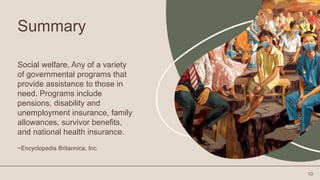
Summary
Social welfare, Any of a variety
of governmental programs that
provide assistance to those in
need. Programs include
pensions, disability and
unemployment insurance, family
allowances, survivor benefits,
and national health insurance.
~Encyclopedia Britannica, Inc.
10
SOCIAL
DEVELOPMENT
Social Development
Social development is about improving the well-
being of every individual in society so they can
reach their full potential. The success of society is
linked to the well-being of each and every citizen.
Social development means investing in people.
~Government of New Brunswick/ www2.gnb.ca
13
Social
Development
Model
Social development theories often draw from broader sociological perspectives.
Theories like modernization theory, dependency theory also play a role in
understanding and promoting social development. They explore economic,
political, and cultural factors influencing societal progress.
Process.
Vygotsky's Theory of Social Development
Social development theory began with a man named Lev Vygotsky, a scientist in
the Soviet Union. He developed a model on social development that continues to
be widely used.
His theory of social development states that children and individuals develop their
behaviors and habits based on the actions of their peers and those whom they see
as authority figures. Through these interactions, they develop a mental framework
of things they can do, things they can only do with help, and things they cannot do
under any circumstances. They also develop a "zone of proximal development,"
which are certain behaviors and actions that they can work on to eventually be able
to complete autonomously. 3
Social development is the process through which
children learn about their society and the proper ways to
act within it. It is a process through which behaviors,
perspectives, and attitudes are learned
3
Examples in relation to
social work:
Education Initiatives: Social workers contribute to social development by
promoting access to education, facilitating school-based programs, and advocating
for policies that enhance educational opportunities, especially for marginalized
populations.
•Community Organizing: Social workers engage in community organizing efforts,
helping communities identify their strengths and needs, facilitating collaboration, and
advocating for resources that enhance overall well-being.
• Crisis Intervention and Disaster Response: Social workers are often involved in
disaster response and recovery efforts, contributing to the social development of
affected communities by providing psychosocial support, coordinating resources,
and facilitating resilience-building activities.
3
Philippine Context
Social development has improved the access of
Filipinos to quality basic social service delivery in
education, training and culture; health and
nutrition; population and development; housing;
social protection; and asset reform..
3
Summary
Social development is the evolution
and improvement in the living
conditions of the individuals of
society.
3
Sustainable Development
Sustainable development is a way of organizing
society so that it can exist in the long term. This
means taking into account both the imperatives
present and those of the future, such as the
preservation of the environment and natural
resources or social and economic equity.
20
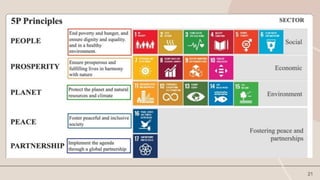
21
22
Examples in relation to social work:
Community-Based Conservation
Projects: Social workers can
engage communities in sustainable
development by promoting
conservation projects that protect
natural resources while addressing
social needs.
20XX presentation title 23
Philippine Context
The 2023 Sustainable Development
Report indicates that the Philippines
has substantial progress to make in its
pursuit of SDG goals, rating it with a
score of 67.1% and rank of 98 out of
166 countries assessed in the SDG
Index.
20XX presentation title 24
Philippine Context
In the Philippines, sustainable development is addressed through various
initiatives, including:
• Community-Based Organic Farming: Encouraging sustainable agriculture
practices that consider environmental impact and support local communities.
• Coastal Resource Management Programs: Focused on preserving marine
ecosystems while providing livelihood opportunities for coastal communities.
• Renewable Energy Projects: Advancing the use of renewable energy sources to
address energy needs while minimizing environmental impact.
• Social Protection Programs: Targeting poverty alleviation and social equity to
ensure that economic development benefits all segments of society.
25
Summary
Sustainable development is
development that meets the needs of
the present without compromising the
ability of future generations to meet
their own needs.
3
27
"When you do the things in the present
that you can see, you are shaping the
future that you are yet to see."
IDOWU KOYENIKAN
thank you

Social Welfare,Social development,Sustainable Development.pptx

  • 1.
    Social Welfare, Social Developmentand Sustainable Development
  • 2.
    Presentors: CRYSTAL A. AGUILAR ALMERAY. ALLER 20XX presentation title 2
  • 3.
  • 4.
    Social Welfare "Social welfareas on organized concern of all people for all people." -Gertrude Wilson "The organized system of social services and institution, designed to aid individuals and groups to attain satisfying standards of life and health " - Walter Friedlander "Social welfare includes those laws, programs, benefits and services which assure or strengthen provisions for meeting social needs recognized as basic to the well-being of the population and the better functioning of the social order.“ -Elizabeth Wickenden (Source: Orange Book page.1) 3
  • 5.
    Social Welfare Theory Emphasizesthe role of interest groups in defining social welfare and provides an explanation of why some groups remain marginal to the welfare enterprise. ~Oxford Academic https://academic.oup.com › article Theory of Social Welfare | Social Work - Oxford Academic 5
  • 6.
    PROCESS 1. Assessment: Thisis the initial step where a social worker or case manager evaluates the individual's or family's situation and needs. 2. Planning: Developed to address the specific needs and goals identified. 3. Implementation: The individual or family can begin accessing the services and support outlined in the plan. 4. Monitoring and evaluation: Throughout the process, progress is monitored to ensure that the individual or family is receiving the necessary support and services. Evaluations may also be conducted to assess the effectiveness of the interventions in meeting the individual's or family's needs. 5. Review and adjustment: As circumstances change, the social welfare plan may need to be reviewed and adjusted to reflect new needs or goals. 6
  • 7.
    Examples in relationto social work: 1. Social security Whole set of compulsory measures instituted to protect the individual and his family against the consequences of an unavoidable interruption of serious diminution of the earn income disposable for the maintenance of a reasonable standard of living. Examples are compulsory employer liability (with or without insurance), provident funds and social insurance. 2. Personal social services refer to service functions which have a major bearing upon personal problems, individual situation of stress, interpersonal helping or helping people in need, and the provision of direct services in collaboration with workers from government and voluntary agencies. Examples are programs for counseling therapy and rehabilitation programs for providing access information and advice; institutional services child protective services; and programs for the treatment of deviants. 3. Public assistance this refer to material/ concrete aids/ support provided usually by government agencies to people who have no income or means of support for themselves and their families for reasons such as loss of employment, natural disaster, etc. In many foreign countries public assistant is simply called "welfare."ation, and Discrimination Act is a legislative measure in this regard. 7
  • 8.
    Philippine Context: In thePhilippines, social welfare is a crucial aspect of governance and community well-being. The country has various programs and policies aimed at addressing social issues and improving the living conditions of its citizens. The Department of Social Welfare and Development (DSWD) is a key government agency responsible for implementing social welfare programs. KEY ASPECTS OF SOCIAL WELFARE IN THE PHILIPPINES: o Conditional Cash Transfer Programs: The Pantawid Pamilyang Pilipino Program (4Ps) is a flagship social assistance program providing cash grants to qualified low-income families. It aims to alleviate poverty and promote human capital development, particularly in health and education. o Community-Based Programs: Barangay-level initiatives and community-driven projects focus on addressing local needs and promoting social welfare. These may include livelihood programs, health services, and disaster preparedness efforts. o Child Protection and Welfare: The government works to protect children's rights through programs addressing issues like child labor, abuse, and neglect. The Special Protection of Children Against Abuse, Exploitation, and Discrimination Act is a legislative measure in this regard. 8
  • 9.
    o Disaster Responseand Rehabilitation: Given the Philippines' vulnerability to natural disasters, social welfare efforts also involve disaster response and rehabilitation programs. The DSWD plays a key role in providing aid to affected communities. o Elderly and Persons with Disabilities: Social pension programs support senior citizens, and there are initiatives to enhance the well-being of persons with disabilities. The Expanded Senior Citizens Act and the Magna Carta for Disabled Persons are legislative measures providing protection and assistance. o Mental Health Programs: Recognizing the importance of mental health, the Philippines has been working on programs to address mental health issues and reduce the stigma associated with mental illnesses. While progress has been made, challenges persist, including issues of poverty, inequality, and regional disparities. Social welfare policies continue to evolve to address these challenges and enhance the overall quality of life for Filipinos. 9
  • 10.
    Summary Social welfare, Anyof a variety of governmental programs that provide assistance to those in need. Programs include pensions, disability and unemployment insurance, family allowances, survivor benefits, and national health insurance. ~Encyclopedia Britannica, Inc. 10
  • 11.
  • 12.
    Social Development Social developmentis about improving the well- being of every individual in society so they can reach their full potential. The success of society is linked to the well-being of each and every citizen. Social development means investing in people. ~Government of New Brunswick/ www2.gnb.ca 13
  • 13.
  • 14.
    Social development theoriesoften draw from broader sociological perspectives. Theories like modernization theory, dependency theory also play a role in understanding and promoting social development. They explore economic, political, and cultural factors influencing societal progress. Process. Vygotsky's Theory of Social Development Social development theory began with a man named Lev Vygotsky, a scientist in the Soviet Union. He developed a model on social development that continues to be widely used. His theory of social development states that children and individuals develop their behaviors and habits based on the actions of their peers and those whom they see as authority figures. Through these interactions, they develop a mental framework of things they can do, things they can only do with help, and things they cannot do under any circumstances. They also develop a "zone of proximal development," which are certain behaviors and actions that they can work on to eventually be able to complete autonomously. 3
  • 15.
    Social development isthe process through which children learn about their society and the proper ways to act within it. It is a process through which behaviors, perspectives, and attitudes are learned 3
  • 16.
    Examples in relationto social work: Education Initiatives: Social workers contribute to social development by promoting access to education, facilitating school-based programs, and advocating for policies that enhance educational opportunities, especially for marginalized populations. •Community Organizing: Social workers engage in community organizing efforts, helping communities identify their strengths and needs, facilitating collaboration, and advocating for resources that enhance overall well-being. • Crisis Intervention and Disaster Response: Social workers are often involved in disaster response and recovery efforts, contributing to the social development of affected communities by providing psychosocial support, coordinating resources, and facilitating resilience-building activities. 3
  • 17.
    Philippine Context Social developmenthas improved the access of Filipinos to quality basic social service delivery in education, training and culture; health and nutrition; population and development; housing; social protection; and asset reform.. 3
  • 18.
    Summary Social development isthe evolution and improvement in the living conditions of the individuals of society. 3
  • 19.
  • 20.
    Sustainable development isa way of organizing society so that it can exist in the long term. This means taking into account both the imperatives present and those of the future, such as the preservation of the environment and natural resources or social and economic equity. 20
  • 21.
  • 22.
  • 23.
    Examples in relationto social work: Community-Based Conservation Projects: Social workers can engage communities in sustainable development by promoting conservation projects that protect natural resources while addressing social needs. 20XX presentation title 23
  • 24.
    Philippine Context The 2023Sustainable Development Report indicates that the Philippines has substantial progress to make in its pursuit of SDG goals, rating it with a score of 67.1% and rank of 98 out of 166 countries assessed in the SDG Index. 20XX presentation title 24
  • 25.
    Philippine Context In thePhilippines, sustainable development is addressed through various initiatives, including: • Community-Based Organic Farming: Encouraging sustainable agriculture practices that consider environmental impact and support local communities. • Coastal Resource Management Programs: Focused on preserving marine ecosystems while providing livelihood opportunities for coastal communities. • Renewable Energy Projects: Advancing the use of renewable energy sources to address energy needs while minimizing environmental impact. • Social Protection Programs: Targeting poverty alleviation and social equity to ensure that economic development benefits all segments of society. 25
  • 26.
    Summary Sustainable development is developmentthat meets the needs of the present without compromising the ability of future generations to meet their own needs. 3
  • 27.
    27 "When you dothe things in the present that you can see, you are shaping the future that you are yet to see." IDOWU KOYENIKAN
  • 28.