Dr. Sujnanendra Mishra
Bolangir
ODISHA
 Two major Hemoglobin Disorders; Sickle Cell
Disease (SCD) and Thalassemia, have been
declared as global health problem by WHO.
 SCD is an autosomal recessive Hb disorder
that affects individuals and societies
physically, economically and psycho-socially,.
 Key to prevention is understanding how SCD
is inherited from parents in the same way as
blood group or any other physical trait..
Hb S is formed by the substitution
of valine for glutamic acid in the
second nucleotide of the sixth codon
of the
β-globin chain of Hb A.
This single-point mutation changes
the codon determining the amino
acid from GAG coding for glutamic
acid to GTG coding for valine.
Base Substitution mutation
Change in one base
May change an amino acid
in the polypeptide chain
This may have no affect or a great effect:
A change in one amino acid may
change the shape of a protein so that
it does not work properly.
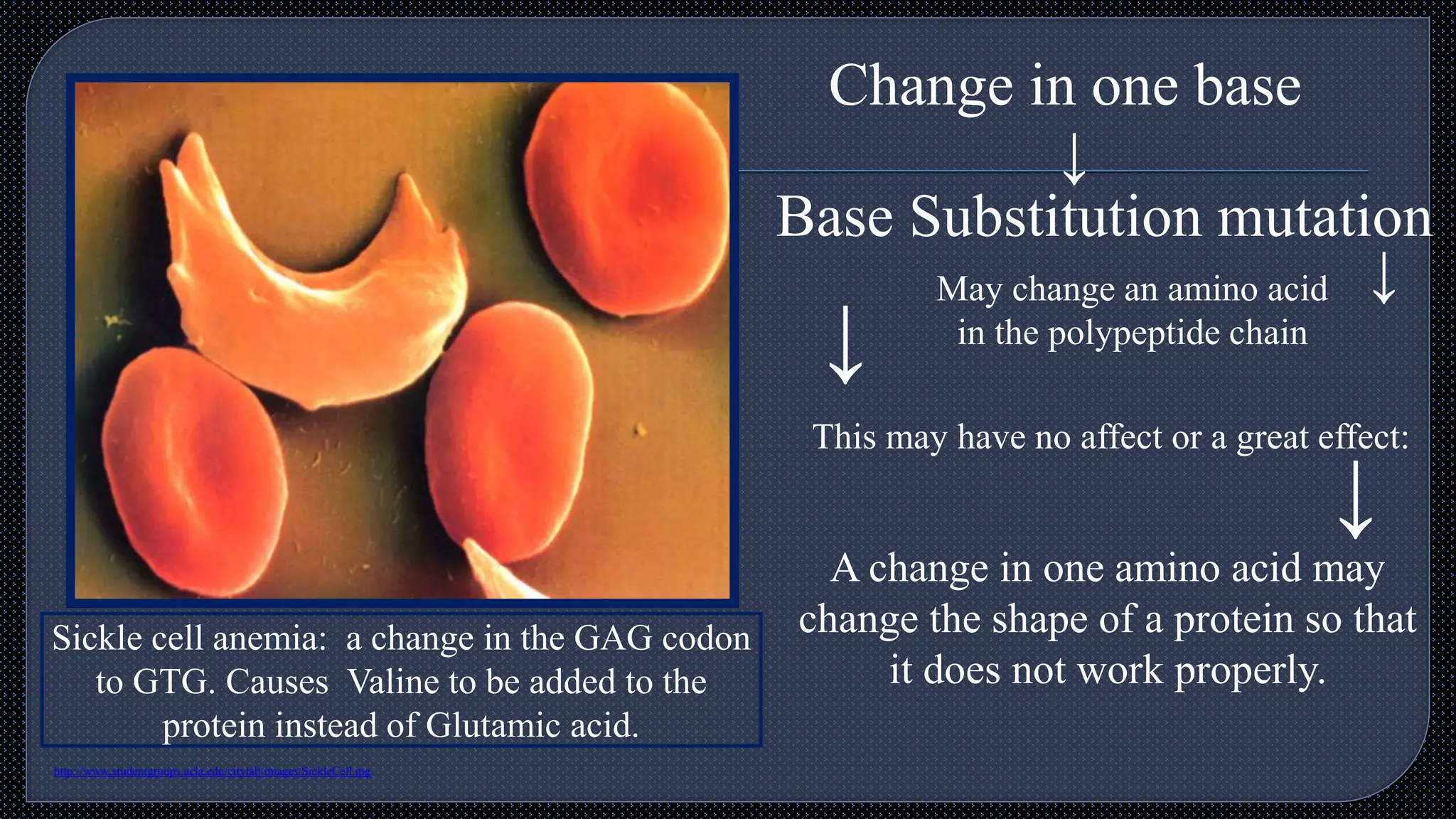
Sickle cell anemia: a change in the GAG codon
to GTG. Causes Valine to be added to the
protein instead of Glutamic acid.
http://www.studentgroups.ucla.edu/citylab/images/SickleCell.jpg
↓
↓
↓
↓
Sickle cell disease is inherited in
an autosomal recessive fashion.
• People with sickle cell disease
have two copies of the mutated
gene.
• People with sickle cell trait have
one normal gene and one mutated
gene.
 Studies are limited.
 Odisha falls in the High prevalence Zone in INDIA.(Incidence 21-40 %)**
• About 6 lac individuals are affected by sickle cell ailment in Odisha.
• 13 districts mostly in western Odisha contribute 90% .
• These Districts are Angul, Bargarh, Bolangir, Boudh, Deogarh, Dhenkanal,
Jharsuguda, Kalahandi, Nuapada, Phulbani,Sambalpur, Sonepur, & Sundergarh.
 In the neighboring Kalahandi district of Odisha*,
• 1668 newborns were screened for Genotype.
 19.03 per cent were sickle heterozygous and
 36 (2.16 %) babies with sickle cell anemia were identified.
 Test Results of Antenatal cases tested for Sickle cell disorders in 5 Patho-
labs situated at different places in the District were analysed.
*Panigrahi S. Patra PK, Khodiar PK. Neonatal screening of sickle cell anemia: a preliminary report. Indian J Pediatr2012; 79: 747-50.) **http://sickleodisha.org/ (NHM sponsored institute at VIMSAR )
PATHOLAB
Total ANC Tested For
Sickle Cell Disorders
Number of
POSITIVE
INCIDENCE
%
A 1174 140 11.92
B 712 69 9.69
C 1280 113 8.83
D 1043 97 9.30
E 1246 124 9.95
Total 5455 543 9.95
GENOTYPE (HPLC) AS SS
Screened Positive
543
461 82
% share
Among Positives
84.90 15.10
Incidence
% Among
5455 ANC(9.95)
8.45 1.50
KNOWLEDGE ON SICKLE CELL
DISORDERS AMONG THE ADOLESCENTS
Adolescents have low levels of knowledge about
 SCD and SCT and health implications thereof.
 Genetic transmission of SCD and SCT.
 The importance of Genetic counseling in prevention of SCD.
A significant number of participants will be uncertain
about their genotype.
To determine the current knowledge and health beliefs of the
Adolescent students regarding
• SCD and
• Its inheritance.
• Their GENOTYPE STATUS
• Genetic Counseling
To determine their behavior towards someone with sickle cell
disorder on Reproductive Health Perspective.
Research findings: when
compared to healthy pregnant
women, pregnant women with
a severe form of sickle cell
disease (SCD) are six times
more likely to die during or
following pregnancy and have
an increased risk for stillbirth,
high blood pressure, and
preterm delivery.
*Maternal Mortality Rate (UK) among women without sickle cell disease is 5 per 1000 Births Maternal Mortality Rate
(UK) among women without sickle cell disease 0.06 per 1000 Births.
*http://www.sickle-thal.nwlh.nhs.uk/forhealthcareprofessionals/MidwivesFocusSickleCell.aspx
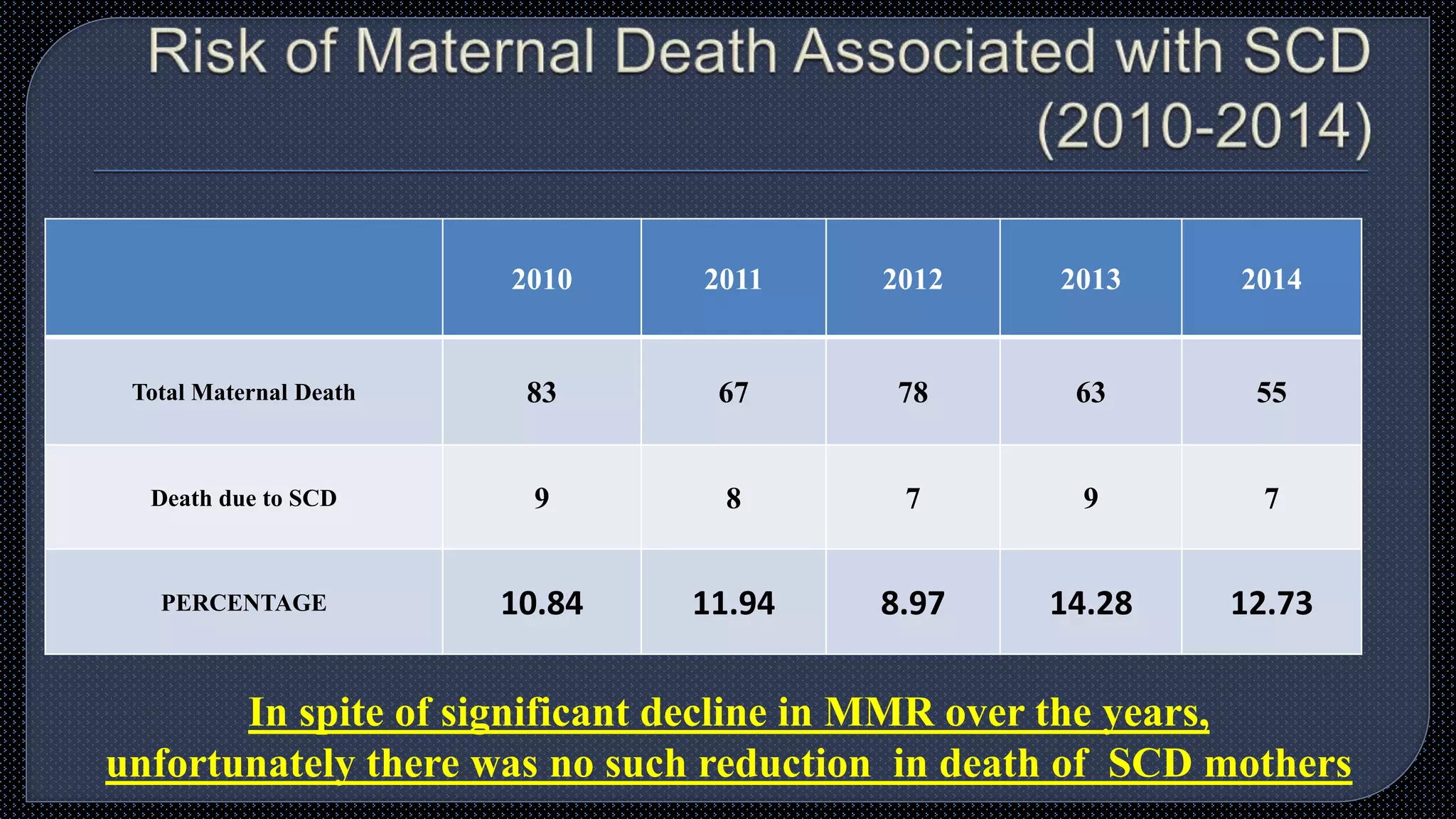
2010 2011 2012 2013 2014
Total Maternal Death 83 67 78 63 55
Death due to SCD 9 8 7 9 7
PERCENTAGE 10.84 11.94 8.97 14.28 12.73
In spite of significant decline in MMR over the years,
unfortunately there was no such reduction in death of SCD mothers
 Participants: 1097 students aged between 16 to 21 years. From 5 colleges out of
29 degree colleges, selected by simple balloting.
 Measures
• Demographic Variables.
• Sickle Cell Trait Knowledge and belief.
• Behavior to someone with sickle cell diseases over RH.
 Procedure
• Self-administered Questionnaire used.
• Consent obtained (opt-in).
• Terminologies were explained to respondents before the test.
 Data Inspection and Analyses
• The data obtained was entered in to XLs data sheet.
• Answer of Participants (296) not aware of Sickle Cell Disorder were excluded from further Analysis.
 Statistical Analyses: Simple percentage analysis of the Data was done.
 The respondent's age ranged
between 16- 21 years, 331 (30.2%)
were 21 years of age.
 Females 599 (54.6%) and males
498 (45.4%).
 The majority were Hindus 995
(90.7%), 81(7.38%) Christians, 21
(1.91%) were Muslim.
 58.52% were from science stream.
 73.02% Aware of SCD.
 97.5% know someone with SCD.
 44.82% have friends with SCD.
 45.94% don't know that it is
inherited.
 40.57 not aware of signs and
symptoms.
 28.81% don't know that SCD is
diagnosed from blood test.
 75.16% know that Blood Transfusion is the
treatment,
 ONLY 35.33% know the importance of other
measures.
 3.25% know that none of the children be
SCD when one of the parents has SC Trait
and
 2.37% belief that chances of ¼th. Children
being SCD when both parents have SC Trait.
 1.62 % know Genetic Counselling as a
preventing measure.
 51.32% think one should know his genotype.
 Only 7.89% know their Genotype.
 As many as 12.5% have SS and 64.58% have
AS among the known genotype.
 67.6% belief, partner genotype will not
influence decision to marry him or her.
 47.7% don't know what to do if there is risk
to their children having SCD.
 Only 11.68% would prefer seeking genetic
counselling.
Treatment without prevention is simply unsustainable.
Bill Gates
Social
determinants
of health
Standards of
Health Care
Genetics factor
POSSIBLE
though
Risk Reduction
Reproductive health
Better Maternal
&
Child health
Reduction of
Morbidity
&
Mortality
Genotype
Testing &
Counseling
Informed
Reproductive
Choice
Opportunity at all STAGES
Life Cycle Approach
 The fetal Genetic identity is the culmination of a sequence of
events and interacting factors during
• Premarital period.
• Preconception and
• Pregnancy Period.
 Major Genetic Disorders can be prevented by ELIMINATION
of RISK.
 Key to Prevention is Universal Genotyping and stage
appropriate Counseling.
 Decreasing high-risk marriages,
• would reduce number of sickle cell pregnant
women.
• would reduce number of maternal deaths.
 To improve this outcome, we need
intensified counseling for
• High-risk adolescents and
• High-risk couples,
 Strengthening of the health education
program
 Timing the screening for yielding HIGH
Impact outcome
• Premarital (i.e. by the end of college
education).
• Pre-conception,
PREMARITAL
COUNSELING
If heterozygous marriage can be prevented or reduced, the risk of
giving birth to affected child also be minimized :
• Sickle cell anaemia,
• Thalassemia.
 Nos. of Sickle cell Disease can be REDUCED.
 This in turn will reduce No. of Pregnancy with SCD.
 Sickle Cell Disease related Maternal Deaths can be AVOIDED.
INHERITANCE
 Sickle cell disease is common, incurable, autosomal
recessive inheritable Hemoglobinopathy that causes
significant morbidity and mortality and imposes a
heavy burden on society.
 A simple blood test before marriage can
• Detect carriers of these diseases,
• Enable couples knowing about their chances of producing
affected children and
• Ensure receiving timely appropriate advice.
 Premarital screening programmes have become widely
accepted and highly valued in preventive healthcare, so
much so that many countries have made them
mandatory.
 Prenatal genotyping and Counselling for High Risk
Couple should be encouraged with in the purview of
PC&PNDT act.
In conclusion,
Social preventive obstetrics. Sickle Cell Disease

Social preventive obstetrics. Sickle Cell Disease

  • 1.
  • 2.
     Two majorHemoglobin Disorders; Sickle Cell Disease (SCD) and Thalassemia, have been declared as global health problem by WHO.  SCD is an autosomal recessive Hb disorder that affects individuals and societies physically, economically and psycho-socially,.  Key to prevention is understanding how SCD is inherited from parents in the same way as blood group or any other physical trait..
  • 3.
    Hb S isformed by the substitution of valine for glutamic acid in the second nucleotide of the sixth codon of the β-globin chain of Hb A. This single-point mutation changes the codon determining the amino acid from GAG coding for glutamic acid to GTG coding for valine.
  • 4.
    Base Substitution mutation Changein one base May change an amino acid in the polypeptide chain This may have no affect or a great effect: A change in one amino acid may change the shape of a protein so that it does not work properly. Sickle cell anemia: a change in the GAG codon to GTG. Causes Valine to be added to the protein instead of Glutamic acid. http://www.studentgroups.ucla.edu/citylab/images/SickleCell.jpg ↓ ↓ ↓ ↓
  • 5.
    Sickle cell diseaseis inherited in an autosomal recessive fashion. • People with sickle cell disease have two copies of the mutated gene. • People with sickle cell trait have one normal gene and one mutated gene.
  • 6.
     Studies arelimited.  Odisha falls in the High prevalence Zone in INDIA.(Incidence 21-40 %)** • About 6 lac individuals are affected by sickle cell ailment in Odisha. • 13 districts mostly in western Odisha contribute 90% . • These Districts are Angul, Bargarh, Bolangir, Boudh, Deogarh, Dhenkanal, Jharsuguda, Kalahandi, Nuapada, Phulbani,Sambalpur, Sonepur, & Sundergarh.  In the neighboring Kalahandi district of Odisha*, • 1668 newborns were screened for Genotype.  19.03 per cent were sickle heterozygous and  36 (2.16 %) babies with sickle cell anemia were identified.  Test Results of Antenatal cases tested for Sickle cell disorders in 5 Patho- labs situated at different places in the District were analysed. *Panigrahi S. Patra PK, Khodiar PK. Neonatal screening of sickle cell anemia: a preliminary report. Indian J Pediatr2012; 79: 747-50.) **http://sickleodisha.org/ (NHM sponsored institute at VIMSAR )
  • 7.
    PATHOLAB Total ANC TestedFor Sickle Cell Disorders Number of POSITIVE INCIDENCE % A 1174 140 11.92 B 712 69 9.69 C 1280 113 8.83 D 1043 97 9.30 E 1246 124 9.95 Total 5455 543 9.95 GENOTYPE (HPLC) AS SS Screened Positive 543 461 82 % share Among Positives 84.90 15.10 Incidence % Among 5455 ANC(9.95) 8.45 1.50
  • 9.
    KNOWLEDGE ON SICKLECELL DISORDERS AMONG THE ADOLESCENTS
  • 10.
    Adolescents have lowlevels of knowledge about  SCD and SCT and health implications thereof.  Genetic transmission of SCD and SCT.  The importance of Genetic counseling in prevention of SCD. A significant number of participants will be uncertain about their genotype.
  • 11.
    To determine thecurrent knowledge and health beliefs of the Adolescent students regarding • SCD and • Its inheritance. • Their GENOTYPE STATUS • Genetic Counseling To determine their behavior towards someone with sickle cell disorder on Reproductive Health Perspective.
  • 13.
    Research findings: when comparedto healthy pregnant women, pregnant women with a severe form of sickle cell disease (SCD) are six times more likely to die during or following pregnancy and have an increased risk for stillbirth, high blood pressure, and preterm delivery. *Maternal Mortality Rate (UK) among women without sickle cell disease is 5 per 1000 Births Maternal Mortality Rate (UK) among women without sickle cell disease 0.06 per 1000 Births. *http://www.sickle-thal.nwlh.nhs.uk/forhealthcareprofessionals/MidwivesFocusSickleCell.aspx
  • 14.
    2010 2011 20122013 2014 Total Maternal Death 83 67 78 63 55 Death due to SCD 9 8 7 9 7 PERCENTAGE 10.84 11.94 8.97 14.28 12.73 In spite of significant decline in MMR over the years, unfortunately there was no such reduction in death of SCD mothers
  • 15.
     Participants: 1097students aged between 16 to 21 years. From 5 colleges out of 29 degree colleges, selected by simple balloting.  Measures • Demographic Variables. • Sickle Cell Trait Knowledge and belief. • Behavior to someone with sickle cell diseases over RH.  Procedure • Self-administered Questionnaire used. • Consent obtained (opt-in). • Terminologies were explained to respondents before the test.  Data Inspection and Analyses • The data obtained was entered in to XLs data sheet. • Answer of Participants (296) not aware of Sickle Cell Disorder were excluded from further Analysis.  Statistical Analyses: Simple percentage analysis of the Data was done.
  • 17.
     The respondent'sage ranged between 16- 21 years, 331 (30.2%) were 21 years of age.  Females 599 (54.6%) and males 498 (45.4%).  The majority were Hindus 995 (90.7%), 81(7.38%) Christians, 21 (1.91%) were Muslim.  58.52% were from science stream.
  • 18.
     73.02% Awareof SCD.  97.5% know someone with SCD.  44.82% have friends with SCD.  45.94% don't know that it is inherited.  40.57 not aware of signs and symptoms.  28.81% don't know that SCD is diagnosed from blood test.
  • 19.
     75.16% knowthat Blood Transfusion is the treatment,  ONLY 35.33% know the importance of other measures.  3.25% know that none of the children be SCD when one of the parents has SC Trait and  2.37% belief that chances of ¼th. Children being SCD when both parents have SC Trait.  1.62 % know Genetic Counselling as a preventing measure.
  • 20.
     51.32% thinkone should know his genotype.  Only 7.89% know their Genotype.  As many as 12.5% have SS and 64.58% have AS among the known genotype.  67.6% belief, partner genotype will not influence decision to marry him or her.  47.7% don't know what to do if there is risk to their children having SCD.  Only 11.68% would prefer seeking genetic counselling.
  • 21.
    Treatment without preventionis simply unsustainable. Bill Gates
  • 22.
    Social determinants of health Standards of HealthCare Genetics factor POSSIBLE though Risk Reduction Reproductive health Better Maternal & Child health Reduction of Morbidity & Mortality Genotype Testing & Counseling Informed Reproductive Choice Opportunity at all STAGES Life Cycle Approach
  • 23.
     The fetalGenetic identity is the culmination of a sequence of events and interacting factors during • Premarital period. • Preconception and • Pregnancy Period.  Major Genetic Disorders can be prevented by ELIMINATION of RISK.  Key to Prevention is Universal Genotyping and stage appropriate Counseling.
  • 24.
     Decreasing high-riskmarriages, • would reduce number of sickle cell pregnant women. • would reduce number of maternal deaths.  To improve this outcome, we need intensified counseling for • High-risk adolescents and • High-risk couples,  Strengthening of the health education program  Timing the screening for yielding HIGH Impact outcome • Premarital (i.e. by the end of college education). • Pre-conception,
  • 25.
    PREMARITAL COUNSELING If heterozygous marriagecan be prevented or reduced, the risk of giving birth to affected child also be minimized : • Sickle cell anaemia, • Thalassemia.  Nos. of Sickle cell Disease can be REDUCED.  This in turn will reduce No. of Pregnancy with SCD.  Sickle Cell Disease related Maternal Deaths can be AVOIDED.
  • 26.
  • 27.
     Sickle celldisease is common, incurable, autosomal recessive inheritable Hemoglobinopathy that causes significant morbidity and mortality and imposes a heavy burden on society.  A simple blood test before marriage can • Detect carriers of these diseases, • Enable couples knowing about their chances of producing affected children and • Ensure receiving timely appropriate advice.  Premarital screening programmes have become widely accepted and highly valued in preventive healthcare, so much so that many countries have made them mandatory.  Prenatal genotyping and Counselling for High Risk Couple should be encouraged with in the purview of PC&PNDT act. In conclusion,