LAQSHYA PROGRAMME
Dr. Pavithra R
DCQM-QA
Raichur
LAQSHYA- LABOUR ROOM QUALITY
IMPROVEMENT INITIATIVE GUIDELINE
 Started in 2018-19 in karnataka
 Goal- To reduce preventable maternal and
newborn mortality, morbidity and still births
associated with care around delivery in
labour room and maternity OT
 To ensure respectful maternity care.
LaQshya is all about improving Quality of Care
around birth
1. Quality Certification of Labour Room and/or
OT – through the existing system
2. Attainment of 75% of Facility level targets
3. At least 80% beneficiaries are satisfied with
the care
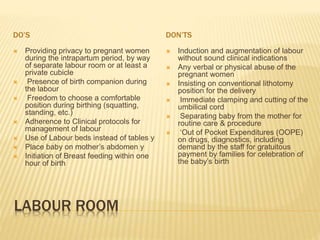
LABOUR ROOM
DO’S DON’TS
 Providing privacy to pregnant women
during the intrapartum period, by way
of separate labour room or at least a
private cubicle
 Presence of birth companion during
the labour
 Freedom to choose a comfortable
position during birthing (squatting,
standing, etc.)
 Adherence to Clinical protocols for
management of labour
 Use of Labour beds instead of tables y
 Place baby on mother’s abdomen y
 Initiation of Breast feeding within one
hour of birth
 Induction and augmentation of labour
without sound clinical indications
 Any verbal or physical abuse of the
pregnant women
 Insisting on conventional lithotomy
position for the delivery
 Immediate clamping and cutting of the
umbilical cord
 Separating baby from the mother for
routine care & procedure
 ‘Out of Pocket Expenditures (OOPE)
on drugs, diagnostics, including
demand by the staff for gratuitous
payment by families for celebration of
the baby’s birth
OBJECTIVES
 1. To reduce maternal and newborn mortality &
morbidity due to APH, PPH, retained placenta,
preterm, preeclampsia & eclampsia, obstructed
labour, puerperal sepsis, newborn asphyxia, and
sepsis, etc.
 2. To improve Quality of care during the delivery and
immediate post-partum care, stabilization of
complications and ensure timely referrals, and enable
an effective two-way follow-up system.
 3. To enhance satisfaction of beneficiaries visiting the
health facilities and provide Respectful Maternity
Care (RMC) to all pregnant women attending the
public health facility.
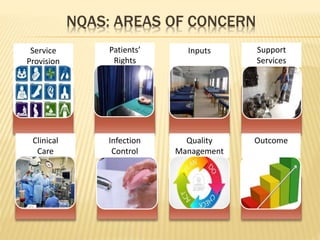
NQAS: AREAS OF CONCERN
Service
Provision
Inputs Support
Services
Clinical
Care
Infection
Control
Quality
Management
Outcome
Patients’
Rights
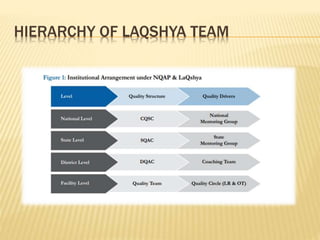
HIERARCHY OF LAQSHYA TEAM
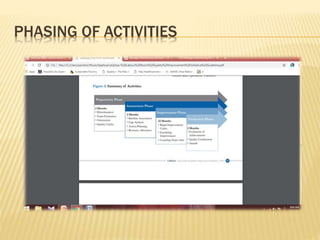
PHASING OF ACTIVITIES
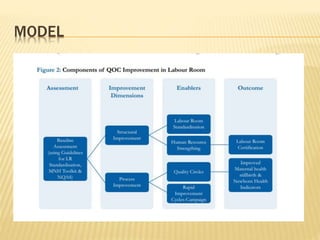
MODEL
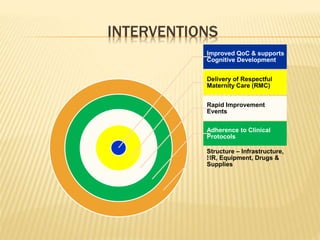
INTERVENTIONS
Improved QoC & supports
Cognitive Development
Delivery of Respectful
Maternity Care (RMC)
Rapid Improvement
Events
Adherence to Clinical
Protocols
Structure – Infrastructure,
HR, Equipment, Drugs &
Supplies
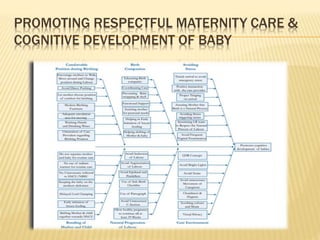
PROMOTING RESPECTFUL MATERNITY CARE &
COGNITIVE DEVELOPMENT OF BABY
RAPID IMPROVEMENT EVENTS
 Cycle 1: Real-time Partograph generation including shift to
electronic partograph & usage of safe birth check-list & surgical
safety check-list and strengthening documentation practices for
generating robust data for driving improvement.
 Cycle 2: Presence of Birth companion during delivery, respectful
maternity care and enhancement of patients’ satisfaction.
 Cycle 3: Assessment, Triage and timely management of
complications including strengthening of referral protocols.
 Cycle 4: Management of Labour as per protocols including
AMTSL & rational use of Oxytocin.
 Cycle 5: Essential and emergency care of Newborn & Pre-term
babies including management of birth asphyxia and timely
initiation of breast feeding as well as KMC for preterm newborn.
 Cycle 6: Infection Prevention including Biomedical Waste
Management.
STRUCTURAL IMPROVEMENT
 Upgrading the infrastructure as per norm &
realistic case-load
 Human Resource augmentation and upskilling
 Ensuring availability of functional & calibrated
equipment, as per need
 Strengthening supply chain of drugs &
consumables
PROCESS IMPROVEMENT
 Assessment and Triage
 Enablers for Respectful care
 Management of Labour including Active Management
of Third stage of labour
 Management of complications and High-Risk
Pregnancies
 Management of referral services
 Perioperative processes for C-Section
 New-born care and resuscitation
 Management of required Support services
OPERATION THEATRE
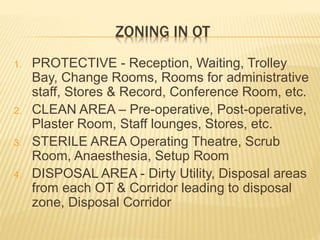
ZONING IN OT
1. PROTECTIVE - Reception, Waiting, Trolley
Bay, Change Rooms, Rooms for administrative
staff, Stores & Record, Conference Room, etc.
2. CLEAN AREA – Pre-operative, Post-operative,
Plaster Room, Staff lounges, Stores, etc.
3. STERILE AREA Operating Theatre, Scrub
Room, Anaesthesia, Setup Room
4. DISPOSAL AREA - Dirty Utility, Disposal areas
from each OT & Corridor leading to disposal
zone, Disposal Corridor
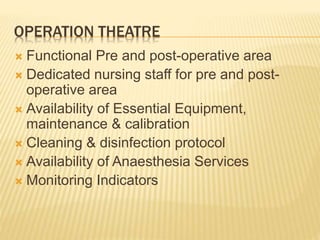
OPERATION THEATRE
 Functional Pre and post-operative area
 Dedicated nursing staff for pre and post-
operative area
 Availability of Essential Equipment,
maintenance & calibration
 Cleaning & disinfection protocol
 Availability of Anaesthesia Services
 Monitoring Indicators
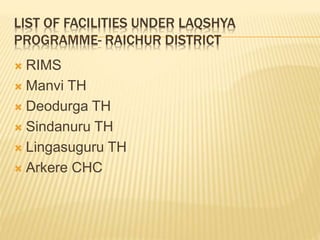
LIST OF FACILITIES UNDER LAQSHYA
PROGRAMME- RAICHUR DISTRICT
 RIMS
 Manvi TH
 Deodurga TH
 Sindanuru TH
 Lingasuguru TH
 Arkere CHC
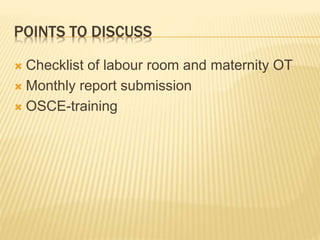
POINTS TO DISCUSS
 Checklist of labour room and maternity OT
 Monthly report submission
 OSCE-training
Thank You

LaQshya programme

  • 1.
  • 2.
    LAQSHYA- LABOUR ROOMQUALITY IMPROVEMENT INITIATIVE GUIDELINE  Started in 2018-19 in karnataka  Goal- To reduce preventable maternal and newborn mortality, morbidity and still births associated with care around delivery in labour room and maternity OT  To ensure respectful maternity care.
  • 4.
    LaQshya is allabout improving Quality of Care around birth 1. Quality Certification of Labour Room and/or OT – through the existing system 2. Attainment of 75% of Facility level targets 3. At least 80% beneficiaries are satisfied with the care
  • 5.
    LABOUR ROOM DO’S DON’TS Providing privacy to pregnant women during the intrapartum period, by way of separate labour room or at least a private cubicle  Presence of birth companion during the labour  Freedom to choose a comfortable position during birthing (squatting, standing, etc.)  Adherence to Clinical protocols for management of labour  Use of Labour beds instead of tables y  Place baby on mother’s abdomen y  Initiation of Breast feeding within one hour of birth  Induction and augmentation of labour without sound clinical indications  Any verbal or physical abuse of the pregnant women  Insisting on conventional lithotomy position for the delivery  Immediate clamping and cutting of the umbilical cord  Separating baby from the mother for routine care & procedure  ‘Out of Pocket Expenditures (OOPE) on drugs, diagnostics, including demand by the staff for gratuitous payment by families for celebration of the baby’s birth
  • 6.
    OBJECTIVES  1. Toreduce maternal and newborn mortality & morbidity due to APH, PPH, retained placenta, preterm, preeclampsia & eclampsia, obstructed labour, puerperal sepsis, newborn asphyxia, and sepsis, etc.  2. To improve Quality of care during the delivery and immediate post-partum care, stabilization of complications and ensure timely referrals, and enable an effective two-way follow-up system.  3. To enhance satisfaction of beneficiaries visiting the health facilities and provide Respectful Maternity Care (RMC) to all pregnant women attending the public health facility.
  • 7.
    NQAS: AREAS OFCONCERN Service Provision Inputs Support Services Clinical Care Infection Control Quality Management Outcome Patients’ Rights
  • 8.
  • 9.
  • 10.
  • 11.
    INTERVENTIONS Improved QoC &supports Cognitive Development Delivery of Respectful Maternity Care (RMC) Rapid Improvement Events Adherence to Clinical Protocols Structure – Infrastructure, HR, Equipment, Drugs & Supplies
  • 12.
    PROMOTING RESPECTFUL MATERNITYCARE & COGNITIVE DEVELOPMENT OF BABY
  • 13.
    RAPID IMPROVEMENT EVENTS Cycle 1: Real-time Partograph generation including shift to electronic partograph & usage of safe birth check-list & surgical safety check-list and strengthening documentation practices for generating robust data for driving improvement.  Cycle 2: Presence of Birth companion during delivery, respectful maternity care and enhancement of patients’ satisfaction.  Cycle 3: Assessment, Triage and timely management of complications including strengthening of referral protocols.  Cycle 4: Management of Labour as per protocols including AMTSL & rational use of Oxytocin.  Cycle 5: Essential and emergency care of Newborn & Pre-term babies including management of birth asphyxia and timely initiation of breast feeding as well as KMC for preterm newborn.  Cycle 6: Infection Prevention including Biomedical Waste Management.
  • 14.
    STRUCTURAL IMPROVEMENT  Upgradingthe infrastructure as per norm & realistic case-load  Human Resource augmentation and upskilling  Ensuring availability of functional & calibrated equipment, as per need  Strengthening supply chain of drugs & consumables
  • 15.
    PROCESS IMPROVEMENT  Assessmentand Triage  Enablers for Respectful care  Management of Labour including Active Management of Third stage of labour  Management of complications and High-Risk Pregnancies  Management of referral services  Perioperative processes for C-Section  New-born care and resuscitation  Management of required Support services
  • 16.
  • 17.
    ZONING IN OT 1.PROTECTIVE - Reception, Waiting, Trolley Bay, Change Rooms, Rooms for administrative staff, Stores & Record, Conference Room, etc. 2. CLEAN AREA – Pre-operative, Post-operative, Plaster Room, Staff lounges, Stores, etc. 3. STERILE AREA Operating Theatre, Scrub Room, Anaesthesia, Setup Room 4. DISPOSAL AREA - Dirty Utility, Disposal areas from each OT & Corridor leading to disposal zone, Disposal Corridor
  • 18.
    OPERATION THEATRE  FunctionalPre and post-operative area  Dedicated nursing staff for pre and post- operative area  Availability of Essential Equipment, maintenance & calibration  Cleaning & disinfection protocol  Availability of Anaesthesia Services  Monitoring Indicators
  • 19.
    LIST OF FACILITIESUNDER LAQSHYA PROGRAMME- RAICHUR DISTRICT  RIMS  Manvi TH  Deodurga TH  Sindanuru TH  Lingasuguru TH  Arkere CHC
  • 20.
    POINTS TO DISCUSS Checklist of labour room and maternity OT  Monthly report submission  OSCE-training
  • 21.