DIC IN PREGNANCY
Dillema
 Major management challenge
 Further complicated when the patient is carrying a fetus at or beyond the
limit of viability.
 To transfuse a pregnant patient with DIC who is bleeding heavily or
performing an emergency cesarean delivery on a pregnant patient with
catastrophic hemorrhage.
 Accounts for approximately 1 to 5 percent of all cases of DIC
 Prevalence ranges from 0.03 to 0.35 percent of all delivery hospitalizations in
population-based studies .
 Patients with specific pregnancy complications, such as placental abruption or
amniotic fluid embolism, can be at very high risk (eg, prevalence >20 percent)
PATHOPHYSIOLOGY
 Pregnancy is a hypercoagulable state .
 The shift in the balance between the hemostatic and fibrinolytic systems
serves to prevent excessive bleeding during placental separation
 Marked increases in most coagulation factors
 Decreased endogenous anticoagulation
 Reduced fibrinolysis
 Increased platelet reactivity.
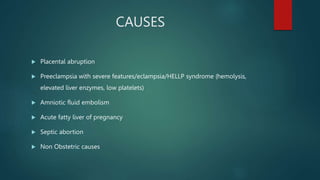
CAUSES
 Placental abruption
 Preeclampsia with severe features/eclampsia/HELLP syndrome (hemolysis,
elevated liver enzymes, low platelets)
 Amniotic fluid embolism
 Acute fatty liver of pregnancy
 Septic abortion
 Non Obstetric causes
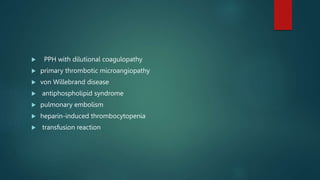
 PPH with dilutional coagulopathy
 primary thrombotic microangiopathy
 von Willebrand disease
 antiphospholipid syndrome
 pulmonary embolism
 heparin-induced thrombocytopenia
 transfusion reaction
DIC in pregnancy.pptx

DIC in pregnancy.pptx

  • 1.
  • 2.
    Dillema  Major managementchallenge  Further complicated when the patient is carrying a fetus at or beyond the limit of viability.  To transfuse a pregnant patient with DIC who is bleeding heavily or performing an emergency cesarean delivery on a pregnant patient with catastrophic hemorrhage.
  • 3.
     Accounts forapproximately 1 to 5 percent of all cases of DIC  Prevalence ranges from 0.03 to 0.35 percent of all delivery hospitalizations in population-based studies .  Patients with specific pregnancy complications, such as placental abruption or amniotic fluid embolism, can be at very high risk (eg, prevalence >20 percent)
  • 4.
    PATHOPHYSIOLOGY  Pregnancy isa hypercoagulable state .  The shift in the balance between the hemostatic and fibrinolytic systems serves to prevent excessive bleeding during placental separation  Marked increases in most coagulation factors  Decreased endogenous anticoagulation  Reduced fibrinolysis  Increased platelet reactivity.
  • 5.
    CAUSES  Placental abruption Preeclampsia with severe features/eclampsia/HELLP syndrome (hemolysis, elevated liver enzymes, low platelets)  Amniotic fluid embolism  Acute fatty liver of pregnancy  Septic abortion  Non Obstetric causes
  • 6.
     PPH withdilutional coagulopathy  primary thrombotic microangiopathy  von Willebrand disease  antiphospholipid syndrome  pulmonary embolism  heparin-induced thrombocytopenia  transfusion reaction