TURNSONPOINT CONSULTING
BUSINESS AND LEGAL STRATEGY

AN INTRODUCTION TO LEGAL RISKS IN
THE EMERGING AGE OF SOCIAL MEDIA
Disclaimer statement
This presentation and related information have been prepared by
  TurnsonPoint Consulting for information purposes only and do
  not constitute advertising, a solicitation, or legal advice. Such
  presentation, materials and information contained herein is not
  intended to create, and receipt thereof does not constitute
  formation of, an attorney-client relationship. The information
  contained in this presentation is provided only as general
  information and may or may not reflect the most current legal
  developments; accordingly, this information is not promised or
  guaranteed to be correct or complete. TurnsonPoint expressly
  disclaims all liability in law or otherwise in respect to actions
  taken or not taken based on any or all the contents of this
  presentation or related information.
SOCIAL MEDIA – WHAT IS IT?

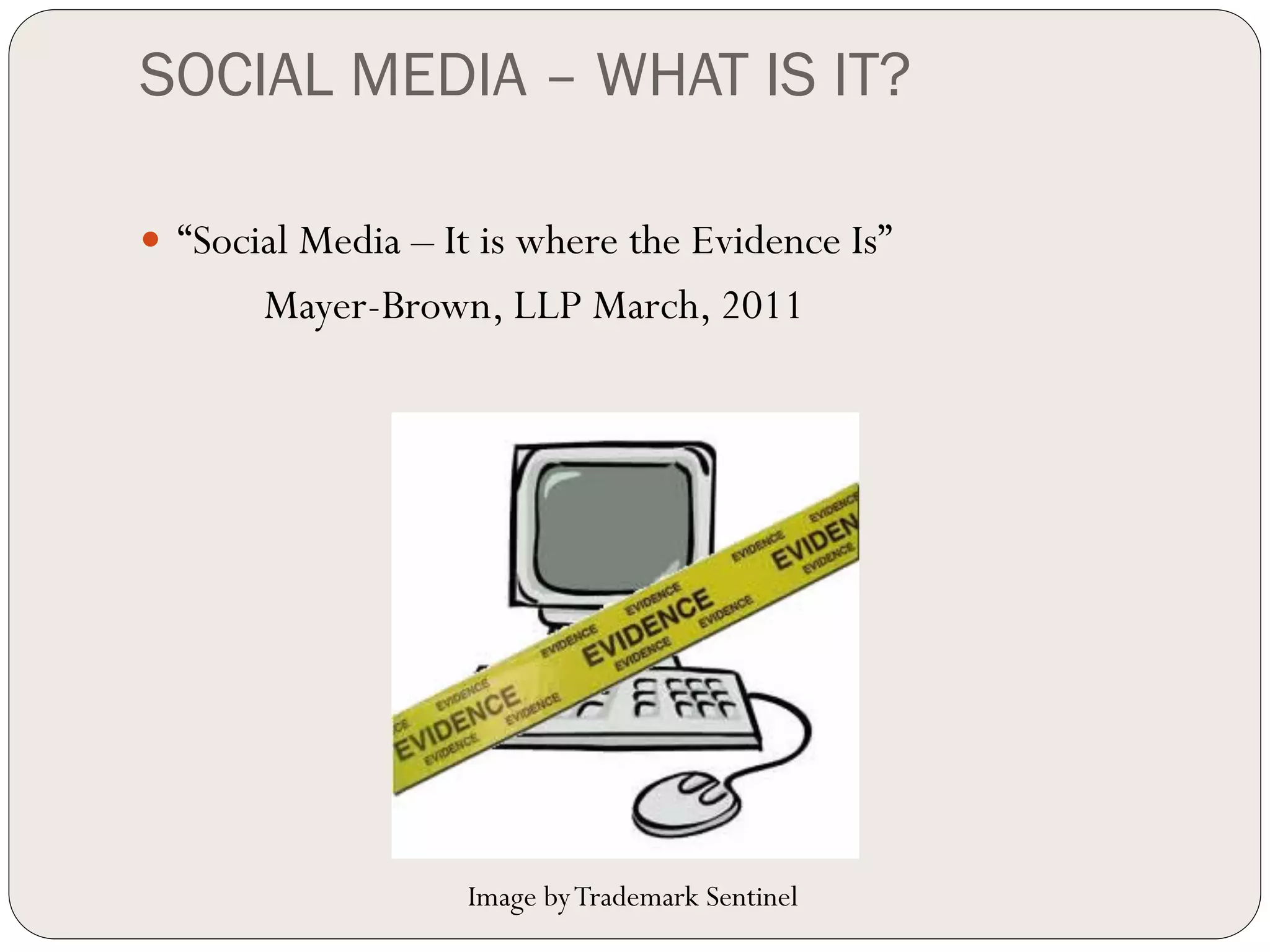
—  “Social Media – It is where the Evidence Is”
       Mayer-Brown, LLP March, 2011


                    Image by Trademark Sentinel
Commonality of the legal risks in Social
Media
—  every law, every statute and regulation that applies to you as an
  individual or a business is applicable.

—  Old Wine in New Bottles – old causes of action can find a new
  home in social media

—  And – all of your activities are:
                  *trackable and traceable - cookies
                  *memorialized in discoverable form
                  *evidence – e discovery – any postings online should
                  be considered the same as email or text message – it is
                  discoverable and can lead to liability
                  available to millions
A sampling of what you or your business or
your clients can be sued for
—  Copyright Infringement        - freely copying what one see’s on
    the Internet
—  Trademark Infringement – confusing consumers about a
    brand
—  1st Amendment -Posting of inappropriate or offensive content;
    online speech (harassment)
—  Title VII; various state laws-Discrimination in hiring; monitoring
    of employees
•  Reputational Damage-when negative information released is
    not contained and acted upon quickly, it can spiral out of control.
    In 24 hours, a video can be viewed more than ten thousand times,
    an article shared thousands of times through Facebook; Twitter
A sampling of what you or your business or
your clients can be sued for (cont’d.)
—  Invasion of Privacy – U.S. and International
          U.S. – PII (personally identifiable information)
          International – EU Data Protection Directive 1995/46 EU
    amended 2011
          -Proprietary and confidential information
                   NDA; legal agreements; trade secrets
          -Defamation/false light
          Example: Twitter is not liable but you or your business or
    your client’s company can be
                   Simorangkir v. Love
§  False Advertising - liability for failing to disclose material
    connection with endorsers – FTC Guideline (16 CFR § 255)
Privacy; Intellectual Property; Online
Advertising
              1. Privacy
—  are postings on social media sites private?
  o  A public posting on a public site is generally not private
  o  A posting may be private if it is on a password protected site
  •  Can an employer check up on employees through
     social media?
  o  LinkedIn to verify information supplied by an applicant
  o  Twitter, Facebook posting that may be viewed as harassment of
     other employees (Espinoza v. County of Orange, 2012 WL
     4201149 (Cal.App.Ct. Feb. 9, 2012)
  o  Michigan Asst. Attorney General terminated for harassing first
     openly gay president of U of M.
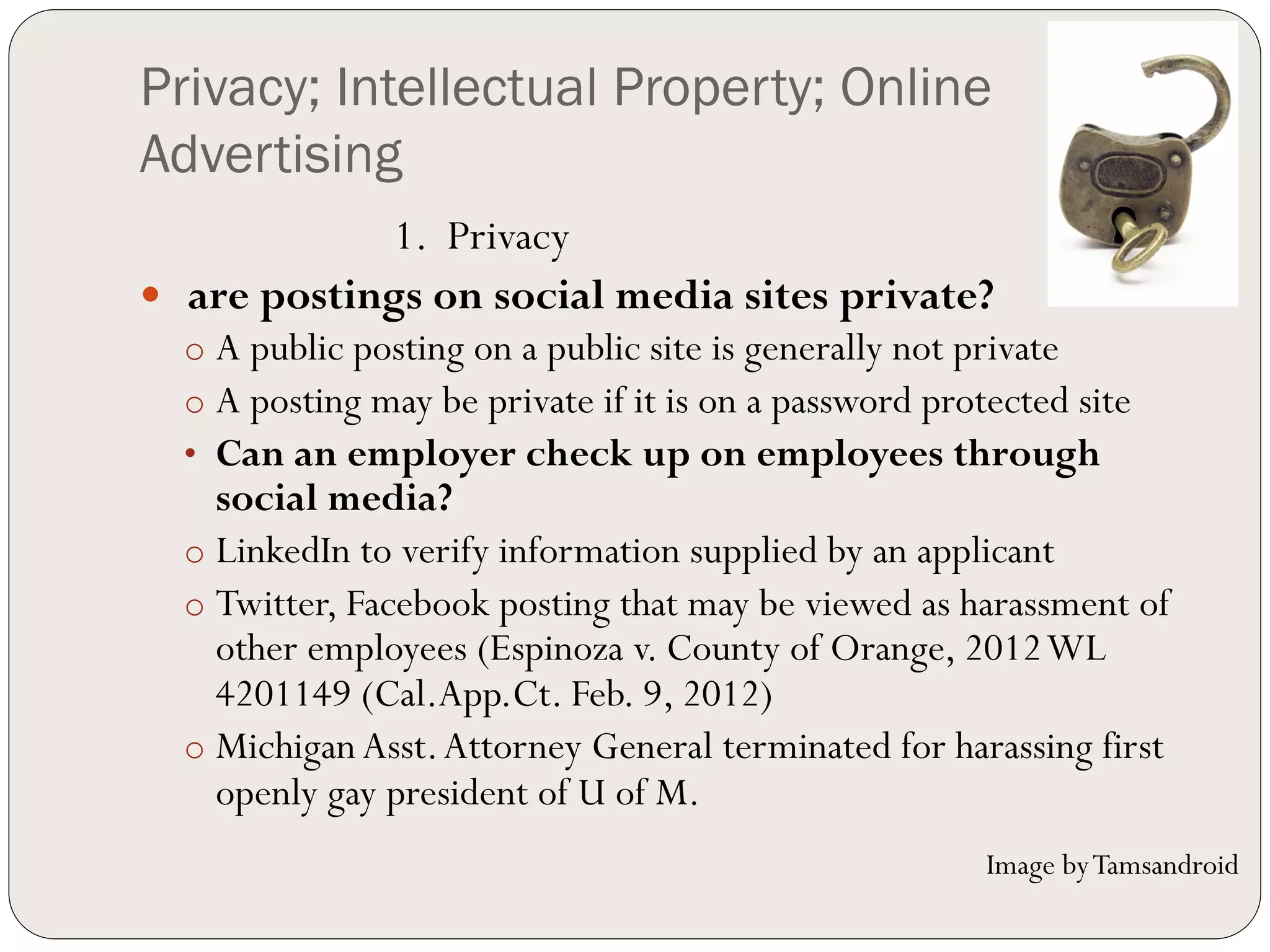
                                                         Image by Tamsandroid
Privacy; Intellectual Property; Online
Advertising (cont’d.)
 o  Cannot use information to discriminate against employees or
   candidates due to race, religion, sexual orientation, marital
   status, pregnancy, political affiliations, disabilities (Title VII and
   various state laws) and CANNOT be the basis of the decision –
   need to be able to prove that.
 Examples of famous tweets “Cisco just offered me a job! Now I
   have to weigh the utility of a fatty paycheck against the daily
   commute to San Jose and hating the work”’ Ketchum public-
   relations exec. Who said of client FedEx’s hometown: “I would
   die if I had to live here!”
Privacy; Intellectual Property; Online
    Advertising (cont’d.)
        •  Can an employer monitor employee activity online to
          assess if there is a problem with information being
          leaked, or inappropriate messages be posted?
             Be cautious: California, Colo., New York, North Dakota
          don’t allow adverse employment actions for legal off-duty
          conduct
             -could lead to invasion of privacy claims
             -risk of discrimination, retaliation, and whistleblower claims
                            California, Colo., Indiana, Oklahoma, South
          Carolina and Utah require employer to obtain consent before
          monitoring

Image by Online Reputation Management
Privacy; Intellectual Property; Online
Advertising (cont’d)
2.  Intellectual Property
    A. Copyright
     Who owns the Copyright material posted on Social
    Media?
    The original author owns the copyright to anything
    posted on Social Media
    Digital Millennium Copyright Act (DMCA)-limits
    liability for service providers (Facebook; LinkedIn
    through an imposed notice-and takedown-regime)
    Pinning Copyright Complaints on Pinterest
Privacy; Intellectual Property; Online
Advertising (cont’d)
   B. Trademarks – TM, ®
•  Infringement on social media sites takes a variety of
   forms, including faux, imposter, parody, and fan accounts,
   as well as improper use of logos on profile pages
•  There may be liability for creating a user name or
   tradename that confuses other users about your
   relationship to a Trademark owner, or dilutes a trademark
   owners brand
•  Brand owners can typically file notices of (non-copyright)
   IP infringement on social media platforms [summary sheet]
Privacy; Intellectual Property; Online
 Advertising (cont’d)
o  Brand owners can file DMCA takedown notices on all major social media platforms
   [summary sheet]
B.1 Trademark Infringement on Twitter
o  Danyelle Freeman is a restaurant critic for the New York Daily News using the name
   “Restaurant Girl”; Adam Robb Rucinsky uses Freeman’s writing style and Freeman’s
   name “Restaurant Girl” for a writing exercise using Twitter and a Blog
o  Freeman is claiming that Rucinsky’s Twitter account and blog impersonating
   Freeman is infringing on her trademark name
o  The question is whether readers would be able to t ell whether they are reading
   Freeman’s or Rucinsky’s blog, despite his recent disclaimers on Rucinsky’s Twitter
   and blog accounts
o  Does Rucinsky have a valid parody defense?
Privacy; Intellectual Property; Online
Advertising (cont’d)
 B-2. Trade Secrets
 Can be easily leaked on social media
 •  An employee leaking Trade Secrets has breached the
    duty of loyalty, misappropriation of Trade Secrets,
    breach of contractual confidentiality, or non-
    disclosure agreements, which can be grounds for
    termination
 •  What happens if a Trade Secret is leaked?
 •  Trade secret protection is based on “reasonable
    efforts” to keep information secret
 •  Once leaked, it is fair game


                                      Image by Howtomakemoneyblogging.net
Privacy; Intellectual Property; Online
Advertising (cont’d)
       3.   Online Advertising
            FTC Guidelines for online Advertising
         FTC Act’s prohibition on “unfair or deceptive acts or
         practices” broadly covers advertising claims, marketing and
         promotional activities, and sales practices in general.
       q  This Act is not limited to any particular medium
         Therefore applies to the Internet
         Rules prohibit specific acts or practices that the FTC has
         found to be unfair or deceptive


             Image by ATXPublishing
Privacy; Intellectual Property; Online
Advertising (cont’d)

—  Guidelines help businesses to comply with the law by providing examples or
    direction on how to avoid unfair or deceptive acts or practices – find guidelines
    for ads at….
—  Online ads are subject to the basic principles of advertising law
     —  Advertising must be truthful and not misleading
     —  Advertisers must have evidence to back up their claims
     —  Advertisements cannot be unfair
         must look at the ad as a whole
Privacy; Intellectual Property; Online
Advertising (cont’d)
 Tweets, Facebook and other social media can qualify as
    endorsements and testimonials in advertising and therefore can
    be subject to FTC rules and guidelines
        FTC Guides concerning Use of Endorsements and Testimonials
    in Advertisements:
    http://www.ftc.gov/bcp/guides/endorse.htm
 False Advertising
 o  Federal/state laws apply equally to traditional and new media platforms
 o  Some social media platforms also have advertising policies to prohibit false or
    misleading advertisements
 New Guidelines coming?
 FTC suggesting that bloggers and social media marketers who use
    false statements about products they promote will be held liable
Take Aways
1.  No one is immune to the risks to their personal and
    professional lives associated with living and operating in
    the Digital Era
2.  Read carefully the privacy policies/terms of use of all social
    media sites you are going to use so you are aware of your
    risks if you violate those policies
3.  Develop an integrated business and legal strategy social
    media policy that meets either or both your internal and
    external needs
For more conversations……….

      Contact Me:
      Judith Delaney
      judith@turnsonpoint.com
      1-415-244-1360
      www.turnsonpoint.com

Turnson Point Risks and Reputation Management presentation

  • 1.
    TURNSONPOINT CONSULTING BUSINESS ANDLEGAL STRATEGY AN INTRODUCTION TO LEGAL RISKS IN THE EMERGING AGE OF SOCIAL MEDIA
  • 2.
    Disclaimer statement This presentationand related information have been prepared by TurnsonPoint Consulting for information purposes only and do not constitute advertising, a solicitation, or legal advice. Such presentation, materials and information contained herein is not intended to create, and receipt thereof does not constitute formation of, an attorney-client relationship. The information contained in this presentation is provided only as general information and may or may not reflect the most current legal developments; accordingly, this information is not promised or guaranteed to be correct or complete. TurnsonPoint expressly disclaims all liability in law or otherwise in respect to actions taken or not taken based on any or all the contents of this presentation or related information.
  • 3.
    SOCIAL MEDIA –WHAT IS IT? —  “Social Media – It is where the Evidence Is” Mayer-Brown, LLP March, 2011 Image by Trademark Sentinel
  • 4.
    Commonality of thelegal risks in Social Media —  every law, every statute and regulation that applies to you as an individual or a business is applicable. —  Old Wine in New Bottles – old causes of action can find a new home in social media —  And – all of your activities are: *trackable and traceable - cookies *memorialized in discoverable form *evidence – e discovery – any postings online should be considered the same as email or text message – it is discoverable and can lead to liability available to millions
  • 5.
    A sampling ofwhat you or your business or your clients can be sued for —  Copyright Infringement - freely copying what one see’s on the Internet —  Trademark Infringement – confusing consumers about a brand —  1st Amendment -Posting of inappropriate or offensive content; online speech (harassment) —  Title VII; various state laws-Discrimination in hiring; monitoring of employees •  Reputational Damage-when negative information released is not contained and acted upon quickly, it can spiral out of control. In 24 hours, a video can be viewed more than ten thousand times, an article shared thousands of times through Facebook; Twitter
  • 6.
    A sampling ofwhat you or your business or your clients can be sued for (cont’d.) —  Invasion of Privacy – U.S. and International U.S. – PII (personally identifiable information) International – EU Data Protection Directive 1995/46 EU amended 2011 -Proprietary and confidential information NDA; legal agreements; trade secrets -Defamation/false light Example: Twitter is not liable but you or your business or your client’s company can be Simorangkir v. Love §  False Advertising - liability for failing to disclose material connection with endorsers – FTC Guideline (16 CFR § 255)
  • 7.
    Privacy; Intellectual Property;Online Advertising 1. Privacy —  are postings on social media sites private? o  A public posting on a public site is generally not private o  A posting may be private if it is on a password protected site •  Can an employer check up on employees through social media? o  LinkedIn to verify information supplied by an applicant o  Twitter, Facebook posting that may be viewed as harassment of other employees (Espinoza v. County of Orange, 2012 WL 4201149 (Cal.App.Ct. Feb. 9, 2012) o  Michigan Asst. Attorney General terminated for harassing first openly gay president of U of M. Image by Tamsandroid
  • 8.
    Privacy; Intellectual Property;Online Advertising (cont’d.) o  Cannot use information to discriminate against employees or candidates due to race, religion, sexual orientation, marital status, pregnancy, political affiliations, disabilities (Title VII and various state laws) and CANNOT be the basis of the decision – need to be able to prove that. Examples of famous tweets “Cisco just offered me a job! Now I have to weigh the utility of a fatty paycheck against the daily commute to San Jose and hating the work”’ Ketchum public- relations exec. Who said of client FedEx’s hometown: “I would die if I had to live here!”
  • 9.
    Privacy; Intellectual Property;Online Advertising (cont’d.) •  Can an employer monitor employee activity online to assess if there is a problem with information being leaked, or inappropriate messages be posted? Be cautious: California, Colo., New York, North Dakota don’t allow adverse employment actions for legal off-duty conduct -could lead to invasion of privacy claims -risk of discrimination, retaliation, and whistleblower claims California, Colo., Indiana, Oklahoma, South Carolina and Utah require employer to obtain consent before monitoring Image by Online Reputation Management
  • 10.
    Privacy; Intellectual Property;Online Advertising (cont’d) 2.  Intellectual Property A. Copyright Who owns the Copyright material posted on Social Media? The original author owns the copyright to anything posted on Social Media Digital Millennium Copyright Act (DMCA)-limits liability for service providers (Facebook; LinkedIn through an imposed notice-and takedown-regime) Pinning Copyright Complaints on Pinterest
  • 11.
    Privacy; Intellectual Property;Online Advertising (cont’d) B. Trademarks – TM, ® •  Infringement on social media sites takes a variety of forms, including faux, imposter, parody, and fan accounts, as well as improper use of logos on profile pages •  There may be liability for creating a user name or tradename that confuses other users about your relationship to a Trademark owner, or dilutes a trademark owners brand •  Brand owners can typically file notices of (non-copyright) IP infringement on social media platforms [summary sheet]
  • 12.
    Privacy; Intellectual Property;Online Advertising (cont’d) o  Brand owners can file DMCA takedown notices on all major social media platforms [summary sheet] B.1 Trademark Infringement on Twitter o  Danyelle Freeman is a restaurant critic for the New York Daily News using the name “Restaurant Girl”; Adam Robb Rucinsky uses Freeman’s writing style and Freeman’s name “Restaurant Girl” for a writing exercise using Twitter and a Blog o  Freeman is claiming that Rucinsky’s Twitter account and blog impersonating Freeman is infringing on her trademark name o  The question is whether readers would be able to t ell whether they are reading Freeman’s or Rucinsky’s blog, despite his recent disclaimers on Rucinsky’s Twitter and blog accounts o  Does Rucinsky have a valid parody defense?
  • 13.
    Privacy; Intellectual Property;Online Advertising (cont’d) B-2. Trade Secrets Can be easily leaked on social media •  An employee leaking Trade Secrets has breached the duty of loyalty, misappropriation of Trade Secrets, breach of contractual confidentiality, or non- disclosure agreements, which can be grounds for termination •  What happens if a Trade Secret is leaked? •  Trade secret protection is based on “reasonable efforts” to keep information secret •  Once leaked, it is fair game Image by Howtomakemoneyblogging.net
  • 14.
    Privacy; Intellectual Property;Online Advertising (cont’d) 3.  Online Advertising FTC Guidelines for online Advertising FTC Act’s prohibition on “unfair or deceptive acts or practices” broadly covers advertising claims, marketing and promotional activities, and sales practices in general. q  This Act is not limited to any particular medium Therefore applies to the Internet Rules prohibit specific acts or practices that the FTC has found to be unfair or deceptive Image by ATXPublishing
  • 15.
    Privacy; Intellectual Property;Online Advertising (cont’d) —  Guidelines help businesses to comply with the law by providing examples or direction on how to avoid unfair or deceptive acts or practices – find guidelines for ads at…. —  Online ads are subject to the basic principles of advertising law —  Advertising must be truthful and not misleading —  Advertisers must have evidence to back up their claims —  Advertisements cannot be unfair must look at the ad as a whole
  • 16.
    Privacy; Intellectual Property;Online Advertising (cont’d) Tweets, Facebook and other social media can qualify as endorsements and testimonials in advertising and therefore can be subject to FTC rules and guidelines FTC Guides concerning Use of Endorsements and Testimonials in Advertisements: http://www.ftc.gov/bcp/guides/endorse.htm False Advertising o  Federal/state laws apply equally to traditional and new media platforms o  Some social media platforms also have advertising policies to prohibit false or misleading advertisements New Guidelines coming? FTC suggesting that bloggers and social media marketers who use false statements about products they promote will be held liable
  • 17.
    Take Aways 1.  Noone is immune to the risks to their personal and professional lives associated with living and operating in the Digital Era 2.  Read carefully the privacy policies/terms of use of all social media sites you are going to use so you are aware of your risks if you violate those policies 3.  Develop an integrated business and legal strategy social media policy that meets either or both your internal and external needs
  • 18.
    For more conversations………. Contact Me: Judith Delaney judith@turnsonpoint.com 1-415-244-1360 www.turnsonpoint.com