Social Media – Down the Rabbit HoleRick Mans - Social Media Evangelist
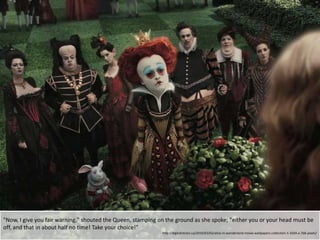
The rabbit-hole went straight on like a tunnel for some way, and then dipped suddenly down, so suddenly that Alice had not a moment to think about stopping herself before she found herself falling down a very deep well.Either the well was very deep, or she fell very slowly, for she had plenty of time as she went down to look about her and to wonder what was going to happen next. First, she tried to look down and make out what she was coming to, but it was too dark to see anything; then she looked at the sides of the well, and noticed that they were filled with cupboards and book-shelves; here and there she saw maps and pictures hung upon pegs. http://digitalcitizen.ca/2010/03/02/alice-in-wonderland-movie-wallpapers-collection-1-1024-x-768-pixels/
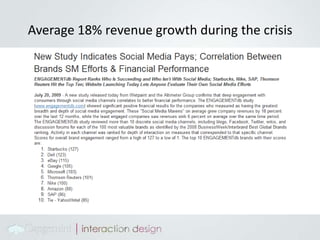
Average 18% revenue growth during the crisis
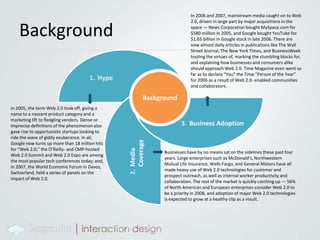
BackgroundIn 2006 and 2007, mainstream media caught on to Web 2.0, driven in large part by major acquisitions in the space — News Corporation bought MySpace.com for $580 million in 2005, and Google bought YouTube for $1.65 billion in Google stock in late 2006. There are now almost daily articles in publications like The Wall Street Journal, The New York Times, and BusinessWeek touting the virtues of, marking the stumbling blocks for, and explaining how businesses and consumers alike should approach Web 2.0. Time Magazine even went so far as to declare “You” the Time “Person of the Year” for 2006 as a result of Web 2.0- enabled communities and collaborators.BackgroundHypeIn 2005, the term Web 2.0 took off, giving a name to a nascent product category and a marketing lift to fledgling vendors. Dense or imprecise definitions of the phenomenon also gave rise to opportunistic startups looking to ride the wave of giddy exuberance. In all, Google now turns up more than 18 million hits for “Web 2.0;” the O’Reilly- and CMP-hosted Web 2.0 Summit and Web 2.0 Expo are among the most popular tech conferences today; and, in 2007, the World Economic Forum in Davos, Switzerland, held a series of panels on the impact of Web 2.0.Business AdoptionBusinesses have by no means sat on the sidelines these past four years. Large enterprises such as McDonald’s, Northwestern Mutual Life Insurance, Wells Fargo, and General Motors have all made heavy use of Web 2.0 technologies for customer and prospect outreach, as well as internal worker productivity and collaboration. The rest of the market is quickly catching up — 56% of North American and European enterprises consider Web 2.0 to be a priority in 2008, and adoption of major Web 2.0 technologies is expected to grow at a healthy clip as a result.Media Coverage
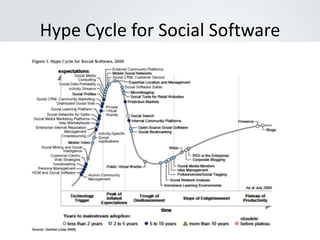
Hype Cycle for Social Software
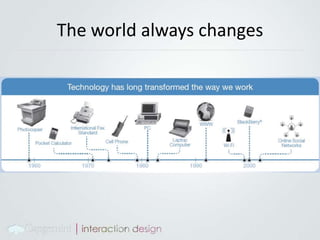
The worldalwayschanges
Social tools a disruptive technology?Managers were afraid Excel was to stimulate workers to make sports- or grocery lists during work hours
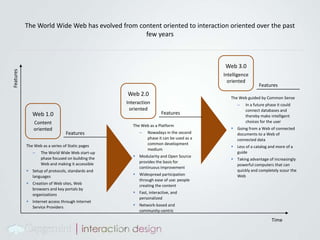
The World Wide Web has evolved from content oriented to interaction oriented over the past few yearsFeaturesFeaturesFeaturesWeb 3.0Intelligence orientedFeaturesWeb 2.0Interaction orientedThe Web guided by Common SenseIn a future phase it could connect databases and thereby make intelligent choices for the user
Going from a Web of connected documents to a Web of connected data
Less of a catalog and more of a guide
Taking advantage of increasingly powerful computers that can quickly and completely scour the WebWeb 1.0Content orientedThe Web as a PlatformNowadays in the second phase it can be used as a common development medium
Modularity and Open Source provides the basis for continuous improvement
Widespread participation through ease of use: people creating the content
Fast, interactive, and personalized
Network-based and community-centricThe Web as a series of Static pagesThe World Wide Web start-up phase focused on building the Web and making it accessible
Setup of protocols, standards and languages
Creation of Web sites, Web browsers and key portals by organizations
Internet access through Internet Service Providers Time
I don't believe there's an atom of meaning in it.http://digitalcitizen.ca/2010/03/02/alice-in-wonderland-movie-wallpapers-collection-1-1024-x-768-pixels/
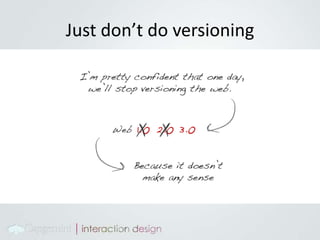
Just don’t do versioning
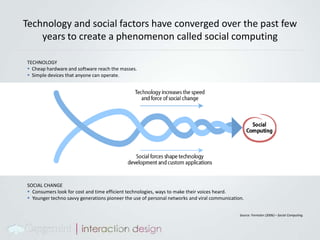
Technology and social factors have converged over the past few years to create a phenomenon called social computingTECHNOLOGYCheap hardware and software reach the masses.
Simple devices that anyone can operate.SOCIAL CHANGEConsumers look for cost and time efficient technologies, ways to make their voices heard.
Younger techno savvy generations pioneer the use of personal networks and viral communication.Source: Forrester (2006) – Social Computing.
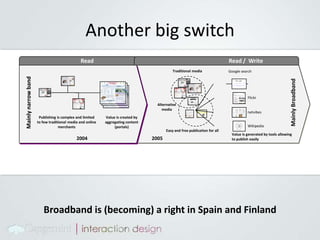
Another big switchReadRead /  WriteTraditional mediaGoogle searchFlickrMainly BroadbandMainly narrow bandAlternative medianetvibesPublishing is complex and limited to few traditional media and online merchantsValue is created by aggregating content (portals)WikipediaEasy and free publication for allValue is generated by tools allowing to publish easily20042005Broadband is (becoming) a right in Spain and Finland
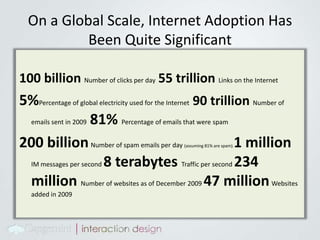
On a Global Scale, Internet Adoption Has Been Quite Significant100 billion Number of clicks per day55 trillion Links on the Internet5%Percentage of global electricity used for the Internet  90 trillion Number of emails sent in 2009  81% Percentage of emails that were spam  200 billionNumber of spam emails per day (assuming 81% are spam).1 million IM messages per second 8 terabytes Traffic per second 234 million Number of websites as of December 2009 47 millionWebsites added in 2009
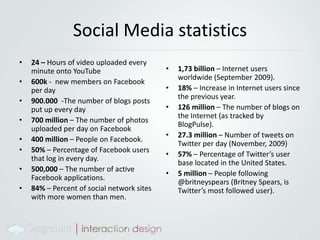
Social Media statistics24 – Hours of video uploaded every minute onto YouTube600k -  new members on Facebook per day900.000  -The number of blogs posts put up every day700 million – The number of photos  uploaded per day on Facebook400 million – People on Facebook.50% – Percentage of Facebook users that log in every day.500,000 – The number of active Facebook applications.84% – Percent of social network sites with more women than men.1,73 billion – Internet users worldwide (September 2009).18% – Increase in Internet users since the previous year.126 million – The number of blogs on the Internet (as tracked by BlogPulse).27.3 million – Number of tweets on Twitter per day (November, 2009)57% – Percentage of Twitter’s user base located in the United States.5 million – People following @britneyspears (Britney Spears, is Twitter’s most followed user).
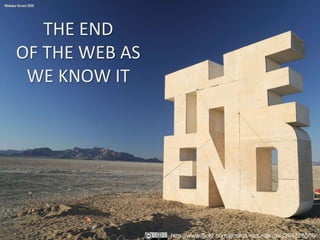
THE END OF THE WEB AS WE KNOW IThttp://www.flickr.com/photos/naturalturn/3264726560/
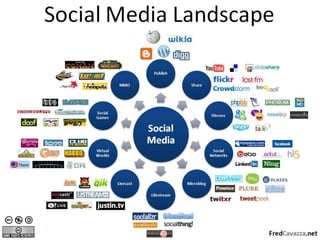
Social Media is a set of communication and collaborationtechnologiesadoptedbypeople in theirdaily livesSocial networks: Social structures of individuals who are bound together by common values, visions, ideas, friendships or interests
Social Media is:Humaninteraction in a virtualworld
Who are YOU?' said the Caterpillar. This was not an encouraging opening for a conversation. Alice replied rather shyly, 'I -- I hardly know, sir, just at present -- at least I know who I was when I got up this morning, but I think I must have been changed several times since then.' http://digitalcitizen.ca/2010/03/02/alice-in-wonderland-movie-wallpapers-collection-1-1024-x-768-pixels/
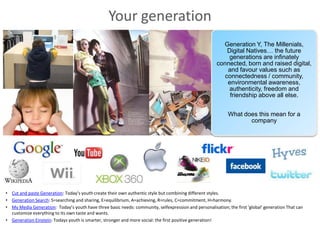
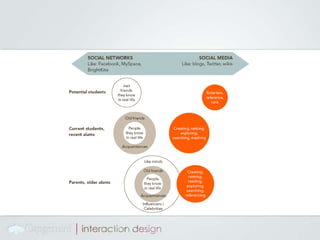
YourgenerationGeneration Y, The Millenials, Digital Natives… the futuregenerations are infinatelyconnected, born and raised digital, and favourvaluessuch as connectedness / community, environmentalawareness,  authenticity, freedom and friendshipabove all else. What does thismeanfor a companyCut and paste Generation: Today’syouthcreatetheirownauthenticstylebutcombining different styles.Generation Search: S=searching and sharing, E=equilibrium, A=achieving, R=rules, C=commitment, H=harmony.My Media Generation:  Today’syouth have threebasicneeds: community, selfexpression and personalisation; the first 'global' generationThatcancustomizeeverything to itsown taste and wants. GenerationEinstein: Todaysyouth is smarter, stronger and more social: the firstpositivegeneration!
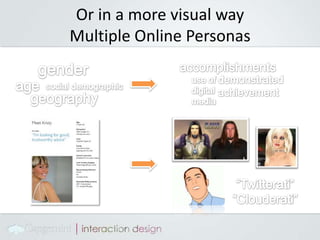
Generation VGeneration Virtual is used to describe a growing online culture in which people participate, often anonymously, through personas in a flat, virtual environment. Generation Virtual is not defined by age, gender, social demographics or geographic location. It is based on demonstrated accomplishments (merit) and an increasing preference for the use of digital media channels to discover information, build knowledge and share insights.The Business Impact of Social Computing on Marketing and 'Generation Virtual‘ – Gartner ID Number: G00158087
Or in a more visual wayMultiple Online Personasgenderaccomplishmentsdemonstrated achievementuse of digital mediaagesocial demographicgeography“Twitterati”“Clouderati”
NetocracyA portmanteau of internet and aristocracy, netocracy refers to a perceived global upper-class that bases its power on a technological advantage and networking skills, in comparison to what is portrayed as a bourgeoisie of a gradually diminishing importance.
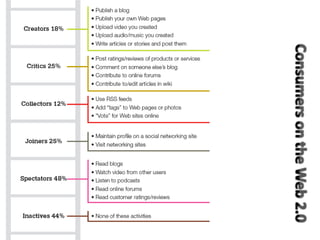
Consumerson the Web 2.0
But then, shall I never get any older than I am now? That'll be a comfort, one way -- never to be an old woman -- but then -- always to have lessons to learn! http://digitalcitizen.ca/2010/03/02/alice-in-wonderland-movie-wallpapers-collection-1-1024-x-768-pixels/
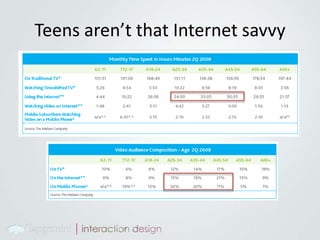
Teensaren’tthat Internet savvy
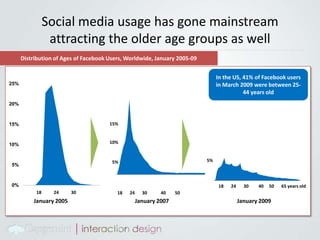
Social media usage has gone mainstream attracting the older age groups as wellSocial media use1824301824304050182430405065 years oldDistribution of Ages of Facebook Users, Worldwide, January 2005-09In the US, 41% of Facebook users in March 2009 were between 25-44 years old15%10%5%5%January 2005January 2007January 2009
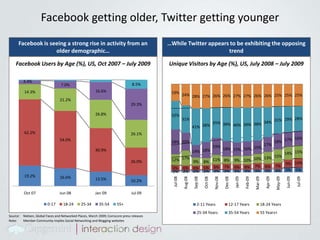
Facebook getting older, Twitter getting youngerFacebook is seeing a strong rise in activity from an older demographic……While Twitter appears to be exhibiting the opposing trendFacebook Users by Age (%), US, Oct 2007 – July 2009Unique Visitors by Age (%), US, July 2008 – July 2009Source:	Nielsen, Global Faces and Networked Places, March 2009; Comscore press releasesNote:	Member Community implies Social Networking and Blogging websites
"Take some more tea," the March Hare said to Alice, very earnestly."I've had nothing yet,“  Alice replied in an offended tone: "so I can't take more.""You mean you can't take less," said the Hatter: "it's very easy to take more than nothing.”http://digitalcitizen.ca/2010/03/02/alice-in-wonderland-movie-wallpapers-collection-1-1024-x-768-pixels/
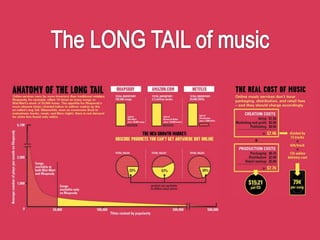
The LONG TAIL of music
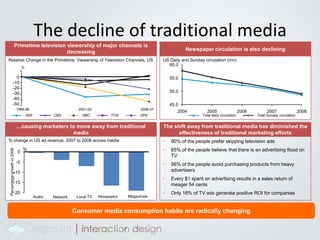
,The decline of traditional mediaPrimetime television viewership of major channels is decreasingNewspaper circulation is also decliningUS Daily and Sunday circulation (mn)Relative Change in the Primetime  Viewership of Television Channels, US%0-10-20-30-40-502006-071995-962001-02Total daily circulationTotal Sunday circulationNBCFOXCBSUPNABS…causing marketers to move away from traditional mediaThe shift away from traditional media has diminished the effectiveness of traditional marketing efforts % change in US ad revenue, 2007 to 2008 across media90% of the people prefer skipping television ads
65% of the people believe that there is an advertising flood on TV
56% of the people avoid purchasing products from heavy advertisers
Every $1 spent on advertising results in a sales return of meager 54 cents
Only 18% of TV ads generate positive ROI for companies%Percentage growth in 2008Local TVMagazinesAudioNewspapersNetworkConsumer media consumption habits are radically changing
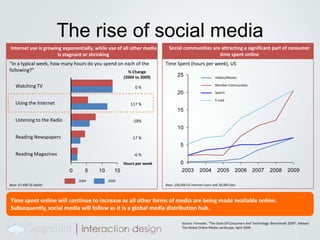
25The rise of social mediaSocial communities are attracting a significant part of consumer time spent onlineInternet use is growing exponentially, while use of all other media is stagnant or shrinking “In a typical week, how many hours do you spend on each of the following?”Time Spent (hours per week), US% Change(2004 to 2009)Videos/Movies0 %Watching TVMember CommunitiesSearchE-mail117 %Using the Internet-18%Listening to the Radio-17 %Reading Newspapers-6 % Reading MagazinesHours per week20042009Base: 230,000 US Internet Users and 30,000 sitesBase: 47,496 US AdultsTime spent online will continue to increase as all other forms of media are being made available online. Subsequently, social media will follow as it is a global media distribution hub.Source: Forrester, “The State Of Consumers And Technology: Benchmark 2009”. Nielsen: The Global Online Media Landscape, April 2009.
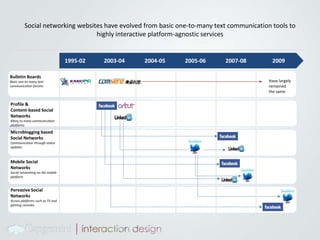
Social networking websites have evolved from basic one-to-many text communication tools to highly interactive platform-agnostic services1995-022007-0820092005-062004-052003-04Bulletin BoardsBasic one-to-many text  communication forumsHave largely remained the sameProfile & Content-based Social NetworksMany to many communication platformsMicroblogging based Social NetworksCommunication through status updatesMobile Social NetworksSocial networking on the mobile platformPervasive Social NetworksAcross platforms such as TV and gaming consoles
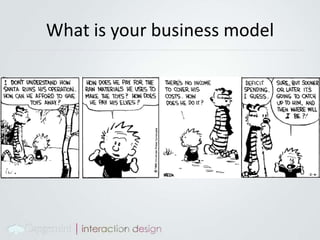
What is your business model
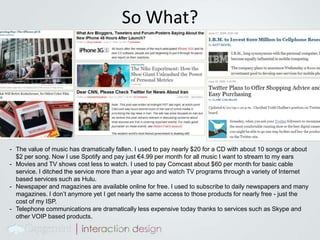
SoWhat?The value of music has dramatically fallen. I used to pay nearly $20 for a CD with about 10 songs or about $2 per song. Now I use Spotify and pay just €4.99 per month for all music I want to stream to my ears
Movies and TV shows cost less to watch. I used to pay Comcast about $60 per month for basic cable service. I ditched the service more than a year ago and watch TV programs through a variety of Internet based services such as Hulu.
Newspaper and magazines are available online for free. I used to subscribe to daily newspapers and many magazines. I don’t anymore yet I get nearly the same access to those products for nearly free - just the cost of my ISP.
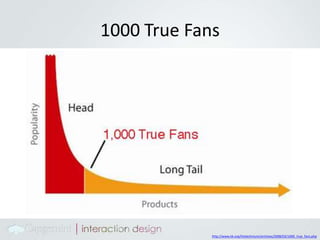
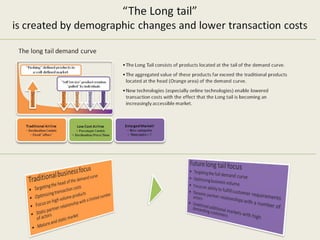
Telephone communications are dramatically less expensive today thanks to services such as Skype and other VOIP based products.WhyyouneedotherpeopleBut the long tail is a decidedly mixed blessing for creators. Individual artists, producers, inventors and makers are overlooked in the equation. The long tail does not raise the sales of creators much, but it does add massive competition and endless downward pressure on prices. Unless artists become a large aggregator of other artist's works, the long tail offers no path out of the quiet doldrums of minuscule sales.One solution is to find 1,000 True Fans. While some artists have discovered this path without calling it that, I think it is worth trying to formalize. The gist of 1,000 True Fans can be stated simply:A creator, such as an artist, musician, photographer, craftsperson, performer, animator, designer, videomaker, or author - in other words, anyone producing works of art - needs to acquire only 1,000 True Fans to make a living.http://www.kk.org/thetechnium/archives/2008/03/1000_true_fans.php
YourBrainCanOnlyHandleThisManyFriends150
In marketing or politics, the weak ties enable reaching populations and audiences that are not accessible via strong ties. The Strength of Weak Ties –  Mark Granovetter
1000 True Fanshttp://www.kk.org/thetechnium/archives/2008/03/1000_true_fans.php
I prefer to make other people famous, as it scales better.Makeitscalable
"Would you tell me, please, which way I ought to go from here?""That depends a good deal on where you want to get to," said the Cat."I don’t much care where--" said Alice."Then it doesn’t matter which way you go," said the Cat."--so long as I get SOMEWHERE," Alice added as an explanation."Oh, you’re sure to do that," said the Cat, "if you only walk long enough.“http://digitalcitizen.ca/2010/03/02/alice-in-wonderland-movie-wallpapers-collection-1-1024-x-768-pixels/
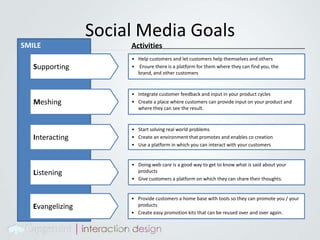
Social Media GoalsSMILEActivitiesSupportingHelp customers and let customers help themselves and others
 Ensure there is a platform for them where they can find you, the brand, and other customersMeshingIntegrate customer feedback and input in your product cycles
Create a place where customers can provide input on your product and where they can see the result.InteractingStart solving real world problems
Create an environment that promotes and enables co creation
Use a platform in which you can interact with your customersListeningDoing web care is a good way to get to know what is said about your products
Give customers a platform on which they can share their thoughts.EvangelizingProvide customers a home base with tools so they can promote you / your products
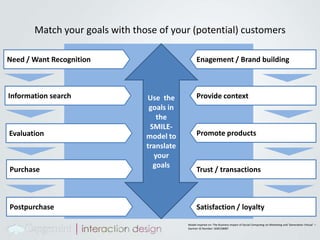
Create easy promotion kits that can be reused over and over again.Match your goals withthose of your (potential) customersUse  the goals in the SMILE-model to translate your goalsEnagement / Brand buildingNeed / Want RecognitionInformation searchProvide contextPromote productsEvaluationPurchaseTrust / transactionsPostpurchaseSatisfaction / loyaltyModel inspired on: The Business Impact of Social Computing on Marketing and 'Generation Virtual‘ – Gartner ID Number: G00158087
Youshould have started 6 monthsagoIfyou want to have successwithsocial media right now
everything you do should at least create the beginning of a relationshipWhenyou are in social media
If you don’t understand the web and strategic application as a marketer, PR professional or member of the media, it shows you don’t care.  There’s no way around this, if you truly cared about your profession and craft you’d embrace what’s new and ultimately better as opposed to rallying against it or outright ignoring the market.  The web isn’t new or novel, and if you think it is you’ve been too stuck in your ways to see the most clear trend of the last century.  Analog has no future in a connected society.If You Don’t Embrace The Web, It Shows You Don’t Care
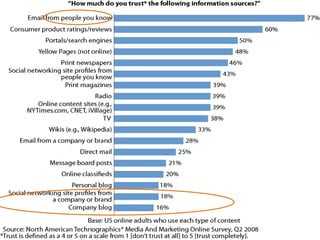
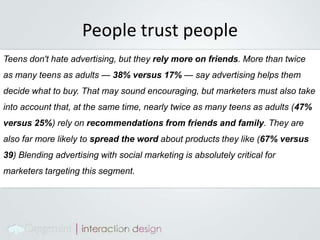
People trust peopleTeens don't hate advertising, but they rely more on friends. More than twice as many teens as adults — 38% versus 17% — say advertising helps them decide what to buy. That may sound encouraging, but marketers must also take into account that, at the same time, nearly twice as many teens as adults (47% versus 25%) rely on recommendations from friends and family. They are also far more likely to spread the word about products they like (67% versus 39) Blending advertising with social marketing is absolutely critical for marketers targeting this segment.
"You've got no right to grow here," said the Dormouse."Don't talk nonsense," said Alice more boldly: "you know you're growing too.""Yes, but I grow at a reasonable pace," said the Dormouse: "not in that ridiculous fashion." http://digitalcitizen.ca/2010/03/02/alice-in-wonderland-movie-wallpapers-collection-1-1024-x-768-pixels/
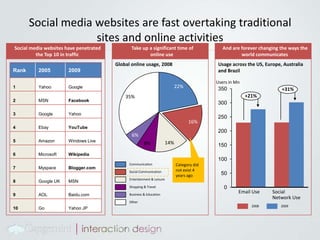
5Social media websites are fast overtaking traditional sites and online activities  Take up a significant time of online useAnd are forever changing the ways the world communicatesSocial media websites have penetrated the Top 10 in trafficUsage across the US, Europe, Australia and BrazilGlobal online usage, 2008Users in Mn22%+31%+21%35%16%6%14%8%Category did not exist 4 years agoCommunicationSocial CommunicationEntertainment & LeisureShopping & TravelSocial Network UseEmail UseBusiness & EducationOther20092008
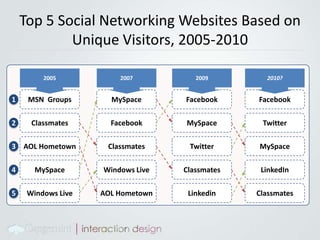
Top 5 Social Networking Websites Based on Unique Visitors, 2005-20102005200720092010?MSN  GroupsMySpaceFacebookFacebook1ClassmatesFacebookMySpaceTwitter2AOL HometownClassmatesTwitterMySpace3MySpaceWindows LiveClassmatesLinkedIn4Windows LiveAOL HometownLinkedinClassmates5
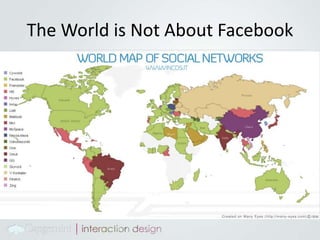
The World is NotAbout Facebook
" I have an excellent idea. Let's change the subject. “ http://digitalcitizen.ca/2010/03/02/alice-in-wonderland-movie-wallpapers-collection-1-1024-x-768-pixels/
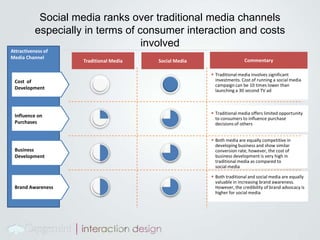
Social media ranks over traditional media channels especially in terms of consumer interaction and costs involvedAttractiveness of Media ChannelCommentaryTraditional MediaSocial MediaTraditional media involves significant investments. Cost of running a social media campaign can be 10 times lower than launching a 30 second TV adCost  of DevelopmentTraditional media offers limited opportunity to consumers to influence purchase decisions of others Influence on PurchasesBoth media are equally competitive in developing business and show similar conversion rate, however, the cost of business development is very high in traditional media as compared to social mediaBusiness DevelopmentBoth traditional and social media are equally valuable in increasing brand awareness. However, the credibility of brand advocacy is higher for social mediaBrand Awareness
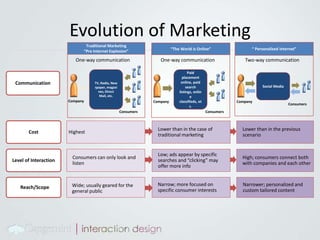
Evolution of Marketing“ Personalized Internet”Traditional Marketing“Pre Internet Explosion”“The World is Online”One-way communicationOne-way communicationTwo-way communicationTV, Radio, Newspaper, magazines, Direct Mail, etc.Paid placement online, paid search listings, online classifieds, etc.CommunicationSocial MediaCompanyCompanyCompanyConsumersConsumersConsumersHighestLower than in the previous scenarioLower than in the case of traditional marketingCostConsumers can only look and listen High; consumers connect both with companies and each otherLow; ads appear by specific searches and “clicking” may offer more infoLevel of Interaction  Reach/ScopeNarrow; more focused on specific consumer interests   Narrower; personalized and custom tailored contentWide; usually geared for the general public
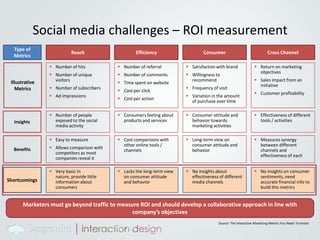
Social media challenges – ROI measurementType of MetricsReachEfficiencyConsumerCross ChannelIllustrative MetricsNumber of hits
Number of unique visitors
Number of subscribers
Ad impressions
Number of referral
Number of comments
Time spent on website
Cost per click
Cost per action
Satisfaction with brand
Willingness to recommend
Frequency of visit
Variation in the amount of purchase over time
Return on marketing objectives
Sales impact from an initiative
Customer profitability
Number of people exposed to the social media activity
Consumers feeling about products and services
Consumer attitude and behavior towards marketing activities
Effectiveness of different tools / activitiesInsightsEasy to measure
Allows comparison with competitors as most companies reveal it
Cost comparisons with other online tools / channels
Long-term view on consumer attitude and behavior
Measures synergy between different channels and effectiveness of eachBenefitsShortcomingsVery basic in nature, provide little information about consumers
Lacks the long-term view on consumer attitude and behavior
No insights about effectiveness of different media channels
No insights on consumer sentiments, need accurate financial info to build this metricsMarketers must go beyond traffic to measure ROI and should develop a collaborative approach in line with company’s objectivesSource: The Interactive Marketing Metrics You Need: Forrester
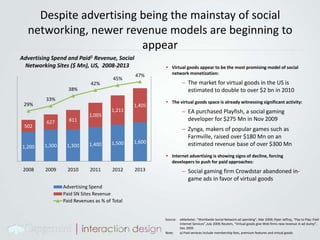
Despite advertising being the mainstay of social networking, newer revenue models are beginning to appearAdvertising Spend and Paid1 Revenue, Social Networking Sites ($ Mn), US,  2008-2013Virtual goods appear to be the most promising model of social network monetization:
The market for virtual goods in the US is estimated to double to over $2 bn in 2010
The virtual goods space is already witnessing significant activity:
EA purchased Playfish, a social gaming developer for $275 Mn in Nov 2009
Zynga, makers of popular games such as Farmville, raised over $180 Mn on an estimated revenue base of over $300 Mn
Internet advertising is showing signs of decline, forcing developers to push for paid approaches:
Social gaming firm Crowdstar abandoned in-game ads in favor of virtual goodsSource:	eMarketer, “Worldwide Social Network ad spending”, Mar 2009; Piper Jaffray, “Pay to Play: Paid Internet Services”,July 2009; Reuters, “Virtual goods give Web firms new revenue in ad slump”, Dec 2009Note:	a) Paid services include membership fees, premium features and virtual goods
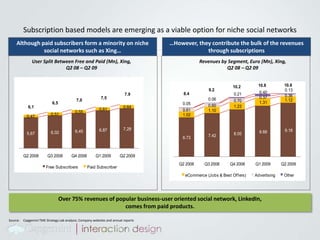
Subscription based models are emerging as a viable option for niche social networksAlthough paid subscribers form a minority on niche social networks such as Xing……However, they contribute the bulk of the revenues through subscriptionsRevenues by Segment, Euro (Mn), Xing, Q2 08 – Q2 09User Split Between Free and Paid (Mn), Xing, Q2 08 – Q2 09Over 75% revenues of popular business-user oriented social network, LinkedIn, comes from paid products.Source:	Capgemini TME Strategy Lab analysis; Company websites and annual reports
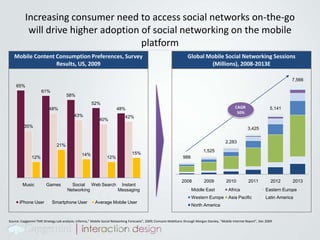
Increasing consumer need to access social networks on-the-go will drive higher adoption of social networking on the mobile platformMobile Content Consumption Preferences, Survey Results, US, 2009Global Mobile Social Networking Sessions (Millions), 2008-2013ECAGR 50%Source: Capgemini TME Strategy Lab analysis; Informa,” Mobile Social Networking Forecasts”, 2009; Comsore MobilLens through Morgan Stanley, “Mobile Internet Report”, Dec 2009
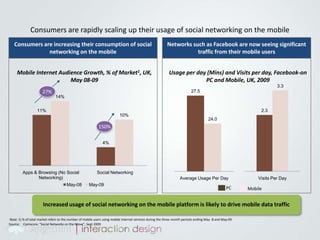
Consumers are rapidly scaling up their usage of social networking on the mobileConsumers are increasing their consumption of social networking on the mobileNetworks such as Facebook are now seeing significant traffic from their mobile usersMobile Internet Audience Growth, % of Market1, UK, May 08-09 Usage per day (Mins) and Visits per day, Facebook-on PC and Mobile, UK, 200927%150%PCMobileIncreased usage of social networking on the mobile platform is likely to drive mobile data traffic Note: 1) % of total market refers to the number of mobile users using mobile Internet services during the three-month periods ending May -8 and May-09Source:	Comscore, “Social Networks on the Move”, Sept 2009
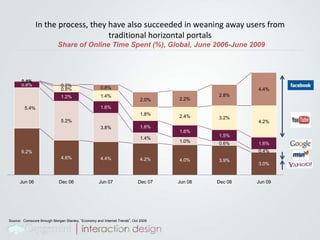
In the process, they have also succeeded in weaning away users from traditional horizontal portals Share of Online Time Spent (%), Global, June 2006-June 2009Source:	Comscore through Morgan Stanley, “Economy and Internet Trends”, Oct 2009

Social Media – Down the Rabbit Hole

  • 1.
    Social Media –Down the Rabbit HoleRick Mans - Social Media Evangelist
  • 2.
    The rabbit-hole wentstraight on like a tunnel for some way, and then dipped suddenly down, so suddenly that Alice had not a moment to think about stopping herself before she found herself falling down a very deep well.Either the well was very deep, or she fell very slowly, for she had plenty of time as she went down to look about her and to wonder what was going to happen next. First, she tried to look down and make out what she was coming to, but it was too dark to see anything; then she looked at the sides of the well, and noticed that they were filled with cupboards and book-shelves; here and there she saw maps and pictures hung upon pegs. http://digitalcitizen.ca/2010/03/02/alice-in-wonderland-movie-wallpapers-collection-1-1024-x-768-pixels/
  • 3.
    Average 18% revenuegrowth during the crisis
  • 4.
    BackgroundIn 2006 and2007, mainstream media caught on to Web 2.0, driven in large part by major acquisitions in the space — News Corporation bought MySpace.com for $580 million in 2005, and Google bought YouTube for $1.65 billion in Google stock in late 2006. There are now almost daily articles in publications like The Wall Street Journal, The New York Times, and BusinessWeek touting the virtues of, marking the stumbling blocks for, and explaining how businesses and consumers alike should approach Web 2.0. Time Magazine even went so far as to declare “You” the Time “Person of the Year” for 2006 as a result of Web 2.0- enabled communities and collaborators.BackgroundHypeIn 2005, the term Web 2.0 took off, giving a name to a nascent product category and a marketing lift to fledgling vendors. Dense or imprecise definitions of the phenomenon also gave rise to opportunistic startups looking to ride the wave of giddy exuberance. In all, Google now turns up more than 18 million hits for “Web 2.0;” the O’Reilly- and CMP-hosted Web 2.0 Summit and Web 2.0 Expo are among the most popular tech conferences today; and, in 2007, the World Economic Forum in Davos, Switzerland, held a series of panels on the impact of Web 2.0.Business AdoptionBusinesses have by no means sat on the sidelines these past four years. Large enterprises such as McDonald’s, Northwestern Mutual Life Insurance, Wells Fargo, and General Motors have all made heavy use of Web 2.0 technologies for customer and prospect outreach, as well as internal worker productivity and collaboration. The rest of the market is quickly catching up — 56% of North American and European enterprises consider Web 2.0 to be a priority in 2008, and adoption of major Web 2.0 technologies is expected to grow at a healthy clip as a result.Media Coverage
  • 5.
    Hype Cycle forSocial Software
  • 6.
  • 7.
    Social tools adisruptive technology?Managers were afraid Excel was to stimulate workers to make sports- or grocery lists during work hours
  • 8.
    The World WideWeb has evolved from content oriented to interaction oriented over the past few yearsFeaturesFeaturesFeaturesWeb 3.0Intelligence orientedFeaturesWeb 2.0Interaction orientedThe Web guided by Common SenseIn a future phase it could connect databases and thereby make intelligent choices for the user
  • 9.
    Going from aWeb of connected documents to a Web of connected data
  • 10.
    Less of acatalog and more of a guide
  • 11.
    Taking advantage ofincreasingly powerful computers that can quickly and completely scour the WebWeb 1.0Content orientedThe Web as a PlatformNowadays in the second phase it can be used as a common development medium
  • 12.
    Modularity and OpenSource provides the basis for continuous improvement
  • 13.
    Widespread participation throughease of use: people creating the content
  • 14.
  • 15.
    Network-based and community-centricTheWeb as a series of Static pagesThe World Wide Web start-up phase focused on building the Web and making it accessible
  • 16.
    Setup of protocols,standards and languages
  • 17.
    Creation of Websites, Web browsers and key portals by organizations
  • 18.
    Internet access throughInternet Service Providers Time
  • 19.
    I don't believethere's an atom of meaning in it.http://digitalcitizen.ca/2010/03/02/alice-in-wonderland-movie-wallpapers-collection-1-1024-x-768-pixels/
  • 20.
    Just don’t doversioning
  • 21.
    Technology and socialfactors have converged over the past few years to create a phenomenon called social computingTECHNOLOGYCheap hardware and software reach the masses.
  • 22.
    Simple devices thatanyone can operate.SOCIAL CHANGEConsumers look for cost and time efficient technologies, ways to make their voices heard.
  • 23.
    Younger techno savvygenerations pioneer the use of personal networks and viral communication.Source: Forrester (2006) – Social Computing.
  • 24.
    Another big switchReadRead/ WriteTraditional mediaGoogle searchFlickrMainly BroadbandMainly narrow bandAlternative medianetvibesPublishing is complex and limited to few traditional media and online merchantsValue is created by aggregating content (portals)WikipediaEasy and free publication for allValue is generated by tools allowing to publish easily20042005Broadband is (becoming) a right in Spain and Finland
  • 25.
    On a GlobalScale, Internet Adoption Has Been Quite Significant100 billion Number of clicks per day55 trillion Links on the Internet5%Percentage of global electricity used for the Internet 90 trillion Number of emails sent in 2009 81% Percentage of emails that were spam 200 billionNumber of spam emails per day (assuming 81% are spam).1 million IM messages per second 8 terabytes Traffic per second 234 million Number of websites as of December 2009 47 millionWebsites added in 2009
  • 26.
    Social Media statistics24– Hours of video uploaded every minute onto YouTube600k - new members on Facebook per day900.000 -The number of blogs posts put up every day700 million – The number of photos uploaded per day on Facebook400 million – People on Facebook.50% – Percentage of Facebook users that log in every day.500,000 – The number of active Facebook applications.84% – Percent of social network sites with more women than men.1,73 billion – Internet users worldwide (September 2009).18% – Increase in Internet users since the previous year.126 million – The number of blogs on the Internet (as tracked by BlogPulse).27.3 million – Number of tweets on Twitter per day (November, 2009)57% – Percentage of Twitter’s user base located in the United States.5 million – People following @britneyspears (Britney Spears, is Twitter’s most followed user).
  • 27.
    THE END OFTHE WEB AS WE KNOW IThttp://www.flickr.com/photos/naturalturn/3264726560/
  • 33.
    Social Media isa set of communication and collaborationtechnologiesadoptedbypeople in theirdaily livesSocial networks: Social structures of individuals who are bound together by common values, visions, ideas, friendships or interests
  • 34.
  • 35.
    Who are YOU?'said the Caterpillar. This was not an encouraging opening for a conversation. Alice replied rather shyly, 'I -- I hardly know, sir, just at present -- at least I know who I was when I got up this morning, but I think I must have been changed several times since then.' http://digitalcitizen.ca/2010/03/02/alice-in-wonderland-movie-wallpapers-collection-1-1024-x-768-pixels/

  • 36.
    YourgenerationGeneration Y, TheMillenials, Digital Natives… the futuregenerations are infinatelyconnected, born and raised digital, and favourvaluessuch as connectedness / community, environmentalawareness, authenticity, freedom and friendshipabove all else. What does thismeanfor a companyCut and paste Generation: Today’syouthcreatetheirownauthenticstylebutcombining different styles.Generation Search: S=searching and sharing, E=equilibrium, A=achieving, R=rules, C=commitment, H=harmony.My Media Generation: Today’syouth have threebasicneeds: community, selfexpression and personalisation; the first 'global' generationThatcancustomizeeverything to itsown taste and wants. GenerationEinstein: Todaysyouth is smarter, stronger and more social: the firstpositivegeneration!
  • 37.
    Generation VGeneration Virtualis used to describe a growing online culture in which people participate, often anonymously, through personas in a flat, virtual environment. Generation Virtual is not defined by age, gender, social demographics or geographic location. It is based on demonstrated accomplishments (merit) and an increasing preference for the use of digital media channels to discover information, build knowledge and share insights.The Business Impact of Social Computing on Marketing and 'Generation Virtual‘ – Gartner ID Number: G00158087
  • 38.
    Or in amore visual wayMultiple Online Personasgenderaccomplishmentsdemonstrated achievementuse of digital mediaagesocial demographicgeography“Twitterati”“Clouderati”
  • 39.
    NetocracyA portmanteau ofinternet and aristocracy, netocracy refers to a perceived global upper-class that bases its power on a technological advantage and networking skills, in comparison to what is portrayed as a bourgeoisie of a gradually diminishing importance.
  • 40.
  • 42.
    But then, shallI never get any older than I am now? That'll be a comfort, one way -- never to be an old woman -- but then -- always to have lessons to learn! http://digitalcitizen.ca/2010/03/02/alice-in-wonderland-movie-wallpapers-collection-1-1024-x-768-pixels/
  • 43.
  • 45.
    Social media usagehas gone mainstream attracting the older age groups as wellSocial media use1824301824304050182430405065 years oldDistribution of Ages of Facebook Users, Worldwide, January 2005-09In the US, 41% of Facebook users in March 2009 were between 25-44 years old15%10%5%5%January 2005January 2007January 2009
  • 46.
    Facebook getting older,Twitter getting youngerFacebook is seeing a strong rise in activity from an older demographic……While Twitter appears to be exhibiting the opposing trendFacebook Users by Age (%), US, Oct 2007 – July 2009Unique Visitors by Age (%), US, July 2008 – July 2009Source: Nielsen, Global Faces and Networked Places, March 2009; Comscore press releasesNote: Member Community implies Social Networking and Blogging websites
  • 47.
    "Take some more tea,"the March Hare said to Alice, very earnestly."I've had nothing yet,“ Alice replied in an offended tone: "so I can't take more.""You mean you can't take less," said the Hatter: "it's very easy to take more than nothing.”http://digitalcitizen.ca/2010/03/02/alice-in-wonderland-movie-wallpapers-collection-1-1024-x-768-pixels/
  • 49.
  • 50.
    ,The decline oftraditional mediaPrimetime television viewership of major channels is decreasingNewspaper circulation is also decliningUS Daily and Sunday circulation (mn)Relative Change in the Primetime Viewership of Television Channels, US%0-10-20-30-40-502006-071995-962001-02Total daily circulationTotal Sunday circulationNBCFOXCBSUPNABS…causing marketers to move away from traditional mediaThe shift away from traditional media has diminished the effectiveness of traditional marketing efforts % change in US ad revenue, 2007 to 2008 across media90% of the people prefer skipping television ads
  • 51.
    65% of thepeople believe that there is an advertising flood on TV
  • 52.
    56% of thepeople avoid purchasing products from heavy advertisers
  • 53.
    Every $1 spenton advertising results in a sales return of meager 54 cents
  • 54.
    Only 18% ofTV ads generate positive ROI for companies%Percentage growth in 2008Local TVMagazinesAudioNewspapersNetworkConsumer media consumption habits are radically changing
  • 55.
    25The rise ofsocial mediaSocial communities are attracting a significant part of consumer time spent onlineInternet use is growing exponentially, while use of all other media is stagnant or shrinking “In a typical week, how many hours do you spend on each of the following?”Time Spent (hours per week), US% Change(2004 to 2009)Videos/Movies0 %Watching TVMember CommunitiesSearchE-mail117 %Using the Internet-18%Listening to the Radio-17 %Reading Newspapers-6 % Reading MagazinesHours per week20042009Base: 230,000 US Internet Users and 30,000 sitesBase: 47,496 US AdultsTime spent online will continue to increase as all other forms of media are being made available online. Subsequently, social media will follow as it is a global media distribution hub.Source: Forrester, “The State Of Consumers And Technology: Benchmark 2009”. Nielsen: The Global Online Media Landscape, April 2009.
  • 56.
    Social networking websiteshave evolved from basic one-to-many text communication tools to highly interactive platform-agnostic services1995-022007-0820092005-062004-052003-04Bulletin BoardsBasic one-to-many text communication forumsHave largely remained the sameProfile & Content-based Social NetworksMany to many communication platformsMicroblogging based Social NetworksCommunication through status updatesMobile Social NetworksSocial networking on the mobile platformPervasive Social NetworksAcross platforms such as TV and gaming consoles
  • 57.
    What is yourbusiness model
  • 58.
    SoWhat?The value ofmusic has dramatically fallen. I used to pay nearly $20 for a CD with about 10 songs or about $2 per song. Now I use Spotify and pay just €4.99 per month for all music I want to stream to my ears
  • 59.
    Movies and TVshows cost less to watch. I used to pay Comcast about $60 per month for basic cable service. I ditched the service more than a year ago and watch TV programs through a variety of Internet based services such as Hulu.
  • 60.
    Newspaper and magazinesare available online for free. I used to subscribe to daily newspapers and many magazines. I don’t anymore yet I get nearly the same access to those products for nearly free - just the cost of my ISP.
  • 61.
    Telephone communications aredramatically less expensive today thanks to services such as Skype and other VOIP based products.WhyyouneedotherpeopleBut the long tail is a decidedly mixed blessing for creators. Individual artists, producers, inventors and makers are overlooked in the equation. The long tail does not raise the sales of creators much, but it does add massive competition and endless downward pressure on prices. Unless artists become a large aggregator of other artist's works, the long tail offers no path out of the quiet doldrums of minuscule sales.One solution is to find 1,000 True Fans. While some artists have discovered this path without calling it that, I think it is worth trying to formalize. The gist of 1,000 True Fans can be stated simply:A creator, such as an artist, musician, photographer, craftsperson, performer, animator, designer, videomaker, or author - in other words, anyone producing works of art - needs to acquire only 1,000 True Fans to make a living.http://www.kk.org/thetechnium/archives/2008/03/1000_true_fans.php
  • 62.
  • 63.
    In marketing orpolitics, the weak ties enable reaching populations and audiences that are not accessible via strong ties. The Strength of Weak Ties – Mark Granovetter
  • 64.
  • 65.
    I prefer tomake other people famous, as it scales better.Makeitscalable
  • 66.
    "Would you tellme, please, which way I ought to go from here?""That depends a good deal on where you want to get to," said the Cat."I don’t much care where--" said Alice."Then it doesn’t matter which way you go," said the Cat."--so long as I get SOMEWHERE," Alice added as an explanation."Oh, you’re sure to do that," said the Cat, "if you only walk long enough.“http://digitalcitizen.ca/2010/03/02/alice-in-wonderland-movie-wallpapers-collection-1-1024-x-768-pixels/
  • 67.
    Social Media GoalsSMILEActivitiesSupportingHelpcustomers and let customers help themselves and others
  • 68.
    Ensure thereis a platform for them where they can find you, the brand, and other customersMeshingIntegrate customer feedback and input in your product cycles
  • 69.
    Create a placewhere customers can provide input on your product and where they can see the result.InteractingStart solving real world problems
  • 70.
    Create an environmentthat promotes and enables co creation
  • 71.
    Use a platformin which you can interact with your customersListeningDoing web care is a good way to get to know what is said about your products
  • 72.
    Give customers aplatform on which they can share their thoughts.EvangelizingProvide customers a home base with tools so they can promote you / your products
  • 73.
    Create easy promotionkits that can be reused over and over again.Match your goals withthose of your (potential) customersUse the goals in the SMILE-model to translate your goalsEnagement / Brand buildingNeed / Want RecognitionInformation searchProvide contextPromote productsEvaluationPurchaseTrust / transactionsPostpurchaseSatisfaction / loyaltyModel inspired on: The Business Impact of Social Computing on Marketing and 'Generation Virtual‘ – Gartner ID Number: G00158087
  • 74.
    Youshould have started6 monthsagoIfyou want to have successwithsocial media right now
  • 76.
    everything you doshould at least create the beginning of a relationshipWhenyou are in social media
  • 78.
    If you don’tunderstand the web and strategic application as a marketer, PR professional or member of the media, it shows you don’t care.  There’s no way around this, if you truly cared about your profession and craft you’d embrace what’s new and ultimately better as opposed to rallying against it or outright ignoring the market.  The web isn’t new or novel, and if you think it is you’ve been too stuck in your ways to see the most clear trend of the last century.  Analog has no future in a connected society.If You Don’t Embrace The Web, It Shows You Don’t Care
  • 80.
    People trust peopleTeensdon't hate advertising, but they rely more on friends. More than twice as many teens as adults — 38% versus 17% — say advertising helps them decide what to buy. That may sound encouraging, but marketers must also take into account that, at the same time, nearly twice as many teens as adults (47% versus 25%) rely on recommendations from friends and family. They are also far more likely to spread the word about products they like (67% versus 39) Blending advertising with social marketing is absolutely critical for marketers targeting this segment.
  • 81.
    "You've got noright to grow here," said the Dormouse."Don't talk nonsense," said Alice more boldly: "you know you're growing too.""Yes, but I grow at a reasonable pace," said the Dormouse: "not in that ridiculous fashion." http://digitalcitizen.ca/2010/03/02/alice-in-wonderland-movie-wallpapers-collection-1-1024-x-768-pixels/
  • 82.
    5Social media websitesare fast overtaking traditional sites and online activities Take up a significant time of online useAnd are forever changing the ways the world communicatesSocial media websites have penetrated the Top 10 in trafficUsage across the US, Europe, Australia and BrazilGlobal online usage, 2008Users in Mn22%+31%+21%35%16%6%14%8%Category did not exist 4 years agoCommunicationSocial CommunicationEntertainment & LeisureShopping & TravelSocial Network UseEmail UseBusiness & EducationOther20092008
  • 83.
    Top 5 SocialNetworking Websites Based on Unique Visitors, 2005-20102005200720092010?MSN GroupsMySpaceFacebookFacebook1ClassmatesFacebookMySpaceTwitter2AOL HometownClassmatesTwitterMySpace3MySpaceWindows LiveClassmatesLinkedIn4Windows LiveAOL HometownLinkedinClassmates5
  • 84.
    The World isNotAbout Facebook
  • 85.
    " I havean excellent idea. Let's change the subject. “ http://digitalcitizen.ca/2010/03/02/alice-in-wonderland-movie-wallpapers-collection-1-1024-x-768-pixels/
  • 86.
    Social media ranksover traditional media channels especially in terms of consumer interaction and costs involvedAttractiveness of Media ChannelCommentaryTraditional MediaSocial MediaTraditional media involves significant investments. Cost of running a social media campaign can be 10 times lower than launching a 30 second TV adCost of DevelopmentTraditional media offers limited opportunity to consumers to influence purchase decisions of others Influence on PurchasesBoth media are equally competitive in developing business and show similar conversion rate, however, the cost of business development is very high in traditional media as compared to social mediaBusiness DevelopmentBoth traditional and social media are equally valuable in increasing brand awareness. However, the credibility of brand advocacy is higher for social mediaBrand Awareness
  • 87.
    Evolution of Marketing“Personalized Internet”Traditional Marketing“Pre Internet Explosion”“The World is Online”One-way communicationOne-way communicationTwo-way communicationTV, Radio, Newspaper, magazines, Direct Mail, etc.Paid placement online, paid search listings, online classifieds, etc.CommunicationSocial MediaCompanyCompanyCompanyConsumersConsumersConsumersHighestLower than in the previous scenarioLower than in the case of traditional marketingCostConsumers can only look and listen High; consumers connect both with companies and each otherLow; ads appear by specific searches and “clicking” may offer more infoLevel of Interaction Reach/ScopeNarrow; more focused on specific consumer interests Narrower; personalized and custom tailored contentWide; usually geared for the general public
  • 88.
    Social media challenges– ROI measurementType of MetricsReachEfficiencyConsumerCross ChannelIllustrative MetricsNumber of hits
  • 89.
  • 90.
  • 91.
  • 92.
  • 93.
  • 94.
  • 95.
  • 96.
  • 97.
  • 98.
  • 99.
  • 100.
    Variation in theamount of purchase over time
  • 101.
  • 102.
    Sales impact froman initiative
  • 103.
  • 104.
    Number of peopleexposed to the social media activity
  • 105.
    Consumers feeling aboutproducts and services
  • 106.
    Consumer attitude andbehavior towards marketing activities
  • 107.
    Effectiveness of differenttools / activitiesInsightsEasy to measure
  • 108.
    Allows comparison withcompetitors as most companies reveal it
  • 109.
    Cost comparisons withother online tools / channels
  • 110.
    Long-term view onconsumer attitude and behavior
  • 111.
    Measures synergy betweendifferent channels and effectiveness of eachBenefitsShortcomingsVery basic in nature, provide little information about consumers
  • 112.
    Lacks the long-termview on consumer attitude and behavior
  • 113.
    No insights abouteffectiveness of different media channels
  • 114.
    No insights onconsumer sentiments, need accurate financial info to build this metricsMarketers must go beyond traffic to measure ROI and should develop a collaborative approach in line with company’s objectivesSource: The Interactive Marketing Metrics You Need: Forrester
  • 115.
    Despite advertising beingthe mainstay of social networking, newer revenue models are beginning to appearAdvertising Spend and Paid1 Revenue, Social Networking Sites ($ Mn), US, 2008-2013Virtual goods appear to be the most promising model of social network monetization:
  • 116.
    The market forvirtual goods in the US is estimated to double to over $2 bn in 2010
  • 117.
    The virtual goodsspace is already witnessing significant activity:
  • 118.
    EA purchased Playfish,a social gaming developer for $275 Mn in Nov 2009
  • 119.
    Zynga, makers ofpopular games such as Farmville, raised over $180 Mn on an estimated revenue base of over $300 Mn
  • 120.
    Internet advertising isshowing signs of decline, forcing developers to push for paid approaches:
  • 121.
    Social gaming firmCrowdstar abandoned in-game ads in favor of virtual goodsSource: eMarketer, “Worldwide Social Network ad spending”, Mar 2009; Piper Jaffray, “Pay to Play: Paid Internet Services”,July 2009; Reuters, “Virtual goods give Web firms new revenue in ad slump”, Dec 2009Note: a) Paid services include membership fees, premium features and virtual goods
  • 122.
    Subscription based modelsare emerging as a viable option for niche social networksAlthough paid subscribers form a minority on niche social networks such as Xing……However, they contribute the bulk of the revenues through subscriptionsRevenues by Segment, Euro (Mn), Xing, Q2 08 – Q2 09User Split Between Free and Paid (Mn), Xing, Q2 08 – Q2 09Over 75% revenues of popular business-user oriented social network, LinkedIn, comes from paid products.Source: Capgemini TME Strategy Lab analysis; Company websites and annual reports
  • 123.
    Increasing consumer needto access social networks on-the-go will drive higher adoption of social networking on the mobile platformMobile Content Consumption Preferences, Survey Results, US, 2009Global Mobile Social Networking Sessions (Millions), 2008-2013ECAGR 50%Source: Capgemini TME Strategy Lab analysis; Informa,” Mobile Social Networking Forecasts”, 2009; Comsore MobilLens through Morgan Stanley, “Mobile Internet Report”, Dec 2009
  • 124.
    Consumers are rapidlyscaling up their usage of social networking on the mobileConsumers are increasing their consumption of social networking on the mobileNetworks such as Facebook are now seeing significant traffic from their mobile usersMobile Internet Audience Growth, % of Market1, UK, May 08-09 Usage per day (Mins) and Visits per day, Facebook-on PC and Mobile, UK, 200927%150%PCMobileIncreased usage of social networking on the mobile platform is likely to drive mobile data traffic Note: 1) % of total market refers to the number of mobile users using mobile Internet services during the three-month periods ending May -8 and May-09Source: Comscore, “Social Networks on the Move”, Sept 2009
  • 125.
    In the process,they have also succeeded in weaning away users from traditional horizontal portals Share of Online Time Spent (%), Global, June 2006-June 2009Source: Comscore through Morgan Stanley, “Economy and Internet Trends”, Oct 2009

Editor's Notes

  • #4 http://press.wetpaint.com/page/New+Study+Indicates+Social+Media+Pays;+Correlation+Between+Brands+SM+Efforts+&+Financial+Performance
  • #7 Manpower - Social Networks vs. Management? Harness the Power of Social Media
  • #11 http://bentremblay.com/en/versioning-the-web-web-3-0?utm_source=feedburner
  • #15 http://www.personalizemedia.com/the-count/
  • #16 Source: http://www.flickr.com/photos/naturalturn/3264726560/
  • #27 There is a big shift in the way we think about personas on the web. Facebook has 300 million users and has recently dropped the initial focus on geographical location as foundation for your personal network.The story “from zero to hero” can become reality now based on a certain achievement or accomplishment. People become internet celebrities (e.gScoble, EsmeeDenters) or highly reputed in their community (e.g. clouderati, twitterati, followers on Twitter)However the big difference with before is that people can have very distinct personas depending on the situation. You can be a blonde babe in second life, in real life have a boring office job and lead a clan in world of warcraft or have hundred thousands of followers on Twitter. They key here is that there is a shift from focusing on the person to focus on the online persona(s).  your facebook or hyves profile is probably different than your linkedin profile. How do you put such a person in a box to target? The information you harvest from his participation in forums, might be actually irelevant to target him when he’s on facebook. Source: Gartner “The Business Impact of Social Computing on Marketing and 'Generation Virtual‘ and Gartner “How to Determine Levels of Engagement for Generation Virtual”
  • #45 Dunbar's number is a theoretical cognitive limit to the number of people with whom one can maintain stable social relationships. These are relationships in which an individual knows who each person is, and how each person relates to every other person.[1] Proponents assert that numbers larger than this generally require more restricted rules, laws, and enforced norms to maintain a stable, cohesive group. No precise value has been proposed for Dunbar's number, but a commonly cited approximation is 150.
  • #56 http://thefuturebuzz.com/2010/01/06/embrace-the-web/
  • #60 3. Define ecosystem, current trends, and make predictions
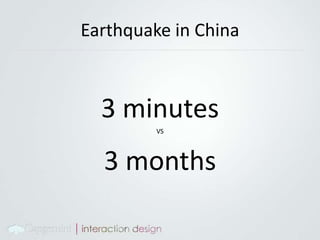
  • #78 http://www.ted.com/talks/clay_shirky_how_cellphones_twitter_facebook_can_make_history.htmlThe last Earthquake in China was newsaround the globe in about 3 minutes. The quakebeforethat was admittedby China afterthreemonths. Social media enabled the people living in the area to bring the news to theirpeers. No governmentregulation.
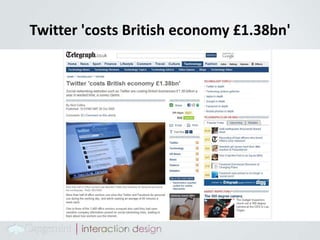
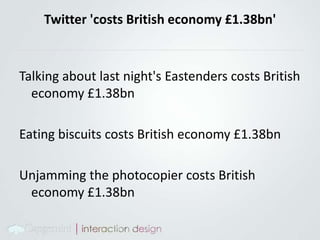
  • #79 http://www.telegraph.co.uk/technology/twitter/6418567/Twitter-costs-British-economy-1.38bn.html
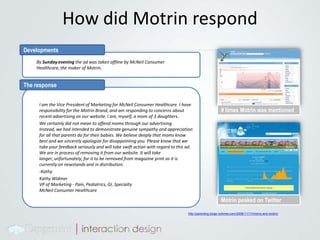
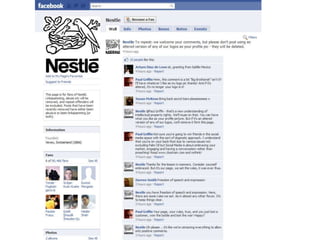
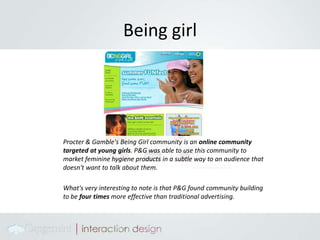
  • #83 http://www.facebook.com/pages/Nestle/24287259392?v=feed&story_fbid=107128462646736
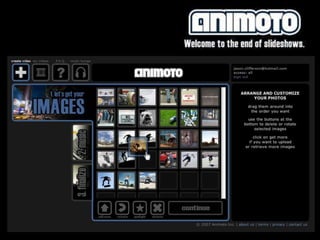
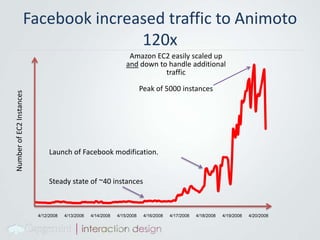
  • #88 These guys at Animoto did it using Amazon Web Services.
  • #89 A couple of nights ago one of our customers—Animoto—saw a monster spike in traffic. Animoto has a product that helps you create web videos with music and graphics. They launched a Facebook app that lets people tell their friends when they’ve uploaded a video that includes that friend. You can see the spike in traffic that this new app caused. The X axis represents time elapsed and the Y axis represents the EC2 instances launched. Because they were using AWS, Animoto didn’t have to do a thing—AWS took care of everything.
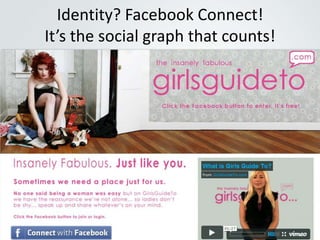
  • #101 So having this hugely distributed Internet where you users are scattered over multiple services and website. How do you look at the concept of identity? It’s a LOT to ask a user to create YET ANOTHER account on your site. However, if the user is willing to do so, it means that he/she is assuming that they will get something out of it. You have a couple of standards that are emerging for online identity management: OpenID, oAuth, etc. However, the real gems are in the social graph: i.e. access to your friends, to your photos, to your profile information, etc. You see many sites now using identity providers from e.g. Facebook as the authentication mechanism and store extra information locally on the server.Other examples:Watchmen movie, BlueRay version: connect via FB Connect with your friends and watch together and chatGirlsGuideTo: the only way to connect is FB Connect. Actually some kind of social network that leverages another social network
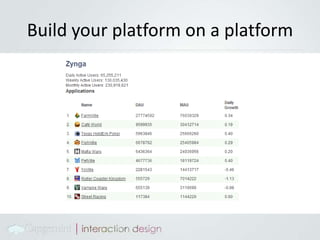
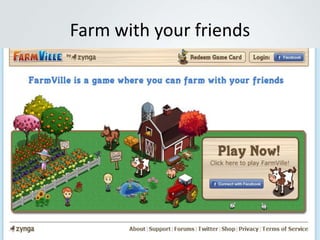
  • #102 http://statistics.allfacebook.com/developers/single/zynga/27/
  • #108 By giving away 100 Ford Fiestas to influential bloggers, 37% of Generation Y were aware of the Ford Fiesta before its launch in the United States.  Is it any wonder why 25% of Ford’s marketing spend has been shifted to digital/social media initiatives?  Ford is the only US auto company that didn’t take a government loan.
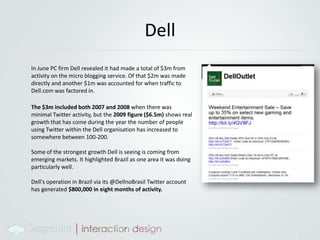
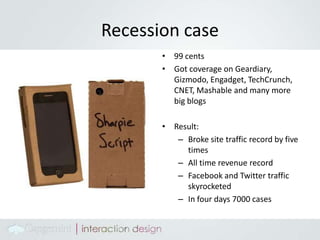
  • #110 Case-mate "Recession Case" drives record sales. Andrew Knight, VP of e-commerce, readily admits he was skeptical when a 22 year old on the marketing staff brought him the idea of selling a cardboard case for the iPhone (see image, above). Appropriately dubbed the recession case, this would retail for 99 cents."My initial thought was that this was never going to work. I was thinking we might sell a couple hundred but most of them we would just have to give away. What I underestimated was the power of social media!" said Knight. What happened is that Knight had met blogger Larry Greenberg through Twitter and Greenberg posted an article about the Recession Case. The next day, almost every major tech news site picked up on the recession case: Gizmodo, Engadget, TechCrunch, CNET, Mashable, etc."We broke our daily site traffic record by five-times and we set an all time revenue record in the same day! Our Facebook & Twitter traffic skyrocketed as the story spread virally and people shared it with friends and family. In four days we had sold over 7,000 recession cases! It was truly unbelievable how fast it took off," said Knight.Case-mate also offered free personalized "Sharpie Script" on the recession case. This sparked a mini-phenomenon of its own, as people were buying cases for each other to simply send a personalized message (aka being social).Knight points out another added bonus of the social propagation, "Our search rankings have improved nicely. Our two most important terms are 'iPhone case' and 'iPhone cases.' We are currently #1 for both of them on Google!"
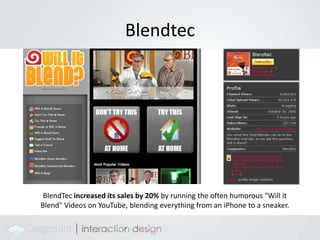
  • #111 BlendTec increased its sales 5x by running the often humorous "Will it Blend" Videos on YouTube, blending everything from an iPhone to a sneaker.