Social Learning in Networks:
Extraction of Deterministic Rules
Rustam Tagiew1 , Dmitry Ignatov2 , Fadi Amroush3
2

1
Qlaym GmbH, Dusseldorf, Germany
¨
National Research University Higher School of Economics, Moscow, Russia
3
Granada Lab of Behavioral Economics (GLOBE), Granada, Spain

EEML 2013 at IEEE ICDM 2013
Dallas, TX, USA
1

Introduction

2

Related Work

3

Social Learning in Networks

4

Data set

5

Results and Interpretations

6

Conclusion
Introduction

Related Work

Social Learning in Networks

Data set

Results and Interpretations

Conclusion

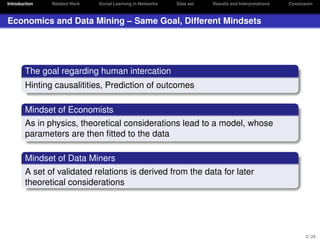
Economics and Data Mining – Same Goal, Different Mindsets

The goal regarding human intercation
Hinting causalitities, Prediction of outcomes
Mindset of Economists
As in physics, theoretical considerations lead to a model, whose
parameters are then fitted to the data
Mindset of Data Miners
A set of validated relations is derived from the data for later
theoretical considerations

3 / 24
Introduction

Related Work

Social Learning in Networks

Data set

Results and Interpretations

Conclusion

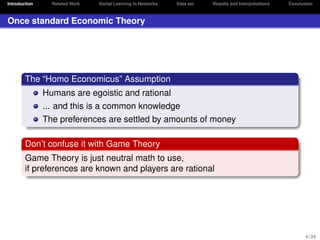
Once standard Economic Theory

The “Homo Economicus” Assumption
Humans are egoistic and rational
... and this is a common knowledge
The preferences are settled by amounts of money
Don’t confuse it with Game Theory
Game Theory is just neutral math to use,
if preferences are known and players are rational

4 / 24
Introduction

Related Work

Social Learning in Networks

Data set

Results and Interpretations

Conclusion

Failure led to Experimental Economics

Unsurprisingly, humans are
... neither throughout egoistic
... no correct in reasoning to be rational.
They therefore deviate from game theoretic equilibria
but in quite predictable ways.
Data situation
Economists continue to conduct laboratory experiments
Excessive field data available since
Orwellian nightmare became reality

5 / 24
Introduction

Related Work

Social Learning in Networks

Data set

Results and Interpretations

Conclusion

Data used in this paper

Same data, different mindset
Choi et al., 2012
“Social learning in networks: quantal response equilibrium
analysis of experimental data”
Tagiew et al., 2013
“Social learning in networks: extraction of deterministic rules”

6 / 24
Introduction

Related Work

Social Learning in Networks

Data set

Results and Interpretations

Conclusion

Related work
Choi et al., 2012

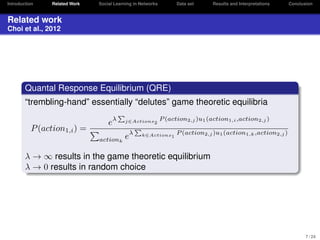
Quantal Response Equilibrium (QRE)
“trembling-hand” essentially “delutes” game theoretic equilibria
P (action1,i ) =

eλ
actionk

j∈Actions2

eλ

P (action2,j )u1 (action1,i ,action2,j )

k∈Actions1

P (action2,j )u1 (action1,k ,action2,j )

λ → ∞ results in the game theoretic equilibrium
λ → 0 results in random choice

7 / 24
Introduction

Related Work

Social Learning in Networks

Data set

Results and Interpretations

Conclusion

Related work
Tagiew, 2012

The two cases of behavior modelling in games
Participation: payoff maximization
→ Non-deterministic models
Spectator: correctness maximization
→ Deterministic models
Performance
Cross-validation results of support vector machine based
deterministic models outperformed related work on two data sets

8 / 24
Introduction

Related Work

Social Learning in Networks

Data set

Results and Interpretations

Conclusion

Social Learning in Networks – Game rules

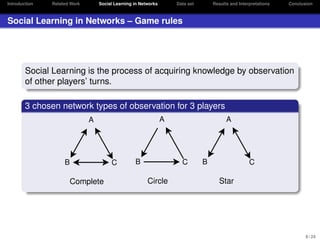
Social Learning is the process of acquiring knowledge by observation
of other players’ turns.
3 chosen network types of observation for 3 players
A

A

B

Complete

C

B

A

C

Circle

B

C

Star

9 / 24
Introduction

Related Work

Social Learning in Networks

Data set

Results and Interpretations

Conclusion

Social Learning in Networks – Game rules

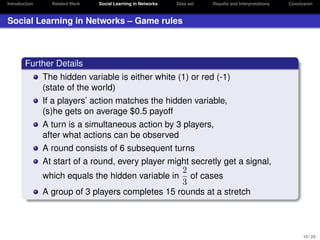
Further Details
The hidden variable is either white (1) or red (-1)
(state of the world)
If a players’ action matches the hidden variable,
(s)he gets on average $0.5 payoff
A turn is a simultaneous action by 3 players,
after what actions can be observed
A round consists of 6 subsequent turns
At start of a round, every player might secretly get a signal,
2
which equals the hidden variable in of cases
3
A group of 3 players completes 15 rounds at a stretch

10 / 24
Introduction

Related Work

Social Learning in Networks

Data set

Results and Interpretations

Conclusion

Social Learning in Networks – Game rules

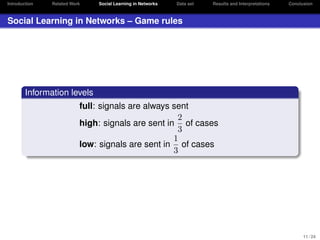
Information levels
full: signals are always sent
2
high: signals are sent in of cases
3
1
low: signals are sent in of cases
3

11 / 24
Introduction

Related Work

Social Learning in Networks

Data set

Results and Interpretations

Conclusion

Data Set

Number of subjects’ groups for 9 game configurations.
Information/
Network type
Complete
Circle
Star

Low

High

Full

6
5
6

5
6
6

6
6
6

Total Number of Human Decisions
3 ∗ 6 ∗ 15 = 270 times the sum of the table results 14040

12 / 24
Introduction

Related Work

Social Learning in Networks

Data set

Results and Interpretations

Conclusion

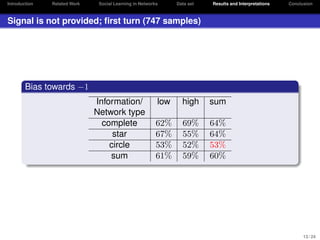
Signal is not provided; first turn (747 samples)

Bias towards −1
Information/
Network type
complete
star
circle
sum

low

high

sum

62%
67%
53%
61%

69%
55%
52%
59%

64%
64%
53%
60%

13 / 24
Introduction

Related Work

Social Learning in Networks

Data set

Results and Interpretations

Conclusion

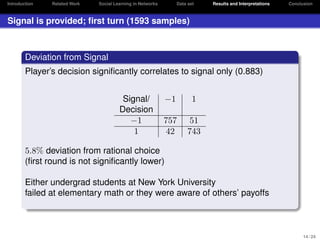
Signal is provided; first turn (1593 samples)

Deviation from Signal
Player’s decision significantly correlates to signal only (0.883)
Signal/
Decision
−1
1

−1

1

757
42

51
743

5.8% deviation from rational choice
(first round is not significantly lower)
Either undergrad students at New York University
failed at elementary math or they were aware of others’ payoffs

14 / 24
Introduction

Related Work

Social Learning in Networks

Data set

Results and Interpretations

Conclusion

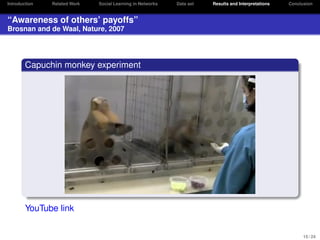
“Awareness of others’ payoffs”
Brosnan and de Waal, Nature, 2007

Capuchin monkey experiment

YouTube link

15 / 24
Introduction

Related Work

Social Learning in Networks

Data set

Results and Interpretations

Conclusion

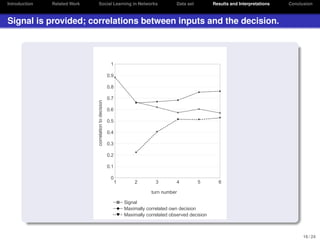
Signal is provided; correlations between inputs and the decision.

1
0.9

correlation to decision

0.8
0.7
0.6
0.5
0.4
0.3
0.2
0.1
0

1

2

3

4

5

6

turn number
Signal
Maximally correlated own decision
Maximally correlated observed decision

16 / 24
Introduction

Related Work

Social Learning in Networks

Data set

Results and Interpretations

Conclusion

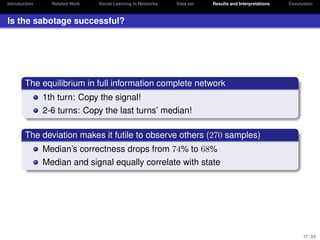
Is the sabotage successful?

The equilibrium in full information complete network
1th turn: Copy the signal!
2-6 turns: Copy the last turns’ median!
The deviation makes it futile to observe others (270 samples)
Median’s correctness drops from 74% to 68%
Median and signal equally correlate with state

17 / 24
Introduction

Related Work

Social Learning in Networks

Data set

Results and Interpretations

Conclusion

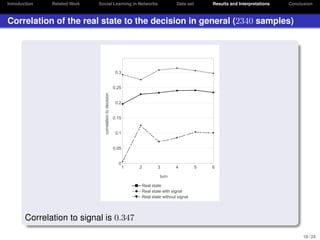
Correlation of the real state to the decision in general (2340 samples)

0.3

correlation to decision

0.25
0.2
0.15
0.1
0.05
0

1

2

3

4

5

6

turn
Real state
Real state with signal
Real state without signal

Correlation to signal is 0.347
18 / 24
Introduction

Related Work

Social Learning in Networks

Data set

Results and Interpretations

Conclusion

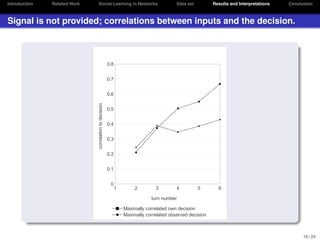
Signal is not provided; correlations between inputs and the decision.

0.8
0.7

correlation to decision

0.6
0.5
0.4
0.3
0.2
0.1
0

1

2

3

4

5

6

turn number
Maximally correlated own decision
Maximally correlated observed decision

19 / 24
Introduction

Related Work

Social Learning in Networks

Data set

Results and Interpretations

Conclusion

Generalization and fit correctness for rule extraction (JRip)

100
95

correctness in procent

90
85
80
75
70
65
60
55
50

1

2

3

4

5

6

turn number
Null hypothesis with signal
Null hypothesis without signal
Generalization with signal
Generalization without signal
Fit with signal
Fit without signal

20 / 24
Introduction

Related Work

Social Learning in Networks

Data set

Results and Interpretations

Conclusion

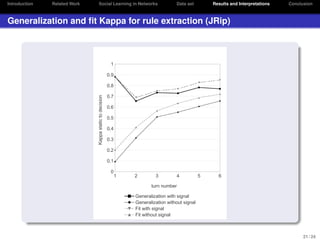
Generalization and fit Kappa for rule extraction (JRip)

1
0.9

Kappa static to decision

0.8
0.7
0.6
0.5
0.4
0.3
0.2
0.1
0

1

2

3

4

5

6

turn number
Generalization with signal
Generalization without signal
Fit with signal
Fit without signal

21 / 24
Introduction

Related Work

Social Learning in Networks

Data set

Results and Interpretations

Conclusion

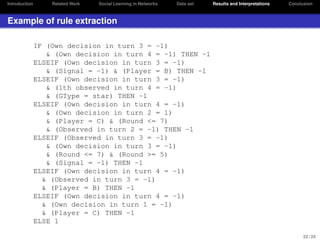
Example of rule extraction
IF (Own decision in turn 3 = -1)
& (Own decision in turn 4 = -1) THEN -1
ELSEIF (Own decision in turn 3 = -1)
& (Signal = -1) & (Player = B) THEN -1
ELSEIF (Own decision in turn 3 = -1)
& (1th observed in turn 4 = -1)
& (GType = star) THEN -1
ELSEIF (Own decision in turn 4 = -1)
& (Own decision in turn 2 = 1)
& (Player = C) & (Round <= 7)
& (Observed in turn 2 = -1) THEN -1
ELSEIF (Observed in turn 3 = -1)
& (Own decision in turn 3 = -1)
& (Round <= 7) & (Round >= 5)
& (Signal = -1) THEN -1
ELSEIF (Own decision in turn 4 = -1)
& (Observed in turn 3 = -1)
& (Player = B) THEN -1
ELSEIF (Own decision in turn 4 = -1)
& (Own decision in turn 1 = -1)
& (Player = C) THEN -1
ELSE 1
22 / 24
Introduction

Related Work

Social Learning in Networks

Data set

Results and Interpretations

Conclusion

Conclusion

Strong hint of pugnacious behavior
Deterministic rules are able to generalize human behavior

23 / 24
Introduction

Related Work

Social Learning in Networks

Data set

Results and Interpretations

Conclusion

Future work

Collecting more data from Experimental Economics domain on a
Web portal
Applying other Data Mining & Machine Learning techniques for
Economics and Social Sciences data concerning human
behavior
In particular emergent sequential patterns seems to be a good
tool for Game Data Mining since we deal with sequences of
actions and their outcomes
Collaboration with other research teams working in Experimental
Economics and Game Theory potentially interested in DM&ML
methods

24 / 24

Social Learning in Networks: Extraction Deterministic Rules

  • 1.
    Social Learning inNetworks: Extraction of Deterministic Rules Rustam Tagiew1 , Dmitry Ignatov2 , Fadi Amroush3 2 1 Qlaym GmbH, Dusseldorf, Germany ¨ National Research University Higher School of Economics, Moscow, Russia 3 Granada Lab of Behavioral Economics (GLOBE), Granada, Spain EEML 2013 at IEEE ICDM 2013 Dallas, TX, USA
  • 2.
    1 Introduction 2 Related Work 3 Social Learningin Networks 4 Data set 5 Results and Interpretations 6 Conclusion
  • 3.
    Introduction Related Work Social Learningin Networks Data set Results and Interpretations Conclusion Economics and Data Mining – Same Goal, Different Mindsets The goal regarding human intercation Hinting causalitities, Prediction of outcomes Mindset of Economists As in physics, theoretical considerations lead to a model, whose parameters are then fitted to the data Mindset of Data Miners A set of validated relations is derived from the data for later theoretical considerations 3 / 24
  • 4.
    Introduction Related Work Social Learningin Networks Data set Results and Interpretations Conclusion Once standard Economic Theory The “Homo Economicus” Assumption Humans are egoistic and rational ... and this is a common knowledge The preferences are settled by amounts of money Don’t confuse it with Game Theory Game Theory is just neutral math to use, if preferences are known and players are rational 4 / 24
  • 5.
    Introduction Related Work Social Learningin Networks Data set Results and Interpretations Conclusion Failure led to Experimental Economics Unsurprisingly, humans are ... neither throughout egoistic ... no correct in reasoning to be rational. They therefore deviate from game theoretic equilibria but in quite predictable ways. Data situation Economists continue to conduct laboratory experiments Excessive field data available since Orwellian nightmare became reality 5 / 24
  • 6.
    Introduction Related Work Social Learningin Networks Data set Results and Interpretations Conclusion Data used in this paper Same data, different mindset Choi et al., 2012 “Social learning in networks: quantal response equilibrium analysis of experimental data” Tagiew et al., 2013 “Social learning in networks: extraction of deterministic rules” 6 / 24
  • 7.
    Introduction Related Work Social Learningin Networks Data set Results and Interpretations Conclusion Related work Choi et al., 2012 Quantal Response Equilibrium (QRE) “trembling-hand” essentially “delutes” game theoretic equilibria P (action1,i ) = eλ actionk j∈Actions2 eλ P (action2,j )u1 (action1,i ,action2,j ) k∈Actions1 P (action2,j )u1 (action1,k ,action2,j ) λ → ∞ results in the game theoretic equilibrium λ → 0 results in random choice 7 / 24
  • 8.
    Introduction Related Work Social Learningin Networks Data set Results and Interpretations Conclusion Related work Tagiew, 2012 The two cases of behavior modelling in games Participation: payoff maximization → Non-deterministic models Spectator: correctness maximization → Deterministic models Performance Cross-validation results of support vector machine based deterministic models outperformed related work on two data sets 8 / 24
  • 9.
    Introduction Related Work Social Learningin Networks Data set Results and Interpretations Conclusion Social Learning in Networks – Game rules Social Learning is the process of acquiring knowledge by observation of other players’ turns. 3 chosen network types of observation for 3 players A A B Complete C B A C Circle B C Star 9 / 24
  • 10.
    Introduction Related Work Social Learningin Networks Data set Results and Interpretations Conclusion Social Learning in Networks – Game rules Further Details The hidden variable is either white (1) or red (-1) (state of the world) If a players’ action matches the hidden variable, (s)he gets on average $0.5 payoff A turn is a simultaneous action by 3 players, after what actions can be observed A round consists of 6 subsequent turns At start of a round, every player might secretly get a signal, 2 which equals the hidden variable in of cases 3 A group of 3 players completes 15 rounds at a stretch 10 / 24
  • 11.
    Introduction Related Work Social Learningin Networks Data set Results and Interpretations Conclusion Social Learning in Networks – Game rules Information levels full: signals are always sent 2 high: signals are sent in of cases 3 1 low: signals are sent in of cases 3 11 / 24
  • 12.
    Introduction Related Work Social Learningin Networks Data set Results and Interpretations Conclusion Data Set Number of subjects’ groups for 9 game configurations. Information/ Network type Complete Circle Star Low High Full 6 5 6 5 6 6 6 6 6 Total Number of Human Decisions 3 ∗ 6 ∗ 15 = 270 times the sum of the table results 14040 12 / 24
  • 13.
    Introduction Related Work Social Learningin Networks Data set Results and Interpretations Conclusion Signal is not provided; first turn (747 samples) Bias towards −1 Information/ Network type complete star circle sum low high sum 62% 67% 53% 61% 69% 55% 52% 59% 64% 64% 53% 60% 13 / 24
  • 14.
    Introduction Related Work Social Learningin Networks Data set Results and Interpretations Conclusion Signal is provided; first turn (1593 samples) Deviation from Signal Player’s decision significantly correlates to signal only (0.883) Signal/ Decision −1 1 −1 1 757 42 51 743 5.8% deviation from rational choice (first round is not significantly lower) Either undergrad students at New York University failed at elementary math or they were aware of others’ payoffs 14 / 24
  • 15.
    Introduction Related Work Social Learningin Networks Data set Results and Interpretations Conclusion “Awareness of others’ payoffs” Brosnan and de Waal, Nature, 2007 Capuchin monkey experiment YouTube link 15 / 24
  • 16.
    Introduction Related Work Social Learningin Networks Data set Results and Interpretations Conclusion Signal is provided; correlations between inputs and the decision. 1 0.9 correlation to decision 0.8 0.7 0.6 0.5 0.4 0.3 0.2 0.1 0 1 2 3 4 5 6 turn number Signal Maximally correlated own decision Maximally correlated observed decision 16 / 24
  • 17.
    Introduction Related Work Social Learningin Networks Data set Results and Interpretations Conclusion Is the sabotage successful? The equilibrium in full information complete network 1th turn: Copy the signal! 2-6 turns: Copy the last turns’ median! The deviation makes it futile to observe others (270 samples) Median’s correctness drops from 74% to 68% Median and signal equally correlate with state 17 / 24
  • 18.
    Introduction Related Work Social Learningin Networks Data set Results and Interpretations Conclusion Correlation of the real state to the decision in general (2340 samples) 0.3 correlation to decision 0.25 0.2 0.15 0.1 0.05 0 1 2 3 4 5 6 turn Real state Real state with signal Real state without signal Correlation to signal is 0.347 18 / 24
  • 19.
    Introduction Related Work Social Learningin Networks Data set Results and Interpretations Conclusion Signal is not provided; correlations between inputs and the decision. 0.8 0.7 correlation to decision 0.6 0.5 0.4 0.3 0.2 0.1 0 1 2 3 4 5 6 turn number Maximally correlated own decision Maximally correlated observed decision 19 / 24
  • 20.
    Introduction Related Work Social Learningin Networks Data set Results and Interpretations Conclusion Generalization and fit correctness for rule extraction (JRip) 100 95 correctness in procent 90 85 80 75 70 65 60 55 50 1 2 3 4 5 6 turn number Null hypothesis with signal Null hypothesis without signal Generalization with signal Generalization without signal Fit with signal Fit without signal 20 / 24
  • 21.
    Introduction Related Work Social Learningin Networks Data set Results and Interpretations Conclusion Generalization and fit Kappa for rule extraction (JRip) 1 0.9 Kappa static to decision 0.8 0.7 0.6 0.5 0.4 0.3 0.2 0.1 0 1 2 3 4 5 6 turn number Generalization with signal Generalization without signal Fit with signal Fit without signal 21 / 24
  • 22.
    Introduction Related Work Social Learningin Networks Data set Results and Interpretations Conclusion Example of rule extraction IF (Own decision in turn 3 = -1) & (Own decision in turn 4 = -1) THEN -1 ELSEIF (Own decision in turn 3 = -1) & (Signal = -1) & (Player = B) THEN -1 ELSEIF (Own decision in turn 3 = -1) & (1th observed in turn 4 = -1) & (GType = star) THEN -1 ELSEIF (Own decision in turn 4 = -1) & (Own decision in turn 2 = 1) & (Player = C) & (Round <= 7) & (Observed in turn 2 = -1) THEN -1 ELSEIF (Observed in turn 3 = -1) & (Own decision in turn 3 = -1) & (Round <= 7) & (Round >= 5) & (Signal = -1) THEN -1 ELSEIF (Own decision in turn 4 = -1) & (Observed in turn 3 = -1) & (Player = B) THEN -1 ELSEIF (Own decision in turn 4 = -1) & (Own decision in turn 1 = -1) & (Player = C) THEN -1 ELSE 1 22 / 24
  • 23.
    Introduction Related Work Social Learningin Networks Data set Results and Interpretations Conclusion Conclusion Strong hint of pugnacious behavior Deterministic rules are able to generalize human behavior 23 / 24
  • 24.
    Introduction Related Work Social Learningin Networks Data set Results and Interpretations Conclusion Future work Collecting more data from Experimental Economics domain on a Web portal Applying other Data Mining & Machine Learning techniques for Economics and Social Sciences data concerning human behavior In particular emergent sequential patterns seems to be a good tool for Game Data Mining since we deal with sequences of actions and their outcomes Collaboration with other research teams working in Experimental Economics and Game Theory potentially interested in DM&ML methods 24 / 24