Scalable Influence Maximization for
    Prevalent Viral Marketing in Large-Scale
                Social Networks

                                  Wei Chen
                            Microsoft Research Asia

                                   In collaboration with
                            Chi Wang     University of Illinois at Urbana-Champaign
                            Yajun Wang   Microsoft Research Asia


1   KDD'10, July 27, 2010
Outline
     Background and problem definition
     Maximum Influence Arborescence (MIA) heuristic
     Experimental evaluations
     Related work and future directions


2   KDD'10, July 27, 2010
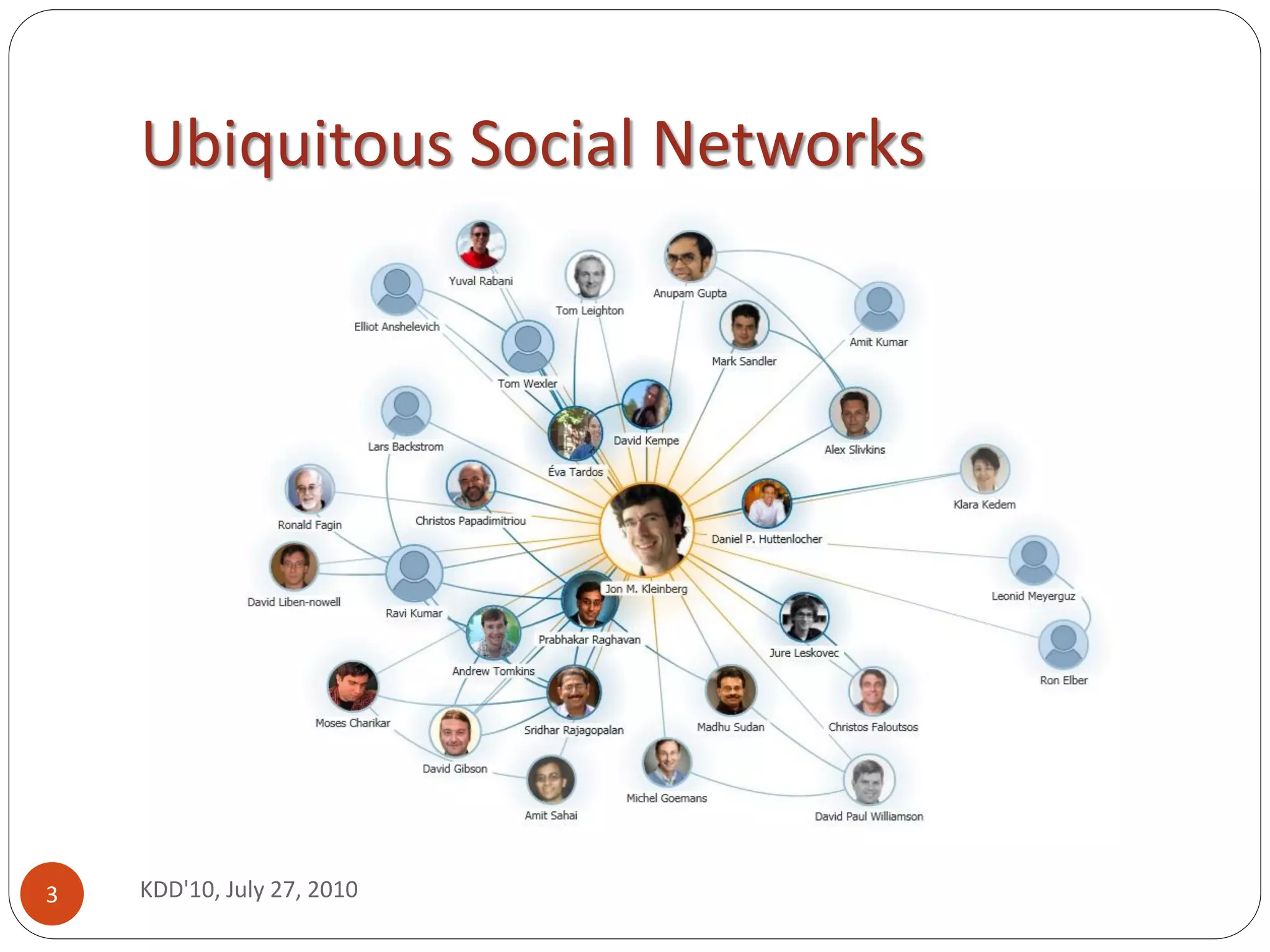
Ubiquitous Social Networks


3   KDD'10, July 27, 2010
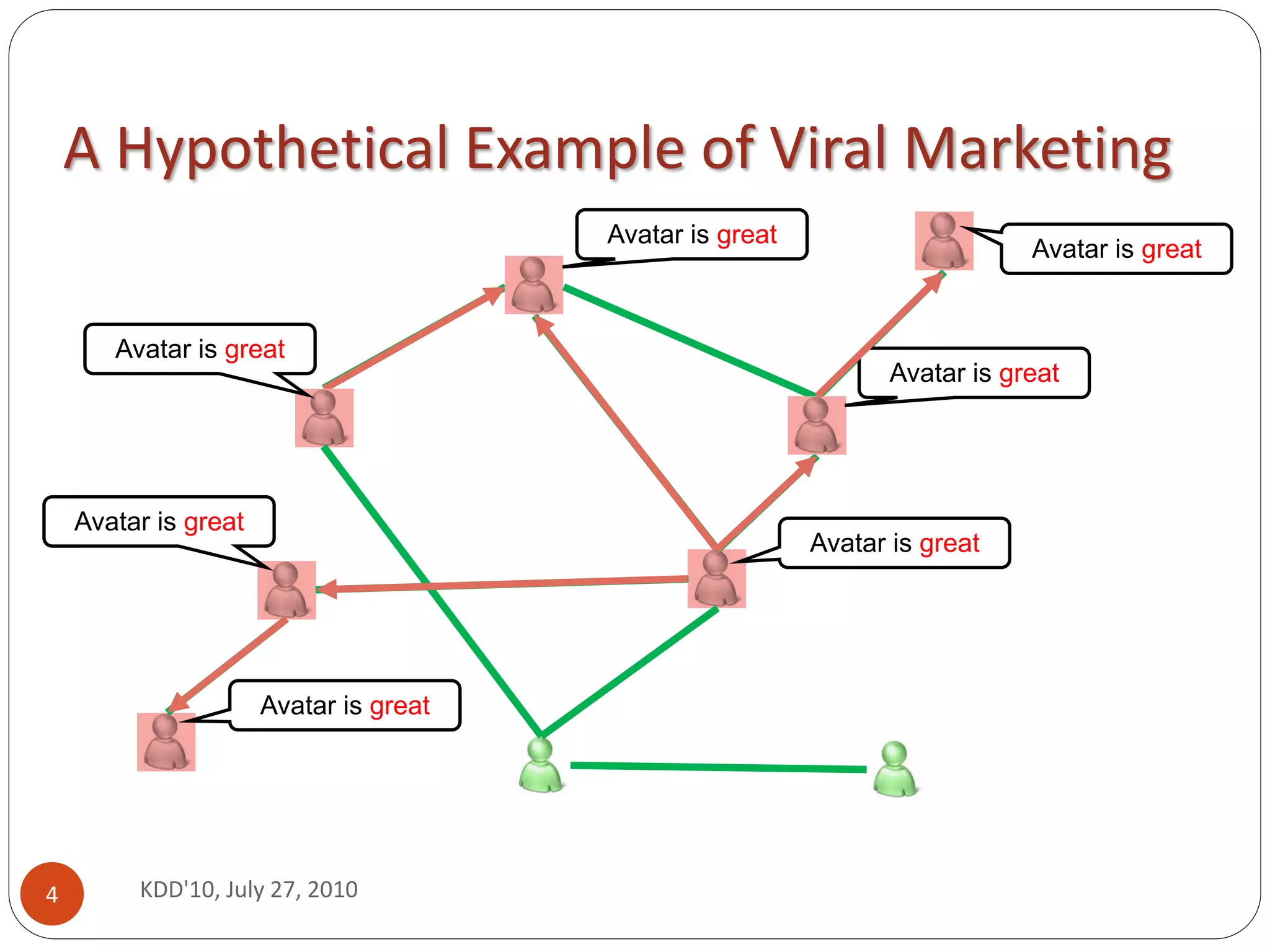
A Hypothetical Example of Viral Marketing
                                        Avatar is great
                                                                             Avatar is great


       Avatar is great
                                                                 Avatar is great


    Avatar is great
                                                          Avatar is great


                      Avatar is great


4        KDD'10, July 27, 2010
Effectiveness of Viral Marketing
                                 level of trust on different types of ads *

                                                                              very effective


    *source from Forrester Research and Intelliseek


5            KDD'10, July 27, 2010
The Problem of Influence Maximization
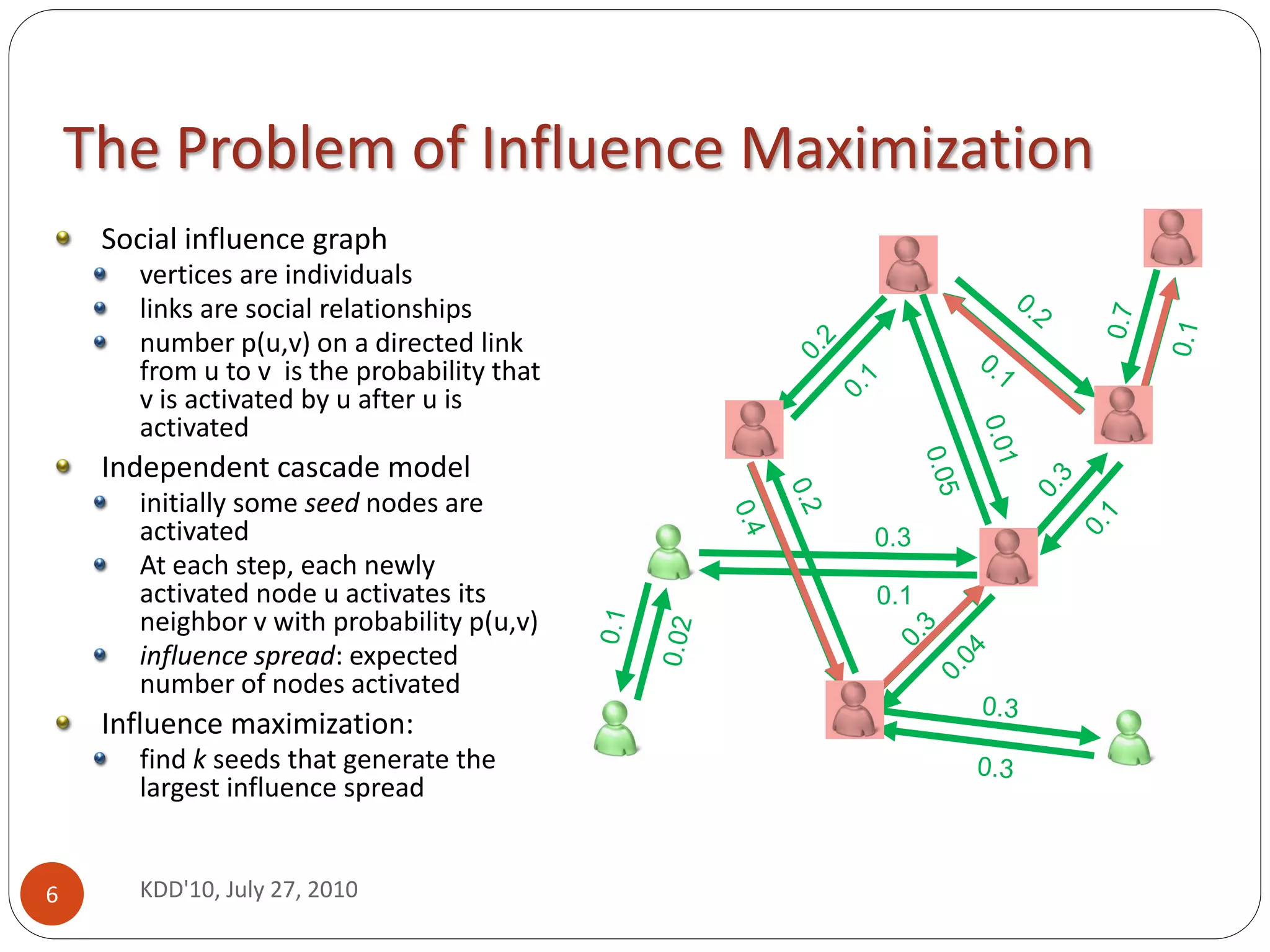
     Social influence graph
       vertices are individuals
       links are social relationships
       number p(u,v) on a directed link
       from u to v is the probability that
       v is activated by u after u is
       activated
     Independent cascade model
       initially some seed nodes are
       activated                             0.3
       At each step, each newly
       activated node u activates its        0.1
       neighbor v with probability p(u,v)
       influence spread: expected
       number of nodes activated
     Influence maximization:
       find k seeds that generate the
       largest influence spread


6      KDD'10, July 27, 2010
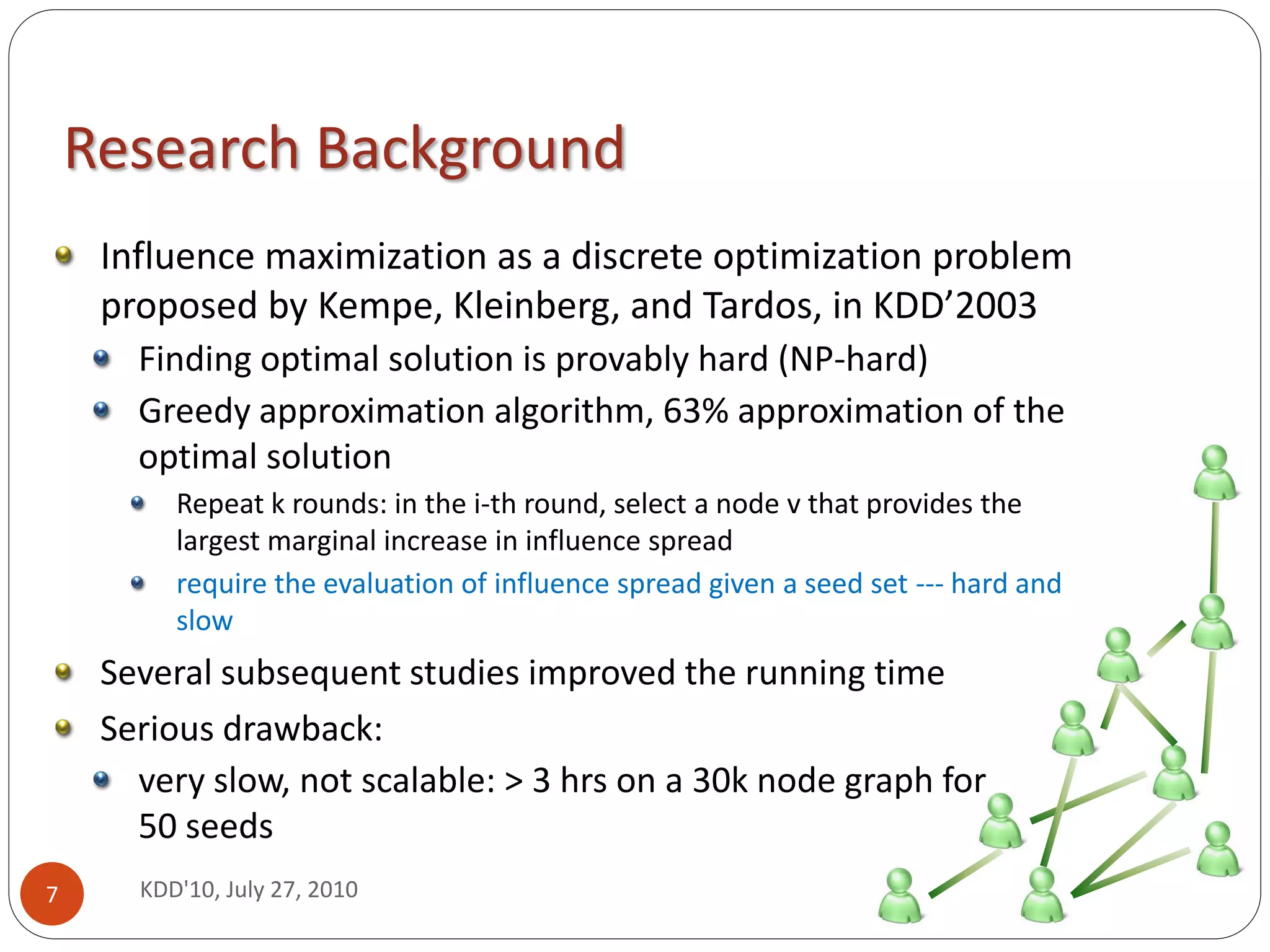
Research Background
     Influence maximization as a discrete optimization problem
     proposed by Kempe, Kleinberg, and Tardos, in KDD’2003
       Finding optimal solution is provably hard (NP-hard)
       Greedy approximation algorithm, 63% approximation of the
       optimal solution
          Repeat k rounds: in the i-th round, select a node v that provides the
          largest marginal increase in influence spread
          require the evaluation of influence spread given a seed set --- hard and
          slow
     Several subsequent studies improved the running time
     Serious drawback:
       very slow, not scalable: > 3 hrs on a 30k node graph for
       50 seeds
7      KDD'10, July 27, 2010
Our Work
     Design new heuristics
       MIA (maximum influence arborescence) heuristic
          for general independent cascade model
          103 speedup --- from hours to seconds (or days to minutes)
          influence spread close to that of the greedy algorithm of [KKT’03]
     We also show that computing exact influence spread given a
     seed set is #P-hard (counting hardness)
       resolve an open problem in [KKT’03]
       indicate the intrinsic difficulty of computing influence spread


8      KDD'10, July 27, 2010
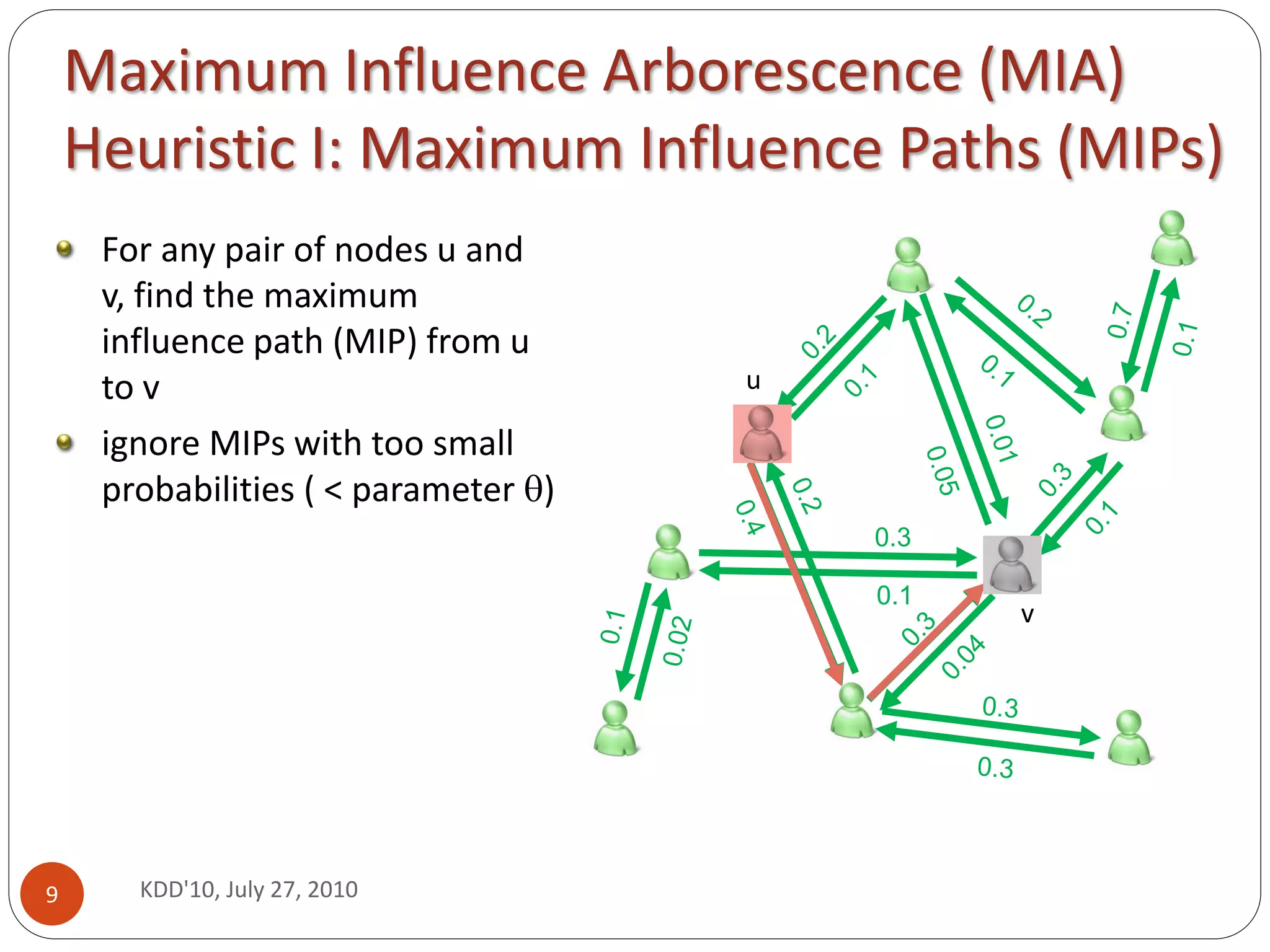
Maximum Influence Arborescence (MIA)
    Heuristic I: Maximum Influence Paths (MIPs)
     For any pair of nodes u and
     v, find the maximum
     influence path (MIP) from u
     to v                             u

     ignore MIPs with too small
     probabilities ( < parameter )
                                          0.3

                                          0.1
                                                v


9      KDD'10, July 27, 2010
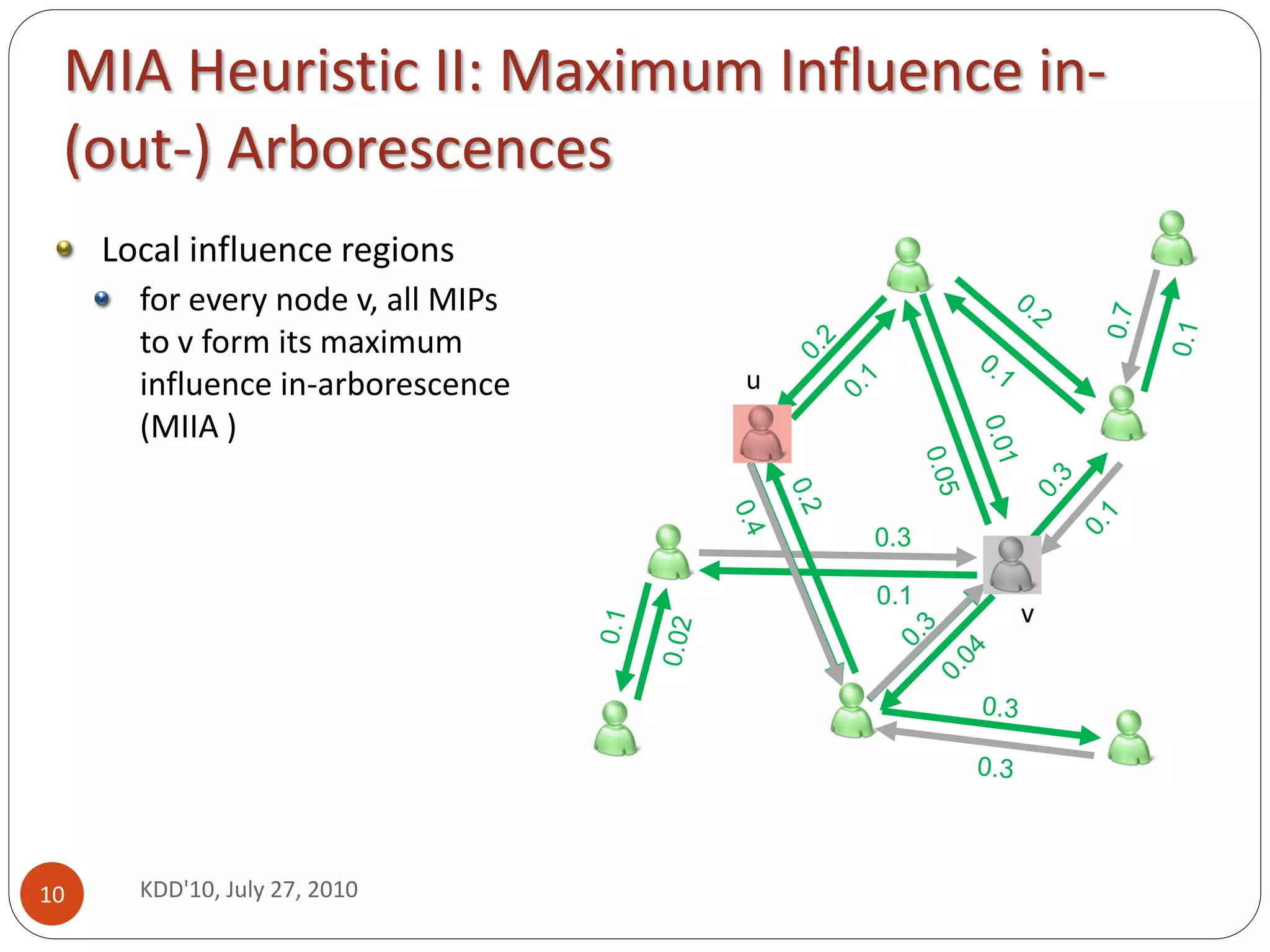
MIA Heuristic II: Maximum Influence in-
 (out-) Arborescences
     Local influence regions
       for every node v, all MIPs
       to v form its maximum
       influence in-arborescence    u
       (MIIA )


                                        0.3

                                        0.1
                                              v


10     KDD'10, July 27, 2010
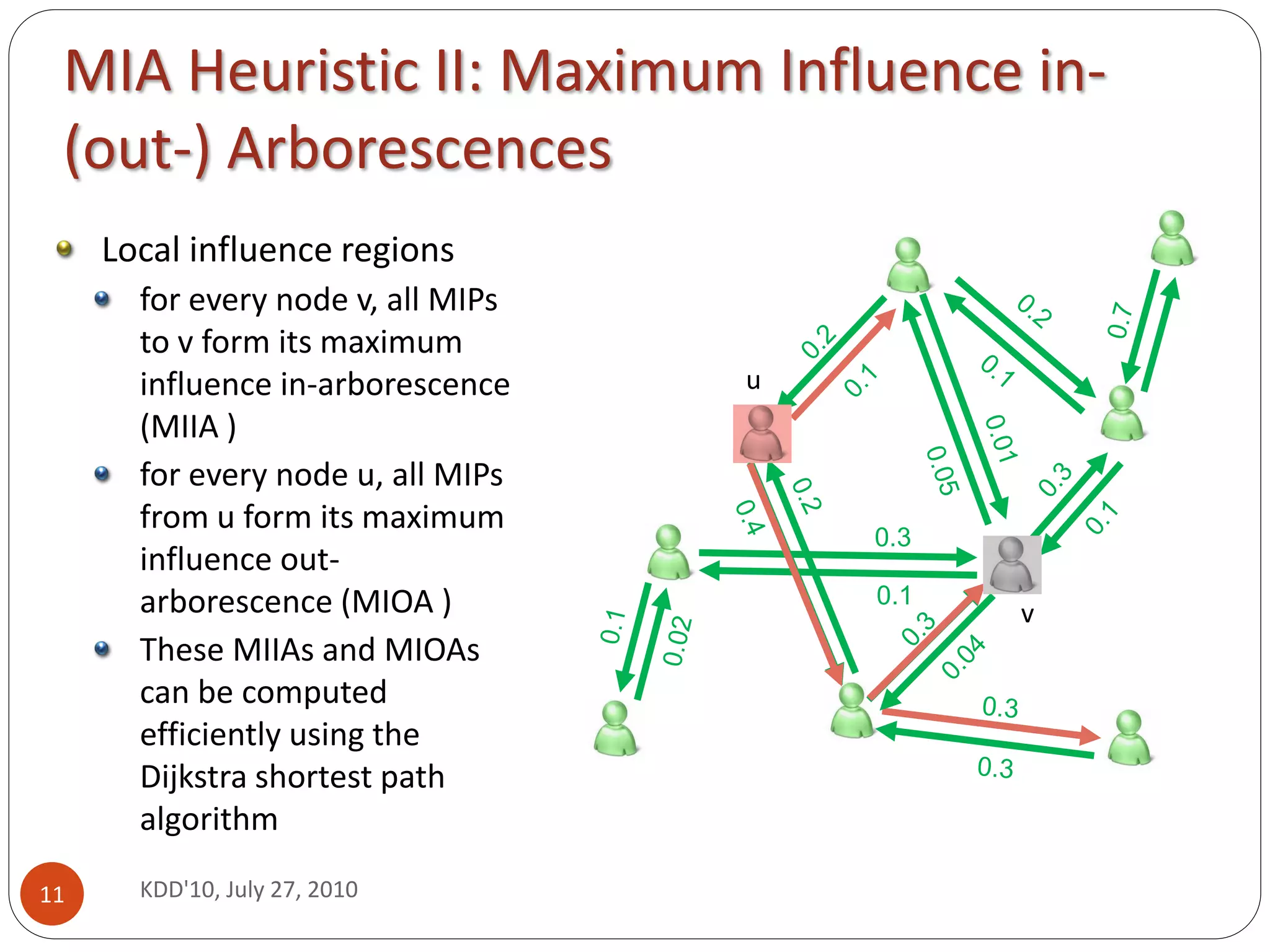
MIA Heuristic II: Maximum Influence in-
 (out-) Arborescences
     Local influence regions
       for every node v, all MIPs
       to v form its maximum
       influence in-arborescence    u
       (MIIA )
       for every node u, all MIPs
       from u form its maximum
                                        0.3
       influence out-
       arborescence (MIOA )             0.1
                                              v
       These MIIAs and MIOAs
       can be computed
       efficiently using the
       Dijkstra shortest path
       algorithm

11     KDD'10, July 27, 2010
MIA Heuristic III: Computing Influence
 through the MIA structure
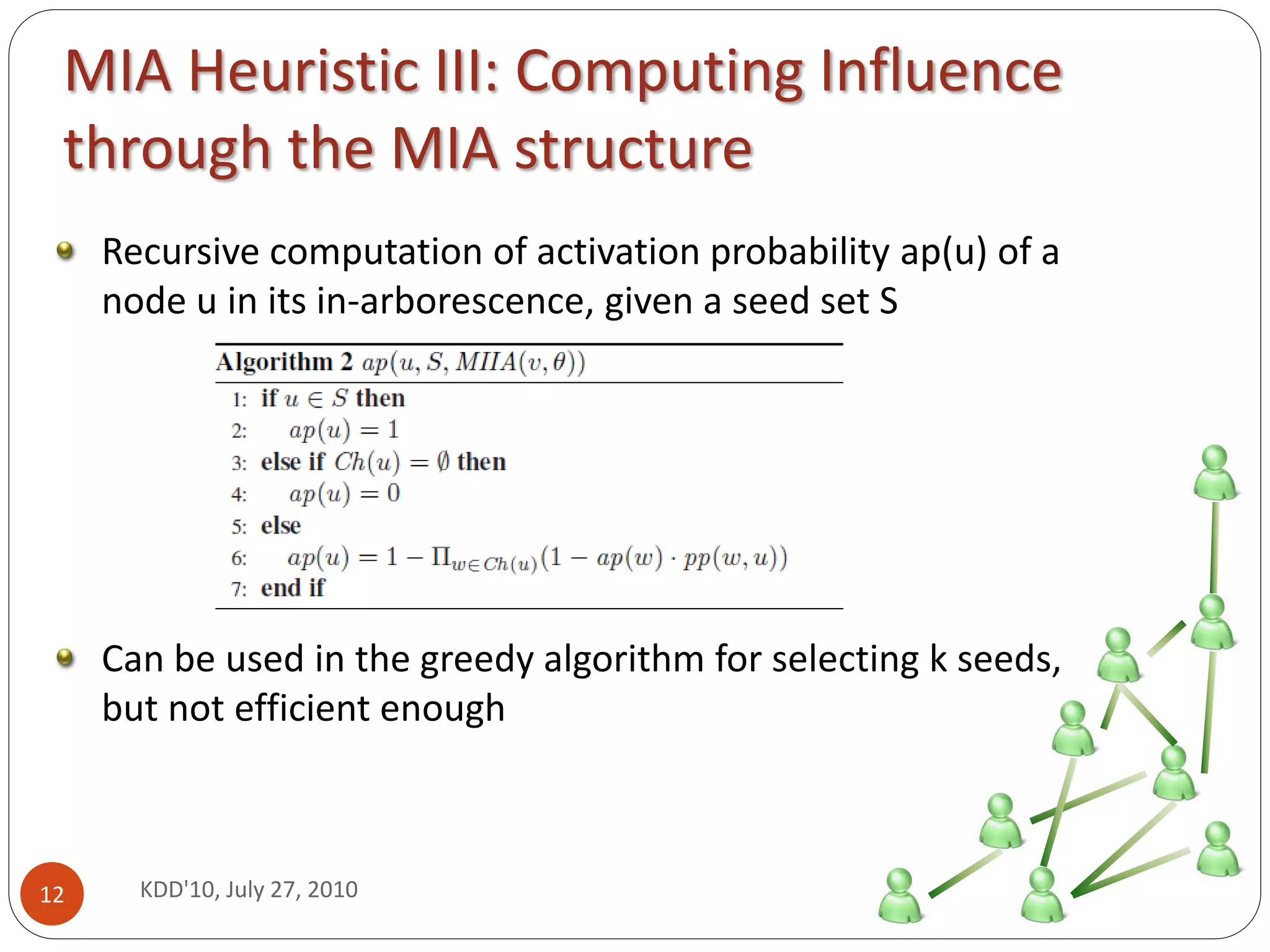
     Recursive computation of activation probability ap(u) of a
     node u in its in-arborescence, given a seed set S


     Can be used in the greedy algorithm for selecting k seeds,
     but not efficient enough


12     KDD'10, July 27, 2010
MIA Heuristic IV: Efficient Updates on
 Activation Probabilities
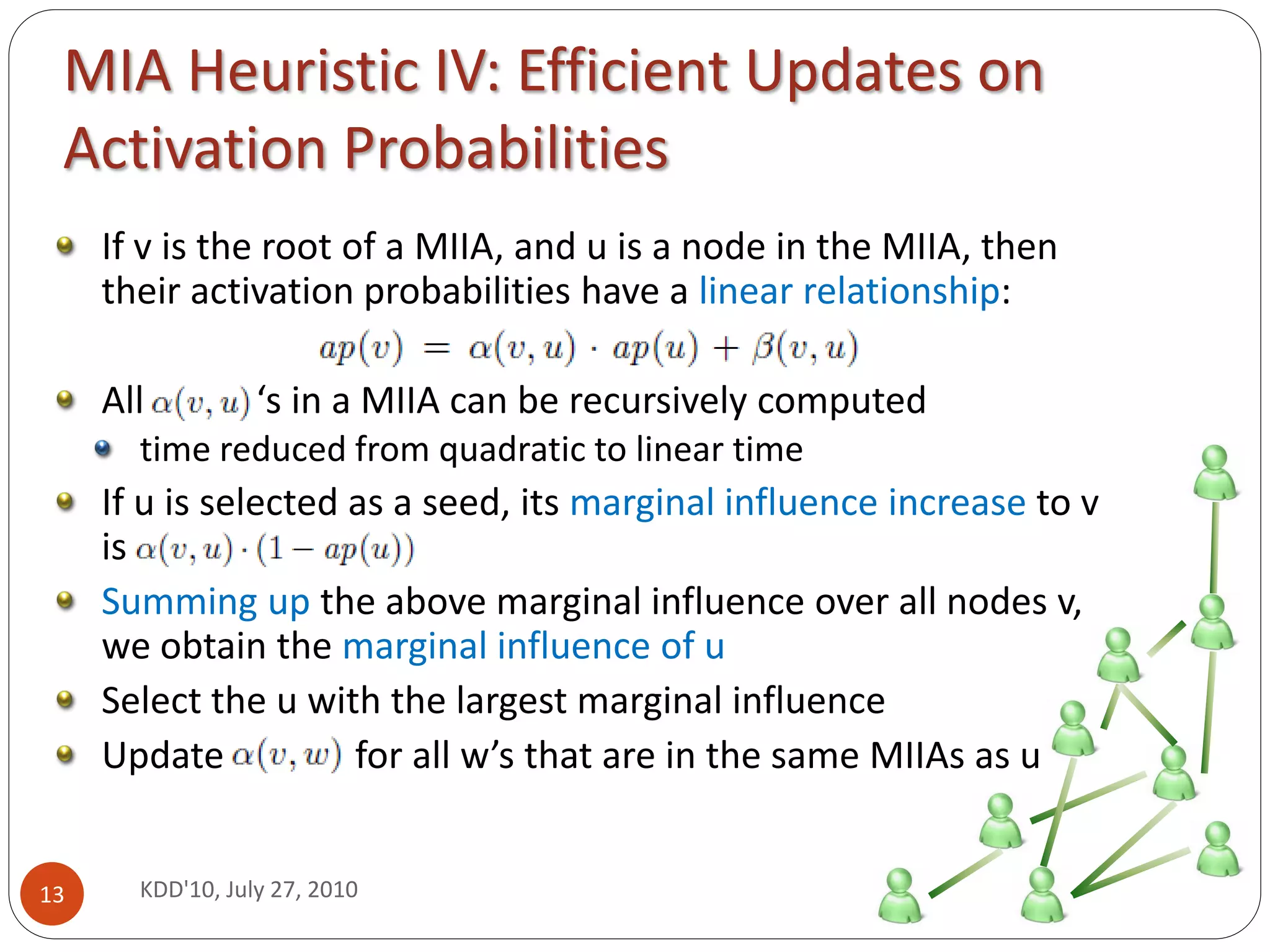
     If v is the root of a MIIA, and u is a node in the MIIA, then
     their activation probabilities have a linear relationship:

     All          ‘s in a MIIA can be recursively computed
       time reduced from quadratic to linear time
     If u is selected as a seed, its marginal influence increase to v
     is
     Summing up the above marginal influence over all nodes v,
     we obtain the marginal influence of u
     Select the u with the largest marginal influence
     Update           for all w’s that are in the same MIIAs as u


13     KDD'10, July 27, 2010
MIA Heuristic IV: Summary
     Iterating the following two steps until finding k seeds
       Selecting the node u giving the largest marginal influence
       Update MIAs (linear coefficients) after selecting u as the seed
     Key features:
       updates are local, and linear to the arborescence size
       tunable with parameter : tradeoff between running time and
       influence spread


14     KDD'10, July 27, 2010
Experiment Results on MIA Heuristic
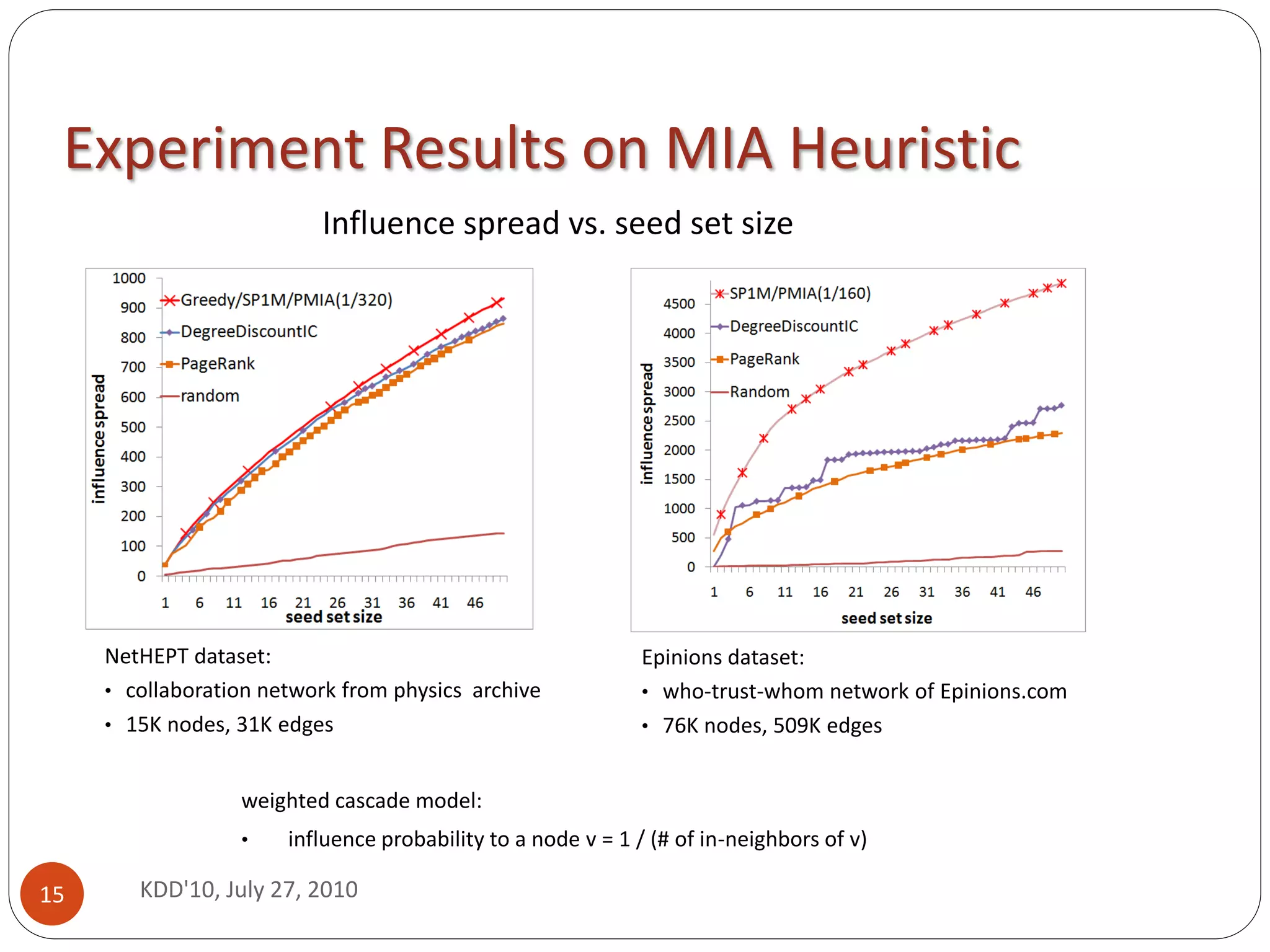
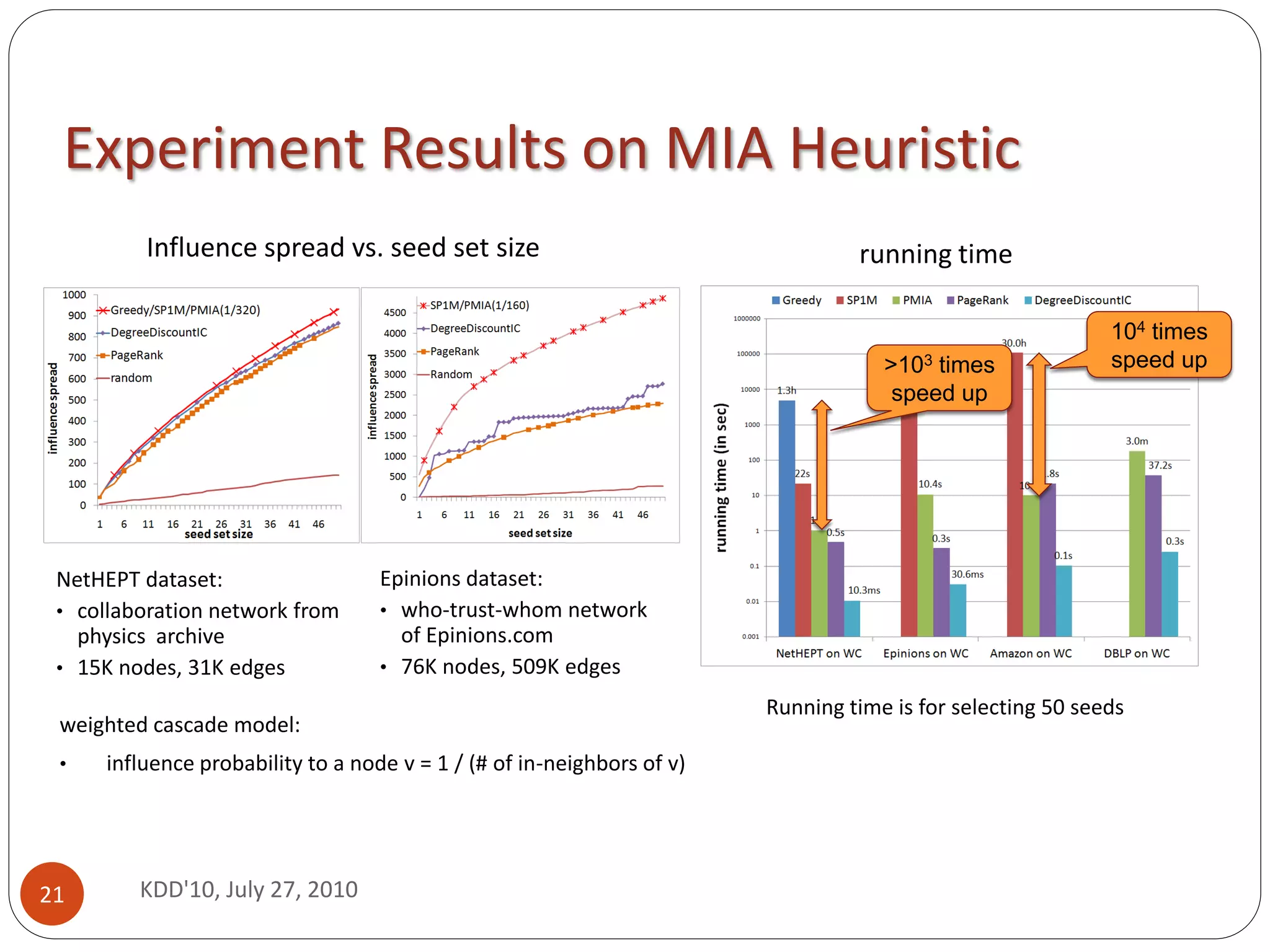
                          Influence spread vs. seed set size


     NetHEPT dataset:                                         Epinions dataset:
     • collaboration network from physics archive             • who-trust-whom network of Epinions.com
     • 15K nodes, 31K edges                                   • 76K nodes, 509K edges


                  weighted cascade model:
                  •    influence probability to a node v = 1 / (# of in-neighbors of v)

15      KDD'10, July 27, 2010
Experiment Results on MIA Heuristic
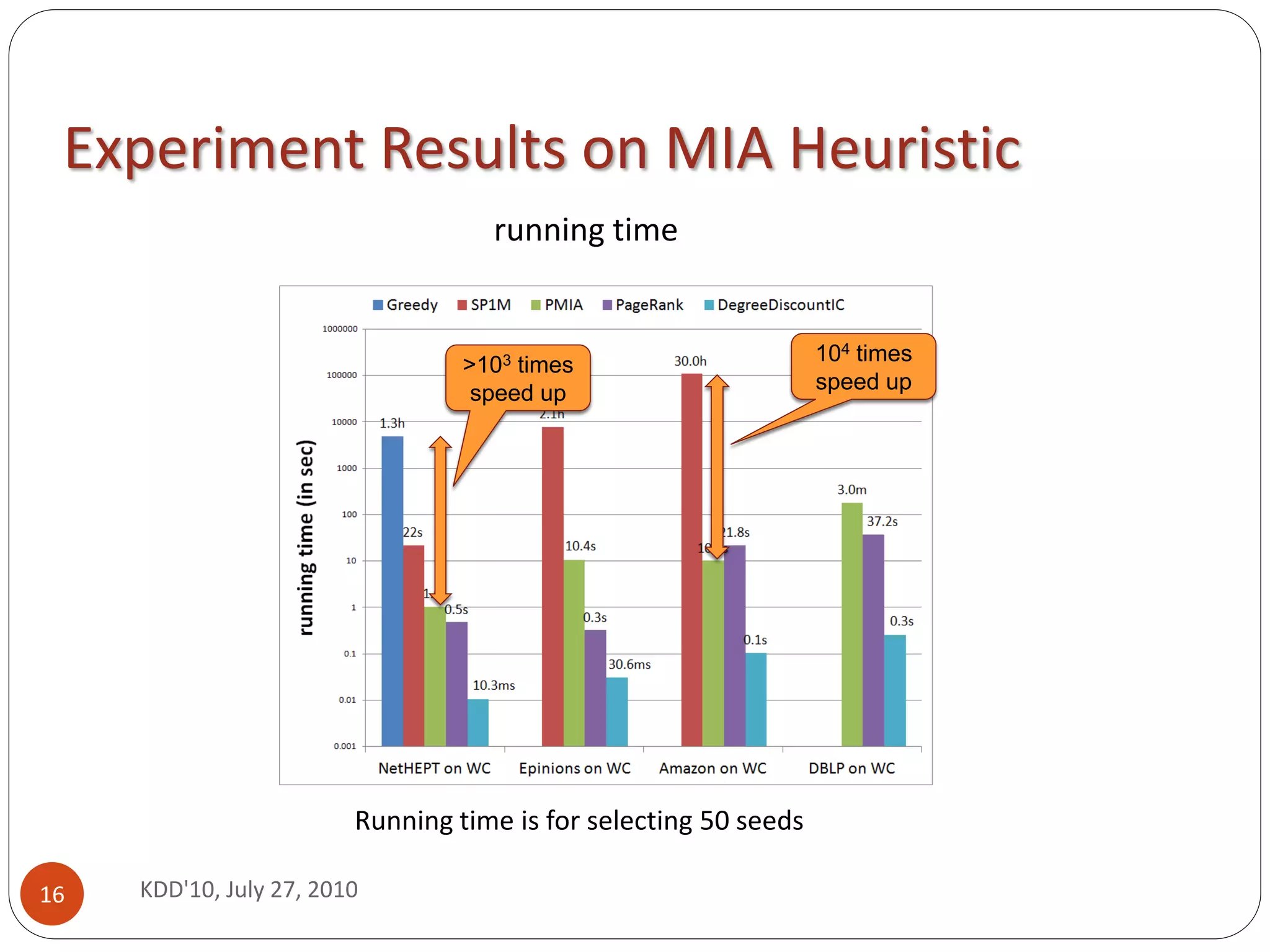
                                    running time


                                  >103 times                      104 times
                                   speed up                       speed up


                         Running time is for selecting 50 seeds

16   KDD'10, July 27, 2010
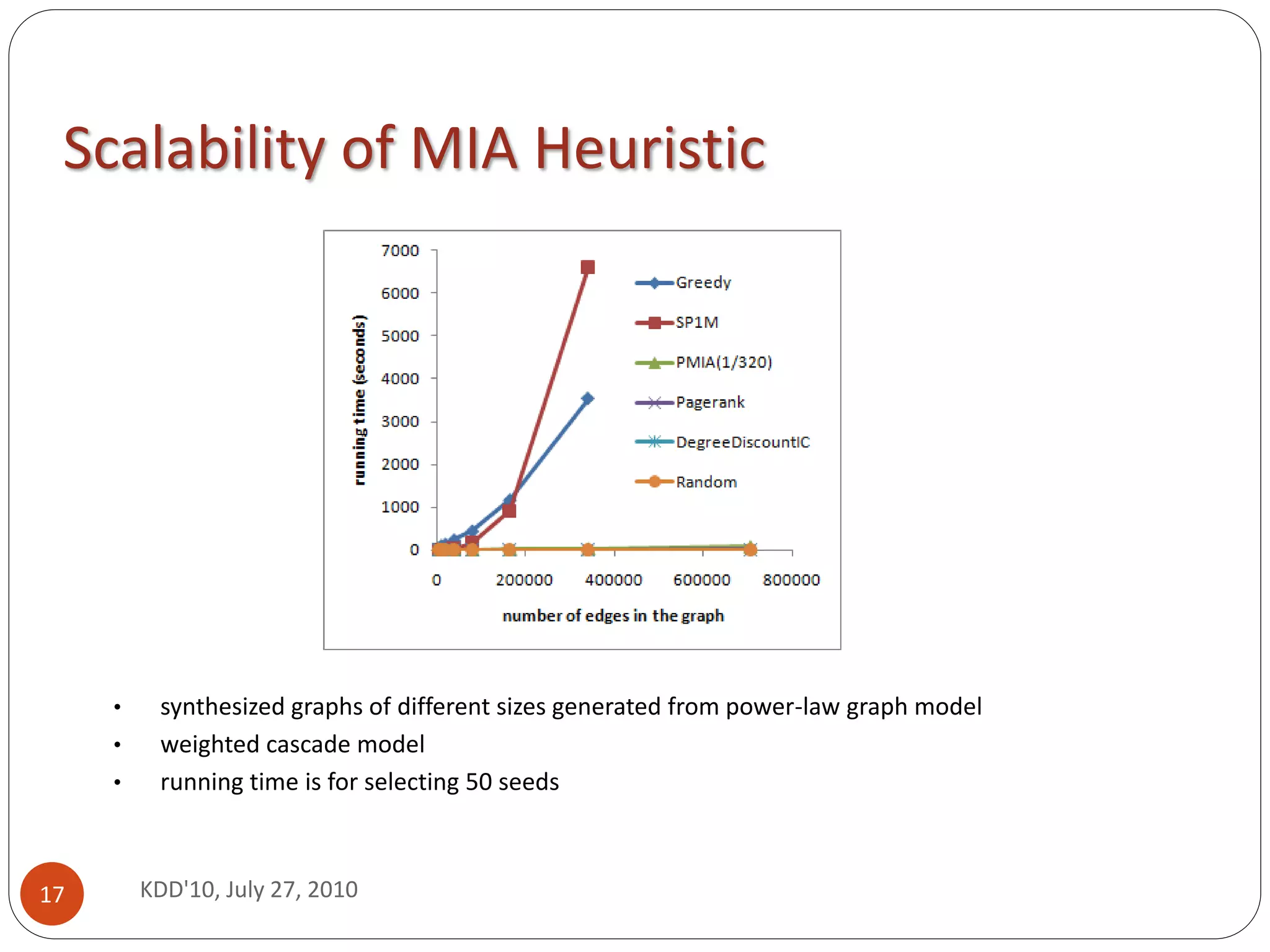
Scalability of MIA Heuristic


     •    synthesized graphs of different sizes generated from power-law graph model
     •    weighted cascade model
     •    running time is for selecting 50 seeds


17       KDD'10, July 27, 2010
Related Work
     Greedy approximation algorithms
       Original greedy algorithm [Kempe, Kleinberg, and Tardos, 2003]
       Lazy-forward optimization [Leskovec, Krause, Guestrin, Faloutsos, VanBriesen, and
       Glance, 2007]
       Edge sampling and reachable sets [Kimura, Saito and Nakano, 2007; C., Wang, and
       Yang, 2009]
       reduced seed selection from days to hours (with 30K nodes), but still not scalable
     Heuristic algorithms
       SPM/SP1M based on shortest paths [Kimura and Saito, 2006], not scalable
       SPIN based on Shapley values [Narayanam and Narahari, 2008], not scalable
       Degree discounts [C., Wang, and Yang, 2009], designed for the uniform IC model
       CGA based on community partitions [Wang, Cong, Song, and Xie 2010]
          complementary
          our local MIAs naturally adapt to the community structure, including overlapping communities


18     KDD'10, July 27, 2010
Future Directions
     Theoretical problem: efficient approximation algorithms:
       How to efficiently approximate influence spread given a seed set?
     Practical problem: Influence analysis from online social media
       How to mine the influence graph?


19     KDD'10, July 27, 2010
Thanks!
               and
               questions?


20   KDD'10, July 27, 2010
Experiment Results on MIA Heuristic
         Influence spread vs. seed set size                                      running time

                                                                                                            104 times
                                                                                    >103 times              speed up
                                                                                     speed up


 NetHEPT dataset:                  Epinions dataset:
 • collaboration network from      • who-trust-whom network
   physics archive                   of Epinions.com
 • 15K nodes, 31K edges            • 76K nodes, 509K edges

                                                                        Running time is for selecting 50 seeds
 weighted cascade model:
 •   influence probability to a node v = 1 / (# of in-neighbors of v)


21       KDD'10, July 27, 2010

Socable Influence Maximization

  • 1.
    Scalable Influence Maximizationfor Prevalent Viral Marketing in Large-Scale Social Networks Wei Chen Microsoft Research Asia In collaboration with Chi Wang University of Illinois at Urbana-Champaign Yajun Wang Microsoft Research Asia 1 KDD'10, July 27, 2010
  • 2.
    Outline  Background and problem definition  Maximum Influence Arborescence (MIA) heuristic  Experimental evaluations  Related work and future directions 2 KDD'10, July 27, 2010
  • 3.
    Ubiquitous Social Networks 3 KDD'10, July 27, 2010
  • 4.
    A Hypothetical Exampleof Viral Marketing Avatar is great Avatar is great Avatar is great Avatar is great Avatar is great Avatar is great Avatar is great 4 KDD'10, July 27, 2010
  • 5.
    Effectiveness of ViralMarketing level of trust on different types of ads * very effective *source from Forrester Research and Intelliseek 5 KDD'10, July 27, 2010
  • 6.
    The Problem ofInfluence Maximization Social influence graph vertices are individuals links are social relationships number p(u,v) on a directed link from u to v is the probability that v is activated by u after u is activated Independent cascade model initially some seed nodes are activated 0.3 At each step, each newly activated node u activates its 0.1 neighbor v with probability p(u,v) influence spread: expected number of nodes activated Influence maximization: find k seeds that generate the largest influence spread 6 KDD'10, July 27, 2010
  • 7.
    Research Background Influence maximization as a discrete optimization problem proposed by Kempe, Kleinberg, and Tardos, in KDD’2003 Finding optimal solution is provably hard (NP-hard) Greedy approximation algorithm, 63% approximation of the optimal solution Repeat k rounds: in the i-th round, select a node v that provides the largest marginal increase in influence spread require the evaluation of influence spread given a seed set --- hard and slow Several subsequent studies improved the running time Serious drawback: very slow, not scalable: > 3 hrs on a 30k node graph for 50 seeds 7 KDD'10, July 27, 2010
  • 8.
    Our Work Design new heuristics MIA (maximum influence arborescence) heuristic for general independent cascade model 103 speedup --- from hours to seconds (or days to minutes) influence spread close to that of the greedy algorithm of [KKT’03] We also show that computing exact influence spread given a seed set is #P-hard (counting hardness) resolve an open problem in [KKT’03] indicate the intrinsic difficulty of computing influence spread 8 KDD'10, July 27, 2010
  • 9.
    Maximum Influence Arborescence(MIA) Heuristic I: Maximum Influence Paths (MIPs) For any pair of nodes u and v, find the maximum influence path (MIP) from u to v u ignore MIPs with too small probabilities ( < parameter ) 0.3 0.1 v 9 KDD'10, July 27, 2010
  • 10.
    MIA Heuristic II:Maximum Influence in- (out-) Arborescences Local influence regions for every node v, all MIPs to v form its maximum influence in-arborescence u (MIIA ) 0.3 0.1 v 10 KDD'10, July 27, 2010
  • 11.
    MIA Heuristic II:Maximum Influence in- (out-) Arborescences Local influence regions for every node v, all MIPs to v form its maximum influence in-arborescence u (MIIA ) for every node u, all MIPs from u form its maximum 0.3 influence out- arborescence (MIOA ) 0.1 v These MIIAs and MIOAs can be computed efficiently using the Dijkstra shortest path algorithm 11 KDD'10, July 27, 2010
  • 12.
    MIA Heuristic III:Computing Influence through the MIA structure Recursive computation of activation probability ap(u) of a node u in its in-arborescence, given a seed set S Can be used in the greedy algorithm for selecting k seeds, but not efficient enough 12 KDD'10, July 27, 2010
  • 13.
    MIA Heuristic IV:Efficient Updates on Activation Probabilities If v is the root of a MIIA, and u is a node in the MIIA, then their activation probabilities have a linear relationship: All ‘s in a MIIA can be recursively computed time reduced from quadratic to linear time If u is selected as a seed, its marginal influence increase to v is Summing up the above marginal influence over all nodes v, we obtain the marginal influence of u Select the u with the largest marginal influence Update for all w’s that are in the same MIIAs as u 13 KDD'10, July 27, 2010
  • 14.
    MIA Heuristic IV:Summary Iterating the following two steps until finding k seeds Selecting the node u giving the largest marginal influence Update MIAs (linear coefficients) after selecting u as the seed Key features: updates are local, and linear to the arborescence size tunable with parameter : tradeoff between running time and influence spread 14 KDD'10, July 27, 2010
  • 15.
    Experiment Results onMIA Heuristic Influence spread vs. seed set size NetHEPT dataset: Epinions dataset: • collaboration network from physics archive • who-trust-whom network of Epinions.com • 15K nodes, 31K edges • 76K nodes, 509K edges weighted cascade model: • influence probability to a node v = 1 / (# of in-neighbors of v) 15 KDD'10, July 27, 2010
  • 16.
    Experiment Results onMIA Heuristic running time >103 times 104 times speed up speed up Running time is for selecting 50 seeds 16 KDD'10, July 27, 2010
  • 17.
    Scalability of MIAHeuristic • synthesized graphs of different sizes generated from power-law graph model • weighted cascade model • running time is for selecting 50 seeds 17 KDD'10, July 27, 2010
  • 18.
    Related Work Greedy approximation algorithms Original greedy algorithm [Kempe, Kleinberg, and Tardos, 2003] Lazy-forward optimization [Leskovec, Krause, Guestrin, Faloutsos, VanBriesen, and Glance, 2007] Edge sampling and reachable sets [Kimura, Saito and Nakano, 2007; C., Wang, and Yang, 2009] reduced seed selection from days to hours (with 30K nodes), but still not scalable Heuristic algorithms SPM/SP1M based on shortest paths [Kimura and Saito, 2006], not scalable SPIN based on Shapley values [Narayanam and Narahari, 2008], not scalable Degree discounts [C., Wang, and Yang, 2009], designed for the uniform IC model CGA based on community partitions [Wang, Cong, Song, and Xie 2010] complementary our local MIAs naturally adapt to the community structure, including overlapping communities 18 KDD'10, July 27, 2010
  • 19.
    Future Directions Theoretical problem: efficient approximation algorithms: How to efficiently approximate influence spread given a seed set? Practical problem: Influence analysis from online social media How to mine the influence graph? 19 KDD'10, July 27, 2010
  • 20.
    Thanks! and questions? 20 KDD'10, July 27, 2010
  • 21.
    Experiment Results onMIA Heuristic Influence spread vs. seed set size running time 104 times >103 times speed up speed up NetHEPT dataset: Epinions dataset: • collaboration network from • who-trust-whom network physics archive of Epinions.com • 15K nodes, 31K edges • 76K nodes, 509K edges Running time is for selecting 50 seeds weighted cascade model: • influence probability to a node v = 1 / (# of in-neighbors of v) 21 KDD'10, July 27, 2010